


Free Camp Counselor Cover Letter Templates & Examples
A great camp counselor cover letter shows you can keep campers safe and engaged. Our simple guide and free examples help you share your leadership skills and enthusiasm so you can stand out to hiring managers.
Real-World Cover Letters That Get Results
 Free
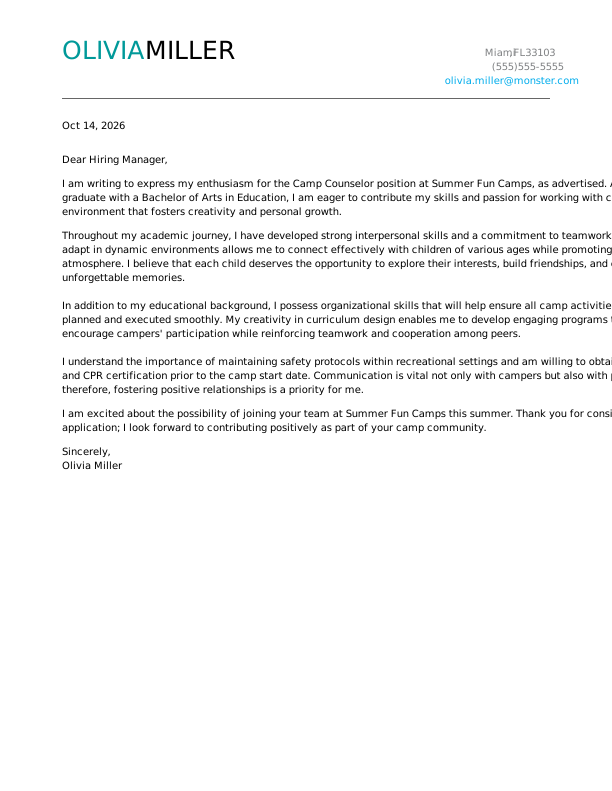
Camp Counselor Entry-Level Cover Letter
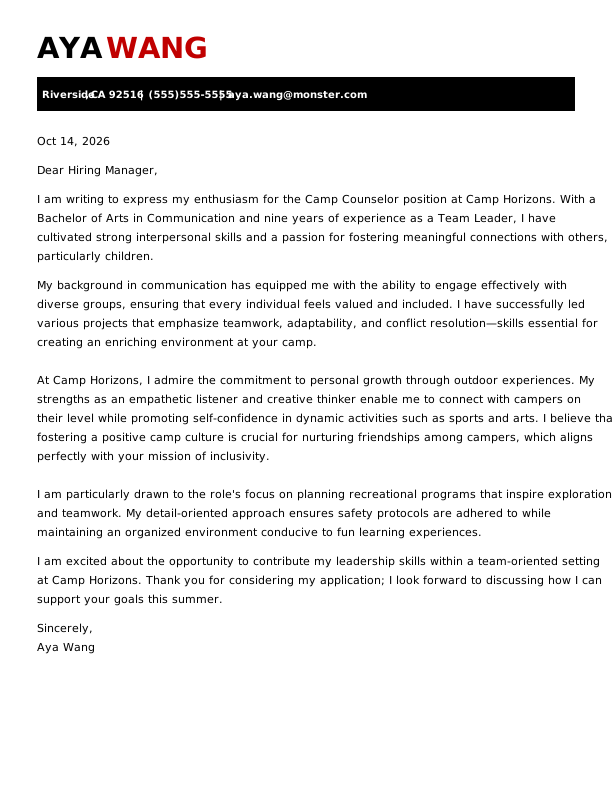
Camp Counselor Mid-Level Cover Letter
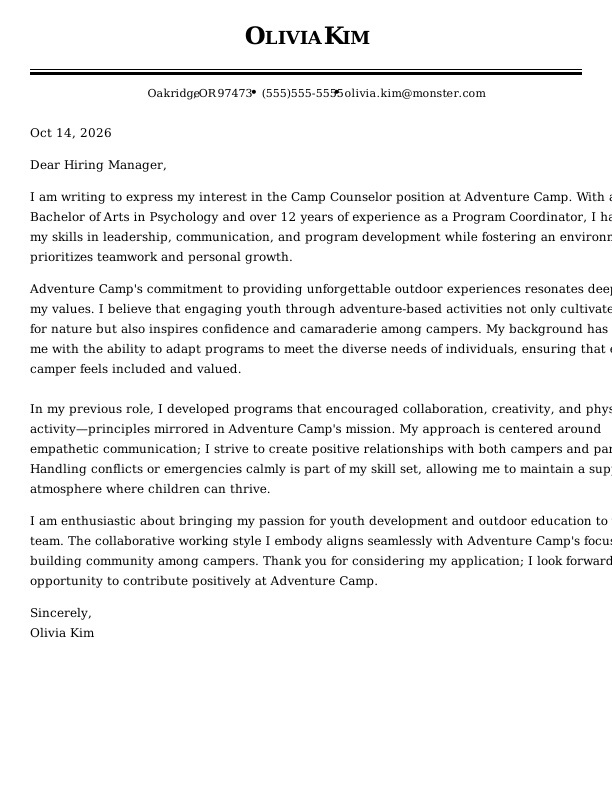
Camp Counselor Experienced Cover Letter
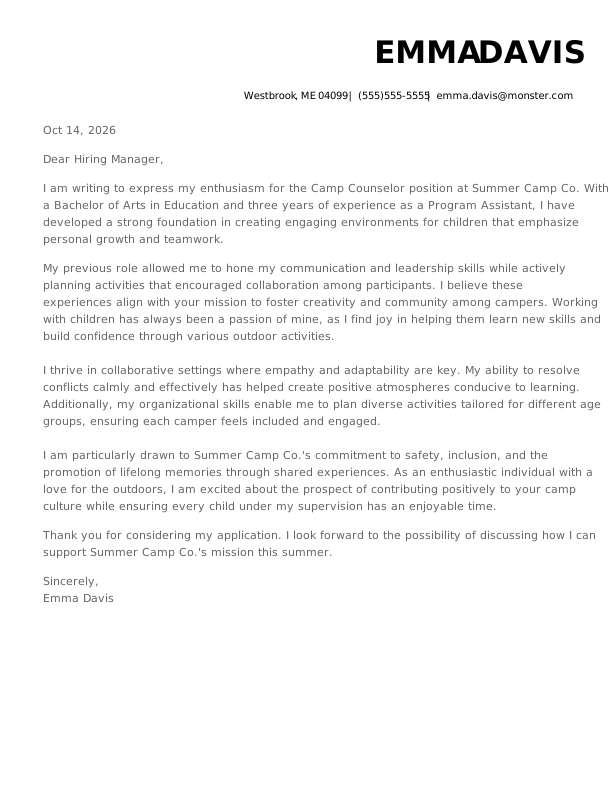
Camp Counselor Entry-Level Cover Letter
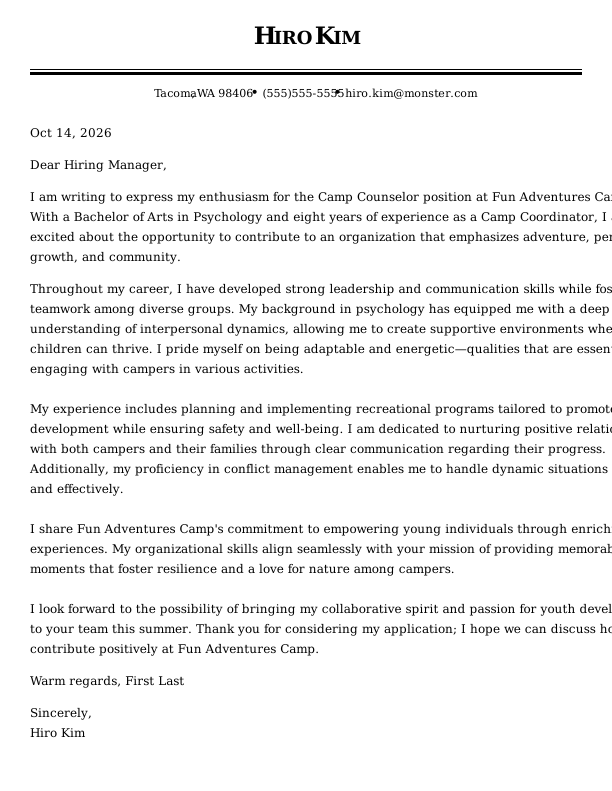
Camp Counselor Mid-Level Cover Letter
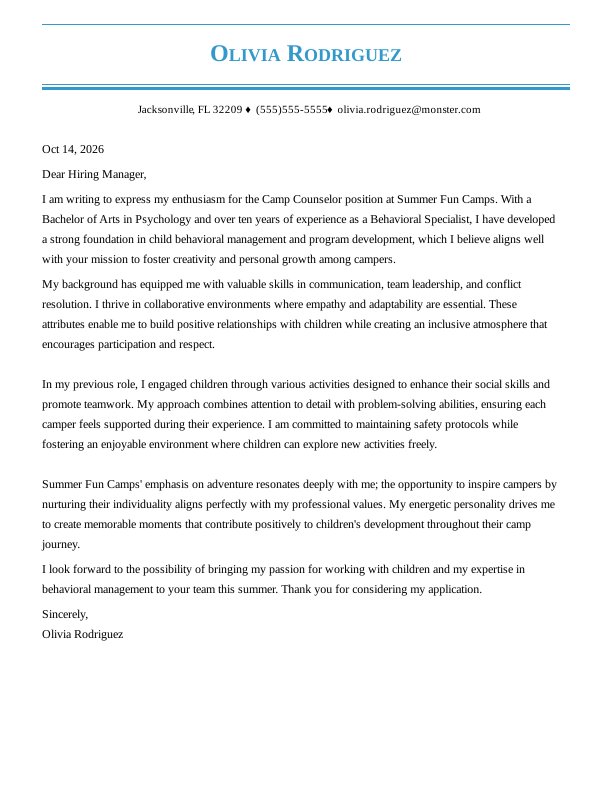
Camp Counselor Experienced Cover Letter
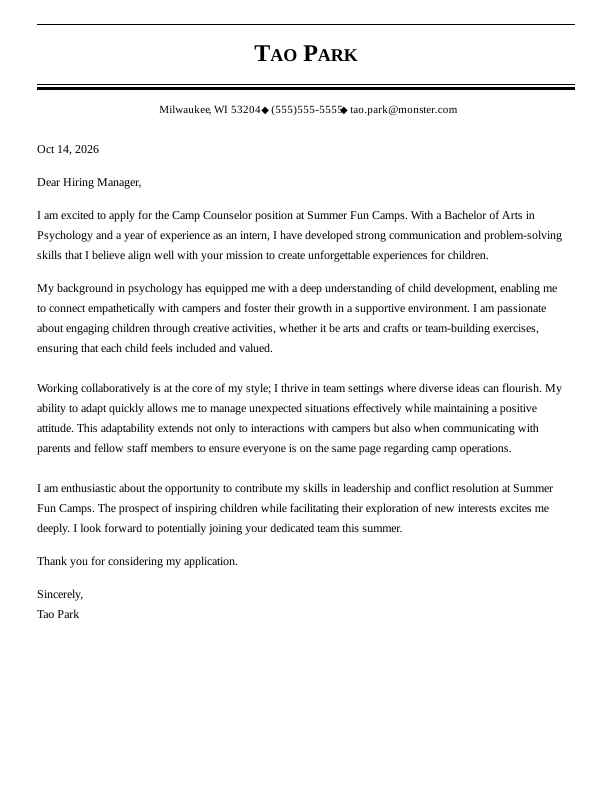
Camp Counselor Entry-Level Cover Letter
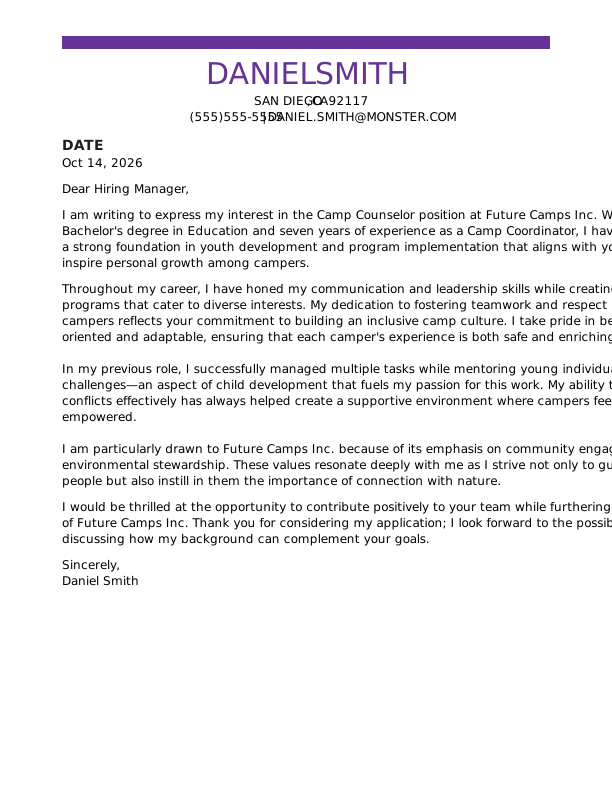
Camp Counselor Mid-Level Cover Letter
Browse Free Cover Letter Templates
- Academic
- Account Manager
- Accountant
- Accounts Payable
- Administrative Assistant
- Admissions Counselor
- Architecture
- Artist
- Assistant Principal
- Babysitter
- Barista
- Bartender
- Bookkeeper
- Brand Ambassador
- Business Analyst
- Business
- Caregiver
- Chef
- Civil Engineering
- Computer Science
- Construction
- Consulting
- Copywriter
- Cosmetology
- Custodian
- Customer Service
- Customer Service Representative
- Data Analyst
- Data Entry
- Dental Assistant
- Dental Hygienist
- Digital Marketing
- Electrical Engineering
- Emt
- Engineering
- Esthetician
- Event Coordinator
- Executive Assistant
- Finance
- Financial Analyst
- Firefighter
- Flight Attendant
- Graphic Designer
- Hair Stylist
- Healthcare
- Hr Generalist
- Investment Banking
- It
- Janitor
- Journalism
- Lab Technician
- Law Clerk
- Lawyer
- Librarian
- Logistics
- Makeup Artist
- Manager
- Marketing Coordinator
- Marketing
- Marketing Manager
- Massage Therapist
- Mechanic
- Mechanical Engineer
- Medical Assistant
- Non Profit
- Nursing
- Occupational Therapy
- Office Assistant
- Office Manager
- Operations Manager
- Paralegal
- Personal Trainer
- Pharmacist
- Pharmacy Technician
- Photographer
- Physician Assistant
- Pilot
- Police Officer
- Program Manager
- Project Manager
- Property Manager
- Psychology
- Receptionist
- Research Assistant
- Restaurant Manager
- Retail
- Sales
- Sales Manager
- School Counselor
- Security Officer
- Social Work
- Software Engineer
- Special Education Teacher
- Starbucks
- Substitute Teacher
- Teacher
- Teaching Assistant
- Truck Driver
- Vet Tech
- Veterinary Assistant
Cover Letter Examples for Camp Counselors
Cover letter expectations change as you gain more experience leading activities and managing campers. Choose the template that fits your career stage to highlight your relevant skills, safety training, and leadership growth.
Entry-Level Camp Counselor Cover Letter
Designed for new graduates and career changers, this template helps you write a compelling cover letter that highlights your enthusiasm, educational background, and readiness to learn on the job.
Mid-Career Camp Counselor Cover Letter
Ideal for counselors with a few years of experience, this template showcases your ability to lead daily programs, support team members, and maintain clear communication across the camp.
Experienced Camp Counselor Cover Letter
Tailored for seasoned camp professionals, this template highlights senior leadership capabilities, long-term program coordination experience, and proven expertise in managing camp operations and safety.
Camp Counselor Cover Letter Template (Text)
Copy this camp counselor cover letter template into your document and customize it with your own activities, camper outcomes, and the summer program or organization you want.
Ming Park
Maplewood, NJ 07040
(555)555-5555
ming.park@monster.com
Oct 14, 2026
Dear Hiring Manager,
I am writing to express my enthusiasm for the Camp Counselor position at Camp Adventure. With a Bachelor of Science in Recreation Management and six years of experience as a Recreation Coordinator, I have honed my skills in program development, team leadership, and event planning. My background has equipped me with a strong foundation in fostering engaging environments where individuals can thrive.
At the heart of my professional journey is a passion for creating memorable experiences that promote personal growth among youth. I believe deeply in the transformative power of play and exploration—values that resonate with your mission at Camp Adventure. My experience has allowed me to develop strong interpersonal skills and an adaptable approach, enabling me to connect with campers from diverse backgrounds while ensuring their safety and enjoyment.
Collaboration is an essential aspect of my working style; I thrive when contributing to a team dedicated to inspiring confidence and resilience in young people. By promoting teamwork and respect among campers, I aim to create an inclusive culture where every child feels valued. Additionally, effective communication with parents remains crucial as we work together toward each camper’s progress.
I am eager to bring my expertise in recreational programming along with my positive attitude and community-focused mindset to Camp Adventure this summer. Thank you for considering my application; I look forward to the opportunity to contribute positively as part of your team.
Sincerely,
Ming Park
How to Write a Camp Counselor Cover Letter
Writing a cover letter for a camp counselor role is all about showing how your hands-on experience, activity planning, and safety awareness make you a great fit.
Follow these straightforward steps to draft a letter that clearly connects your background to what the camp needs this season.
1. Research & Prepare
Before you start writing, take time to learn about the camp’s specific programs, values, and daily routines. Reviewing their website helps you understand their safety standards, activity focus, and age groups so you can tailor your letter directly to their culture.
Here are a few practical research steps you can take before drafting your letter:
- Identify required safety certifications like CPR, First Aid, or Lifeguard training from the job post so you can mention them clearly.
- Look up the camp’s core philosophy on team building, outdoor education, or behavior management to align with their tone.
- Check whether they operate as a day camp or sleepaway camp so you can emphasize the right supervision experience.
2. Hook the Reader
Your opening paragraph should capture attention by highlighting your passion for working with youth alongside immediate proof of your reliability. Focus on a key accomplishment or specific strength that proves you can manage campers safely.
Consider using strong lead-in opening lines like these tailored examples:
- Safety-first routine: “I led daily headcounts and buddy checks for 28 campers during water activities, ensuring full group accountability without missing a single check.”
- Program design focus: “Over the past two summers, I designed and ran a weekly arts-and-crafts showcase that engaged over 20 campers per session.”
- Team leadership focus: “As a cabin assistant, I collaborated with senior staff to guide daily routines and resolve peer conflicts using positive behavior strategies.”
3. Tell Your Professional Story
Use the middle paragraphs to share concrete stories about how you supervise groups, lead activities, and support camper development. Sharing measurable details helps hiring managers envision how you will handle daily responsibilities on site.
You can highlight your impact effectively using specific metrics like these:
- Reduced camper behavioral issues by 20% during a multi-week session by establishing daily reward charts and clear expectations.
- Supervised groups of up to 25 campers across daily rotation schedules, maintaining a perfect attendance tracking record.
- Organized daily check-ins with parents, improving parent satisfaction ratings for cabin communication by 15%.
4. Showcase Your Skills
Show how your skills translate into real action by pointing to real scenarios where you demonstrated patience, adaptability, or conflict resolution. Briefly describe what you did to keep campers safe and happy.
Here are examples of how to frame key camp counselor skills in your text:
- Behavior support: “When disagreements arose during team sports, I used calm redirection to help campers agree on shared rules and stay involved.”
- Safety protocols: “I consistently carried out headcounts before and after all outdoor transitions to ensure complete camper safety.”
- Parent relations: “I spoke directly with parents at end-of-day pickup to share positive achievements and address minor behavioral updates.”
5. Explain Any Special Circumstances
If you have an employment gap, are changing careers, or are transitioning to full-time seasonal work, address it briefly. Frame your experience positively by emphasizing transferable youth leadership skills or recent certifications.
You can use these examples to explain unique career situations smoothly:
- “After focusing on my academic studies last year, I renewed my CPR and First Aid certifications and led weekend youth volunteer programs.”
- “I am transitioning from classroom tutoring to camp counseling to apply my group facilitation skills in an outdoor recreation setting.”
- “Having recently relocated to the area, I have updated my background checks and joined local community sports programs as a volunteer coach.”
6. End With a Professional Goodbye
Wrap up your letter with a polite, professional closing paragraph. Restate your enthusiasm for joining the camp team, suggest a clear next step for an interview, and thank the hiring manager for reviewing your application.
For example, you might write: “I would welcome the opportunity to discuss how my background in activity planning can support your summer programs. Thank you for your time and consideration.”
Then close with “Sincerely,” followed by your full name.
4 Tips for Formatting Your Cover Letter
When camp directors evaluate applications, they often review dozens of candidate files quickly. A clean, well-organized letter makes it easy for reviewers to scan your qualifications, spot your safety certifications, and evaluate your experience leading youth activities.

Use a Professional Font & Layout
Choose clean, standard fonts like Arial, Calibri, or Georgia at 10 to 12 points. Maintain standard 1-inch margins so your document looks balanced and easy to read on screens or printed pages.

Match Your Header to Your Resume
Keep your header consistent across both your cover letter and resume by using the same font style, full name, phone number, and email. This cohesive formatting creates a polished appearance for your application package.

Use Bullet Points for Key Achievements
Use bullet points to draw attention to your top achievements, such as safety milestones, group sizes, or specialized skills. Bullet points break up large text blocks and help hiring teams quickly spot your strengths.

Balance Spacing & Margins
Use single or 1.15 line spacing with clear spaces between paragraphs to prevent your letter from feeling crowded. Balanced spacing makes your document easy to read during a fast review.
Key Takeaways
- Focus on child safety, active supervision, and conflict management to show you can handle daily cabin responsibilities.
- Include concrete metrics like camper group sizes, attendance numbers, or years of experience to prove your reliability.
- Tailor your cover letter directly to the specific camp environment, whether it focuses on day camp activities or overnight routines.
More Cover Letter Examples
Browse Monster’s Resume Templates
Monster also has hundreds of ATS-friendly resume templates for all career levels and industries. Create a matching resume to help you land the interview.
Frequently Asked Questions
Last Update:
Do I really need a cover letter?
A cover letter for a camp counselor job lets you explain your enthusiasm and youth leadership experience beyond simple resume bullet points.
A well-crafted cover letter highlights your communication skills, dedication to camper safety, and personal reasons for joining that specific summer program, helping you stand out to camp directors.
How long should my cover letter be?
Your camp counselor cover letter should be kept to a single page and fall between 250 and 400 words.
Camp directors review many applications quickly during hiring season, so concise messaging with three or four short paragraphs ensures your key qualifications, safety certifications, and youth experience are clear and easy to read.
Should my cover letter match my resume?
Your cover letter should match your resume in visual style by using the same font, margin sizes, color palette, and header contact block. Matching design elements create a unified, professional application package, while the text itself should expand on your key accomplishments rather than just repeating your resume details.
Can I use AI to write my cover letter?
You can use AI to help outline or draft your camp counselor cover letter, but you should personalize the final text. Camp directors value authentic stories about your hands-on work with kids, so review AI drafts carefully to add your own real examples of activity planning, safety management, and enthusiasm for the role.
Should I mention salary expectations in my cover letter?
You should only mention salary expectations in your camp counselor cover letter if the job post specifically asks for them. If required, provide a flexible pay range based on local seasonal rates and express enthusiasm for learning more about the full compensation package and camp benefits during an interview.

Kirsten Chorpenning is a career advice writer who empowers job seekers to take control of their career paths using Monster’s comprehensive job search and resume tools. She specializes in helping job seekers find rewarding jobs in today’s dynamic work environment.
See More From Kirsten ChorpenningExplore Related Career Advice







How to Write a Cover Letter for Internal Positions or Promotions (Examples & Tips)
Updated:
Apr 23, 2026
|
19 min read


Cover Letter vs Resume: What’s the Difference & Do You Need Both?

Updated:
Apr 23, 2026
|
18 min read