


Free Art Teacher Cover Letter Templates & Examples
A strong art teacher cover letter should show your ability to inspire creativity while supporting student growth through clear lesson planning and inclusive classroom management. Our free cover letter examples and step-by-step guidance help you write a focused letter that highlights your teaching approach, portfolio support, and collaboration skills so hiring managers take notice.
Real-World Cover Letters That Get Results
 Free
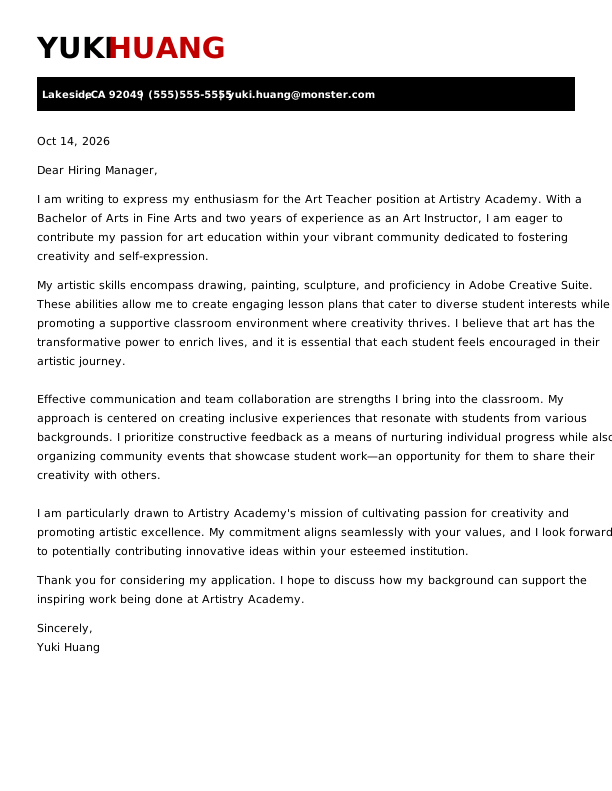
Art Teacher Entry-Level Cover Letter
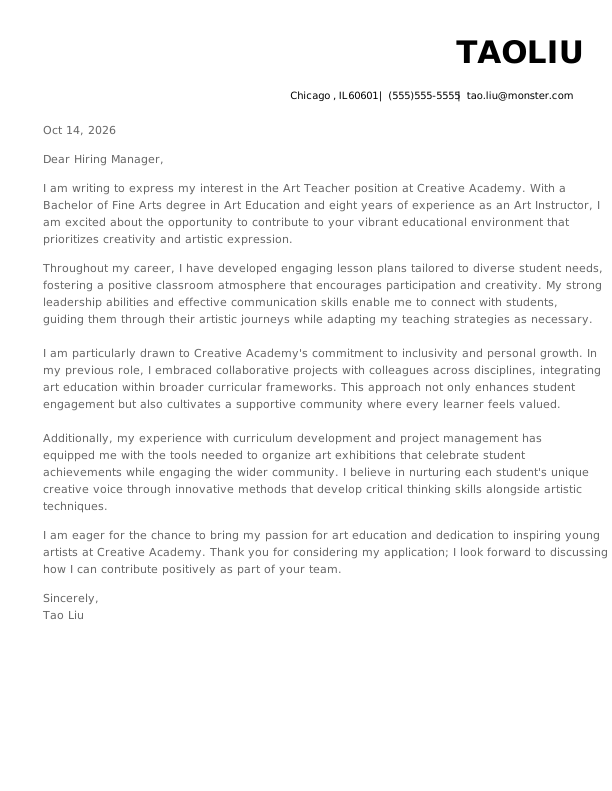
Art Teacher Mid-Level Cover Letter
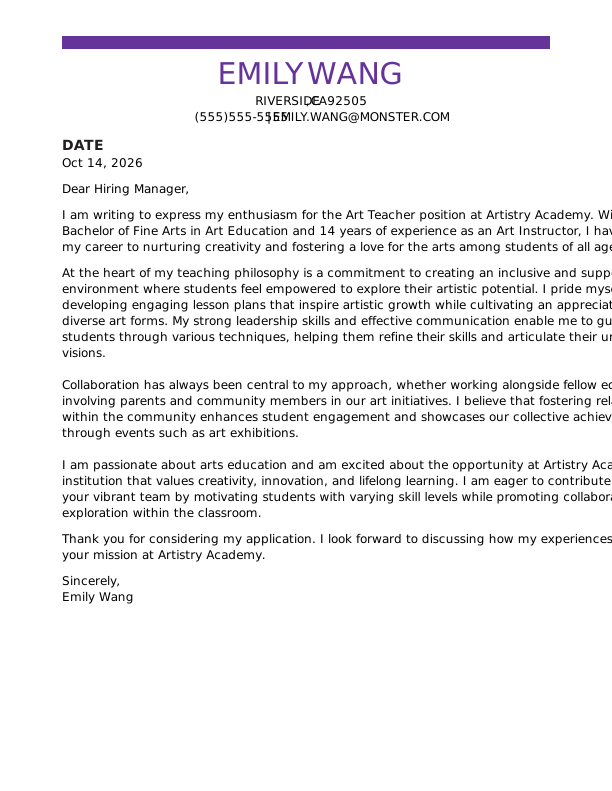
Art Teacher Experienced Cover Letter
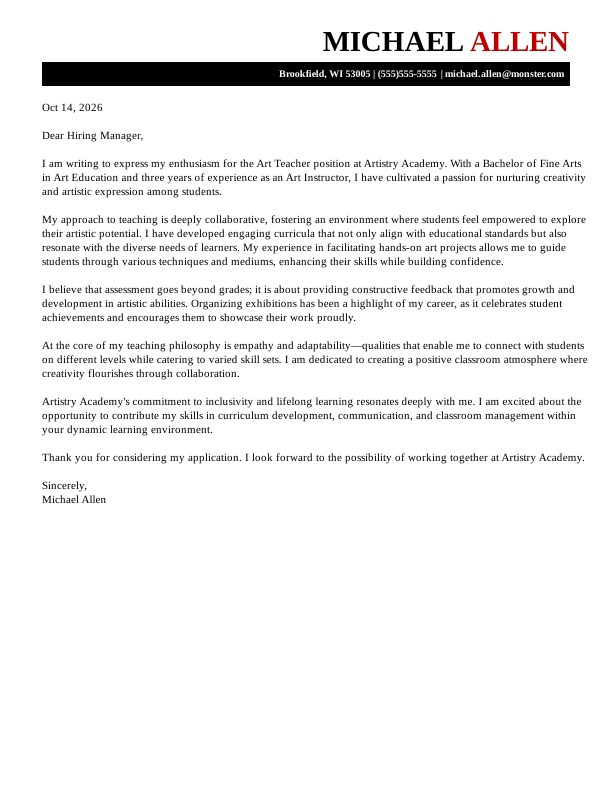
Art Teacher Entry-Level Cover Letter
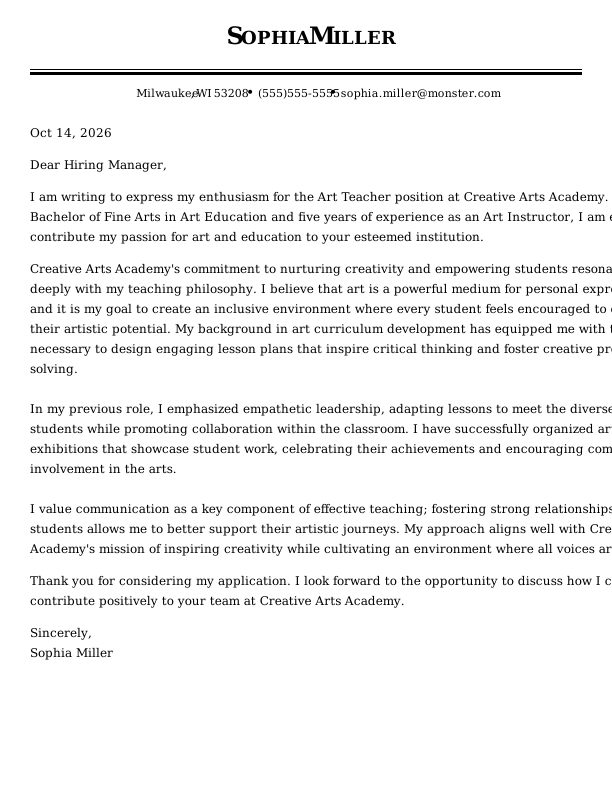
Art Teacher Mid-Level Cover Letter
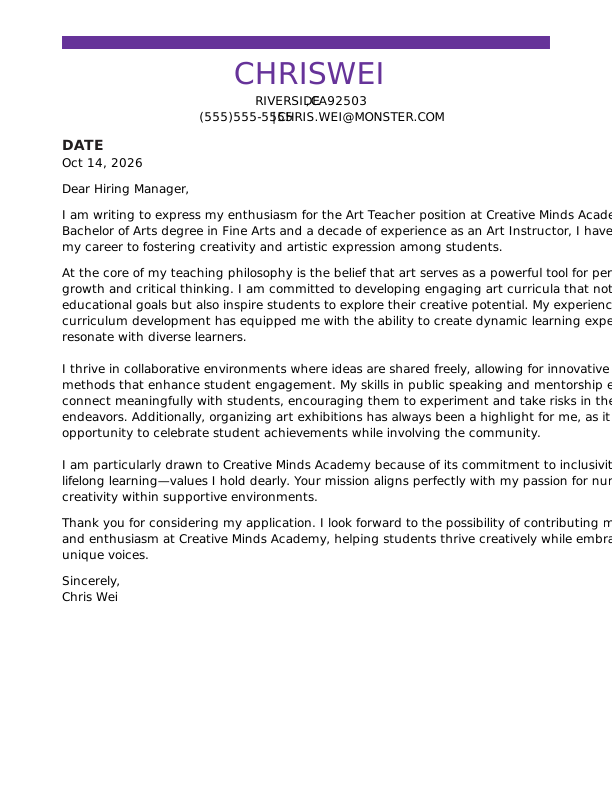
Art Teacher Experienced Cover Letter
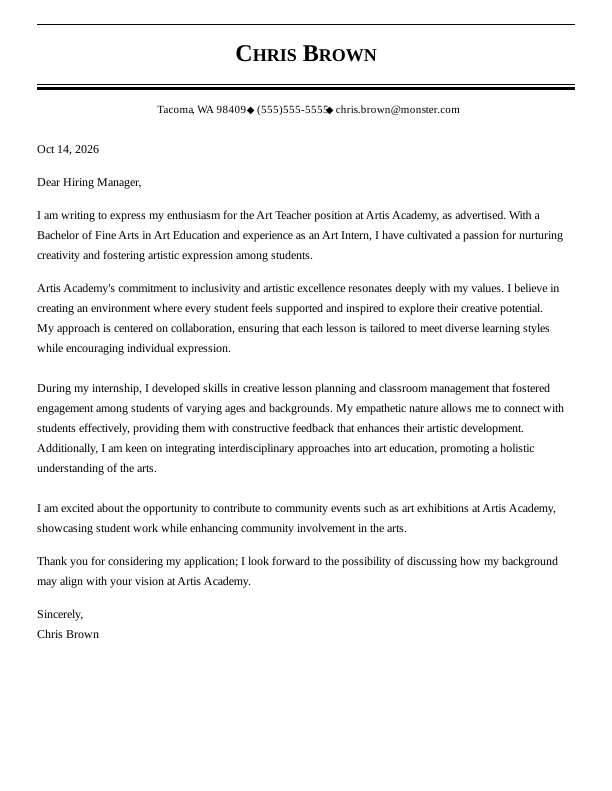
Art Teacher Entry-Level Cover Letter
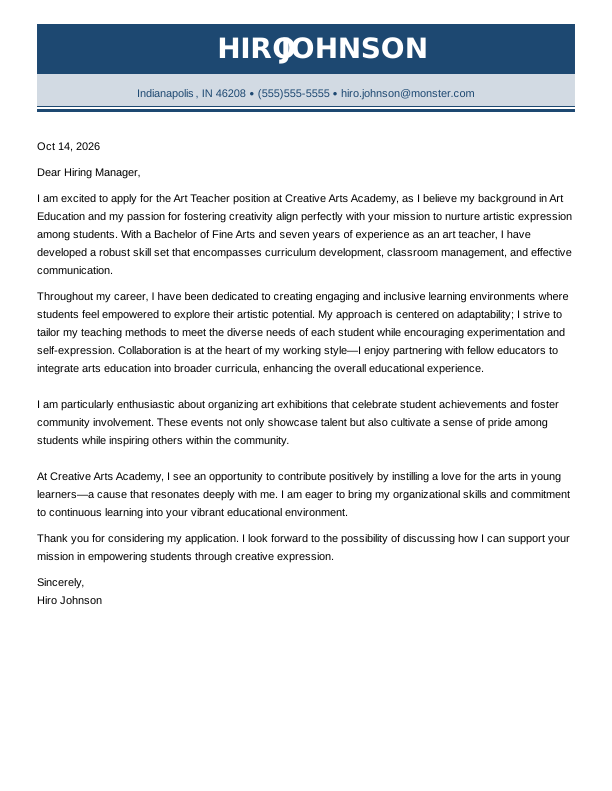
Art Teacher Mid-Level Cover Letter
Browse Free Cover Letter Templates
- Academic
- Account Manager
- Accountant
- Accounts Payable
- Administrative Assistant
- Admissions Counselor
- Architecture
- Artist
- Assistant Principal
- Babysitter
- Barista
- Bartender
- Bookkeeper
- Brand Ambassador
- Business Analyst
- Business
- Caregiver
- Chef
- Civil Engineering
- Computer Science
- Construction
- Consulting
- Copywriter
- Cosmetology
- Custodian
- Customer Service
- Customer Service Representative
- Data Analyst
- Data Entry
- Dental Assistant
- Dental Hygienist
- Digital Marketing
- Electrical Engineering
- Emt
- Engineering
- Esthetician
- Event Coordinator
- Executive Assistant
- Finance
- Financial Analyst
- Firefighter
- Flight Attendant
- Graphic Designer
- Hair Stylist
- Healthcare
- Hr Generalist
- Investment Banking
- It
- Janitor
- Journalism
- Lab Technician
- Law Clerk
- Lawyer
- Librarian
- Logistics
- Makeup Artist
- Manager
- Marketing Coordinator
- Marketing
- Marketing Manager
- Massage Therapist
- Mechanic
- Mechanical Engineer
- Medical Assistant
- Non Profit
- Nursing
- Occupational Therapy
- Office Assistant
- Office Manager
- Operations Manager
- Paralegal
- Personal Trainer
- Pharmacist
- Pharmacy Technician
- Photographer
- Physician Assistant
- Pilot
- Police Officer
- Program Manager
- Project Manager
- Property Manager
- Psychology
- Receptionist
- Research Assistant
- Restaurant Manager
- Retail
- Sales
- Sales Manager
- School Counselor
- Security Officer
- Social Work
- Software Engineer
- Special Education Teacher
- Starbucks
- Substitute Teacher
- Teacher
- Teaching Assistant
- Truck Driver
- Vet Tech
- Veterinary Assistant
Cover Letter Examples for Art Teachers
Requirements for an art teacher cover letter change as your career progresses. Choose the template that matches your experience level so you can spotlight the right studio work, classroom training, and student outcomes.
Entry-Level Art Teacher Cover Letter
Designed for recent graduates and career changers, this template demonstrates how to present studio art training, student teaching experience, and foundational lesson planning skills with confidence when applying for initial art educator roles.
Mid-Career Art Teacher Cover Letter
Tailored for candidates with several years of classroom experience, this template shows how to highlight independent curriculum development, studio safety protocols, student exhibitions, and cross-curricular project collaboration.
Experienced Art Teacher Cover Letter
Ideal for senior art educators and department leads, this template emphasizes school-wide arts leadership, curriculum alignment, student portfolio development, community art events, and teacher mentorship.
Art Teacher Cover Letter Template (Text)
Copy this art teacher cover letter template, paste it into your document, and swap in your studio projects, exhibition outcomes, or school name for the role.
Sophia Singh
Los Angeles, CA 90008
(555)555-5555
sophia.singh@monster.com
Oct 14, 2026
Dear Hiring Manager,
I am writing to express my enthusiasm for the art teacher position at Creative Minds Academy. With a Bachelor of Fine Arts in Art Education and six years of experience as an art instructor, I am eager to contribute to your vibrant community that values creativity and personal growth.
Throughout my career, I have developed engaging art curricula that encourage students to explore their artistic voices while fostering an inclusive classroom environment. My approach emphasizes adaptability and empathy, allowing me to connect with students across various skill levels. I believe in nurturing creativity through innovative techniques and methods that resonate with young artists.
In addition to my strong background in curriculum development and classroom management, I possess excellent communication skills that facilitate collaboration with colleagues on integrating art education into broader academic programs. Organizing student art exhibits has been one of the highlights of my teaching journey, as it provides an opportunity for students to showcase their work while building confidence in their creative expression.
I admire Creative Minds Academy’s commitment to inspiring a lifelong appreciation for the arts among its students. Your mission aligns seamlessly with my passion for empowering young learners through artistic exploration. As a team player who thrives in collaborative environments, I look forward to contributing meaningfully alongside fellow educators dedicated to cultivating creativity within our community.
Thank you for considering my application. I am excited about the possibility of joining Creative Minds Academy and fostering artistic expression among your talented students.
Sincerely,
Sophia Singh
How to Write an Art Teacher Cover Letter
Writing an effective art teacher cover letter requires showing hiring managers that you understand lesson planning, studio management, and student engagement. Follow these steps to align your experience with a specific job posting.
1. Research & Prepare
Before writing, research the school’s arts curriculum, available studio resources, and community exhibition programs. Discovering whether the school emphasizes traditional fine arts, digital media, or choice-based art education allows you to highlight the exact teaching methods that matter most to the hiring committee.
Gather actionable context by exploring these key information sources:
- Review the job description to confirm required state teaching endorsements, art software, or specific studio media expertise.
- Explore the school or district website to understand their visual arts standards, student gallery events, and interdisciplinary goals.
- Check state education department guidelines to ensure your teaching credentials align with local licensing requirements.
2. Hook the Reader
Start your letter with an engaging opening line that demonstrates your active studio routines and instructional approach. Avoid generic statements like “I am writing to apply for the open art teacher position.” Instead, capture the hiring manager’s attention by leading with a concrete lesson win or studio management success.
Choose an opening line tailored to your experience using these example approaches:
- Studio routines: “I structure my studio sessions with a 20-minute technique demonstration followed by choice-based stations in printmaking and painting, evaluating progress with biweekly rubrics.”
- Standards-aligned units: “In my recent identity portrait unit, students created three value-scale studies inspired by contemporary artists, connecting their final critiques directly to state visual arts standards.”
- Exhibition planning: “I organized an annual student gallery night in partnership with our library team, displaying 45 matted student works alongside written artist statements.”
3. Tell Your Professional Story
Use the body of your letter to give hiring managers a clear view of your daily classroom instruction. While your resume lists past schools and degrees, your cover letter explains how you guide student growth, manage supply budgets, and foster a positive studio environment. Using specific numbers makes your accomplishments far more compelling.
Incorporate concrete benchmarks like these to illustrate your impact:
- Increased student assignment completion rates from 62% to 86% by introducing weekly sketchbook checks and structured rubrics.
- Managed a $1,200 annual art supply budget and reduced material waste by 22% by implementing standardized material preparation templates.
- Taught three daily class sections averaging 28 students each, raising average midterm project evaluation scores by 15 points.
4. Showcase Your Skills
Rather than using broad self-descriptors like “creative” or “passionate,” illustrate how your skills resolve real classroom challenges. Showing the exact moments where your lesson adaptations, tool demonstrations, or feedback encouraged a student builds trust with the employer.
Connect your practical abilities directly to daily teaching needs using these examples:
- Lesson adaptation: “I revised my color-mixing demonstration after noticing students struggling with shade transitions, breaking the steps into smaller guided practices so everyone completed their gradients successfully.”
- Studio tools and software: “I prepared cut-ready stencil templates using Adobe Illustrator, testing them on scrap materials before guiding students through their printmaking projects.”
- Student feedback: “I provided each student with targeted, actionable feedback during
5. Explain Any Special Circumstances
If you have an employment gap, are transitioning careers, or recently relocated, address it briefly in one or two direct sentences. Focus your explanation on your active teaching credentials, updated lesson plans, and current studio practice so the hiring team knows you are ready for the classroom.
Frame your circumstances clearly using these straightforward approaches:
- Addressing an employment gap: “Following a year-long career break, I maintained my instructional readiness by leading community drawing workshops and updating my watercolor unit plans.”
- Transitioning positions: “I am pivoting from commercial graphic design into classroom art instruction, completing my state art education requirements while developing student-ready digital media projects.”
- Handling relocation: “After moving to the area last fall, I transferred my teaching license and resumed leading community center studio sessions to stay active in arts education.”
6. End With a Professional Goodbye
Conclude your letter with a polite, confident statement that invites the hiring manager to contact you for an interview. Keep your sign-off concise, thank the reader for their time, and express enthusiasm for discussing your art curriculum in detail.
Structure your final paragraph using this clear approach:
- Offer a clear next step: “I would welcome the opportunity to discuss how my studio lesson planning and differentiated instruction can support your school’s visual arts program.”
- Express gratitude: “Thank you for your time and consideration.”
- End with a clean sign-off: “Sincerely,” followed by your full name.
4 Tips for Formatting Your Cover Letter
When you apply for an art teacher position, principals and department heads often scan your application quickly alongside your teaching portfolio. They look rapidly for state teaching certifications, studio skills, and lesson planning experience. A clean visual presentation with consistent spacing and logical organization makes your top qualifications easy to spot and proves that you take pride in clear, professional presentation.

Address the Hiring Manager Directly
Search the job posting, school staff directory, or district website to identify the specific principal, fine arts coordinator, or department head. If you cannot find an individual name, address your letter to “Dear Hiring Manager” or “Dear Selection Committee” rather than using outdated phrases.

Match Your Header to Your Resume
Copy the exact same name layout, typography, contact details, and location formatting from your resume onto your cover letter. A matching header allows hiring managers to instantly recognize your application package and confirm your details while reviewing your resume and portfolio together.

Balance Spacing & Margins
Set line spacing between 1.0 and 1.15, leaving a full blank line between paragraphs to keep the layout clean and readable. Use uniform margins between 0.75 and 1 inch so your letter looks well-proportioned on screens and printed copies.

Save & Send as a PDF
Save your final cover letter as a PDF to preserve your margins, line spacing, and general layout across different operating systems or mobile devices. Use a clean, professional filename like Firstname_Lastname_Cover_Letter.pdf to make your application easy for recruiters to organize.
Key Takeaways
- Demonstrate instructional clarity by sharing a specific lesson where you scaffolded artistic techniques step-by-step to support student learning.
- Include clear performance metrics like assignment completion rates, supply budget savings, or rubric score improvements to prove classroom effectiveness.
- Tailor your letter to the grade level by emphasizing foundational skills for elementary, portfolio development for high school, or community engagement for arts nonprofits.
More Cover Letter Examples
Browse Monster’s Resume Templates
Monster also has hundreds of ATS-friendly resume templates for all career levels and industries. Create a matching resume to help you land the interview.
- Art Teacher
- Dance Instructor
- Dance Teacher
- Education
- Elementary School Teacher
- English Teacher
- Esl Teacher
- Flight Instructor
- Kindergarten Teacher
- Math Teacher
- Music Teacher
- Physical Education Teacher
- Preschool Teacher
- Science Teacher
- Social Studies Teacher
- Spanish Teacher
- Special Education Teacher
- Substitute Teacher
- Teacher Assistant
- Teacher
Frequently Asked Questions
Last Update:
Do I really need a cover letter?
Yes, submitting a cover letter with your art teacher application is strongly recommended because it provides instructional context that a resume cannot offer alone. While a resume lists past schools and degrees, a cover letter explains your teaching philosophy, studio routines, and lesson planning approach. It also offers space to explain career transitions or gaps.
How long should my cover letter be?
An art teacher cover letter should stay within one page, targeting between 250 and 400 words. School administrators review many applications quickly, so direct, concise writing works best. Divide your text into three or four short paragraphs that focus strictly on your teaching achievements, studio management skills, and student outcomes without adding extra clutter.
Should my cover letter match my resume?
Yes, your art teacher cover letter should match your resume’s visual formatting to present a polished, cohesive application package. Use the same font styles, margin sizes, color choices, and contact header across both documents. Instead of repeating your resume bullet points, use your cover letter to expand on a specific lesson outcome or explain how your approach fits the school’s mission.
Can I use AI to write my cover letter?
Using AI tools can help you outline your art teacher cover letter and organize your thoughts, but you should rewrite the draft heavily before submitting it. AI-generated text often uses generic phrasing that lacks the specific lesson examples, studio techniques, and student project outcomes hiring managers look for. Personalizing your content ensures the letter accurately reflects your unique teaching background.
How do I write a cover letter for an internal position?
To write an internal art teacher cover letter, highlight your existing knowledge of the school’s studio workflows, student behavior expectations, and curriculum pacing. Mention how you successfully improved project completion rates, updated portfolio reviews, or collaborated with colleagues in your current role. Express your readiness to take on added department responsibilities while completing all required internal application steps.

Megan Dawkins is a career industry editor who empowers job seekers to take control of their career paths using Monster’s comprehensive job search and resume tools. She specializes in helping job seekers navigate the flexible job market.
See More From Megan DawkinsExplore Related Career Advice







How to Write a Cover Letter for Internal Positions or Promotions (Examples & Tips)

Updated:
Apr 23, 2026
|
19 min read


Cover Letter vs Resume: What’s the Difference & Do You Need Both?

Updated:
Apr 23, 2026
|
18 min read