


Free Financial Advisor Cover Letter Templates & Examples
A strong financial advisor cover letter highlights relevant impact and skills, showing clients and employers you can manage money wisely and communicate clearly. Use our examples and practical tips to build a compelling application tailored to the role.
Real-World Cover Letters That Get Results
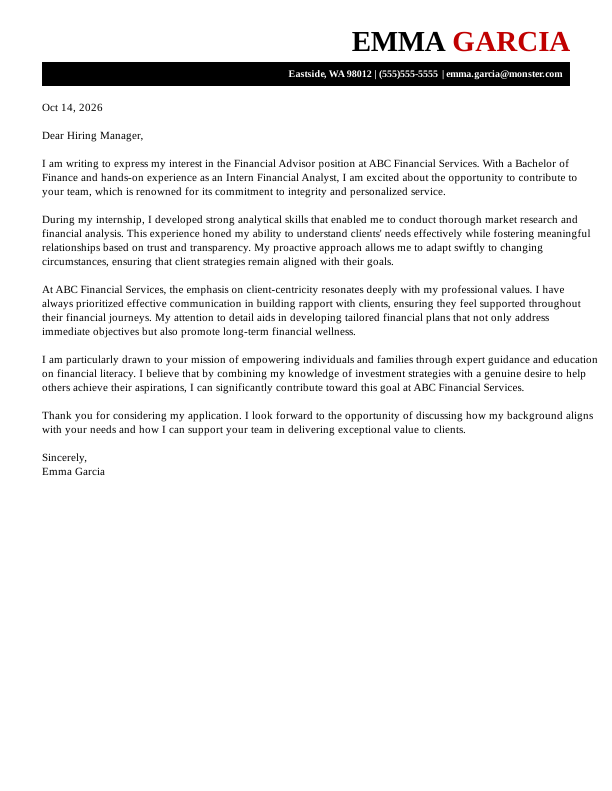
 Free
Financial Advisor Entry-Level Cover Letter
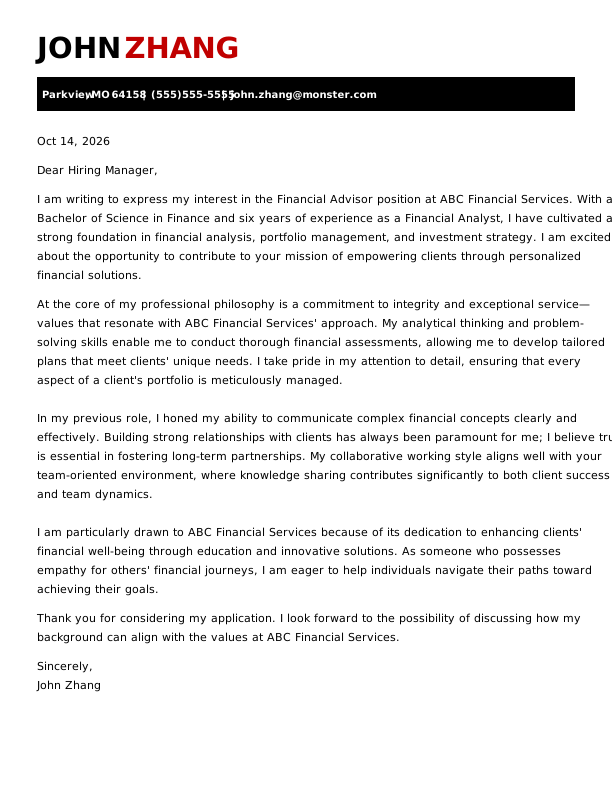
Financial Advisor Mid-Level Cover Letter
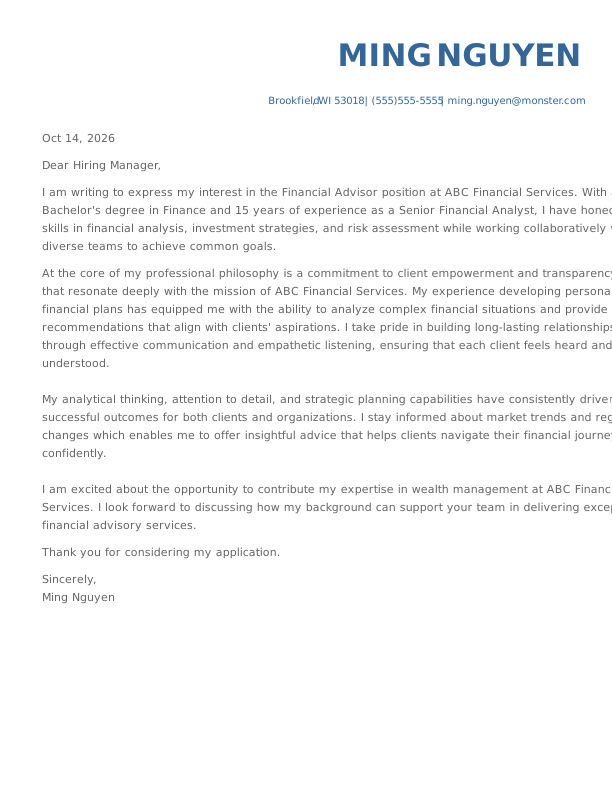
Financial Advisor Experienced Cover Letter
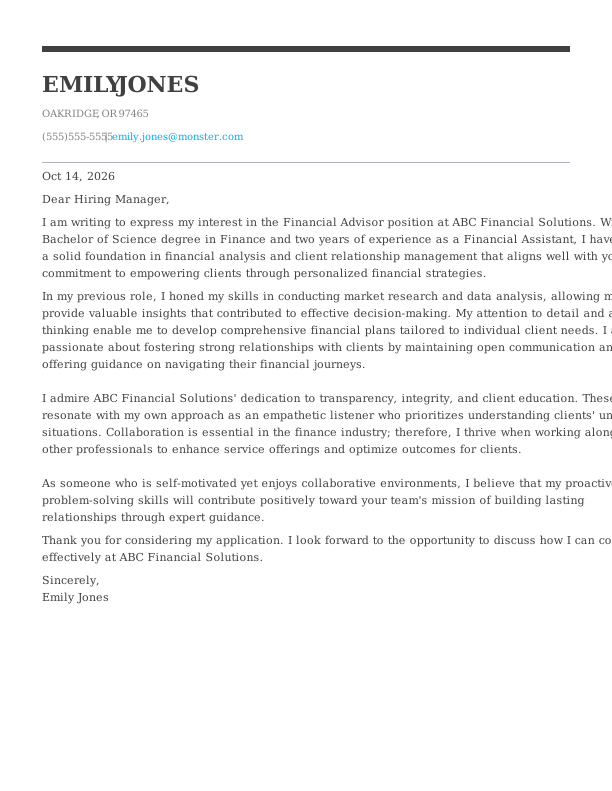
Financial Advisor Entry-Level Cover Letter
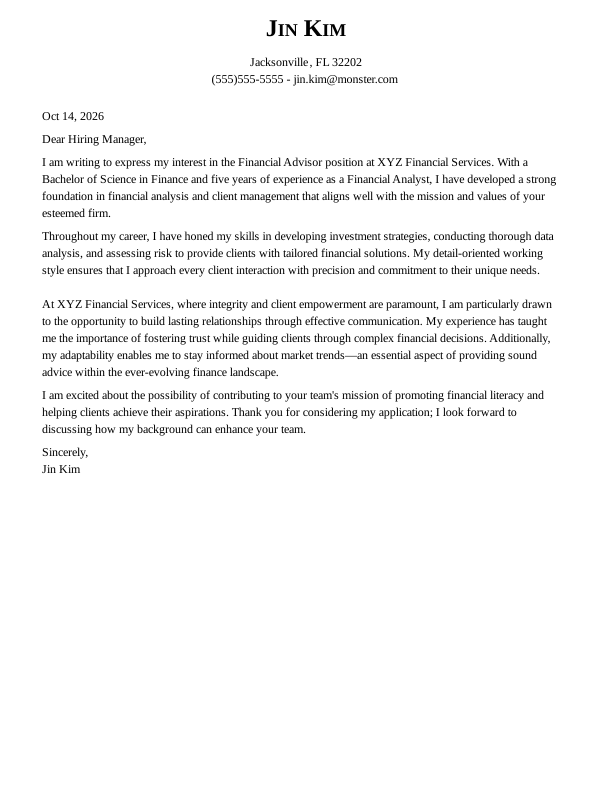
Financial Advisor Mid-Level Cover Letter
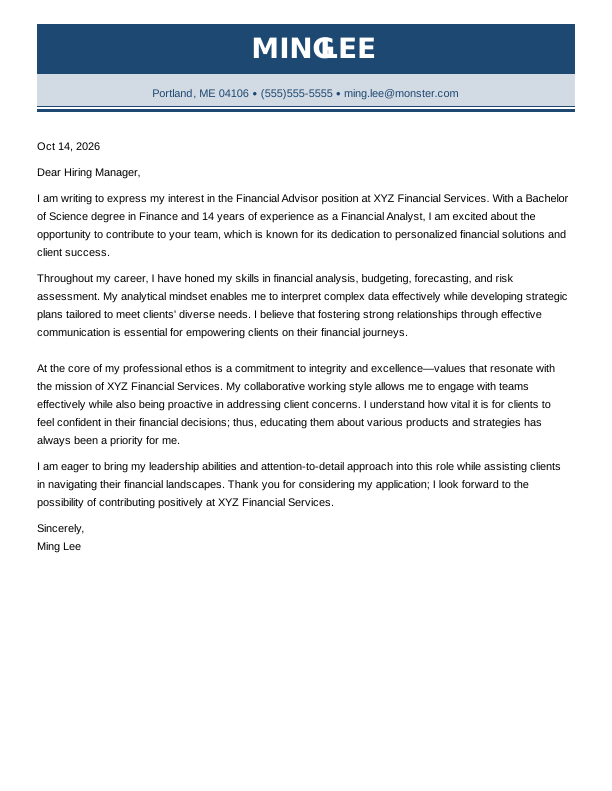
Financial Advisor Experienced Cover Letter
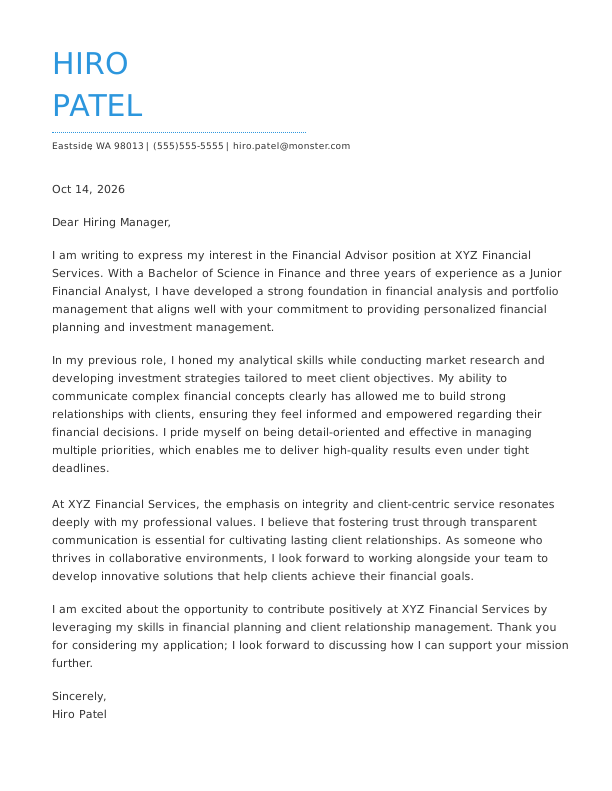
Financial Advisor Entry-Level Cover Letter
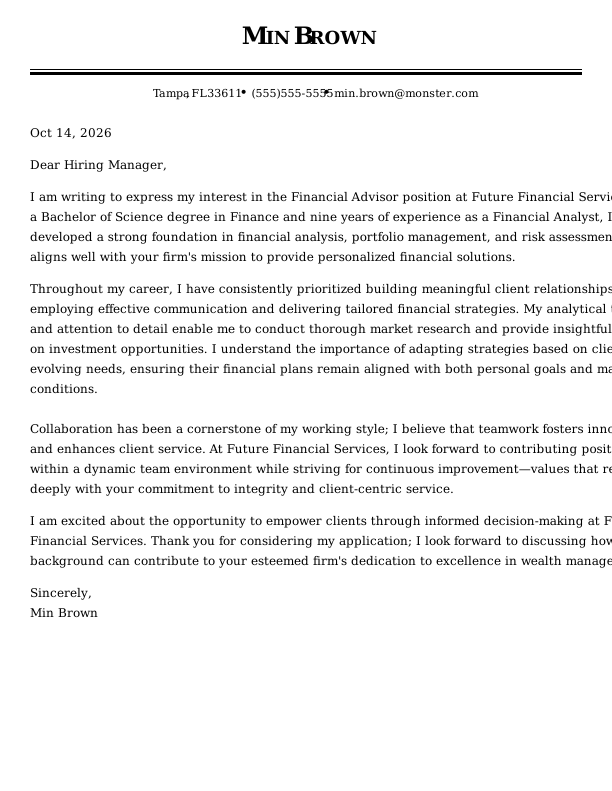
Financial Advisor Mid-Level Cover Letter
Browse Free Cover Letter Templates
- Academic
- Account Manager
- Accountant
- Accounts Payable
- Administrative Assistant
- Admissions Counselor
- Architecture
- Artist
- Assistant Principal
- Babysitter
- Barista
- Bartender
- Bookkeeper
- Brand Ambassador
- Business Analyst
- Business
- Caregiver
- Chef
- Civil Engineering
- Computer Science
- Construction
- Consulting
- Copywriter
- Cosmetology
- Custodian
- Customer Service
- Customer Service Representative
- Data Analyst
- Data Entry
- Dental Assistant
- Dental Hygienist
- Digital Marketing
- Electrical Engineering
- Emt
- Engineering
- Esthetician
- Event Coordinator
- Executive Assistant
- Finance
- Financial Analyst
- Firefighter
- Flight Attendant
- Graphic Designer
- Hair Stylist
- Healthcare
- Hr Generalist
- Investment Banking
- It
- Janitor
- Journalism
- Lab Technician
- Law Clerk
- Lawyer
- Librarian
- Logistics
- Makeup Artist
- Manager
- Marketing Coordinator
- Marketing
- Marketing Manager
- Massage Therapist
- Mechanic
- Mechanical Engineer
- Medical Assistant
- Non Profit
- Nursing
- Occupational Therapy
- Office Assistant
- Office Manager
- Operations Manager
- Paralegal
- Personal Trainer
- Pharmacist
- Pharmacy Technician
- Photographer
- Physician Assistant
- Pilot
- Police Officer
- Program Manager
- Project Manager
- Property Manager
- Psychology
- Receptionist
- Research Assistant
- Restaurant Manager
- Retail
- Sales
- Sales Manager
- School Counselor
- Security Officer
- Social Work
- Software Engineer
- Special Education Teacher
- Starbucks
- Substitute Teacher
- Teacher
- Teaching Assistant
- Truck Driver
- Vet Tech
- Veterinary Assistant
Cover Letter Examples for Financial Advisors
Cover letter requirements for a financial advisor shift as your career progresses, from foundational client-facing skills to deeper planning and portfolio experience. Choose the template that matches your stage so you can highlight the right certifications, advisory work, and outcomes.
Entry-Level Financial Advisor Cover Letter
If you are starting or transitioning into financial advisory work, this cover letter shows how to leverage coursework, internships, and core analytical strengths to demonstrate job readiness.
Mid-Career Financial Advisor Cover Letter
For advisors with a few years of experience, this cover letter format highlights portfolio management, client relationship building, and collaborative team growth.
Experienced Financial Advisor Cover Letter
Designed for seasoned professionals, this cover letter template emphasizes long-term wealth management strategy, risk oversight, and senior-level client advisory expertise.
Financial Advisor Cover Letter Template (Text)
Copy this financial advisor cover letter template, paste it into your document, and swap in your client portfolio results and certifications for the role.
David Brown
Tampa, FL 33609
(555)555-5555
david.brown@monster.com
Oct 14, 2026
Dear Hiring Manager,
I am writing to express my interest in the Financial Advisor position at ABC Financial Services. With a Bachelor of Science degree in Finance and eight years of experience as a Financial Analyst, I have developed a comprehensive skill set that aligns well with your firm’s mission to empower clients through personalized financial solutions.
Throughout my career, I have honed my abilities in financial analysis and data interpretation, allowing me to create tailored investment strategies that resonate with diverse client needs. My background has equipped me with strong analytical thinking skills and an attention to detail, essential for developing customized financial plans that align with clients’ personal goals.
At the core of my professional philosophy is a commitment to building trust-based client relationships. I understand the importance of effective communication and strive to ensure that clients feel informed and confident about their financial decisions. My collaborative approach not only enhances service delivery but also fosters team synergy, allowing us collectively to provide exceptional value.
As I seek new opportunities at ABC Financial Services, I am particularly drawn by your emphasis on integrity and transparency. These values resonate deeply with me as they form the foundation upon which successful client relationships are built. I am eager to contribute my knowledge of market trends and investment opportunities while remaining empathetic toward each client’s unique circumstances.
Thank you for considering my application. I look forward to the opportunity to discuss how my background can contribute positively at ABC Financial Services.
Sincerely,
David Brown
How to Write a Financial Advisor Cover Letter
Writing a strong financial advisor cover letter is straightforward when you break it down into clear steps. Follow these practical tips to highlight your expertise and connect with hiring managers.
1. Research & Prepare
Take time to research the firm before you start writing so you can tailor your message to their specific client base and advisory style.
Here are three effective ways to gather key insights:
- Review the firm’s careers page for the portfolio management system they expect you to use.
- Search the SEC Investment Adviser Public Disclosure site for their ADV details on services and compliance emphasis.
- Read recent industry updates from FINRA about supervision or suitability rules that may shape how you advise clients.
2. Hook the Reader
Start your letter with an engaging line that highlights your financial expertise or key achievements right away.
Consider these strong lead-in styles to capture attention:
- Portfolio construction discipline: “Built and monitored $5M in client portfolios using a rules-based rebalancing schedule tied to target allocations, which reduced tracking error versus benchmarks by 0.8% over two quarters.”
- Retirement planning outcomes: “Ran RMD readiness reviews each fall and lifted on-time IRA distributions from 71% to 92% within one year using cash flow forecasts and tax loss harvesting checks.”
- Client service operating system: “After adopting Morningstar Direct workflows and an annual fee audit checklist reviewed with CPAs, cut plan review turnaround from 10 days to 4 while keeping IPS updates current.”
3. Tell Your Professional Story
Use clear examples and concrete numbers from your career to demonstrate how you deliver value to clients.
Review these sample metric highlights to inspire your own bullet points:
- Helped 42 clients move from cash to diversified portfolios, increasing their median after-fee return by 2.1% over 12 months.
- Reduced annual tax-prep fees for an average household by $180 by consolidating documents and coordinating with CPAs.
- Reviewed 25 to 30 accounts per week and cut follow-up time from 6 days to 2 days by standardizing meeting notes and task tracking.
4. Showcase Your Skills
Focus on core skills that match the job description and show how you apply them in real client situations.
Here are a few ways to describe your daily capabilities:
- Financial planning: “Built a retirement cash flow plan in MoneyGuide and adjusted the assumptions after a client changed their target retirement date.”
- Risk management: “Reviewed a client’s portfolio holdings and flagged an outsized concentration risk before recommending any rebalancing.”
- Client communication: “Explained the difference between Roth and traditional contributions, then asked follow-up questions to confirm they understood before we moved to next steps.”
5. Explain Any Special Circumstances
If you have a career gap, relocation, or industry transition, address it directly in one or two simple sentences.
Use these examples as a guide for brief, positive phrasing:
- “After nine months managing my own family health needs, I stayed current by completing continuing education for CFP renewal and resumed client meetings in March using my AUM reporting workflow in Orion.”
- “Pivoting from insurance sales into fee-based advisory work by finishing the CFP coursework while building model portfolios in Morningstar Direct and preparing IPS documents for new prospects.”
- “Relocated from Austin to Phoenix last November, and my Texas registration is now updated with my Arizona compliance filings so I can continue serving households under the same broker-dealer umbrella.”
6. End With a Professional Goodbye
Conclude your cover letter with a polite, confident sign-off that invites further discussion about how you can support the firm’s clients.
Reiterate your enthusiasm for the position, express gratitude for their consideration, and close with a professional sign-off like “Best regards.”
4 Tips for Formatting Your Cover Letter
Clean layout and clear structure make your cover letter easy for recruiters and hiring managers to scan quickly. Paying attention to visual presentation, line spacing, margins, and standard file formats ensures your application looks polished and professional on any device.

Address the Hiring Manager Directly
Find the name of the hiring manager or department lead to make a direct connection. If no name is available, use a respectful greeting like “Dear Hiring Manager” rather than generic salutations.

Use Bullet Points for Key Achievements
Organize your top achievements into three or four bullet points so key metrics and portfolio outcomes stand out immediately during a quick review.

Balance Spacing & Margins
Set line spacing between 1.0 and 1.15 and maintain 0.75-inch to 1-inch margins so your document looks balanced and easy to read.

Save & Send as a PDF
Save your cover letter as a PDF file to lock in your layout and prevent formatting issues across different screens and operating systems.
Top-Paying States for Financial Advisor Roles
Understanding what financial advisors earn helps you compare offers, plan your career path, and negotiate with confidence. Salary figures should be grounded in reliable data, such as the U.S. Bureau of Labor Statistics (BLS), which publishes nationwide averages for advisor-related roles.
Keep in mind that pay can vary based on your location, years of experience, and whether you work at a large firm versus an independent practice. Your specialty, client base size, and performance expectations may also affect earnings.
| Alabama | $129,240 |
| Arizona | $104,330 |
| Arkansas | $116,990 |
| California | $170,480 |
| Connecticut | $144,310 |
| Delaware | $133,620 |
| District of Columbia | $137,650 |
| Florida | $157,670 |
| Georgia | $150,650 |
| Hawaii | $124,640 |
| Idaho | $143,410 |
| Illinois | $153,440 |
| Indiana | $158,560 |
| Iowa | $129,680 |
| Kansas | $164,480 |
| Kentucky | $162,520 |
| Louisiana | $166,400 |
| Maryland | $173,120 |
| Massachusetts | $147,450 |
| Michigan | $144,370 |
| Minnesota | $134,100 |
| Mississippi | $154,090 |
| Missouri | $127,820 |
| Montana | $145,440 |
| Nebraska | $127,430 |
| Nevada | $142,290 |
| New Hampshire | $104,340 |
| New Jersey | $170,950 |
| New Mexico | $135,110 |
| New York | $225,930 |
| North Dakota | $114,900 |
| Ohio | $120,980 |
| Oklahoma | $118,980 |
| Oregon | $121,410 |
| Pennsylvania | $164,140 |
| Rhode Island | $118,310 |
| South Carolina | $140,490 |
| South Dakota | $174,340 |
| Tennessee | $143,910 |
| Texas | $126,020 |
| Utah | $130,030 |
| Vermont | $114,990 |
| Virginia | $155,160 |
| Washington | $156,310 |
| West Virginia | $132,360 |
| Wisconsin | $158,660 |
| Puerto Rico | $52,200 |
Key Takeaways
- Demonstrate client suitability and trust by explaining how you align investment plans with individual risk profiles.
- Highlight measurable achievements like assets under management growth, client retention, and performance benchmarks to prove your impact.
- Tailor your letter to match the specific focus of the firm, whether it emphasizes wealth management, banking, or independent advisory services.
More Cover Letter Examples
Browse Monster’s Resume Templates
Monster also has hundreds of ATS-friendly resume templates for all career levels and industries. Create a matching resume to help you land the interview.
Frequently Asked Questions
Last Update:
Do I really need a cover letter?
You should include a cover letter when applying for a financial advisor role because it provides crucial context beyond your resume. While a resume lists certifications and employment history, a cover letter highlights your communication style, client relationship skills, and professional motivation.
It shows hiring managers how you approach client care and problem-solving.
How long should my cover letter be?
Your cover letter should ideally be between 250 and 400 words, fitting neatly onto a single page. Keeping your letter concise allows hiring managers to quickly scan your key achievements, certifications, and background.
Focus on three to four well-structured paragraphs that highlight your most relevant experience for the financial advisor position.
Should my cover letter match my resume?
Your cover letter should match your resume in visual style and header formatting to present a unified application. Using consistent fonts and layouts creates a polished look.
Rather than repeating your resume bullet points, use the cover letter to elaborate on key financial achievements and client-focused successes.
How do I address my cover letter if I don’t know the hiring manager’s name?
If you do not know the hiring manager’s name, try researching the firm’s LinkedIn page or company website to find the recruiting lead or department director.
If the name remains unavailable, address your letter to “Dear Hiring Manager” or “Dear Financial Advisory Hiring Team” to maintain a professional tone.
How do I write a cover letter for an internal position?
When writing a cover letter for an internal financial advisor role, emphasize your familiarity with the company’s systems, compliance standards, and team culture.
Highlight recent internal achievements, such as improving account review workflows or meeting performance targets, to demonstrate your readiness for advancement within the firm.

Vicki Salemi is a nationally recognized career expert who helps professionals navigate the hiring landscape and find the right fit on Monster. With over 15 years of experience in corporate recruiting and HR, she offers expert guidance on job search strategies, interview preparation, and career development to help candidates land their next role.
See More From Vicki SalemiExplore Related Career Advice







How to Write a Cover Letter for Internal Positions or Promotions (Examples & Tips)

Updated:
Apr 23, 2026
|
19 min read


Cover Letter vs Resume: What’s the Difference & Do You Need Both?

Updated:
Apr 23, 2026
|
18 min read