


Free Management Consultant Cover Letter Templates & Examples
A strong management consultant cover letter shows you’re able to diagnose business challenges and build practical, data-informed strategies that improve results. Our free cover letter examples and step-by-step guidance will help you present your consulting experience clearly so hiring managers quickly see your fit.
Real-World Cover Letters That Get Results
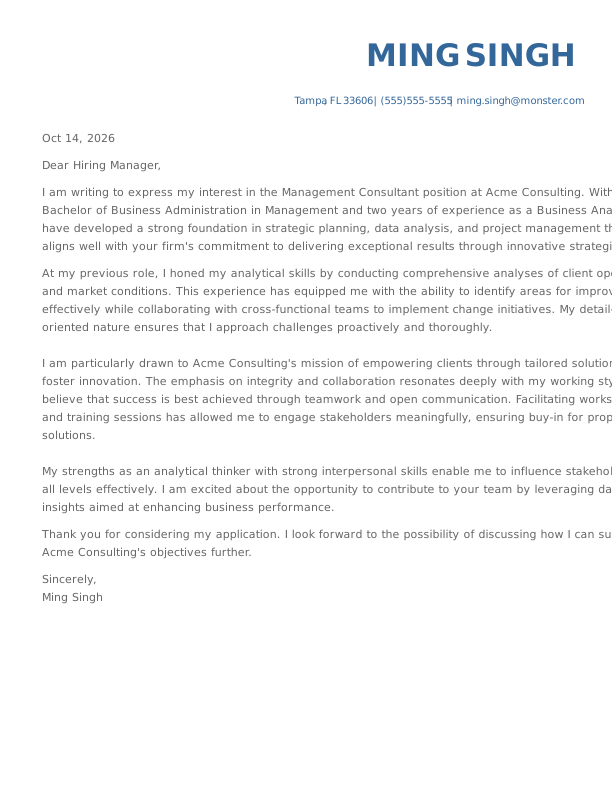
 Free
Management Consultant Entry-Level Cover Letter
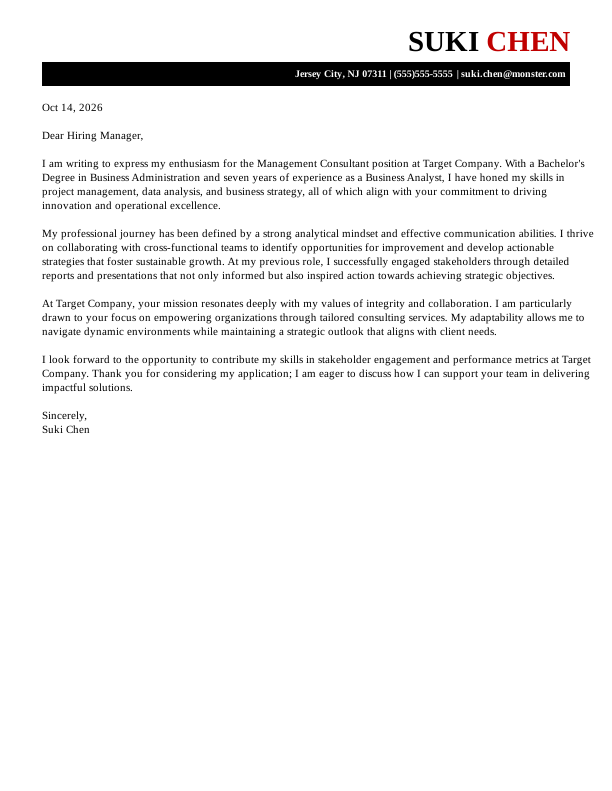
Management Consultant Mid-Level Cover Letter
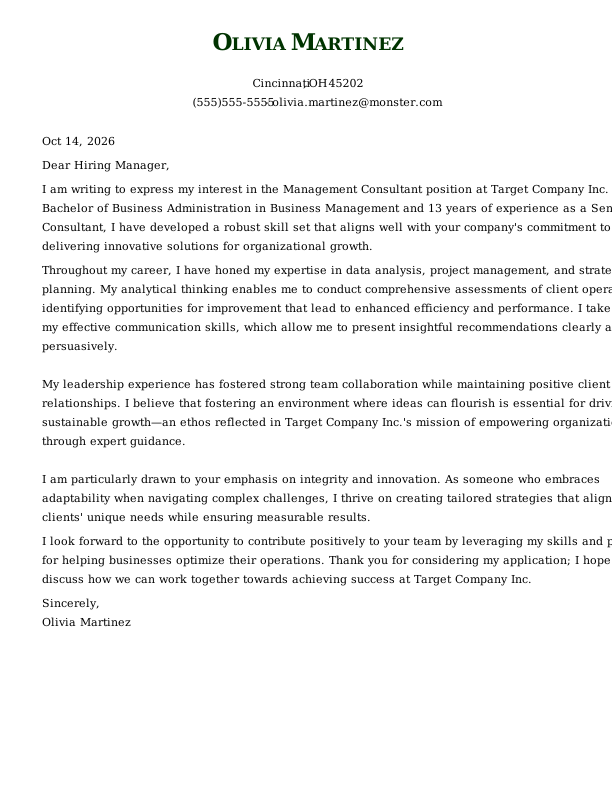
Management Consultant Experienced Cover Letter
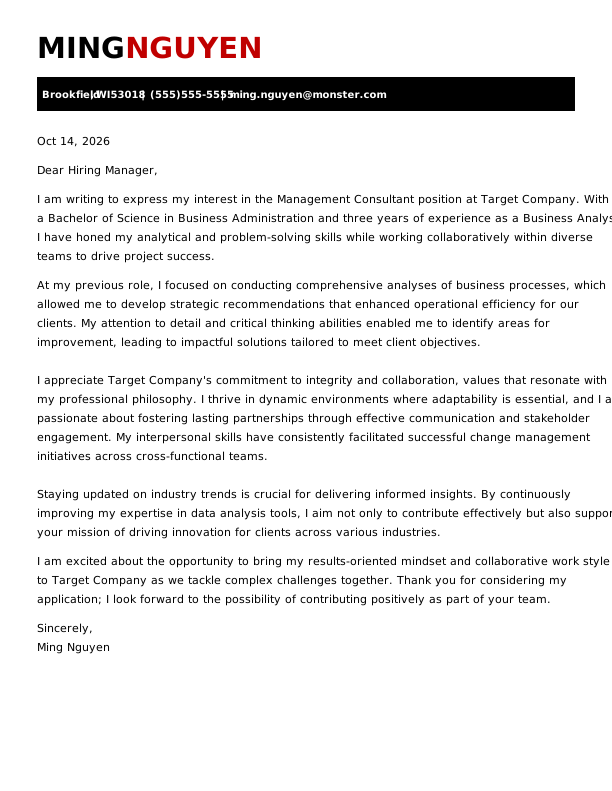
Management Consultant Entry-Level Cover Letter
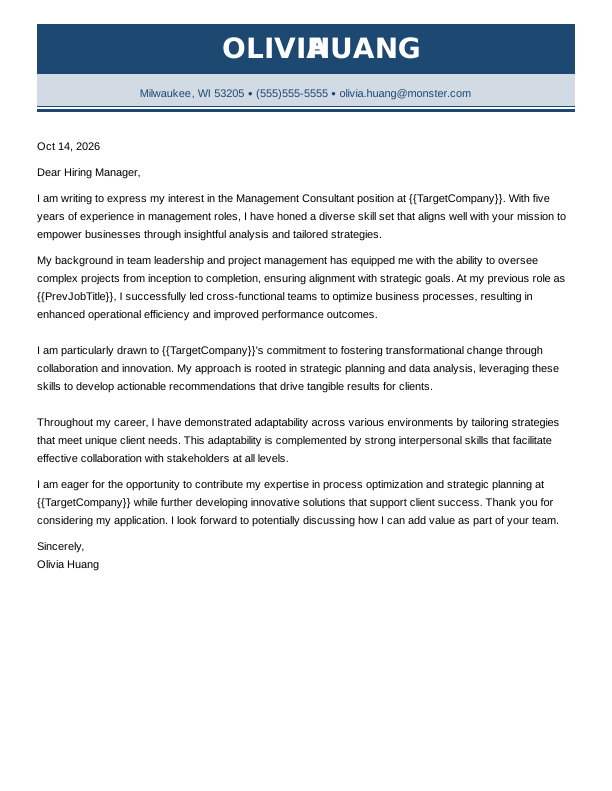
Management Consultant Mid-Level Cover Letter
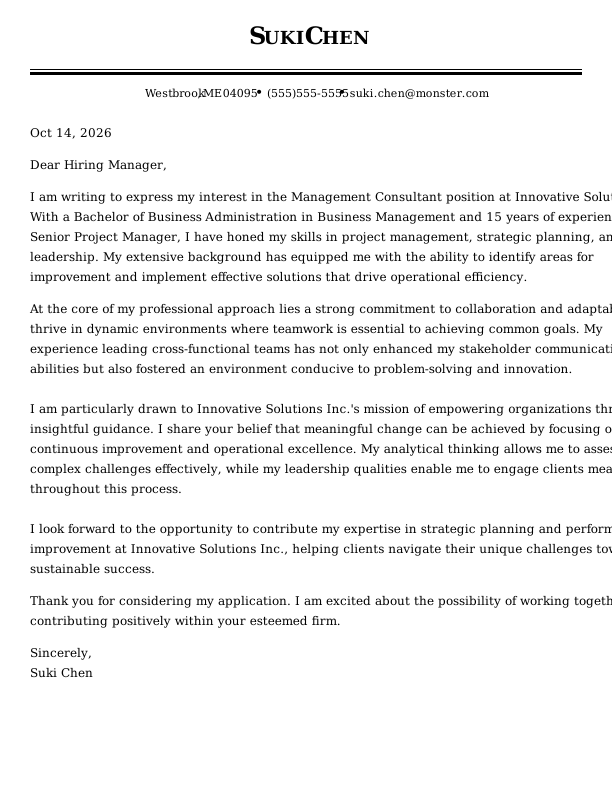
Management Consultant Experienced Cover Letter
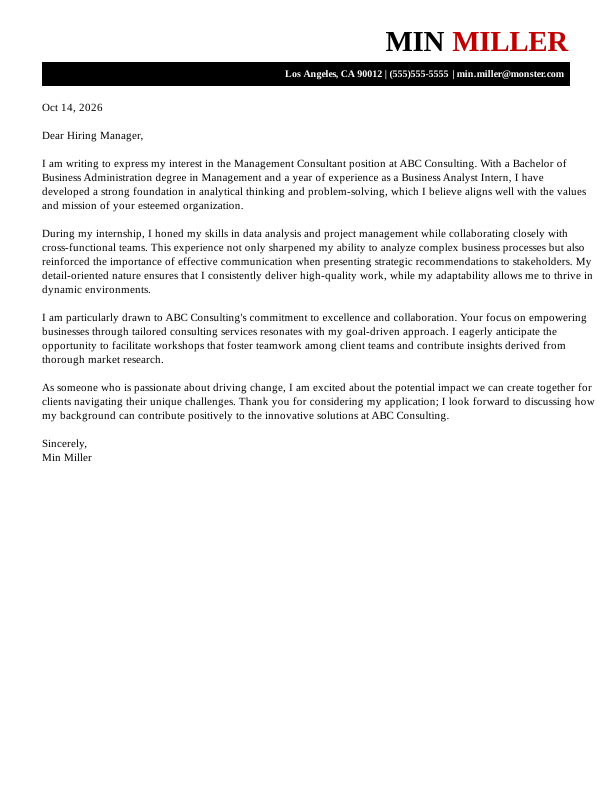
Management Consultant Entry-Level Cover Letter
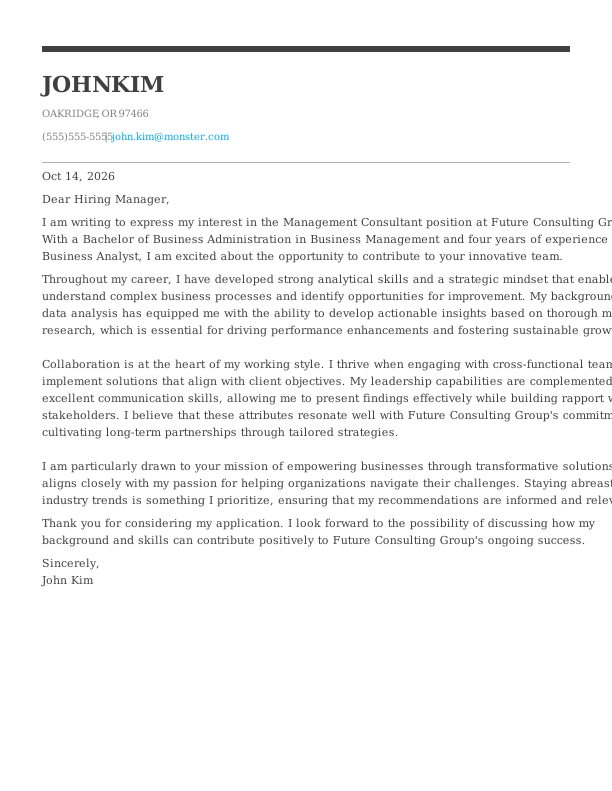
Management Consultant Mid-Level Cover Letter
Browse Free Cover Letter Templates
- Academic
- Account Manager
- Accountant
- Accounts Payable
- Administrative Assistant
- Admissions Counselor
- Architecture
- Artist
- Assistant Principal
- Babysitter
- Barista
- Bartender
- Bookkeeper
- Brand Ambassador
- Business Analyst
- Business
- Caregiver
- Chef
- Civil Engineering
- Computer Science
- Construction
- Consulting
- Copywriter
- Cosmetology
- Custodian
- Customer Service
- Customer Service Representative
- Data Analyst
- Data Entry
- Dental Assistant
- Dental Hygienist
- Digital Marketing
- Electrical Engineering
- Emt
- Engineering
- Esthetician
- Event Coordinator
- Executive Assistant
- Finance
- Financial Analyst
- Firefighter
- Flight Attendant
- Graphic Designer
- Hair Stylist
- Healthcare
- Hr Generalist
- Investment Banking
- It
- Janitor
- Journalism
- Lab Technician
- Law Clerk
- Lawyer
- Librarian
- Logistics
- Makeup Artist
- Manager
- Marketing Coordinator
- Marketing
- Marketing Manager
- Massage Therapist
- Mechanic
- Mechanical Engineer
- Medical Assistant
- Non Profit
- Nursing
- Occupational Therapy
- Office Assistant
- Office Manager
- Operations Manager
- Paralegal
- Personal Trainer
- Pharmacist
- Pharmacy Technician
- Photographer
- Physician Assistant
- Pilot
- Police Officer
- Program Manager
- Project Manager
- Property Manager
- Psychology
- Receptionist
- Research Assistant
- Restaurant Manager
- Retail
- Sales
- Sales Manager
- School Counselor
- Security Officer
- Social Work
- Software Engineer
- Special Education Teacher
- Starbucks
- Substitute Teacher
- Teacher
- Teaching Assistant
- Truck Driver
- Vet Tech
- Veterinary Assistant
Cover Letter Examples for Management Consultants
Cover letter expectations shift as you advance from early research and analysis to leading client work and managing teams. Choose a template that matches your career stage, so you’ll highlight the right consulting experience, training, and results.
Entry-Level Management Consultant Cover Letter
Designed for recent graduates tackling a cover letter with no experience, this template will also support career changers transitioning into management consultant roles.
Mid-Career Management Consultant Cover Letter
Designed for management consultants a few years into their career, this template’s built for analysts who now lead client workstreams, own deliverables, and mentor teammates.
Experienced Management Consultant Cover Letter
Ideal for management consultants with close to nine years of experience, this template fits professionals who lead cross-functional engagements, own strategic planning deliverables, and drive measurable transformation through data-backed recommendations.
Management Consultant Cover Letter Template (Text)
Copy this management consultant cover letter text, paste it into your document, and swap in your case study outcomes and client industries for the role you want.
Yuki Kim
Eastside, WA 98006
(555)555-5555
yuki.kim@monster.com
Oct 14, 2026
Dear Hiring Manager,
I am writing to express my interest in the Management Consultant position at Global Consulting Group. With a Bachelor of Science in Business Administration and six years of experience as a Business Analyst, I have developed a strong foundation in strategic thinking, data analysis, and project management, which I believe aligns well with your commitment to delivering tailored consulting services.
Throughout my career, I have honed my skills in conducting comprehensive analyses of operations and market conditions. My analytical mindset allows me to identify key opportunities for improvement while ensuring that solutions are both sustainable and impactful. As an empathetic communicator, I thrive in collaborative settings where diverse perspectives come together to achieve common goals.
In my previous role, I successfully facilitated workshops that enhanced team capabilities and fostered knowledge transfer among stakeholders. My attention to detail ensures that all documentation supports informed decision-making processes effectively.
I am particularly drawn to Global Consulting Group’s values of integrity and collaboration. Your mission resonates with me as it emphasizes long-term success through innovative solutions—principles that guide my professional approach.
I am eager for the opportunity to contribute positively within your team by leveraging my leadership skills and adaptability in navigating complex challenges. Thank you for considering my application; I look forward to the possibility of discussing how I can support your clients’ journeys towards operational excellence.
Sincerely,
Yuki Kim
How to Write a Management Consultant Cover Letter
Crafting an effective management consultant cover letter involves translating project notes, client outcomes, and problem-solving approaches into clear, compelling proof. The six steps below walk you through tailoring your letter directly to the job listing.
1. Research & Prepare
To understand what a consulting team needs right now, review their recent case studies, service pages, and job postings for specific software and active priorities like cost reduction or operating model redesign. Here are three ways to gather that targeted evidence:
- Scan the firm’s careers page for specific workstreams and methodologies they name.
- Read their published insights or blog posts to see which analytics platforms and KPIs they emphasize.
- Review recent press releases or news coverage to spot active restructuring efforts or major initiatives.
2. Hook the Reader
Your opening line should grab attention immediately by showing your understanding of how consulting teams win projects and deliver results. Instead of relying on boilerplate statements that repeat your job title, lead with clear proof of impact and methodology using options like these:
- Deal-shaped impact: “I reduced procurement cycle time by 28% during a cost takeout engagement by redesigning supplier onboarding and building an Excel scenario model for category managers.”
- Casework method: “On my last strategy case with a consumer lender, I structured work around hypothesis-driven driver trees, then stress-tested assumptions with a Monte Carlo model before presenting to the partner.”
- Stakeholder execution: “At my last transformation project, I coordinated weekly steering decks with the CFO office and ops leads, tracking 15 workstreams through RAID logs until benefits were realized within 90 days.”
3. Tell Your Professional Story
Your cover letter explains how you drove decisions and achieved tangible outcomes. Using concrete numbers helps readers picture your exact scope and results through examples such as these:
- Reduced order-to-cash cycle time by 33% by redesigning handoffs across finance, sales ops, and billing teams.
- Saved $1.2 million annually by consolidating vendor contracts and renegotiating terms during a cost takeout workstream.
- Led a cross-functional program with 18 stakeholders that cut process defects from 6.5% to 3.1% after implementing standard operating procedures and QA checks.
4. Showcase Your Skills
Bring core requirements from the job posting to life by sharing brief, real-world examples from past projects rather than relying on buzzwords. The following examples illustrate how to demonstrate your hands-on problem-solving process:
- Client discovery: “I facilitated a kickoff workshop, then summarized stakeholder priorities into a one-page issue map we agreed on before building any models.”
- Data analysis tools: “I used Excel and SQL to clean inconsistent CRM fields, then ran segment cuts that explained why leads were stalling at the same step.”
- Stakeholder communication: “I presented findings to a non-technical leadership team and tailored risks and tradeoffs in plain language until they asked for next steps.”
5. Explain Any Special Circumstances
If you need to address employment gaps, industry pivots, or relocations, keep your explanation brief and direct so the focus stays on your consulting expertise. You can address these situations clearly using examples like these:
- “After a nine-month gap between projects, I stayed sharp by leading a pro bono strategy engagement using Power BI for KPI dashboards, delivering final decks built to standard client specs.”
- “I’m pivoting from internal operations into management consulting, targeting transformation work through structured case practice, Lean Six Sigma Green Belt coursework, and weekly stakeholder interviews.”
- “After relocating to Austin last fall for family reasons, I restarted immediately with contract advisory support for a retail client and refreshed my Tableau skills on new forecasting models.”
6. End With a Professional Goodbye
Wrap up your letter with a friendly, direct closing that thanks the reader and invites a specific next step. Avoid passive phrases and instead use a concise call to action, such as: “I’d welcome the chance to walk through how you’d structure client engagement for their next market expansion.” Finish with “Thank you for your time,” followed by “Best regards.”
4 Tips for Formatting Your Cover Letter
In management consulting, you’ll get a fast skim before anyone decides to read about your project fit, so formatting should make key industries, problem-solving examples, and results easy to spot. These guidelines hold whether you’re aiming for an associate consultant role or moving into a principal consultant position.

Keep It to One Page
In management consulting, you’ll often face rapid screening by partners who scan for fit while juggling client decks, so long letters dilute key points. Target 250 to 400 words across three to four short paragraphs, using one concise case example and a clear metric to show consulting impact.

Address the Hiring Manager Directly
Check the job posting, the firm’s leadership team page, and LinkedIn to find who owns hiring—often a partner or recruiting lead. If you can’t find a name, “Dear Hiring Manager” or “To the Hiring Team” both work well. Avoid “To Whom It May Concern” since it’s outdated.

Match Your Header to Your Resume
Use the exact same name, credentials, contact details, and typography across both your cover letter and resume so hiring managers will quickly confirm you’re the same applicant across files.

Use Bullet Points for Key Achievements
Use three to four bullets to spotlight measurable wins, like revenue lift, cost savings, or delivery timelines. When reviewers scan fast, bullets will help them spot impact quickly and decide to read your full story.
Key Takeaways
- Consulting firms look closely at how you structure problems. Show this skill by explaining how you took a complex business challenge, broke it into clear hypotheses, and tested them with data or interviews to reach your recommendation.
- Use concrete metrics like cost-to-serve, EBITDA impact, or forecast accuracy to highlight tangible project outcomes.
- A strategy firm values top-down frameworks and executive storytelling, while an operations team emphasizes process KPIs. Boutique risk or turnaround shops will look for hands-on diligence under tight timelines.
More Cover Letter Examples
Browse Monster’s Resume Templates
Monster also has hundreds of ATS-friendly resume templates for all career levels and industries. Create a matching resume to help you land the interview.
Frequently Asked Questions
Last Update:
Do I really need a cover letter?
Including a cover letter is strongly recommended for management consultant roles, even when postings say it’s optional. Resumes list experience and skills, but they can’t provide context behind your choices or show genuine enthusiasm for a specific team.
A cover letter is especially valuable when you’re explaining a career transition or employment gap. It’ll also help connect your interest directly to key consulting work like client advocacy and stakeholder alignment.
How long should my cover letter be?
Your cover letter should stay within one page maximum, targeting 250 to 400 words. Hiring teams scan applications quickly, so tight messaging helps you stand out right away.
Aim for quality over quantity by organizing text into three to four short paragraphs. Highlight only your most relevant wins and certifications that fit the role’s primary needs.
Should my cover letter match my resume?
Your cover letter should match your resume’s formatting so the whole package looks unified. Use the same fonts, colors, header layout, and contact details so everything’s clearly connected.
The text should complement rather than repeat your resume points. Use your letter to dive deeper into one key project outcome or explain why you’re drawn to this firm’s priorities.
How do I address my cover letter if I don’t know the hiring manager’s name?
Addressing your cover letter properly just takes a few minutes of research when a name isn’t listed. Start with the job posting, then check the firm’s website or LinkedIn for practice leads or recruiting contacts.
If you can’t locate a specific name, use “Dear Hiring Manager” or “Dear Consulting Recruitment Team.” Skip “To Whom It May Concern” because it’s outdated.
How do I write a cover letter for an internal position?
Writing a cover letter for an internal position means building on your team’s existing workflow and shared achievements. Highlight how you scope requests with ops and track decisions through weekly governance. Try something like, “In the past quarter, I’ve streamlined two process handoffs and helped cut turnaround time by 18% while improving audit-ready quality. I’m ready to own larger engagements, mentor new analysts, and follow every step of the internal application process.”

Megan Dawkins is a career industry editor who empowers job seekers to take control of their career paths using Monster’s comprehensive job search and resume tools. She specializes in helping job seekers navigate the flexible job market.
See More From Megan DawkinsExplore Related Career Advice







How to Write a Cover Letter for Internal Positions or Promotions (Examples & Tips)

Updated:
Apr 23, 2026
|
19 min read


Cover Letter vs Resume: What’s the Difference & Do You Need Both?

Updated:
Apr 23, 2026
|
18 min read