


Free Landscaping Cover Letter Templates & Examples
A strong landscaping cover letter highlights your ability to care for outdoor spaces, use equipment safely, and complete work reliably. Our cover letter examples and writing tips help you connect your skills and experience to the job’s requirements.
Real-World Cover Letters That Get Results
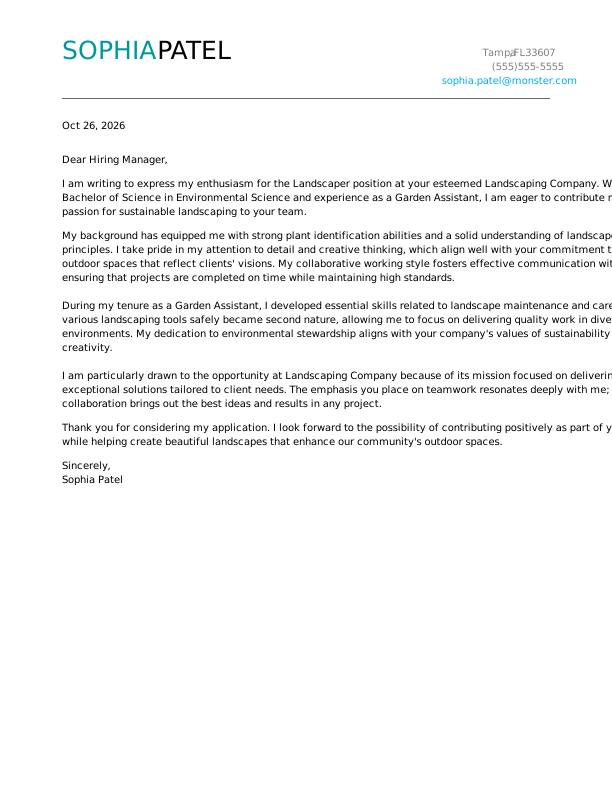
 Free
Landscaping Entry-Level Cover Letter
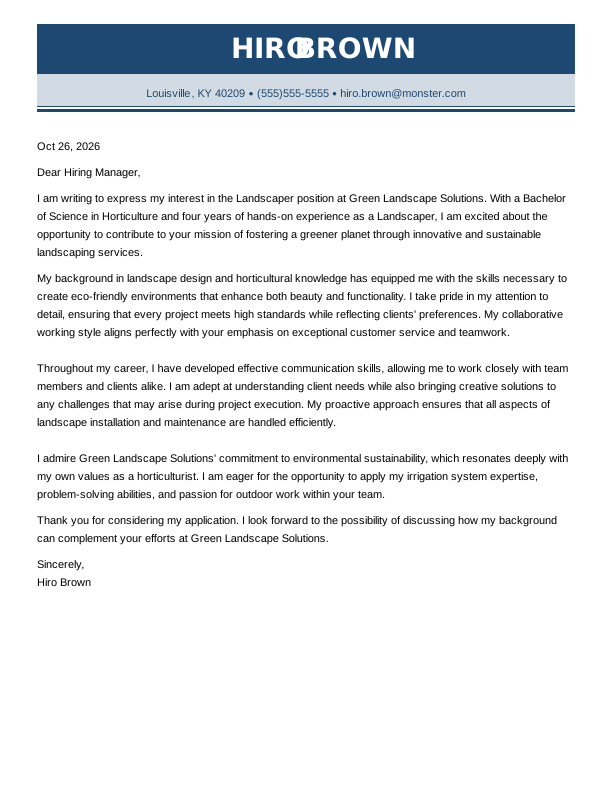
Landscaping Mid-Level Cover Letter
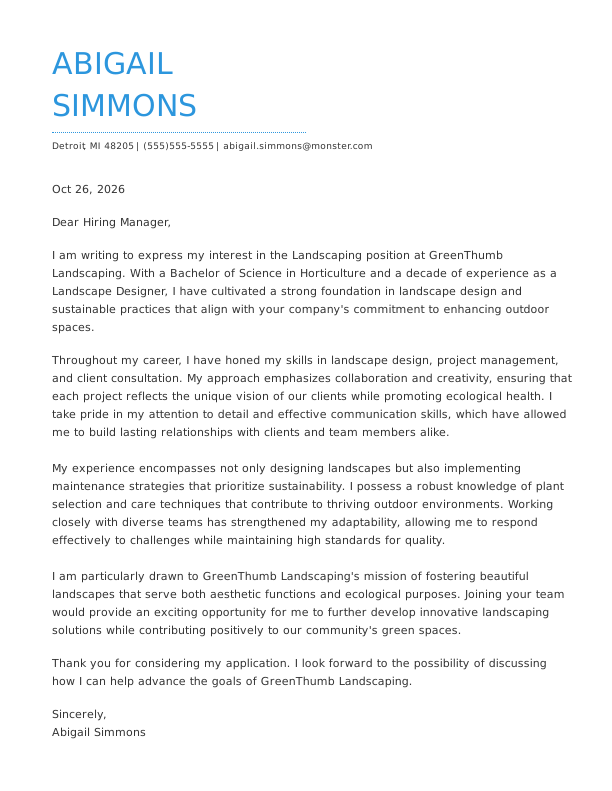
Landscaping Experienced Cover Letter
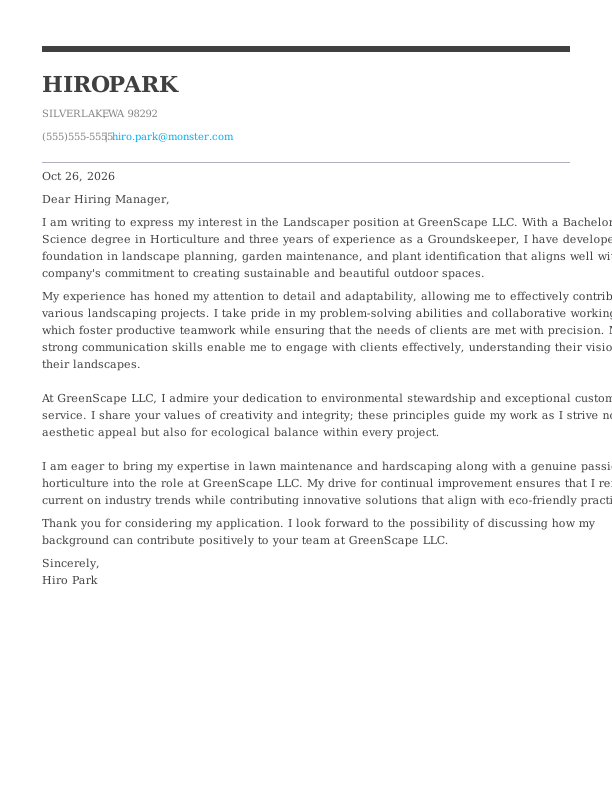
Landscaping Entry-Level Cover Letter
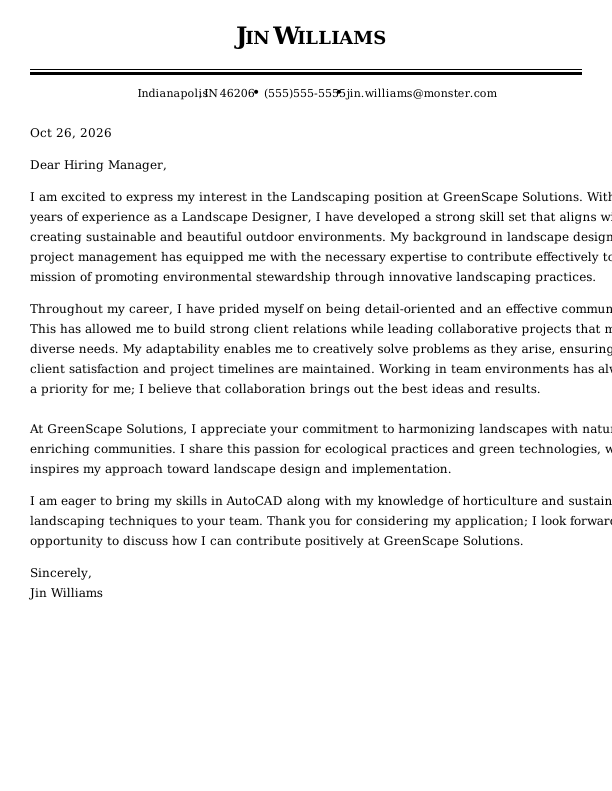
Landscaping Mid-Level Cover Letter
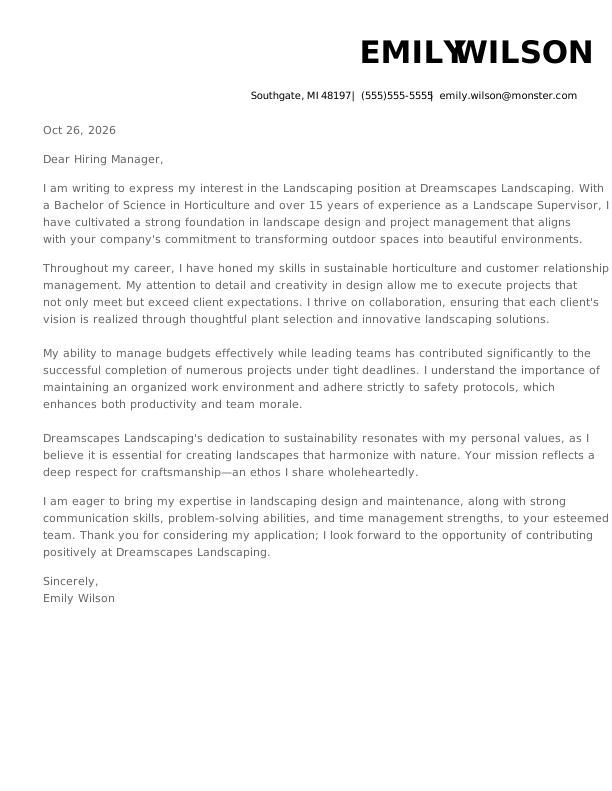
Landscaping Experienced Cover Letter
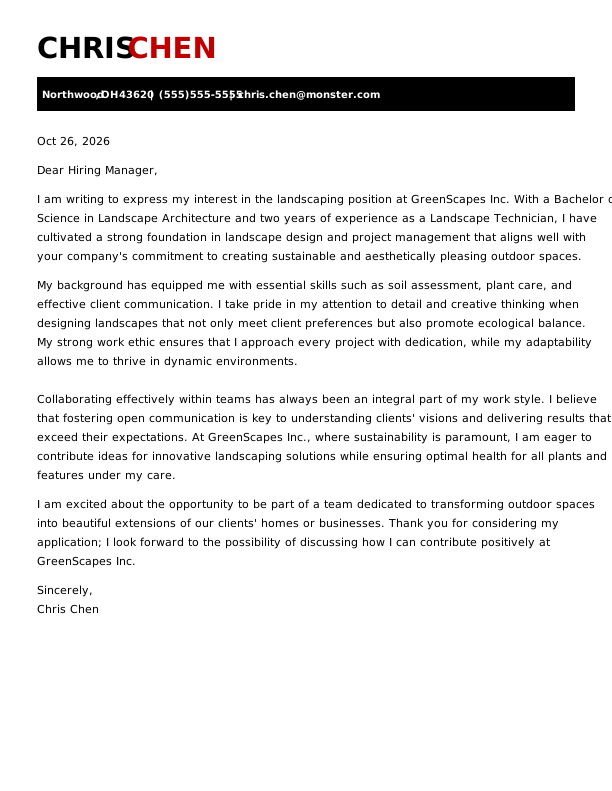
Landscaping Entry-Level Cover Letter
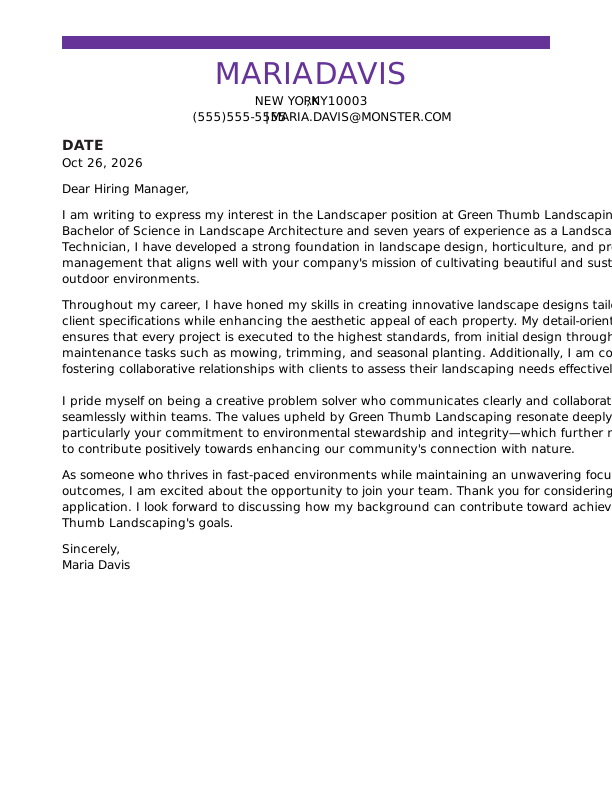
Landscaping Mid-Level Cover Letter
Browse Free Cover Letter Templates
- Academic
- Account Manager
- Accountant
- Accounts Payable
- Administrative Assistant
- Admissions Counselor
- Architecture
- Artist
- Assistant Principal
- Babysitter
- Barista
- Bartender
- Bookkeeper
- Brand Ambassador
- Business Analyst
- Business
- Caregiver
- Chef
- Civil Engineering
- Computer Science
- Construction
- Consulting
- Copywriter
- Cosmetology
- Custodian
- Customer Service
- Customer Service Representative
- Data Analyst
- Data Entry
- Dental Assistant
- Dental Hygienist
- Digital Marketing
- Electrical Engineering
- Emt
- Engineering
- Esthetician
- Event Coordinator
- Executive Assistant
- Finance
- Financial Analyst
- Firefighter
- Flight Attendant
- Graphic Designer
- Hair Stylist
- Healthcare
- Hr Generalist
- Investment Banking
- It
- Janitor
- Journalism
- Lab Technician
- Law Clerk
- Lawyer
- Librarian
- Logistics
- Makeup Artist
- Manager
- Marketing Coordinator
- Marketing
- Marketing Manager
- Massage Therapist
- Mechanic
- Mechanical Engineer
- Medical Assistant
- Non Profit
- Nursing
- Occupational Therapy
- Office Assistant
- Office Manager
- Operations Manager
- Paralegal
- Personal Trainer
- Pharmacist
- Pharmacy Technician
- Photographer
- Physician Assistant
- Pilot
- Police Officer
- Program Manager
- Project Manager
- Property Manager
- Psychology
- Receptionist
- Research Assistant
- Restaurant Manager
- Retail
- Sales
- Sales Manager
- School Counselor
- Security Officer
- Social Work
- Software Engineer
- Special Education Teacher
- Starbucks
- Substitute Teacher
- Teacher
- Teaching Assistant
- Truck Driver
- Vet Tech
- Veterinary Assistant
Cover Letter Examples for Landscaping
Cover letter requirements evolve as your landscaping career progresses, especially as you move from learning site work to managing larger projects. Choose the template that matches your experience level to highlight the skills, training, and accomplishments that fit entry-level, mid-career, or experienced roles.
Entry-Level Landscaping Cover Letter
Designed for recent graduates and career changers entering the landscaping industry, this example shows how to highlight relevant training, transferable skills, and related experience.
Mid-Career Landscaping Cover Letter
For landscaping professionals with several years of experience, this example shows how to highlight practical skills and the responsibilities you’ve handled on the job.
Experienced Landscaping Cover Letter
For professionals with an extensive landscaping background, this example shows how to highlight your expertise, project experience, and ability to meet client needs.
Landscaping Cover Letter Template (Text)
Paste this landscaping cover letter template into your document, then copy and customize it by swapping in your crew experience, equipment skills, and preferred employer.
Tao Kim
Tampa, FL 33605
(555)555-5555
tao.kim@monster.com
Oct 26, 2026
Dear Hiring Manager,
I am writing to express my enthusiasm for the Landscaping position at GreenScape Innovations. With a Bachelor of Science in Horticulture and five years of experience as a Landscape Technician, I am eager to contribute my skills in landscape design and project management to your esteemed company.
At GreenScape Innovations, your commitment to sustainability and creativity resonates deeply with me. I have always believed in the importance of transforming outdoor spaces into environments that not only enhance beauty but also promote ecological balance. My expertise in plant identification, soil analysis, and sustainable practices aligns well with your mission to inspire communities through innovative landscaping solutions.
Throughout my career, I have developed strong attention to detail and a keen aesthetic sense that guide my design work. Leading teams has allowed me to hone my communication abilities while ensuring collaborative efforts meet client expectations. I approach every project with creativity and problem-solving skills that facilitate effective planning and execution.
In addition, my background includes safe operation of landscaping equipment and tools while maintaining high standards for plant care throughout all stages of development. My passion for customer satisfaction drives me to actively engage with clients, understanding their unique needs for tailored landscaping solutions.
I am excited about the opportunity to bring my background in horticulture, along with a proactive working style, to the team at GreenScape Innovations. Thank you for considering my application; I look forward to the possibility of discussing how I can contribute positively to your projects.
Sincerely,
Tao Kim
How to Write a Landscaping Cover Letter
To write a strong landscaping cover letter, start by turning your experience into clear details about hardscaping, plant selection, and seasonal care. Use the steps below to match your experience to the job and organize your letter so it’s easy for the hiring manager to scan.
1. Research & Prepare
Before writing, read the job posting and explore the company’s website to learn more about its services. Look for connections between your background and the work, whether that’s residential lawn care, commercial grounds maintenance, or landscape installation.
As you research, focus on these details:
- Note the required skills, equipment experience, licenses, and certifications.
- Look at the types of properties the company serves and examples of its projects.
- Choose one or two examples from your experience that relate to those needs.
2. Hook the Reader
Begin with a skill or accomplishment that connects to the job you’re applying for. Depending on your background, you could mention experience maintaining properties, installing landscapes, or coordinating a crew. If you’re just starting out, draw on relevant training or related work to explain what’s prepared you for the role.
Consider an opening along these lines:
- Related experience: “As a garden assistant, I’ve cared for plants, prepared planting beds, and learned to use landscaping tools safely.”
- Hands-on experience: “Over four years as a landscaper, I’ve installed planting beds, maintained irrigation systems, and cared for residential properties.”
- Project experience: “I recently coordinated a three-person crew to complete a courtyard planting project before the property’s scheduled reopening.”
3. Tell Your Professional Story
Build on your opening by describing a relevant project or responsibility in more detail. Explain what you did and how it helped, adding accurate numbers when they clarify the workload or result. If you don’t have reliable figures, focus on an outcome you can describe clearly, such as completing an installation before a scheduled event.
Adapt examples like these using your own details and figures:
- “Maintained 15 residential properties each week, handling mowing, edging, pruning, and cleanup.”
- “Introduced a final site checklist that reduced return visits for missed work from six per month to two.”
- “Organized tools and materials before each shift, cutting average loading time from 30 minutes to 20 minutes.”
4. Showcase Your Skills
As you describe your experience, work in skills the employer has requested. Rather than simply listing a skill such as equipment care or client communication, explain how you’ve used it on the job. Be clear about your role, including whether you handled the work independently or followed a supervisor’s guidance.
You might describe your skills through examples like these:
- Equipment care: “I checked mower blades, tires, and fluid levels before each shift and reported problems before taking equipment to a site.”
- Plant care: “I checked soil moisture around newly planted shrubs and adjusted watering under my supervisor’s guidance.”
- Client communication: “I reviewed the planting layout with the homeowner before installation to confirm plant locations and access to walkways.”
5. Explain Any Special Circumstances
If a career change, relocation, or employment gap needs context, address it briefly before returning to your qualifications. Share only what helps explain your readiness or availability for the position, and skip an explanation when your job descriptions already make a seasonal gap clear.
For situations that need a little context, try wording like this:
- “My seasonal groundskeeping position ended in November, and I’m now looking for year-round landscaping work.”
- “My construction experience has prepared me to work outdoors, follow site safety procedures, and coordinate tasks with a crew.”
- “I’m moving to the area in May and will be available to start work on June 1.”
6. End With a Professional Goodbye
Close by thanking the hiring manager and expressing interest in discussing the position. For example: “Thank you for considering my application. I’d welcome the opportunity to discuss how my landscape installation and maintenance experience could support your crew.” End with “Sincerely” or “Best regards,” followed by your full name.
4 Tips for Formatting Your Cover Letter
A clear layout helps a hiring manager find your landscaping experience and qualifications during a quick scan. Short paragraphs and consistent spacing make the page easier to read on a phone or computer, or in print. Leave enough space around details such as equipment experience and certifications so the reader can spot them easily.

Address the Hiring Manager Directly
Check the posting and company website for the person handling applications, such as the owner or crew supervisor. If you can verify the name, use “Dear” followed by the person’s full name. Otherwise, “Dear Hiring Manager” works well.

Match Your Header to Your Resume
Use the same header, font, and contact details on your letter and resume. Include your name, phone number, and professional email address so the employer can easily reach you about an interview.

Balance Spacing & Margins
Use a readable font, such as Arial or Calibri, at 10–12 points. Set margins between 0.75 and 1 inch, use single to 1.15 line spacing, and leave a blank line between paragraphs. If the letter runs over one page, trim less relevant details instead of shrinking the text.

Save & Send as a PDF
Follow the posting’s file instructions. If no format is specified, use a PDF to preserve your layout across devices. Choose a clear filename, such as Firstname_Lastname_Cover_Letter.pdf, and open the saved file to check for cut-off text, spacing problems, or an extra page.
Top-Paying States for Landscaping Roles
Knowing what landscapers earn helps you compare job offers, plan your budget, and set realistic income goals. Salary figures below are based on the most recent nationwide averages from the U.S. Bureau of Labor Statistics (BLS).
Keep in mind that pay can vary by location, years of experience, and whether you work for a landscaping company or as a contractor. Specialties like lawn care, hardscaping, irrigation systems, or seasonal snow services can also affect earnings. Your schedule and the type of projects you take on may influence how much you make throughout the year.
| Alabama | $52,810 |
| Alaska | $71,630 |
| Arizona | $54,980 |
| Arkansas | $50,300 |
| California | $64,980 |
| Connecticut | $72,470 |
| Delaware | $66,660 |
| District of Columbia | $66,900 |
| Florida | $55,300 |
| Georgia | $49,080 |
| Hawaii | $66,260 |
| Idaho | $54,210 |
| Illinois | $60,870 |
| Indiana | $59,930 |
| Iowa | $54,950 |
| Kansas | $56,470 |
| Kentucky | $54,640 |
| Louisiana | $54,110 |
| Maine | $61,870 |
| Maryland | $53,470 |
| Massachusetts | $70,150 |
| Michigan | $58,290 |
| Minnesota | $61,910 |
| Mississippi | $51,800 |
| Missouri | $51,800 |
| Montana | $55,430 |
| Nebraska | $55,490 |
| Nevada | $58,860 |
| New Hampshire | $68,880 |
| New Jersey | $73,640 |
| New Mexico | $57,030 |
| New York | $68,610 |
| North Carolina | $57,120 |
| North Dakota | $59,840 |
| Ohio | $56,840 |
| Oklahoma | $54,410 |
| Oregon | $64,050 |
| Pennsylvania | $55,510 |
| Rhode Island | $64,460 |
| South Carolina | $56,790 |
| South Dakota | $53,590 |
| Tennessee | $54,250 |
| Texas | $55,430 |
| Utah | $59,440 |
| Vermont | $72,250 |
| Virginia | $56,990 |
| Washington | $72,240 |
| West Virginia | $50,610 |
| Wisconsin | $64,890 |
| Wyoming | $59,030 |
| Guam | $35,320 |
| Puerto Rico | $33,390 |
| Virgin Islands | $35,760 |
Key Takeaways
- Match your landscaping skills and experience to the duties in the job posting.
- Describe your contribution with specific examples and accurate numbers when they add context.
- Keep your letter to one readable page and follow the employer’s application instructions.
More Cover Letter Examples
Browse Monster’s Resume Templates
Monster also has hundreds of ATS-friendly resume templates for all career levels and industries. Create a matching resume to help you land the interview.
Frequently Asked Questions
Last Update:
Do I really need a cover letter?
A landscaping cover letter is worth including, even when it’s optional, because it gives you room to explain how your experience fits the job. You can describe relevant work, explain a career change, or share why you’re interested in the company’s services. Keep the focus on useful details the employer won’t get from your resume alone.
How long should my cover letter be?
Your landscaping cover letter should fit on one page, usually around 250–400 words. Aim for three or four short paragraphs covering your interest, relevant experience, and a brief closing. Choose one or two examples, such as maintaining properties or completing an installation, and explain your contribution without walking through every job you’ve held.
Should my cover letter match my resume?
Your landscaping cover letter should match your resume’s font, header, and contact details so the employer can easily recognize both documents as part of your application. Keep dates, job titles, and qualifications consistent, too. Use the letter to expand on relevant work, such as solving an irrigation problem, rather than repeating your resume’s bullet points.
How do I address my cover letter if I don’t know the hiring manager’s name?
If you don’t know the hiring manager’s name, use “Dear Hiring Manager” in your landscaping cover letter. Check the job posting and company website first for a named contact, such as the owner or crew supervisor. If you can’t confirm who handles applications, a general greeting works well and lets you move on to explaining your qualifications.
How do I write a cover letter for an internal position?
For an internal landscaping position, use your cover letter to connect your current experience to the responsibilities you’d like to take on. Describe a relevant contribution, such as helping train a crew member or coordinating a maintenance schedule, and explain your interest in the move. Include enough context for someone who may not know your daily work.

Kirsten Chorpenning is a career advice writer who empowers job seekers to take control of their career paths using Monster’s comprehensive job search and resume tools. She specializes in helping job seekers find rewarding jobs in today’s dynamic work environment.
See More From Kirsten ChorpenningExplore Related Career Advice







How to Write a Cover Letter for Internal Positions or Promotions (Examples & Tips)
Updated:
Apr 23, 2026
|
19 min read


Cover Letter vs Resume: What’s the Difference & Do You Need Both?

Updated:
Apr 23, 2026
|
18 min read