


Free Construction Worker Cover Letter Templates & Examples
A strong construction worker cover letter highlights your jobsite experience, safety commitment, and practical skills. Our simple guide and clear examples help you build a professional letter that shows hiring managers you are ready to contribute on day one.
Real-World Cover Letters That Get Results
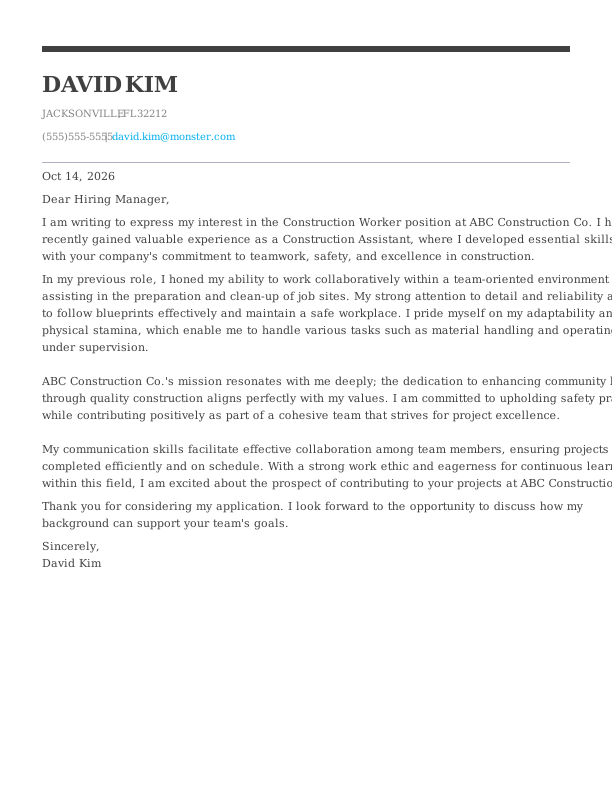
 Free
Construction Worker Entry-Level Cover Letter
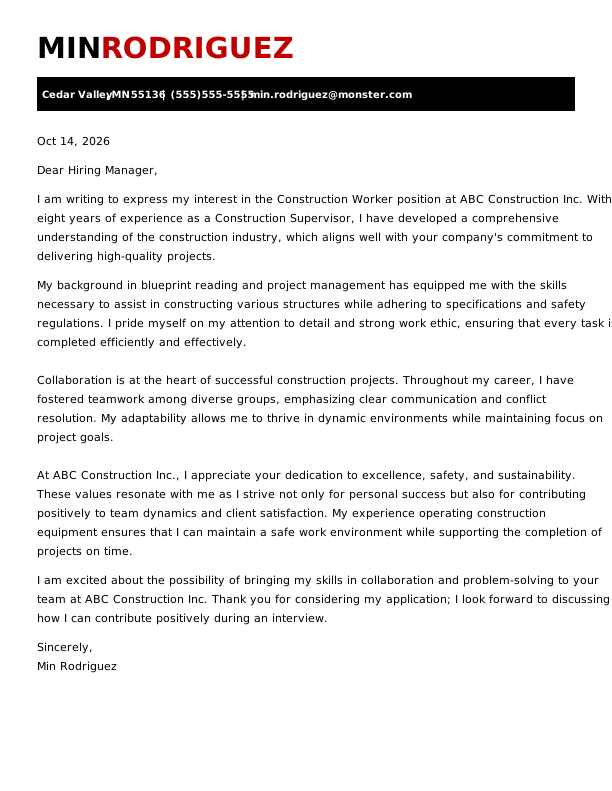
Construction Worker Mid-Level Cover Letter
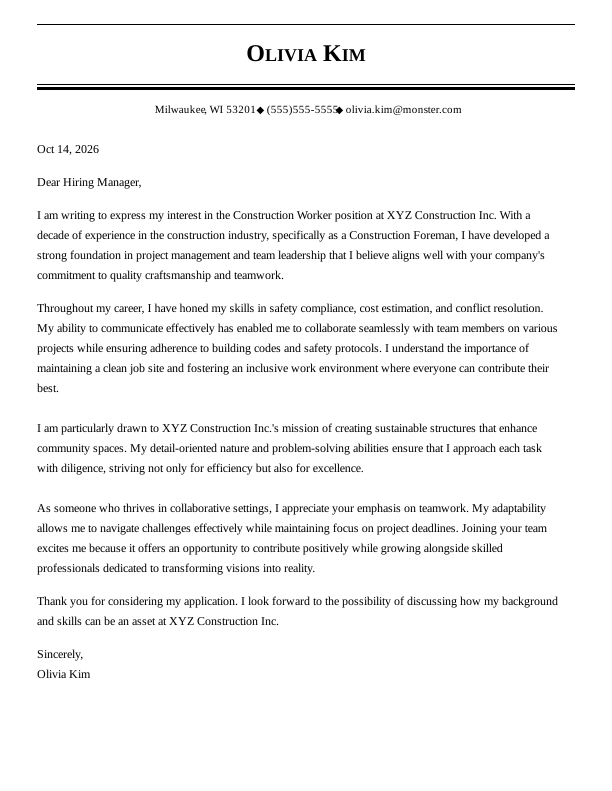
Construction Worker Experienced Cover Letter
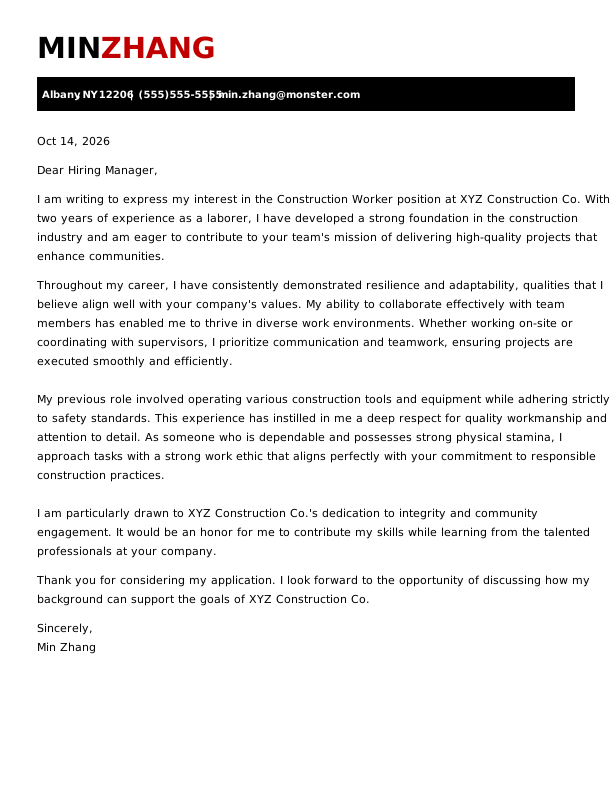
Construction Worker Entry-Level Cover Letter
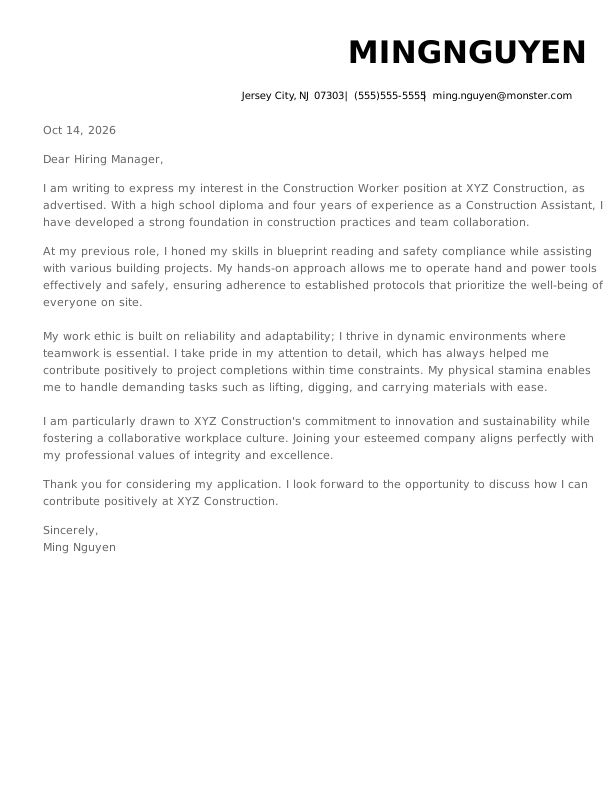
Construction Worker Mid-Level Cover Letter
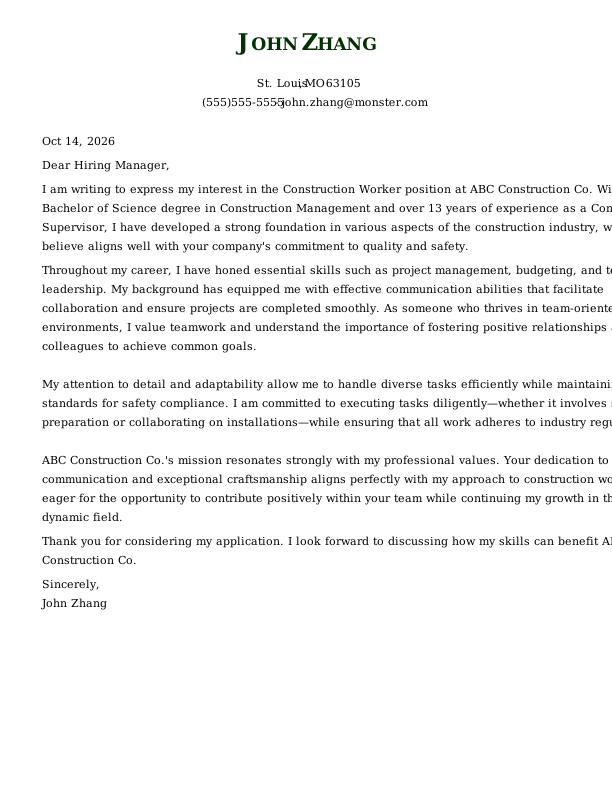
Construction Worker Experienced Cover Letter
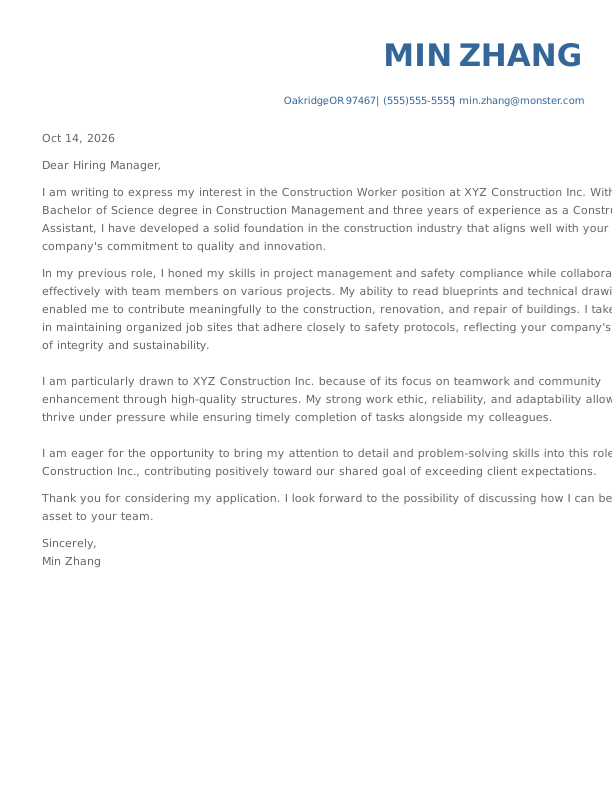
Construction Worker Entry-Level Cover Letter
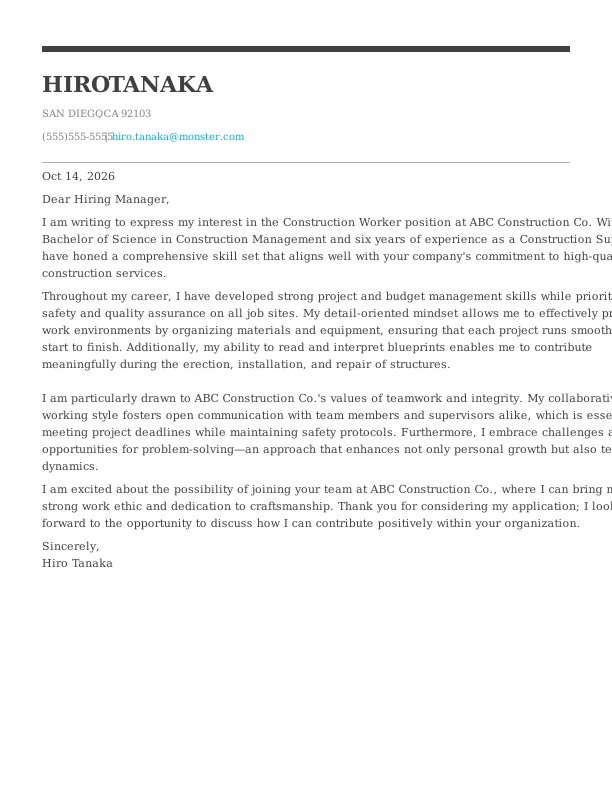
Construction Worker Mid-Level Cover Letter
Browse Free Cover Letter Templates
- Academic
- Account Manager
- Accountant
- Accounts Payable
- Administrative Assistant
- Admissions Counselor
- Architecture
- Artist
- Assistant Principal
- Babysitter
- Barista
- Bartender
- Bookkeeper
- Brand Ambassador
- Business Analyst
- Business
- Caregiver
- Chef
- Civil Engineering
- Computer Science
- Construction
- Consulting
- Copywriter
- Cosmetology
- Custodian
- Customer Service
- Customer Service Representative
- Data Analyst
- Data Entry
- Dental Assistant
- Dental Hygienist
- Digital Marketing
- Electrical Engineering
- Emt
- Engineering
- Esthetician
- Event Coordinator
- Executive Assistant
- Finance
- Financial Analyst
- Firefighter
- Flight Attendant
- Graphic Designer
- Hair Stylist
- Healthcare
- Hr Generalist
- Investment Banking
- It
- Janitor
- Journalism
- Lab Technician
- Law Clerk
- Lawyer
- Librarian
- Logistics
- Makeup Artist
- Manager
- Marketing Coordinator
- Marketing
- Marketing Manager
- Massage Therapist
- Mechanic
- Mechanical Engineer
- Medical Assistant
- Non Profit
- Nursing
- Occupational Therapy
- Office Assistant
- Office Manager
- Operations Manager
- Paralegal
- Personal Trainer
- Pharmacist
- Pharmacy Technician
- Photographer
- Physician Assistant
- Pilot
- Police Officer
- Program Manager
- Project Manager
- Property Manager
- Psychology
- Receptionist
- Research Assistant
- Restaurant Manager
- Retail
- Sales
- Sales Manager
- School Counselor
- Security Officer
- Social Work
- Software Engineer
- Special Education Teacher
- Starbucks
- Substitute Teacher
- Teacher
- Teaching Assistant
- Truck Driver
- Vet Tech
- Veterinary Assistant
Cover Letter Examples for Construction Workers
Cover letter expectations change as you move through your construction career, from learning site basics to guiding crews. Pick the sample that matches your career stage to present your practical background effectively.
Entry-Level Construction Worker Cover Letter
Ideal for candidates entering the construction field, this example shows how to highlight reliable teamwork, adaptability, and readiness to learn on active job sites.
Mid-Career Construction Worker Cover Letter
Designed for workers with several years in the trades, this template focuses on supervisory experience, blueprint reading, and equipment operation.
Experienced Construction Worker Cover Letter
Suited for seasoned professionals, this template highlights decade-long leadership, safety compliance, and overall project management experience.
Construction Worker Cover Letter Template (Text)
Copy this construction worker cover letter text, paste it into your document, and swap in your site experience, safety certifications, and employer name.
Chris Rodriguez
San Francisco, CA 94110
(555)555-5555
chris.rodriguez@monster.com
Oct 14, 2026
Dear Hiring Manager,
I am writing to express my interest in the Construction Worker position at your esteemed organization. As a recent graduate, I am eager to apply my strong work ethic and adaptability within a dynamic team environment. My background has equipped me with essential skills such as communication, leadership, teamwork, problem-solving, and time management—qualities I believe are vital in the construction industry.
My experiences during my studies have honed my attention to detail and allowed me to develop effective collaborative strategies. Whether leading group projects or participating as a team member, I have learned the importance of clear communication and mutual support in achieving common goals. These experiences have instilled in me a commitment to maintaining high standards of quality while ensuring that tasks are completed efficiently.
Even though I may not yet possess formal experience in construction, my eagerness to learn and adapt will allow me to quickly become an integral part of your team. I thrive in hands-on environments where challenges arise daily; this motivates me to approach each task with enthusiasm and diligence.
I am excited about the opportunity to contribute positively while expanding my knowledge within your organization. Thank you for considering my application. I look forward to discussing how I can be an asset on your team.
Sincerely,
Chris Rodriguez
How to Write a Construction Worker Cover Letter
Writing a great cover letter means turning your hands-on work into clear examples of safety, teamwork, and trade skills. Follow these straightforward steps to draft a clear letter that fits the specific job you want.
1. Research & Prepare
Start by reviewing the job description to see what the employer values most on the job site. Take time to research the contractor’s main project types and safety expectations so your letter speaks directly to their needs.
Here are three quick ways to prepare before writing:
- Identify required certifications, site rules, and equipment needs from the job post.
- Review relevant OSHA safety guidelines that apply to your daily work scope.
- Look up recent company projects to understand the work environment and schedule demands.
2. Hook the Reader
Grab the hiring manager’s attention right away with an opening line that shows your practical value. Instead of standard opening phrases, show that you can work safely and help keep projects moving on schedule.
Consider these strong opening approaches for your first paragraph:
- “I bring over three years of hands-on job site experience, keeping our concrete pours running smoothly and on schedule every single day.”
- “With a strong focus on job site safety, I maintain a zero-incident record and actively lead daily toolbox talks to keep crews protected.”
- “My precision with layout elevations and laser levels ensures framing starts the first time accurately, eliminating costly rework.”
3. Tell Your Professional Story
Use your body paragraphs to explain how you handle real jobsite challenges. Specific details and clear numbers help employers picture your real impact on site performance.
Here are examples of achievements you can share:
- Supported 4 to 6 concrete pours per week while maintaining a zero-incident record across 120 work hours.
- Saved $18,000 in rework costs in one quarter by performing thorough layout checks before framing began.
- Cleared punch-list tasks 22% faster by staging materials efficiently and coordinating work with other trades.
4. Showcase Your Skills
Rather than simply listing general traits, give concrete examples of how you put your skills into action. Match your examples directly to what the employer requests in the job posting.
Use these ideas to show your skills in practice:
- Safety compliance: “Secured an open, unsafe stairwell by installing temporary safety guardrails and warning signage, preventing potential site hazards and maintaining strict OSHA compliance.”
- Tool use: “Calibrated laser levels and optical layout tools daily before framing began, ensuring precise structural alignment and eliminating costly rework.”
- Team communication: “Briefed a crew of eight workers on safety protocols and task assignments prior to a major concrete pour, resulting in an efficient, zero-incident placement.”
5. Explain Any Special Circumstances
If you have an employment gap, career change, or relocation, address it briefly and positively. Focus on your active site practice and current certifications to assure employers that your skills are up to date.
Useful ways to frame special circumstances include:
- “After taking time off for family care, I refreshed my site safety training and completed my OSHA-10 certification to ensure I am fully prepared to return to active jobsite work.”
- “Building on my strong foundation in residential carpentry, I am expanding into commercial concrete work where my layout accuracy and tool handling directly apply.”
- “Relocating to the area this month, I am fully available for immediate local project assignments with active regional safety credentials ready to go.”
6. End With a Professional Goodbye
Wrap up your letter with a polite closing paragraph that expresses interest in a conversation. Keep it brief and focused on how you can support their team, followed by a professional sign-off like “Best regards,”.
4 Tips for Formatting Your Cover Letter
Clear visual formatting makes your cover letter easy to scan in a few seconds. A clean, organized presentation highlights your trade background and certifications right away, helping you make a strong impression on busy hiring managers.

Address the Hiring Manager Directly
Try to find the specific hiring manager or site supervisor’s name in the job posting or staff directory. If you cannot find a name, using “Dear Hiring Manager” works well and keeps your opening professional.

Use Bullet Points for Key Achievements
Use three or four bullet points to showcase your top accomplishments, such as safety records, schedule achievements, or quality metrics. Bullet points help readers notice your key results quickly during a fast scan.

Balance Spacing & Margins
Set line spacing between 1.0 and 1.15, and leave clean space between paragraphs so your text feels uncluttered. Standard margins of 0.75 to 1 inch keep your document tidy and easy to read.

Save & Send as a PDF
Save your final cover letter as a PDF to preserve its formatting across different devices. Use a clear filename format like Firstname_Lastname_Cover_Letter.pdf so recruiters can organize your file easily.
Key Takeaways
- Highlight your commitment to jobsite safety with practical examples of hazard prevention.
- Use specific metrics like safety records, project timelines, and inspection results to prove your productivity.
- Tailor your cover letter details to match the focus of residential, commercial, or industrial contractors.
More Cover Letter Examples
Browse Monster’s Resume Templates
Monster also has hundreds of ATS-friendly resume templates for all career levels and industries. Create a matching resume to help you land the interview.
Frequently Asked Questions
Last Update:
Do I really need a cover letter?
While some postings list cover letters as optional, submitting a construction worker cover letter helps you stand out.
A resume lists your work experience and credentials, but a letter gives you space to explain how you apply safety habits, work in teams, and handle daily jobsite tasks. It is also an excellent tool for explaining career shifts or employment gaps directly to hiring managers.
How long should my cover letter be?
Your construction worker cover letter should be brief and fit on a single page, ideally between 250 and 400 words. Hiring managers review applications quickly, so concise writing ensures your key qualifications get noticed.
Focus on three or four short paragraphs that emphasize your site experience, safety record, and core trade skills without adding extra fluff.
Should my cover letter match my resume?
Your construction worker cover letter should visually match your resume by using the same font, layout style, and header information. This creates a neat, unified application package.
The letter content should expand on your background rather than simply repeating bullet points, giving deeper context to your key achievements and site experience.
How do I address my cover letter if I don’t know the hiring manager’s name?
If you do not know the hiring manager’s name for a construction worker position, start by checking the job listing or company website for a site superintendent or manager. If no name is available, use a professional greeting like “Dear Hiring Manager” or “Dear Construction Team” to keep your opening polite and respectful.
How do I write a cover letter for an internal position?
When writing a cover letter for an internal construction worker position, highlight your existing knowledge of company safety procedures and site workflows. Mention recent contributions, such as helping reduce rework or improving task efficiency on current projects.
Express your enthusiasm for taking on new responsibilities within the company while confirming that you are following all standard internal application procedures.

Kirsten Chorpenning is a career advice writer who empowers job seekers to take control of their career paths using Monster’s comprehensive job search and resume tools. She specializes in helping job seekers find rewarding jobs in today’s dynamic work environment.
See More From Kirsten ChorpenningExplore Related Career Advice







How to Write a Cover Letter for Internal Positions or Promotions (Examples & Tips)
Updated:
Apr 23, 2026
|
19 min read


Cover Letter vs Resume: What’s the Difference & Do You Need Both?

Updated:
Apr 23, 2026
|
18 min read