


Free Maintenance Worker Cover Letter Templates & Examples
A strong maintenance worker cover letter shows you can keep facilities running safely through reliable repairs, preventive care, and troubleshooting. Our examples and step-by-step tips help you present your skills clearly so hiring managers see your value right away.
Real-World Cover Letters That Get Results
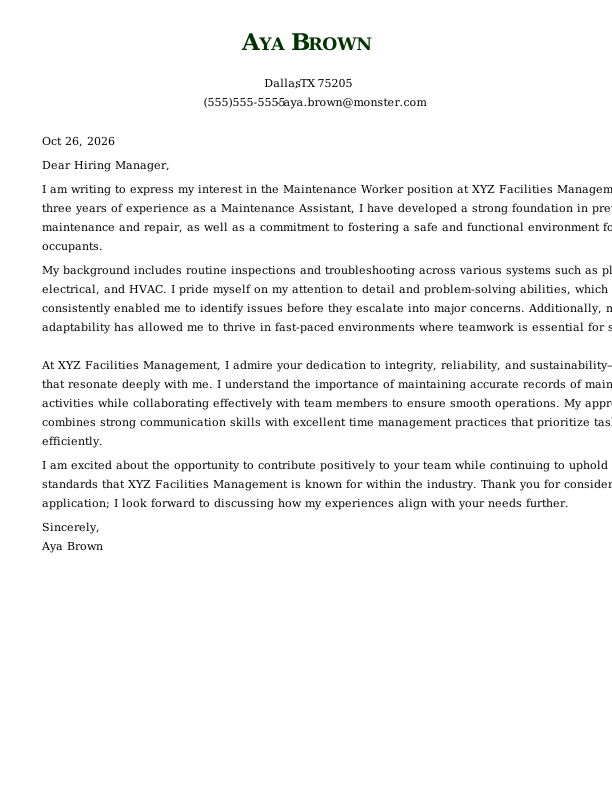
 Free
Maintenance Worker Entry-Level Cover Letter
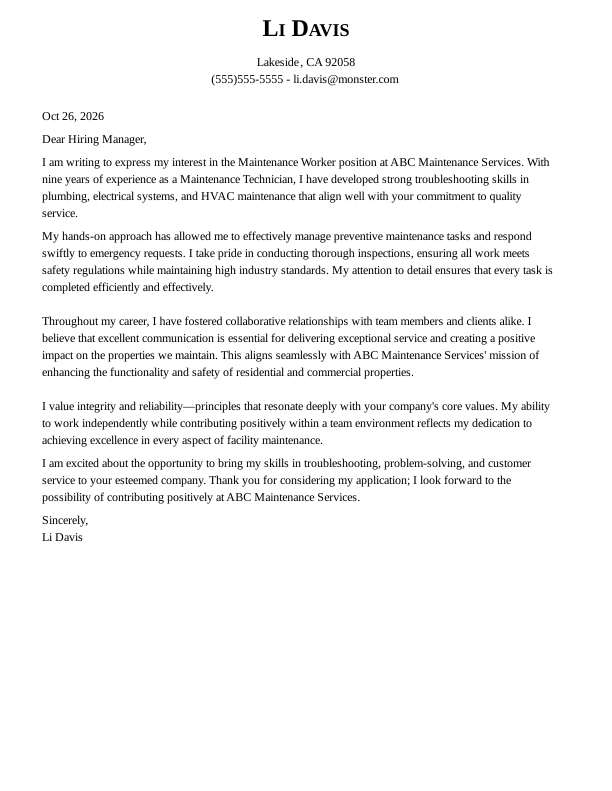
Maintenance Worker Mid-Level Cover Letter
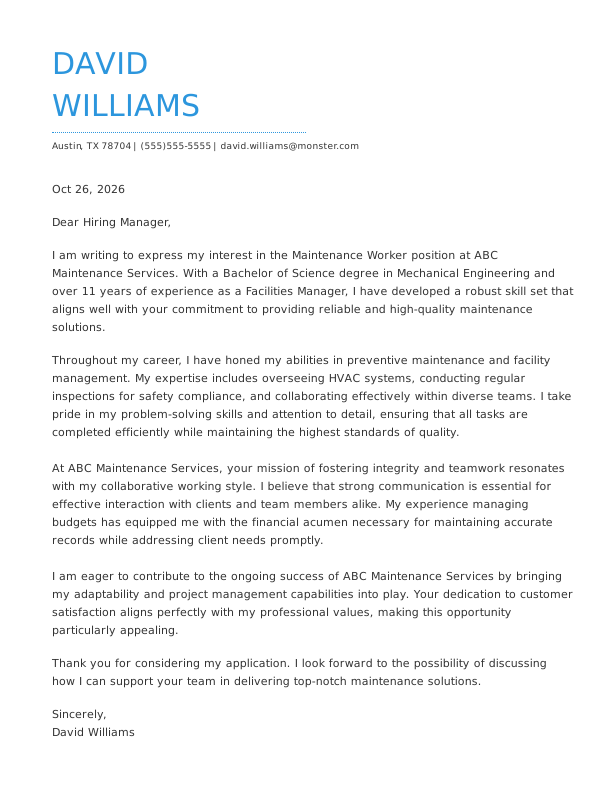
Maintenance Worker Experienced Cover Letter
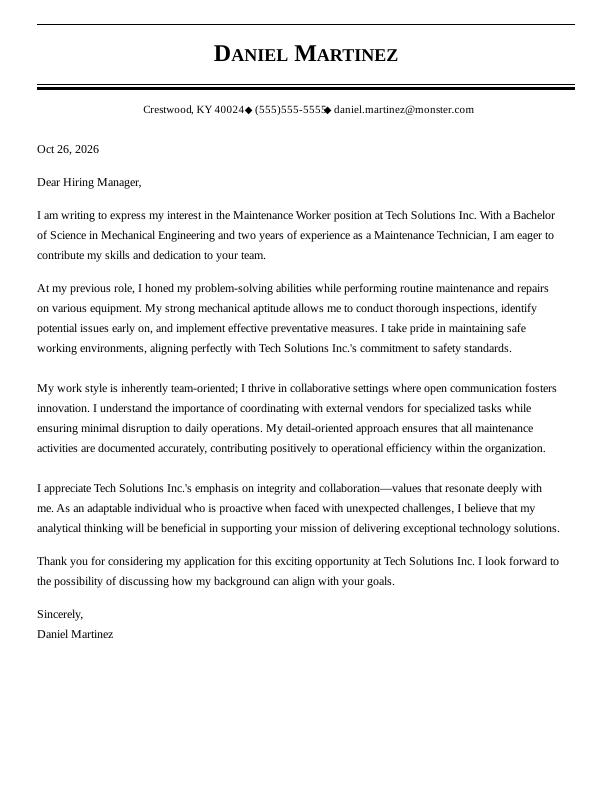
Maintenance Worker Entry-Level Cover Letter
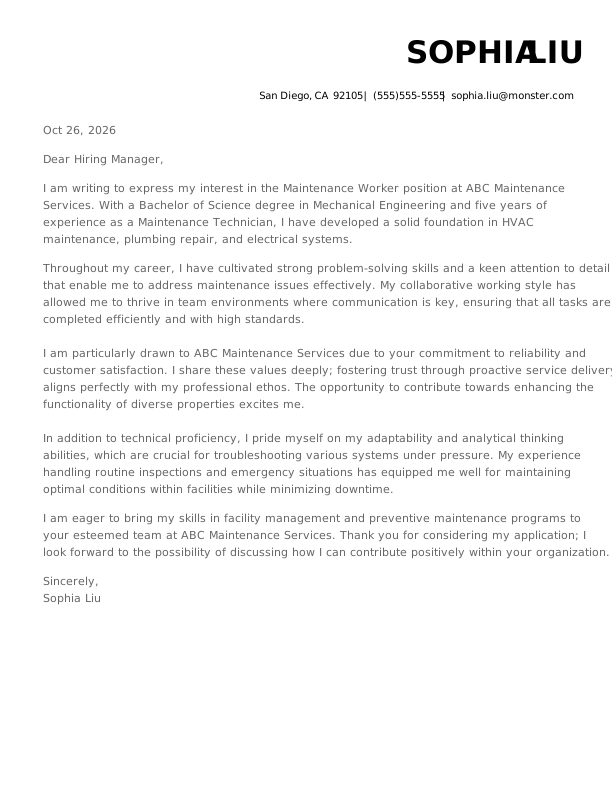
Maintenance Worker Mid-Level Cover Letter
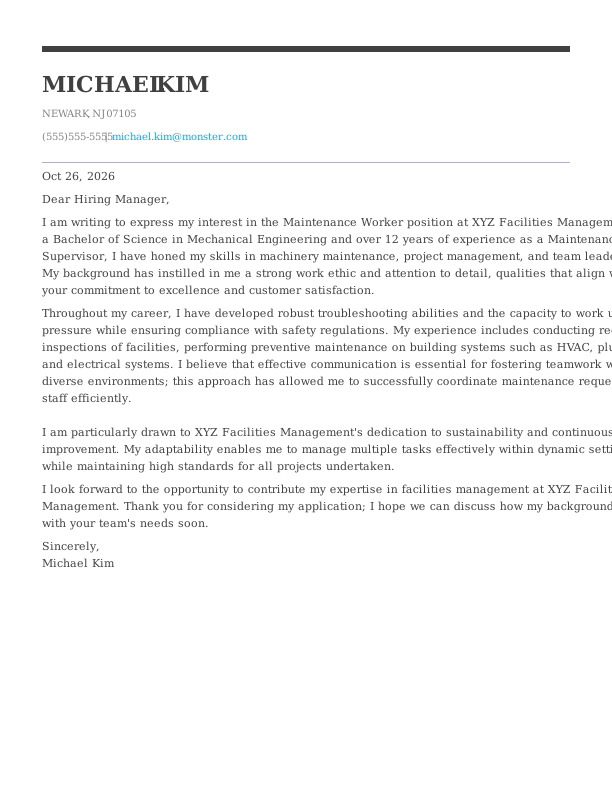
Maintenance Worker Experienced Cover Letter
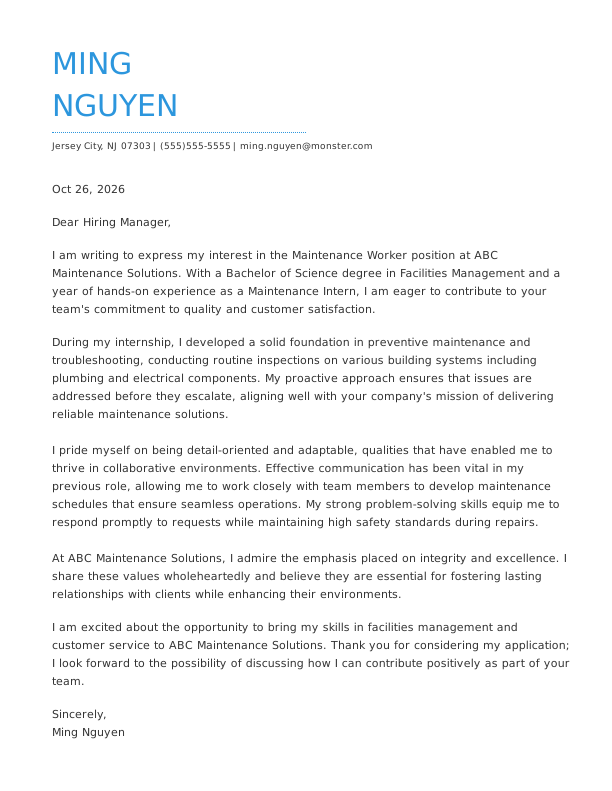
Maintenance Worker Entry-Level Cover Letter
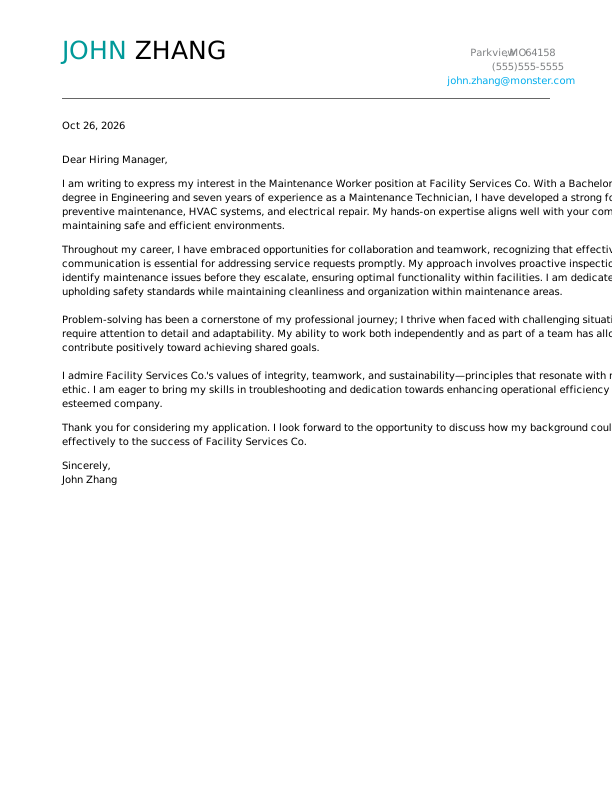
Maintenance Worker Mid-Level Cover Letter
Browse Free Cover Letter Templates
- Academic
- Account Manager
- Accountant
- Accounts Payable
- Administrative Assistant
- Admissions Counselor
- Architecture
- Artist
- Assistant Principal
- Babysitter
- Barista
- Bartender
- Bookkeeper
- Brand Ambassador
- Business Analyst
- Business
- Caregiver
- Chef
- Civil Engineering
- Computer Science
- Construction
- Consulting
- Copywriter
- Cosmetology
- Custodian
- Customer Service
- Customer Service Representative
- Data Analyst
- Data Entry
- Dental Assistant
- Dental Hygienist
- Digital Marketing
- Electrical Engineering
- Emt
- Engineering
- Esthetician
- Event Coordinator
- Executive Assistant
- Finance
- Financial Analyst
- Firefighter
- Flight Attendant
- Graphic Designer
- Hair Stylist
- Healthcare
- Hr Generalist
- Investment Banking
- It
- Janitor
- Journalism
- Lab Technician
- Law Clerk
- Lawyer
- Librarian
- Logistics
- Makeup Artist
- Manager
- Marketing Coordinator
- Marketing
- Marketing Manager
- Massage Therapist
- Mechanic
- Mechanical Engineer
- Medical Assistant
- Non Profit
- Nursing
- Occupational Therapy
- Office Assistant
- Office Manager
- Operations Manager
- Paralegal
- Personal Trainer
- Pharmacist
- Pharmacy Technician
- Photographer
- Physician Assistant
- Pilot
- Police Officer
- Program Manager
- Project Manager
- Property Manager
- Psychology
- Receptionist
- Research Assistant
- Restaurant Manager
- Retail
- Sales
- Sales Manager
- School Counselor
- Security Officer
- Social Work
- Software Engineer
- Special Education Teacher
- Starbucks
- Substitute Teacher
- Teacher
- Teaching Assistant
- Truck Driver
- Vet Tech
Cover Letter Examples for Maintenance Workers
Cover letter requirements evolve as a maintenance worker’s career progresses, especially as responsibilities shift from basic repairs to planning and leading fixes. Choose the template that matches your experience level so you can highlight the right skills, certifications, and results for the roles you’re pursuing.
Entry-Level Maintenance Worker Cover Letter
Ideal for recent graduates or those transitioning into maintenance work, this template focuses on transferable mechanical skills, an eagerness to learn on the job, and readiness to support a busy team.
Mid-Career Maintenance Worker Cover Letter
Mid-career maintenance roles demand a track record of handling complex work orders independently. This template centers on dependable day-to-day execution, routine problem-solving, and managing full facility upkeep with minimal supervision.
Experienced Maintenance Worker Cover Letter
Best suited to maintenance workers with close to a decade of experience, this template fits professionals who manage facilities and HVAC systems, oversee safety inspections, and handle budgeted repairs.
Maintenance Worker Cover Letter Template (Text)
Copy this maintenance worker cover letter template, paste it into your document, and swap in your repair experience, safety certifications, and the property name you’re targeting.
Min Zhang
Brookfield, WI 53012
(555)555-5555
min.zhang@monster.com
Oct 26, 2026
Dear Hiring Manager,
I am writing to express my interest in the maintenance worker position at XYZ Corporation, as advertised. With a Bachelor of Science in Mechanical Engineering and four years of experience as a maintenance technician, I am excited about the opportunity to contribute to your team.
Throughout my career, I have honed my skills in preventive maintenance and troubleshooting, ensuring that facilities operate efficiently and safely. My attention to detail allows me to perform thorough inspections and maintain accurate records of completed work, aligning with your commitment to quality and operational excellence.
Collaboration has been at the heart of my working style; I thrive in environments where teamwork is essential for success. By effectively communicating with colleagues and identifying areas for improvement, I have contributed positively to past projects while fostering a culture of safety among team members.
I believe that adaptability is crucial in maintenance roles. My strong work ethic drives me to tackle challenges proactively while remaining open-minded about learning new systems or processes necessary for achieving optimal functionality within facilities management.
I am particularly drawn to XYZ Corporation’s mission of enhancing operational efficiency through reliable services while upholding integrity and sustainability values. I would be honored to bring my technical skills and dedication to your esteemed company.
Thank you for considering my application. I look forward to the possibility of discussing how I can support XYZ Corporation’s goals further.
Sincerely,
Min Zhang
How to Write a Maintenance Worker Cover Letter
A well-crafted cover letter highlights your ability to troubleshoot problems, complete repairs, and maintain a safe facility. The guide below outlines how to present your trade skills and work history to meet the employer’s exact requirements.
1. Research & Prepare
Before you start writing, take time to learn how the facility runs its daily operations and what standards it prioritizes. Look into whether the team focuses heavily on emergency turnaround times, tenant satisfaction, or rigid regulatory compliance. Identifying the specific work order platform or equipment types the facility relies on allows you to tailor your letter directly to its operational needs.
To gather practical details before you draft your letter, consider these useful steps:
- Review the job listing for mentions of specific computerized maintenance management systems (CMMS) or work order apps.
- Check OSHA safety guidelines or local building codes relevant to the facility type to speak comfortably about safety requirements.
- Visit the company website to see if it manages commercial properties, residential apartments, or industrial plants, as each environment has different upkeep priorities.
2. Hook the Reader
Your opening line should grab the reader’s attention right away instead of repeating standard phrases like “I am writing to apply.” Lead with a concrete summary of your core strengths, your primary technical skills, or the specific equipment you already know how to service.
Use these examples to build an opening line tailored to your background:
- Response time mindset: “In my last role, I logged 95% of daily work orders within 24 hours using CMMS tickets and kept equipment downtime under 2 hours per repair.”
- Hydraulics and pumps focus: “I troubleshoot commercial air-handling units by checking VFD settings, pump seal wear, and bearing temperatures before closing out work tickets.”
- Preventive program credibility: “In my previous role, I reduced recurring plumbing leaks by 25% by establishing a structured preventive maintenance inspection routine.”
3. Tell Your Professional Story
Your resume lists your past employers and job titles, but your cover letter gives you space to explain the real-world results of your work. Use specific metrics whenever possible to show how your repairs saved time, lowered operating costs, or prevented equipment breakdowns.
Here are examples of how to frame your daily accomplishments with clear numbers:
- Completed an average of 45 work orders each month while lowering emergency callouts by 20% through proactive part replacements.
- Reduced average repair turnaround time from 5.5 hours to 2.5 hours by reorganizing the parts supply room and standardizing routine tool kits.
- Prevented costly secondary damage and saved approximately $8,000 in outside contractor fees by personally identifying and fixing major valve leaks.
4. Showcase Your Skills
Rather than offering a generic list of personality traits like “punctual” or “hardworking,” describe actual situations where your skills solved a problem. Connect your technical abilities directly to workplace safety and reliable building operations.
Use these examples to highlight practical skills in action:
- Preventive maintenance: “I regularly follow strict lockout-tagout procedures to inspect drive belts, grease motor bearings, and test safety shutoffs before returning machinery to service.”
- Repairs and troubleshooting: “When an air handler stopped blowing cold air, I traced the issue to a failed contactor, replaced the faulty part, and verified normal electrical draw using a multimeter.”
- Customer communication: “I make a point to give residents clear, polite updates during water shutoffs or heating disruptions so they always know when service will return.”
5. Explain Any Special Circumstances
If you have a gap in your employment, are changing careers, or are relocating to a new area, explain it directly in one or two simple sentences. Keeping your tone positive and focusing on your current hands-on abilities reassures the employer that your trade skills are sharp and ready to use.
Frame your situation using these straightforward examples:
- Career break: “During an eight-month career break, I kept my technical skills sharp by completing volunteer home repairs and rebuilding small engines in my home workshop.”
- Career transition: “I am transitioning from warehouse material handling into commercial building maintenance, pairing my established forklift safety and inventory coordination skills with recent vocational coursework in basic electrical and plumbing repair.”
- Relocation: “I have relocated to the area and am available to start immediately, with full availability for standard day shifts as well as rotational on-call emergency coverage.”
6. End With a Professional Goodbye
Wrap up your letter with a brief, confident closing that invites the hiring manager to start a conversation. State clearly what you would like to discuss in an interview, thank the reader for their time, and sign off professionally.
To close smoothly, you can write something like: “I would welcome the opportunity to discuss how my preventive maintenance background and troubleshooting skills can support your team. Thank you for your time and consideration.” Follow that with a clean sign-off, such as “Sincerely” or “Best regards,” followed by your full name.
4 Tips for Formatting Your Cover Letter
Hiring managers and facilities supervisors often review dozens of applications between urgent maintenance tasks, meaning they may scan your letter in under a minute. A clean, well-organized page makes your qualifications immediately obvious and shows that you take pride in clear communication, attention to detail, and methodical work.

Use a Professional Font & Layout
Stick to clean, traditional fonts like Arial, Calibri, Georgia, or Times New Roman set at 10 to 12 points. Avoid decorative fonts that distract the eye or make technical terms hard to read. Use consistent 1-inch margins around the page to ensure your text has breathing room and looks balanced.

Match Your Header to Your Resume
Use the exact same contact header styling on both your cover letter and your resume. Matching your name, phone number, email address, and formatting creates a unified application package, making it effortless for a busy supervisor to verify your contact information and review your materials.

Balance Spacing & Margins
Keep your line spacing between 1.0 and 1.15, and always leave a blank line between paragraphs to break up large blocks of text. Keeping your margins between 0.75 and 1 inch ensures your letter looks organized on mobile screens, desktop monitors, and printed pages.

Save & Send as a PDF
Export your completed document as a standard PDF file so your layout, fonts, and spacing remain intact across all devices and operating systems. Save the file with a clear, professional name, such as Firstname_Lastname_Cover_Letter.pdf, optionally adding MAINT_Cert.
Top-Paying States for Maintenance Worker Roles
Knowing what maintenance workers earn helps you compare offers and plan your next move. Salary ranges vary, but the U.S. Bureau of Labor Statistics (BLS) provides a solid starting point using nationwide wage data for maintenance and repair roles.
Your actual pay can shift based on location, years of experience, and whether you work in facilities like manufacturing plants, hospitals, or commercial properties. Union membership, on-call schedules, and specialized skills such as HVAC or electrical troubleshooting can also affect outcomes.
| Alabama | $58,150 |
| Alaska | $74,400 |
| Arizona | $64,400 |
| Arkansas | $53,180 |
| California | $68,420 |
| Connecticut | $68,180 |
| Delaware | $59,500 |
| District of Columbia | $58,350 |
| Florida | $60,690 |
| Georgia | $59,420 |
| Hawaii | $76,340 |
| Idaho | $59,660 |
| Illinois | $64,490 |
| Indiana | $59,670 |
| Iowa | $64,070 |
| Kansas | $58,440 |
| Kentucky | $60,700 |
| Louisiana | $61,600 |
| Maine | $55,470 |
| Maryland | $58,580 |
| Massachusetts | $72,780 |
| Michigan | $58,950 |
| Minnesota | $66,530 |
| Mississippi | $58,290 |
| Missouri | $63,180 |
| Montana | $58,280 |
| Nebraska | $57,270 |
| Nevada | $62,800 |
| New Hampshire | $68,060 |
| New Jersey | $57,350 |
| New Mexico | $46,540 |
| New York | $68,760 |
| North Carolina | $63,460 |
| North Dakota | $62,640 |
| Ohio | $66,240 |
| Oklahoma | $64,590 |
| Oregon | $62,100 |
| Pennsylvania | $64,370 |
| Rhode Island | $59,660 |
| South Carolina | $62,550 |
| South Dakota | $48,380 |
| Tennessee | $63,400 |
| Texas | $59,030 |
| Utah | $63,290 |
| Vermont | $55,950 |
| Virginia | $65,890 |
| Washington | $70,210 |
| West Virginia | $59,000 |
| Wisconsin | $60,630 |
| Wyoming | $87,300 |
| Guam | $45,610 |
| Puerto Rico | $50,540 |
Key Takeaways
- Prove your safety habits and mechanical ability by describing a specific time you properly inspected, isolated, and repaired faulty equipment.
- Support your daily work history with clear numbers like faster response times, reduced downtime, or lower contractor costs.
- Tailor your letter to the exact property type, whether that means highlighting fast apartment turns or strict industrial preventive maintenance schedules.
More Cover Letter Examples
Browse Monster’s Resume Templates
Monster also has hundreds of ATS-friendly resume templates for all career levels and industries. Create a matching resume to help you land the interview.
Frequently Asked Questions
Last Update:
Do I really need a cover letter?
You should include a cover letter for a maintenance worker role even when an employer lists it as optional. A resume highlights where you worked, but a cover letter lets you explain your practical troubleshooting approach and daily work ethic. Sending a tailored letter shows genuine initiative and gives you an opportunity to explain how you keep facilities running safely, respond to urgent work orders, and communicate clearly with occupants.
How long should my cover letter be?
Your maintenance worker cover letter should be three or four short paragraphs that comfortably fit on a single page, totaling roughly 250 to 400 words. Facilities supervisors and property managers have busy schedules, so keeping your letter focused helps them spot your strengths quickly. Use this concise space to highlight your most relevant repair experience, technical certifications, and routine safety practices without repeating every detail from your resume.
Should my cover letter match my resume?
Yes, your cover letter should match your resume’s visual layout, using the same font, text sizes, and contact header design. Presenting a clean, matching set of documents demonstrates strong organization and pride in your work. Rather than simply repeating the bullet points from your work history, use the letter to expand on a key repair project, share equipment specialties, or highlight your safety record.
How do I address my cover letter if I don’t know the hiring manager’s name?
When you do not know the hiring manager’s name, take a few minutes to check the job posting, the employer’s website, or LinkedIn for the maintenance supervisor or facilities director. If you still cannot locate an individual, use a polite, contemporary greeting like “Dear Hiring Manager” or “Dear Facilities Team.” Avoid outdated phrases such as “To Whom It May Concern,” which can make your application feel generic.
How do I write a cover letter for an internal position?
When writing for an internal maintenance position, reference your existing knowledge of the property’s layout, equipment history, and safety protocols. Mention specific improvements you have contributed to on-site, such as shortening work order turnaround times or improving parts inventory storage. Conclude by explaining how stepping into this new internal role allows you to take on additional equipment responsibilities, support coworker safety, and help the department meet its operational goals.

Toni Frana is a Certified Professional Resume Writer (CPRW), member of the Professional Association of Resume Writers & Career Coaches, and career expert who empowers job seekers to take control of their career paths using Monster’s comprehensive job search and resume tools.
See More From Toni FranaExplore Related Career Advice







How to Write a Cover Letter for Internal Positions or Promotions (Examples & Tips)

Updated:
Apr 23, 2026
|
19 min read


Cover Letter vs Resume: What’s the Difference & Do You Need Both?

Updated:
Apr 23, 2026
|
18 min read