

Free Nursing Student Cover Letter Templates & Examples
A strong nursing student cover letter shows you can deliver safe, compassionate care during clinical rotations. Our examples and guide help you highlight your clinical skills and teamwork, making it easy for hiring managers to see your value to their healthcare facility.
Real-World Cover Letters That Get Results
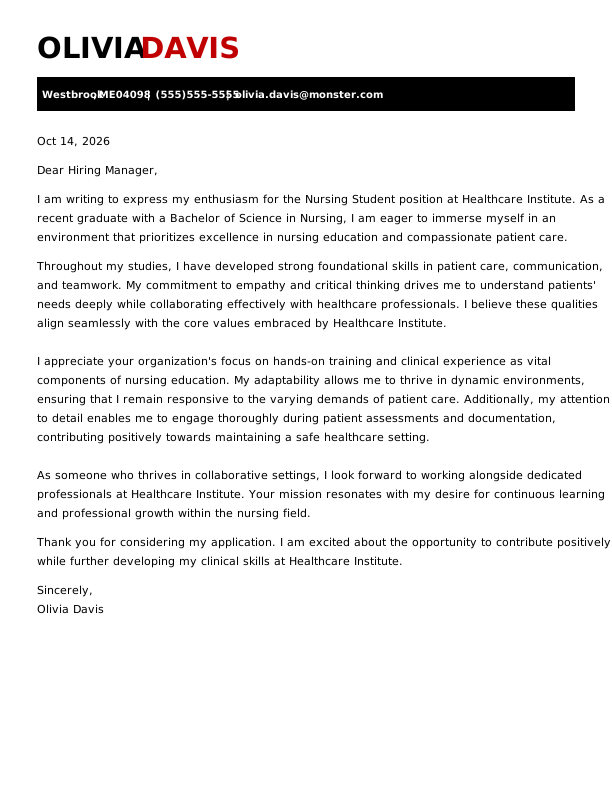
 Free
Nursing Student Entry-Level Cover Letter
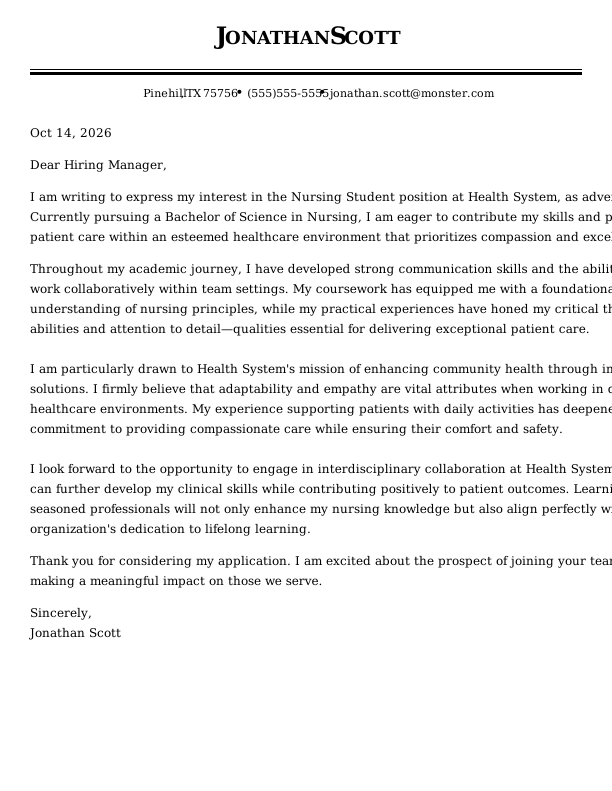
Nursing Student Mid-Level Cover Letter
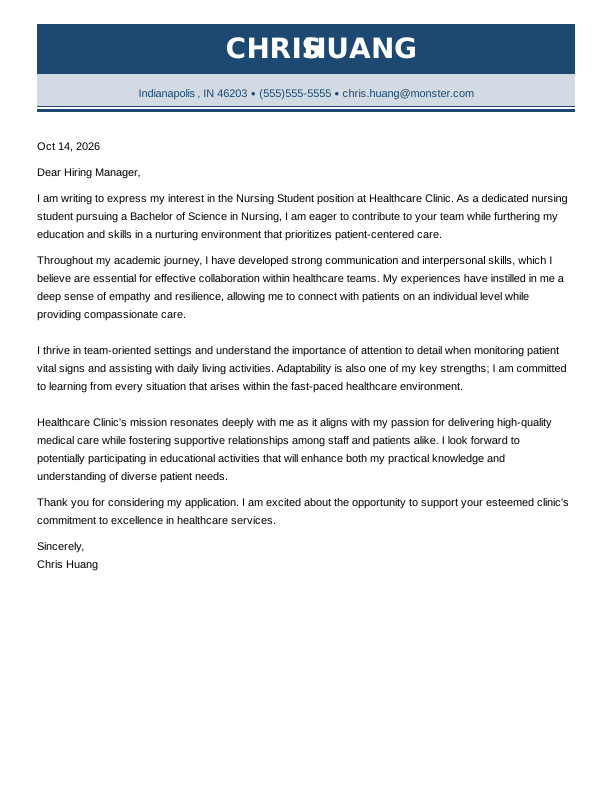
Nursing Student Experienced Cover Letter
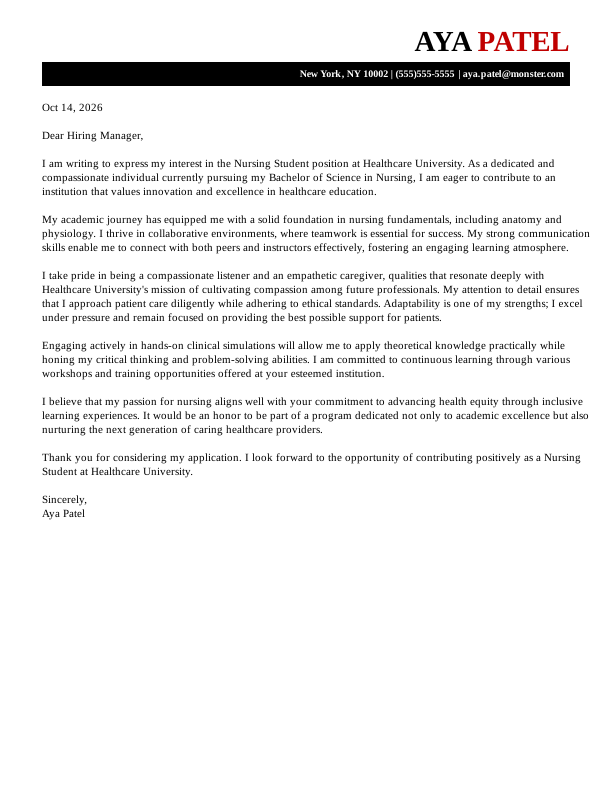
Nursing Student Entry-Level Cover Letter
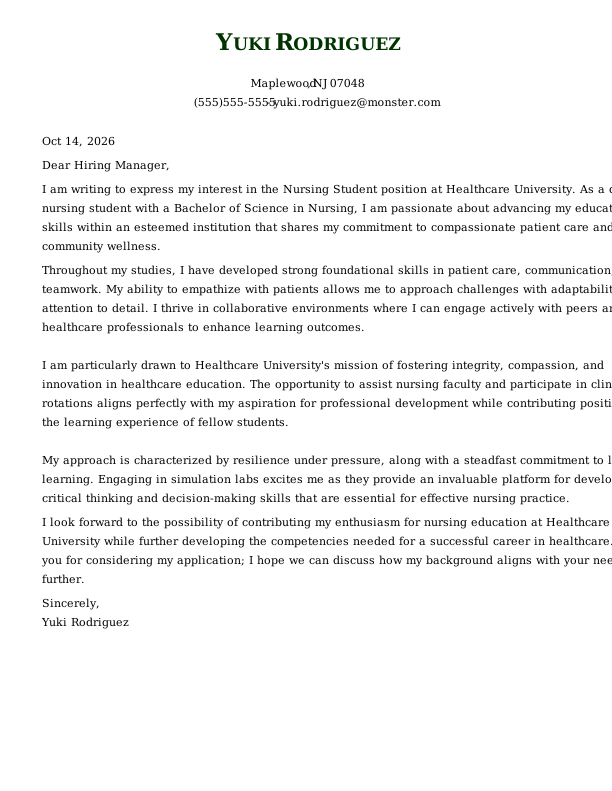
Nursing Student Mid-Level Cover Letter
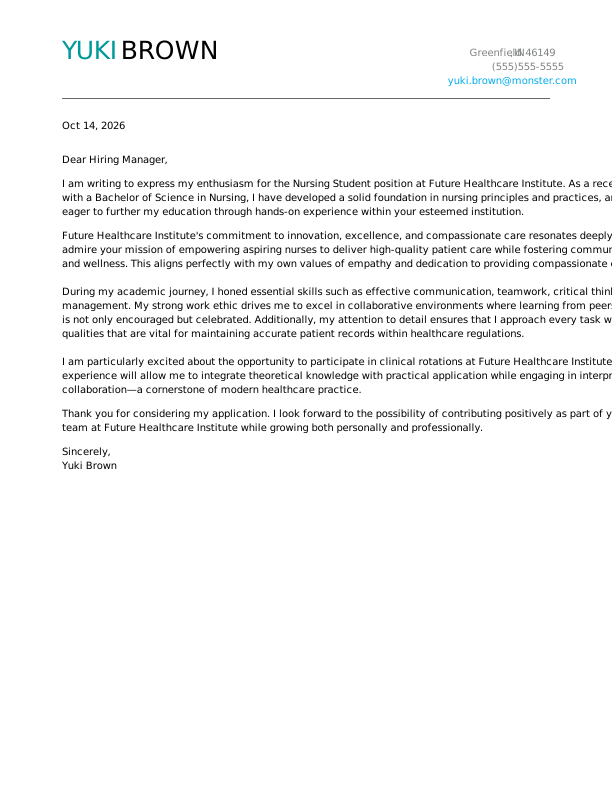
Nursing Student Experienced Cover Letter
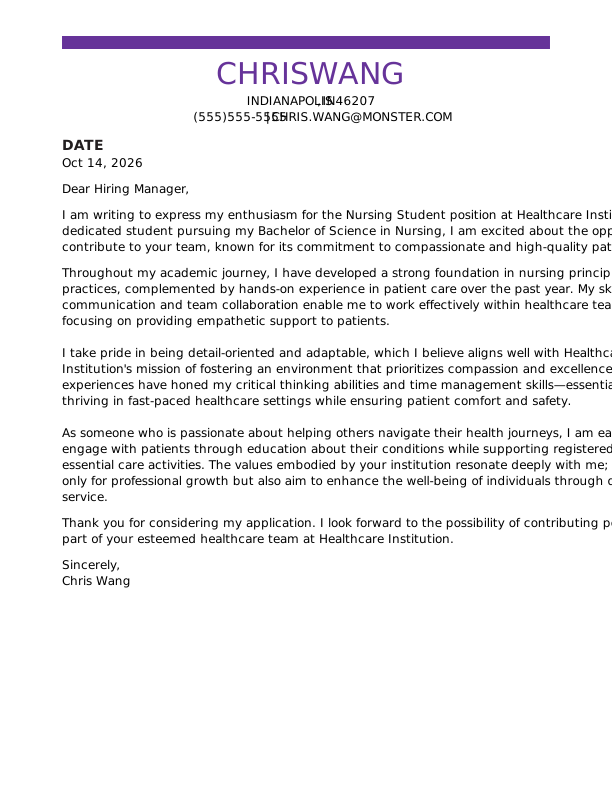
Nursing Student Entry-Level Cover Letter
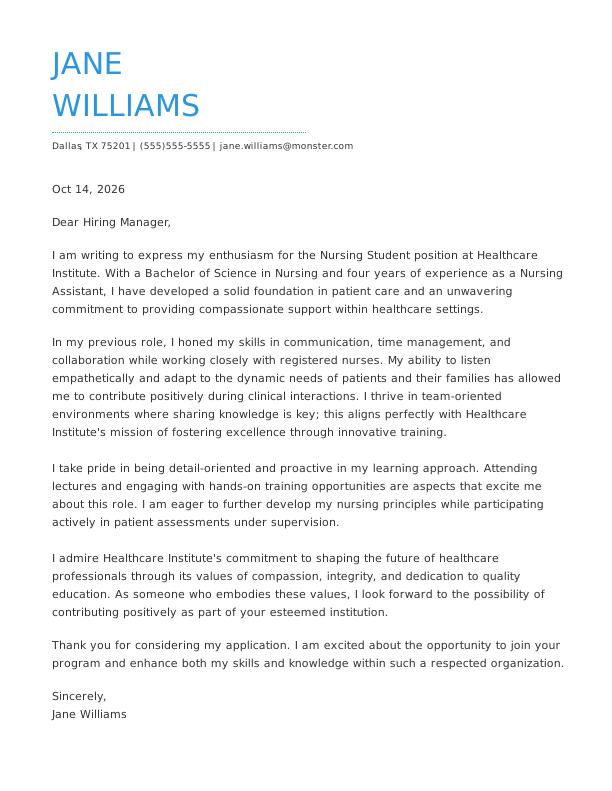
Nursing Student Mid-Level Cover Letter
Browse Free Cover Letter Templates
- Academic
- Account Manager
- Accountant
- Accounts Payable
- Administrative Assistant
- Admissions Counselor
- Architecture
- Artist
- Assistant Principal
- Babysitter
- Barista
- Bartender
- Bookkeeper
- Brand Ambassador
- Business Analyst
- Business
- Caregiver
- Chef
- Civil Engineering
- Computer Science
- Construction
- Consulting
- Copywriter
- Cosmetology
- Custodian
- Customer Service
- Customer Service Representative
- Data Analyst
- Data Entry
- Dental Assistant
- Dental Hygienist
- Digital Marketing
- Electrical Engineering
- Emt
- Engineering
- Esthetician
- Event Coordinator
- Executive Assistant
- Finance
- Financial Analyst
- Firefighter
- Flight Attendant
- Graphic Designer
- Hair Stylist
- Healthcare
- Hr Generalist
- Investment Banking
- It
- Janitor
- Journalism
- Lab Technician
- Law Clerk
- Lawyer
- Librarian
- Logistics
- Makeup Artist
- Manager
- Marketing Coordinator
- Marketing
- Marketing Manager
- Massage Therapist
- Mechanic
- Mechanical Engineer
- Medical Assistant
- Non Profit
- Nursing
- Occupational Therapy
- Office Assistant
- Office Manager
- Operations Manager
- Paralegal
- Personal Trainer
- Pharmacist
- Pharmacy Technician
- Photographer
- Physician Assistant
- Pilot
- Police Officer
- Program Manager
- Project Manager
- Property Manager
- Psychology
- Receptionist
- Research Assistant
- Restaurant Manager
- Retail
- Sales
- Sales Manager
- School Counselor
- Security Officer
- Social Work
- Software Engineer
- Special Education Teacher
- Substitute Teacher
- Teacher
- Teaching Assistant
- Truck Driver
- Vet Tech
- Veterinary Assistant
- Web Developer
Cover Letter Examples for Nursing Students
Cover letter expectations change as a nursing student progresses toward graduation and licensure. Choose the template that matches your career stage to spotlight clinical rotations, relevant coursework, and any patient care or leadership experience you have built so far.
Entry-Level Nursing Student Cover Letter
Ideal for students beginning their clinical rotations or recent graduates entering the healthcare field, this sample demonstrates how to highlight your foundational nursing education and clinical enthusiasm.
Mid-Career Nursing Student Cover Letter
Designed for nursing students progressing through advanced rotations, this sample shows how to emphasize growing clinical autonomy and hands-on patient care experience.
Experienced Nursing Student Cover Letter
Perfect for advanced nursing students or those with extensive prior healthcare background, this sample illustrates how to showcase clinical leadership, complex patient support, and team coordination.
Nursing Student Cover Letter Template (Text)
Paste this nursing student cover letter template into your document, then copy and adapt it by swapping in your clinical rotations, skills, and the hospital name you want.
Daniel Garcia
Maplewood, NJ 07046
(555)555-5555
daniel.garcia@monster.com
Oct 14, 2026
Dear Hiring Manager,
I am writing to express my enthusiastic application for the nursing student position at your esteemed Nursing School. As a recent graduate with a Bachelor of Science in Nursing, I am eager to further my education and develop the skills necessary to excel in healthcare.
My academic journey has equipped me with a solid foundation in patient care principles, while my experiences have fostered a deep commitment to compassionate service. I am particularly drawn to your institution’s mission of nurturing future healthcare professionals through rigorous training and an emphasis on lifelong learning. I resonate strongly with your values of compassion, integrity, and excellence.
Throughout my studies, I honed essential skills such as effective communication and teamwork—qualities that are vital in collaborative environments like yours. My empathy allows me to connect with others genuinely, fostering positive relationships that enhance any team dynamic. Additionally, my adaptability ensures that I can thrive even in high-pressure situations typical within clinical settings.
I am excited about the opportunity to engage actively in lectures and hands-on training while contributing positively during community health initiatives at your institution. The prospect of not only gaining knowledge but also participating meaningfully in practical exercises aligns perfectly with my aspirations as an emerging nursing professional.
Thank you for considering my application. I look forward to the possibility of contributing to your renowned program and embarking on this important journey toward becoming a skilled nurse under your guidance.
Sincerely,
Daniel Garcia
How to Write a Nursing Student Cover Letter
Grounding your story in your clinical notes, skills checklists, and the target job description is key to writing an effective cover letter. Follow these steps to tailor your draft for a specific role and clearly demonstrate your fit to hiring managers.
1. Research & Prepare
Before drafting your letter, take time to understand what the facility expects from a nursing student on the unit. Investigating their care model and focus areas allows you to align your background directly with their needs. To prepare effectively, consider these steps:
- Read the job posting carefully to identify specific electronic health record (EHR) systems, unit protocols, or required clinical certifications.
- Explore the facility’s website to review recent patient safety initiatives, quality goals, or community health programs.
- Check your state nursing board’s official guidelines to ensure your clinical hours and documentation standards meet local requirements.
2. Hook the Reader
Grab the hiring manager’s attention immediately by highlighting how your clinical background prepares you to support their team. Rather than using generic opening phrases, open with a sentence that highlights patient safety, clinical skills, and your enthusiasm for the unit. The following examples show how to structure an engaging lead sentence:
- Safety Focus: On my med-surg rotation, I consistently verified high-risk medications using the MAR scan workflow, and I am ready to support your unit’s fall-prevention rounds.
- Facility Focus: Your hospital’s emphasis on patient-centered diabetes education is why I am applying, having recently documented A1c trends and patient barriers during 30 hours of community clinic rotations.
- Clinical Skills: I regularly use SBAR communication during shift handoffs, which I refined during my ICU shadowing to maintain high care standards during complex patient checks.
3. Tell Your Professional Story
While your resume outlines your clinical placements, your cover letter provides context on how you actually care for patients. Incorporating specific numbers and metrics helps hiring managers picture your daily workload and efficiency. Review these examples of detailed impact statements:
- Documented vital signs every 4 hours for 10 to 12 assigned patients per shift while maintaining a 100% charting completion rate.
- Reduced unit call-light response time from about 8 minutes to under 5 minutes by prioritizing urgent patient requests and communicating promptly with charge nurses.
- Supported care delivery for approximately 20 patients per month across med-surg rotations while participating in weekly wound-assessment rounds.
4. Showcase Your Skills
Replace broad claims about your work ethic with concrete examples of moments when you delivered safe, effective care. Demonstrating your clinical judgment in real scenarios builds trust with preceptors and nurse managers. Use these examples to guide how you describe your core competencies:
- Medication Safety: I cross-referenced the patient’s wristband with the MAR before administering medication, pausing to double-check whenever a dose appeared unexpected.
- Clinical Documentation: I charted vital signs and patient assessments immediately after care delivery, ensuring incoming nurses had up-to-date information for shift handoffs.
- Patient Communication: I used open-ended questions to assess patient concerns and explained upcoming procedures clearly so patients felt comfortable and informed.
5. Explain Any Special Circumstances
If you have a gap in your studies, a career pivot, or a recent relocation, explain it briefly in one or two clear sentences. Frame your experience around active learning, current certifications, and clinical readiness. The following examples demonstrate how to address unique situations smoothly:
- After taking a brief academic pause for family commitments, I maintained my clinical readiness by completing skills checkoffs and returning to rotations in the hospital simulation lab.
- I am transitioning from a certified nursing assistant role into registered nursing, applying my hands-on patient care background directly to my med-surg rotations.
- Following a mid-year relocation, I transferred my nurse aide registry credentials and seamlessly resumed my required clinical hours under the local program schedule.
6. End With a Professional Goodbye
Close your letter with a clear, polite statement expressing your interest in an interview, followed by a professional sign-off. Avoid passive closing lines, opting instead for a proactive finish that reinforces your enthusiasm.
The following approach offers a clean, professional template for your closing:
For example: “I welcome the opportunity to discuss how my clinical rotations in med-surg have prepared me to contribute to your unit. Thank you for your time and consideration. Best regards, [Your Name].”
4 Tips for Formatting Your Cover Letter
Presenting a clean, well-organized document is essential when applying for nursing roles. Recruiters and nurse managers often review applications during brief breaks between shifts, so clear formatting ensures your key credentials, clinical hours, and skills stand out immediately. A scannable layout reflects the professional attention to detail required in patient care.

Keep It to One Page
Keep your cover letter to a single page, ideally between 250 and 400 words across three or four short paragraphs. Nurse managers review applications quickly, so concise formatting helps your clinical rotations, CPR certification, and patient care achievements stand out immediately without clutter.

Use a Professional Font & Layout
Select standard fonts like Arial, Calibri, or Georgia at a 10-to-12-point font size with standard 1-inch margins. A clean visual layout makes your document easy to read on mobile devices and desktop computers, showing hiring managers that you value clear, organized communication.

Match Your Header to Your Resume
Format your cover letter header using the same font, color scheme, and contact layout as your resume. Maintaining a uniform design across both documents creates a cohesive, polished application that emphasizes your professionalism.

Use Bullet Points for Key Achievements
Incorporate three to four bullet points in the middle section of your letter to highlight specific clinical metrics, such as documentation accuracy, patient satisfaction, or skills checkoff completion. Bulleted lists break up text, allowing reviewers to scan your top achievements in seconds.
Key Takeaways
- Focus on clear clinical communication by highlighting a specific instance where you clarified an order or reported a change in a patient’s status.
- Include measurable clinical achievements, such as medication accuracy rates, skills checkoff completions, or prompt documentation metrics.
- Adapt your tone to the setting, emphasizing fast-paced teamwork for hospital units, routine safety for long-term care, or education for outpatient clinics.
More Cover Letter Examples
Browse Monster’s Resume Templates
Monster also has hundreds of ATS-friendly resume templates for all career levels and industries. Create a matching resume to help you land the interview.
- Aesthetic Nurse
- Certified Nursing Assistant
- Dialysis Nurse
- Director Of Nursing
- Entry-Level Nurse
- Er Nurse
- Family Nurse Practitioner
- Home Health Nurse
- Hospice Nurse
- Icu Nurse
- Labor And Delivery Nurse
- Licensed Practical Nurse
- Lvn
- Mds Coordinator
- Med-Surg Nurse
- New Grad Nurse
- Nurse Case Manager
- Nurse Educator
- Nurse Manager
- Nurse Practitioner
- Nursing Home
- Nursing Instructor
- Nursing
- Nursing Student
- Oncology Nurse
- Operating Room Nurse
- Pacu Nurse
- Pediatric Nurse
- Psychiatric Nurse Practitioner
- Psychiatric Nurse
- Registered Nurse
- Travel Nursing
- Travel Rn
- Utilization Review Nurse
Frequently Asked Questions
Last Update:
Do I really need a cover letter?
Yes. Including a cover letter as a nursing student is strongly recommended, even when the job posting lists it as optional. While your resume lists your coursework and clinical placements, a cover letter provides space to explain your passion for patient care and your clinical strengths. Submitting one shows strong initiative and helps your application stand out to hiring managers.
How long should my cover letter be?
A nursing student cover letter should remain one page long, ideally ranging between 250 and 400 words. Nurse managers often review applications quickly between patient care duties, so a concise letter ensures your core qualifications stand out. Focus on writing three or four short, structured paragraphs that highlight your relevant clinical rotations, skills, and certifications clearly.
Should my cover letter match my resume?
Yes, your nursing student cover letter should match your resume’s visual formatting to create a cohesive application set. Using the same font style, text sizing, and header design across both documents presents a clean, professional image. Ensure the text expands on your clinical achievements rather than simply repeating the bullet points from your resume.
How do I address my cover letter if I don’t know the hiring manager’s name?
When addressing a nursing student cover letter without a named contact, try researching the facility’s site or calling the unit to request the hiring manager’s name. If you cannot find a specific individual, use professional greetings like “Dear Hiring Manager” or “Dear Nursing Recruitment Team.” Avoid outdated phrases such as “To Whom It May Concern.”
Should I mention salary expectations in my cover letter?
You should only mention salary expectations in your cover letter if the position explicitly requires candidates to include them. If requested, provide a broad, well-researched pay range based on local nursing student pay rates. State that you are flexible and eager to discuss the complete compensation package, including shift differentials or tuition assistance options.

Kirsten Chorpenning is a career advice writer who empowers job seekers to take control of their career paths using Monster’s comprehensive job search and resume tools. She specializes in helping job seekers find rewarding jobs in today’s dynamic work environment.
See More From Kirsten ChorpenningExplore Related Career Advice







How to Write a Cover Letter for Internal Positions or Promotions (Examples & Tips)
Updated:
Apr 23, 2026
|
19 min read


Cover Letter vs Resume: What’s the Difference & Do You Need Both?

Updated:
Apr 23, 2026
|
18 min read