

Free Research Cover Letter Templates & Examples
A great research cover letter shows how researchers turn raw data into clear insights that help people make smart decisions. Use our templates and straightforward tips to highlight your most relevant skills and show hiring managers why you are a great fit.
Real-World Cover Letters That Get Results
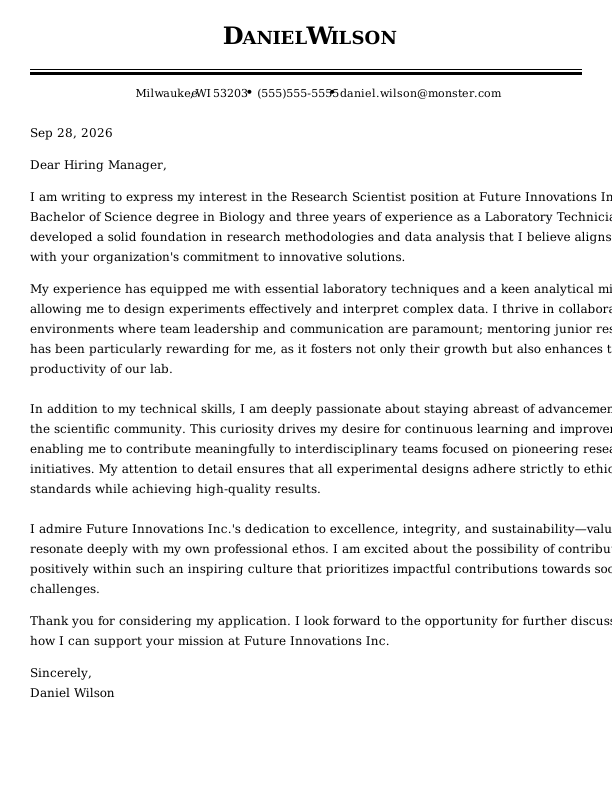
 Free
Research Entry-Level Cover Letter
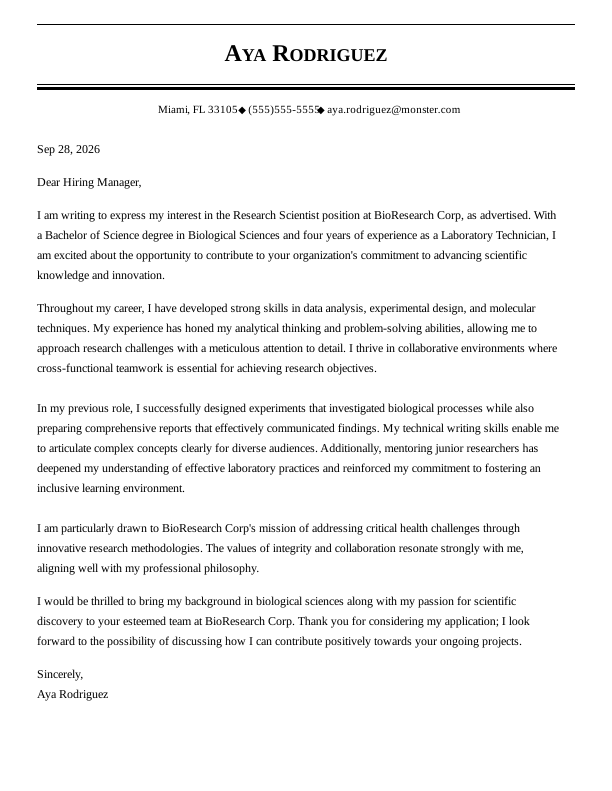
Research Mid-Level Cover Letter
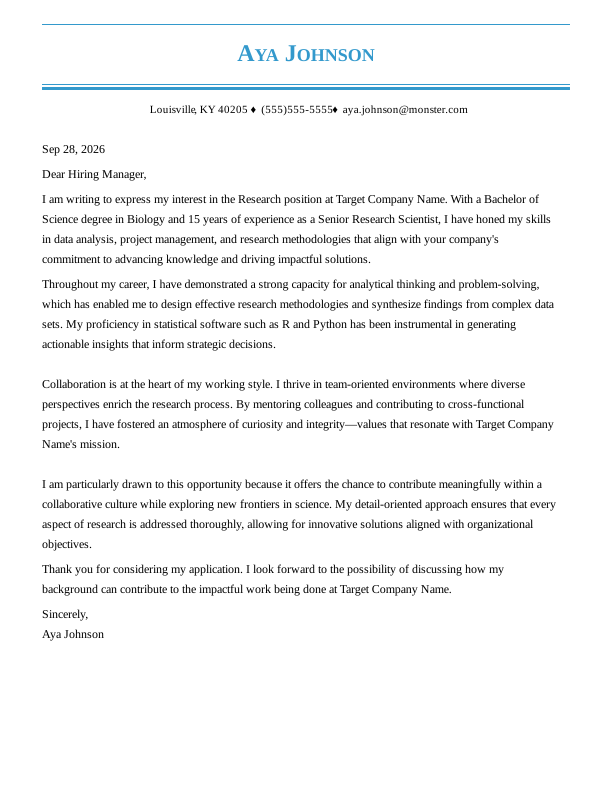
Research Experienced Cover Letter
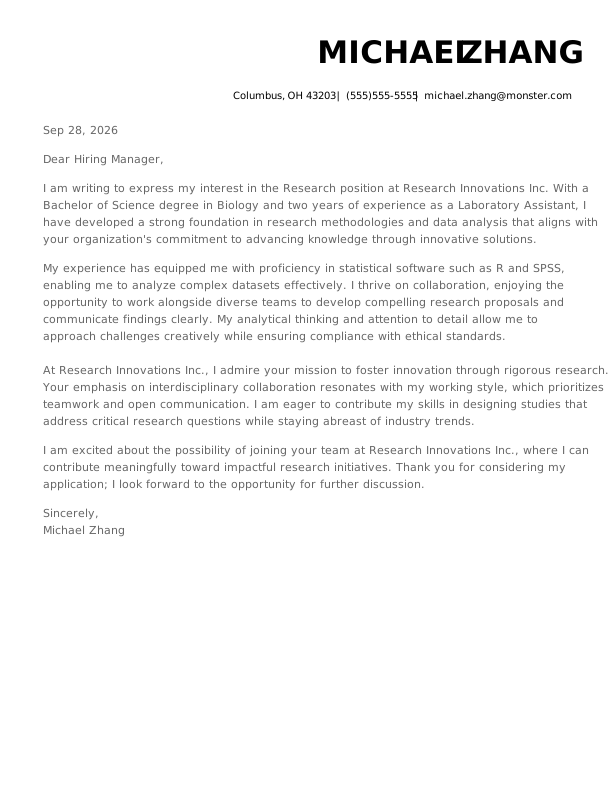
Research Entry-Level Cover Letter
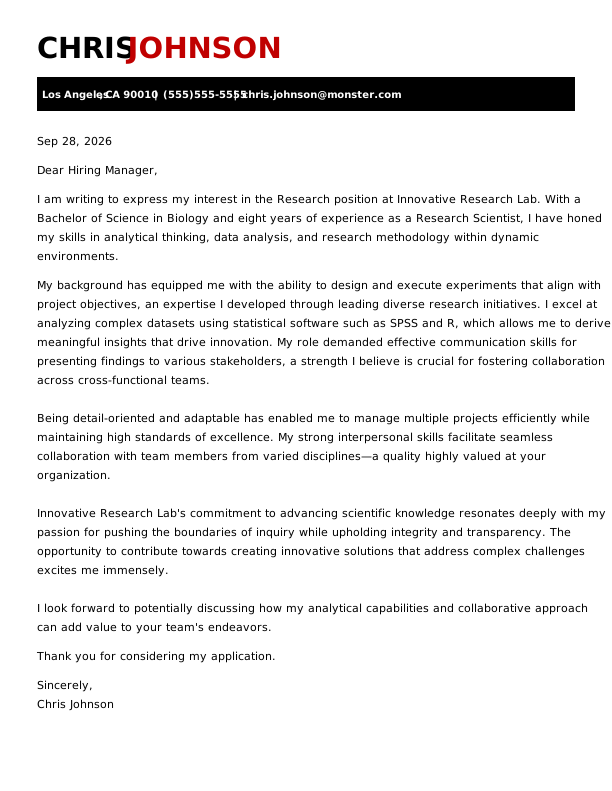
Research Mid-Level Cover Letter
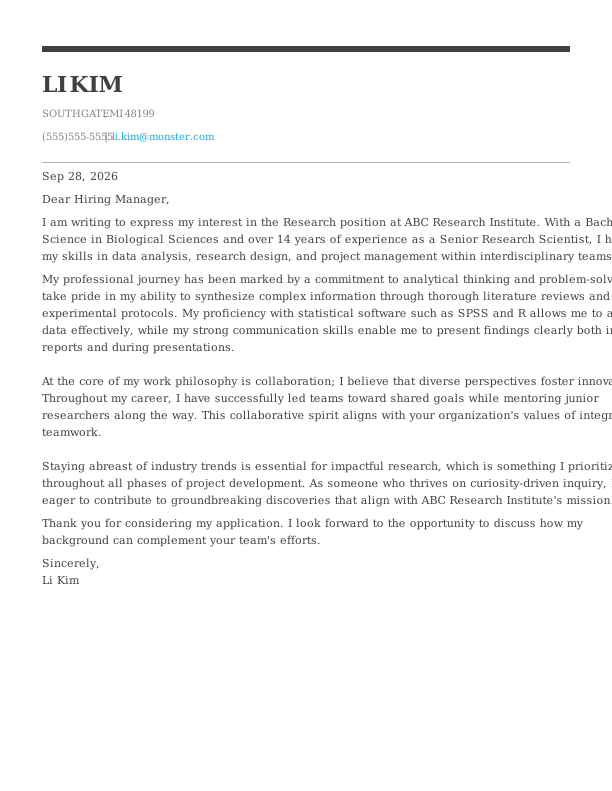
Research Experienced Cover Letter
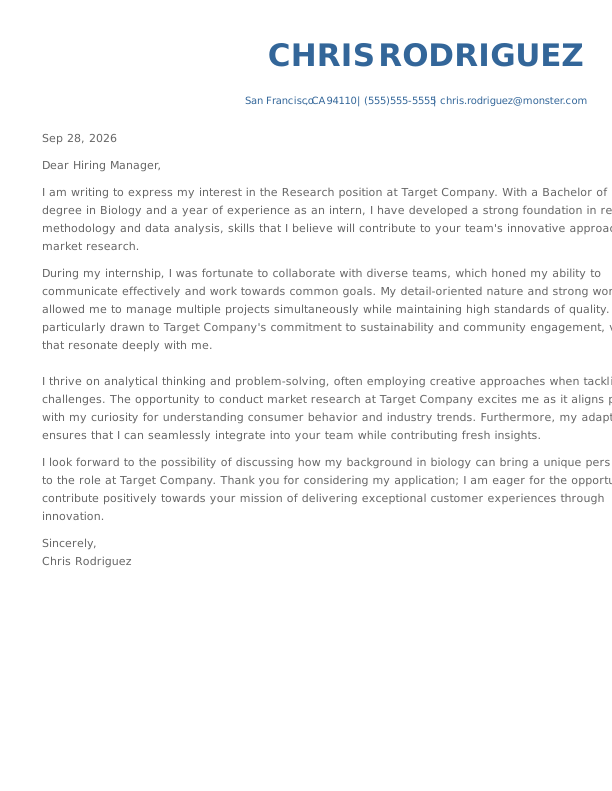
Research Entry-Level Cover Letter
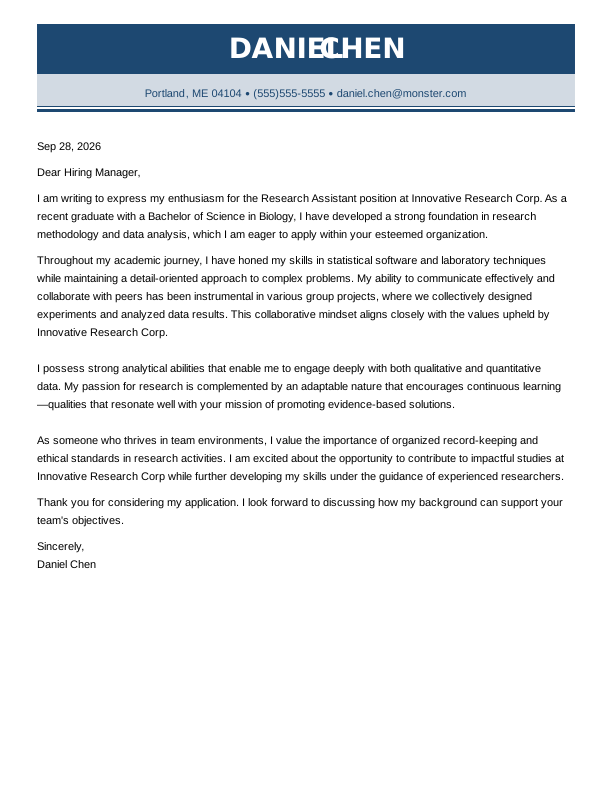
Research Mid-Level Cover Letter
Browse Free Cover Letter Templates
- Academic
- Account Manager
- Accountant
- Accounts Payable
- Administrative Assistant
- Admissions Counselor
- Architecture
- Artist
- Assistant Principal
- Babysitter
- Barista
- Bartender
- Bookkeeper
- Brand Ambassador
- Business Analyst
- Business
- Caregiver
- Chef
- Civil Engineering
- Computer Science
- Construction
- Consulting
- Copywriter
- Cosmetology
- Custodian
- Customer Service
- Customer Service Representative
- Data Analyst
- Data Entry
- Dental Assistant
- Dental Hygienist
- Digital Marketing
- Electrical Engineering
- Emt
- Engineering
- Esthetician
- Event Coordinator
- Executive Assistant
- Finance
- Financial Analyst
- Firefighter
- Flight Attendant
- Graphic Designer
- Hair Stylist
- Healthcare
- Hr Generalist
- Investment Banking
- It
- Janitor
- Journalism
- Lab Technician
- Law Clerk
- Lawyer
- Librarian
- Logistics
- Makeup Artist
- Manager
- Marketing Coordinator
- Marketing
- Marketing Manager
- Massage Therapist
- Mechanic
- Mechanical Engineer
- Medical Assistant
- Non Profit
- Nursing
- Occupational Therapy
- Office Assistant
- Office Manager
- Operations Manager
- Paralegal
- Personal Trainer
- Pharmacist
- Pharmacy Technician
- Photographer
- Physician Assistant
- Pilot
- Police Officer
- Program Manager
- Project Manager
- Property Manager
- Psychology
- Receptionist
- Research Assistant
- Restaurant Manager
- Retail
- Sales
- Sales Manager
- School Counselor
- Security Officer
- Social Work
- Software Engineer
- Special Education Teacher
- Substitute Teacher
- Teacher
- Teaching Assistant
- Truck Driver
- Vet Tech
- Veterinary Assistant
- Web Developer
Cover Letter Examples for Researchers
As you grow in your research career, your cover letter needs to highlight different strengths and experiences. Choose the template that best matches where you are right now to show employers exactly what you bring to the table.
Entry-Level Research Cover Letter
Designed for recent graduates and career changers transitioning into research roles, this cover letter with no experience template helps you frame transferable skills confidently.
Mid-Career Research Cover Letter
Geared toward research professionals a few years into their careers, this template emphasizes leading study design, mentoring junior lab staff, and owning data analysis and reporting for publication.
Experienced Research Cover Letter
Best suited for research professionals with close to a decade of experience, this template fits those who own complex study design, lead cross-functional projects, and mentor analysts.
Research Cover Letter Template (Text)
Copy this research cover letter template, paste it into your document, and customize the study focus and publications or metrics for the role you want.
Suki Tanaka
Riverside, CA 92501
(555)555-5555
suki.tanaka@monster.com
Sep 28, 2026
Dear Hiring Manager,
I am writing to express my interest in the Research position at Innovative Research Solutions. With a Bachelor of Science degree in Biology and nine years of experience as a Senior Research Associate, I have honed my skills in data analysis, project management, and effective communication while fostering collaborative environments.
Throughout my career, I have developed a strong analytical mindset that drives my passion for uncovering insights through meticulous research. My experience includes designing research methodologies tailored to specific project needs and conducting comprehensive literature reviews to support ongoing studies. This aligns with your organization’s commitment to delivering actionable insights that empower decision-making.
In addition to technical proficiency with statistical software and data visualization tools, I thrive in team settings where diverse perspectives contribute to innovative solutions. My adaptability enables me to navigate changing priorities while maintaining a focus on quality outcomes. I believe that curiosity is essential for driving discovery, which resonates deeply with the core values at Innovative Research Solutions.
I am particularly drawn to your mission of harnessing research power for innovation and supporting clients’ goals ethically. This aligns perfectly with my professional ethos of continuous improvement and integrity within all facets of research practice.
I look forward to the opportunity to contribute positively as part of your team at Innovative Research Solutions. Thank you for considering my application; I am eager to discuss how my background can complement your esteemed organization’s objectives.
Sincerely,
Suki Tanaka
How to Write a Research Cover Letter
Writing a great research cover letter comes down to connecting your past accomplishments directly to what the lab needs next. Follow these step-by-step tips to clearly explain your background and show why you are the right person for the job.
1. Research & Prepare
Before drafting your letter, take time to learn about the team’s current projects, key tools, and main research goals. Here are a few quick ways to gather background information before you write:
- Review the job posting on the company website and note any specific methods or software it requires.
- Check recent publications or project updates on the employer’s research page for their top focus areas.
- Search the FDA 510(k) database for relevant product or device submissions linked to the company to understand regulatory context.
2. Hook the Reader
Grab the hiring manager’s attention right away by mentioning a specific method, dataset, or research result you achieved. These examples show how to craft a memorable opening line:
- Methods-first: “I designed a randomized pilot with 300 participants and analyzed outcomes in R using mixed-effects models to account for site-level variation.”
- Data stewardship: “On my last longitudinal project, I reduced missingness from 18% to 6% by tightening data collection rules and documenting QA checks in REDCap.”
- Impact through dissemination: “I coauthored a manuscript based on my biomarker assay work and presented results at the annual Society meeting, targeting decision makers in translational labs.”
3. Tell Your Professional Story
Use the body of your letter to show how you solve problems, handle tricky data, and deliver clear findings under real-world conditions. These bullet points demonstrate how to highlight your impact with numbers and facts:
- Reduced study turnaround time from 10 days to 6 days by standardizing data extraction and cleaning workflows across 3 ongoing trials.
- Analyzed 240 patient records for risk-factor associations and increased model accuracy from 72% to 81% after correcting missing-variable handling.
- Saved $18,000 per quarter by automating recurring KPI pulls in Python and cutting manual reporting hours from about 30 to 8 hours.
4. Showcase Your Skills
Rather than just saying you have strong analytical skills, give brief examples of how you applied them during key projects. Consider using these approaches to prove your expertise:
- Study design: “I drafted a protocol in R for an observational cohort, then adjusted inclusion criteria after a quick pilot showed missing baseline variables.”
- Literature synthesis: “I wrote a structured summary for my PI that compared three competing methods and clearly stated why we chose one based on our sample size constraints.”
- Data documentation: “I maintained my analysis notes and code comments in Jupyter so another teammate could reproduce each figure exactly from the same dataset snapshot.”
5. Explain Any Special Circumstances
If you have an employment gap or are changing career paths, address it in one or two clear, positive sentences. Here are simple ways to explain unique circumstances smoothly:
- “After six months on leave for caregiving, I stayed current by updating my lab notebook workflows in R and rerunning my code on the latest dataset.”
- “I am pivoting from clinical trial operations into applied research by building a causal inference pipeline using R packages like MatchIt and estimatr on new retrospective cohorts.”
- “After relocating to Seattle last fall, I reestablished access to our computational cluster and started fresh preprints while coordinating with collaborators through GitHub.”
6. End With a Professional Goodbye
Wrap up your letter with a polite thank-you and a friendly invitation to continue the conversation. Express genuine appreciation for the hiring team’s time and consideration, then briefly restate how your research background aligns with their goals.
Suggest a phone call or meeting to discuss how your experience can support their upcoming projects, keeping the tone warm, professional, and enthusiastic. Conclude with a classic professional sign-off such as “Sincerely,” “Best regards,” or “Respectfully,” followed by your full name.
4 Tips for Formatting Your Cover Letter
Hiring managers often glance through cover letters quickly to see if a candidate’s skills match the team’s needs. Presenting your letter with clean formatting, crisp spacing, and an organized layout makes a great first impression and ensures your key strengths stand out immediately.

Address the Hiring Manager Directly
Try to find the hiring manager’s name on the job post or team page so you can address them directly. If you cannot find a specific name, use “Dear Hiring Manager” or “Dear Research Team” to keep the greeting professional and friendly.

Match Your Header to Your Resume
Use the same contact header, font styles, and header design on both your cover letter and resume. This creates a polished, cohesive look across your application materials so hiring managers recognize your profile instantly.

Balance Spacing & Margins
Set line spacing to 1.15 and leave an empty line between paragraphs so the text feels open and easy to skim. Stick to standard 0.75-inch to 1-inch margins to give your content plenty of breathing room on the page.

Save & Send as a PDF
Save and send your cover letter as a PDF file so your original formatting, fonts, and layout stay completely intact. Name the file clearly using a simple format like Firstname_Lastname_Cover_Letter.pdf.
Top-Paying States for Research Roles
Knowing what researchers earn across the country helps you compare job offers, plan your next move, and negotiate with confidence. Salary figures can vary widely based on location, years of experience, and whether the role is in academia, industry, or government.
The U.S. Bureau of Labor Statistics (BLS) publishes nationwide wage data that can help you understand typical pay ranges for research roles. Keep in mind that specialized skills and project funding cycles may also affect compensation year to year.
| Alabama | $118,370 |
| Alaska | $102,840 |
| Arizona | $158,100 |
| Arkansas | $75,670 |
| California | $163,890 |
| Connecticut | $129,200 |
| Delaware | $103,380 |
| District of Columbia | $149,800 |
| Florida | $122,610 |
| Georgia | $98,640 |
| Hawaii | $140,140 |
| Idaho | $162,410 |
| Illinois | $129,370 |
| Indiana | $92,040 |
| Iowa | $89,480 |
| Kansas | $99,860 |
| Kentucky | $94,160 |
| Louisiana | $111,260 |
| Maine | $94,740 |
| Maryland | $143,220 |
| Massachusetts | $175,700 |
| Michigan | $114,760 |
| Minnesota | $135,220 |
| Mississippi | $111,360 |
| Missouri | $125,930 |
| Montana | $75,230 |
| Nebraska | $117,740 |
| Nevada | $93,880 |
| New Hampshire | $138,460 |
| New Jersey | $147,070 |
| New Mexico | $178,400 |
| New York | $201,790 |
| North Carolina | $132,560 |
| North Dakota | $81,460 |
| Ohio | $130,930 |
| Oklahoma | $98,010 |
| Oregon | $211,010 |
| Pennsylvania | $128,790 |
| Rhode Island | $124,170 |
| South Carolina | $118,120 |
| South Dakota | $69,160 |
| Tennessee | $103,690 |
| Texas | $115,880 |
| Utah | $103,600 |
| Vermont | $104,040 |
| Virginia | $159,480 |
| Washington | $204,290 |
| West Virginia | $187,000 |
| Wisconsin | $171,150 |
| Wyoming | $73,750 |
| Guam | $47,230 |
| Puerto Rico | $69,040 |
| Virgin Islands | $53,580 |
Key Takeaways
- Highlight specific research methods and study design experience to show hiring managers how you handle data and experiments.
- Include clear metrics like sample sizes, dataset scales, or timeline improvements to give concrete proof of your impact.
- Tailor your message to the organization’s goals, whether they focus on academic publishing, commercial product development, or regulatory compliance.
More Cover Letter Examples
Browse Monster’s Resume Templates
Monster also has hundreds of ATS-friendly resume templates for all career levels and industries. Create a matching resume to help you land the interview.
Frequently Asked Questions
Last Update:
Do I really need a cover letter?
Including a cover letter for research roles gives you a valuable chance to explain the story behind your resume. While your resume lists your background, your letter lets you connect your specific analytical skills, methods, and project accomplishments directly to what the research team needs right now.
How long should my cover letter be?
Your research cover letter should be kept to a single page, ideally around 250 to 350 words. Hiring managers value clear, direct communication, so focus on three or four brief paragraphs that highlight your strongest skills, methodologies, and achievements without overwhelming the reader with unnecessary detail.
Should my cover letter match my resume?
Yes, matching your cover letter layout to your resume creates a polished, unified application packet. Use the exact same header, font choices, and general layout on both documents, while ensuring the text in your letter expands on key research projects rather than simply repeating your resume bullets.
Can I use AI to write my cover letter?
You can use AI tools to outline or brainstorm ideas for your research cover letter, but you should always rewrite the content in your own voice. Be sure to add genuine details about your specific studies, datasets, and research goals so the letter feels personal and authentic to employers.
Should I mention salary expectations in my cover letter?
You should only mention salary expectations in your cover letter if the job post specifically asks for them. In those cases, provide a reasonable range based on local market research and mention that you are open to discussing overall compensation during the interview process.
Vicki Salemi is a nationally recognized career expert who helps professionals navigate the hiring landscape and find the right fit on Monster. With over 15 years of experience in corporate recruiting and HR, she offers expert guidance on job search strategies, interview preparation, and career development to help candidates land their next role.
See More From Vicki SalemiExplore Related Career Advice






How to Write a Cover Letter for Internal Positions or Promotions (Examples & Tips)

Updated:
Apr 23, 2026
|
19 min read


Cover Letter vs Resume: What’s the Difference & Do You Need Both?

Updated:
Apr 23, 2026
|
18 min read