

Free Scientist Cover Letter Templates & Examples
A strong scientist cover letter shows how you turn complex research into real-world results. Whether you excel at thoughtful experimental design or data-driven problem-solving, your letter should clearly highlight the impact of your work. Use our free cover letter examples and step-by-step guidance to build a cover letter that stands out and makes it easy for hiring managers to see why you’re a great fit for the team.
Real-World Cover Letters That Get Results
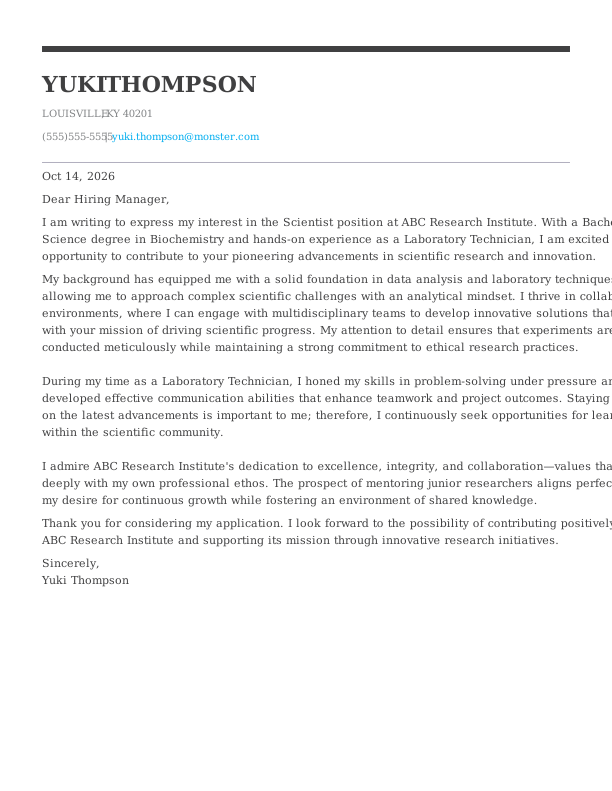
 Free
Scientist Entry-Level Cover Letter
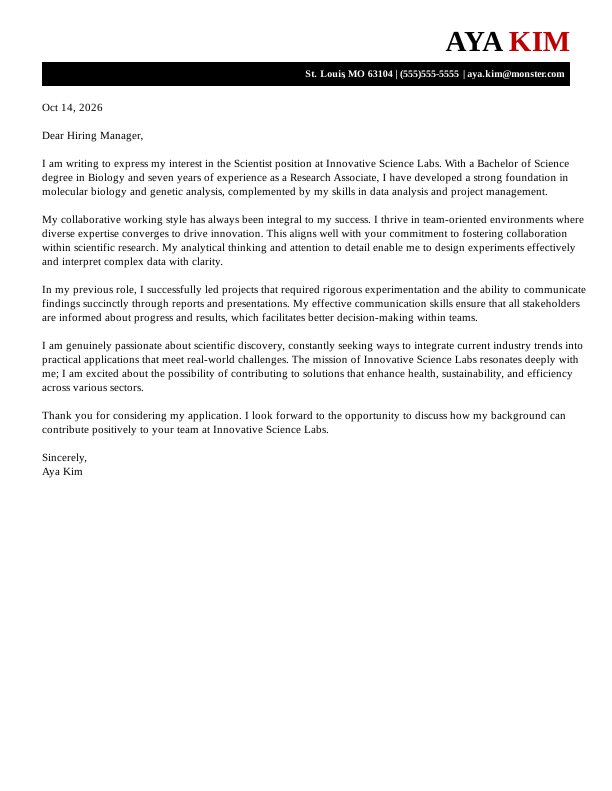
Scientist Mid-Level Cover Letter
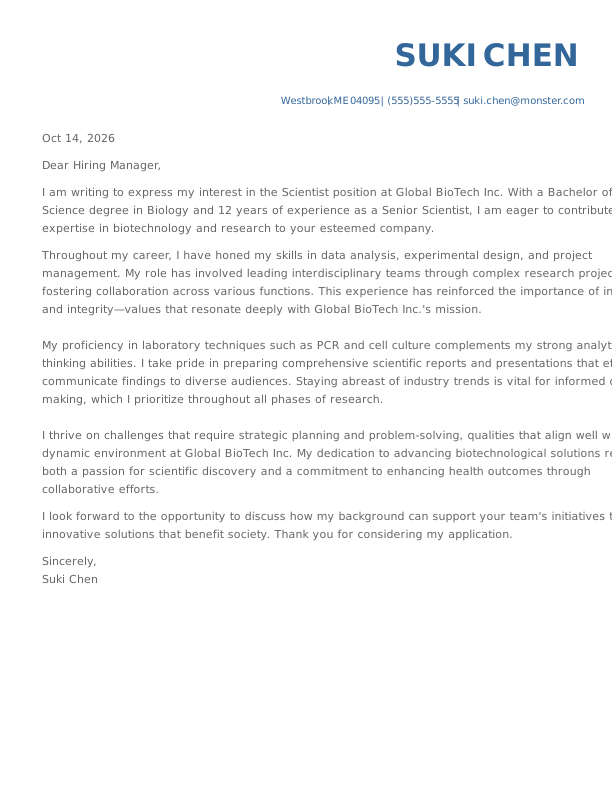
Scientist Experienced Cover Letter
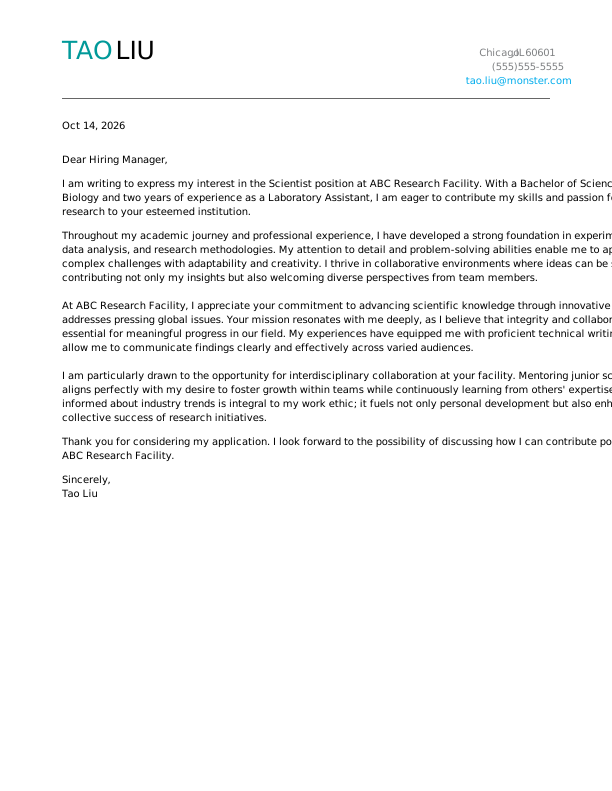
Scientist Entry-Level Cover Letter
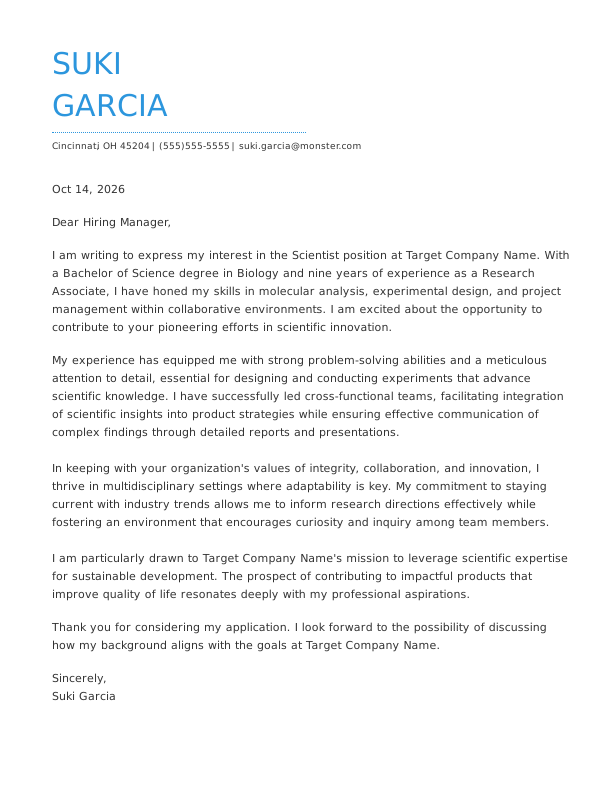
Scientist Mid-Level Cover Letter
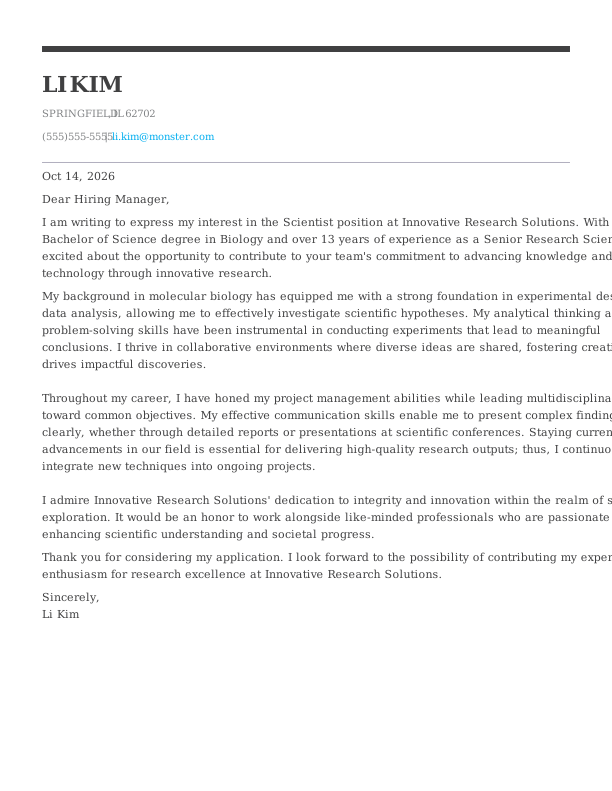
Scientist Experienced Cover Letter
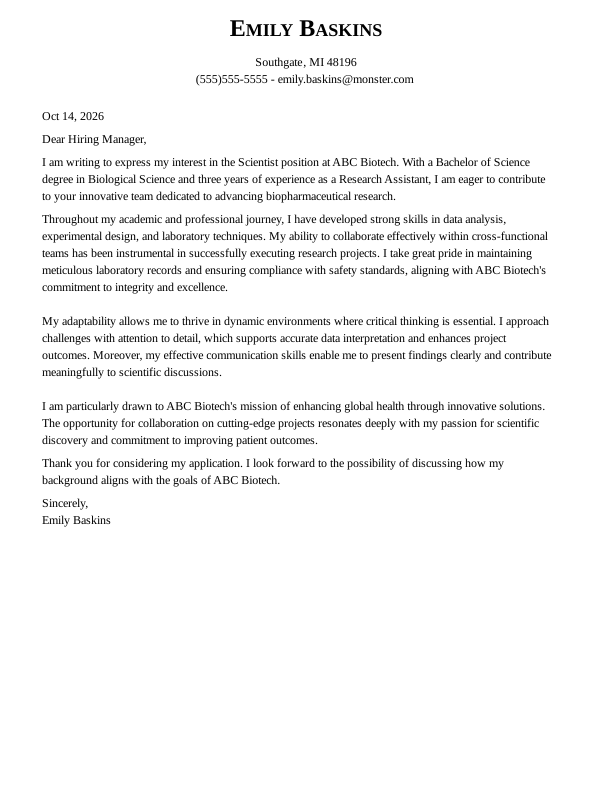
Scientist Entry-Level Cover Letter
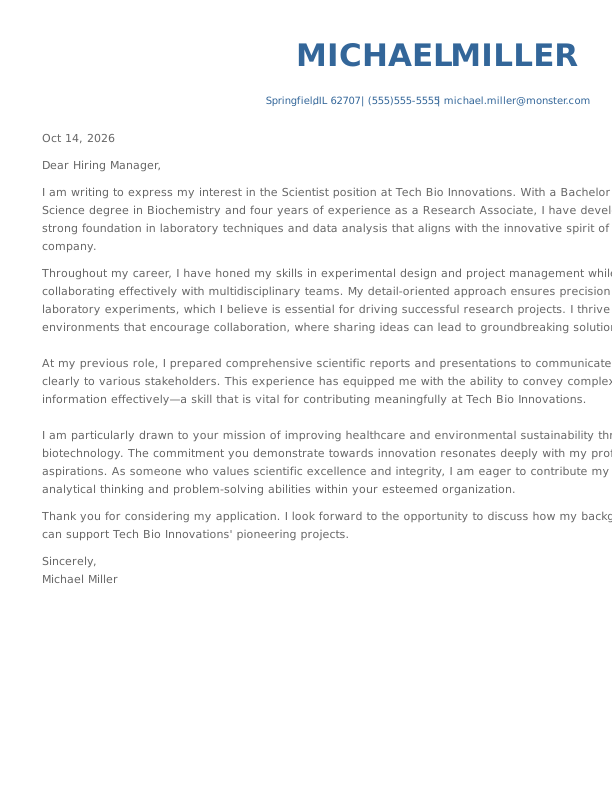
Scientist Mid-Level Cover Letter
Browse Free Cover Letter Templates
- Academic
- Account Manager
- Accountant
- Accounts Payable
- Administrative Assistant
- Admissions Counselor
- Architecture
- Artist
- Assistant Principal
- Babysitter
- Barista
- Bartender
- Bookkeeper
- Brand Ambassador
- Business Analyst
- Business
- Caregiver
- Chef
- Civil Engineering
- Computer Science
- Construction
- Consulting
- Copywriter
- Cosmetology
- Custodian
- Customer Service
- Customer Service Representative
- Data Analyst
- Data Entry
- Dental Assistant
- Dental Hygienist
- Digital Marketing
- Electrical Engineering
- Emt
- Engineering
- Esthetician
- Event Coordinator
- Executive Assistant
- Finance
- Financial Analyst
- Firefighter
- Flight Attendant
- Graphic Designer
- Hair Stylist
- Healthcare
- Hr Generalist
- Investment Banking
- It
- Janitor
- Journalism
- Lab Technician
- Law Clerk
- Lawyer
- Librarian
- Logistics
- Makeup Artist
- Manager
- Marketing Coordinator
- Marketing
- Marketing Manager
- Massage Therapist
- Mechanic
- Mechanical Engineer
- Medical Assistant
- Non Profit
- Nursing
- Occupational Therapy
- Office Assistant
- Office Manager
- Operations Manager
- Paralegal
- Personal Trainer
- Pharmacist
- Pharmacy Technician
- Photographer
- Physician Assistant
- Pilot
- Police Officer
- Program Manager
- Project Manager
- Property Manager
- Psychology
- Receptionist
- Research Assistant
- Restaurant Manager
- Retail
- Sales
- Sales Manager
- School Counselor
- Security Officer
- Social Work
- Software Engineer
- Special Education Teacher
- Substitute Teacher
- Teacher
- Teaching Assistant
- Truck Driver
- Vet Tech
- Veterinary Assistant
- Web Developer
Cover Letter Examples for Scientists
What hiring managers look for in a scientist cover letter changes as your career grows—from your first lab projects to leading complex research teams. Pick the template below that fits your current level to showcase the right skills, methods, and achievements for where you are today.
Entry-Level Scientist Cover Letter
Tailored for recent graduates and career changers entering the scientific field, this template highlights transferable strengths to build a compelling cover letter despite limited experience.
Mid-Career Scientist Cover Letter
Tailored for mid-level scientists, this template highlights your ability to lead independent studies, coordinate cross-functional teams, and ensure dataset integrity in publication-ready workflows.
Experienced Scientist Cover Letter
Tailored for experienced scientists nearing a decade in the lab, this template highlights your ability to own experimental programs, lead cross-functional teams, and leverage advanced technical certifications.
Scientist Cover Letter Template (Text)
Copy this scientist cover letter template, paste it into your document, and swap in your experiments, publication metrics, and target lab or company.
Chris Lee
San Diego, CA 92118
(555)555-5555
chris.lee@monster.com
Oct 14, 2026
Dear Hiring Manager,
I am writing to express my interest in the Scientist position at Innovative Research Corp. With a Bachelor of Science degree in Biology and eight years of experience as a Research Assistant, I have developed a strong foundation in conducting experiments, analyzing data, and collaborating within interdisciplinary teams. My background has equipped me with essential skills that align well with the innovative spirit of your organization.
Throughout my career, I have honed my abilities in molecular biology techniques and data analysis using statistical software such as R and SPSS. My commitment to thorough documentation ensures compliance with regulatory standards while maintaining the integrity of research processes. I pride myself on my analytical thinking and attention to detail, which allow me to approach scientific inquiries methodically.
At the core of my work ethic is a passion for collaboration. I thrive in team-oriented environments where diverse perspectives drive creative solutions to complex challenges. The mission of Innovative Research Corp resonates deeply with me, particularly your focus on enhancing quality of life through sustainable practices.
I am eager to bring my project management experience and effective communication skills to your esteemed organization, contributing positively to impactful research initiatives. Thank you for considering my application; I look forward to the possibility of discussing how I can support your team’s objectives at Innovative Research Corp.
Sincerely,
Chris Lee
How to Write a Scientist Cover Letter
Writing a great scientist cover letter comes down to translating your lab skills, methods, and data into clear evidence of your impact. The steps below will help you tailor your research background to a specific position so hiring teams immediately see what you bring to the bench.
1. Research & Prepare
Before typing a single word, get clear on the lab instruments, computational pipelines, and specific research goals the hiring team relies on. Understanding their focus lets you match your technical methods directly to their current operational priorities. You can gather this background using these quick preparation steps:
- Scan the job description for required software or instruments to mirror in your letter.
- Explore the company’s website to find their active projects and target outcomes.
- Search PubMed for the group’s latest publications to spot key datasets and techniques.
2. Hook the Reader
Skip generic openings like “I am writing to apply.” Instead, open with a specific discovery, assay method, or dataset detail that proves you understand the lab’s core work from day one. Here are three effective ways to structure an attention-grabbing first line depending on your focus:
- Highlighting methods: “In my single-cell RNA-seq postdoc, I used Harmony to minimize batch effects and boost marker detection accuracy by 18%.”
- Emphasizing deliverables: “I recently led an assay redesign that cut ELISA turnaround time from three days down to 18 hours.”
- Focusing on pipeline fit: “Having managed CRISPR screens using Benchling workflows, I can step right into your lab’s active screening pipeline.”
3. Tell Your Professional Story
While your resume lists your routine responsibilities, your cover letter tells the story of what your research accomplished. Quantifiable results—like processing speed or assay sensitivity—make your expertise much easier to evaluate. Notice how these sample bullet points connect specific technical changes to clear outcomes:
- Boosted assay sensitivity by 35% after optimizing sample preparation variables across 60 validation runs.
- Reduced qPCR turnaround time from five days to three days by standardizing extraction steps for 240 monthly samples.
- Saved $18,000 annually by redesigning an experimental protocol to cut reagent consumption by 22%.
4. Showcase Your Skills
Rather than using vague buzzwords like “detail-oriented,” demonstrate your problem-solving skills with brief real-world examples. Select key requirements from the job post and show how your practical judgment solved past research challenges, as shown in these examples:
- Experimental design: “I built an assay control plan in R and adjusted the protocol after pilot runs showed baseline drift.”
- Data analysis: “I used Python notebooks to filter outliers, document transformations, and confirm data trends held.”
- Scientific communication: “I turned complex findings into clear charts for non-technical partners to align on next steps.”
5. Explain Any Special Circumstances
If you have a career gap, pivot, or relocation, address it directly in one or two clear sentences. Hiring managers want to see that your lab techniques and certifications remain current. These examples demonstrate how to frame unique circumstances constructively:
- During a nine-month career pause, I maintained hands-on skills through weekly qPCR practice and protocol updates.
- Transitioning from computational biology to wet-lab immunology, I recently completed flow cytometry training using BD FACSDiva.
- Following a move to Seattle, I joined a new research collaboration and have been publishing single-cell analyses using R and Seurat.
6. End With a Professional Goodbye
Wrap up your cover letter with a direct call to action and a brief thank you. Skip passive stock phrases like “I look forward to hearing from you” so your closing stays purposeful and confident.
For instance: “I’d welcome the chance to discuss how my proteomics background fits your biomarker research.” Sign off politely with “Thank you for your time,” followed by a standard sign-off like “Best regards.”
4 Tips for Formatting Your Cover Letter
When you’re applying for a science role—whether it’s a postdoc or a principal investigator position—hiring managers usually scan your application quickly. Good formatting helps them immediately spot your key results, methods, and publications.

Use a Professional Font & Layout
Stick to clean fonts like Arial, Calibri, Georgia, or Helvetica at 10 to 12 pt so your grant numbers, complex methodologies, and publication details are easy to read. Use 1-inch margins and match your resume header style to present a single, polished professional identity.

Address the Hiring Manager Directly
Find the lab director, principal investigator, or recruiter name on the lab directory or LinkedIn before using a generic opening. If you can’t find a specific contact, greetings like “Dear Search Committee” or “To the Hiring Team” work well—just stay away from “To Whom It May Concern,” which feels dated.

Match Your Header to Your Resume
Copy the header from your resume onto your cover letter so your name, academic credentials, ORCID iD, and contact details match perfectly. Maintaining uniform typography across both documents creates a cohesive look that highlights your attention to detail.

Use Bullet Points for Key Achievements
Bullet points give reviewers a quick way to scan your top grant wins, lab workflows, or high-impact publications without digging through dense paragraphs. Highlight 3 or 4 key measurable impacts to show your strengths fast.
Top-Paying States for Scientist Roles
Knowing what scientists earn can help you compare offers, plan your next step, and negotiate with confidence. Salary ranges vary widely by field and setting, so it helps to start with reliable benchmarks. The data below comes from the U.S. Bureau of Labor Statistics (BLS) and reflects the most recent nationwide averages for scientists.
Keep in mind that location, years of experience, research specialty, and whether you work in academia, industry, or government can all affect outcomes. Funding cycles and project scope may also shift pay over time.
| Alabama | $130,920 |
| Alaska | $124,500 |
| Arizona | $158,100 |
| Arkansas | $104,560 |
| California | $163,890 |
| Connecticut | $129,200 |
| Delaware | $110,670 |
| District of Columbia | $166,630 |
| Florida | $137,410 |
| Georgia | $126,220 |
| Hawaii | $140,140 |
| Idaho | $162,410 |
| Illinois | $129,370 |
| Indiana | $132,370 |
| Iowa | $109,980 |
| Kansas | $113,140 |
| Kentucky | $100,410 |
| Louisiana | $111,260 |
| Maine | $127,100 |
| Maryland | $148,480 |
| Massachusetts | $175,700 |
| Michigan | $119,030 |
| Minnesota | $149,950 |
| Mississippi | $116,340 |
| Missouri | $125,930 |
| Montana | $111,490 |
| Nebraska | $117,740 |
| Nevada | $117,540 |
| New Hampshire | $138,460 |
| New Jersey | $147,070 |
| New Mexico | $178,400 |
| New York | $201,790 |
| North Carolina | $132,560 |
| North Dakota | $124,770 |
| Ohio | $130,930 |
| Oklahoma | $121,650 |
| Oregon | $211,010 |
| Pennsylvania | $138,120 |
| Rhode Island | $124,170 |
| South Carolina | $132,010 |
| South Dakota | $92,460 |
| Tennessee | $114,830 |
| Texas | $157,370 |
| Utah | $119,640 |
| Vermont | $119,630 |
| Virginia | $159,480 |
| Washington | $204,290 |
| West Virginia | $187,000 |
| Wisconsin | $171,150 |
| Wyoming | $90,110 |
| Guam | $74,560 |
| Puerto Rico | $77,560 |
| Virgin Islands | $58,290 |
Key Takeaways
- Address your cover letter directly to the department head or hiring manager and state right away how your research background fits the open position.
- Quantify your scientific achievements using clear metrics like grant funding secured, journal publications, or measurable experiment outcomes.
- Explain how your research goals align with the organization’s mission and close with a confident request for an interview.
More Cover Letter Examples
Browse Monster’s Resume Templates
Monster also has hundreds of ATS-friendly resume templates for all career levels and industries. Create a matching resume to help you land the interview.
Frequently Asked Questions
Last Update:
Do I really need a cover letter?
Yes, you should always include one. While your resume lists technical skills, publications, and lab techniques, it can’t convey the story behind your research. A cover letter lets you explain complex project contexts, bridge career transitions, or clarify employment gaps. It shows real initiative by demonstrating how your scientific expertise aligns directly with the lab’s goals and research methodology.
How long should my cover letter be?
Keep your cover letter to a single page—ideally between 250 and 400 words. Hiring managers and principal investigators review dozens of applications, so brief messaging is key. Structure your letter into three or four focused paragraphs highlighting your most impact-driven clinical or laboratory achievements. Quality matters far more than length, so focus solely on research details relevant to the specific position.
Should my cover letter match my resume?
Yes, matching your visual formatting creates a polished presentation. Use the same typography, margins, and header styles across both documents. Rather than repeating resume bullet points, elaborate on significant findings, assay developments, or team leadership experiences. Explain what draws you to their specific research team—like groundbreaking studies or novel methodologies—and how your scientific background complements their current initiatives.
Can I use AI to write my cover letter?
AI tools are great for outlining or overcoming writer’s block, but deep personalization remains essential. Generative tools don’t know your actual lab experience, specific datasets, or passion for a niche field. Treat AI drafts as initial starting points, then heavily edit them with your authentic voice. Include concrete research details—such as experimental design or specialized assay results—to avoid generic phrasing that hiring teams easily spot.
How do I write a cover letter for an internal position?
Focus on your familiarity with current lab protocols, ongoing projects, and cross-departmental collaborations. Highlight specific contributions—like optimizing assay workflows, cutting repeat runs by 18%, or improving sample handling—that benefited the organization. Emphasize your desire to take on greater research responsibilities or mentor junior staff. Don’t skip formal steps; present a complete application packet that underscores your commitment to advancing the team’s mission.

Elizabeth Muenzen is a Certified Professional Resume Writer (CPRW) and member of the Professional Association of Resume Writers & Career Coaches who empowers job seekers to take control of their career paths using Monster’s comprehensive job search and resume tools.
See More From Elizabeth MuenzenExplore Related Career Advice







How to Write a Cover Letter for Internal Positions or Promotions (Examples & Tips)

Updated:
Apr 23, 2026
|
19 min read


Cover Letter vs Resume: What’s the Difference & Do You Need Both?
Updated:
Apr 23, 2026
|
18 min read