

Free Data Scientist Cover Letter Templates & Examples
A strong data scientist cover letter shows you can turn messy data into clear insights and communicate results that drive decisions. Our free cover letter examples and step-by-step guidance help you craft a focused narrative that highlights your analytics skills and projects in a way hiring managers will notice.
Real-World Cover Letters That Get Results
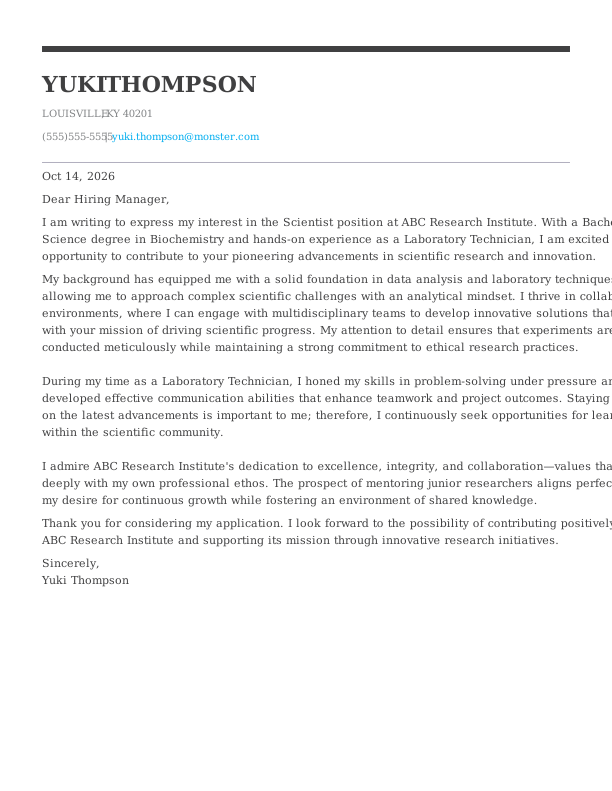
 Free
Scientist Entry-Level Cover Letter
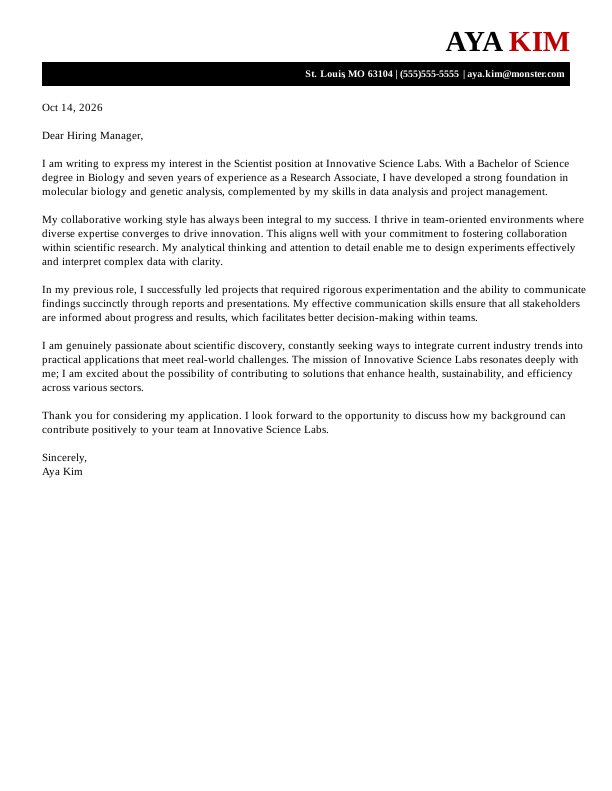
Scientist Mid-Level Cover Letter
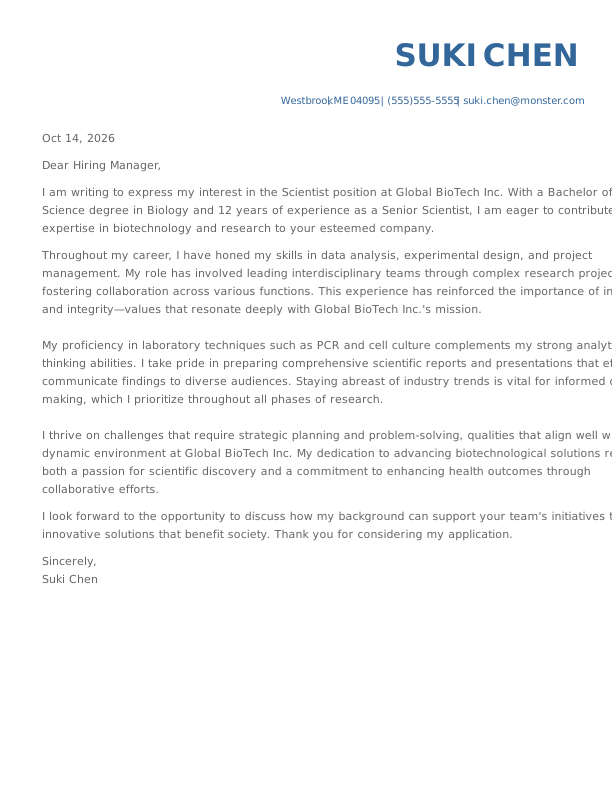
Scientist Experienced Cover Letter
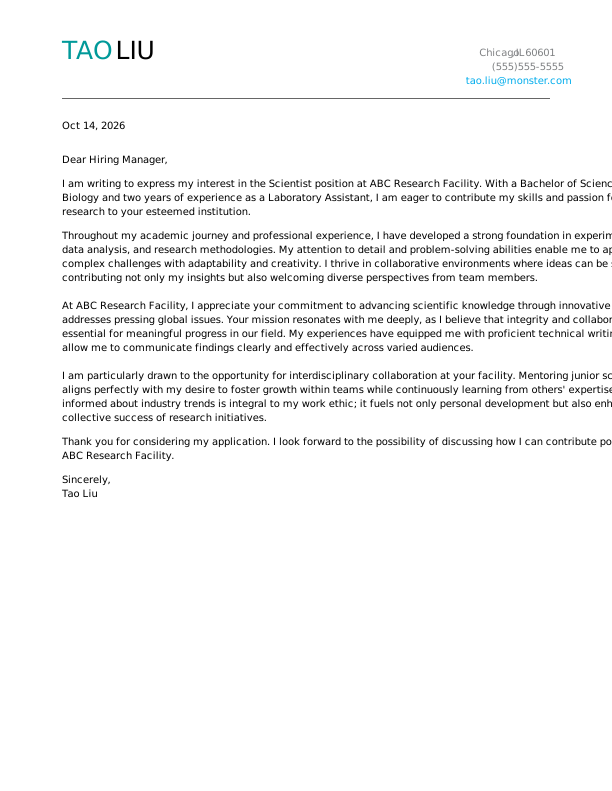
Scientist Entry-Level Cover Letter
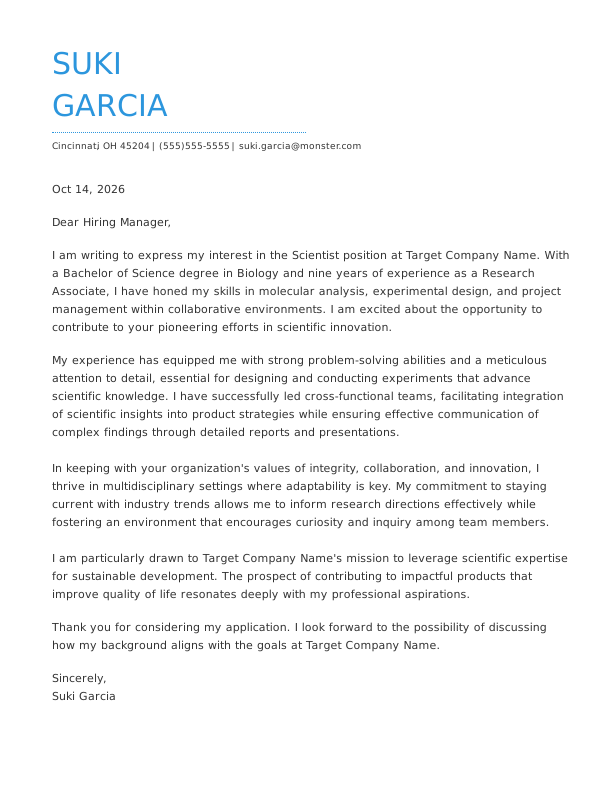
Scientist Mid-Level Cover Letter
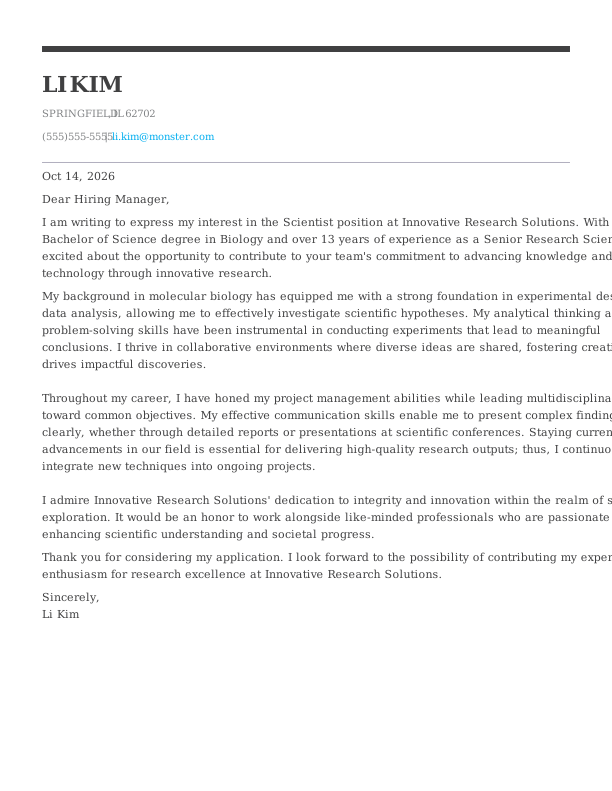
Scientist Experienced Cover Letter
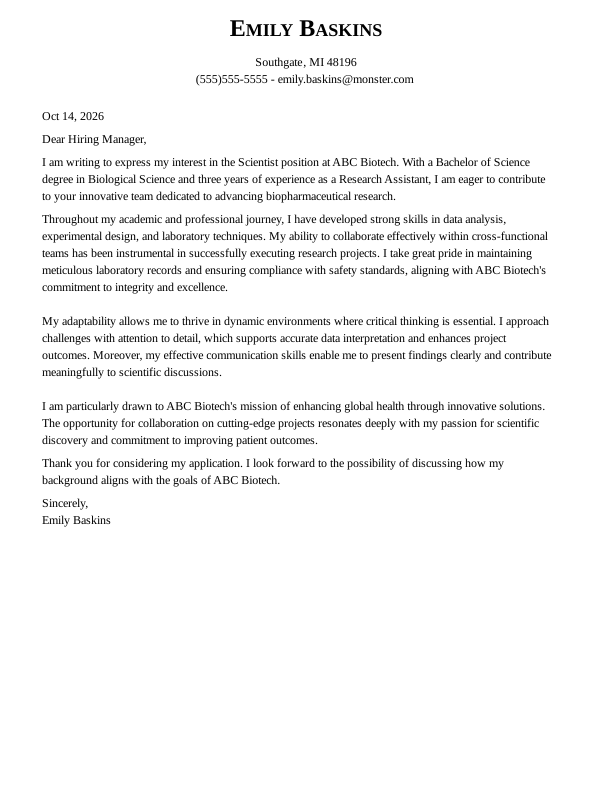
Scientist Entry-Level Cover Letter
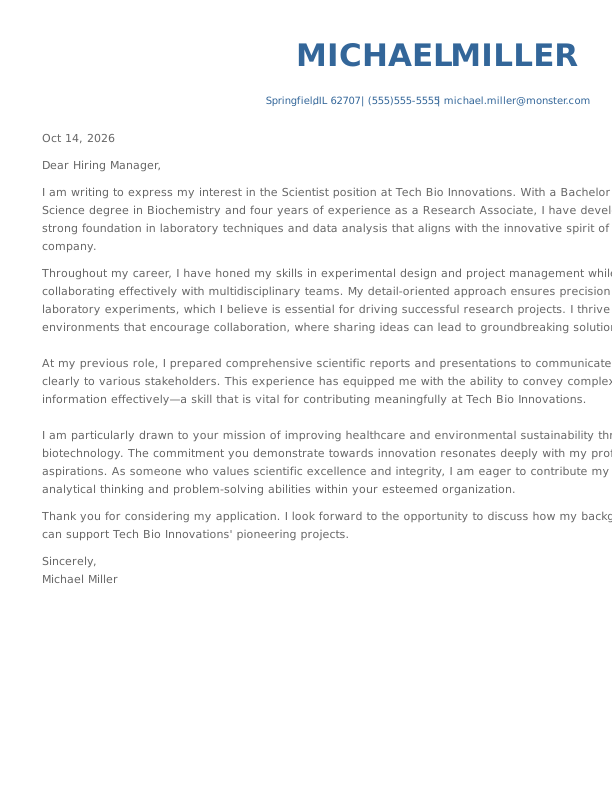
Scientist Mid-Level Cover Letter
Browse Free Cover Letter Templates
- Academic
- Account Manager
- Accountant
- Accounts Payable
- Administrative Assistant
- Admissions Counselor
- Architecture
- Artist
- Assistant Principal
- Babysitter
- Barista
- Bartender
- Bookkeeper
- Brand Ambassador
- Business Analyst
- Business
- Caregiver
- Chef
- Civil Engineering
- Computer Science
- Construction
- Consulting
- Copywriter
- Cosmetology
- Custodian
- Customer Service
- Customer Service Representative
- Data Analyst
- Data Entry
- Dental Assistant
- Dental Hygienist
- Digital Marketing
- Electrical Engineering
- Emt
- Engineering
- Esthetician
- Event Coordinator
- Executive Assistant
- Finance
- Financial Analyst
- Firefighter
- Flight Attendant
- Graphic Designer
- Hair Stylist
- Healthcare
- Hr Generalist
- Investment Banking
- It
- Janitor
- Journalism
- Lab Technician
- Law Clerk
- Lawyer
- Librarian
- Logistics
- Makeup Artist
- Manager
- Marketing Coordinator
- Marketing
- Marketing Manager
- Massage Therapist
- Mechanic
- Mechanical Engineer
- Medical Assistant
- Non Profit
- Nursing
- Occupational Therapy
- Office Assistant
- Office Manager
- Operations Manager
- Paralegal
- Personal Trainer
- Pharmacist
- Pharmacy Technician
- Photographer
- Physician Assistant
- Pilot
- Police Officer
- Program Manager
- Project Manager
- Property Manager
- Psychology
- Receptionist
- Research Assistant
- Restaurant Manager
- Retail
- Sales
- Sales Manager
- School Counselor
- Security Officer
- Social Work
- Software Engineer
- Special Education Teacher
- Substitute Teacher
- Teacher
- Teaching Assistant
- Truck Driver
- Vet Tech
- Veterinary Assistant
- Web Developer
Cover Letter Examples for Data Scientists
Cover letter expectations change as a data scientist advances, especially from learning and coursework to leading analyses and projects. Choose the template that matches your career stage so you can spotlight the right work, like model building, experimentation, stakeholder reporting, or team collaboration.
Entry-Level Data Scientist Cover Letter
Designed for recent graduates and career changers, this template demonstrates how to present academic projects, coding skills, and statistical training with confidence when applying for initial data science roles.
Mid-Career Data Scientist Cover Letter
Tailored for candidates with several years of hands-on experience, this template shows how to highlight production model deployment, machine learning workflows, and cross-functional team support.
Experienced Data Scientist Cover Letter
Ideal for senior data scientists and analytics leads, this template emphasizes predictive modeling pipelines, strategic project ownership, business impact, and team mentorship.
Data Scientist Cover Letter Template (Text)
Copy this data scientist cover letter text into your document and customize it with your own model results, metrics, and target company.
Jane Zhang
San Diego, CA 92110
(555)555-5555
jane.zhang@monster.com
Oct 14, 2026
Dear Hiring Manager,
I am writing to express my interest in the data scientist position at Tech Innovations Inc. With a Bachelor of Science in Computer Science and nine years of experience as a data analyst, I have developed a robust skill set that aligns well with your team’s commitment to harnessing the power of data for innovative solutions.
Throughout my career, I have honed my abilities in data analysis and statistical methods, utilizing programming languages such as Python and SQL to derive insights from complex datasets. My experience includes developing predictive models and implementing data collection systems that enhance operational efficiency while ensuring high-quality standards.
I thrive in collaborative environments where analytical thinking and attention to detail are essential. By working closely with cross-functional teams, I have successfully communicated intricate analytical findings through clear visualizations and reports tailored for diverse audiences. This adaptability has allowed me to remain current with industry trends while continuously seeking out new methodologies that can benefit the projects I am involved in.
The mission of Tech Innovations Inc. resonates deeply with me; your dedication to transforming raw data into actionable insights aligns perfectly with my passion for driving impactful change through technology. I am excited about the opportunity to contribute my expertise and work alongside innovative thinkers who share a commitment to excellence.
Thank you for considering my application. I look forward to the possibility of discussing how my experience can contribute positively to your team at Tech Innovations Inc.
Sincerely,
Jane Zhang
How to Write a Data Scientist Cover Letter
Writing an effective data scientist cover letter requires showing hiring managers that you understand data pipelines, statistical modeling, and business decision-making. Follow these steps to align your experience with a specific job posting.
1. Research & Prepare
Before writing, research the employer’s data stack, engineering infrastructure, and core business models. Discovering whether the team prioritizes real-time machine learning inference, customer churn prediction, or experimental A/B testing allows you to highlight the exact technical skills that matter most to its leadership.
Gather actionable context by exploring these key information sources:
- Review the job description to identify required programming languages, database systems, and machine learning frameworks.
- Read the company’s engineering blog or tech talks to understand its current production challenges and data architecture.
- Explore public GitHub repositories or technical publications from the team to align with its coding standards and analytical methods.
2. Hook the Reader
Start your letter with an engaging opening line that demonstrates your ability to deliver measurable value through data. Avoid generic statements like “I am writing to apply for the open data scientist role.” Instead, capture the hiring manager’s attention by leading with a concrete modeling achievement or analytics win.
Choose an opening line tailored to your experience using these example approaches:
- Model performance: “By retraining our gradient boosted models weekly and monitoring calibration drift, I reduced customer churn by 9% in production.”
- Experimentation impact: “On your analytics team, I would apply my A/B testing experience, where I previously improved checkout completion by 3.1% using uplift modeling.”
- Operational optimization: “Collaborating with machine learning engineers and operations leaders, I deployed a demand-forecasting pipeline that cut inventory stockouts by 18%.”
3. Tell Your Professional Story
Use the body of your letter to give hiring managers a clear view of your modeling impact and technical problem-solving. While your resume lists past roles and programming languages, your cover letter explains how your algorithms improved accuracy, lowered costs, or guided business strategy. Using specific numbers makes your accomplishments far more compelling.
Incorporate concrete benchmarks like these to illustrate your impact:
- Reduced mean absolute percentage error on demand forecasts from 18% to 9.5% by feature engineering updated seasonality metrics.
- Saved $210,000 annually by cutting compute costs 34% through model compression and scheduled batch inference.
- Built customer churn models that processed 1.6 million records monthly and increased ROC-AUC from 0.71 to 0.81.
4. Showcase Your Skills
Rather than using broad self-descriptors like “data-driven” or “analytical thinker,” illustrate how your skills resolve real technical challenges. Showing the exact moments where your code cleanup, statistical checks, or communication saved a project builds trust with the employer.
Connect your practical abilities directly to daily data science needs using these examples:
- Machine learning pipelines: “I built a scikit-learn pipeline to predict user churn, auditing feature correlations carefully to eliminate data leakage before model deployment.”
- Data quality and SQL: “I wrote complex SQL queries to reconcile mismatched customer tables, flagging inconsistent user IDs so our data engineering team could fix the source pipeline.”
- Stakeholder communication: “I presented complex predictive findings in clear, accessible language to marketing leaders, translating their strategic feedback into model updates for our next trial.”
5. Explain Any Special Circumstances
If you have an employment gap, are changing career paths, or recently relocated, address it briefly in one or two direct sentences. Focus your explanation on your current technical readiness, active modeling projects, and up-to-date coding skills so the manager knows you are ready to manage data pipelines right away.
Frame your circumstances clearly using these straightforward approaches:
- Addressing an employment gap: “Following an eight-month career break, I maintained my technical skills by building forecasting pipelines in Python and retraining models on open datasets.”
- Transitioning positions: “I am pivoting from data analytics into applied machine learning by completing end-to-end projects in PyTorch and using MLflow for experiment tracking.”
- Handling relocation: “After moving to the area last spring, I refreshed my cloud ETL workflows in AWS and updated my BigQuery skills to ensure a smooth transition into a new role.”
6. End With a Professional Goodbye
Conclude your letter with a polite, confident statement that invites the hiring manager to contact you for an interview. Keep your sign-off concise, thank the reader for their time, and express enthusiasm for discussing your technical projects in detail.
Structure your final paragraph using this clear approach:
- Offer a clear next step: “I would welcome the opportunity to discuss how my predictive modeling experience and retention analysis can support your data science goals.”
- Express gratitude: “Thank you for your time and consideration.”
- End with a clean sign-off: “Sincerely,” followed by your full name.
4 Tips for Formatting Your Cover Letter
When you apply for a data scientist position, hiring managers often scan your application quickly between managing production models and reviewing data pipelines. They look rapidly for coding proficiency, statistical tools, and measurable modeling results. A clean presentation with consistent spacing and logical organization makes your top technical achievements easy to spot and proves that you take pride in producing neat, well-structured work.

Address the Hiring Manager Directly
Search the job posting, company careers page, or professional networking profiles to identify the specific data science manager or technical recruiter. If you cannot find an individual name, address your letter to “Dear Hiring Manager” or “Dear Data Science Team” rather than using outdated phrases.

Match Your Header to Your Resume
Use the exact same name layout, typography, contact details, and location formatting on both your cover letter and resume. A matching header allows hiring managers to instantly recognize your application package and confirm your details while reviewing your technical resume and portfolio together.

Use Bullet Points for Key Achievements
Incorporate three to four bullet points in the body of your letter to highlight key metrics like model accuracy gains, latency reductions, or compute cost savings. Bulleted lists break up dense text, making it simple for technical reviewers to spot your top contributions during a quick initial scan.

Balance Spacing & Margins
Set line spacing between 1.0 and 1.15, leaving a full blank line between paragraphs to keep the layout clean and readable. Use uniform margins between 0.75 and 1 inch so your letter looks well-proportioned on screens and printed copies.
Top-Paying States for Data Scientist Roles
Knowing what data scientists earn can help you compare offers and plan next steps with confidence. Salary ranges in the U.S. vary by demand, industry, and experience level, so it’s useful to start with reliable benchmarks. The figures below come from the U.S. Bureau of Labor Statistics (BLS) and represent the latest nationwide averages for data scientists.
Keep in mind that location, years of experience, and specialty, like machine learning or analytics, can shift pay. Employers may also value advanced skills such as Python, SQL, or cloud platforms differently.
| Alabama | $102,970 |
| Alaska | $88,690 |
| Arizona | $112,460 |
| Arkansas | $104,560 |
| California | $155,450 |
| Connecticut | $120,270 |
| District of Columbia | $148,170 |
| Florida | $117,670 |
| Georgia | $111,020 |
| Hawaii | $124,530 |
| Idaho | $120,410 |
| Illinois | $119,010 |
| Indiana | $92,620 |
| Iowa | $97,300 |
| Kansas | $107,300 |
| Kentucky | $100,410 |
| Louisiana | $71,740 |
| Maine | $101,890 |
| Maryland | $135,370 |
| Massachusetts | $139,670 |
| Michigan | $102,030 |
| Minnesota | $118,110 |
| Mississippi | $77,830 |
| Missouri | $95,310 |
| Montana | $111,490 |
| Nebraska | $97,720 |
| Nevada | $98,820 |
| New Hampshire | $102,230 |
| New Jersey | $131,800 |
| New Mexico | $86,520 |
| New York | $133,450 |
| North Carolina | $118,020 |
| North Dakota | $94,130 |
| Ohio | $100,260 |
| Oklahoma | $89,940 |
| Oregon | $124,060 |
| Pennsylvania | $107,450 |
| Rhode Island | $119,400 |
| South Carolina | $96,970 |
| South Dakota | $92,460 |
| Tennessee | $114,830 |
| Texas | $114,800 |
| Utah | $119,640 |
| Vermont | $119,630 |
| Virginia | $132,230 |
| Washington | $162,730 |
| West Virginia | $102,770 |
| Wisconsin | $105,540 |
| Wyoming | $85,480 |
| Puerto Rico | $72,370 |
Key Takeaways
- Demonstrate modeling judgment by sharing a specific example where you evaluated model tradeoffs to improve accuracy or efficiency.
- Include concrete performance metrics like ROC-AUC scores, error rate reductions, or inference latency times to quantify your technical impact.
- Tailor your letter to the industry by emphasizing risk detection for fintech, causal measurement for adtech, or model explainability for healthcare.
More Cover Letter Examples
Browse Monster’s Resume Templates
Monster also has hundreds of ATS-friendly resume templates for all career levels and industries. Create a matching resume to help you land the interview.
- Actuary
- Analyst
- Bioinformatics
- Biology
- Biostatistician
- Business Analyst
- Business Intelligence
- Chief Data Officer
- Clinical Data Manager
- Compensation Analyst
- Data Analyst
- Data Annotator
- Data Engineer
- Data Scientist
- Environmental Science
- Healthcare Data Analyst
- Hris Analyst
- Intelligence Analyst
- Math
- Physical Science
- Quantitative Analyst
- Quantitative Researcher
- Science
- Scientist
- Social Science
- Tableau Developer
Frequently Asked Questions
Last Update:
Do I really need a cover letter?
Yes, submitting a cover letter with your data science application is strongly recommended because it provides technical context that a resume cannot offer alone. While a resume lists past jobs and programming languages, a cover letter explains how you frame business problems, choose algorithms, and interpret model results. It also offers space to explain career transitions or employment gaps.
How long should my cover letter be?
A data scientist cover letter should stay within one page, targeting between 250 and 400 words. Hiring managers review applications quickly, so direct, concise writing works best. Divide your text into three or four short paragraphs that focus strictly on your modeling achievements, coding skills, and measurable business impact without adding unnecessary technical clutter or filler.
Should my cover letter match my resume?
Your data scientist cover letter should match your resume’s visual formatting to create a polished, cohesive application package. Use the same font styles, margin sizes, color choices, and contact header across both documents. Instead of repeating your resume bullet points, use your cover letter to expand on a specific modeling decision or explain why the company’s data challenges fit your career goals.
Can I use AI to write my cover letter?
Using AI tools can help you outline your data science cover letter and organize your thoughts, but you should rewrite the draft heavily before submitting it. AI-generated text often uses generic phrasing that lacks the specific algorithms, datasets, and measurable metrics hiring managers look for. Personalizing your content ensures the letter accurately reflects your unique technical experience.
Should I mention salary expectations in my cover letter?
You should only mention salary expectations in a data scientist cover letter if the job posting explicitly requests them. If required, state a flexible pay range based on local market research for your experience level. Mention briefly that you are open to discussing total compensation, including performance bonuses and equity, during the interview process.

Kirsten Chorpenning is a career advice writer who empowers job seekers to take control of their career paths using Monster’s comprehensive job search and resume tools. She specializes in helping job seekers find rewarding jobs in today’s dynamic work environment.
See More From Kirsten ChorpenningExplore Related Career Advice







How to Write a Cover Letter for Internal Positions or Promotions (Examples & Tips)
Updated:
Apr 23, 2026
|
19 min read


Cover Letter vs Resume: What’s the Difference & Do You Need Both?

Updated:
Apr 23, 2026
|
18 min read