

Free Science Cover Letter Templates & Examples
A strong science cover letter shows how you turn curiosity into clear experiments, accurate data analysis, and reliable conclusions. Our free examples and step-by-step guidance help you spotlight your research skills, technical methods, and real-world impact to impress hiring managers.
Real-World Cover Letters That Get Results
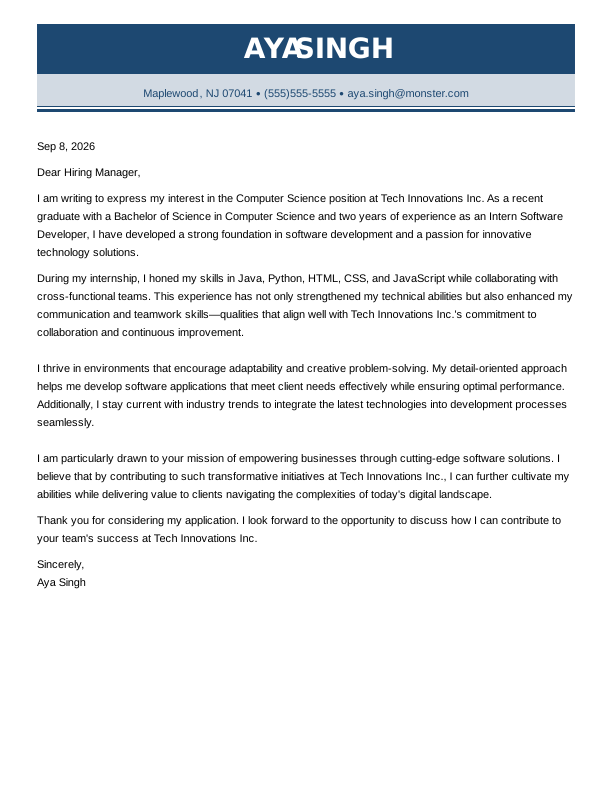
 Free
Science Entry-Level Cover Letter
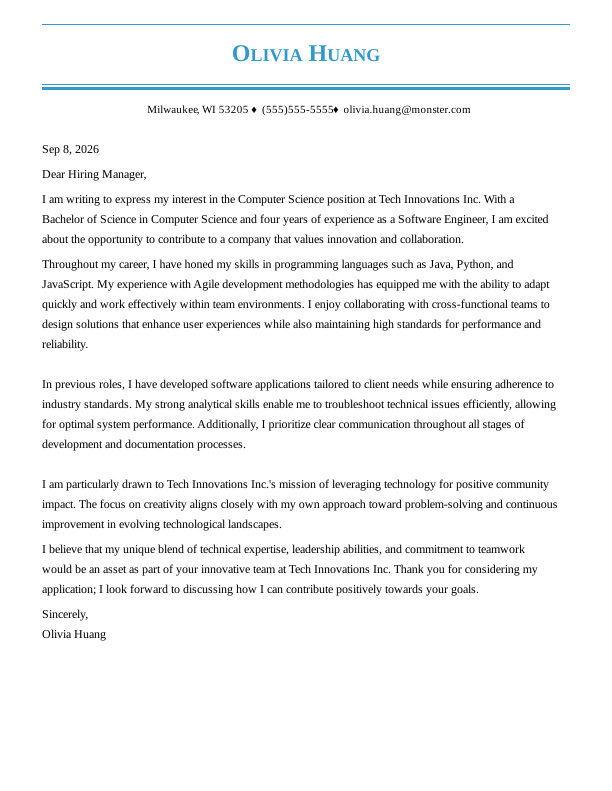
Science Mid-Level Cover Letter
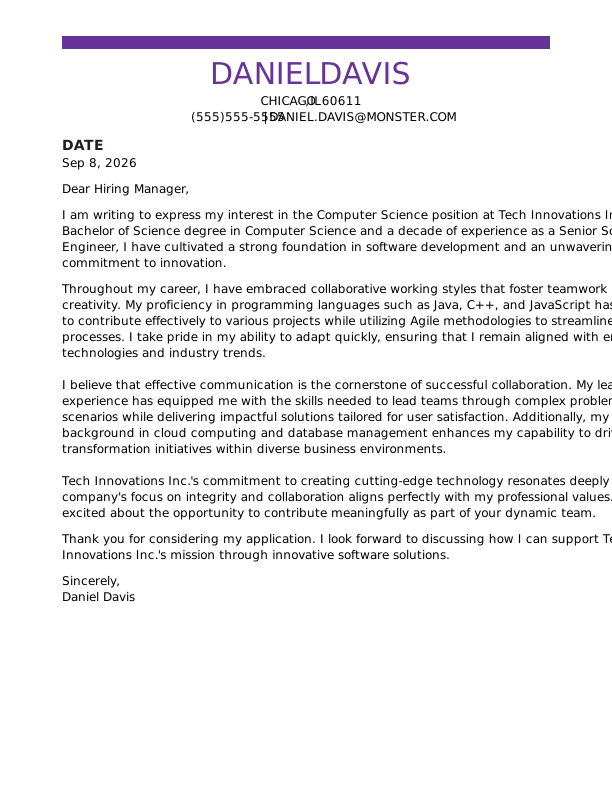
Science Experienced Cover Letter
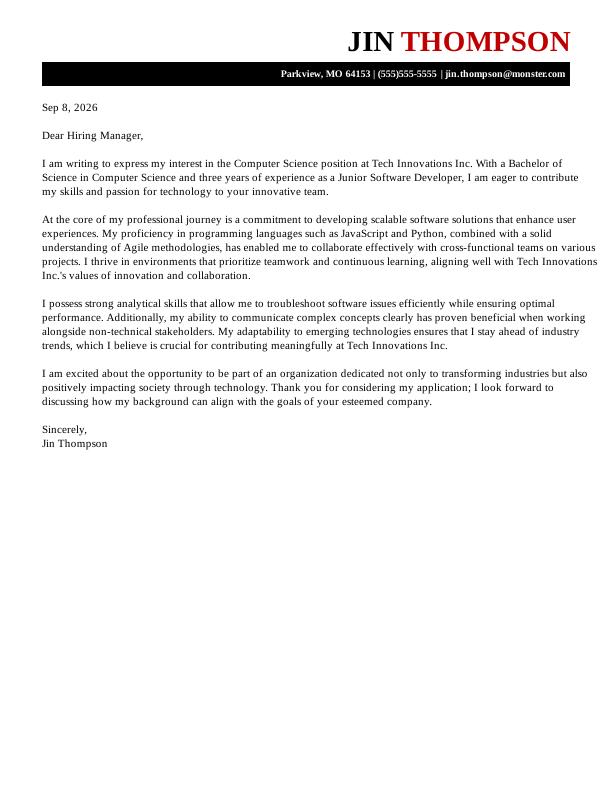
Science Entry-Level Cover Letter
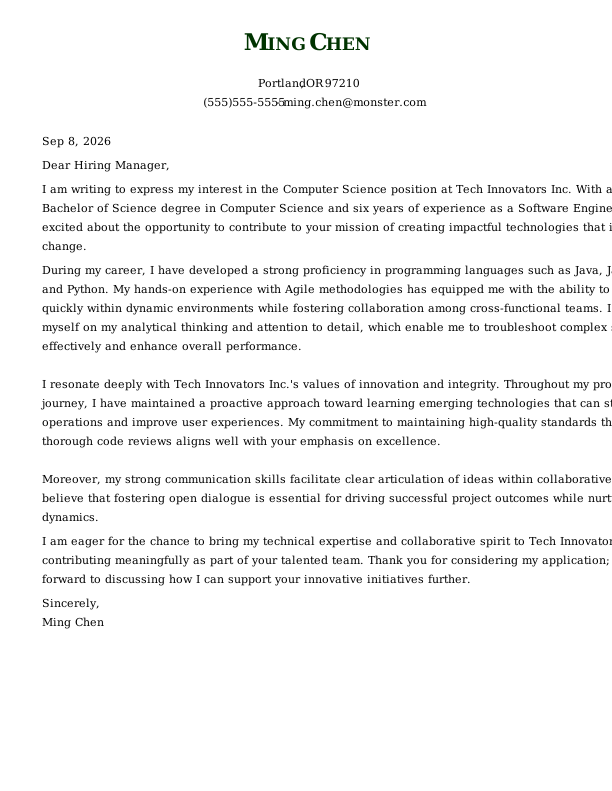
Science Mid-Level Cover Letter
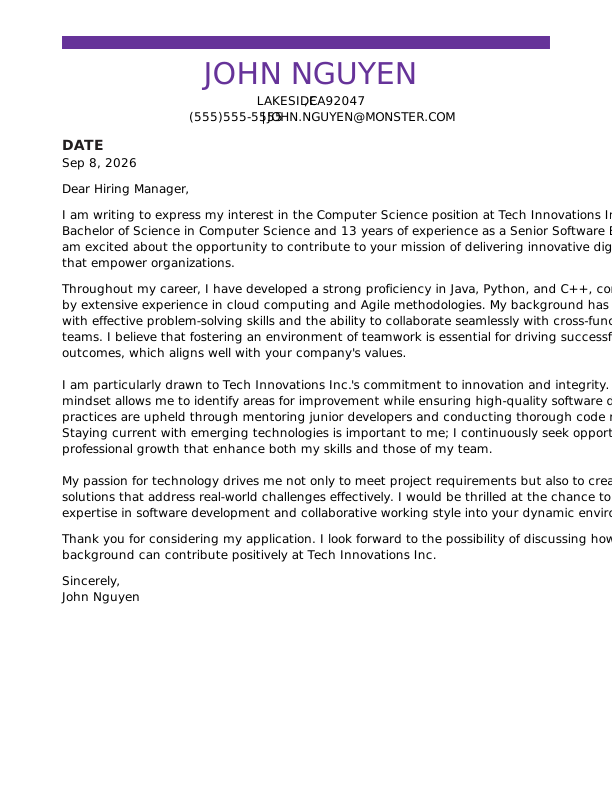
Science Experienced Cover Letter
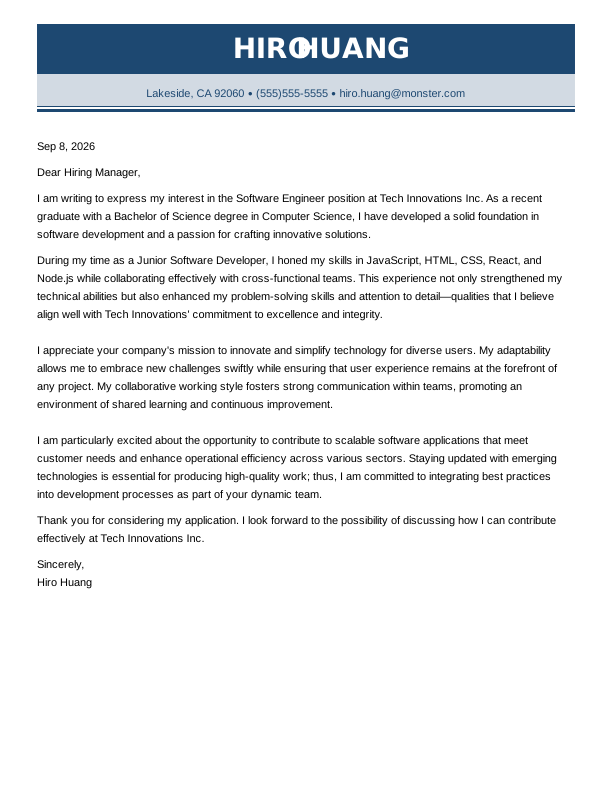
Science Entry-Level Cover Letter
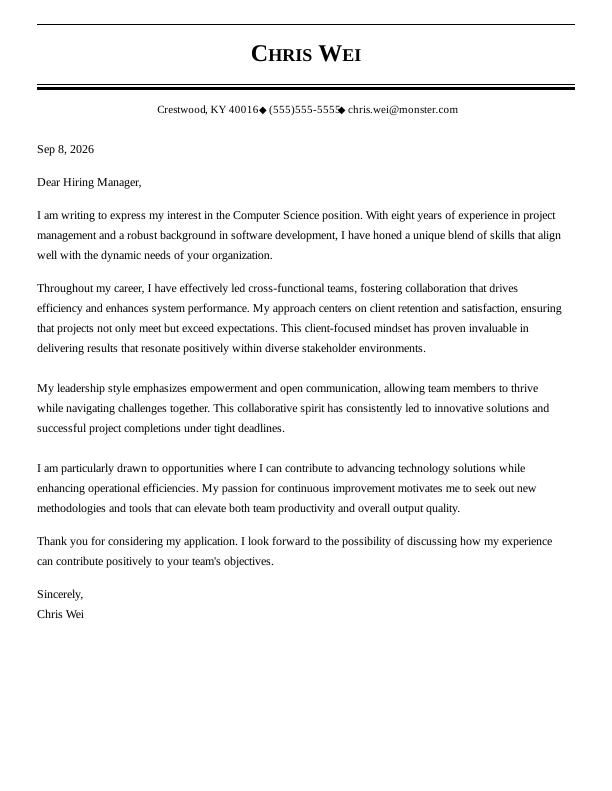
Science Mid-Level Cover Letter
Browse Free Cover Letter Templates
- Academic
- Account Manager
- Accountant
- Accounts Payable
- Administrative Assistant
- Admissions Counselor
- Architecture
- Artist
- Assistant Principal
- Babysitter
- Barista
- Bartender
- Bookkeeper
- Brand Ambassador
- Business Analyst
- Business
- Caregiver
- Chef
- Civil Engineering
- Computer Science
- Construction
- Consulting
- Copywriter
- Cosmetology
- Custodian
- Customer Service
- Customer Service Representative
- Data Analyst
- Data Entry
- Dental Assistant
- Dental Hygienist
- Digital Marketing
- Electrical Engineering
- Emt
- Engineering
- Esthetician
- Event Coordinator
- Executive Assistant
- Finance
- Financial Analyst
- Firefighter
- Flight Attendant
- Graphic Designer
- Hair Stylist
- Healthcare
- Hr Generalist
- Investment Banking
- It
- Janitor
- Journalism
- Lab Technician
- Law Clerk
- Lawyer
- Librarian
- Logistics
- Makeup Artist
- Manager
- Marketing Coordinator
- Marketing
- Marketing Manager
- Massage Therapist
- Mechanic
- Mechanical Engineer
- Medical Assistant
- Non Profit
- Nursing
- Occupational Therapy
- Office Assistant
- Office Manager
- Operations Manager
- Paralegal
- Personal Trainer
- Pharmacist
- Pharmacy Technician
- Photographer
- Physician Assistant
- Pilot
- Police Officer
- Program Manager
- Project Manager
- Property Manager
- Psychology
- Receptionist
- Research Assistant
- Restaurant Manager
- Retail
- Sales
- Sales Manager
- School Counselor
- Security Officer
- Social Work
- Software Engineer
- Special Education Teacher
- Substitute Teacher
- Teacher
- Teaching Assistant
- Truck Driver
- Vet Tech
- Veterinary Assistant
- Web Developer
Cover Letter Examples for Science Roles
Cover letter requirements evolve as a science career progresses, especially from entry-level lab work to leading projects and mentoring. Choose the template that matches your experience level so you can highlight relevant training, methods, and outcomes.
Entry-Level Science Cover Letter
Ideal for recent graduates and career changers, this template demonstrates how to present academic lab experience, technical coursework, and foundational research skills with confidence.
Mid-Career Science Cover Letter
Designed for candidates with several years of hands-on research experience, this template shows how to highlight independent experiment design, data pipelines, and cross-functional project support.
Experienced Science Cover Letter
Best suited for senior researchers and lab leaders, this template emphasizes program management, grant acquisition, team mentorship, and high-impact publication records.
Science Cover Letter Template (Text)
Copy this science cover letter template, paste it into your document, and swap in your research focus and key publications or metrics for the role.
Olivia Kim
Maplewood, NJ 07049
(555)555-5555
olivia.kim@monster.com
Oct 14, 2026
Dear Hiring Manager,
I am writing to express my interest in the research scientist position at Research Innovations Inc. With a Bachelor of Science degree in Biological Sciences and eight years of experience as a research scientist, I have developed a strong foundation in scientific research and data analysis that aligns with your organization’s commitment to advancing knowledge through innovation.
Throughout my career, I have successfully led projects that required meticulous attention to detail and adaptability in fast-paced environments. My role involved conducting experiments, analyzing complex data sets, and preparing comprehensive reports for diverse stakeholders. This experience has honed my problem-solving skills and reinforced the importance of collaboration within cross-functional teams.
I admire Research Innovations Inc.’s mission to foster curiosity and integrity while contributing positively to society through cutting-edge research. I believe that my strengths in critical thinking and technical writing will enable me to effectively contribute to your ongoing projects while ensuring compliance with safety standards.
Moreover, I am committed to staying current with industry trends, which allows me not only to inform project direction but also contributes towards innovative solutions that enhance both industries and lives. My collaborative working style aligns well with your organizational values, fostering an environment where creativity can thrive.
Thank you for considering my application. I look forward to the opportunity to discuss how my background can contribute effectively at Research Innovations Inc.
Sincerely,
Olivia Kim
How to Write a Science Cover Letter
Writing an effective science cover letter requires translating your lab notes, experimental results, and technical methods into clear proof that you can solve problems for a hiring team. Follow these steps to align your background with a specific job posting.
1. Research & Prepare
Before writing, learn about the research focus, instrumentation, and core data systems of the target organization. Discovering whether it prioritizes rapid trial turnaround, strict regulatory compliance, or novel discovery helps you highlight the exact skills and tools that matter most to its leadership.
Gather relevant background details by reviewing these key information sources:
- Scan the job posting for specific equipment, software platforms, and laboratory protocols required for the daily workflow.
- Review recent publications or news releases from the organization to understand its current studies and primary research goals.
- Check regulatory guidelines from agencies like the FDA or EMA to align your wording with the team’s compliance standards.
2. Hook the Reader
Start with a strong opening that demonstrates a clear understanding of daily scientific work. Avoid generic introductions like “I am writing to apply for the open scientist role.” Instead, grab the reader’s attention immediately with a specific technical achievement, method, or efficiency win.
Choose an opening line tailored to your experience using these example approaches:
- Assay performance: “By standardizing plate layouts and daily quality control checks, I improved assay reproducibility from 68% to 92% across our immunology studies.”
- Workflow efficiency: “I reduced sample processing time by 35% using automated liquid handling tools and a LIMS tracking system.”
- Research verification: “During a recent method validation study, I led the testing protocol that passed internal review on the first cycle and supported a peer-reviewed manuscript submission.”
3. Tell Your Professional Story
Use the body of your letter to show how you apply your training to real-world scientific challenges. While your resume lists past positions and credentials, your cover letter explains the outcomes of your experiments and projects. Including specific metrics makes your technical accomplishments far more convincing.
Incorporate concrete benchmarks like these to illustrate your impact:
- Co-authored three first-author papers after processing 1,200 samples through a standardized qPCR pipeline that reduced batch variance by 22%.
- Helped secure $180,000 in grant funding by presenting preliminary research data and clear project milestones.
- Raised predictive model accuracy from 0.74 to 0.81 by designing 40 ablation tests and expanding the training dataset to 25,000 records.
4. Showcase Your Skills
Rather than using broad self-descriptors like “detail-oriented” or “analytical,” illustrate how your skills resolved specific technical challenges in past work. Showing the exact moments where your thoroughness saved time, corrected data errors, or improved communication builds trust with hiring managers.
Connect your practical abilities directly to daily laboratory needs using these examples:
- Troubleshooting and quality control: “When an automated assay began producing inconsistent readings, I audited the calibration logs and fixed a fluidics alignment error before data was compromised.”
- Data integrity: “I managed experimental data using strict version control in Git, reviewing code updates line by line to ensure analysis pipelines remained accurate and reproducible.”
- Cross-functional communication: “When study requirements were ambiguous, I met with project managers to clarify goals and drafted a plain-language summary for our lab technicians.”
5. Explain Any Special Circumstances
If you have an employment gap, career pivot, or recent relocation, address it briefly in one or two direct sentences. Focus your explanation on your current technical readiness, active certifications, and refreshed lab skills so the employer knows you are fully prepared to contribute.
Frame your circumstances clearly using these straightforward approaches:
- Addressing an employment gap: “During a year away from formal lab work, I maintained my technical edge by completing GLP documentation training and completing advanced data analysis coursework.”
- Transitioning focus areas: “I am pivoting from wet lab research to computational biology by building open-source analysis pipelines in Python and publishing datasets on GitHub.”
- Managing relocation: “After moving last fall, I updated my active biosafety certifications and am ready to start immediately in a local research facility.”
6. End With a Professional Goodbye
Conclude your letter with a polite, confident statement that invites the hiring manager to discuss your research background further. Keep your sign-off concise, thank the reader for their time, and offer a specific topic for an upcoming interview.
Structure your final paragraph using this clear approach:
- Offer a clear next step: “I would welcome the opportunity to discuss how my experience in experimental design and data analysis can support your current research goals.”
- Express gratitude: “Thank you for your time and consideration.”
- End with a professional closing line: “Best regards,” followed by your full name.
4 Tips for Formatting Your Cover Letter
When you apply for a science role, hiring managers often perform a quick initial scan to check for specific methods, relevant instrumentation, and familiar software tools. A clean visual presentation with consistent spacing and logical organization ensures your key research achievements stand out immediately. Taking the time to format your cover letter properly demonstrates the same attention to detail and precision required in a laboratory setting.

Keep It to One Page
A strong science cover letter fits on a single page, ideally between 250 and 400 words spread across three to four short paragraphs. Keeping your message concise ensures that busy lab directors can easily find your core methods, major project outcomes, and technical skills without getting bogged down in unnecessary detail.

Use a Professional Font & Layout
Select standard, highly legible fonts such as Helvetica, Arial, Georgia, or Times New Roman in 10–12 pt size. Maintain clean 1-inch margins and use the exact same header design as your resume so your entire application package presents a clean, consistent look.

Use Bullet Points for Key Achievements
Incorporate three or four bullet points in the middle of your letter to draw attention to major research milestones, published findings, or technical efficiencies. Bulleted lists break up dense text, making it simple for reviewers to spot your top metrics and compare your qualifications against the job requirements.

Save & Send as a PDF
Save your completed cover letter as a PDF to preserve your formatting, margins, and layout across different operating systems and application platforms. Name the file clearly using a professional format, such as Firstname_Lastname_Cover_Letter.pdf, and consider adding your degree or highest credential to the filename.
Top-Paying States for Science Roles
Knowing what science professionals earn can help you compare offers, plan your next move, and negotiate with confidence. Salary figures in the U.S. are often tracked by the U.S. Bureau of Labor Statistics (BLS), which publishes nationwide pay data for many science-related roles.
Keep in mind that your actual earnings may vary based on location, years of experience, education level, and whether you work in research labs, industry, government, or universities. Specialty areas like biotech or environmental science can also affect pay, as can demand in your region.
| Alabama | $127,650 |
| Alaska | $130,570 |
| Arizona | $136,550 |
| Arkansas | $156,220 |
| California | $219,470 |
| Connecticut | $192,360 |
| Delaware | $92,060 |
| District of Columbia | $162,620 |
| Florida | $129,030 |
| Georgia | $117,990 |
| Hawaii | $127,300 |
| Idaho | $128,440 |
| Illinois | $166,910 |
| Indiana | $108,850 |
| Iowa | $126,500 |
| Kansas | $163,250 |
| Kentucky | $135,590 |
| Louisiana | $100,740 |
| Maine | $152,370 |
| Maryland | $174,950 |
| Massachusetts | $229,780 |
| Michigan | $155,020 |
| Minnesota | $144,660 |
| Mississippi | $117,320 |
| Missouri | $144,510 |
| Montana | $134,660 |
| Nebraska | $117,460 |
| Nevada | $110,950 |
| New Hampshire | $160,070 |
| New Jersey | $207,130 |
| New Mexico | $153,380 |
| New York | $145,890 |
| North Carolina | $182,560 |
| North Dakota | $139,210 |
| Ohio | $140,730 |
| Oklahoma | $120,670 |
| Oregon | $146,500 |
| Pennsylvania | $157,740 |
| Rhode Island | $152,970 |
| South Carolina | $147,240 |
| South Dakota | $130,840 |
| Tennessee | $146,790 |
| Texas | $136,950 |
| Utah | $128,920 |
| Vermont | $104,380 |
| Virginia | $148,370 |
| Washington | $204,820 |
| West Virginia | $138,380 |
| Wisconsin | $137,270 |
| Wyoming | $113,780 |
| Guam | $97,380 |
| Puerto Rico | $111,050 |
| Virgin Islands | $63,200 |
Key Takeaways
- Describe a specific study where you controlled variables and interpreted the data to prove your experimental design skills.
- Use metrics like assay sensitivity, sample throughput, or publication counts to quantify your technical impact.
- Tailor your letter to the target environment by emphasizing novelty for academic labs, regulatory compliance for biotech, or standardized protocols for government agencies.
More Cover Letter Examples
Browse Monster’s Resume Templates
Monster also has hundreds of ATS-friendly resume templates for all career levels and industries. Create a matching resume to help you land the interview.
Frequently Asked Questions
Last Update:
Do I really need a cover letter?
Yes, including a cover letter with your application for a science role is strongly recommended, even when it is listed as optional. A resume lists your past roles and degrees, but a cover letter explains the story behind your research, your technical problem-solving approach, and your enthusiasm for a specific project. It also provides space to explain career shifts or employment gaps cleanly.
How long should my cover letter be?
A science cover letter should be one page long and stay between 250 and 400 words. Hiring teams often review many applications, so direct and concise writing makes a stronger impression. Focus your text on three or four short paragraphs that highlight your most relevant laboratory methods, technical tools, and measurable research accomplishments without adding filler.
Should my cover letter match my resume?
Matching your cover letter to your resume creates a professional, unified look for your application package. Use identical fonts, margin sizes, color choices, and contact header designs across both documents. Instead of repeating the bullet points from your resume, use your cover letter to expand on a specific research accomplishment or explain how your background aligns with the team’s goals.
How do I address my cover letter if I don’t know the hiring manager’s name?
When addressing a cover letter without a contact name, try searching the job posting, organization website, or professional networks for the department head or lead recruiter. If you cannot find a specific name, address your letter to “Dear Hiring Manager” or “Dear Research Selection Committee.” Avoid using “To Whom It May Concern,” as it sounds outdated.
Can I use AI to write my cover letter?
Using AI tools can help you outline your science cover letter and organize your thoughts, but you should rewrite the draft heavily before submitting it. AI-generated text often uses generic phrasing that lacks the specific laboratory methods, experimental results, and technical details hiring managers look for. Personalizing the content ensures the letter accurately reflects your unique scientific background.

Elizabeth Muenzen is a Certified Professional Resume Writer (CPRW) and member of the Professional Association of Resume Writers & Career Coaches who empowers job seekers to take control of their career paths using Monster’s comprehensive job search and resume tools.
See More From Elizabeth MuenzenExplore Related Career Advice







How to Write a Cover Letter for Internal Positions or Promotions (Examples & Tips)

Updated:
Apr 23, 2026
|
19 min read


Cover Letter vs Resume: What’s the Difference & Do You Need Both?
Updated:
Apr 23, 2026
|
18 min read