

Free Restaurant Cover Letter Templates & Examples
A strong restaurant cover letter shows you can deliver friendly service while keeping orders accurate, safe, and on time. Our free examples and step-by-step guidance help you present your experience clearly so hiring managers see your value right away.
Real-World Cover Letters That Get Results
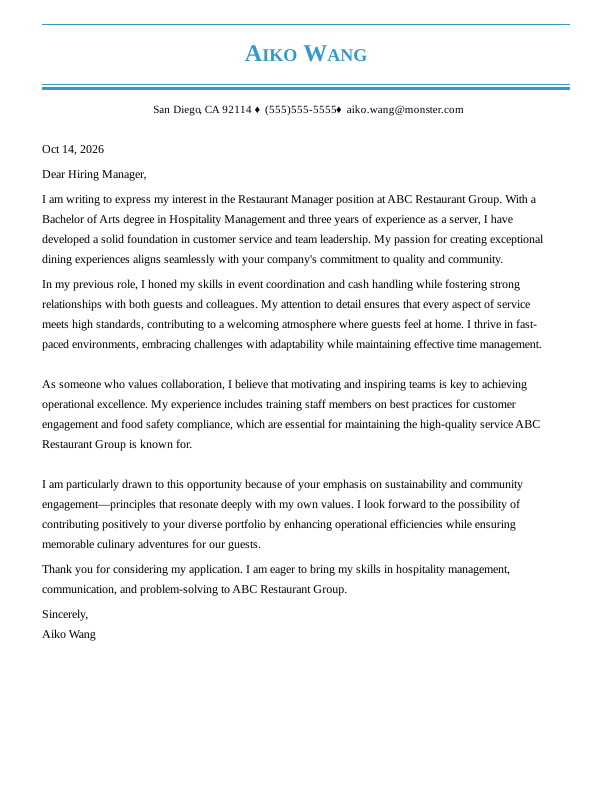
 Free
Restaurant Entry-Level Cover Letter
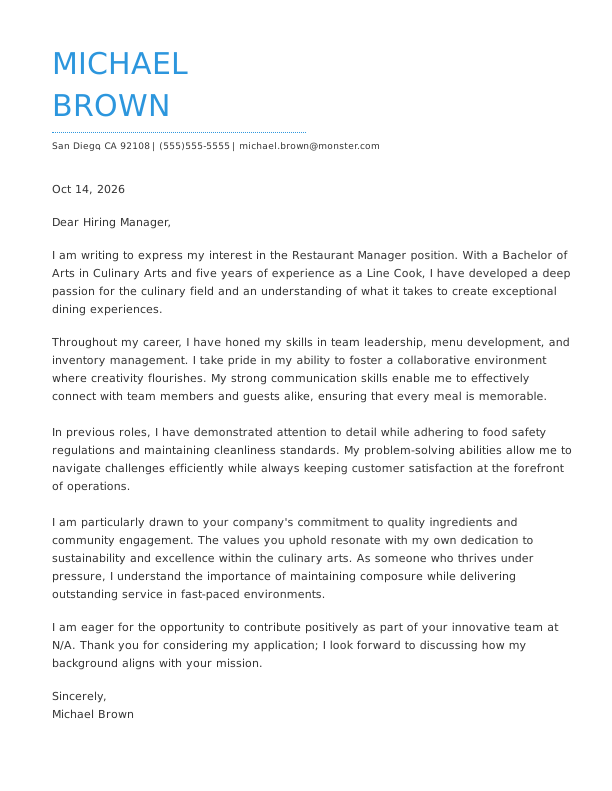
Restaurant Mid-Level Cover Letter
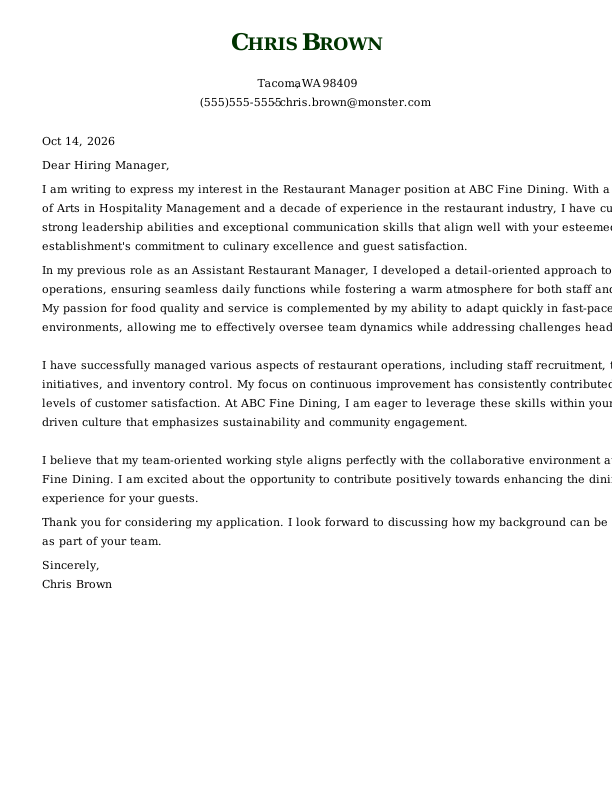
Restaurant Experienced Cover Letter
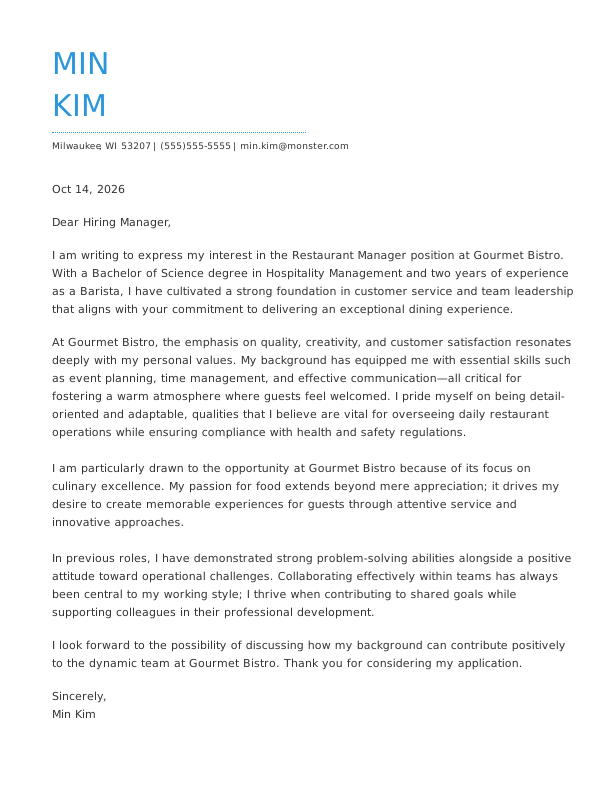
Restaurant Entry-Level Cover Letter
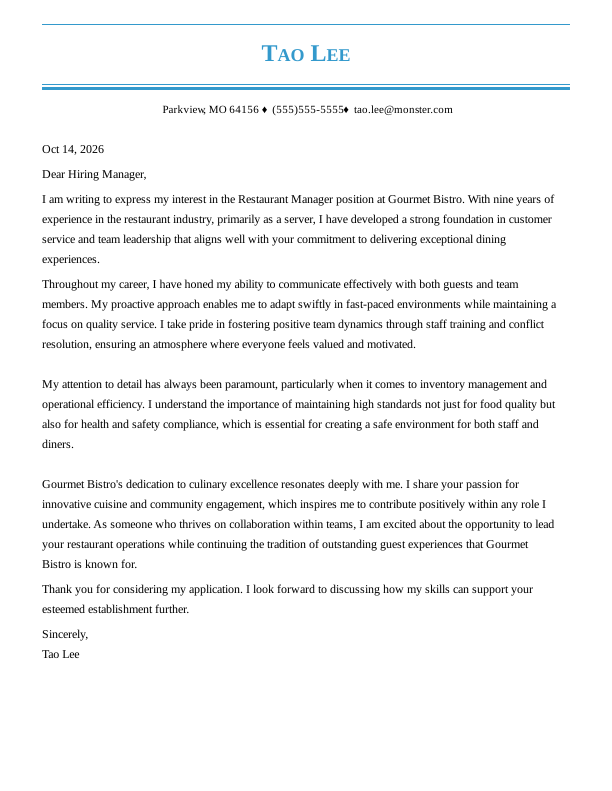
Restaurant Mid-Level Cover Letter
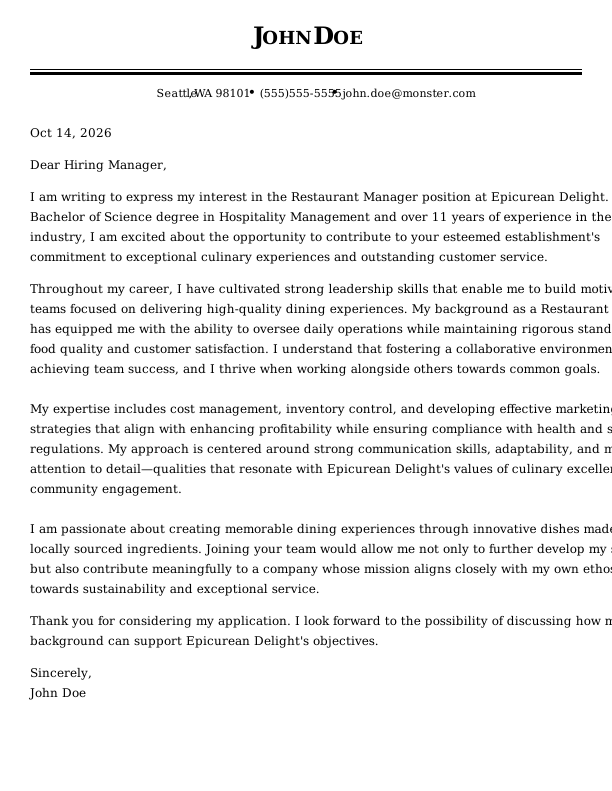
Restaurant Experienced Cover Letter
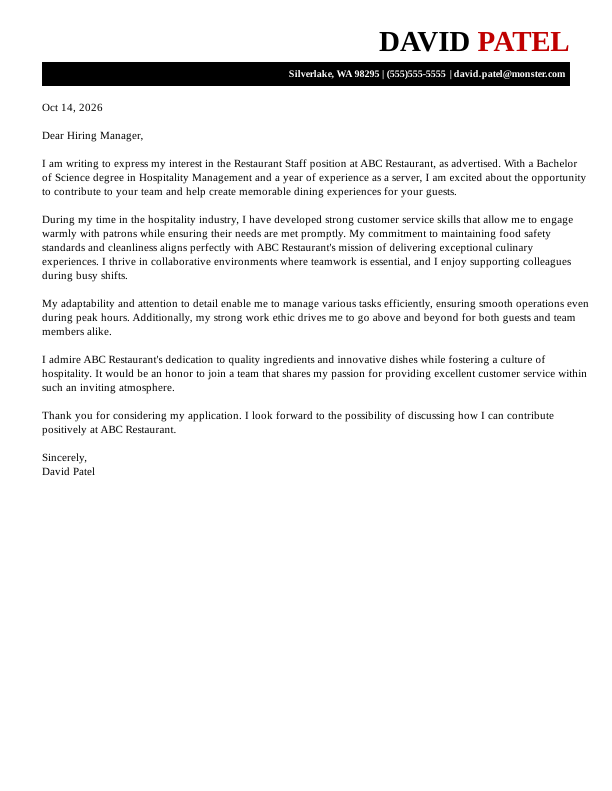
Restaurant Entry-Level Cover Letter
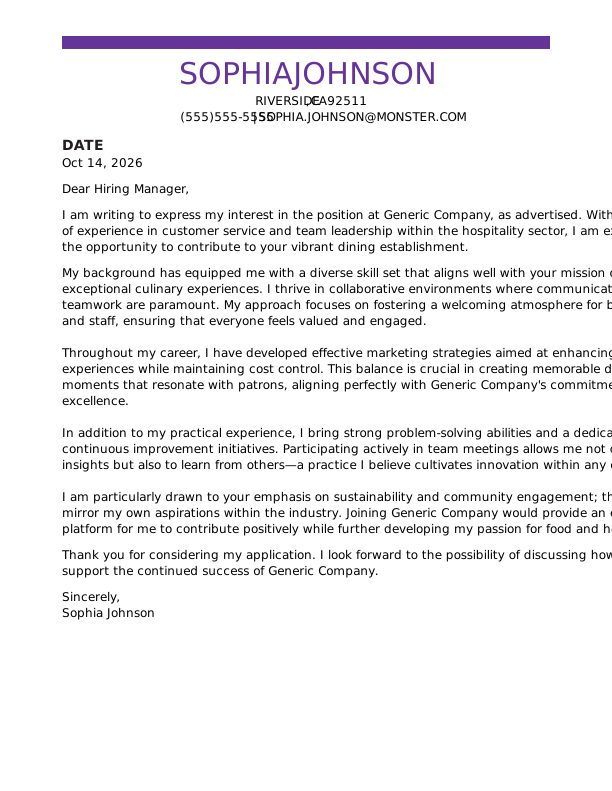
Restaurant Mid-Level Cover Letter
Browse Free Cover Letter Templates
- Academic
- Account Manager
- Accountant
- Accounts Payable
- Administrative Assistant
- Admissions Counselor
- Architecture
- Artist
- Assistant Principal
- Babysitter
- Barista
- Bartender
- Bookkeeper
- Brand Ambassador
- Business Analyst
- Business
- Caregiver
- Chef
- Civil Engineering
- Computer Science
- Construction
- Consulting
- Copywriter
- Cosmetology
- Custodian
- Customer Service
- Customer Service Representative
- Data Analyst
- Data Entry
- Dental Assistant
- Dental Hygienist
- Digital Marketing
- Electrical Engineering
- Emt
- Engineering
- Esthetician
- Event Coordinator
- Executive Assistant
- Finance
- Financial Analyst
- Firefighter
- Flight Attendant
- Graphic Designer
- Hair Stylist
- Healthcare
- Hr Generalist
- Investment Banking
- It
- Janitor
- Journalism
- Lab Technician
- Law Clerk
- Lawyer
- Librarian
- Logistics
- Makeup Artist
- Manager
- Marketing Coordinator
- Marketing
- Marketing Manager
- Massage Therapist
- Mechanic
- Mechanical Engineer
- Medical Assistant
- Non Profit
- Nursing
- Occupational Therapy
- Office Assistant
- Office Manager
- Operations Manager
- Paralegal
- Personal Trainer
- Pharmacist
- Pharmacy Technician
- Photographer
- Physician Assistant
- Pilot
- Police Officer
- Program Manager
- Project Manager
- Property Manager
- Psychology
- Receptionist
- Research Assistant
- Restaurant Manager
- Retail
- Sales
- Sales Manager
- School Counselor
- Security Officer
- Social Work
- Software Engineer
- Special Education Teacher
- Substitute Teacher
- Teacher
- Teaching Assistant
- Truck Driver
- Vet Tech
- Veterinary Assistant
- Web Developer
Cover Letter Examples for Restaurants
Cover letter expectations change as a restaurant career progresses from training and line work to leading shifts, managing inventory, or coordinating service. Pick the template that matches your experience level so you can highlight the right skills, such as food safety training, guest service results, or team supervision.
Entry-Level Restaurant Cover Letter
Designed for recent graduates and career changers, this template demonstrates how to present transferable customer service, teamwork, and communication skills with confidence when applying for foundational restaurant roles.
Mid-Career Restaurant Cover Letter
Tailored for candidates with several years of hands-on experience, this template shows how to highlight shift leadership, inventory oversight, menu execution, and cross-functional team coordination.
Experienced Restaurant Cover Letter
Ideal for senior professionals and managers, this template emphasizes operational leadership, staff recruitment, budget control, and high-standard guest satisfaction across busy service environments.
Restaurant Cover Letter Template (Text)
Copy this restaurant cover letter template, paste it into your document, and customize it with your shifts, guest reviews, or preferred location name.
Sophia Rodriguez
Greenfield, IN 46141
(555)555-5555
sophia.rodriguez@monster.com
Oct 14, 2026
Dear Hiring Manager,
I am writing to express my interest in the restaurant manager position at Target Restaurant Co. With a Bachelor of Arts in Hospitality Management and four years of experience as a server, I have developed a solid foundation in customer service and team leadership that aligns well with your commitment to exceptional dining experiences.
At Target Restaurant Co., I admire your dedication to quality food and service, as well as your focus on creating welcoming environments for guests. My background has equipped me with strong communication skills and problem-solving capabilities, which are essential in managing daily restaurant operations effectively. I thrive in team-oriented settings, where collaboration fosters an atmosphere conducive to both staff satisfaction and guest delight.
Throughout my career, I have honed my abilities in inventory management and staff training. These experiences have not only enhanced my attention to detail but also reinforced the importance of maintaining high standards of health and safety compliance within the workplace.
Moreover, I bring a proactive approach to developing marketing strategies aimed at increasing visibility while ensuring customer engagement remains at the forefront. My ability to work efficiently under pressure allows me to adapt swiftly to changing circumstances without compromising service quality or operational integrity.
I am excited about the opportunity to contribute positively to Target Restaurant Co.’s mission. Thank you for considering my application; I look forward to discussing how my background can support your goals.
Sincerely,
Sophia Rodriguez
How to Write a Restaurant Cover Letter
Writing an effective restaurant cover letter requires showing hiring managers that you understand fast-paced shift rhythms, guest service standards, and food safety practices. Follow these steps to align your experience with a specific restaurant posting.
1. Research & Prepare
Before writing, learn about the restaurant’s service style, target audience, and operational pace. Discovering whether the business relies on high-volume table turns, fine-dining guest pacing, or specialized POS software helps you highlight the exact skills that matter most to the general manager or chef.
Gather actionable context by exploring these key information sources:
- Review the job posting for specific POS systems, reservation platforms, or required shift availability.
- Explore the restaurant’s online menu and social media pages to understand its culinary style, seasonal offerings, and brand voice.
- Check local health department guidelines to align your language with current sanitation and food safety expectations.
2. Hook the Reader
Start your letter with an engaging opening line that immediately highlights your restaurant experience and comfort during peak service hours. Avoid generic openings like “I am writing to apply for the open server position.” Instead, grab the hiring manager’s attention by leading with a concrete accomplishment or operational win.
Choose an opening line tailored to your background using these example approaches:
- Service pace: “On busy Friday nights, I kept ticket times under 10 minutes by leading pre-shift station huddles and organizing server pass-throughs.”
- Food waste reduction: “I reduced kitchen food waste by 18% in my last position by adjusting daily prep par levels and tracking inventory against weekly deliveries.”
- Compliance leadership: “During peak dinner rushes, I maintained flawless health inspection standards by enforcing closing sanitizer checks and temperature logs.”
3. Tell Your Professional Story
Use the body of your letter to give hiring managers a clear view of your performance during demanding shifts. While your resume lists past positions and general duties, your cover letter explains how you manage floor rushes, resolve guest issues, and keep operations running smoothly. Using specific numbers makes your accomplishments far more compelling.
Incorporate concrete benchmarks like these to illustrate your impact:
- Reduced average guest wait time by 42% by redesigning host stand procedures and implementing a two-step greeting process.
- Increased weekly sales by $18,500 after introducing seasonal menu pairings and training front-of-house staff on upselling techniques.
- Raised order accuracy from 93% to 98% by standardizing ticket review processes across six kitchen stations.
4. Showcase Your Skills
Rather than using broad self-descriptors like “hardworking” or “people person,” illustrate how your skills resolve real daily challenges on the floor or in the kitchen. Showing the exact moments where your focus saved time, fixed a mistake, or pleased a guest builds trust with the employer.
Connect your practical abilities directly to daily restaurant needs using these examples:
- Order accuracy: “I verified every dish modification against the POS ticket before running plates to ensure allergy requests and special orders were accurate.”
- Team communication: “During heavy rushes, I maintained constant verbal checks with the kitchen line to confirm ticket timing before stepping back out to my floor section.”
- Guest resolution: “When a guest expressed dissatisfaction with a meal, I addressed their concern immediately, coordinated a fresh order with the kitchen, and followed up to ensure a positive experience.”
5. Explain Any Special Circumstances
If you have an employment gap, are changing roles, or recently moved, address it briefly in one or two direct sentences. Focus your explanation on your current availability, active certifications, and refreshed service skills so the manager knows you are ready to jump onto the schedule.
Frame your circumstances clearly using these straightforward approaches:
- Addressing an employment gap: “Following a six-month seasonal break, I refreshed my skills by completing updated Toast POS training and taking shifts at a high-volume kitchen.”
- Transitioning positions: “I am moving from prep cook to line cook after completing intensive station training and practicing high-speed mise en place techniques.”
- Handling relocation: “After moving to the area last month, I renewed my local food handler certifications and am fully available for open evening and weekend shifts.”
6. End With a Professional Goodbye
Conclude your letter with a polite, confident statement that invites the hiring manager to contact you for an interview. Keep your sign-off concise, thank the reader for their time, and express enthusiasm for contributing to their dining room or kitchen team.
Structure your final paragraph using this clear approach:
- Offer a clear next step: “I would welcome the opportunity to discuss how my fast-paced service experience and focus on guest satisfaction can support your team during peak hours.”
- Express gratitude: “Thank you for your time and consideration.”
- End with a clean sign-off: “Best regards,” followed by your full name.
4 Tips for Formatting Your Cover Letter
When you apply for a restaurant position, hiring managers often scan your application in seconds while managing daily floor or kitchen operations. They look quickly for schedule availability, relevant experience, and role-specific skills like POS familiarity or food safety credentials. A clean presentation with clear spacing and consistent organization ensures your application is easy to read and shows that you take pride in professional standards.

Match Your Header to Your Resume
Use the exact same name layout, typography, contact details, and location formatting on both your cover letter and resume. A matching header allows hiring managers to instantly recognize your application package and confirm your contact information at a glance.

Use Bullet Points for Key Achievements
Incorporate three to four bullet points in the body of your letter to highlight key metrics like average ticket sizes, inventory control numbers, or guest satisfaction scores. Bulleted lists break up dense text, making it simple for busy managers to spot your top contributions during a quick scan.

Balance Spacing & Margins
Set line spacing between 1.0 and 1.15, leaving a full blank line between paragraphs to keep the layout clean and readable. Use uniform margins between 0.75 and 1 inch so your letter looks well-proportioned on screens and printed copies.

Save & Send as a PDF
Save your final cover letter as a PDF to prevent formatting shifts or layout errors across different operating systems or mobile devices. Use a clean, professional filename like Firstname_Lastname_Cover_Letter.pdf to make your document easy for recruiters to save and organize.
Top-Paying States for Restaurant Roles
Knowing what restaurant staff earn helps you compare offers and plan your next move. Salary and hourly wage data are commonly tracked by the U.S. Bureau of Labor Statistics (BLS), which publishes nationwide figures for many restaurant roles.
Your pay can vary based on where you work, your experience level, and whether the position relies on tips, like servers or bartenders. Scheduling can also matter since weekend and evening shifts often change total earnings. If you’re moving into a supervisory role, expect pay to reflect added responsibility.
| Alabama | $31,510 |
| Alaska | $40,580 |
| Arizona | $39,660 |
| Arkansas | $30,970 |
| California | $44,240 |
| Connecticut | $40,190 |
| Delaware | $37,450 |
| District of Columbia | $44,890 |
| Florida | $36,620 |
| Georgia | $33,630 |
| Hawaii | $46,330 |
| Idaho | $33,420 |
| Illinois | $37,840 |
| Indiana | $33,670 |
| Iowa | $35,280 |
| Kansas | $33,730 |
| Kentucky | $32,340 |
| Louisiana | $30,280 |
| Maine | $44,320 |
| Maryland | $39,060 |
| Massachusetts | $45,160 |
| Michigan | $36,150 |
| Minnesota | $40,020 |
| Mississippi | $29,690 |
| Missouri | $35,730 |
| Montana | $38,230 |
| Nebraska | $36,280 |
| Nevada | $40,150 |
| New Hampshire | $40,390 |
| New Jersey | $40,900 |
| New Mexico | $34,160 |
| New York | $42,890 |
| North Carolina | $34,820 |
| North Dakota | $35,530 |
| Ohio | $33,230 |
| Oklahoma | $33,320 |
| Oregon | $40,350 |
| Pennsylvania | $34,140 |
| Rhode Island | $41,470 |
| South Carolina | $34,690 |
| South Dakota | $35,150 |
| Tennessee | $35,030 |
| Texas | $33,250 |
| Utah | $37,290 |
| Vermont | $44,140 |
| Virginia | $37,840 |
| Washington | $44,860 |
| West Virginia | $30,150 |
| Wisconsin | $37,080 |
| Wyoming | $37,690 |
| Guam | $24,340 |
| Puerto Rico | $25,640 |
| Virgin Islands | $35,940 |
Key Takeaways
- Prioritize service speed and order precision by highlighting a specific moment where you corrected an issue or managed a floor rush successfully.
- Include concrete performance numbers such as average ticket values, table turn rates, or labor cost percentages to prove your operational efficiency.
- Tailor your letter to the dining environment by focusing on throughput for fast-casual, high-touch pacing for fine dining, or shift control for high-volume bars.
More Cover Letter Examples
Browse Monster’s Resume Templates
Monster also has hundreds of ATS-friendly resume templates for all career levels and industries. Create a matching resume to help you land the interview.
- Agriculture
- Baker
- Banquet Server
- Bar Manager
- Barback
- Barista
- Bartender
- Busser
- Cake Decorator
- Catering
- Chef
- Cook
- Dietary Aide
- Dishwasher
- Executive Chef
- Fast Food
- Fine Dining Server
- Food And Beverage Director
- Food And Beverage Manager
- Food Runner
- Hostess
- Kitchen Manager
- Line Cook
- Mcdonald's
- Meat Cutter
- Pastry Chef
- Prep Cook
- Private Chef
- Restaurant General Manager
- Restaurant Manager
- Restaurant
- Restaurant Server
- Shift Leader
- Sommelier
- Sous Chef
- Starbucks
- Waiter
- Waitress
Frequently Asked Questions
Last Update:
Do I really need a cover letter?
Yes, a cover letter is strongly recommended for restaurant roles because it adds professional context that a resume cannot provide on its own. While a resume lists past jobs, a cover letter shows how you handle fast-paced shifts, work with team members, and deliver great guest experiences. It also offers a great space to explain employment gaps or career changes.
How long should my cover letter be?
A restaurant cover letter should be one page maximum, targeting between 250 and 400 words. Hiring managers review applications quickly between shifts, so direct, concise messaging works best. Keep your letter to three or four short paragraphs that focus strictly on your service achievements, floor experience, and relevant safety certifications without adding unnecessary filler text.
Should my cover letter match my resume?
Yes, your restaurant cover letter should match your resume’s visual formatting to create a polished, cohesive application package. Use the same font styles, margins, color choices, and contact header across both documents. Instead of repeating your resume bullet points, use your cover letter to expand on key accomplishments, such as improving order turnaround times or boosting guest satisfaction.
What should I include in my cover letter header?
Your cover letter header for a restaurant position should include your full name, phone number, professional email address, and general location. Beneath your contact information, add the current date, followed by the recipient’s name, title, and restaurant name if available. Keeping this header identical to your resume header gives your entire application a clean, intentional presentation.
How do I write a cover letter for an internal position?
When writing an internal restaurant cover letter, restate your knowledge of the business’s shift flows, prep routines, and safety standards. Mention how you helped improve order turnaround times, reduced ticket errors, or supported station handoffs in your current role. Express your desire to mentor new team members and take on added shift responsibilities while following all formal internal application steps.

Elizabeth Muenzen is a Certified Professional Resume Writer (CPRW) and member of the Professional Association of Resume Writers & Career Coaches who empowers job seekers to take control of their career paths using Monster’s comprehensive job search and resume tools.
See More From Elizabeth MuenzenExplore Related Career Advice






How to Write a Cover Letter for Internal Positions or Promotions (Examples & Tips)

Updated:
Apr 23, 2026
|
19 min read


Cover Letter vs Resume: What’s the Difference & Do You Need Both?
Updated:
Apr 23, 2026
|
18 min read