


Free Social Services Cover Letter Templates & Examples
A strong social services cover letter shows your passion for helping others and your ability to connect people with vital resources. Use our free examples and practical tips to build a cover letter that highlights your real-world impact and earns a hiring team’s trust.
Real-World Cover Letters That Get Results
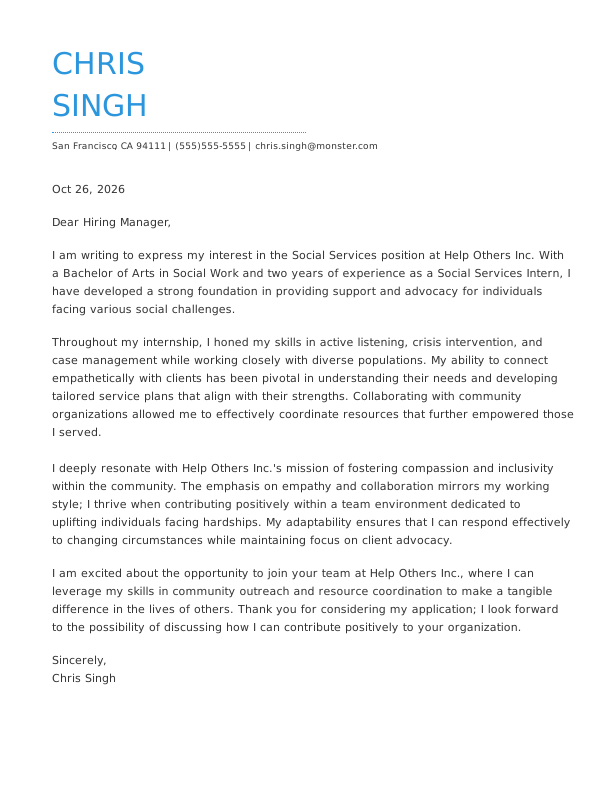
 Free
Social Services Entry-Level Cover Letter
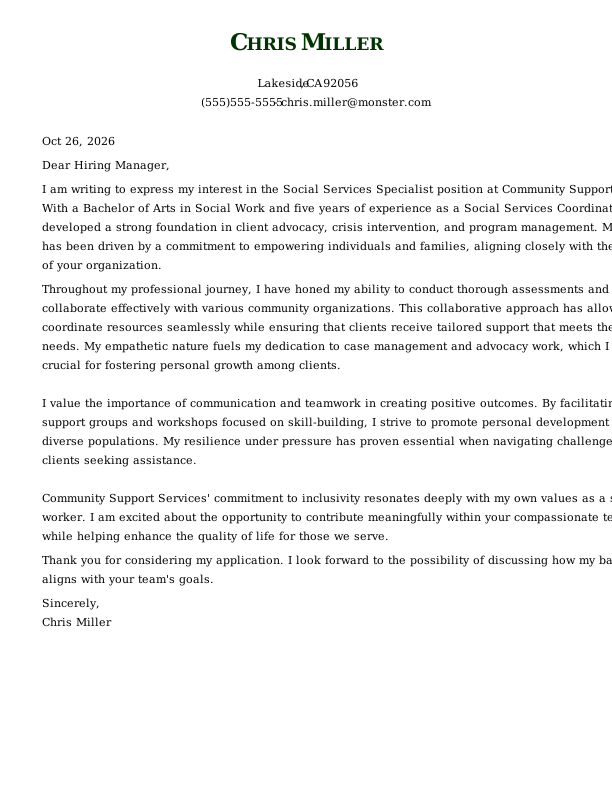
Social Services Mid-Level Cover Letter
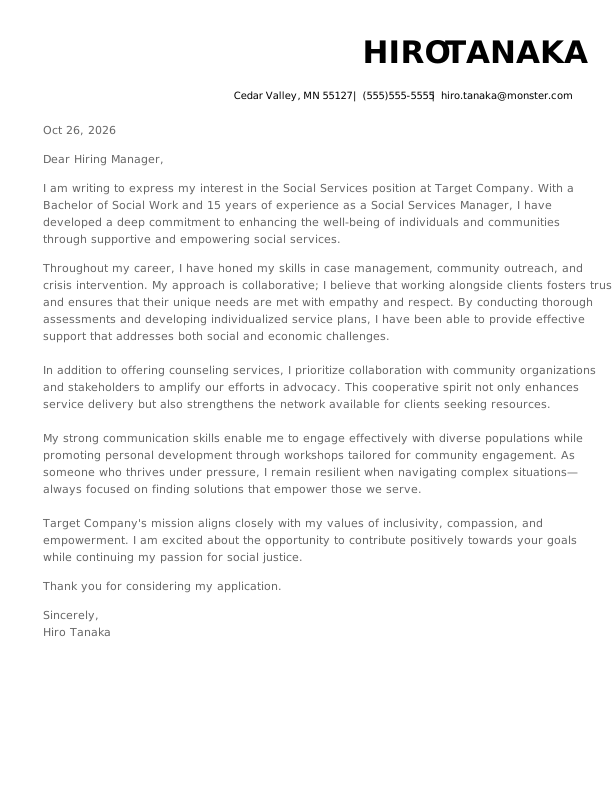
Social Services Experienced Cover Letter
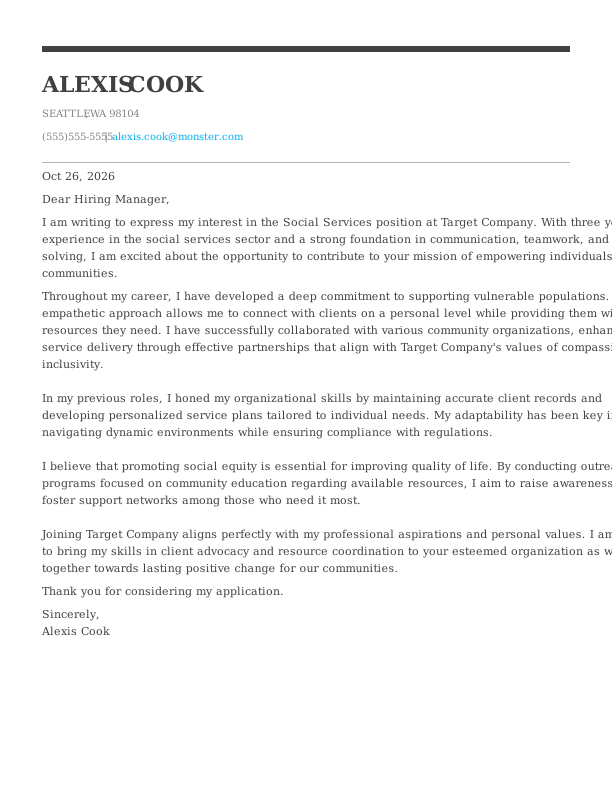
Social Services Entry-Level Cover Letter
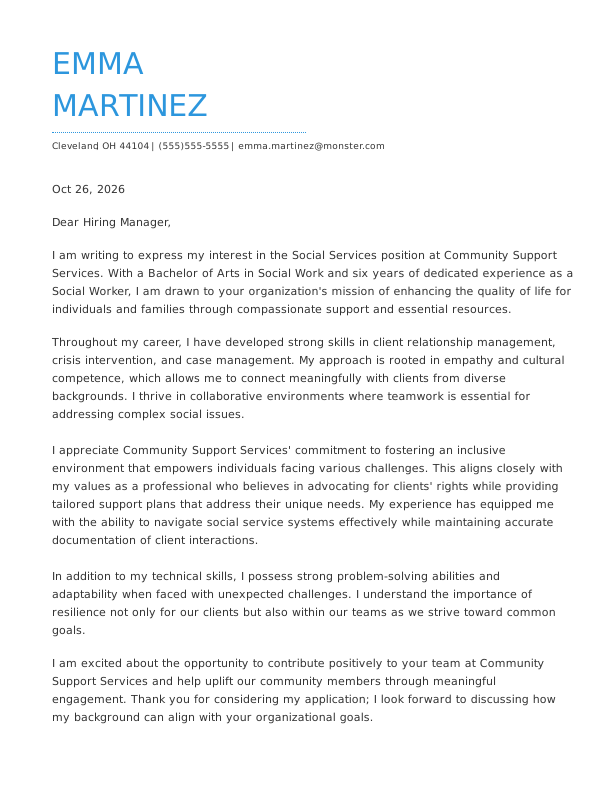
Social Services Mid-Level Cover Letter
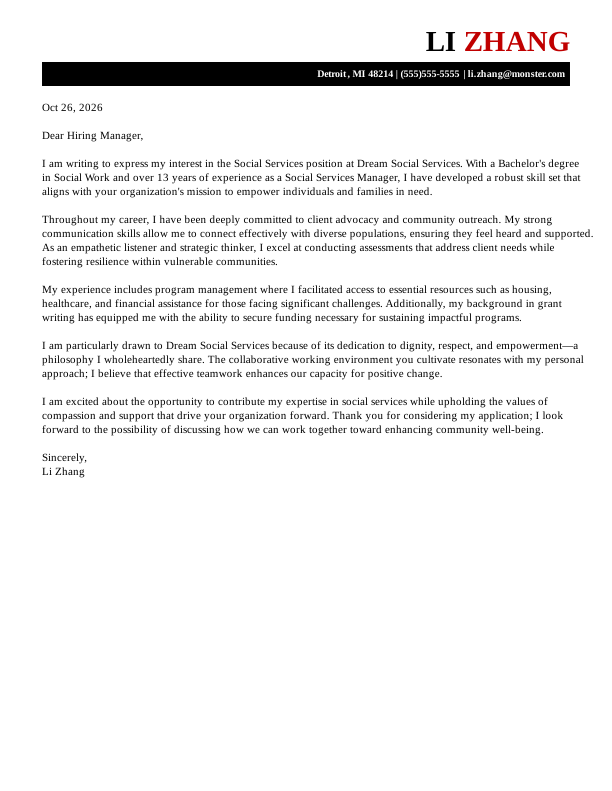
Social Services Experienced Cover Letter
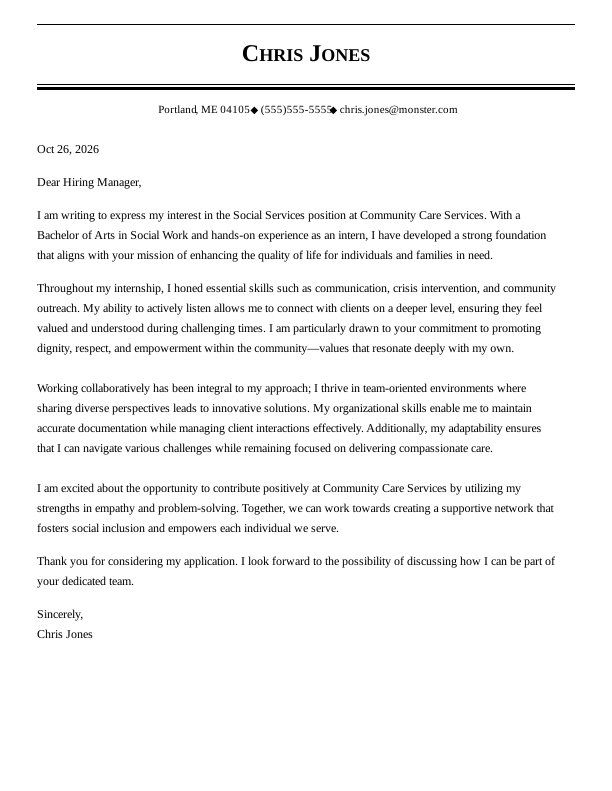
Social Services Entry-Level Cover Letter
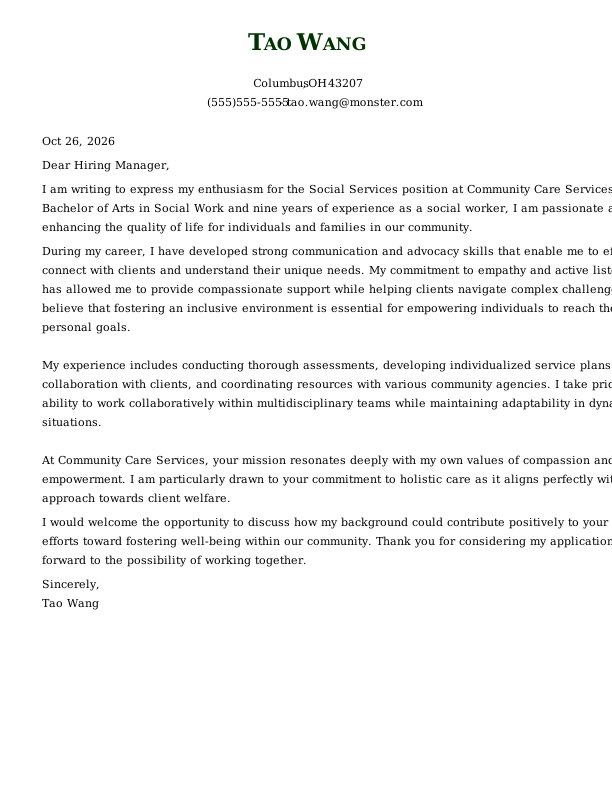
Social Services Mid-Level Cover Letter
Browse Free Cover Letter Templates
- Academic
- Account Manager
- Accountant
- Accounts Payable
- Administrative Assistant
- Admissions Counselor
- Architecture
- Artist
- Assistant Principal
- Babysitter
- Barista
- Bartender
- Bookkeeper
- Brand Ambassador
- Business Analyst
- Business
- Caregiver
- Chef
- Civil Engineering
- Computer Science
- Construction
- Consulting
- Copywriter
- Cosmetology
- Custodian
- Customer Service
- Customer Service Representative
- Data Analyst
- Data Entry
- Dental Assistant
- Dental Hygienist
- Digital Marketing
- Electrical Engineering
- Emt
- Engineering
- Esthetician
- Event Coordinator
- Executive Assistant
- Fashion Designer
- Finance
- Financial Analyst
- Firefighter
- Flight Attendant
- Graphic Designer
- Hair Stylist
- Healthcare
- Hr Generalist
- Investment Banking
- It
- Janitor
- Journalism
- Lab Technician
- Law Clerk
- Lawyer
- Librarian
- Logistics
- Maintenance Worker
- Makeup Artist
- Manager
- Marketing Coordinator
- Marketing
- Marketing Manager
- Massage Therapist
- Mechanic
- Mechanical Engineer
- Medical Assistant
- Non Profit
- Nursing
- Occupational Therapy
- Office Assistant
- Office Manager
- Operations Manager
- Paralegal
- Personal Trainer
- Pharmacist
- Pharmacy Technician
- Photographer
- Physician Assistant
- Pilot
- Police Officer
- Program Manager
- Project Manager
- Property Manager
- Psychology
- Receptionist
- Research Assistant
- Restaurant Manager
- Retail
- Sales
- Sales Manager
- School Counselor
- Security
- Security Officer
- Social Work
- Software Engineer
- Special Education Teacher
- Starbucks
- Substitute Teacher
- Teacher
- Teaching Assistant
Cover Letter Examples for Social Services
As your social services career grows, hiring managers’ expectations change too. Whether you’re providing direct client care or leading entire programs, choose the template below that matches your experience level to highlight your strengths.
Entry-Level Social Services Cover Letter
Perfect for recent graduates or career changers, this template helps you spotlight your transferable skills, relevant coursework, and dedication to supporting clients even if you don’t have direct job experience yet.
Mid-Career Social Services Cover Letter
Designed for professionals with a few years in the field, this template lets you highlight your hands-on case management, crisis response skills, and ability to collaborate across community teams.
Experienced Social Services Cover Letter
Ideal for seasoned professionals and leaders, this template helps you showcase your experience leading social work teams, managing community programs, and driving long-term operational success.
Social Services Cover Letter Template (Text)
Copy this social services cover letter template, paste it into your document, and swap in your casework outcomes, certifications, and the organization you want to join.
Li Brown
Southgate, MI 48203
(555)555-5555
li.brown@monster.com
Oct 26, 2026
Dear Hiring Manager,
I am writing to express my interest in the Social Services position at Target Company. With a Bachelor of Arts degree in Social Work and seven years of experience as a social worker, I am enthusiastic about the opportunity to contribute to your mission of enhancing community well-being through compassionate and equitable support services.
Throughout my career, I have developed strong skills in client advocacy, crisis intervention, and community outreach. My approach is rooted in empathy and understanding, allowing me to connect effectively with individuals from diverse backgrounds. I believe that fostering positive relationships is essential for empowering clients to navigate their challenges successfully.
In my previous role, I was responsible for conducting assessments and developing personalized service plans tailored to each client’s unique needs. This experience honed my organizational skills while reinforcing the importance of collaboration with community organizations. Working as part of a team has always been integral to my success; sharing knowledge and resources ultimately leads to more effective service delivery.
I am particularly drawn to Target Company’s commitment to social justice and improving the quality of life for underserved populations. Your focus on mental health support resonates deeply with me, as I have seen firsthand how essential these services are in creating lasting change within our communities.
Thank you for considering my application. I look forward to the possibility of discussing how my background aligns with your goals at Target Company.
Sincerely,
Li Brown
How to Write a Social Services Cover Letter
A solid social services cover letter shows how your direct experience with case intake, support planning, and community programs matches the job requirements. Use these steps to tailor your letter to the employer and demonstrate how you manage daily operational tasks.
1. Research & Prepare
Learn what matters most to the organization before writing. Take note of their client groups, intake software, and core operational challenges, such as large caseloads or strict state reporting guidelines. Gathering these details helps you highlight relevant skills and achievements.
Use this practical checklist to gather key details before drafting your letter:
- Scan the job description: Identify required case management tools, intake software, or tracking databases to reference by name.
- Review the agency website: Note their primary service models, outreach initiatives, and target demographic focus.
- Check regulatory standards: Verify state or local licensing requirements and active certifications needed for the position.
2. Hook the Reader
Capture attention in your opening lines by focusing on how your background resolves typical workplace challenges rather than using stock phrasing. Show hiring managers right away that you understand client coordination, workflows, and performance targets.
Consider structuring your opening line around one of these proven strategies:
- Caseload result focus: “On my housing stability caseload, I lowered eviction-related emergency room visits by 18% over six months by partnering with our benefits specialist.”
- Process improvement focus: “I updated our intake screening to be trauma-informed, reducing client wait times from 21 days to 9 days through faster behavioral health referrals.”
- Community partnership focus: “By partnering with Legal Aid and our local food bank, I helped 32 families secure urgent documentation last quarter using streamlined handoffs.”
3. Tell Your Professional Story
Use your cover letter to explain the practical results of your work. Include specific metrics and figures so hiring managers can evaluate your overall workload capacity and quality of service.
Transform basic job duties into impactful statements using data-driven examples like these:
- Improving client attendance: Lowered missed appointments by 22% over six months after establishing automated phone reminders and offering public transit passes.
- Managing high caseloads: Successfully managed an active caseload of 38 individuals while maintaining a 94% on-time completion rate for all required service plans.
- Optimizing program resources: Reallocated $12,500 in unused funds directly toward emergency food vouchers by closely analyzing monthly client utilization rates.
4. Showcase Your Skills
Describe concrete situations where you applied your key skills instead of simply listing personal traits. Detail how you managed client intake, case documentation, or challenging conversations to demonstrate problem-solving capabilities.
Illustrate your core competencies effectively using descriptive bullet points like these:
- Case documentation: “I logged intake notes in Salesforce right after calls, keeping next-shift staff informed on all housing risks and next steps.”
- De-escalation & crisis communication: “I stayed calm with distressed callers, identified immediate safety needs, and involved the supervisor on call before wrapping up.”
- Resource coordination: “I verified food pantry eligibility rules directly with providers and emailed clear instructions to clients.”
5. Explain Any Special Circumstances
Address career gaps, industry changes, or relocations concisely in one or two clear sentences. Focus on recent background, certifications, and active community involvement to confirm job readiness.
Address unique career scenarios clearly using straightforward explanations like these:
- “Following a nine-month caregiving gap, I maintained field knowledge by completing annual Child Protective Services training and volunteering at a local shelter.”
- “I am moving into social services from community outreach, where I gained experience in trauma-informed intake while pursuing my CADC certification.”
- “Since moving to Austin, I updated state credentials, completed local background checks, and began using HMIS software at a local shelter.”
6. End With a Professional Goodbye
Close your cover letter in two to three clear sentences expressing thanks and suggesting a specific next step. Propose a discussion topic related to client care or casework management, thank the reader for their time, and end with a standard professional sign-off like “Best regards.”
4 Tips for Formatting Your Cover Letter
In social services, hiring managers often skim cover letters in under a minute. A clear, well-organized letter highlights your professionalism, scannability, and core achievements. Proper spacing and consistent file formats ensure your layout remains intact across screeners and printed files, making a strong first impression.

Use a Professional Font & Layout
Pick a clear font like Arial, Calibri, Georgia, or Helvetica at 10–12 pt so readers can scan your text easily on screens or printed pages. Set 1-inch margins and match your header style to your resume, keeping your contact details clean and easy to verify.

Use Bullet Points for Key Achievements
Add three or four bullet points to spotlight specific numbers, like caseload size, referral outcomes, or service delivery times. Bullet points draw the reader’s eye directly to your achievements so they see your fit for the role right away.

Balance Spacing & Margins
Use single to 1.15 line spacing, and place a blank line between paragraphs to give your content room to breathe. Uniform margins between 0.75 and 1 inch frame your letter nicely, keeping it tidy both on screen and on paper.

Save & Send as a PDF
Save your cover letter as a PDF to preserve your layout across different systems. Name the file clearly, such as Firstname_Lastname_Cover_Letter.pdf, and include a relevant credential like MSW if you hold one.
Key Takeaways
- Highlight a specific example where you coordinated assessments, referrals, and follow-ups to demonstrate strong case management skills.
- Quantify your achievements using measurable metrics such as caseload size, initial contact speed, or service completion rates.
- Tailor your experience to match the target environment, whether focusing on trauma-informed care, regulatory compliance, or rapid crisis stabilization.
More Cover Letter Examples
Browse Monster’s Resume Templates
Monster also has hundreds of ATS-friendly resume templates for all career levels and industries. Create a matching resume to help you land the interview.
Frequently Asked Questions
Last Update:
Do I really need a cover letter?
Yes, you really need a cover letter for social services roles, even if listed as optional. A resume highlights your credentials, but a cover letter explains the human context behind your experience, career transitions, or employment gaps. It lets you show your genuine commitment to client advocacy, community support, and the organization’s core mission before you even step into an interview.
How long should my cover letter be?
Your social services cover letter should be 250-400 words and fit on a single page. Hiring managers in community organizations review applications quickly, so keep it brief. Stick to three or four short paragraphs that spotlight your most relevant client outcomes, certifications, and hands-on case management skills to make a strong impression without overwhelming the reader.
Should my cover letter match my resume?
Yes, your cover letter should match your resume in visual style to present a cohesive application package. Use identical fonts, color palettes, and header layouts across both documents. Rather than repeating your resume bullet points word-for-word, use the cover letter body text to elaborate on key achievements, human services philosophy, and your specific interest in serving their client population.
How do I address my cover letter if I don’t know the hiring manager’s name?
If you don’t know the hiring manager’s name, address your cover letter using specific professional greetings like “Dear Social Services Hiring Team” or “Dear Search Committee.” Take a moment to search the agency website or LinkedIn directory first, or call the main office to inquire. Avoid outdated terms like “To Whom It May Concern” to keep a warm, modern, personal tone throughout.
What should I include in my cover letter header?
In your social services cover letter header, include your full name, phone number, professional email, city and state, current date, and the recipient’s information. Adding relevant details like agency department names or credentials helps frame your background immediately. Align the typography and formatting with your resume header to create a polished, unified presentation for healthcare and social service decision-makers.

Toni Frana is a Certified Professional Resume Writer (CPRW), member of the Professional Association of Resume Writers & Career Coaches, and career expert who empowers job seekers to take control of their career paths using Monster’s comprehensive job search and resume tools.
See More From Toni FranaExplore Related Career Advice







How to Write a Cover Letter for Internal Positions or Promotions (Examples & Tips)

Updated:
Apr 23, 2026
|
19 min read


Cover Letter vs Resume: What’s the Difference & Do You Need Both?

Updated:
Apr 23, 2026
|
18 min read