


Free Fashion Designer Cover Letter Templates & Examples
A strong fashion designer cover letter should show your creative vision and ability to translate trends into wearable, market-ready pieces. Our free cover letter examples and step-by-step guidance help you spotlight your portfolio highlights, design process, and fit with each brand so hiring managers can see your value fast.
Real-World Cover Letters That Get Results
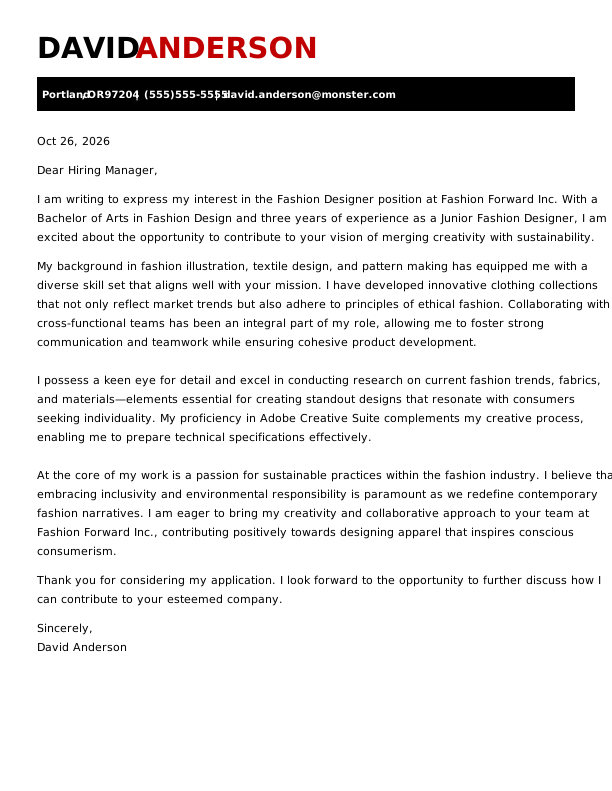
 Free
Fashion Designer Entry-Level Cover Letter
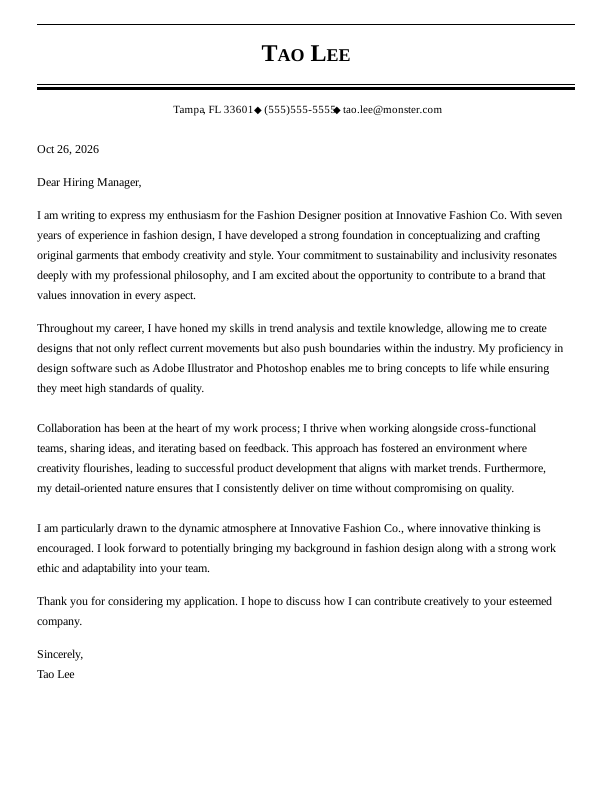
Fashion Designer Mid-Level Cover Letter
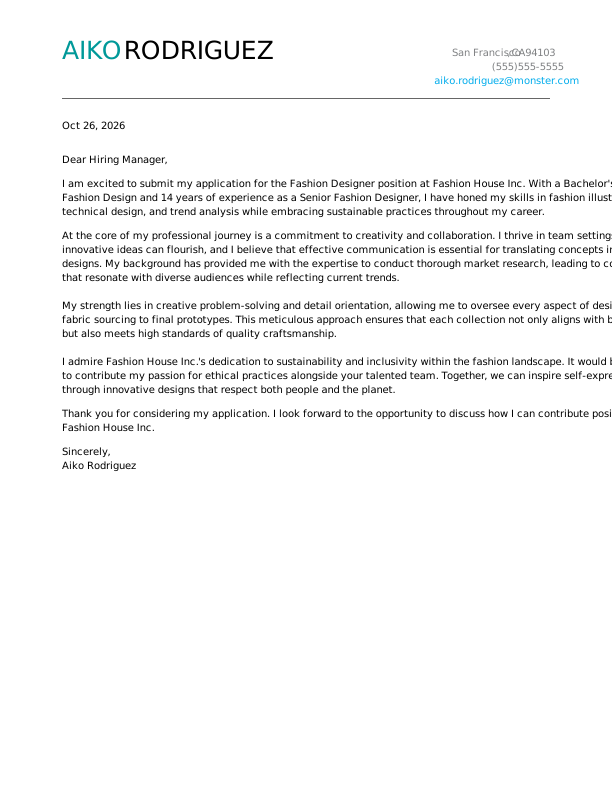
Fashion Designer Experienced Cover Letter
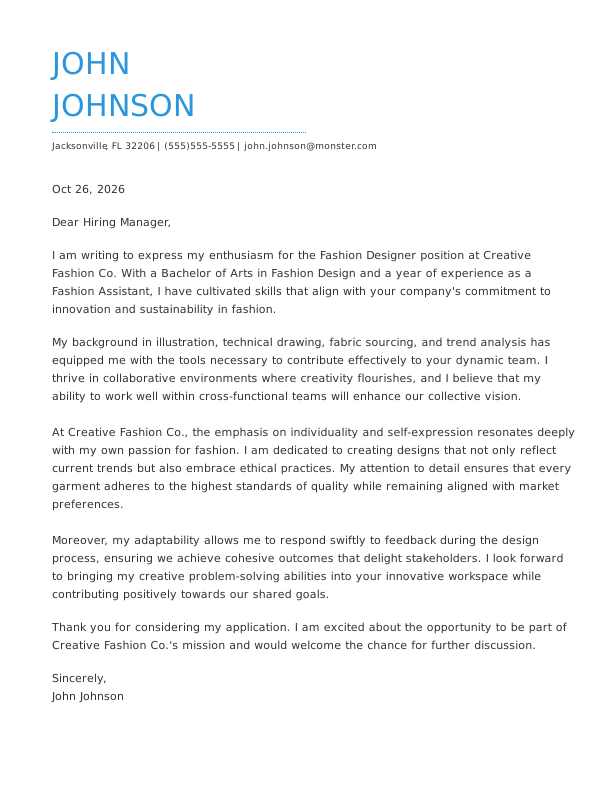
Fashion Designer Entry-Level Cover Letter
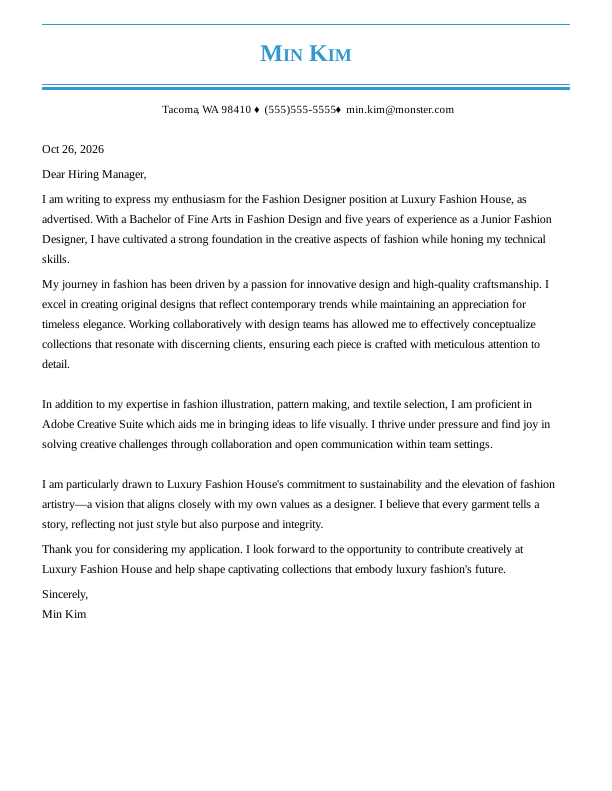
Fashion Designer Mid-Level Cover Letter
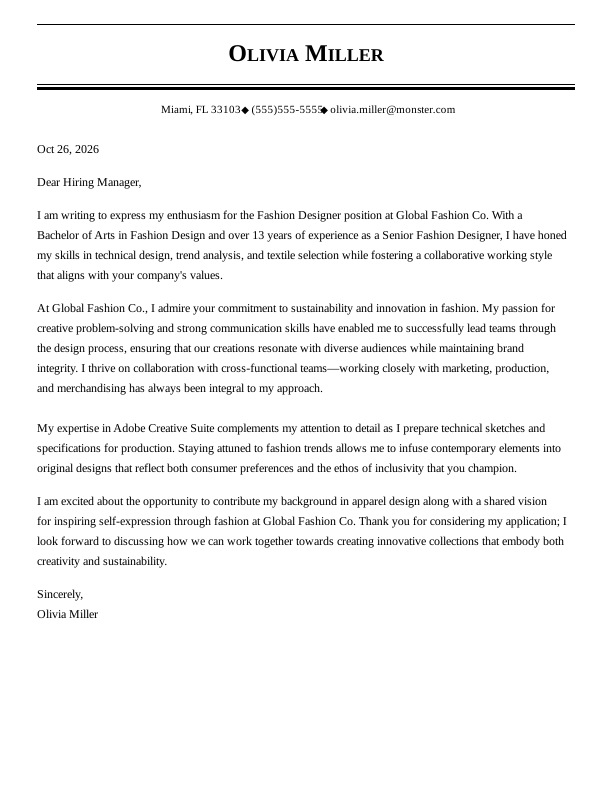
Fashion Designer Experienced Cover Letter
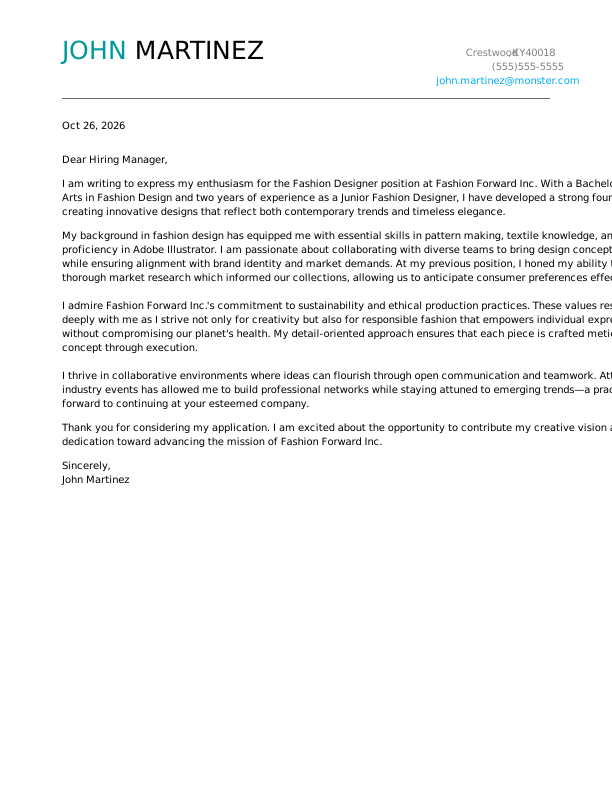
Fashion Designer Entry-Level Cover Letter
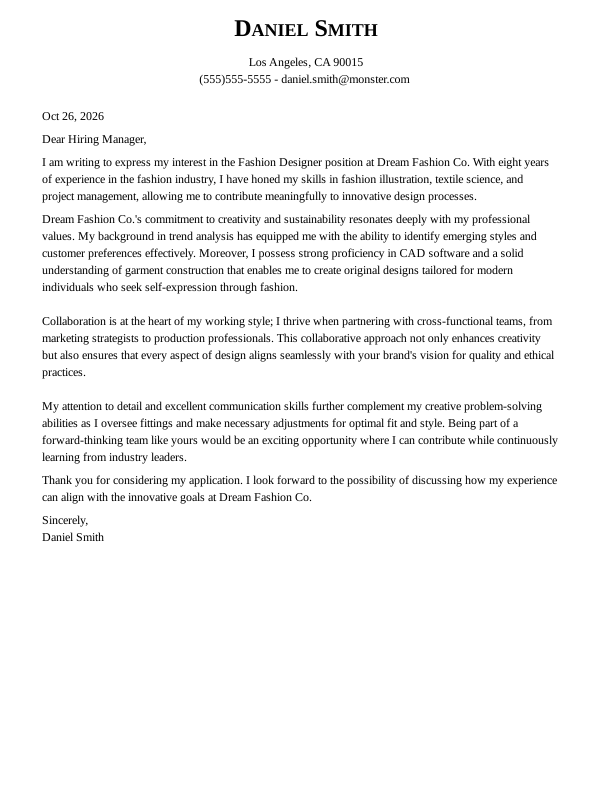
Fashion Designer Mid-Level Cover Letter
Browse Free Cover Letter Templates
- Academic
- Account Manager
- Accountant
- Accounts Payable
- Administrative Assistant
- Admissions Counselor
- Architecture
- Artist
- Assistant Principal
- Babysitter
- Barista
- Bartender
- Bookkeeper
- Brand Ambassador
- Business Analyst
- Business
- Caregiver
- Chef
- Civil Engineering
- Computer Science
- Construction
- Consulting
- Copywriter
- Cosmetology
- Custodian
- Customer Service
- Customer Service Representative
- Data Analyst
- Data Entry
- Dental Assistant
- Dental Hygienist
- Digital Marketing
- Electrical Engineering
- Emt
- Engineering
- Esthetician
- Event Coordinator
- Executive Assistant
- Finance
- Financial Analyst
- Firefighter
- Flight Attendant
- Graphic Designer
- Hair Stylist
- Healthcare
- Hr Generalist
- Investment Banking
- It
- Janitor
- Journalism
- Lab Technician
- Law Clerk
- Lawyer
- Librarian
- Logistics
- Maintenance Worker
- Makeup Artist
- Manager
- Marketing Coordinator
- Marketing
- Marketing Manager
- Massage Therapist
- Mechanic
- Mechanical Engineer
- Medical Assistant
- Non Profit
- Nursing
- Occupational Therapy
- Office Assistant
- Office Manager
- Operations Manager
- Paralegal
- Personal Trainer
- Pharmacist
- Pharmacy Technician
- Photographer
- Physician Assistant
- Pilot
- Police Officer
- Program Manager
- Project Manager
- Property Manager
- Psychology
- Receptionist
- Research Assistant
- Restaurant Manager
- Retail
- Sales
- Sales Manager
- School Counselor
- Security
- Security Officer
- Social Work
- Software Engineer
- Special Education Teacher
- Starbucks
- Substitute Teacher
- Teacher
- Teaching Assistant
Cover Letter Examples for Fashion Designers
Cover letter requirements shift as a fashion designer builds experience, from learning skills like pattern work and sourcing to managing collections and timelines. Choose the template that matches your career stage so you can spotlight the most relevant training, portfolio projects, or leadership accomplishments.
Entry-Level Fashion Designer Cover Letter
Designed for recent graduates and career changers, this template demonstrates how to present fashion design coursework, patternmaking skills, technical sketches, and studio internships with confidence when applying for initial design roles.
Mid-Career Fashion Designer Cover Letter
Tailored for candidates with several years of industry experience, this template shows how to highlight independent trend analysis, seasonal collection ownership, cross-functional collaboration, and digital design tool expertise.
Experienced Fashion Designer Cover Letter
Ideal for senior designers and creative directors, this template emphasizes end-to-end collection development, fabric sourcing oversight, prototype quality control, market research leadership, and sustainable design practices.
Fashion Designer Cover Letter Template (Text)
Paste this fashion designer cover letter template into your document, then customize it by swapping in your portfolio highlights and specific brand or collection names.
Hiro Lee
Eastside, WA 98003
(555)555-5555
hiro.lee@monster.com
Oct 26, 2026
Dear Hiring Manager,
I am writing to express my interest in the fashion designer position at ABC Fashion Corp. With a Bachelor of Fine Arts in Fashion Design and nine years of experience as a senior fashion designer, I have developed a strong foundation in creating innovative designs that align with market trends while maintaining an emphasis on sustainability.
My background has equipped me with skills in fashion trend analysis, technical sketching, and proficiency in Adobe Creative Suite. I have consistently leveraged these abilities to collaborate effectively with cross-functional teams, ensuring that design concepts resonate with target audiences and uphold brand vision. My commitment to ethical practices mirrors your company’s values, making ABC Fashion Corp an ideal environment for my creative contributions.
Throughout my career, I have honed a keen eye for detail and aesthetics while embracing challenges under pressure. This adaptability has enabled me to conduct thorough market research that informs my design decisions, ensuring they remain relevant amidst the ever-evolving fashion landscape.
I believe that mentorship and collaboration are key components of success within the industry; thus, I prioritize fostering strong relationships within my team. Presenting ideas clearly and incorporating constructive feedback is something I value deeply as it leads to superior final products.
I am excited about the opportunity to contribute my unique perspective and design philosophy at ABC Fashion Corp. Thank you for considering my application; I look forward to discussing how we can work together to inspire self-expression through fashion.
Sincerely,
Hiro Lee
How to Write a Fashion Designer Cover Letter
Writing an effective fashion designer cover letter requires showing hiring managers that you understand garment construction, technical specification packets, and seasonal production schedules. Follow these steps to align your experience with a specific brand’s aesthetic and target customer.
1. Research & Prepare
Before writing, research the fashion label’s signature aesthetic, seasonal release calendar, and target customer demographic. Discovering whether the brand emphasizes sustainable ready-to-wear lines, fast-fashion trend translation, or luxury evening wear allows you to highlight the exact design and textile skills that matter most to the creative director.
Gather actionable context by exploring these key information sources:
- Review the job description to confirm required design software, 3D modeling tools, and garment construction expectations.
- Read recent collection reviews, runway coverage, or press releases to understand the brand’s current material choices and creative themes.
- Explore the company’s retail channels or product catalogs to evaluate its pricing tiers, sizing standards, and core silhouettes.
2. Hook the Reader
Start your letter with an engaging opening line that demonstrates your technical efficiency and aesthetic alignment with the brand’s production schedule. Avoid generic statements like “I am writing to apply for the open fashion designer role.” Instead, capture the hiring manager’s attention by leading with a concrete design accomplishment or calendar win.
Choose an opening line tailored to your experience using these example approaches:
- Production turnaround: “On my last capsule line, I translated mood boards into complete technical packs within 48 hours, delivering pre-production samples two weeks ahead of schedule.”
- Material innovation: “For our fall outerwear drop, I specified recycled bonded-seam fabrics to reduce garment bulk by 15% while documenting stitch allowances for uniform factory production.”
- Calendar alignment: “To prepare for an upcoming seasonal collection, I established a four-week fitting schedule that allowed our team to finalize garment silhouettes well before the runway deadline.”
3. Tell Your Professional Story
Use the body of your letter to give hiring managers a clear view of your daily design process and commercial performance. While your portfolio displays sketches and final garments, your cover letter explains how your technical choices improved production efficiency, fit consistency, and retail sales. Using specific numbers makes your accomplishments far more compelling.
Incorporate concrete benchmarks like these to illustrate your impact:
- Reduced first-week customer returns by 12% across a 600-unit spring collection by refining pattern grading and standardizing garment specs.
- Designed three seasonal capsule drops that increased boutique sell-through from 58% to 74% within six weeks through targeted colorways.
- Cut manufacturing lead time by nine days by standardizing technical packets and streamlining supplier fit feedback across four seasonal orders.
4. Showcase Your Skills
Rather than using broad self-descriptors like “creative” or “trend-focused,” illustrate how your skills resolve real construction challenges. Showing the exact moments where your pattern adjustments, textile testing, or technical sketches solved a production problem builds trust with the employer.
Connect your practical abilities directly to daily design needs using these examples:
- Patternmaking: “I adjusted the foundational pattern after an initial muslin fitting, marking adjustments directly on the toile to ensure the final sample matched our silhouette goals.”
- Fabric selection: “I evaluated lining swatches under both natural daylight and warm showroom lighting, selecting the textile that maintained consistent color fidelity.”
- Client and team communication: “I reviewed client fit notes, asked clarifying questions about movement and comfort, and translated that feedback directly into updated technical sketches.”
5. Explain Any Special Circumstances
If you have an employment gap, are transitioning categories, or recently relocated, address it briefly in one or two direct sentences. Focus your explanation on your active portfolio, current technical design skills, and trend awareness so the manager knows you are ready for studio production.
Frame your circumstances clearly using these straightforward approaches:
- Addressing an employment gap: “Following a nine-month career break, I kept my design skills sharp by producing independent capsule looks and updating my portfolio with fresh technical sketches.”
- Transitioning positions: “I am pivoting from costume design into contemporary ready-to-wear, translating my structural patternmaking background into commercial collections using digital design tools.”
- Handling relocation: “After moving to the area last fall, I updated my regional supplier contacts and began leading freelance garment fittings to stay connected to local production.”
6. End With a Professional Goodbye
Conclude your letter with a polite, confident statement that invites the hiring manager to review your full portfolio and contact you for an interview. Keep your sign-off concise, thank the reader for their time, and express enthusiasm for discussing your design process in detail.
Structure your final paragraph using this clear approach:
- Offer a clear next step: “I would welcome the opportunity to discuss how my pattern-cutting skills and technical design background can support your upcoming collection calendar.”
- Express gratitude: “Thank you for your time and consideration.”
- End with a clean sign-off: “Best regards,” followed by your full name.
4 Tips for Formatting Your Cover Letter
When you apply for a fashion designer position, creative directors often scan your application quickly between fit sessions, sourcing meetings, and seasonal reviews. They look rapidly for your aesthetic point of view, technical software skills, and collection results. A clean visual presentation with consistent spacing and logical organization makes your top achievements easy to spot and proves that you have an eye for refined presentation.

Keep It to One Page
Keep your cover letter to a single page, ideally between 250 and 400 words spread across three to four short paragraphs. Concise writing ensures that busy design leads can evaluate your technical skills, collection outcomes, and digital tool proficiency quickly without wading through dense text.

Address the Hiring Manager Directly
Search the job posting, brand website, or professional networking profiles to identify the specific creative director, head of design, or fashion recruiter. If you cannot find an individual name, address your letter to “Dear Hiring Manager” or “Dear Design Team” rather than using outdated phrases, such as “To Whom It May Concern.”

Balance Spacing & Margins
Set line spacing between 1.0 and 1.15, leaving a full blank line between paragraphs to keep the layout clean and readable. Use uniform margins between 0.75 and 1 inch so your letter looks well-proportioned on screens and printed copies.

Save & Send as a PDF
Save your final cover letter as a PDF to preserve your margins, line spacing, and general layout across different operating systems or mobile devices. Use a clean, professional filename like Firstname_Lastname_Cover_Letter.pdf or Firstname_Lastname_Designer_Cover_Letter.pdf to make your application easy for recruiters to organize.
Top-Paying States for Fashion Designer Roles
Knowing what fashion designers earn helps you compare opportunities and plan your next step with confidence. Salary ranges below are based on the U.S. Bureau of Labor Statistics (BLS) and reflect recent nationwide averages for fashion designers.
Keep in mind that your actual pay can vary by location, years of experience, and the type of work you do, such as apparel design, costume work, or brand-specific roles. Portfolio strength and specialty also matter. In faster-paced markets or higher-demand niches, compensation may trend higher than the national average.
| Arizona | $46,150 |
| Connecticut | $101,850 |
| Florida | $57,550 |
| Georgia | $77,500 |
| Indiana | $58,670 |
| Kansas | $65,410 |
| Kentucky | $64,220 |
| Massachusetts | $107,560 |
| Minnesota | $44,130 |
| Missouri | $87,290 |
| New Hampshire | $90,750 |
| New Jersey | $96,380 |
| New York | $106,180 |
| North Carolina | $82,370 |
| Ohio | $65,050 |
| Oregon | $134,060 |
| Pennsylvania | $80,740 |
| Tennessee | $117,100 |
| Utah | $71,330 |
| Virginia | $79,150 |
| Washington | $80,350 |
| Wisconsin | $39,200 |
Key Takeaways
- Demonstrate design direction by describing a specific collection concept you developed from initial research through final silhouette construction.
- Include concrete performance metrics like retail sell-through rates, lead-time reductions, or return rate decreases to prove commercial value.
- Tailor your letter to the market level by emphasizing craftsmanship for luxury labels, fast trend translation for mass retailers, or rapid iteration for emerging brands.
More Cover Letter Examples
- Communications
- Creative Director
- Fashion
- Interior Designer
- Production Assistant
- Ux Designer
- Ux Researcher
- Video Editor
- Web Designer
Browse Monster’s Resume Templates
Monster also has hundreds of ATS-friendly resume templates for all career levels and industries. Create a matching resume to help you land the interview.
Frequently Asked Questions
Last Update:
Do I really need a cover letter?
Yes, submitting a cover letter with your fashion design application is strongly recommended even when it’s listed as optional because it provides creative and technical context that a portfolio or resume cannot share alone. While a portfolio showcases your sketches and finished pieces, a cover letter explains how you research trends, construct garments, and collaborate with production teams. It also gives you space to explain career transitions.
How long should my cover letter be?
A fashion designer cover letter should stay within one page, targeting between 250 and 400 words. Creative directors and design managers review applications quickly between studio fittings, so direct, concise writing works best. Divide your text into three or four short paragraphs that focus strictly on your design process, technical skills, and collection achievements without adding unnecessary filler.
Should my cover letter match my resume?
Yes, your fashion designer cover letter should match your resume’s visual formatting to present a polished, cohesive application package. Use the same font styles, margin sizes, color accents, and contact header across both documents. Instead of repeating your resume bullet points, use your cover letter to expand on a specific collection launch or explain how your design philosophy aligns with the brand’s aesthetic.
Can I use AI to write my cover letter?
Using AI tools can help you outline your fashion designer cover letter and organize your thoughts, but you should rewrite the draft heavily before submitting it. AI-generated text often uses generic phrasing that lacks the specific fabric choices, construction techniques, and collection outcomes hiring managers look for. Personalizing your content ensures the letter accurately reflects your unique creative point of view.
Should I mention salary expectations in my cover letter?
You should only mention salary expectations in a fashion designer cover letter if the job posting explicitly requests them. If required, state a flexible pay range based on local market research for your design specialty and experience level. Mention briefly that you are open to discussing total compensation, including benefits and potential performance bonuses, during the interview process.

Elizabeth Muenzen is a Certified Professional Resume Writer (CPRW) and member of the Professional Association of Resume Writers & Career Coaches who empowers job seekers to take control of their career paths using Monster’s comprehensive job search and resume tools.
See More From Elizabeth MuenzenExplore Related Career Advice







How to Write a Cover Letter for Internal Positions or Promotions (Examples & Tips)

Updated:
Apr 23, 2026
|
19 min read


Cover Letter vs Resume: What’s the Difference & Do You Need Both?
Updated:
Apr 23, 2026
|
18 min read