


Free UX Designer Cover Letter Templates & Examples
A strong UX designer cover letter shows you can turn user research into clear, accessible interfaces while collaborating smoothly across product, engineering, and design. These free cover letter examples and step-by-step guidance help you write a focused application that highlights your impact to hiring managers.
Real-World Cover Letters That Get Results
 Free
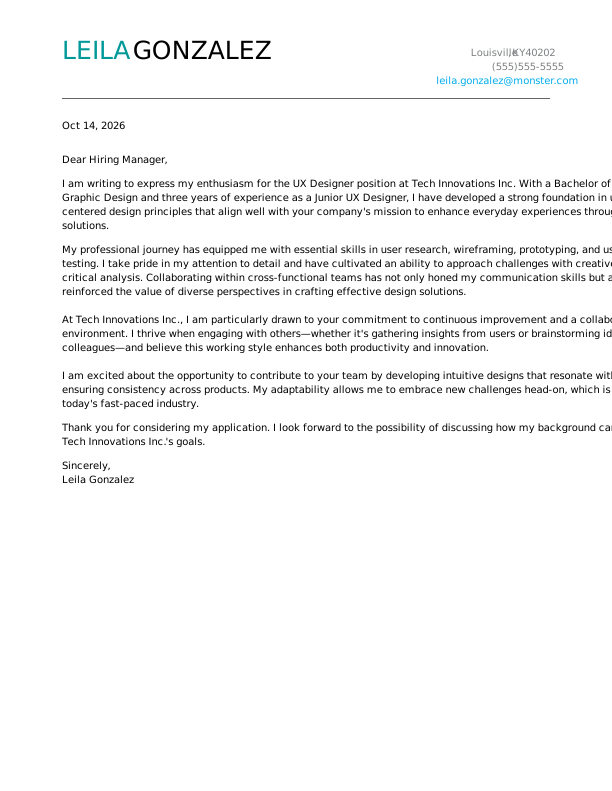
UX Designer Entry-Level Cover Letter
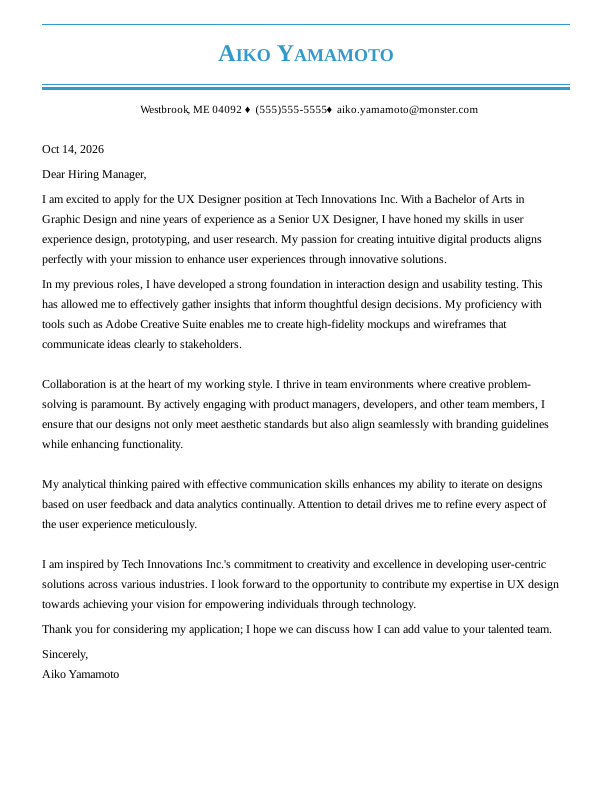
UX Designer Mid-Level Cover Letter
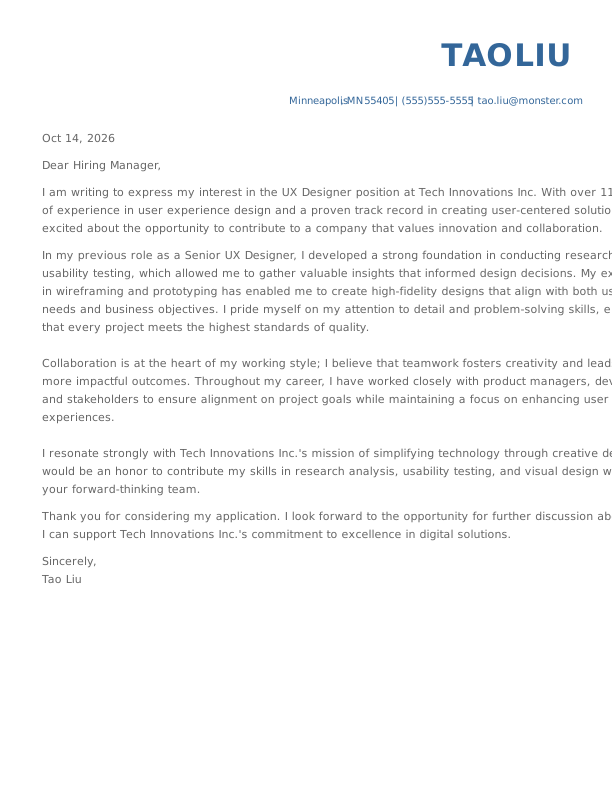
UX Designer Experienced Cover Letter
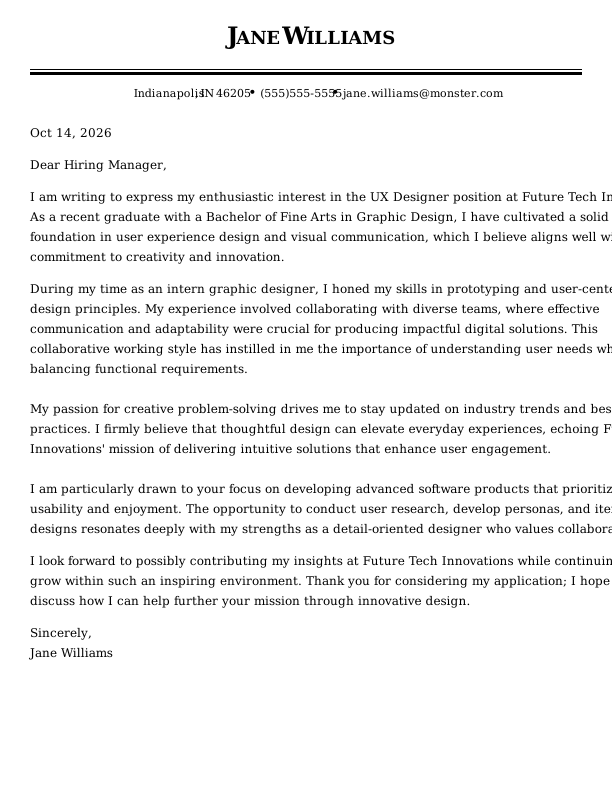
UX Designer Entry-Level Cover Letter
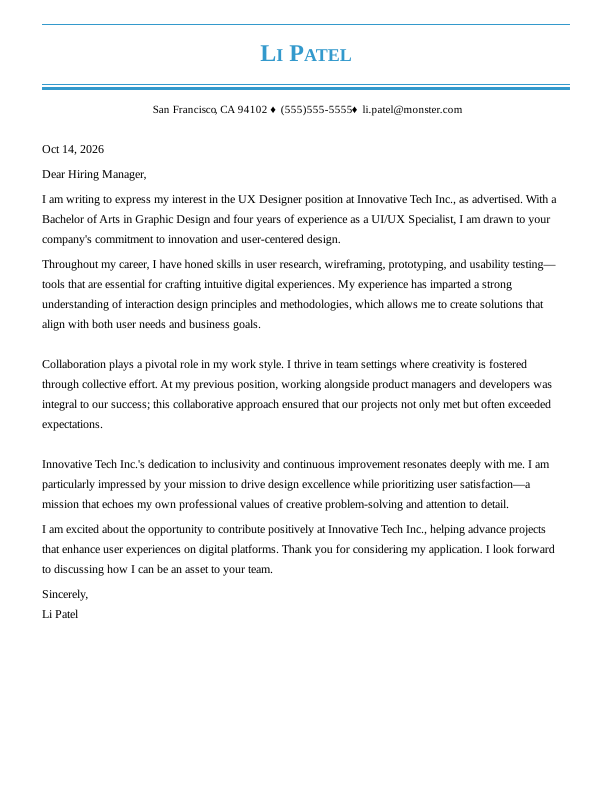
UX Designer Mid-Level Cover Letter
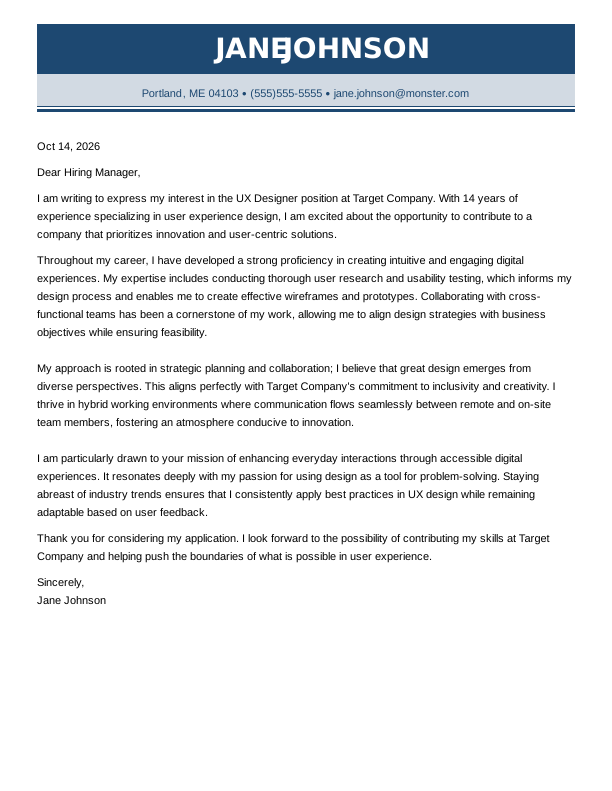
UX Designer Experienced Cover Letter
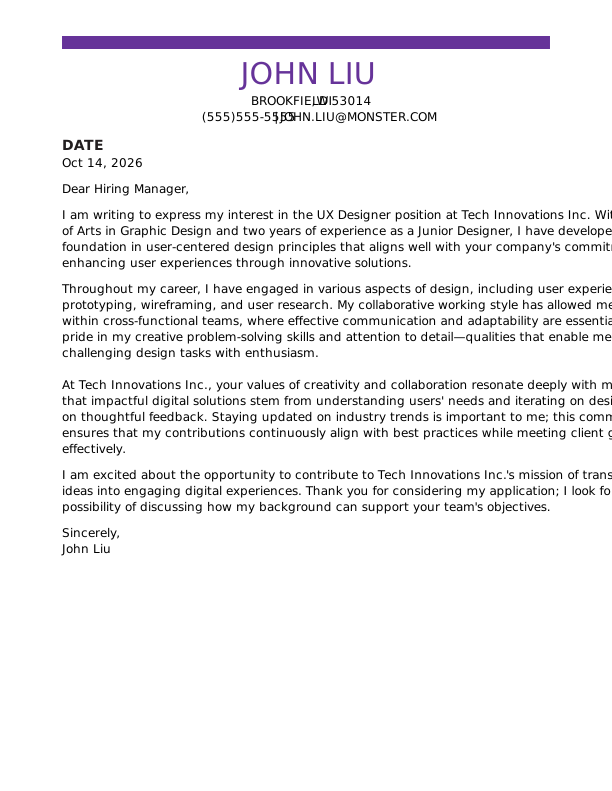
UX Designer Entry-Level Cover Letter
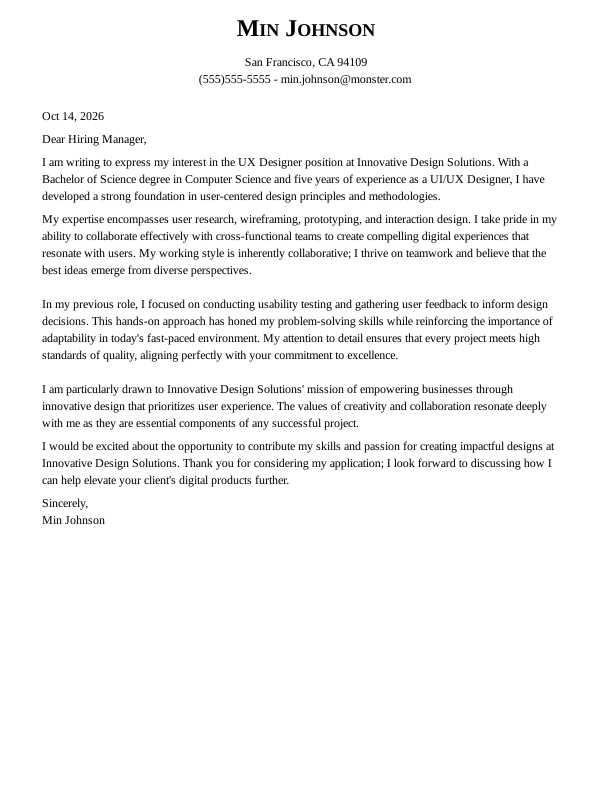
UX Designer Mid-Level Cover Letter
Browse Free Cover Letter Templates
- Academic
- Account Manager
- Accountant
- Accounts Payable
- Administrative Assistant
- Admissions Counselor
- Architecture
- Artist
- Assistant Principal
- Babysitter
- Barista
- Bartender
- Bookkeeper
- Brand Ambassador
- Business Analyst
- Business
- Caregiver
- Chef
- Civil Engineering
- Computer Science
- Construction
- Consulting
- Copywriter
- Cosmetology
- Custodian
- Customer Service
- Customer Service Representative
- Data Analyst
- Data Entry
- Dental Assistant
- Dental Hygienist
- Digital Marketing
- Electrical Engineering
- Emt
- Engineering
- Esthetician
- Event Coordinator
- Executive Assistant
- Finance
- Financial Analyst
- Firefighter
- Flight Attendant
- Graphic Designer
- Hair Stylist
- Healthcare
- Hr Generalist
- Investment Banking
- It
- Janitor
- Journalism
- Lab Technician
- Law Clerk
- Lawyer
- Librarian
- Logistics
- Makeup Artist
- Manager
- Marketing Coordinator
- Marketing
- Marketing Manager
- Massage Therapist
- Mechanic
- Mechanical Engineer
- Medical Assistant
- Non Profit
- Nursing
- Occupational Therapy
- Office Assistant
- Office Manager
- Operations Manager
- Paralegal
- Personal Trainer
- Pharmacist
- Pharmacy Technician
- Photographer
- Physician Assistant
- Pilot
- Police Officer
- Program Manager
- Project Manager
- Property Manager
- Psychology
- Receptionist
- Research Assistant
- Restaurant Manager
- Retail
- Sales
- Sales Manager
- School Counselor
- Security Officer
- Social Work
- Software Engineer
- Special Education Teacher
- Starbucks
- Substitute Teacher
- Teacher
- Teaching Assistant
- Truck Driver
- Vet Tech
- Veterinary Assistant
Cover Letter Examples for Ux Designers
Cover letter expectations for a UX designer shift as your career grows, especially from early portfolio work to leading research and design decisions. Choose the template that matches your experience level so you can spotlight the right skills, training, and outcomes.
Entry-Level UX Designer Cover Letter
Ideal for recent graduates and career changers transitioning into UX designer roles, this cover letter with no experience template helps you highlight transferable skills and design passion.
Mid-Career UX Designer Cover Letter
Built for UX designers a few years into their career, this template emphasizes design ownership, leading discovery and usability testing, and mentoring teammates on research-to-delivery.
Experienced UX Designer Cover Letter
Designed for UX designers with close to a decade of experience, this template fits professionals who lead cross-functional research and usability testing, own end-to-end product design systems, and mentor teams on strategic design decisions.
UX Designer Cover Letter Template (Text)
Copy this ux designer cover letter template, paste it into your document, and swap in your portfolio project outcomes, usability metrics, and target company details.
Michael Jones
Minneapolis, MN 55409
(555)555-5555
michael.jones@monster.com
Oct 14, 2026
Dear Hiring Manager,
I am excited to apply for the UX Designer position at Tech Innovations Inc. With a Bachelor of Arts in Graphic Design and over seven years of experience as a UI/UX Designer, I have cultivated a strong foundation in user-centered design principles and methodologies that align well with your company’s mission to enhance user experiences across digital platforms.
Throughout my career, I have demonstrated a commitment to creativity and collaboration, working closely with cross-functional teams to develop innovative solutions that address complex challenges. My expertise lies in user interface design, prototyping, and interaction design, complemented by proficiency in the Adobe Creative Suite. I thrive in dynamic environments where teamwork is essential to achieving high-quality outcomes.
In my previous roles, I have conducted extensive user research and usability testing to gather valuable insights that inform design decisions. Creating wireframes and high-fidelity mockups has allowed me to effectively communicate concepts while ensuring consistency across various digital platforms through well-maintained design systems. My strong analytical skills enable me to synthesize user feedback into actionable iterations that significantly enhance overall user experience.
At Tech Innovations Inc., where creativity meets technology, I am eager to contribute my attention to detail and creative problem-solving skills towards fostering meaningful interactions between users and products. Your commitment to pushing technological boundaries resonates with my professional philosophy.
Thank you for considering my application. I look forward to the opportunity to discuss how I can be an asset to your team.
Sincerely,
Michael Jones
How to Write a UX Designer Cover Letter
To write an effective UX designer cover letter, translate your portfolio work into clear evidence using case study details like problem, research, iterations, and outcomes. Review the six steps below to tailor your cover letter to a specific UX designer job using project notes and metrics.
1. Research & Prepare
Learn what the team needs and how they define project success. Review the product, design standards, and current team goals like accessibility or sign-up rates. Specific details show you understand the team’s daily workflow and operational demands.
- Scan the company careers page for design tools and workflow keywords to align with their process.
- Review the company design system site or repository for components, accessibility standards, and documentation style.
- Read recent product release notes on the company blog to identify user journeys under active iteration.
2. Hook the Reader
Start with a strong sentence that demonstrates your understanding of real product decisions and results. Opening with direct evidence of your work helps your application stand out instantly during review.
- Prototype impact: “I reduced checkout drop-off by 18% in our A/B test after redesigning the payment flow using Figma variants and usability notes from 5 moderated sessions.”
- Research rigor: “For your onboarding revamp, I would run rapid generative interviews followed by a task-based study, reporting findings through a journey map tied to measurable funnel metrics.”
- Design system leverage: “When rolling out a component library with tokens in Sketch and Storybook, my team cut new UI build time by 30% while keeping accessibility checks consistent across releases.”
3. Tell Your Professional Story
Focus on how your choices solved real problems for users and businesses. Practical details show clear context, such as how updating a checkout layout reduced user mistakes and completed orders faster.
- Reduced task failure in moderated usability tests from 22% to 9% by redesigning the onboarding flow and error states.
- Improved checkout conversion by 14% after running A/B tests on a new pricing page layout and simplifying form fields.
- Cut account-access support tickets by 31% within 2 months by updating information architecture and adding inline guidance.
4. Showcase Your Skills
Connect specific skills to practical project results mentioned in the job posting. Showing how a user feedback finding directly changed a screen design builds trust in your process.
- User research synthesis: “Synthesized interview notes into key themes and mapped them to existing flows, recommending targeted changes that reduced user confusion during checkout.”
- Prototyping tools: “Built an interactive Figma prototype with clickable error states, enabling stakeholders to review layout and copy variations effectively.”
- Collaboration and communication: “Addressed engineering constraints by explaining core user pain points clearly, reaching alignment on an updated interaction plan.”
5. Explain Any Special Circumstances
Explain career changes, employment gaps, or relocations in one or two clear sentences. Address these context points directly to keep the focus on your relevant portfolio work and design experience.
- “Following an 8-month caregiving gap, updated portfolio case studies and usability tests using Figma and Lookback.”
- “Transitioning from graphic design to UX by conducting moderated interviews and synthesizing findings into journey maps.”
- “Relocated to Austin after leading remote workshops from the East Coast, maintaining collaboration through Miro and design reviews.”
6. End With a Professional Goodbye
End your letter with a clear next step and a quick word of thanks. Suggesting a short conversation about a product goal creates a clear path forward.
Use action-oriented closing lines such as, “I’d love to walk you through how I’d improve your onboarding flow using quick usability tests and interaction maps.” Follow with “Thank you for your time,” and close with “Best regards” or “Sincerely.”
4 Tips for Formatting Your Cover Letter
Hiring managers often scan UX cover letters in under 1 minute, searching for evidence of research skills, usability testing, and accessible design choices. Adhering to standard formatting principles ensures your document remains readable across early-career and senior design roles.

Keep It to One Page
Target 250–400 words across 3 to 4 short paragraphs. Highlight 1 key portfolio project, core research methods like usability testing, and 2 or 3 measurable outcomes to ensure essential evidence remains prominent during initial review.

Use a Professional Font & Layout
Select standard fonts such as Arial, Calibri, Georgia, or Helvetica at 10–12 pt body size. Maintain 1-inch margins and match your resume header design to present a consistent, structured document set.

Address the Hiring Manager Directly
Identify the recipient via the job posting, team page, or LinkedIn—such as a product design manager or recruiter. If a specific name isn’t available, use “Dear Hiring Manager” or “To the Hiring Team” instead of outdated options like “To Whom It May Concern.”

Save & Send as a PDF
Export your cover letter as a PDF to preserve layout formatting, fonts, and spacing across systems. Use a clear file naming convention such as Firstname_Lastname_Cover_Letter.pdf.
Key Takeaways
- Demonstrate usability problem-solving by describing how research or heuristic insights guided a key redesign decision.
- Quantify impact with metrics like task success rate, time on task, conversion rates, or usability completion scores.
- Tailor achievements to the employer context—tech product teams value iterative discovery, agencies prioritize client collaboration, and startups seek rapid prototyping.
More Cover Letter Examples
Browse Monster’s Resume Templates
Monster also has hundreds of ATS-friendly resume templates for all career levels and industries. Create a matching resume to help you land the interview.
Frequently Asked Questions
Last Update:
Do I really need a cover letter?
Including a cover letter as a UX designer is strongly recommended, even when optional, because a well-crafted cover letter provides key context behind your design decisions and demonstrates genuine initiative.
A cover letter is especially valuable if you are navigating a career transition, explaining an employment gap, or highlighting specific interest in an employer’s product line. Connecting your background to core responsibilities like user research planning and user advocacy reinforces your application.
How long should my cover letter be?
A UX designer cover letter should stay within 1 page maximum, targeting 250–400 words across 3 to 4 short paragraphs so hiring managers can skim key points quickly. Focus on quality by keeping content concise, highlighting your most relevant achievements or certifications, and dedicating each paragraph to a clear takeaway.
Should my cover letter match my resume?
Matching your cover letter to your resume formatting ensures a cohesive application set, using consistent typography, spacing, and header layouts. Keep content complementary rather than repeating resume bullet points verbatim. Use the letter to expand on significant design accomplishments and explain how your approach aligns with the company’s goals.
What should I include in my cover letter header?
A UX designer cover letter header should include your full name, phone number, professional email, location (city/state), date, recipient details, and links to your portfolio or GitHub. Aligning typography and styling with your resume header creates a unified visual design.
Should I mention salary expectations in my cover letter?
Mention salary expectations in your cover letter only if explicitly requested by the posting, stating a flexible range based on market research while remaining open to total compensation discussions.

Toni Frana is a Certified Professional Resume Writer (CPRW), member of the Professional Association of Resume Writers & Career Coaches, and career expert who empowers job seekers to take control of their career paths using Monster’s comprehensive job search and resume tools.
See More From Toni FranaExplore Related Career Advice






How to Write a Cover Letter for Internal Positions or Promotions (Examples & Tips)

Updated:
Apr 23, 2026
|
19 min read


Cover Letter vs Resume: What’s the Difference & Do You Need Both?

Updated:
Apr 23, 2026
|
18 min read