

Free Acting Cover Letter Templates & Examples
A great acting cover letter shows casting directors what you bring to the role. By highlighting your key skills and achievements in clear, simple language, you can quickly prove you are the right fit for the production.
Real-World Cover Letters That Get Results
 Free
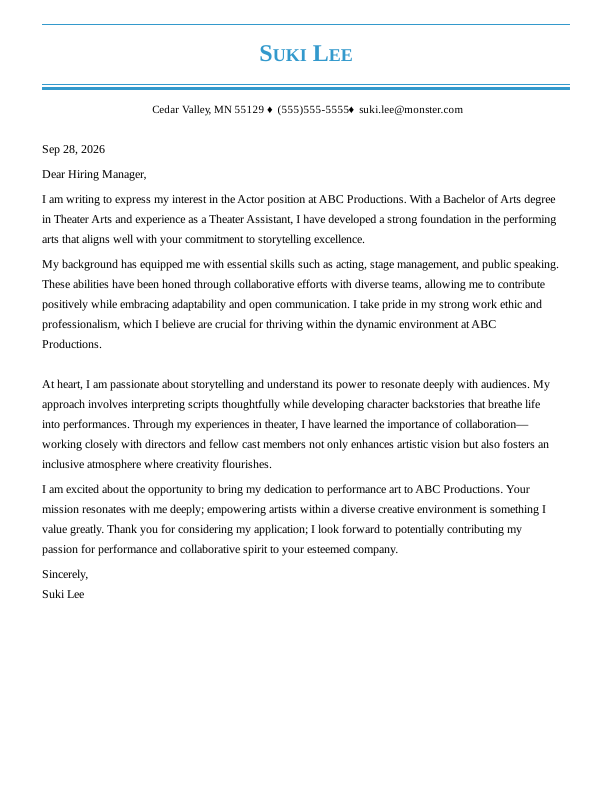
Acting Entry-Level Cover Letter
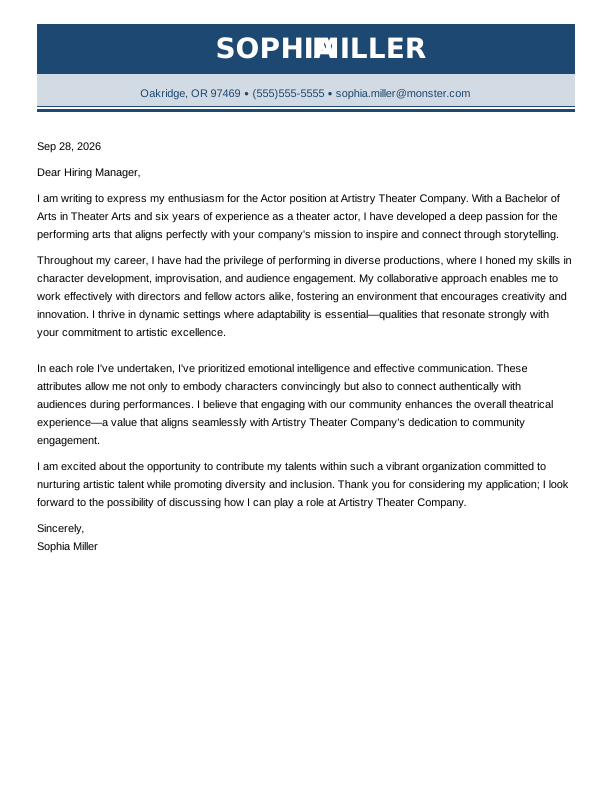
Acting Mid-Level Cover Letter
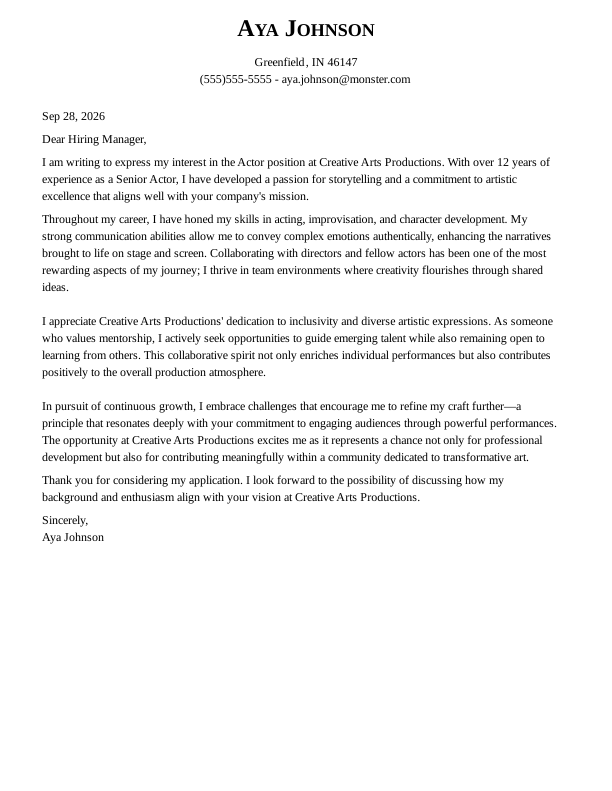
Acting Experienced Cover Letter
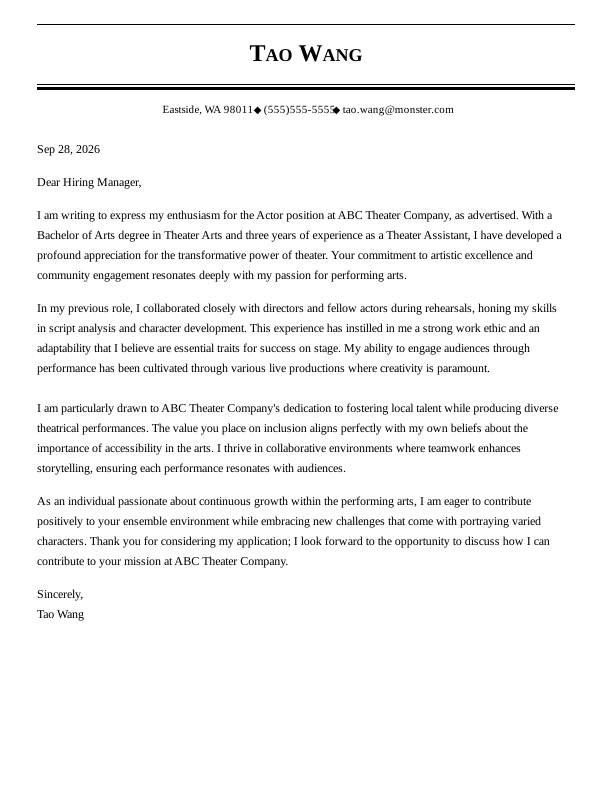
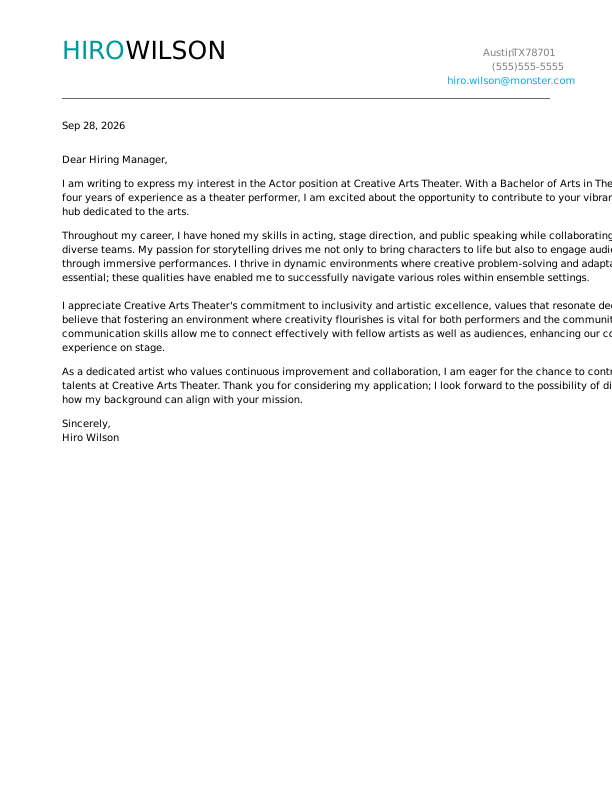
Acting Entry-Level Cover Letter
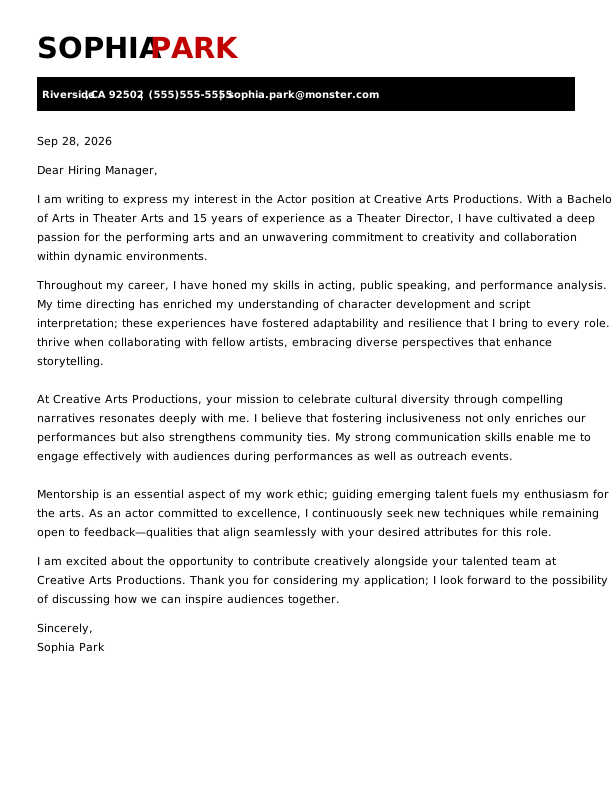
Acting Mid-Level Cover Letter
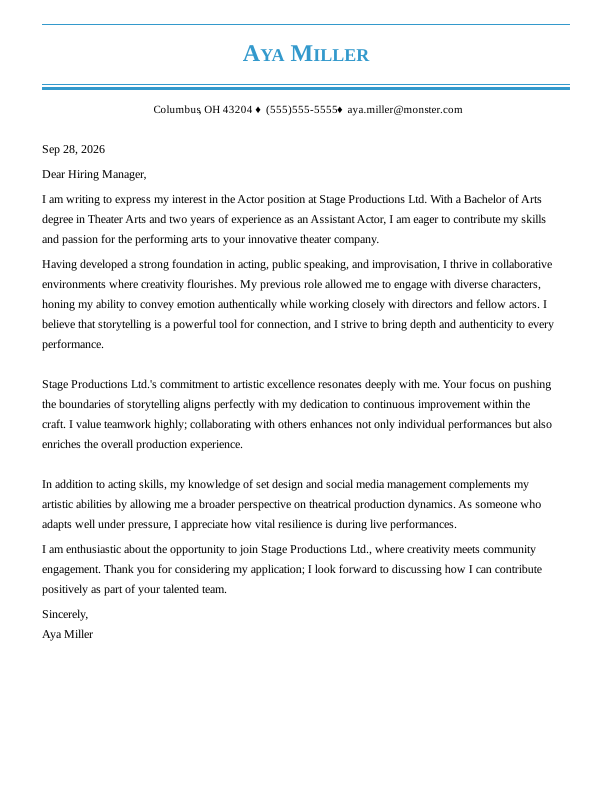
Acting Experienced Cover Letter
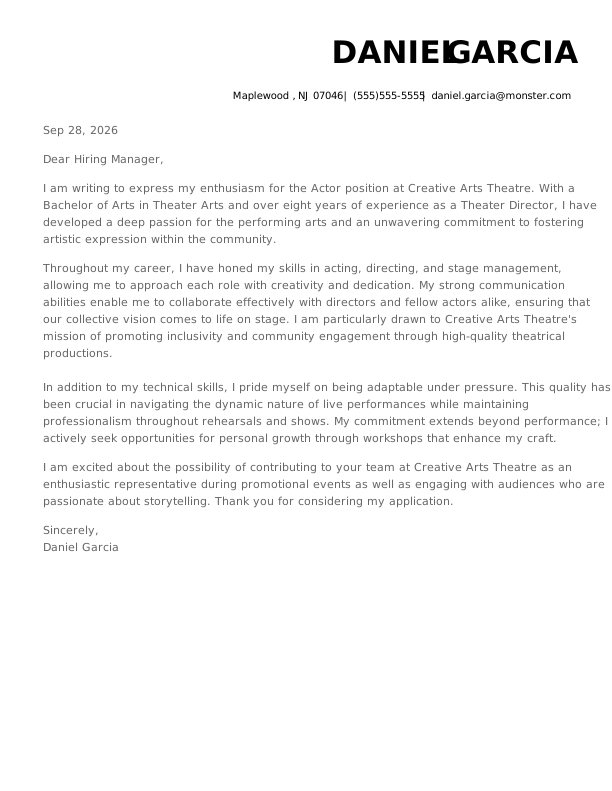
Acting Entry-Level Cover Letter
Acting Mid-Level Cover Letter
Browse Free Cover Letter Templates
- Academic
- Account Manager
- Accountant
- Accounts Payable
- Administrative Assistant
- Admissions Counselor
- Architecture
- Artist
- Assistant Principal
- Babysitter
- Barista
- Bartender
- Bookkeeper
- Brand Ambassador
- Business Analyst
- Business
- Caregiver
- Chef
- Civil Engineering
- Computer Science
- Construction
- Consulting
- Copywriter
- Cosmetology
- Custodian
- Customer Service
- Customer Service Representative
- Data Analyst
- Data Entry
- Dental Assistant
- Dental Hygienist
- Digital Marketing
- Electrical Engineering
- Emt
- Engineering
- Esthetician
- Event Coordinator
- Executive Assistant
- Finance
- Financial Analyst
- Firefighter
- Flight Attendant
- Graphic Designer
- Hair Stylist
- Healthcare
- Hr Generalist
- Investment Banking
- It
- Janitor
- Journalism
- Lab Technician
- Law Clerk
- Lawyer
- Librarian
- Logistics
- Makeup Artist
- Manager
- Marketing Coordinator
- Marketing
- Marketing Manager
- Massage Therapist
- Mechanic
- Mechanical Engineer
- Medical Assistant
- Non Profit
- Nursing
- Occupational Therapy
- Office Assistant
- Office Manager
- Operations Manager
- Paralegal
- Personal Trainer
- Pharmacist
- Pharmacy Technician
- Photographer
- Physician Assistant
- Pilot
- Police Officer
- Program Manager
- Project Manager
- Property Manager
- Psychology
- Receptionist
- Research Assistant
- Restaurant Manager
- Retail
- Sales
- Sales Manager
- School Counselor
- Security Officer
- Social Work
- Software Engineer
- Special Education Teacher
- Substitute Teacher
- Teacher
- Teaching Assistant
- Truck Driver
- Vet Tech
- Veterinary Assistant
- Web Developer
Cover Letter Examples for Actors
Tailoring your letter to the specific role makes your experience feel relevant and engaging. Focus on your most meaningful impact so decision-makers see your value right away, no matter where you are in your career.
Entry-Level Acting Cover Letter
Designed for actors starting out, this template focuses on foundational strengths and passion for the craft.
Mid-Career Acting Cover Letter
Ideal for actors building momentum, this template highlights growing experience and professional development.
Experienced Acting Cover Letter
Tailored for seasoned performers, this template emphasizes high-level experience and artistic leadership.
Acting Cover Letter Template (Text)
Copy this acting cover letter template into your document, then personalize it with your credits, audition training, and the specific production or studio you’re targeting.
Emma Nguyen
Minneapolis, MN 55406
(555)555-5555
emma.nguyen@monster.com
Sep 28, 2026
Dear Hiring Manager,
I am writing to express my interest in the Acting position at Dream Productions, as advertised. With a Bachelor of Arts in Theatre and five years of experience as an actor, I have developed a deep passion for storytelling and a commitment to delivering authentic performances that resonate with audiences.
Throughout my career, I have embraced opportunities for creative collaboration, working closely with directors and fellow cast members to enhance character portrayals across various mediums. My background in improvisation and public speaking has equipped me with strong communication skills, allowing me to engage effectively within diverse teams while adapting seamlessly to the dynamic nature of performance environments.
I pride myself on my ability to analyze scripts thoughtfully, ensuring that each role is approached with attention to detail and emotional depth. Whether memorizing lines or participating in rehearsals, I demonstrate reliability and dedication—qualities that align with Dream Productions’ mission of excellence in artistic expression.
As an adaptable team player who values constructive feedback, I continuously seek growth within my craft. My strong stage presence allows me not only to portray characters convincingly but also to connect meaningfully with audiences—a vital aspect of the captivating experiences Dream Productions aims to create.
I am excited about the opportunity to contribute my skills and passion for performing arts at Dream Productions. Thank you for considering my application; I look forward to discussing how I can be part of your innovative team.
Sincerely,
Emma Nguyen
How to Write an Acting Cover Letter
Writing a great acting cover letter is all about connecting your training and performance experience to what a casting director is looking for. Here is a step-by-step guide to organizing your thoughts and submitting a polished application.
1. Research & Prepare
Take time to understand what the project needs before drafting your letter. Check casting notices for key details on performance style, rehearsal schedules, or specific audition materials, and explore these helpful resources to get fully prepared:
- The employer’s website or casting portal for submission guidelines and required sides
- Actors’ Equity Association updates to verify current theatrical contract standards
- Industry trade news for background on the production team’s recent work and vision
2. Hook the Reader
Skip generic opening lines like “I am writing to apply for the role.” Instead, grab attention immediately by showcasing your readiness, craft, or training using strong hook examples like these:
- Highlighting audition speed: “In my last audition cycle, I delivered two contrasting monologues and adapted instantly to direction on my second take.”
- Focusing on specific preparation: “For your upcoming short film, I built character choices directly from the script breakdown and practiced with exact stage cues.”
- Emphasizing training and collaboration: “Fresh off an intensive at Atlantic Acting School, I recently worked with an indie director to refine multi-location scene blocking.”
3. Tell Your Professional Story
While your resume lists credits, your cover letter highlights your real impact on set or stage. Use concrete details and figures to demonstrate your reliability, as shown in the examples below:
- Earned a lead role after 3 audition rounds and maintained precise blocking across 12 rehearsals.
- Mastered revised script lines within hours to keep rehearsal production running smoothly on set.
- Performed across 24 sold-out theatrical shows, maintaining high energy and positive audience reviews.
4. Showcase Your Skills
Rather than using vague buzzwords, connect key requirements from the casting call to real moments from past productions. The following bullet points illustrate how to phrase these practical skills effectively:
- Taking direction: “Adjusted scene pacing instantly upon request, repeating takes until emotional beats hit clearly.”
- Clear communication: “Coordinated complex entrances with stage management prior to rehearsals to prevent timing issues.”
- Technical readiness: “Marked sides with prop cues and lighting marks to hit every technical transition accurately.”
5. Explain Any Special Circumstances
Address career gaps, genre shifts, or relocations concisely in a sentence or two so casting directors see your active engagement.
For example:
- You can talk about local theater work or recent technique classes you took to explain an employment gap.
- You can address a genre shift from comedy or improv to scripted drama by sharing specialized training.
- You can mention a recent relocation to a new market by sharing updated local headshots and casting profiles.
6. End With a Professional Goodbye
Wrap up with a clear sign-off that invites further discussion. Express enthusiasm for the project, thank the team for their consideration, and close with a professional sign-off like “Best regards.”
4 Tips for Formatting Your Cover Letter
Casting teams skim submissions fast, so put your key credits, training, and availability front and center right away. This holds true whether you’re trying out for your debut background spot or stepping into a lead role.

Keep It to One Page
Keep your letter concise—around 250 to 400 words across three or four quick paragraphs. Highlight your training, major credits, and standout accomplishments like rapid script memorization.
Address the Hiring Manager Directly
Look up the casting director or project coordinator on the breakdown or agency listing. If a specific contact is unavailable, address your letter to “Dear Casting Team.”
Match Your Header to Your Resume
Use the exact same name, contact info, and layout as your acting resume. A unified header gives your submission a polished look so directors can focus on your talent.
Save & Send as a PDF
Export your cover letter as a PDF to preserve your layout on any device. Name the file clearly, like Firstname_Lastname_Acting_Cover_Letter.pdf, before submitting.
Top-Paying States for Acting Roles
Knowing what actors earn can help you set realistic expectations, plan your next steps, and compare opportunities. Salary ranges vary widely based on project type, role size, union status, and whether work is steady or project-based. For baseline context, the U.S. Bureau of Labor Statistics (BLS) tracks earnings for related occupations such as actors and performers, using nationwide data.
Keep in mind that location and experience can affect pay. Lead roles in larger markets often come with higher compensation than smaller productions or local gigs.
| Alabama | $42,660 |
| Arizona | $46,080 |
| Arkansas | $45,310 |
| California | $49,750 |
| Connecticut | $47,970 |
| Florida | $42,290 |
| Georgia | $45,190 |
| Idaho | $47,350 |
| Illinois | $51,770 |
| Indiana | $46,540 |
| Iowa | $48,920 |
| Kansas | $45,760 |
| Kentucky | $40,350 |
| Louisiana | $46,860 |
| Maine | $52,460 |
| Maryland | $43,820 |
| Massachusetts | $45,630 |
| Michigan | $44,890 |
| Minnesota | $52,840 |
| Mississippi | $41,030 |
| Missouri | $48,040 |
| Montana | $53,080 |
| Nebraska | $45,920 |
| Nevada | $48,080 |
| New Hampshire | $45,980 |
| New Jersey | $48,890 |
| New Mexico | $34,550 |
| New York | $50,270 |
| North Carolina | $49,540 |
| North Dakota | $45,940 |
| Ohio | $45,960 |
| Oklahoma | $46,530 |
| Oregon | $51,120 |
| Pennsylvania | $55,390 |
| Rhode Island | $40,250 |
| South Carolina | $49,590 |
| South Dakota | $45,120 |
| Tennessee | $43,070 |
| Texas | $40,830 |
| Utah | $44,670 |
| Vermont | $48,260 |
| Virginia | $49,630 |
| Washington | $52,300 |
| West Virginia | $48,190 |
| Wisconsin | $45,350 |
| Puerto Rico | $24,360 |
Key Takeaways
- Highlight specific roles where you successfully hit demanding emotional or physical beats on set or stage.
- Quantify your experience with clear figures like performance counts, rehearsal hours, and callback rates.
- Tailor your strengths to the medium by emphasizing continuity for screen, stamina for theater, or timing for commercial work.
Browse Monster’s Resume Templates
Monster also has hundreds of ATS-friendly résumé templates for all career levels and industries. Create a matching resume to help you land the interview.
Frequently Asked Questions
Last Update:
Do I really need a cover letter?
Attaching an acting cover letter or pitch note is an essential requirement when submitting headshots and reels to casting directors or talent agents. This concise introduction allows you to highlight recent theatrical or on-camera credits, current union affiliations such as SAG-AFTRA, and specialized vocal or physical performance skills. A personalized note demonstrates your professional decorum and shows directors precisely how your unique background fits their project vision.
How long should my cover letter be?
Your acting cover note length should be ultra-compact, staying between 100 and 200 words to respect the tight schedules of casting teams. Express your enthusiasm for the specific role or production while pointing directly to key media links, training institutions, and reel highlights. Keeping the text punchy allows casting directors to evaluate your background instantly before diving into your headshot and audition materials.
Should my cover letter match my resume?
Your acting cover letter should match your resume by directly citing the prominent stage, film, or TV credits listed on your performance resume. Matching the typography and contact header with your headshot-resume backing creates a cohesive professional brand for casting agencies. Consistent details regarding your representation, union status, and vocal range eliminate any confusion during talent selection.
Should I mention salary expectations in my cover letter?
Including salary expectations in an acting cover note is inappropriate, as pay rates are governed by union contracts, scale rates, or project budgets. Instead of listing figures, confirm your current union status (such as SAG-AFTRA or Equity) or willingness to work under specific contract types. This approach keeps the focus on your talent fit and willingness to collaborate on the production.
How do I write a cover letter for an internal position?
Write an internal acting cover note by referencing your past successful collaborations with the theater company, director, or production studio. Highlight your familiarity with the creative team’s rehearsal expectations, stage environment, and ensemble dynamics. Emphasizing your reliable work ethic and previous positive working rapport reassures directors of a smooth production process.

Elizabeth Muenzen is a Certified Professional Resume Writer (CPRW) and member of the Professional Association of Resume Writers & Career Coaches who empowers job seekers to take control of their career paths using Monster’s comprehensive job search and resume tools.
See More From Elizabeth MuenzenExplore Related Career Advice







How to Write a Cover Letter for Internal Positions or Promotions (Examples & Tips)

Updated:
Apr 23, 2026
|
19 min read


Cover Letter vs Resume: What’s the Difference & Do You Need Both?
Updated:
Apr 23, 2026
|
18 min read