


Free Adjunct Professor Cover Letter Templates & Examples
A strong adjunct professor cover letter should show teaching clarity and student-centered support, with evidence of curriculum development and effective classroom leadership. Our free cover letter examples and step-by-step guidance help you craft a focused application that highlights your academic strengths to hiring managers.
Real-World Cover Letters That Get Results
 Free
Adjunct Professor Entry-Level Cover Letter
Adjunct Professor Mid-Level Cover Letter
Adjunct Professor Experienced Cover Letter
Adjunct Professor Entry-Level Cover Letter
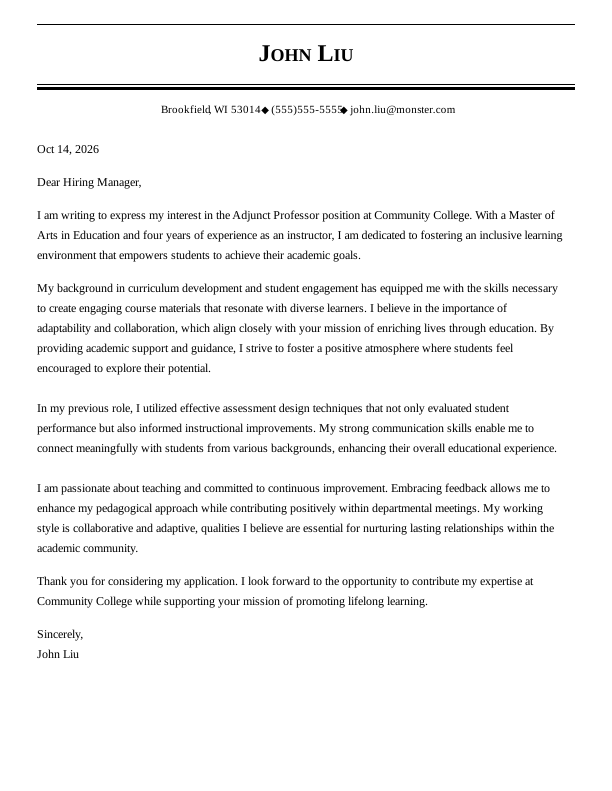
Adjunct Professor Mid-Level Cover Letter
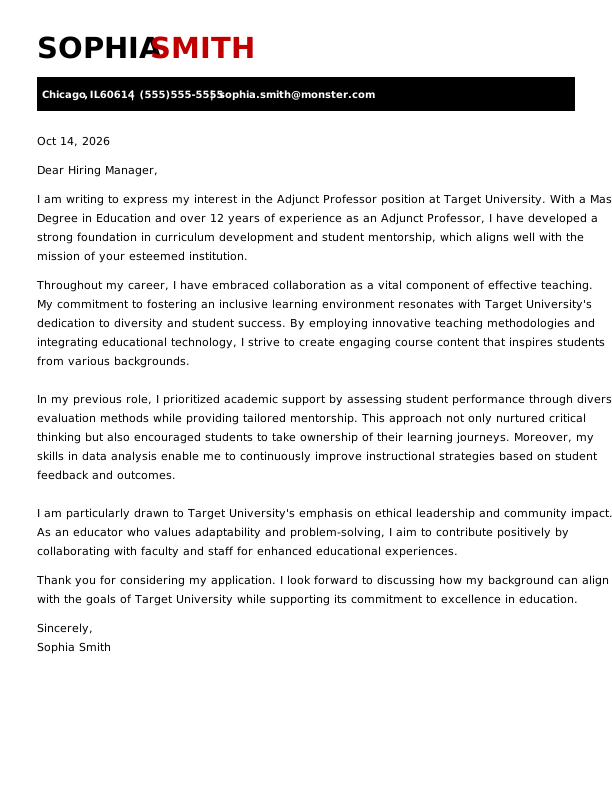
Adjunct Professor Experienced Cover Letter
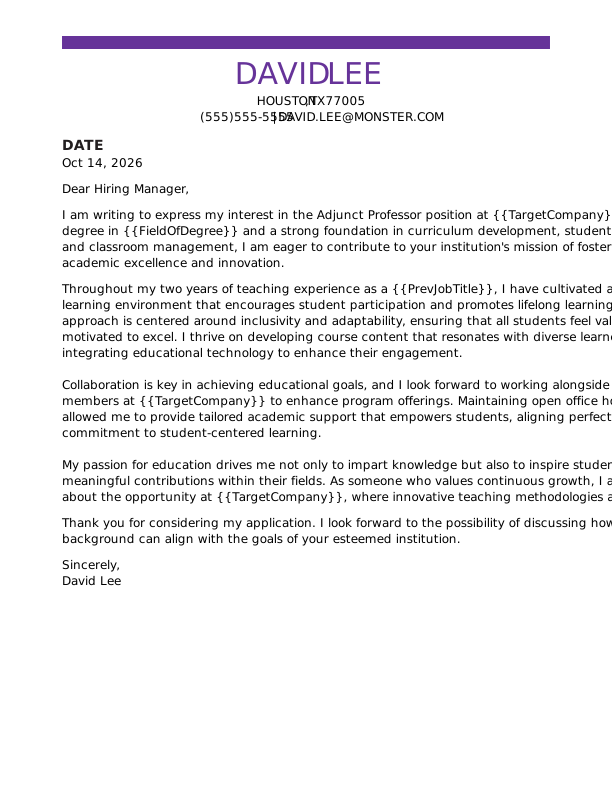
Adjunct Professor Entry-Level Cover Letter
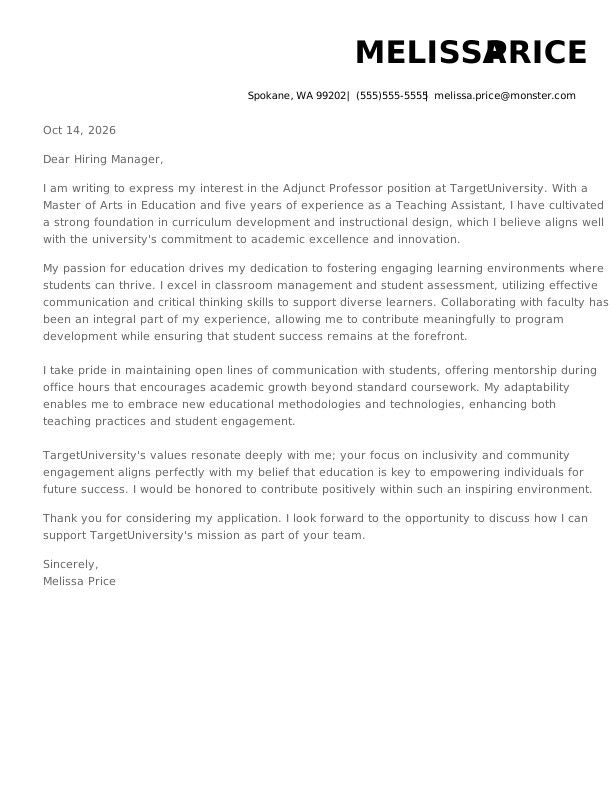
Adjunct Professor Mid-Level Cover Letter
Browse Free Cover Letter Templates
- Academic
- Account Manager
- Accountant
- Accounts Payable
- Administrative Assistant
- Admissions Counselor
- Architecture
- Artist
- Assistant Principal
- Babysitter
- Barista
- Bartender
- Bookkeeper
- Brand Ambassador
- Business Analyst
- Business
- Caregiver
- Chef
- Civil Engineering
- Computer Science
- Construction
- Consulting
- Copywriter
- Cosmetology
- Custodian
- Customer Service
- Customer Service Representative
- Data Analyst
- Data Entry
- Dental Assistant
- Dental Hygienist
- Digital Marketing
- Electrical Engineering
- Emt
- Engineering
- Esthetician
- Event Coordinator
- Executive Assistant
- Finance
- Financial Analyst
- Firefighter
- Flight Attendant
- Graphic Designer
- Hair Stylist
- Healthcare
- Hr Generalist
- Investment Banking
- It
- Janitor
- Journalism
- Lab Technician
- Law Clerk
- Lawyer
- Librarian
- Logistics
- Makeup Artist
- Manager
- Marketing Coordinator
- Marketing
- Marketing Manager
- Massage Therapist
- Mechanic
- Mechanical Engineer
- Medical Assistant
- Non Profit
- Nursing
- Occupational Therapy
- Office Assistant
- Office Manager
- Operations Manager
- Paralegal
- Personal Trainer
- Pharmacist
- Pharmacy Technician
- Photographer
- Physician Assistant
- Pilot
- Police Officer
- Program Manager
- Project Manager
- Property Manager
- Psychology
- Receptionist
- Research Assistant
- Restaurant Manager
- Retail
- Sales
- Sales Manager
- School Counselor
- Security Officer
- Social Work
- Software Engineer
- Special Education Teacher
- Starbucks
- Substitute Teacher
- Teacher
- Teaching Assistant
- Truck Driver
- Vet Tech
- Veterinary Assistant
Cover Letter Examples for Adjunct Professors
Cover letter expectations shift as an adjunct professor gains experience, especially around teaching focus and course leadership. Choose the template that matches your career stage so you can spotlight relevant training, syllabi work, student outcomes, and any department service or curriculum development.
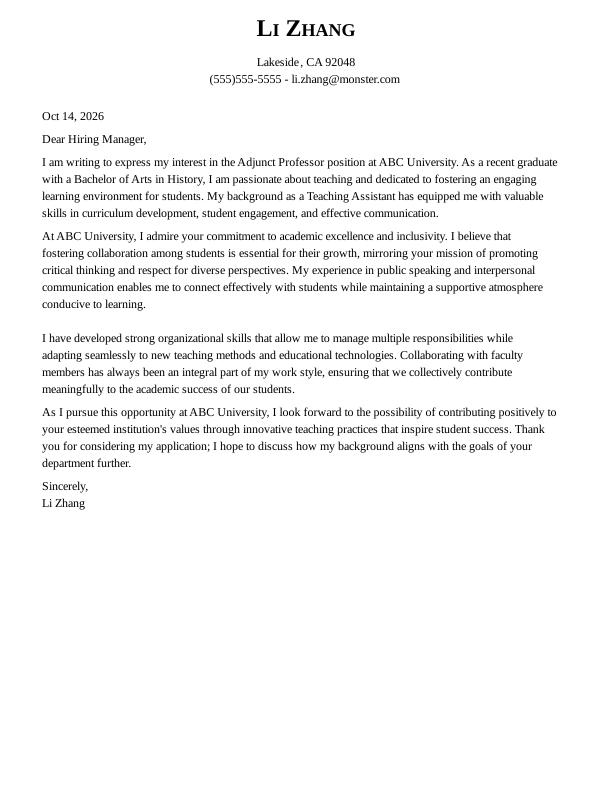
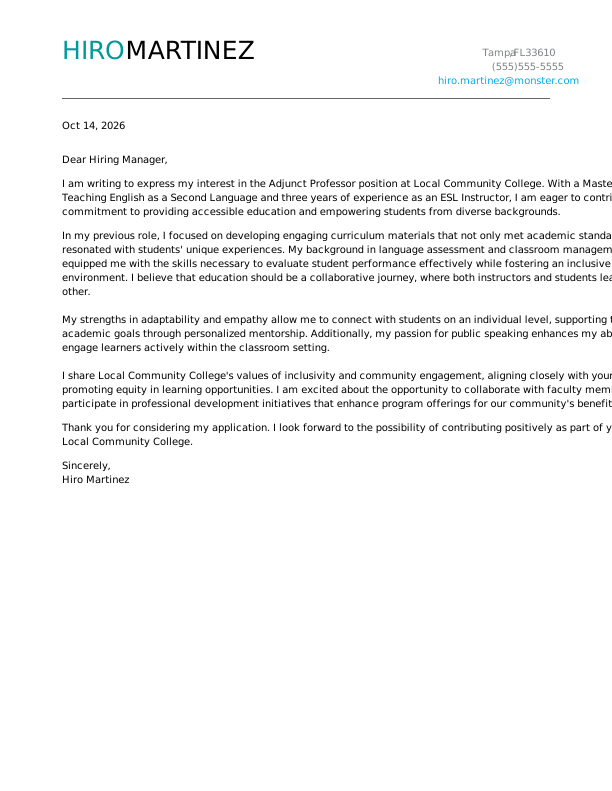
Entry-Level Adjunct Professor Cover Letter
Designed for recent graduate students and career changers, this template demonstrates how to present academic background, teaching assistant experience, and foundational course preparation with confidence when applying for initial higher education roles.
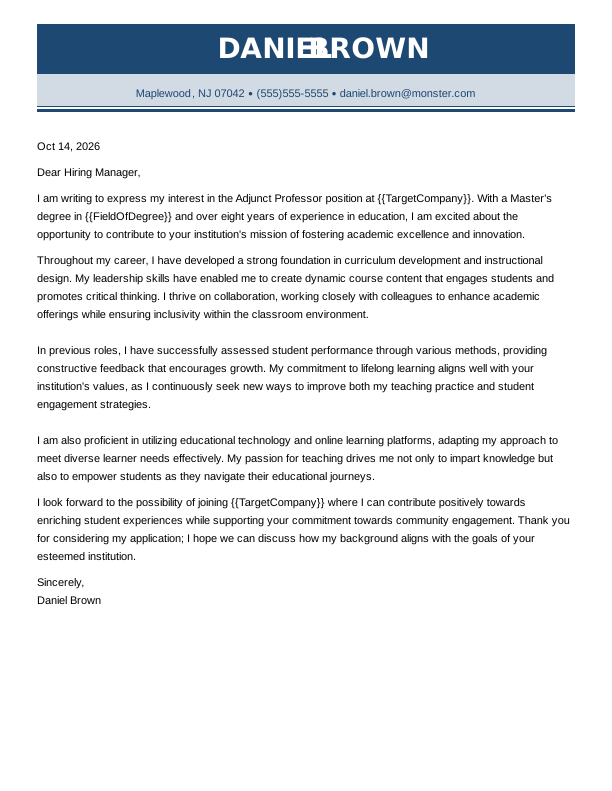
Mid-Career Adjunct Professor Cover Letter
Tailored for instructors with several years of higher education teaching, this template shows how to highlight independent course delivery, syllabus design, office hours advising, and student outcome assessments.
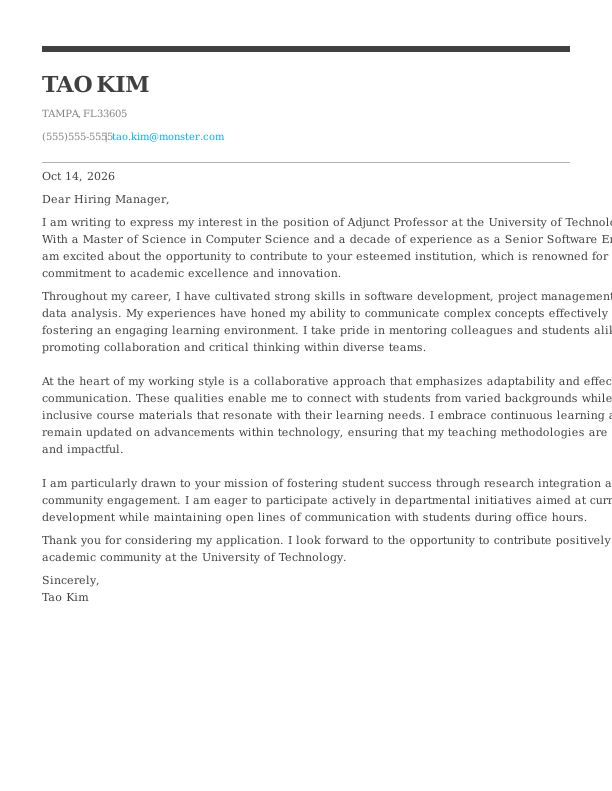
Experienced Adjunct Professor Cover Letter
Ideal for veteran educators and industry experts, this template emphasizes advanced course strategy, interdisciplinary curriculum development, industry-aligned projects, and academic mentorship.
Adjunct Professor Cover Letter Template (Text)
Copy this adjunct professor cover letter template, paste it into your document, and customize the courses taught and publication highlights for your application.
Jane Rodriguez
Dallas, TX 75202
(555)555-5555
jane.rodriguez@monster.com
Oct 14, 2026
Dear Hiring Manager,
I am writing to express my interest in the adjunct professor position at Community College ABC. With a Master of Arts in Education and nine years of experience as a lecturer, I am committed to fostering an inclusive and engaging learning environment that aligns with your institution’s mission.
Throughout my career, I have developed and implemented innovative curriculum strategies that not only enhance student engagement but also promote critical thinking and problem-solving skills. My collaborative working style allows me to effectively partner with faculty and staff, ensuring that we meet the diverse needs of our students while contributing positively to departmental initiatives.
My teaching methodologies focus on creating a supportive atmosphere where learners feel empowered to achieve their academic goals. I believe in the importance of mentorship, guiding students through their educational journeys while maintaining clear communication and feedback. Additionally, my proficiency with educational technology enhances my ability to deliver content in a manner that resonates with today’s learners.
I am particularly drawn to Community College ABC’s dedication to lifelong learning and community development. It would be an honor to contribute my skills in curriculum development and student engagement towards your mission of providing equitable educational opportunities for all individuals.
Thank you for considering my application. I look forward to the opportunity to discuss how I can support the success of your students at Community College ABC.
Sincerely,
Jane Rodriguez
How to Write an Adjunct Professor Cover Letter
Writing an effective adjunct professor cover letter requires showing hiring committees that you understand syllabus design, active teaching strategies, and student assessment. Follow these steps to align your experience with a specific job posting.
1. Research & Prepare
Before writing, research the institution’s academic department, course catalog, and student demographics. Discovering whether the college prioritizes online learning management tools, workforce-aligned practical skills, or traditional academic research allows you to highlight the exact teaching methods that matter most to the department chair.
Gather actionable context by exploring these key information sources:
- Review the job description to confirm required degree credentials, specific course topics, and expected online learning platforms.
- Explore the department’s program pages to understand its learning outcomes, degree tracks, and course sequencing.
- Check regional accreditation standards or campus news to align your language with current institutional goals and quality initiatives.
2. Hook the Reader
Start your letter with an engaging opening line that demonstrates your practical teaching methods and course management skills. Avoid generic statements like “I am writing to apply for the open adjunct professor position.” Instead, capture the committee’s attention by leading with a concrete instructional achievement or curriculum success.
Choose an opening line tailored to your experience using these example approaches:
- Course redesign: “In my introductory course section, I rebuilt weekly modules around clear learning objectives, raising average assignment rubric scores from 2.1 to 2.8 out of 4.0.”
- Student support systems: “For a section of 120 students, I ran targeted virtual office hours and structured peer review sessions, reducing late assignment submissions by 18%.”
- Department collaboration: “I co-developed two ethics case studies with our program director, mapping assignments to writing benchmarks to ensure consistent grading across multiple course sections.”
3. Tell Your Professional Story
Use the body of your letter to give hiring committees a clear view of your performance in the classroom or online environment. While your CV lists degrees and past courses, your cover letter explains how you engage students, evaluate assignments, and support academic retention. Using specific numbers makes your accomplishments far more compelling.
Incorporate concrete benchmarks like these to illustrate your impact:
- Raised average midterm exam scores by 12% after redesigning weekly quizzes and introducing targeted office-hour review sessions.
- Graded 180 student research submissions per term while turning around detailed feedback within 48 hours to support student revisions.
- Advised 10 graduate students through thesis milestones, with nine meeting their target defense dates within two weeks of schedule.
4. Showcase Your Skills
Rather than using broad self-descriptors like “passionate educator” or “skilled lecturer,” illustrate how your skills resolve real academic challenges. Showing the exact moments where your lesson adjustments, rubrics, or one-on-one student meetings improved learning outcomes builds trust with the hiring committee.
Connect your practical abilities directly to daily higher education needs using these examples:
- Curriculum design: “I revised my syllabus after midterm discussion posts showed common misunderstandings, adding a targeted practice module to address learning gaps.”
- Assessment and feedback: “I evaluated student work using a shared rubric, meeting individually with struggling students to explain how to apply feedback to future drafts.”
- Student communication: “During office hours, I asked open-ended questions to identify where a student was stuck, guiding them through a sample problem before having them try on their own.”
5. Explain Any Special Circumstances
If you have an employment gap, are transitioning from industry into academia, or recently relocated, address it briefly in one or two direct sentences. Focus your explanation on your active subject matter expertise, current course materials, and readiness to teach so the committee knows you are prepared for the upcoming term.
Frame your circumstances clearly using these straightforward approaches:
- Addressing an employment gap: “Following a year-long career break, I maintained my academic currency by facilitating online workshops and updating course lecture materials.”
- Transitioning from industry: “I am pivoting from industry software engineering into higher education teaching, having built lab modules in GitHub Classroom for hands-on student practice.”
- Handling relocation: “After moving to the area last fall, I updated my state teaching documentation and aligned my course syllabi with the local college system’s grading standards.”
6. End With a Professional Goodbye
Conclude your letter with a polite, confident statement that invites the department chair or committee to contact you for an interview. Keep your sign-off concise, thank the reader for their time, and express enthusiasm for discussing your course design in detail.
Structure your final paragraph using this clear approach:
- Offer a clear next step: “I would welcome the opportunity to discuss how my course design and student engagement strategies can support your department’s upcoming curriculum goals.”
- Express gratitude: “Thank you for your time and consideration.”
- End with a clean sign-off: “Sincerely,” followed by your full name.
4 Tips for Formatting Your Cover Letter
When you apply for an adjunct professor position, academic search committees often scan your application quickly alongside numerous faculty portfolios. They look rapidly for advanced degrees, teaching experience, and course fit. A clean visual presentation with consistent spacing and logical organization makes your top credentials easy to spot and proves that you take pride in professional academic communication.

Keep It to One Page
Keep your cover letter to a single page, ideally between 250 and 400 words spread across three to four short paragraphs. Concise writing ensures that busy faculty committees can evaluate your teaching background, course highlights, and student outcomes quickly without wading through dense text.

Use a Professional Font & Layout
Select standard, highly legible fonts such as Arial, Calibri, Georgia, or Times New Roman in 10–12 pt size. Maintain clean 1-inch margins and use the exact same header design as your CV or resume so your entire application package presents a unified appearance.

Address the Hiring Manager Directly
Search the job posting, department directory, or faculty list to identify the specific department chair, program director, or search committee lead. If you cannot find an individual name, address your letter to “Dear Hiring Manager” or “Dear Search Committee” rather than using outdated phrases.

Save & Send as a PDF
Save your final cover letter as a PDF to preserve your margins, line spacing, and general layout across different operating systems or mobile devices. Use a clean, professional filename like Firstname_Lastname_Cover_Letter.pdf to make your application easy for committee members to review.
Key Takeaways
- Demonstrate instructional clarity by sharing a specific course modification you made following student feedback to improve learning outcomes.
- Include clear performance metrics like course pass rates, student evaluation averages, or assignment turnaround speeds to prove teaching effectiveness.
- Tailor your letter to the institution by emphasizing workforce preparation for community colleges, specialized research for universities, or practical applications for trade programs.
More Cover Letter Examples
Browse Monster’s Resume Templates
Monster also has hundreds of ATS-friendly resume templates for all career levels and industries. Create a matching resume to help you land the interview.
Frequently Asked Questions
Last Update:
Do I really need a cover letter?
Yes, submitting a cover letter with your adjunct professor application is strongly recommended because it provides teaching context that a resume or CV cannot offer alone. While a CV lists degrees and course titles, a cover letter explains your instructional methods, student engagement strategies, and syllabus design. It also offers space to explain career transitions or gaps.
How long should my cover letter be?
An adjunct professor cover letter should stay within one page, targeting between 250 and 400 words. Department committees review many applications quickly, so direct, concise writing works best. Divide your text into three or four short paragraphs that focus strictly on your teaching experience, assessment methods, and course outcomes without adding unnecessary fluff.
Should my cover letter match my resume?
Your adjunct professor cover letter should match your resume or CV’s visual formatting to present a polished, cohesive application package. Use the same font styles, margin sizes, color choices, and contact header across both documents. Instead of repeating your CV bullet points, use your cover letter to expand on a specific teaching accomplishment or explain how your background aligns with the department’s courses.
What should I include in my cover letter header?
Your cover letter header for an adjunct professor position should include your full name, phone number, professional email address, and general location. Beneath your contact information, add the current date, followed by the department chair’s name, title, and institution address if available. Keeping this header identical to your CV header gives your entire application a clean, intentional presentation.
How do I write a cover letter for an internal position?
To write an internal adjunct professor cover letter, highlight your existing knowledge of the institution’s course sequences, learning management system, and department grading rubrics. Mention how you successfully updated course modules, improved grading turnaround times, or supported departmental learning goals in your current role. Express your readiness to take on additional course sections while completing all formal internal application steps.

Toni Frana is a Certified Professional Resume Writer (CPRW), member of the Professional Association of Resume Writers & Career Coaches, and career expert who empowers job seekers to take control of their career paths using Monster’s comprehensive job search and resume tools.
See More From Toni FranaExplore Related Career Advice







How to Write a Cover Letter for Internal Positions or Promotions (Examples & Tips)

Updated:
Apr 23, 2026
|
19 min read


Cover Letter vs Resume: What’s the Difference & Do You Need Both?

Updated:
Apr 23, 2026
|
18 min read