


Free Actor Cover Letter Templates & Examples
A strong actor cover letter showcases your range and professionalism. Use our free examples and simple step-by-step guidance to highlight your training and credits so casting directors can see your fit for the role.
Real-World Cover Letters That Get Results
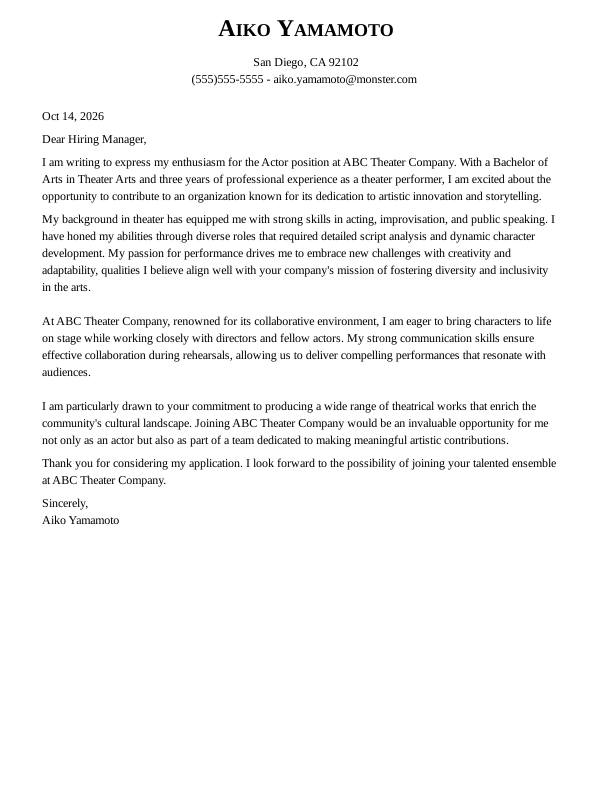
 Free
Actor Entry-Level Cover Letter
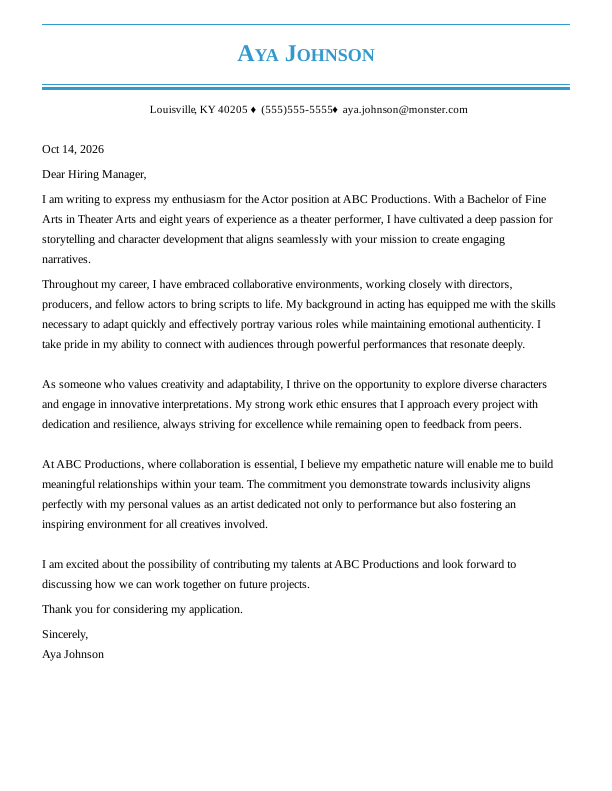
Actor Mid-Level Cover Letter
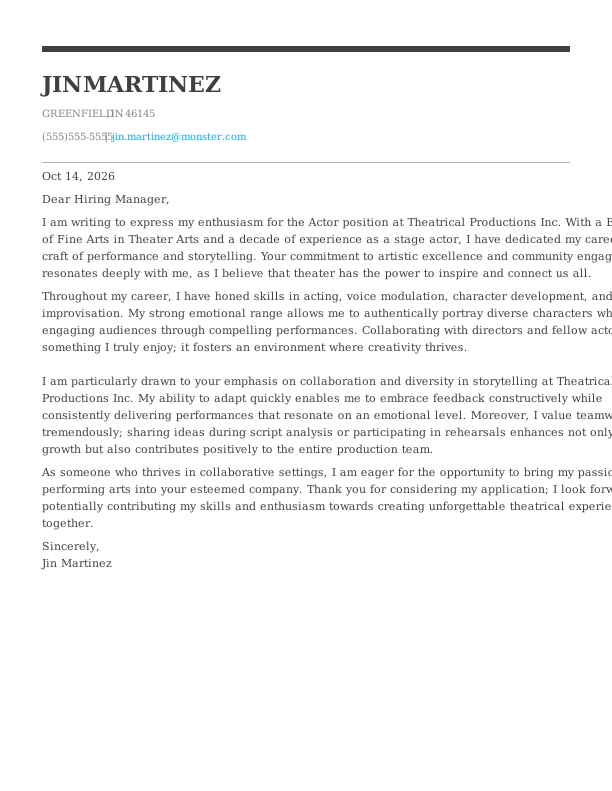
Actor Experienced Cover Letter
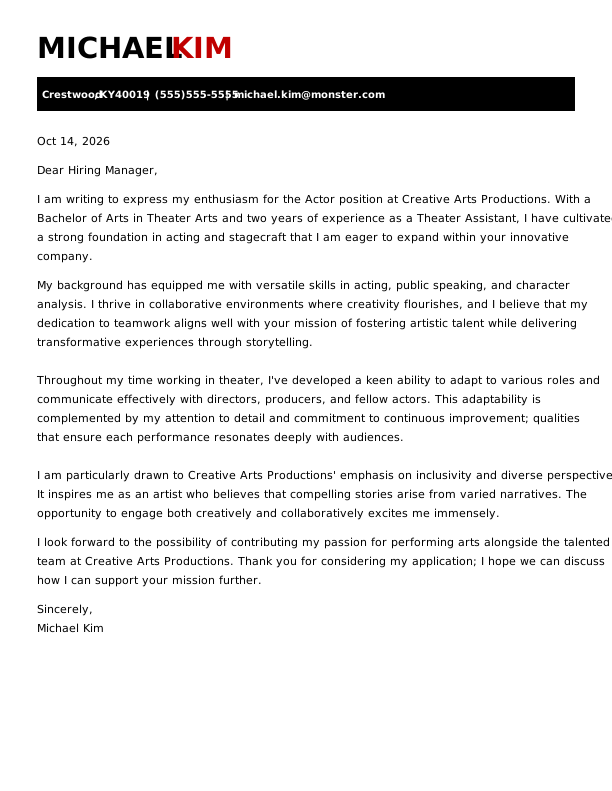
Actor Entry-Level Cover Letter
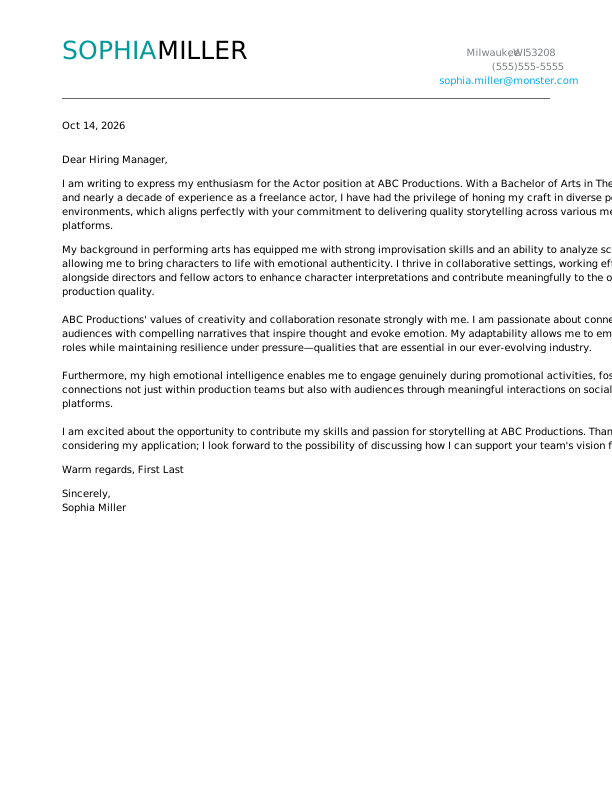
Actor Mid-Level Cover Letter
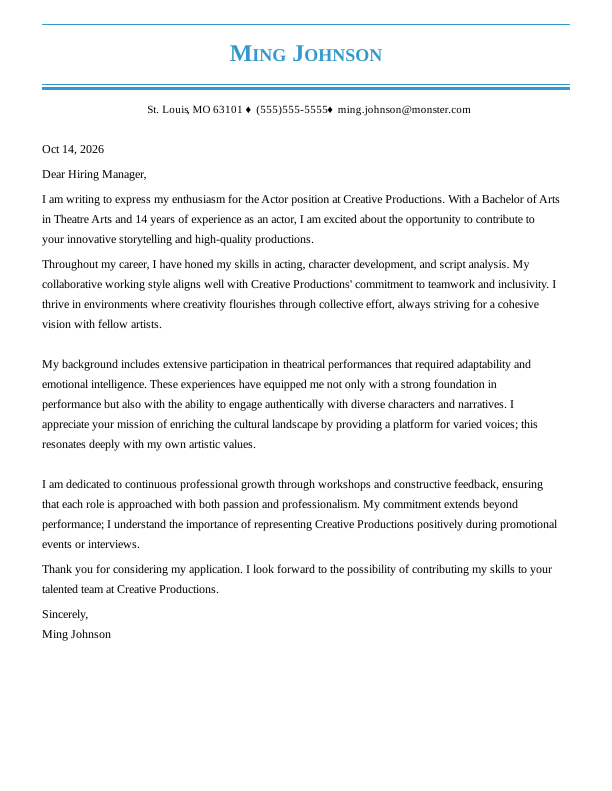
Actor Experienced Cover Letter
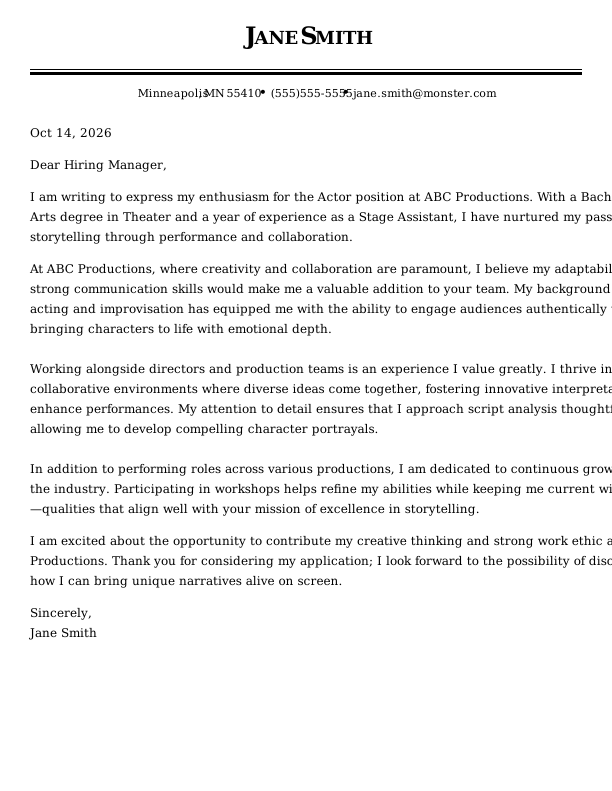
Actor Entry-Level Cover Letter
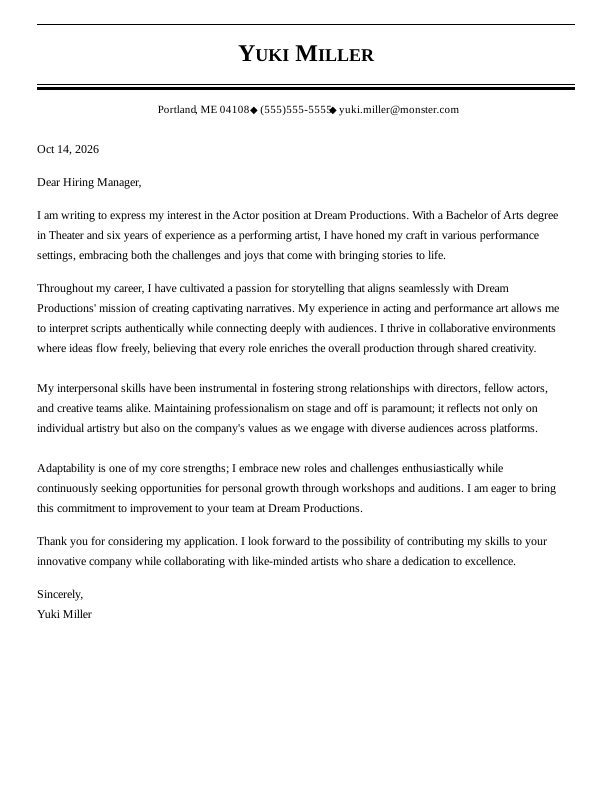
Actor Mid-Level Cover Letter
Browse Free Cover Letter Templates
- Academic
- Account Manager
- Accountant
- Accounts Payable
- Administrative Assistant
- Admissions Counselor
- Architecture
- Artist
- Assistant Principal
- Babysitter
- Barista
- Bartender
- Bookkeeper
- Brand Ambassador
- Business Analyst
- Business
- Caregiver
- Chef
- Civil Engineering
- Computer Science
- Construction
- Consulting
- Copywriter
- Cosmetology
- Custodian
- Customer Service
- Customer Service Representative
- Data Analyst
- Data Entry
- Dental Assistant
- Dental Hygienist
- Digital Marketing
- Electrical Engineering
- Emt
- Engineering
- Esthetician
- Event Coordinator
- Executive Assistant
- Finance
- Financial Analyst
- Firefighter
- Flight Attendant
- Graphic Designer
- Hair Stylist
- Healthcare
- Hr Generalist
- Investment Banking
- It
- Janitor
- Journalism
- Lab Technician
- Law Clerk
- Lawyer
- Librarian
- Logistics
- Makeup Artist
- Manager
- Marketing Coordinator
- Marketing
- Marketing Manager
- Massage Therapist
- Mechanic
- Mechanical Engineer
- Medical Assistant
- Non Profit
- Nursing
- Occupational Therapy
- Office Assistant
- Office Manager
- Operations Manager
- Paralegal
- Personal Trainer
- Pharmacist
- Pharmacy Technician
- Photographer
- Physician Assistant
- Pilot
- Police Officer
- Program Manager
- Project Manager
- Property Manager
- Psychology
- Receptionist
- Research Assistant
- Restaurant Manager
- Retail
- Sales
- Sales Manager
- School Counselor
- Security Officer
- Social Work
- Software Engineer
- Special Education Teacher
- Starbucks
- Substitute Teacher
- Teacher
- Teaching Assistant
- Truck Driver
- Vet Tech
- Veterinary Assistant
Cover Letter Examples for Actors
As your acting career grows, your cover letter should reflect your evolving experience. Select the template below that best aligns with your background to showcase your relevant training and performance highlights.
Entry-Level Actor Cover Letter
This sample cover letter is tailored for early-career actors and recent performance graduates. It focuses on foundational acting training, passion for the craft, and transferable set skills.
Mid-Career Actor Cover Letter
Designed for actors with several years of professional experience, this template highlights featured roles, specialized stage or screen work, and proven reliability during rehearsals and productions.
Experienced Actor Cover Letter
Ideal for seasoned performers, this template emphasizes lead credits, character development expertise, and leadership roles such as mentoring ensemble members or assisting directors.
Actor Cover Letter Template (Text)
Copy this actor cover letter template into your document, then customize the roles, awards, and production names to match the audition or project you want.
Aiko Yamamoto
Detroit, MI 48202
(555)555-5555
aiko.yamamoto@monster.com
Oct 14, 2026
Dear Hiring Manager,
I am writing to express my enthusiasm for the Actor position at Dream Productions. With a Bachelor of Arts in Theater Arts and five years of experience as a theatrical performer, I have developed a strong foundation in acting, improvisation, and voice modulation that aligns with your commitment to captivating storytelling.
Throughout my career, I have thrived in collaborative environments where creativity and inclusivity are paramount. My ability to work well under pressure has not only enabled me to deliver compelling performances but also fostered meaningful partnerships with directors and fellow actors. The dynamic nature of the entertainment industry excites me, and I embrace challenges as opportunities for growth.
My passion for character development allows me to bring depth and authenticity to every role I undertake. By actively participating in rehearsals and workshops, I continuously refine my craft while welcoming feedback that enhances overall performance quality. Additionally, my strong communication skills extend beyond the stage; engaging with audiences during promotional activities enriches both their experience and mine.
Dream Productions’ dedication to storytelling resonates deeply with me. It would be an honor to contribute my creativity, adaptability, and leadership capabilities within your talented team. Thank you for considering my application; I look forward to the possibility of discussing how we can collaboratively create powerful narratives together.
Warm regards,
John Doe
Sincerely,
Aiko Yamamoto
How to Write an Actor Cover Letter
Writing a clear cover letter requires turning your performance background into specific examples that show casting teams how you work. Use the following steps to craft a tailored letter for your next audition or project submission.
1. Research & Prepare
Before writing, research the production company or theater group to understand their current artistic focus and casting style. Take the following preparation actions to align your letter with their specific needs:
- Review the employer’s casting or auditions page to find what roles they prioritize.
- Read the production company or theater’s press releases to identify current artistic focus.
- Search the local actors union site for audition rules and submission expectations.
2. Hook the Reader
Start your cover letter with an engaging line that instantly highlights your range and readiness for the role. Consider using one of these opening approaches to grab the casting team’s attention:
- Audition tape proof: “On my last self-tape for a supporting lead, I delivered three distinct reads across 48 hours using my phone rig and timed marks, then adjusted pacing after notes from the director of development.”
- Range through credited work: “For my indie feature run as Maya, I switched from courtroom stillness to action beats by week two, and I hit continuity targets by tracking props and eyelines during rehearsals led by the stage manager.”
- Direction responsiveness: “In rehearsal for a short film shoot this season, I incorporated new blocking within one take after the acting coach asked for a tighter objective shift during the final monologue.”
3. Tell Your Professional Story
Use body paragraphs to describe real performance conditions and measurable achievements that demonstrate your reliability. Point to key accomplishments like these to show your proven record on set or stage:
- Performed 120 shows over a season while maintaining 98% on-time curtain call compliance across weekly matinees and evening runs.
- Improved ticket sales by 22% for my character after leading two promotional interviews that increased social engagement from 3,800 to 4,700 followers.
- Reduced rehearsal-to-performance script errors by 35% after implementing daily line checks for a cast of 15 actors.
4. Showcase Your Skills
Focus on technical acting skills and preparation techniques that match the project’s medium. Illustrate your practical expertise using concrete examples like these:
- Audition preparation: “I arrived early, warmed up my voice, then used the casting note they gave me to adjust my monologue beat-by-beat before I performed again.”
- On-set collaboration: “When the director changed the blocking mid-scene, I repeated my lines while moving so continuity stayed consistent for the camera team.”
- Script and continuity tools: “I marked my script with cues in pencil and tracked prop handoffs during rehearsal so I could hit every timing point without fumbling.”
5. Explain Any Special Circumstances
If you have employment gaps, career transitions, or recent relocations, address them briefly in a plain, confident sentence. Explain your current career momentum using examples like these:
- After a year away for caregiving, I stayed active by booking local commercials and updating my headshots and reel on Actors Access.
- I am pivoting into voice acting by taking regular sessions at a studio specializing in audiobook reads and recording new samples for my website.
- I relocated from Atlanta to Los Angeles last fall, and I have been submitting weekly through Backstage while building credits with SAG-AFTRA background calls.
6. End With a Professional Goodbye
Conclude your cover letter with a polite, professional call to action and expression of thanks. Structure your closing paragraph using clear steps like these:
In paragraph two, use an offer tied to their work, like “I’d love to audition for your upcoming indie feature and discuss how I approach character research.” Then thank them with “Thank you for considering my application.” Finish with “Best regards.”
4 Tips for Formatting Your Cover Letter
Casting directors often review hundreds of applications quickly, so a clean layout helps your qualifications stand out immediately. Proper page layout and clear structure ensure your performance background, credits, and contact information are easy to read across all digital devices and printouts.

Match Your Header to Your Resume
Use the exact same header styling across your actor cover letter and resume, including your full name, contact information, portfolio links, and font choices. Creating a uniform visual brand across both pages helps casting directors instantly recognize your application package and review your credentials without visual friction.

Use Bullet Points for Key Achievements
Organize your top production achievements, awards, and specialized performance skills into three or four concise bullet points. Bullet points break up long blocks of body text, allowing busy casting teams to quickly spot your most relevant credits during brief initial reviews.

Balance Spacing & Margins
Set line spacing between 1.0 and 1.15, leaving a full blank line between paragraphs to keep the document inviting to read. Maintain consistent margins between 0.75 and 1 inch on all sides to frame your text neatly, preserving professional structure on screen and in print.

Save & Send as a PDF
Export your cover letter as a PDF file to lock in your document formatting and prevent layout shifts on different computers. Name the file professionally using a standardized format like Firstname_Lastname_Cover_Letter.pdf so casting agents can easily locate and store your document.
Top-Paying States for Actor Roles
Knowing what actors earn can help you compare opportunities, plan your finances, and set realistic expectations. Salary data is often reported in different ways by role type, project size, and union status, so it’s important to look at reliable benchmarks. The U.S. Bureau of Labor Statistics (BLS) is a helpful source for understanding nationwide pay trends for actors.
Keep in mind that earnings can vary widely based on location, experience level, training, audition volume, and whether you work in film, TV, theater, or commercials.
| Alabama | $80,630 |
| Alaska | $110,410 |
| Arizona | $87,520 |
| Arkansas | $104,330 |
| California | $125,040 |
| Connecticut | $103,270 |
| Delaware | $58,330 |
| District of Columbia | $71,900 |
| Florida | $86,450 |
| Georgia | $72,940 |
| Hawaii | $98,370 |
| Idaho | $72,600 |
| Illinois | $89,940 |
| Indiana | $90,130 |
| Iowa | $73,330 |
| Kansas | $84,350 |
| Kentucky | $75,970 |
| Louisiana | $94,270 |
| Maine | $102,310 |
| Maryland | $85,580 |
| Massachusetts | $94,210 |
| Michigan | $91,160 |
| Minnesota | $101,500 |
| Mississippi | $91,250 |
| Missouri | $72,240 |
| Montana | $80,250 |
| Nebraska | $112,830 |
| Nevada | $91,330 |
| New Hampshire | $75,380 |
| New Jersey | $114,450 |
| New Mexico | $95,360 |
| New York | $139,850 |
| North Carolina | $113,850 |
| North Dakota | $85,270 |
| Ohio | $117,030 |
| Oklahoma | $96,040 |
| Oregon | $96,950 |
| Pennsylvania | $80,550 |
| Rhode Island | $80,740 |
| South Carolina | $115,160 |
| South Dakota | $96,820 |
| Tennessee | $80,490 |
| Texas | $101,250 |
| Utah | $68,050 |
| Vermont | $57,050 |
| Virginia | $93,190 |
| Washington | $93,670 |
| West Virginia | $81,840 |
| Wisconsin | $88,870 |
| Wyoming | $80,350 |
| Guam | $38,560 |
| Puerto Rico | $67,050 |
| Virgin Islands | $45,770 |
Key Takeaways
- Show your acting range and preparation by sharing concise, real-world examples from past auditions or productions.
- Include specific performance metrics such as show runs, callback history, or ticket impact to demonstrate your proven reliability.
- Tailor your cover letter details to reflect the exact demands of the medium, whether focusing on film continuity or live theater stamina.
More Cover Letter Examples
Browse Monster’s Resume Templates
Monster also has hundreds of ATS-friendly resume templates for all career levels and industries. Create a matching resume to help you land the interview.
Frequently Asked Questions
Last Update:
Do I really need a cover letter?
You need a cover letter for actor roles because it provides context that your resume cannot offer on its own. While a resume lists past credits and training, a cover letter highlights your creative approach, passion, and interest in a specific production. Submitting a tailored cover letter shows strong initiative and helps casting directors see how you will collaborate with their team.
How long should my cover letter be?
Your actor cover letter should be between 250 and 400 words long, fitting neatly on a single page. Keeping your letter brief respects the casting team’s time and ensures your top achievements stand out during quick reviews. Focus on three to four concise paragraphs that emphasize your most relevant credits, training, and suitability for the target role without overwhelming the reader.
Should my cover letter match my resume?
Your cover letter should match your resume to present a cohesive, professional application package. Using the same font style, color scheme, margins, and header format across both documents creates a clean visual identity. This consistent presentation demonstrates your attention to detail, allowing casting agents to focus on your qualifications while the letter complements and expands upon your resume highlights.
What should I include in my cover letter header?
Your cover letter header should include your full name, phone number, professional email address, current location, and relevant portfolio or casting links. Follow these contact details with the date and recipient information, such as the casting director’s name and production company. Matching the layout and typography to your resume header ensures both documents present a unified, polished appearance.
Should I mention salary expectations in my cover letter?
You should only mention salary expectations in an actor cover letter if the job posting explicitly asks you to provide them. When requested, state a flexible pay range based on local market standards and your performance experience level. If pay details are not requested by the employer, leave them out completely so the focus stays entirely on your artistic talents and qualifications.

Toni Frana is a Certified Professional Resume Writer (CPRW), member of the Professional Association of Resume Writers & Career Coaches, and career expert who empowers job seekers to take control of their career paths using Monster’s comprehensive job search and resume tools.
See More From Toni FranaExplore Related Career Advice







How to Write a Cover Letter for Internal Positions or Promotions (Examples & Tips)

Updated:
Apr 23, 2026
|
19 min read


Cover Letter vs Resume: What’s the Difference & Do You Need Both?

Updated:
Apr 23, 2026
|
18 min read