


Free Aviation Cover Letter Templates & Examples
A strong aviation cover letter shows you can prioritize safety, follow procedures, and communicate clearly during high-stakes operations. Our free cover letter examples and step-by-step guidance help you present your flight or maintenance experience so hiring managers can quickly trust your qualifications.
Real-World Cover Letters That Get Results
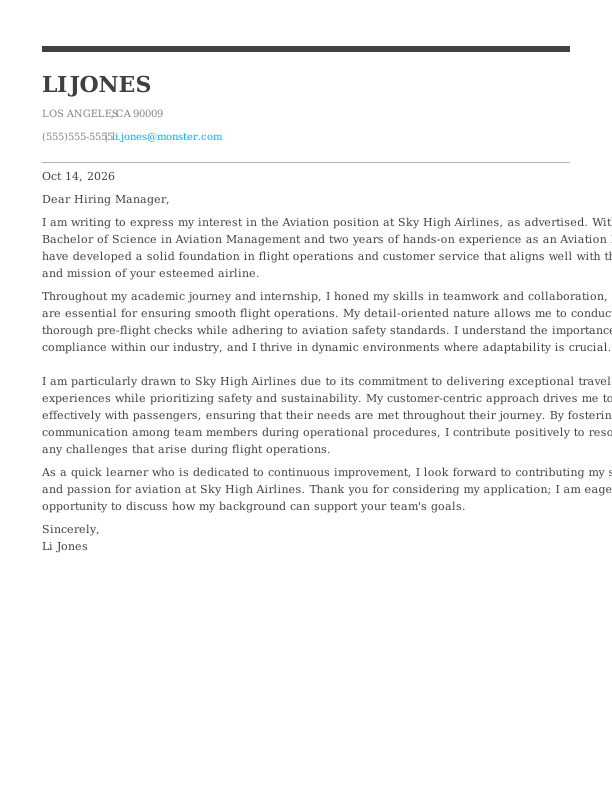
 Free
Aviation Entry-Level Cover Letter
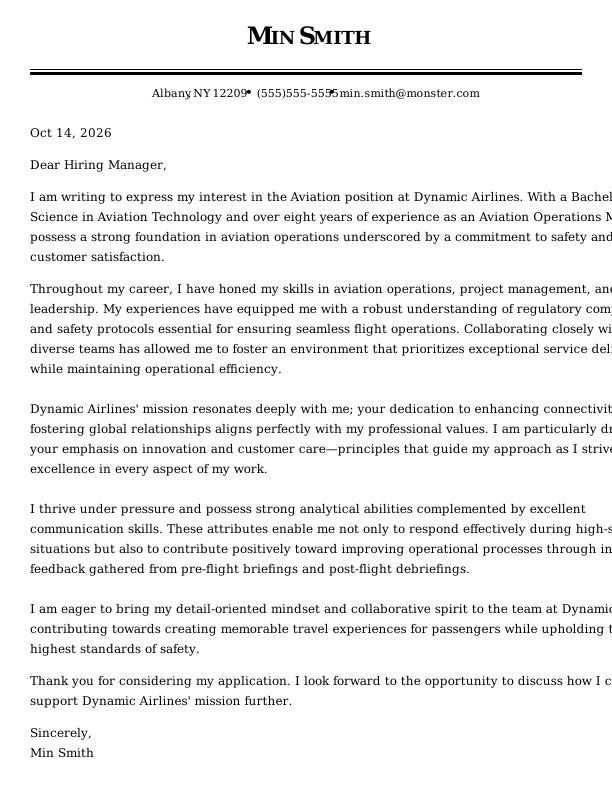
Aviation Mid-Level Cover Letter
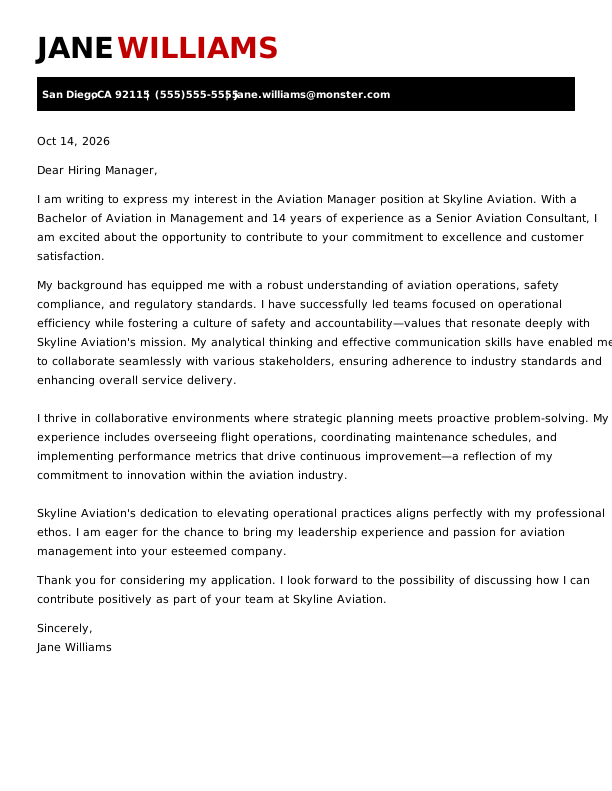
Aviation Experienced Cover Letter
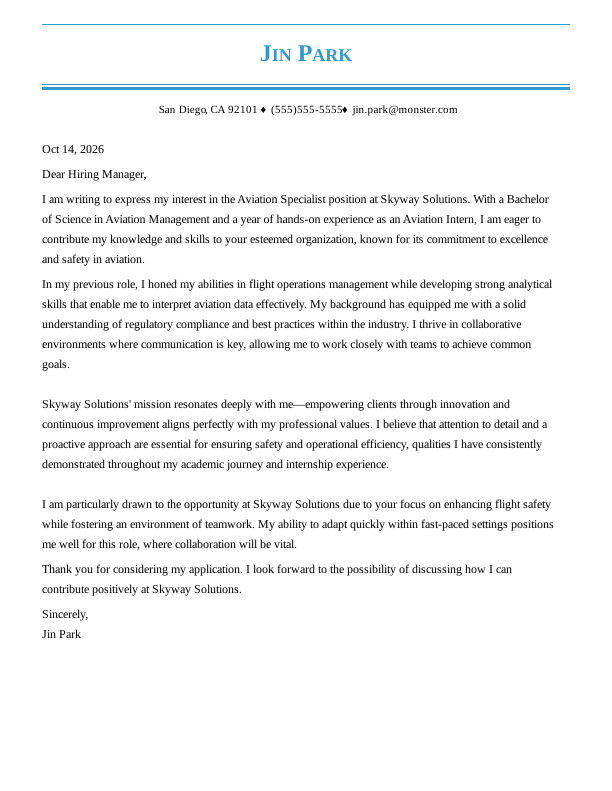
Aviation Entry-Level Cover Letter
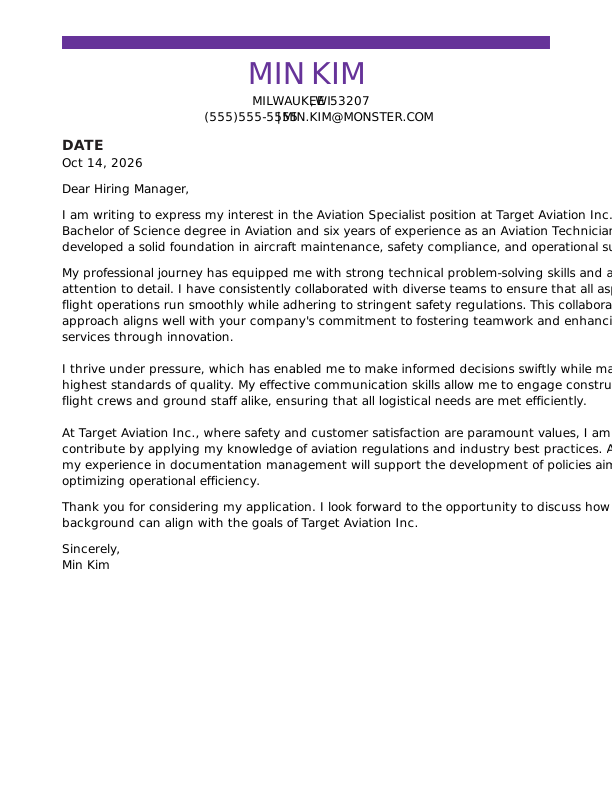
Aviation Mid-Level Cover Letter
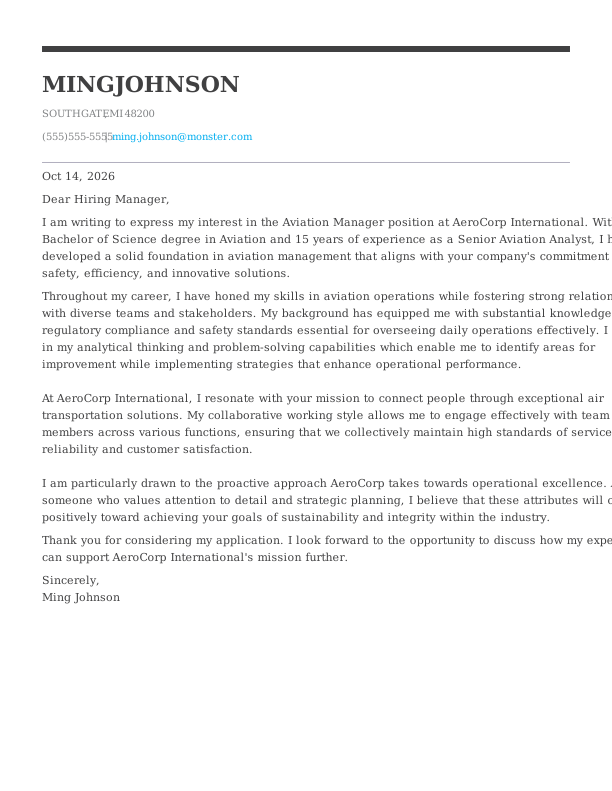
Aviation Experienced Cover Letter
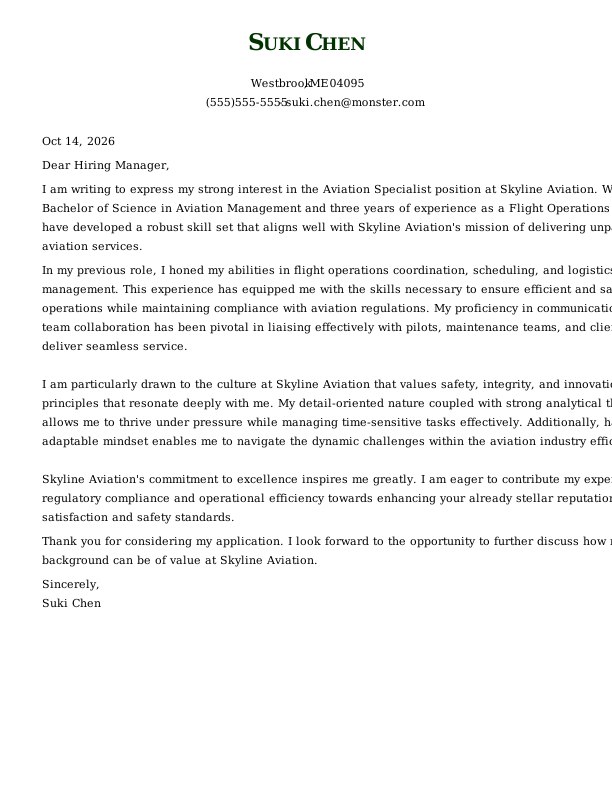
Aviation Entry-Level Cover Letter
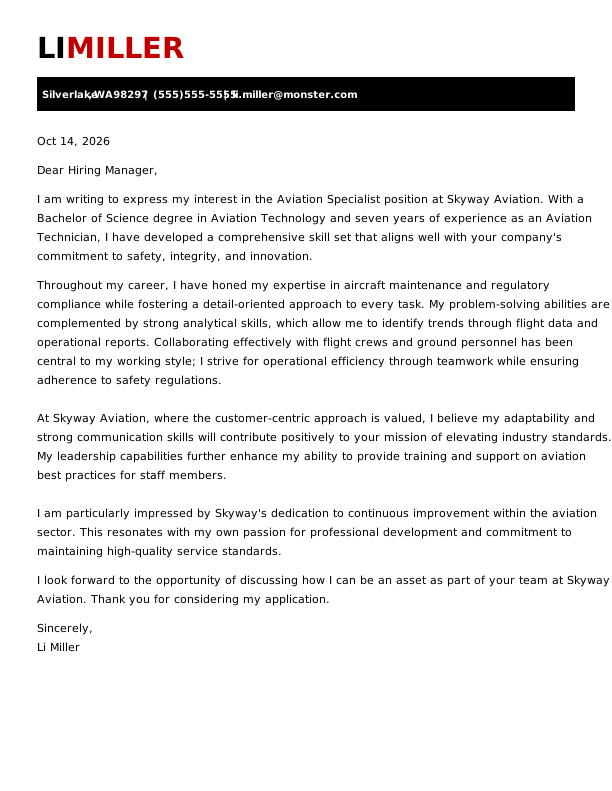
Aviation Mid-Level Cover Letter
Browse Free Cover Letter Templates
- Academic
- Account Manager
- Accountant
- Accounts Payable
- Administrative Assistant
- Admissions Counselor
- Architecture
- Artist
- Assistant Principal
- Babysitter
- Barista
- Bartender
- Bookkeeper
- Brand Ambassador
- Business Analyst
- Business
- Caregiver
- Chef
- Civil Engineering
- Computer Science
- Construction
- Consulting
- Copywriter
- Cosmetology
- Custodian
- Customer Service
- Customer Service Representative
- Data Analyst
- Data Entry
- Dental Assistant
- Dental Hygienist
- Digital Marketing
- Electrical Engineering
- Emt
- Engineering
- Esthetician
- Event Coordinator
- Executive Assistant
- Finance
- Financial Analyst
- Firefighter
- Flight Attendant
- Graphic Designer
- Hair Stylist
- Healthcare
- Hr Generalist
- Investment Banking
- It
- Janitor
- Journalism
- Lab Technician
- Law Clerk
- Lawyer
- Librarian
- Logistics
- Makeup Artist
- Manager
- Marketing Coordinator
- Marketing
- Marketing Manager
- Massage Therapist
- Mechanic
- Mechanical Engineer
- Medical Assistant
- Non Profit
- Nursing
- Occupational Therapy
- Office Assistant
- Office Manager
- Operations Manager
- Paralegal
- Personal Trainer
- Pharmacist
- Pharmacy Technician
- Photographer
- Physician Assistant
- Pilot
- Police Officer
- Program Manager
- Project Manager
- Property Manager
- Psychology
- Receptionist
- Research Assistant
- Restaurant Manager
- Retail
- Sales
- Sales Manager
- School Counselor
- Security Officer
- Social Work
- Software Engineer
- Special Education Teacher
- Starbucks
- Substitute Teacher
- Teacher
- Teaching Assistant
- Truck Driver
- Vet Tech
- Veterinary Assistant
Cover Letter Examples for Aviations
Expectations for an aviation professional change as your career progresses from training to operational leadership. Choose the template that matches your experience level to highlight relevant flight or maintenance qualifications, safety work, and program responsibilities.
Entry-Level Aviation Cover Letter
Designed for recent graduates and career changers transitioning into aviation roles, this template helps you confidently present transferable strengths when you lack direct industry experience.
Mid-Career Aviation Cover Letter
Designed for aviation professionals a few years into their career, this template highlights safety leadership, ownership of regulatory compliance, and mentoring across operations teams.
Experienced Aviation Cover Letter
Best suited to managers nearly a decade into their careers, this template fits leaders who own safety systems, oversee flight operations teams, and drive performance improvements.
Aviation Cover Letter Template (Text)
Copy this aviation cover letter template, paste it into your document, and swap in your safety certifications and flight ops experience for the role you want.
Min Lee
Brookfield, WI 53005
(555)555-5555
min.lee@monster.com
Oct 14, 2026
Dear Hiring Manager,
I am writing to express my interest in the Aviation Consultant position at AeroConsult Corp, as advertised. With a Bachelor of Science degree in Aviation Management and five years of experience as an Aviation Operations Specialist, I am excited about the opportunity to contribute to your team.
My background in aviation operations has equipped me with a robust understanding of safety compliance and operational efficiency. I have honed my skills in conducting comprehensive analyses and developing strategic recommendations that enhance performance within the aviation sector. My experiences have also nurtured strong communication abilities, allowing me to effectively present findings and collaborate seamlessly with cross-functional teams.
At AeroConsult Corp, I appreciate your commitment to integrity, innovation, and collaboration—values that resonate deeply with my professional ethos. I thrive in dynamic environments where adaptability is crucial for success. My proactive problem-solving approach enables me to navigate complex challenges while fostering strong relationships with clients and stakeholders.
I am particularly drawn to AeroConsult’s mission of enhancing efficiency and sustainability within the aviation industry through bespoke solutions. I am eager to leverage my analytical thinking abilities alongside my passion for aviation to support your clients’ needs as they adapt to industry changes.
Thank you for considering my application. I look forward to the possibility of discussing how my background can align with the goals at AeroConsult Corp.
Sincerely,
Min Lee
How to Write an Aviation Cover Letter
Writing a strong cover letter means turning your experience into clear evidence. Use concrete details, like safety training records, highlights from your flight or maintenance log, and incident-response examples, to build a focused story for your job application.
1. Research & Prepare
Before writing, learn what the employer operates and maintains right now. Check current aircraft types, maintenance programs, and safety standards so your letter mirrors their operational reality. Take these three research steps before drafting your letter:
- Review the job posting and note which aircraft systems, manuals, or software tools the company mentions.
- Read the FAA Airworthiness Directives or service bulletins referenced by the role to match how you approach compliance.
- Scan published safety management system updates to see which operational metrics the team tracks.
2. Hook the Reader
Your opening line must earn attention beyond standard job application language. Replace generic phrasing with an opening sentence that proves you understand real flight or safety priorities. Consider these three opening options for your cover letter:
- Safety snapshot: “I reduced write-ups for tail-scrape events by 35% in six months by tightening ground-handling briefings and using our risk matrix during ramp checks.”
- Performance focus: “When I supported three daily A320 rotations, I improved on-time departures from 86% to 93% by partnering with dispatch on MEL reviews.”
- Regulatory alignment: “After completing EASA Part-145 audits and updating our checklist, I helped close repeat findings within two audit cycles.”
3. Tell Your Professional Story
Your resume lists flight experience, but your letter shows how you perform during actual operations. Numbers prove sound decision-making under pressure. Use specific operational metrics like these to illustrate your accomplishments:
- Improved on-time departures from 86% to 93% over nine months by coordinating turnarounds across ground handling and flight crews.
- Reduced fuel burn costs by $120,000 annually by standardizing routing checks and optimizing step climbs within dispatch constraints.
- Handled an average of 18 daily passenger disruptions while maintaining a 98.5% compliance rate for required documentation and incident reporting.
4. Showcase Your Skills
Instead of describing yourself as detail-focused, share a specific moment when you managed an operational constraint. Show what you inspected and how you resolved the issue before it escalated. Highlight your technical capabilities using examples like these:
- Preflight checklist discipline: “I caught a mismatched tire size during preflight inspection and paused dispatch until maintenance confirmed the correct configuration.”
- Maintenance documentation: “I logged findings in the aircraft record immediately after troubleshooting an intermittent alert so the next crew had an exact trail.”
- Crew coordination: “When weather delayed our approach plan, I briefed my team on revised timing expectations clearly and confirmed everyone understood their roles.”
5. Explain Any Special Circumstances
Use one or two clear sentences to explain an employment gap, career pivot, or relocation. Focus on current certifications and recent flight hours so hiring teams know your qualifications are up to date. Address potential concerns directly with statements like these:
- “After six months between assignments, I stayed current by flying under an instructor endorsement and completing my FAR Part 61 recurrent training.”
- “I’m pivoting from corporate piloting into air carrier operations by logging time with an airline-style SOP workflow using Jeppesen and EFB checklists.”
- “I relocated to Florida last fall, updated my medical status promptly, and transferred relevant certificates to FAA-approved training providers.”
6. End With a Professional Goodbye
Your closing should state your desired next step, thank the reader, and conclude cleanly. Keep it brief so hiring managers can review it quickly. State your call to action using clear wording like this:
“I’d be glad to discuss how I can support your aircraft turnaround workflow using my safety-first checklist process. Thank you for your time.”
4 Tips for Formatting Your Cover Letter
In aviation hiring, screeners scan applications quickly. Proper formatting surfaces key details like certifications, flight hours, and safety records right away.

Address the Hiring Manager Directly
Check the job posting, company directory, and LinkedIn to find the air operations manager or recruiter. If you can’t find a specific name, use “Dear Hiring Manager” or “To the Hiring Team” instead of outdated greetings.

Match Your Header to Your Resume
Use the same name, contact details, and typography on your cover letter as your resume. Visual consistency creates a cohesive application package that highlights your professional standards.

Balance Spacing & Margins
Set line spacing between 1.0 and 1.15 with a blank line between paragraphs. Keep uniform margins between 0.75 and one inch so your document remains easy to read on screen or in print.

Save & Send as a PDF
Export your cover letter as a PDF to preserve your layout across different devices and screening systems. Save the file using a professional format like Firstname_Lastname_Cover_Letter.pdf.
Key Takeaways
- Emphasize safety decision-making by describing how you identified and mitigated an operational risk.
- Include specific metrics such as on-time departure rates, completion rates, and turnaround efficiency.
- Tailor your tone to the operator type, focusing on schedule reliability for airlines or flexibility for charter operations.
More Cover Letter Examples
Browse Monster’s Resume Templates
Monster also has hundreds of ATS-friendly resume templates for all career levels and industries. Create a matching resume to help you land the interview.
Frequently Asked Questions
Last Update:
Do I really need a cover letter?
An aviation professional benefits from including a cover letter because it explains the operational context behind your flight hours and certifications. While your resume lists technical qualifications, your cover letter demonstrates your commitment to safety standards and communication.
How long should my cover letter be?
Your cover letter as an aviation professional should be one page maximum, targeting 250 to 400 words across three or four short paragraphs. Focus on your most relevant achievements and leave minor details for your resume.
Should my cover letter match my resume?
Your cover letter should match your resume in visual style, including font choices, margin sizes, and header layout. Use the content to expand on key accomplishments rather than repeating bullet points word for word.
How do I address my cover letter if I don’t know the hiring manager’s name?
If you don’t know the hiring manager’s name, check the job posting or company LinkedIn page for the department lead. If you still can’t find the name, address your letter to “Dear Hiring Manager” or “Dear Aviation Recruitment Team.”
How do I write a cover letter for an internal position?
When applying for an internal position as an aviation professional, highlight your direct contributions to current fleet operations and safety compliance. Mention recent operational improvements you supported and outline how you plan to lead expanded initiatives.

Vicki Salemi is a nationally recognized career expert who helps professionals navigate the hiring landscape and find the right fit on Monster. With over 15 years of experience in corporate recruiting and HR, she offers expert guidance on job search strategies, interview preparation, and career development to help candidates land their next role.
See More From Vicki SalemiExplore Related Career Advice







How to Write a Cover Letter for Internal Positions or Promotions (Examples & Tips)

Updated:
Apr 23, 2026
|
19 min read


Cover Letter vs Resume: What’s the Difference & Do You Need Both?

Updated:
Apr 23, 2026
|
18 min read