


Free Claims Adjuster Cover Letter Templates & Examples
A strong claims adjuster cover letter shows how you evaluate policies, investigate details fairly, and keep documentation organized. Our free examples and guide help you write a clear story highlighting your skills.
Real-World Cover Letters That Get Results
 Free
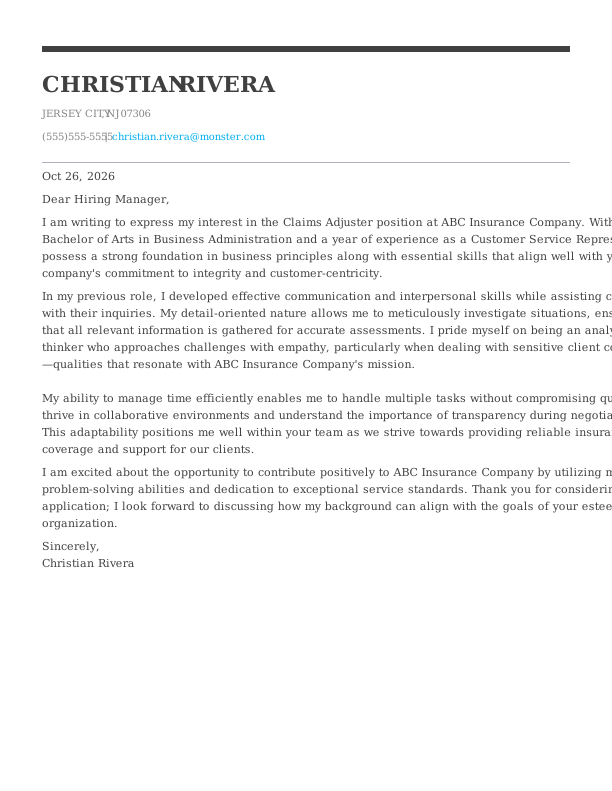
Claims Adjuster Entry-Level Cover Letter
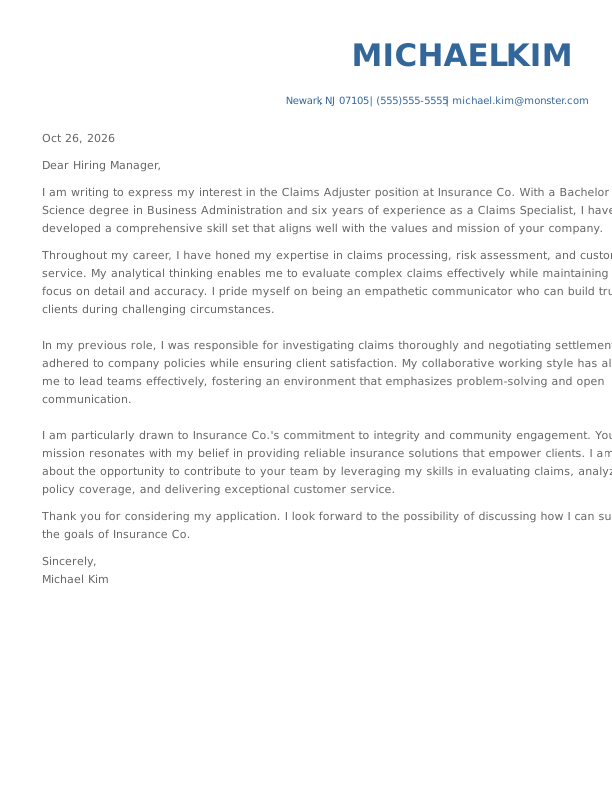
Claims Adjuster Mid-Level Cover Letter
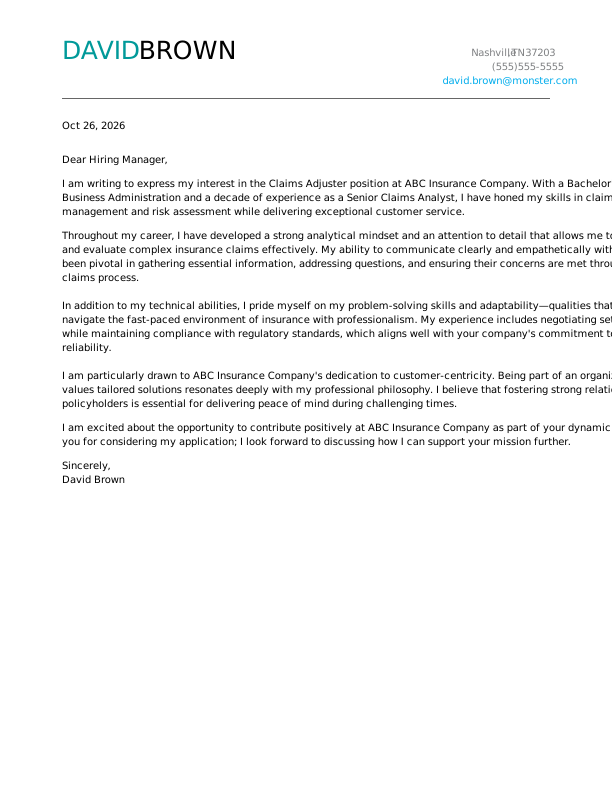
Claims Adjuster Experienced Cover Letter
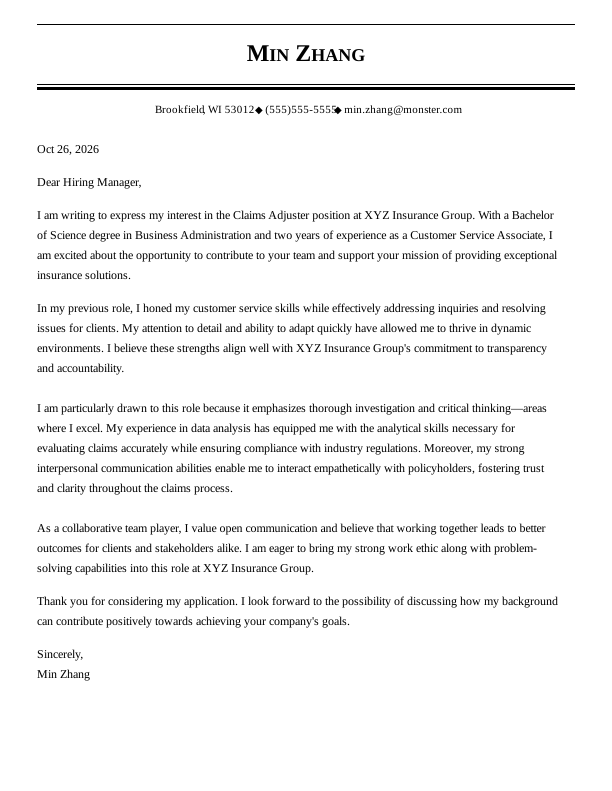
Claims Adjuster Entry-Level Cover Letter
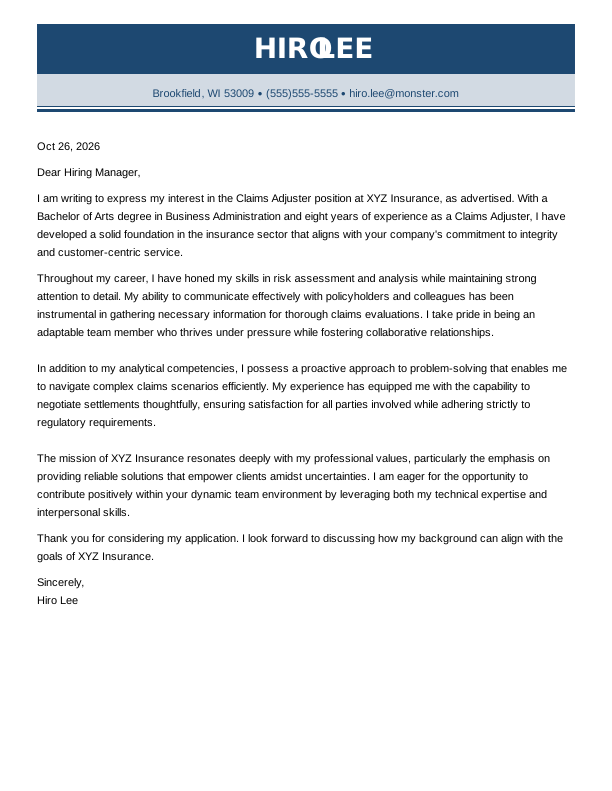
Claims Adjuster Mid-Level Cover Letter
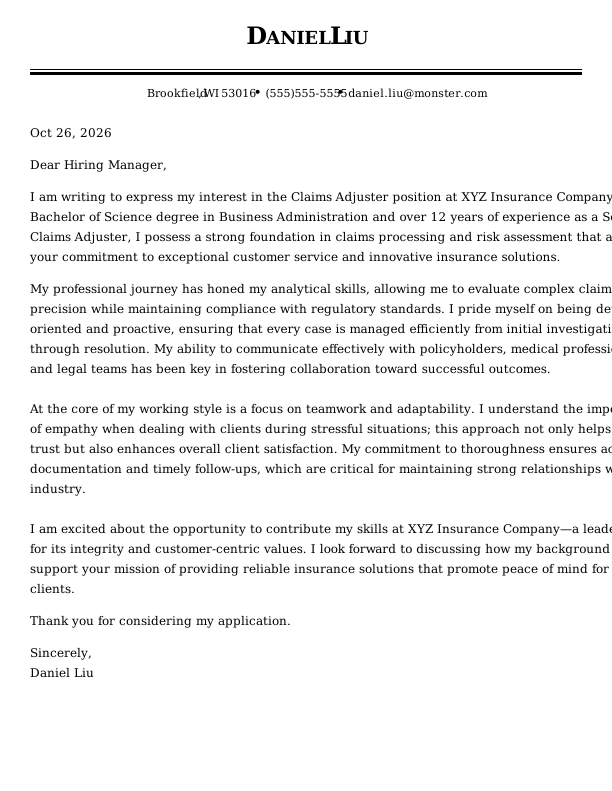
Claims Adjuster Experienced Cover Letter
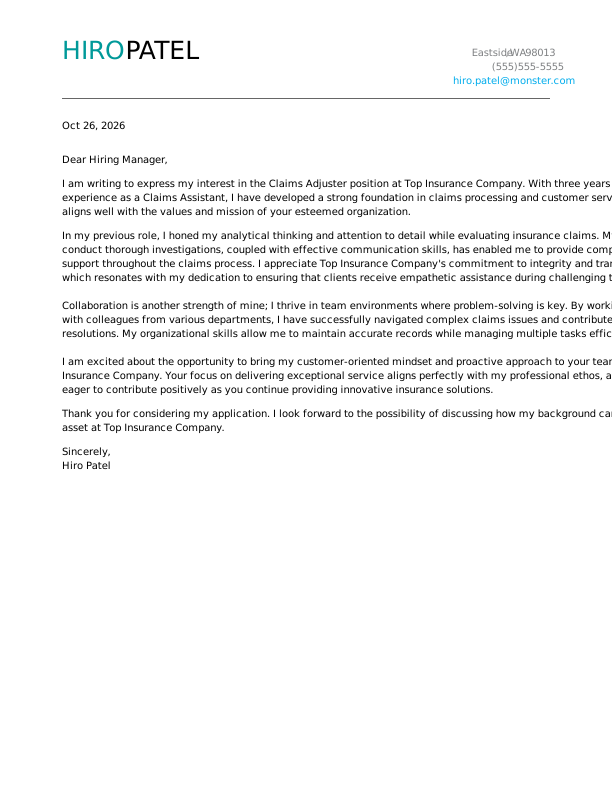
Claims Adjuster Entry-Level Cover Letter
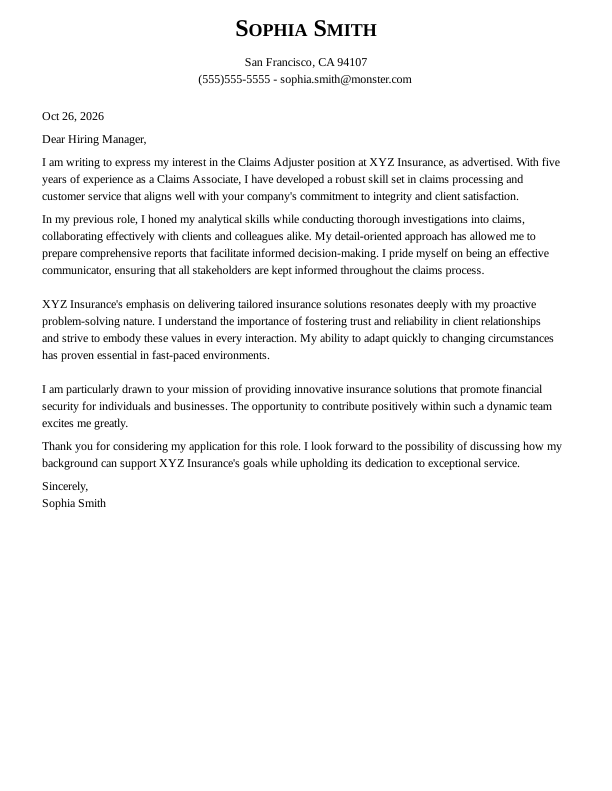
Claims Adjuster Mid-Level Cover Letter
Browse Free Cover Letter Templates
- Academic
- Account Manager
- Accountant
- Accounts Payable
- Administrative Assistant
- Admissions Counselor
- Architecture
- Artist
- Assistant Principal
- Babysitter
- Barista
- Bartender
- Bookkeeper
- Brand Ambassador
- Business Analyst
- Business
- Caregiver
- Chef
- Civil Engineering
- Computer Science
- Construction
- Consulting
- Copywriter
- Cosmetology
- Custodian
- Customer Service
- Customer Service Representative
- Data Analyst
- Data Entry
- Dental Assistant
- Dental Hygienist
- Digital Marketing
- Electrical Engineering
- Emt
- Engineering
- Esthetician
- Event Coordinator
- Executive Assistant
- Fashion Designer
- Finance
- Financial Analyst
- Firefighter
- Flight Attendant
- Graphic Designer
- Hair Stylist
- Healthcare
- Hr Generalist
- Investment Banking
- It
- Janitor
- Journalism
- Lab Technician
- Law Clerk
- Lawyer
- Librarian
- Logistics
- Maintenance Worker
- Makeup Artist
- Manager
- Marketing Coordinator
- Marketing
- Marketing Manager
- Massage Therapist
- Mechanic
- Mechanical Engineer
- Medical Assistant
- Non Profit
- Nursing
- Occupational Therapy
- Office Assistant
- Office Manager
- Operations Manager
- Paralegal
- Personal Trainer
- Pharmacist
- Pharmacy Technician
- Photographer
- Physician Assistant
- Pilot
- Police Officer
- Program Manager
- Project Manager
- Property Manager
- Psychology
- Receptionist
- Research Assistant
- Restaurant Manager
- Retail
- Sales
- Sales Manager
- School Counselor
- Security
- Security Officer
- Social Work
- Software Engineer
- Special Education Teacher
- Starbucks
- Substitute Teacher
- Teacher
- Teaching Assistant
Cover Letter Examples for Claims Adjusters
Your cover letter changes as you move from learning coverage basics to managing complex losses. Pick the sample matching your career stage to highlight the right skills and experience.
Entry-Level Claims Adjuster Cover Letter
Ideal for recent graduates and career changers transitioning into claims adjuster roles, this template supports a cover letter with no experience while highlighting transferable skills.
Mid-Career Claims Adjuster Cover Letter
Built for claims adjusters several years into their careers, this template emphasizes managing claims independently and working with team members.
Experienced Claims Adjuster Cover Letter
Best suited to claims adjusters with close to a decade of experience, this template supports professionals leading complex investigations and handling high-value settlements.
Claims Adjuster Cover Letter Template (Text)
Copy this claims adjuster cover letter text, paste it into your document, and swap in your case metrics or carrier experience for the role you want.
Melissa Price
Spokane, WA 99202
(555)555-5555
melissa.price@monster.com
Oct 26, 2026
Dear Hiring Manager,
I am writing to express my interest in the Claims Adjuster position at Target Insurance Company. With a Bachelor of Science degree in Business Administration and nine years of experience as a Claims Specialist, I have developed a robust foundation in claims management that aligns well with your company’s commitment to delivering exceptional service and innovative insurance solutions.
Throughout my career, I have honed my analytical skills and attention to detail, enabling me to effectively assess risks and evaluate claims comprehensively. My strong organizational abilities ensure that I can manage multiple priorities while maintaining high standards under pressure. Additionally, my experience has equipped me with effective communication skills necessary for interacting professionally with policyholders and stakeholders throughout the claims process.
Collaboration has been key in my previous roles; I thrive in team-oriented environments where critical thinking is essential for problem-solving complex claims scenarios. My dedication to customer service drives me to approach sensitive situations with empathy, ensuring clients feel supported during their interactions.
I admire Target Insurance Company’s mission of empowering clients through reliable coverage and exceptional service. Your emphasis on integrity and community involvement resonates deeply with me, reflecting values I uphold both personally and professionally.
I look forward to the opportunity to contribute positively to your team while helping safeguard the futures of your clients through diligent claims adjustment practices. Thank you for considering my application; I am excited about the possibility of joining Target Insurance Company.
Sincerely,
Melissa Price
How to Write a Claims Adjuster Cover Letter
Writing a great claims adjuster cover letter means turning your experience with policy language, investigations, and settlements into a clear story. Follow these simple steps to build your letter.
1. Research & Prepare
Learn what the company expects before you begin writing so you can tailor your letter to its daily operations and software. Here are a few ways to prepare your application:
- Review the job posting on the employer’s site to identify the claims system and key responsibilities.
- Search the state insurance regulator guidance for licensing rules that match the role.
- Read recent industry coverage on claim handling trends to reflect the operational pressure they face.
2. Hook the Reader
Start with a strong sentence that shows you understand claims handling instead of using a generic opening. Use these examples to inspire your intro paragraph:
- Triage and accuracy: “Reduced claim cycle time by 18% in six months by tightening first-contact checklist for auto bodily injury losses and documenting coverage decisions in Xactimate notes within 24 hours.”
- Investigation method: “On complex property water losses, coordinated with a public adjuster and used cause-and-origin reasoning to separate wear-and-tear from sudden discharge in field reports.”
- Stakeholder handling: “When counsel disputed liability on a bodily injury file, prepared a timeline summary using recorded statements and medical records summaries before the adjuster review call led by the senior SIU analyst.”
3. Tell Your Professional Story
Use body paragraphs to describe specific results from your previous roles to prove your effectiveness under pressure. The following bullet points demonstrate how to highlight measurable achievements:
- Reduced average claim cycle time by 22% after tightening triage rules and prioritizing liability review within 24 hours of assignment.
- Recovered $31,500 in overpayments by identifying duplicate medical billing and documenting discrepancies for adjustment approvals.
- Handled caseloads of 60 to 75 property claims per week while maintaining a 95% compliance rate on documentation requirements.
4. Showcase Your Skills
Connect your core technical skills directly to real scenarios you faced on the job. Consider these examples of framing key adjusting competencies:
- Claims investigation: “Pulled the loss report, photos, and policy language together in Xactimate to confirm what damage was consistent with the stated cause.”
- Documentation and compliance: “Wrote my coverage notes in Salesforce Service Cloud so another adjuster could trace every assumption back to the file.”
- Customer communication: “Gathering missing details from claimants by explaining requirements clearly, answering questions, and setting transparent next steps without placing blame.”
5. Explain Any Special Circumstances
If you have an employment gap, license update, or career transition, explain it briefly and positively. Use these sample statements to address common career situations clearly:
- “After a six-month break between roles, I kept my property-casualty knowledge current by completing state-approved continuing education and reviewing claim files weekly before applying.”
- “Pivoting from underwriting into adjusting because I want hands-on work on coverage decisions, and I recently used Xactimate for estimate review during training.”
- “Relocated from Texas to Florida in May, and my Texas adjuster license is inactive while my Florida appointment is active through the NAIC system.”
6. End With a Professional Goodbye
Wrap up your cover letter with a clear next step and a polite thank you, keeping it brief and natural. Use direct, conversational language such as “I’d welcome the opportunity to discuss how I can help manage your pending auto and property claims with accurate documentation and prompt updates.”
Follow that with a simple “Thank you for your time,” and close with “Best regards.”
4 Tips for Formatting Your Cover Letter
A well-formatted cover letter makes a strong first impression on hiring managers who scan applications quickly. Clear structure, consistent margins, and simple typography help highlight your professional experience and organizational skills immediately.

Address the Hiring Manager Directly
Try to find the hiring manager or recruiter’s name in the job post or company directory. If you cannot find a contact name, use “Dear Hiring Manager” rather than generic options like “To Whom It May Concern.”

Match Your Header to Your Resume
Keep the header layout, fonts, and contact info identical between your cover letter and resume. A matching look presents your application as a polished, cohesive package.

Balance Spacing & Margins
Set line spacing between 1.0 and 1.15 with blank spaces separating paragraphs. Standard margins between 0.75 and 1 inch keep the page clean and easy to scan.

Save & Send as a PDF
Save your letter as a PDF to preserve your layout across different screens and applicant tracking systems. Use a clear file name like Firstname_Lastname_Cover_Letter.pdf.
Top-Paying States for Claims Adjuster Roles
Understanding what claims adjusters earn can help you compare offers and plan your next move. The salary ranges below are based on the U.S. Bureau of Labor Statistics (BLS) and reflect recent nationwide averages for claims adjusters.
Keep in mind that your actual pay can vary by location, experience level, and the type of employer you work for, such as insurance carriers versus independent adjusting firms. Specialty matters too. Adjusters handling complex property or casualty claims may see different compensation than those working more routine cases.
| Alabama | $76,630 |
| Alaska | $89,220 |
| Arizona | $69,310 |
| Arkansas | $73,920 |
| California | $92,060 |
| Connecticut | $93,640 |
| Delaware | $82,380 |
| District of Columbia | $92,830 |
| Florida | $74,190 |
| Georgia | $76,510 |
| Hawaii | $80,210 |
| Idaho | $72,160 |
| Illinois | $76,930 |
| Indiana | $71,810 |
| Iowa | $71,750 |
| Kansas | $78,530 |
| Kentucky | $73,900 |
| Louisiana | $71,200 |
| Maine | $78,180 |
| Maryland | $91,080 |
| Massachusetts | $88,090 |
| Michigan | $77,280 |
| Minnesota | $80,330 |
| Mississippi | $75,060 |
| Missouri | $76,040 |
| Montana | $68,900 |
| Nebraska | $74,010 |
| Nevada | $70,820 |
| New Hampshire | $82,250 |
| New Jersey | $90,390 |
| New Mexico | $69,570 |
| New York | $88,020 |
| North Carolina | $75,220 |
| North Dakota | $66,010 |
| Ohio | $65,300 |
| Oklahoma | $70,330 |
| Oregon | $82,070 |
| Pennsylvania | $80,690 |
| Rhode Island | $87,280 |
| South Carolina | $75,290 |
| South Dakota | $78,610 |
| Tennessee | $76,260 |
| Texas | $81,100 |
| Utah | $71,880 |
| Vermont | $78,930 |
| Virginia | $80,890 |
| Washington | $83,810 |
| West Virginia | $72,700 |
| Wisconsin | $75,670 |
| Wyoming | $76,990 |
| Guam | $55,110 |
| Puerto Rico | $47,940 |
| Virgin Islands | $65,370 |
Key Takeaways
- Show your understanding of claims handling by describing how you applied policy language to arrive at accurate coverage decisions.
- Highlight specific metrics such as average cycle times, closure rates, and settlement savings to quantify your impact.
- Tailor your letter to the employer type by emphasizing speed for large carriers, documentation quality for third-party administrators, or technical expertise for specialty insurers.
More Cover Letter Examples
Browse Monster’s Resume Templates
Monster also has hundreds of ATS-friendly resume templates for all career levels and industries. Create a matching resume to help you land the interview.
Frequently Asked Questions
Last Update:
Do I really need a cover letter?
Including a cover letter is highly recommended because it gives you space to explain the reasoning behind your claim decisions, your communication style, and your career goals beyond what a resume can show.
How long should my cover letter be?
Your cover letter should be three to four short paragraphs on a single page, totaling 250 to 400 words. Keeping it concise helps busy hiring managers quickly see your key qualifications.
Should my cover letter match my resume?
Yes, your cover letter should match your resume in formatting, font, and contact details to create a cohesive application package. Use the letter to expand on specific achievements rather than repeating your resume line by line.
How do I address my cover letter if I don’t know the hiring manager’s name?
Try to find the hiring manager’s name first by checking the job posting or company directory, but if no name is available, use “Dear Hiring Manager” or “Dear Claims Team.” Avoid outdated phrases like “To Whom It May Concern.”
Should I mention salary expectations in my cover letter?
Only mention salary expectations if the job posting explicitly requests them. In that case, provide a realistic, researched salary range based on your location and experience level while noting your flexibility.

Kirsten Chorpenning is a career advice writer who empowers job seekers to take control of their career paths using Monster’s comprehensive job search and resume tools. She specializes in helping job seekers find rewarding jobs in today’s dynamic work environment.
See More From Kirsten ChorpenningExplore Related Career Advice







How to Write a Cover Letter for Internal Positions or Promotions (Examples & Tips)
Updated:
Apr 23, 2026
|
19 min read


Cover Letter vs Resume: What’s the Difference & Do You Need Both?

Updated:
Apr 23, 2026
|
18 min read