


Free Insurance Cover Letter Templates & Examples
A strong insurance cover letter shows you can assess risk, clearly explain policy details, and guide clients through claims or underwriting. Use our free examples and simple tips to craft a focused application that helps hiring managers quickly see you’re fit for the role.
Real-World Cover Letters That Get Results
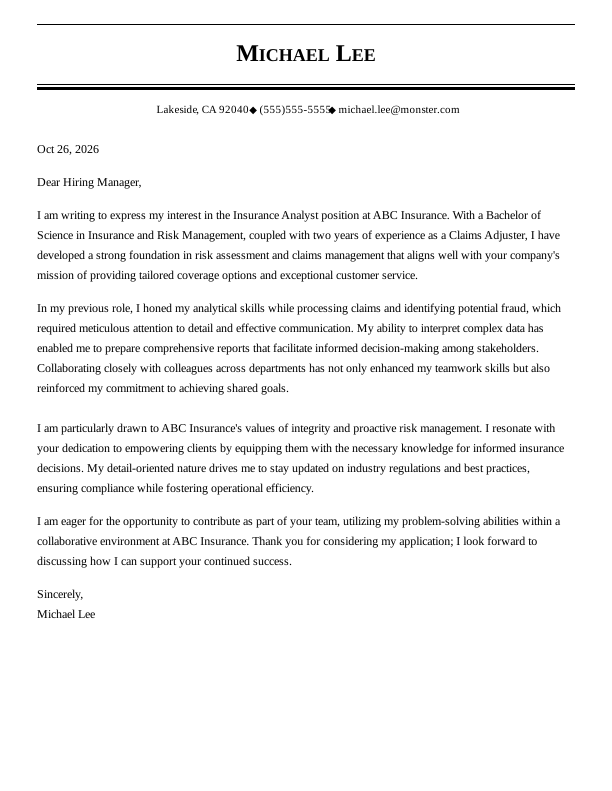
 Free
Insurance Entry-Level Cover Letter
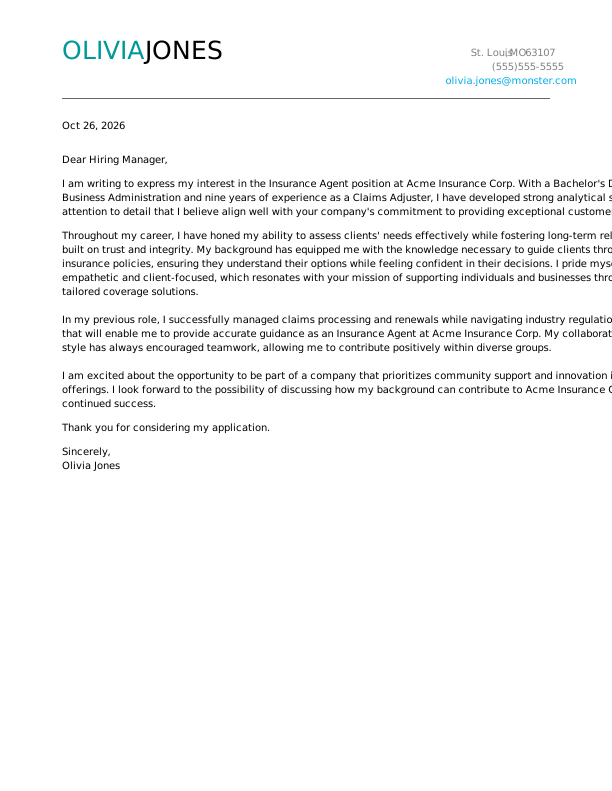
Insurance Mid-Level Cover Letter
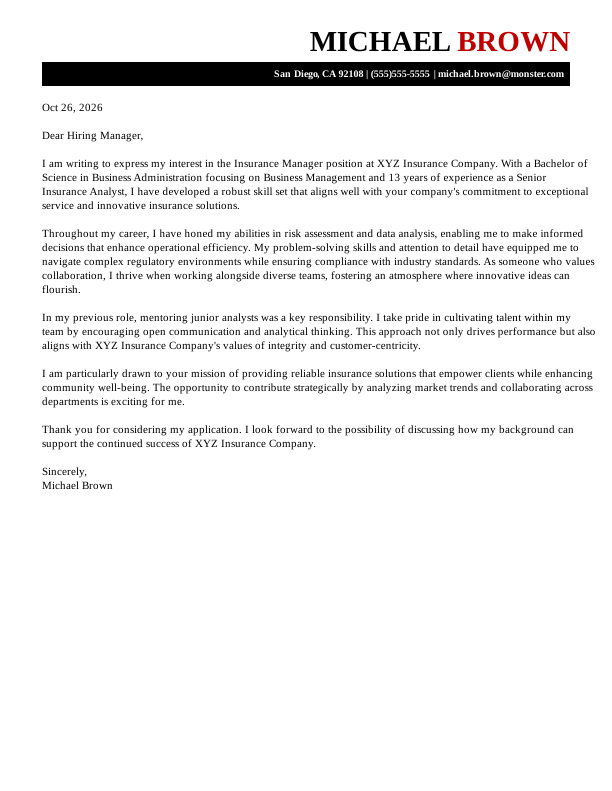
Insurance Experienced Cover Letter
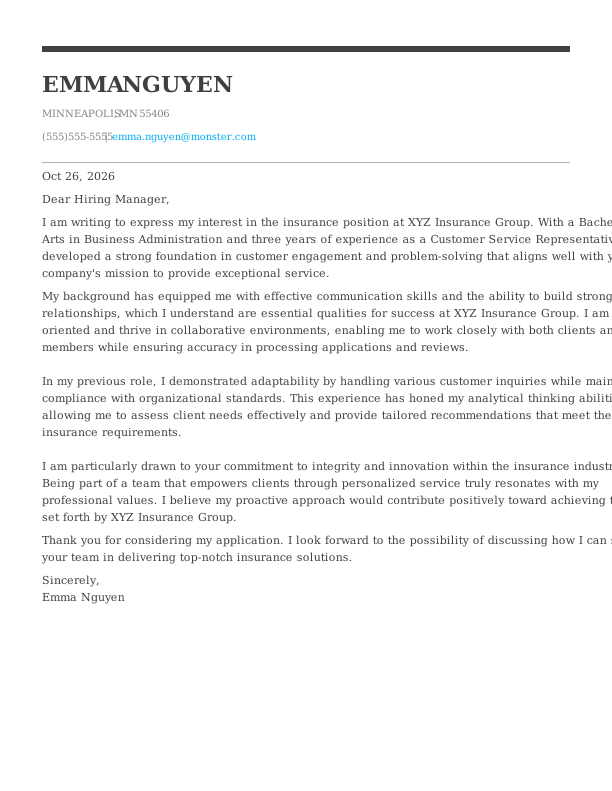
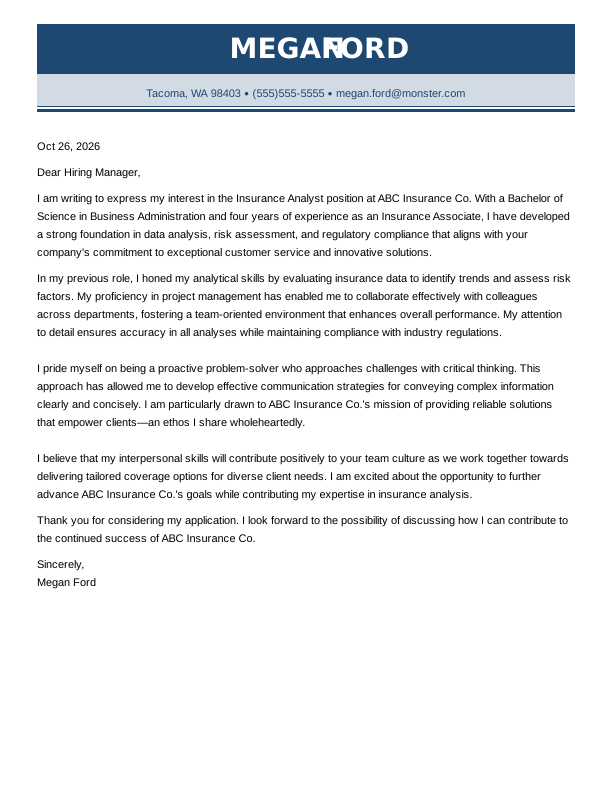
Insurance Entry-Level Cover Letter
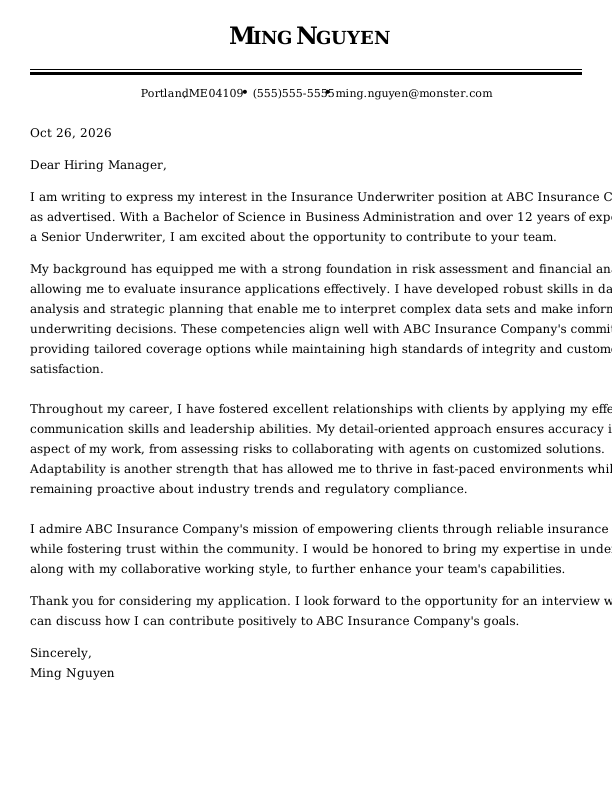
Insurance Mid-Level Cover Letter
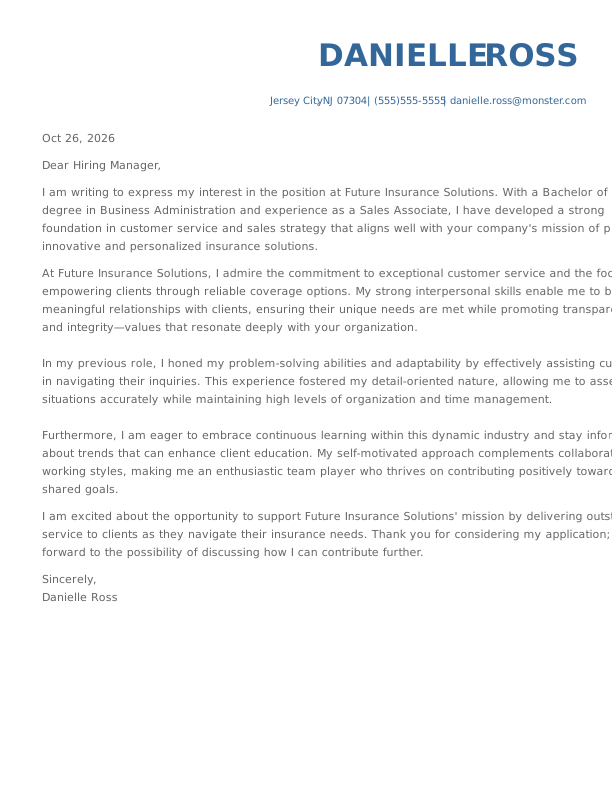
Insurance Experienced Cover Letter
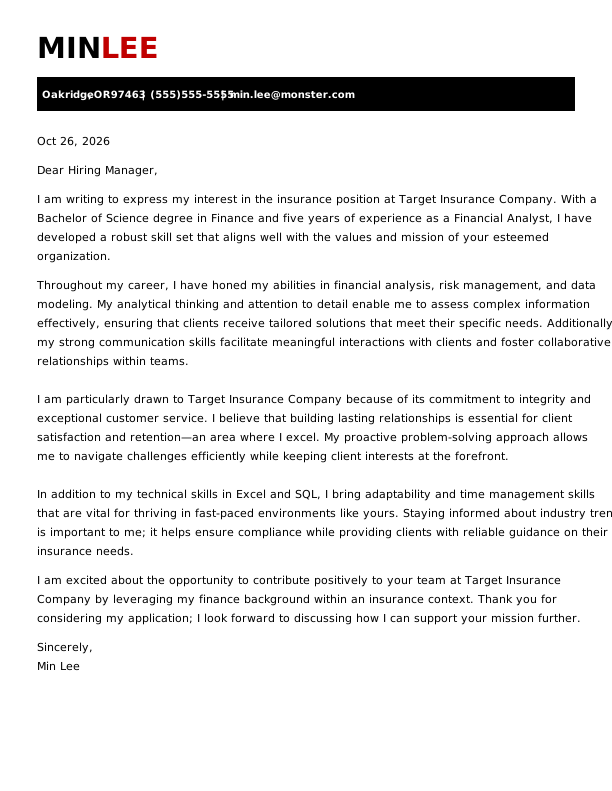
Insurance Entry-Level Cover Letter
Insurance Mid-Level Cover Letter
Browse Free Cover Letter Templates
- Academic
- Account Manager
- Accountant
- Accounts Payable
- Administrative Assistant
- Admissions Counselor
- Architecture
- Artist
- Assistant Principal
- Babysitter
- Barista
- Bartender
- Bookkeeper
- Brand Ambassador
- Business Analyst
- Business
- Caregiver
- Chef
- Civil Engineering
- Computer Science
- Construction
- Consulting
- Copywriter
- Cosmetology
- Custodian
- Customer Service
- Customer Service Representative
- Data Analyst
- Data Entry
- Dental Assistant
- Dental Hygienist
- Digital Marketing
- Electrical Engineering
- Emt
- Engineering
- Esthetician
- Event Coordinator
- Executive Assistant
- Fashion Designer
- Finance
- Financial Analyst
- Firefighter
- Flight Attendant
- Graphic Designer
- Hair Stylist
- Healthcare
- Hr Generalist
- Investment Banking
- It
- Janitor
- Journalism
- Lab Technician
- Law Clerk
- Lawyer
- Librarian
- Logistics
- Maintenance Worker
- Makeup Artist
- Manager
- Marketing Coordinator
- Marketing
- Marketing Manager
- Massage Therapist
- Mechanic
- Mechanical Engineer
- Medical Assistant
- Non Profit
- Nursing
- Occupational Therapy
- Office Assistant
- Office Manager
- Operations Manager
- Paralegal
- Personal Trainer
- Pharmacist
- Pharmacy Technician
- Photographer
- Physician Assistant
- Pilot
- Police Officer
- Program Manager
- Project Manager
- Property Manager
- Psychology
- Receptionist
- Research Assistant
- Restaurant Manager
- Retail
- Sales
- Sales Manager
- School Counselor
- Security
- Security Officer
- Social Work
- Software Engineer
- Special Education Teacher
- Starbucks
- Substitute Teacher
- Teacher
- Teaching Assistant
Cover Letter Examples for Insurances
Cover letter requirements evolve as an insurance professional’s career progresses. Choose the template that matches your experience level so you can highlight the right mix of licenses, claims or underwriting work, and relevant results.
Entry-Level Insurance Cover Letter
Designed for recent graduates and career changers entering the insurance field, this template helps you showcase foundational skills, transferable experience, and your readiness to learn core underwriting or claims workflows.
Mid-Career Insurance Cover Letter
Built for professionals with several years of industry experience, this template highlights your ability to manage complex claims, build client relationships, and take ownership of daily policy operations.
Experienced Insurance Cover Letter
Best suited for seasoned insurance experts, this template focuses on leadership, advanced risk systems management, and driving compliance-focused process improvements across your team.
Insurance Cover Letter Template (Text)
Copy this insurance cover letter template, paste it into your document, and customize it with your own policies handled, claims metrics, and employer name.
Chris Wei
Crestwood, KY 40016
(555)555-5555
chris.wei@monster.com
Oct 26, 2026
Dear Hiring Manager,
I am writing to express my interest in the Insurance Manager position at Target Insurance Company. With a Bachelor of Science in Business Administration and six years of experience as an Insurance Analyst, I have developed a comprehensive understanding of the insurance industry, particularly in data analysis, risk assessment, and claims management.
In my previous role, I excelled at generating detailed reports that informed strategic decisions and enhanced operational efficiency. My ability to analyze market trends has allowed me to contribute valuable insights into developing tailored insurance products that meet diverse client needs. I pride myself on being detail-oriented and adaptable, qualities that help me navigate the complexities of risk management while ensuring compliance with industry regulations.
Collaboration is central to my working style; I thrive in team environments where open communication fosters innovative solutions. As a problem solver committed to customer satisfaction, I have successfully led projects that improved service delivery while maintaining strong relationships with clients and colleagues alike.
At Target Insurance Company, your mission of delivering reliable insurance solutions resonates deeply with my professional values. I am eager to bring my analytical thinking and leadership abilities to your team as we work together towards enhancing client experiences through effective policy development and operational excellence.
Thank you for considering my application. I look forward to the opportunity to discuss how my background can align with the goals of Target Insurance Company.
Sincerely,
Chris Wei
How to Write an Insurance Cover Letter
A great insurance cover letter shows hiring managers that you can evaluate risk, handle claims fairly, and manage high volume without missing key details. Use the steps below to organize your information and match it directly to the job description.
1. Research & Prepare
Before writing, study the company’s focus areas, target market, and operational tools. Understanding whether they specialize in commercial liability, personal lines, or health policies helps you match your past work directly to their current team needs.
- Check the job posting for specific software requirements like Guidewire or ImageRight.
- Look up recent news articles to see if the insurer is expanding into new state markets.
- Review employee LinkedIn profiles to learn about typical caseloads and team hierarchies.
2. Hook the Reader
Start your opening paragraph with a strong, measurable accomplishment that proves your value right away. Highlight metrics like policy retention rates, underwriting accuracy, or claim processing speeds to prove you can hit the ground running.
- Underwriting accuracy: “Maintained a 98% loss ratio accuracy across a $12M commercial property portfolio.”
- Claims efficiency: “Processed 45 complex auto claims weekly while maintaining a 96% policyholder satisfaction rating.”
- Risk reduction: “Identified fraudulent claim patterns that saved the firm $150,000 in payouts over one year.”
3. Tell Your Professional Story
Use the middle paragraphs to connect your past roles with the carrier’s broader business goals. Explain how you handled tricky negotiations, audited coverage terms, or streamlined daily workflows to deliver consistent financial and operational performance.
- Negotiated subrogation terms with third-party carriers, recovering $85,000 in withheld payouts.
- Audited 200+ high-risk accounts annually to ensure full compliance with updated state regulations.
- Automated risk intake forms, cutting policy issue times down from five business days to two.
4. Showcase Your Skills
Rather than dumping bullet points of skill keywords, show how you apply technical knowledge under pressure. Connect your soft skills and hard tools directly to real insurance tasks like dispute resolution, policy drafting, and risk pricing.
- Policy analysis: Evaluated complex liability endorsements to prevent coverage gaps across commercial accounts.
- Conflict resolution: De-escalated challenging claimant discussions while maintaining strict adherence to policy boundaries.
- Data modeling: Used statistical risk software to price custom umbrella policies accurately for corporate clients.
5. Explain Any Special Circumstances
If you are switching industries or addressing an employment gap, address it briefly and steer focus to relevant strengths. Highlight transferable abilities like contract law knowledge, analytical thinking, or customer support that suit insurance roles well.
- “Completed an Associate in Claims (AIC) designation during my career transition to build specialized technical knowledge.”
- “Pivoted from paralegal work to claims adjusting, leveraging my deep legal research background in contract analysis.”
- “Applied past financial auditing experience toward commercial underwriting assessment after relocating to this market.”
6. End With a Professional Goodbye
Close with a clear, polite call to action reiterating your interest in joining their underwriting or claims team. Express your enthusiasm for an interview, thank the hiring manager for their time, and close with a standard business sign-off like “Sincerely.”
4 Tips for Formatting Your Cover Letter
In insurance hiring, your cover letter needs to highlight key details fast. Clear formatting helps recruiters spot your licenses, claims experience, and core skills immediately, whether you are starting out or moving into management.

Use a Professional Font & Layout
Pick clear fonts like Arial, Calibri, or Helvetica at 10 to 12 points. Set one-inch margins and match your font style across all documents so your application looks organized and easy to read.

Match Your Header to Your Resume
Use the exact same contact details, layout, and typography on both your cover letter and resume. Matching headers help hiring managers quickly recognize your application as a complete set.

Use Bullet Points for Key Achievements
Bullet points help hiring managers quickly spot your best work. Use three or four concise points to show the direct impact of your claims handling. Highlight specific insurance metrics to prove your value.

Save & Send as a PDF
Save your letter as a PDF to preserve your layout across different screens and applicant tracking systems. Use a simple file name like Firstname_Lastname_Cover_Letter.pdf so recruiters can find it easily.
Top-Paying States for Insurance Roles
Understanding insurance-related pay can help you compare offers and plan your next career move. Salary figures for many insurance roles are commonly tracked using data from the U.S. Bureau of Labor Statistics (BLS), which provides nationwide averages that reflect overall market conditions.
Keep in mind that your actual earnings can vary based on location, years of experience, and whether you work in sales, claims, or underwriting. Employer type and industry demand also matter. If you hold relevant credentials or specialize in a high-demand area, compensation may be higher than the base average.
| Alabama | $91,730 |
| Alaska | $68,690 |
| Arizona | $80,980 |
| Arkansas | $72,260 |
| California | $101,720 |
| Connecticut | $100,950 |
| Delaware | $78,770 |
| District of Columbia | $112,270 |
| Florida | $89,710 |
| Georgia | $91,300 |
| Hawaii | $81,690 |
| Idaho | $88,600 |
| Illinois | $97,210 |
| Indiana | $82,260 |
| Iowa | $86,410 |
| Kansas | $98,130 |
| Kentucky | $90,150 |
| Louisiana | $80,590 |
| Maine | $97,810 |
| Maryland | $93,190 |
| Massachusetts | $105,050 |
| Michigan | $81,020 |
| Minnesota | $98,220 |
| Mississippi | $68,200 |
| Missouri | $80,330 |
| Montana | $74,520 |
| Nebraska | $77,620 |
| Nevada | $93,300 |
| New Hampshire | $99,830 |
| New Jersey | $100,100 |
| New Mexico | $71,120 |
| New York | $105,490 |
| North Carolina | $81,960 |
| North Dakota | $90,400 |
| Ohio | $96,560 |
| Oklahoma | $75,780 |
| Oregon | $86,660 |
| Pennsylvania | $89,340 |
| Rhode Island | $87,260 |
| South Carolina | $86,930 |
| South Dakota | $103,880 |
| Tennessee | $84,210 |
| Texas | $85,950 |
| Utah | $77,720 |
| Vermont | $92,710 |
| Virginia | $88,760 |
| Washington | $106,810 |
| West Virginia | $61,840 |
| Wisconsin | $87,420 |
| Wyoming | $73,280 |
| Guam | $45,450 |
| Puerto Rico | $44,040 |
| Virgin Islands | $84,400 |
Key Takeaways
- Hiring managers look for accurate claim handling, which you can show by explaining a complex denial you successfully resolved.
- Support your experience with clear metrics like cycle times, loss ratios, and reduced rework rates.
- Tailor your focus depending on the role, highlighting accuracy for insurers, speed for third-party administrators, or client retention for brokers.
More Cover Letter Examples
Browse Monster’s Resume Templates
Monster also has hundreds of ATS-friendly resume templates for all career levels and industries. Create a matching resume to help you land the interview.
Frequently Asked Questions
Last Update:
Do I really need a cover letter?
Yes, including a cover letter helps you stand out for insurance roles even when it is listed as optional. While a resume lists your history, a cover letter provides context for your decisions, explains career transitions, and shows your enthusiasm for policyholder service.
How long should my cover letter be?
Keep your insurance cover letter to a single page, ideally between 250 and 400 words. Stick to three or four short paragraphs that focus on your top achievements and credentials so busy hiring managers can review your application quickly.
Should my cover letter match my resume?
Your cover letter should match your resume in visual style, using identical fonts, margins, and header designs. However, write fresh text that expands on key accomplishments rather than simply repeating the bullet points from your resume.
Can I use AI to write my cover letter?
You can use AI tools to outline or polish your initial draft. Always rewrite the content in your own voice, adding specific claims examples and measurable achievements, as hiring managers easily spot generic templates.
How do I write a cover letter for an internal position?
Focus on your knowledge of current claims workflows, internal checkpoints, and team collaboration. Highlight recent contributions, such as turnaround time improvements, and state your commitment to supporting upcoming audits and company goals.

Elizabeth Muenzen is a Certified Professional Resume Writer (CPRW) and member of the Professional Association of Resume Writers & Career Coaches who empowers job seekers to take control of their career paths using Monster’s comprehensive job search and resume tools.
See More From Elizabeth MuenzenExplore Related Career Advice







How to Write a Cover Letter for Internal Positions or Promotions (Examples & Tips)

Updated:
Apr 23, 2026
|
19 min read


Cover Letter vs Resume: What’s the Difference & Do You Need Both?
Updated:
Apr 23, 2026
|
18 min read