


Free Fashion Cover Letter Templates & Examples
A strong fashion cover letter highlights relevant impact and skills tailored directly to the job title. By connecting your style sense to real merchandising and presentation results, you help hiring managers immediately understand your fit in clear, conversational language.
Real-World Cover Letters That Get Results
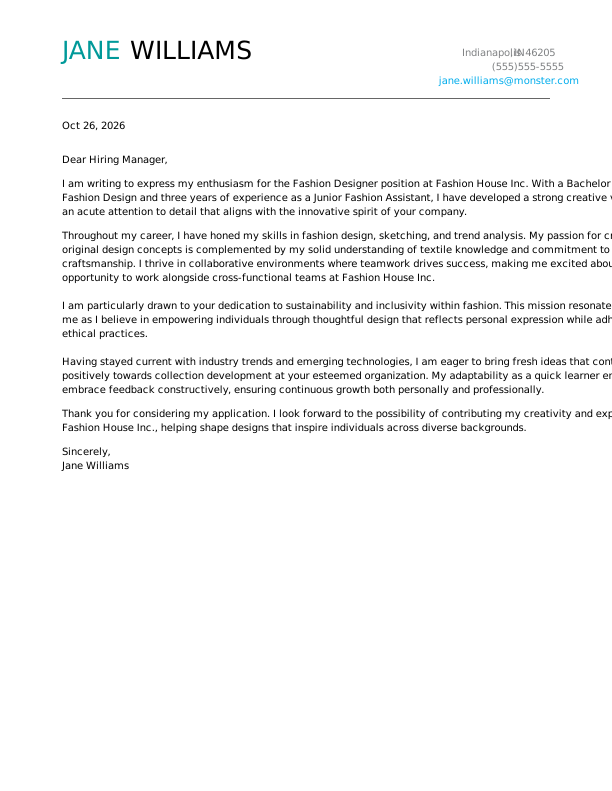
 Free
Fashion Entry-Level Cover Letter
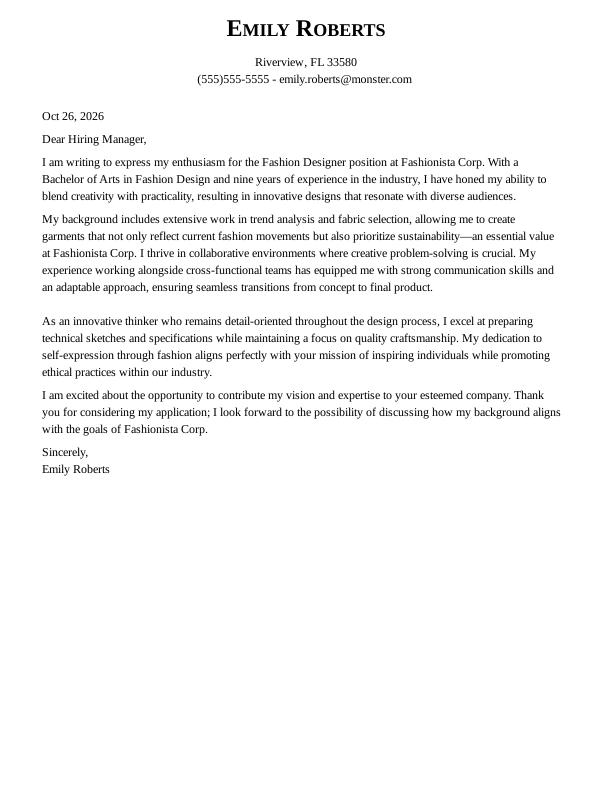
Fashion Mid-Level Cover Letter
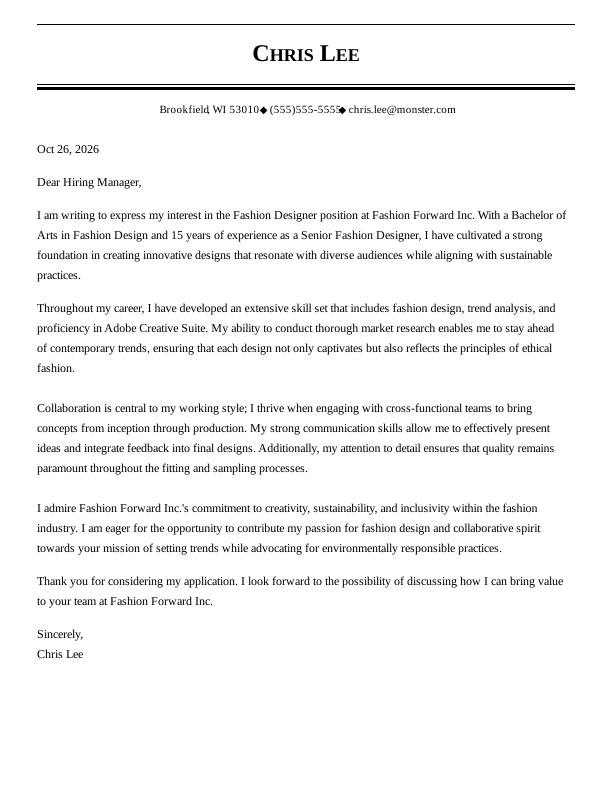
Fashion Experienced Cover Letter
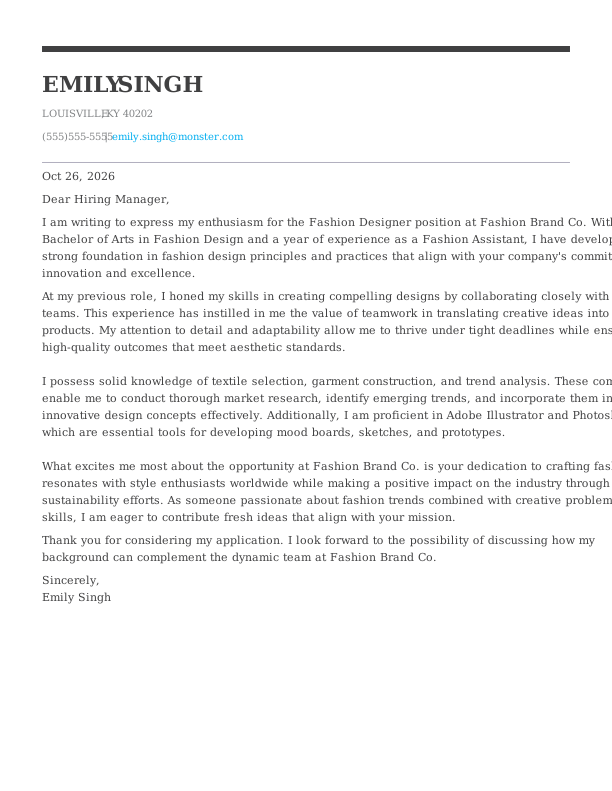
Fashion Entry-Level Cover Letter
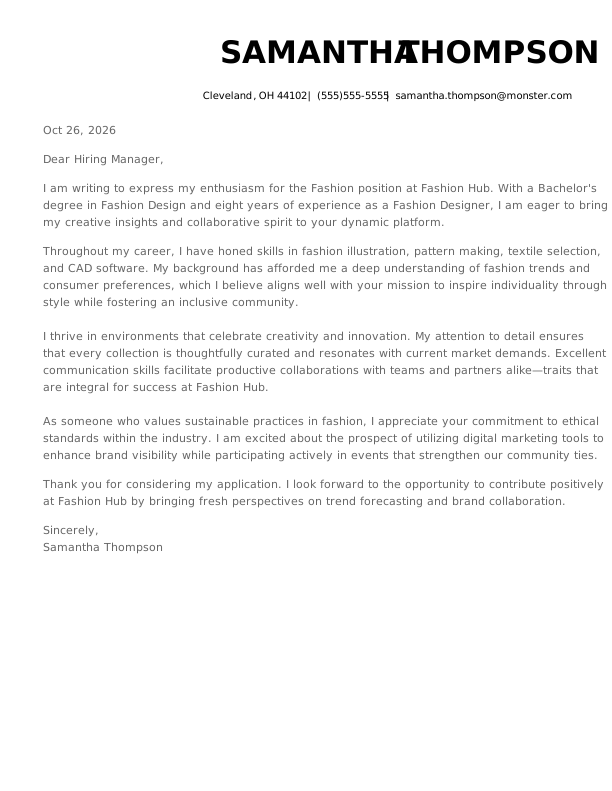
Fashion Mid-Level Cover Letter
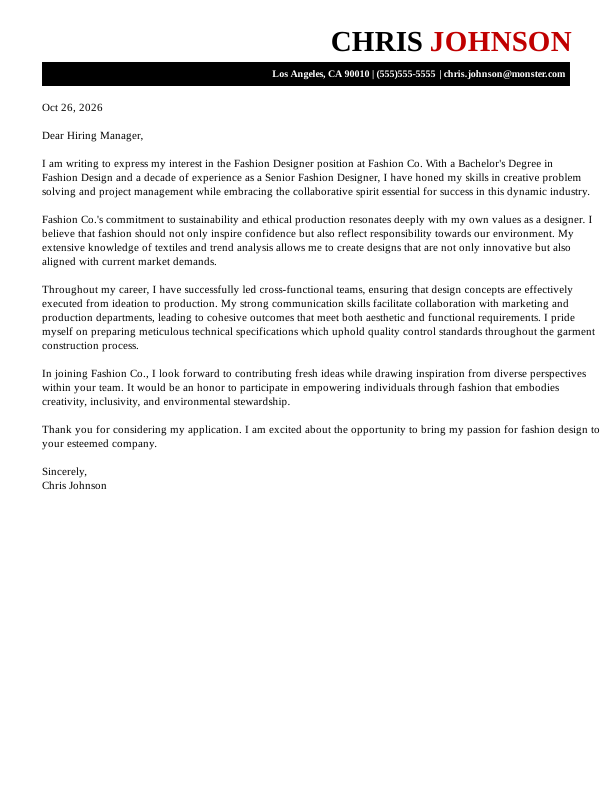
Fashion Experienced Cover Letter
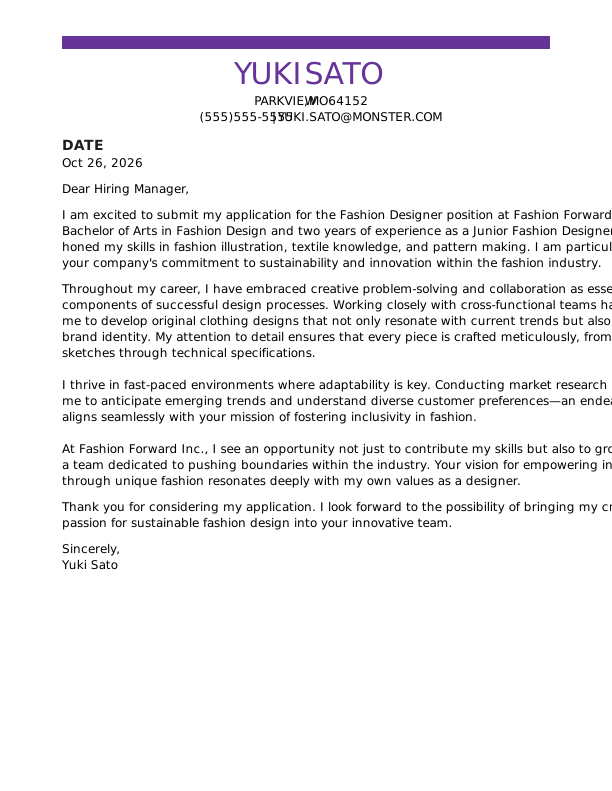
Fashion Entry-Level Cover Letter
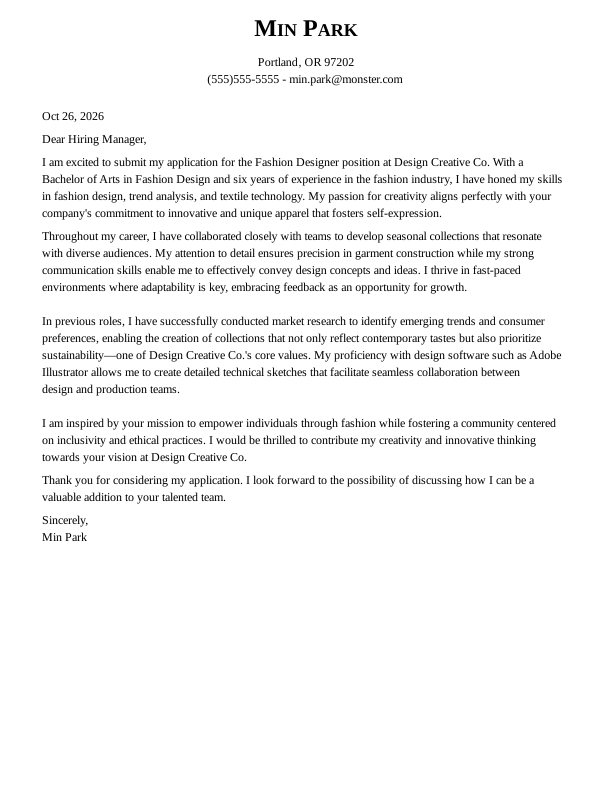
Fashion Mid-Level Cover Letter
Browse Free Cover Letter Templates
- Academic
- Account Manager
- Accountant
- Accounts Payable
- Administrative Assistant
- Admissions Counselor
- Architecture
- Artist
- Assistant Principal
- Babysitter
- Barista
- Bartender
- Bookkeeper
- Brand Ambassador
- Business Analyst
- Business
- Caregiver
- Chef
- Civil Engineering
- Computer Science
- Construction
- Consulting
- Copywriter
- Cosmetology
- Custodian
- Customer Service
- Customer Service Representative
- Data Analyst
- Data Entry
- Dental Assistant
- Dental Hygienist
- Digital Marketing
- Electrical Engineering
- Emt
- Engineering
- Esthetician
- Event Coordinator
- Executive Assistant
- Finance
- Financial Analyst
- Firefighter
- Flight Attendant
- Graphic Designer
- Hair Stylist
- Healthcare
- Hr Generalist
- Investment Banking
- It
- Janitor
- Journalism
- Lab Technician
- Law Clerk
- Lawyer
- Librarian
- Logistics
- Makeup Artist
- Manager
- Marketing Coordinator
- Marketing
- Marketing Manager
- Massage Therapist
- Mechanic
- Mechanical Engineer
- Medical Assistant
- Non Profit
- Nursing
- Occupational Therapy
- Office Assistant
- Office Manager
- Operations Manager
- Paralegal
- Personal Trainer
- Pharmacist
- Pharmacy Technician
- Photographer
- Physician Assistant
- Pilot
- Police Officer
- Program Manager
- Project Manager
- Property Manager
- Psychology
- Receptionist
- Research Assistant
- Restaurant Manager
- Retail
- Sales
- Sales Manager
- School Counselor
- Security Officer
- Social Work
- Software Engineer
- Special Education Teacher
- Starbucks
- Substitute Teacher
- Teacher
- Teaching Assistant
- Truck Driver
- Vet Tech
- Veterinary Assistant
Cover Letter Examples for Fashion Jobs
As your fashion career grows, what you need to highlight in your cover letter changes too. Choosing a template that fits your experience level helps you tell the right story for where you are today.
Entry-Level Fashion Cover Letter
Discover how an entry-level fashion cover letter establishes your foundational skills and passion for design as you step into the industry.
Mid-Career Fashion Cover Letter
See how a mid-career cover letter highlights seasonal collection ownership and cross-functional collaboration to demonstrate professional advancement.
Experienced Fashion Cover Letter
Explore how an experienced cover letter showcases high-level leadership and a sustainable collection strategy for senior fashion roles.
Fashion Cover Letter Template (Text)
Copy this fashion cover letter template, paste it into your document, and swap in your styling or merchandising projects and brand-specific metrics for the role.
Yuki Nguyen
Greenfield, IN 46150
(555)555-5555
yuki.nguyen@monster.com
Oct 26, 2026
Dear Hiring Manager,
I am writing to express my interest in the Fashion Designer position at Fashion Forward Inc. With a Bachelor of Arts in Fashion Design and four years of experience in the industry, I am excited about the opportunity to contribute to your innovative team.
At my previous role as a Fashion Designer, I honed my skills in creating original clothing collections that resonate with diverse audiences while maintaining a focus on sustainability. My proficiency in trend forecasting and textile knowledge has equipped me with the ability to identify emerging styles and consumer preferences, ensuring that my designs are both relevant and appealing.
Collaboration is at the heart of my working style. I thrive when working alongside cross-functional teams, such as marketing and production, to bring concepts from initial sketches to final products. My strong communication skills allow me to articulate design ideas effectively while remaining open to feedback that enhances our collective vision.
Attention to detail is one of my key strengths; this ensures that each technical sketch I produce meets high standards for quality and accuracy throughout the production process. Moreover, my adaptability allows me to navigate fast-paced environments efficiently without compromising creativity or innovation.
I am particularly drawn to Fashion Forward Inc.’s commitment to sustainability and empowering individuality through design. I believe that together we can push boundaries within fashion while promoting ethical practices.
Thank you for considering my application. I look forward to the possibility of discussing how I can contribute positively at Fashion Forward Inc.
Sincerely,
Yuki Nguyen
How to Write a Fashion Cover Letter
Writing a standout fashion cover letter involves connecting your portfolio and experiences directly to the employer’s current goals. Follow these simple steps to build a persuasive letter that demonstrates your industry expertise and professional value.
1. Research & Prepare
Before you start writing, take time to research the company’s current product lines, market position, and core brand values. Understanding what the brand prioritizes right now lets you tailor your letter effectively.
Use the following strategies to prepare your application:
- Review the job posting for required design software like Adobe Illustrator and look for the workflows they mention.
- Check the brand’s sustainability or sourcing page for specific materials, targets, or certifications to address in your examples.
- Search recent press releases or trade coverage for current collection launches so you can connect your experience to their newest priorities.
2. Hook the Reader
Your opening paragraph needs to capture attention right away by demonstrating clear commercial awareness and professional relevance. Open with a concrete achievement or insight that highlights your immediate value to the team.
Review these example lead-in styles for inspiration:
- Merchandising impact: “Improved sell-through by 9% by tightening size curve planning and coordinating markdown timing with our demand forecast.”
- Creative direction and production: “Led a capsule launch using Adobe Illustrator spec packs and tech pack checklists, which cut sampling revisions from 6 rounds to 3 under our weekly vendor calendar.”
- Trend-to-market workflow: “Using WGSN insights plus sales data from Shopify reports, proposed three trend-led colorways that increased accessory attachment by 14% in Q2 as our merchandising lead reviewed performance.”
3. Tell Your Professional Story
Use the main body of your letter to paint a clear picture of your past successes and career growth. Sharing specific examples backed by measurable benchmarks proves your capabilities and gives employers confidence in your track record.
Consider incorporating key metrics like these into your story:
- Increased online conversion by 22% during a fall collection launch after refreshing product pages and sizing guides for mobile shoppers.
- Managed a $180,000 monthly marketing spend while reducing cost per acquisition by 17% through audience testing and creative iteration.
- Sold out two limited-edition capsules after driving 14,500 total email sign-ups and lifting average order value from $74 to $89 within six weeks.
4. Showcase Your Skills
Highlighting your core strengths is most effective when you ground them in real workplace scenarios rather than listing abstract traits. Point to specific moments where your expertise made a difference in project execution, styling, or team communication.
Below are several ways to illustrate your key skills:
- Merchandising: “Styled a capsule collection around the store’s current color story and adjusted the assortment after reviewing what sold during similar weeks.”
- Visual presentation: “Rebuilt an endcap layout after noticing customers kept missing the size range sign, and repositioned fixtures and clarified the messaging.”
- Stakeholder collaboration: “Coordinated with sales associates on fabric feel and sizing questions by collecting their feedback each day and feeding it back into the next styling plan.”
5. Explain Any Special Circumstances
If you have a career gap, recent industry pivot, or geographical relocation, explain it briefly and positively in one or two simple sentences. Keeping the focus on active skills, continuous learning, and portfolio updates assures employers of your readiness.
Here are examples of how to address these situations cleanly:
- “After a nine-month break to care for a parent, I stayed current by completing a pattern-making course and building a small capsule collection that I photographed for my portfolio last month.”
- “Pivoting from retail buying into product development to acquire hands-on construction work. Using Adobe Illustrator and TechPack software to create tech packs for new styles each week.”
- “Relocated from Austin to Brooklyn this spring, continued working remotely with a local studio on garment fittings while updating fashion folio with new measurements and finish details.”
6. End With a Professional Goodbye
Conclude your cover letter with a polite, professional closing that invites further discussion. Reiterate your enthusiasm for contributing to the brand’s vision and express gratitude for the reader’s time and consideration.
Mention your eagerness to discuss how your styling or merchandising experience aligns with the company’s upcoming goals. Close with a courteous sign-off such as “Sincerely” or “Best regards,” followed by your full name.
4 Tips for Formatting Your Cover Letter
A clean, well-structured cover letter creates an immediate positive impression on hiring managers during a quick review. Thoughtful spacing, readable typography, and standard file formats ensure your document looks polished and remains easy to scan on any screen or device.

Keep It to One Page
Keeping your cover letter to a single page ensures your strongest qualifications stay front and center for fast reviewing. Aim for 250 to 400 words across three or four brief paragraphs to maintain a clean layout while covering your essential experience.

Use Bullet Points for Key Achievements
Bullet points draw the eye directly to your key accomplishments and metric benchmarks, making your impact simple to spot. Highlighting three or four bulleted wins breaks up dense text and allows hiring teams to compare your performance metrics instantly.

Balance Spacing & Margins
Maintaining proper margins and spacing creates a visually balanced document that feels open and approachable. Set margins to 1 inch and line spacing to 1.15 to prevent your letter from appearing crowded, improving overall scannability across digital displays and printouts.

Save & Send as a PDF
Exporting your letter as a PDF preserves your formatting, fonts, and layout across different screen sizes and operating systems. Naming the file clearly with your name and document type helps recruiters organize your application materials easily within their tracking systems.
Top-Paying States for Fashion Roles
Knowing what fashion professionals earn can help you compare offers, plan your next move, and set realistic salary expectations. Salary ranges vary by role and specialty, so it’s important to look at data that matches the work you do.
The U.S. Bureau of Labor Statistics (BLS) provides nationwide wage information that can serve as a helpful starting point for research. Keep in mind that location, years of experience, portfolio strength, and employer type can shift compensation up or down, especially in areas with higher demand or more competitive markets.
| Arizona | $46,150 |
| Connecticut | $101,850 |
| Florida | $57,550 |
| Georgia | $77,500 |
| Indiana | $58,670 |
| Kansas | $65,410 |
| Kentucky | $64,220 |
| Massachusetts | $107,560 |
| Minnesota | $44,130 |
| Missouri | $87,290 |
| New Hampshire | $90,750 |
| New Jersey | $96,380 |
| New York | $106,180 |
| North Carolina | $82,370 |
| Ohio | $65,050 |
| Oregon | $134,060 |
| Pennsylvania | $80,740 |
| Tennessee | $117,100 |
| Utah | $71,330 |
| Virginia | $79,150 |
| Washington | $80,350 |
| Wisconsin | $39,200 |
Key Takeaways
- Tailor your cover letter to highlight relevant skills and impact directly aligned with the specific fashion role.
- Use concise summaries and clear bullet points to prove your career readiness and showcase measurable achievements.
- Maintain a clean layout with standard formatting to ensure your application remains professional and easy to scan.
More Cover Letter Examples
Browse Monster’s Resume Templates
Monster also has hundreds of ATS-friendly resume templates for all career levels and industries. Create a matching resume to help you land the interview.
Frequently Asked Questions
Last Update:
Do I really need a cover letter?
A cover letter for a fashion position provides essential context that a standard resume cannot convey. While your resume lists previous roles and technical skills, a well-written letter allows you to explain your creative vision, styling philosophy, and passion for the brand. It shows real initiative and helps the employer see your personality instantly.
How long should my cover letter be?
Your cover letter should ideally be one page long, staying between 250 and 400 words. Keeping your document concise ensures that a hiring manager can scan your qualifications quickly without feeling overwhelmed.
Focusing on three or four strong paragraphs allows you to highlight your best achievements, key design skills, and enthusiasm for the position without adding unnecessary filler text.
Should my cover letter match my resume?
Your cover letter should match your resume in visual style to present a cohesive application package. Using identical fonts, header formatting, and color accents creates a clean look that hiring teams appreciate.
Beyond formatting, ensure the narrative in your letter expands on your resume details rather than repeating them word for word, giving the employer fresh insight into your experience.
Can I use AI to write my cover letter?
You can use AI to help outline or polish your cover letter, but you should always personalize the final draft yourself. Generative tools offer great structure suggestions and phrasing ideas, yet a hiring manager wants to hear your authentic voice.
Adding personal anecdotes, specific portfolio details, and genuine brand enthusiasm ensures your letter stands out from generic AI-generated submissions.
What should I include in my cover letter header?
Your cover letter header should include your full name, phone number, professional email address, portfolio link, and city location, followed by the date and company information.
Matching this layout to your resume header establishes consistent visual branding across your application materials. Clear contact details ensure the hiring team can reach out to schedule an interview without searching through paragraphs.

Vicki Salemi is a nationally recognized career expert who helps professionals navigate the hiring landscape and find the right fit on Monster. With over 15 years of experience in corporate recruiting and HR, she offers expert guidance on job search strategies, interview preparation, and career development to help candidates land their next role.
See More From Vicki SalemiExplore Related Career Advice



How to Write a Cover Letter for Internal Positions or Promotions (Examples & Tips)

Updated:
Apr 23, 2026
|
19 min read

Cover Letter vs Resume: What’s the Difference & Do You Need Both?

Updated:
Apr 23, 2026
|
18 min read