


Free Federal Cover Letter Templates & Examples
A strong federal cover letter shows you can meet compliance requirements while delivering results through clear communication and policy awareness. Our free cover letter templates and step-by-step guidance help you spotlight your qualifications so hiring managers quickly see the value you bring.
Real-World Cover Letters That Get Results
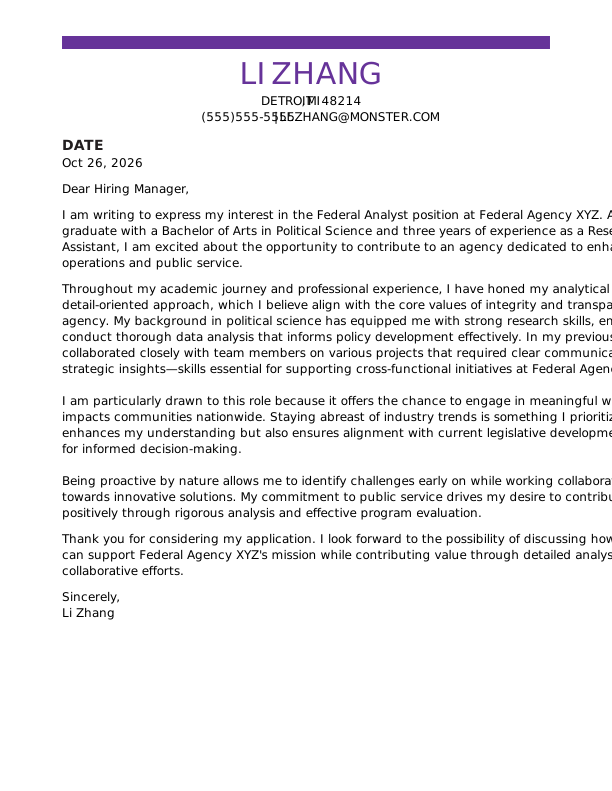
 Free
Federal Entry-Level Cover Letter
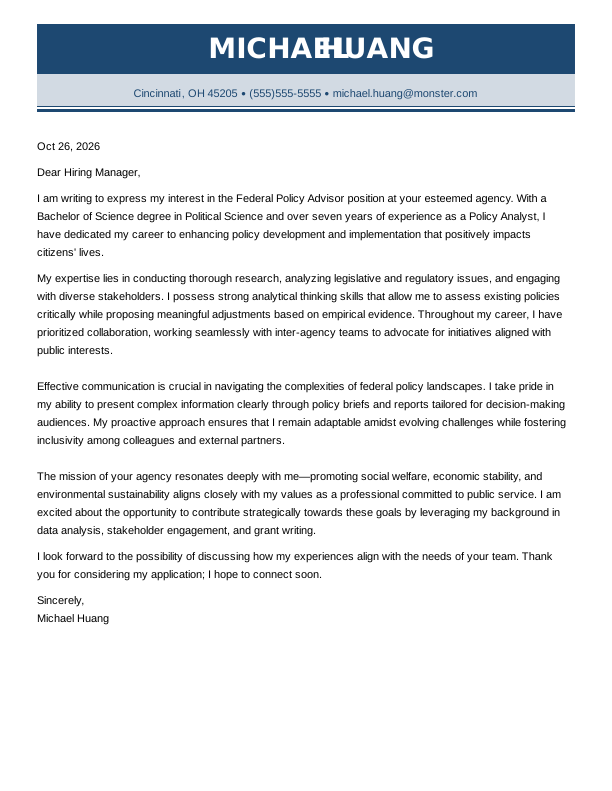
Federal Mid-Level Cover Letter
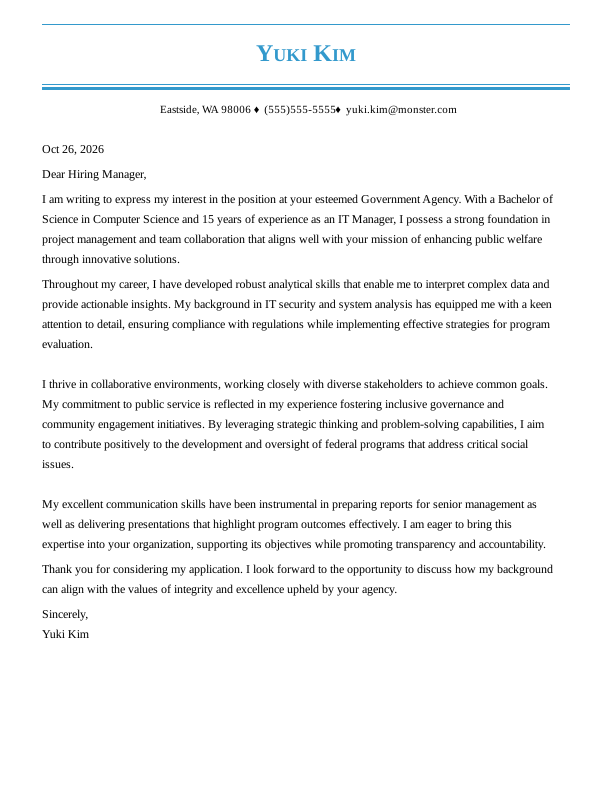
Federal Experienced Cover Letter
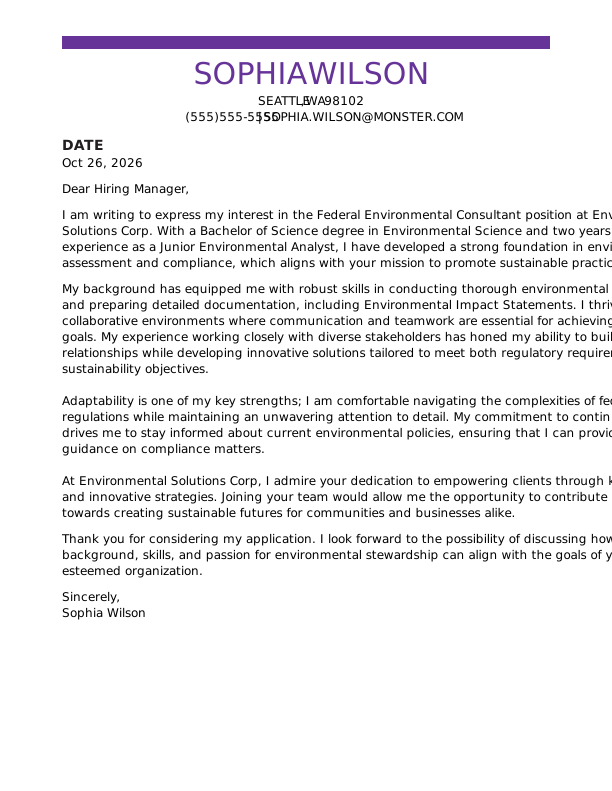
Federal Entry-Level Cover Letter
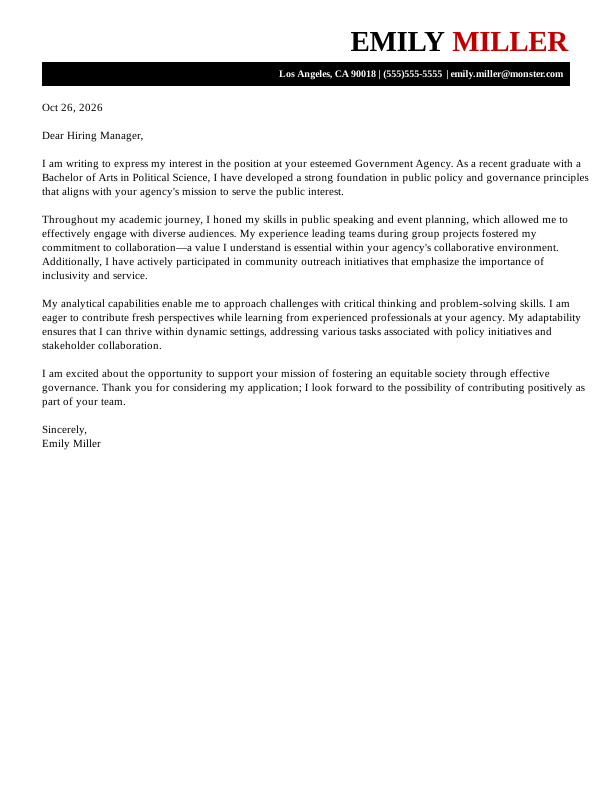
Federal Mid-Level Cover Letter
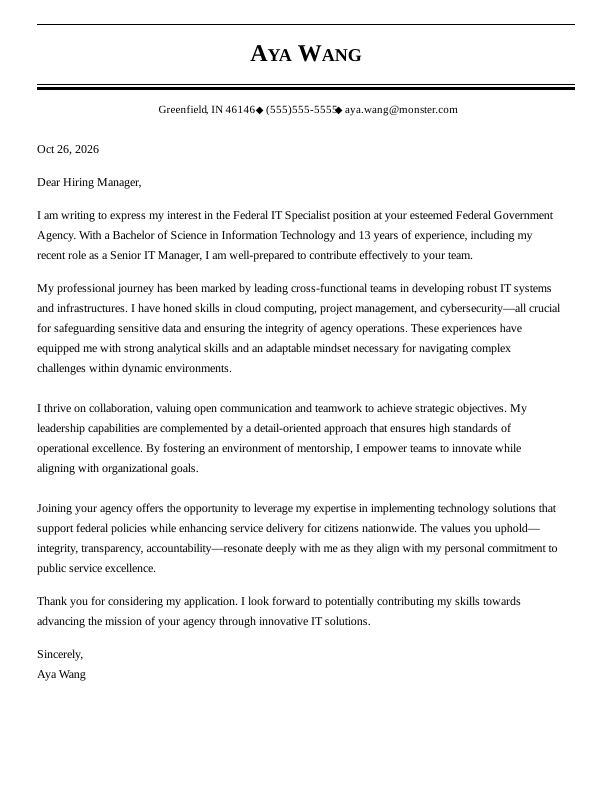
Federal Experienced Cover Letter
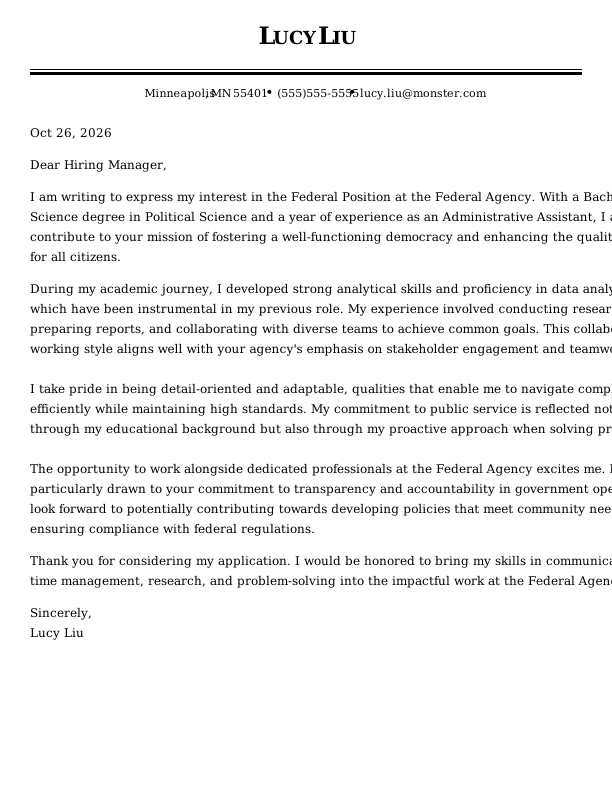
Federal Entry-Level Cover Letter
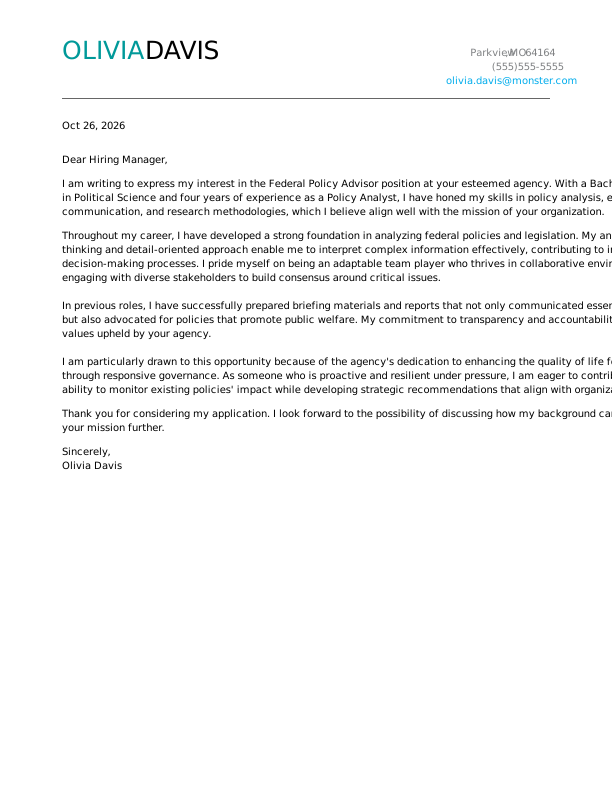
Federal Mid-Level Cover Letter
Browse Free Cover Letter Templates
- Academic
- Account Manager
- Accountant
- Accounts Payable
- Administrative Assistant
- Admissions Counselor
- Architecture
- Artist
- Assistant Principal
- Babysitter
- Barista
- Bartender
- Bookkeeper
- Brand Ambassador
- Business Analyst
- Business
- Caregiver
- Chef
- Civil Engineering
- Computer Science
- Construction
- Consulting
- Copywriter
- Cosmetology
- Custodian
- Customer Service
- Customer Service Representative
- Data Analyst
- Data Entry
- Dental Assistant
- Dental Hygienist
- Digital Marketing
- Electrical Engineering
- Emt
- Engineering
- Esthetician
- Event Coordinator
- Executive Assistant
- Fashion Designer
- Finance
- Financial Analyst
- Firefighter
- Flight Attendant
- Graphic Designer
- Hair Stylist
- Healthcare
- Hr Generalist
- Investment Banking
- It
- Janitor
- Journalism
- Lab Technician
- Law Clerk
- Lawyer
- Librarian
- Logistics
- Maintenance Worker
- Makeup Artist
- Manager
- Marketing Coordinator
- Marketing
- Marketing Manager
- Massage Therapist
- Mechanic
- Mechanical Engineer
- Medical Assistant
- Non Profit
- Nursing
- Occupational Therapy
- Office Assistant
- Office Manager
- Operations Manager
- Paralegal
- Personal Trainer
- Pharmacist
- Pharmacy Technician
- Photographer
- Physician Assistant
- Pilot
- Police Officer
- Program Manager
- Project Manager
- Property Manager
- Psychology
- Receptionist
- Research Assistant
- Restaurant Manager
- Retail
- Sales
- Sales Manager
- School Counselor
- Security
- Security Officer
- Social Work
- Software Engineer
- Special Education Teacher
- Starbucks
- Substitute Teacher
- Teacher
- Teaching Assistant
Cover Letter Examples for Federal Roles
Cover letter expectations for a federal role change as your career progresses, especially around scope and accountability. Choose the template that matches your experience level so you can highlight the right skills, training, and accomplishments for the positions you’re targeting.
Entry-Level Federal Cover Letter
Designed for recent graduates and career changers, this template demonstrates how to present academic research, analytical skills, and public service dedication with confidence when applying for initial government positions.
Mid-Career Federal Cover Letter
Tailored for analysts and specialists with several years of public sector experience, this template shows how to highlight policy development, inter-agency collaboration, stakeholder engagement, and data-driven recommendations.
Experienced Federal Cover Letter
Ideal for senior program directors and IT leaders, this template emphasizes cross-functional program oversight, federal regulatory compliance, system security standards, and strategic guidance for executive leadership.
Federal Cover Letter Template (Text)
Copy this federal cover letter template, paste it into your document, and swap in your relevant agency experience and clearance details for your application.
Min Lee
Oakridge, OR 97463
(555)555-5555
min.lee@monster.com
Oct 26, 2026
Dear Hiring Manager,
I am writing to express my interest in the position at Federal Tech Solutions, as advertised. With a Bachelor of Science in Computer Science and nine years of experience as a software developer, I am excited about the opportunity to contribute to your mission of providing innovative technology solutions for federal agencies.
Throughout my career, I have honed my skills in programming languages such as Java, Python, and JavaScript while developing strong capabilities in SQL. My background has equipped me with a solid understanding of project management methodologies and compliance standards relevant to federal operations. This foundation allows me to approach complex challenges with analytical thinking and creative problem-solving techniques.
I thrive in collaborative environments where effective communication and teamwork are essential. Working alongside diverse teams has enhanced my ability to adapt quickly while maintaining attention to detail—a crucial attribute for managing project timelines and resources effectively. Moreover, I recognize the importance of cybersecurity measures within government initiatives; thus, I prioritize risk assessments and ongoing support throughout every project phase.
I admire Federal Tech Solutions’ commitment to integrity and excellence in serving federal clients. It aligns with my professional values and dedication to delivering high-quality services that enhance operational efficiency.
Thank you for considering my application. I look forward to the possibility of discussing how I can contribute positively towards achieving your organizational goals.
Sincerely,
Min Lee
How to Write a Federal Cover Letter
Writing an effective federal cover letter requires showing hiring officials that you understand agency missions, regulatory guidelines, and structured reporting standards. Follow these steps to align your background directly with a specific vacancy announcement.
1. Research & Prepare
Before writing, research the agency’s primary mission, strategic objectives, and operational frameworks. Finding out whether the bureau focuses on regulatory enforcement, public health administration, or IT modernization allows you to highlight the exact administrative and technical skills that matter most to the hiring committee.
Gather actionable context by exploring these key information sources:
- Review the USAJOBS vacancy announcement to confirm required specialized experience, education substitutions, and security clearance levels.
- Check the agency’s official website for its most recent strategic plan and annual performance reports to understand its current public service priorities.
- Review relevant federal regulations, such as the Federal Acquisition Regulation (FAR) or NIST security frameworks, to align your language with mandatory standards.
2. Hook the Reader
Start your letter with an engaging opening line that demonstrates your ability to support federal missions and improve operational efficiency. Avoid generic openers like “I am writing to apply for the federal analyst position.” Instead, capture the reviewer’s attention by leading with a concrete program accomplishment, audit success, or process improvement.
Choose an opening line tailored to your experience using these example approaches:
- Caseload and workflow efficiency: “At the Department of Health and Human Services, I helped drive a 5% reduction in case backlogs by standardizing intake triage notes and tracking weekly processing cycles.”
- Acquisition and compliance rigor: “In my contract support work, I developed a traceability matrix mapping deliverables to FAR clauses, reducing audit findings from 7 to 2 within two quarters.”
- Security and procedural discipline: “Managing sensitive information under strict access controls, I led SOP updates that allowed external audit teams to verify evidence on their first pass.”
3. Tell Your Professional Story
Use the body of your letter to give federal hiring panels a clear view of your public sector contributions and accountability. While your federal resume outlines detailed duties and salary history, your cover letter explains how your analysis, planning, and teamwork solved agency challenges. Using specific numbers makes your accomplishments far more believable.
Incorporate concrete benchmarks like these to illustrate your impact:
- Reduced average case processing time by 24% by redesigning intake triage workflows for an active 1,200-case monthly volume.
- Delivered $680,000 in taxpayer savings over one fiscal year by renegotiating vendor contracts and eliminating redundant service agreements.
- Increased on-time grant deliverable submissions from 72% to 91% by instituting weekly milestone tracking and proactive risk escalations.
4. Showcase Your Skills
Rather than using broad self-descriptors like “detail-oriented” or “dedicated,” illustrate how your skills resolve real government operational challenges. Showing the exact moments where your regulatory reviews, technical controls, or stakeholder communication protected agency interests builds trust with the hiring team.
Connect your practical abilities directly to daily federal operations using these examples:
- Compliance documentation: “I implemented NIST-aligned security controls when updating access to internal databases, documenting full approval trails so audits could trace every change.”
- System security practices: “I resolved an API validation vulnerability by establishing server-side authentication checks and running regression tests before deploying updates to production.”
- Stakeholder communication: “I translated technical compliance assessments into plain-language summaries, giving non-technical program directors actionable steps to meet security deadlines.”
5. Explain Any Special Circumstances
If you have an employment gap, are transitioning into federal service, or recently relocated, address it briefly in one or two direct sentences. Focus your explanation on your active clearance status, completed training courses, or transferable competencies so the reviewer knows your qualifications are fully current.
Frame your circumstances clearly using these straightforward approaches:
- Addressing an employment gap: “During a six-month career break, I kept my federal regulatory knowledge current by completing DoD cybersecurity refreshers and studying updated federal compliance frameworks.”
- Transitioning positions: “I am pivoting from corporate IT support into federal systems delivery, pairing my technical problem-solving and customer de-escalation skills with AWS Security certification and secure software development training.”
- Handling relocation: “After relocating to the Washington area last year, I updated my regional contact details and confirmed my security clearance reciprocity is ready for immediate onboarding.”
6. End With a Professional Goodbye
Conclude your letter with a polite, confident statement that invites the hiring panel to contact you for an interview. Keep your closing concise, thank the reader for their time and consideration, and express enthusiasm for discussing your public service commitment in detail.
Structure your final paragraph using this clear approach:
- Offer a clear next step: “I would welcome the opportunity to discuss how my policy analysis background and compliance focus can support your agency’s mission goals.”
- Express gratitude: “Thank you for your time and consideration.”
- End with a clean sign-off: “Best regards,” followed by your full name.
4 Tips for Formatting Your Cover Letter
When you apply for a federal position, human resources specialists and hiring panels often review extensive application packages with tight review deadlines. They look rapidly for your specialized experience, security clearance status, and compliance background. A clean visual presentation with consistent spacing and logical organization makes your qualifications easy to spot and proves that you take pride in producing orderly, official documentation.

Keep It to One Page
Keep your cover letter to a single page, ideally between 250 and 400 words spread across three to four short paragraphs. Concise writing ensures that busy federal reviewers can evaluate your clearance details, policy background, and measurable program achievements quickly without wading through redundant text.

Use a Professional Font & Layout
Select standard, highly legible fonts such as Arial, Calibri, Georgia, or Helvetica in 10–12 pt size. Maintain clean 1-inch margins and use the exact same header design as your resume so your entire application package presents a unified, official appearance.

Use Bullet Points for Key Achievements
Incorporate three to four bullet points in the body of your letter to highlight key government metrics like budget execution rates, compliance audit scores, or grant timeliness gains. Bulleted lists break up dense text, making it simple for reviewers to spot your top public sector contributions during a fast initial scan.

Save & Send as a PDF
Save your final cover letter as a PDF to preserve your margins, line spacing, and general layout across different government operating systems or automated staffing portals. Use a clean, professional filename like Firstname_Lastname_Cover_Letter.pdf or Firstname_Lastname_Federal_Cover_Letter.pdf to make your application easy for HR teams to organize.
Key Takeaways
- Prioritize compliance and accountability by describing a specific project where you applied a federal regulation or policy framework to deliver positive results.
- Include concrete performance metrics like budget execution rates, grant submission timeliness, or audit finding reductions to prove your public sector impact.
- Tailor your letter to the organizational structure by focusing on regulatory documentation for agency staff, SLA delivery for federal contractors, or program compliance for grant-funded partners.
More Cover Letter Examples
Browse Monster’s Resume Templates
Monster also has hundreds of ATS-friendly resume templates for all career levels and industries. Create a matching resume to help you land the interview.
Frequently Asked Questions
Last Update:
Do I really need a cover letter?
Yes, submitting a cover letter with your federal application is strongly recommended, even when the job posting lists it as optional. While a federal resume details your specialized experience and grade-level history, a cover letter explains your dedication to public service, communication strengths, and mission alignment. It also provides dedicated space to explain career transitions, active clearance details, or employment gaps.
How long should my cover letter be?
A federal cover letter should stay within one page, targeting between 250 and 400 words. Federal hiring officials and subject-matter experts review numerous extensive application packets, so direct, concise writing works best. Divide your text into three or four short paragraphs that focus strictly on your specialized experience, regulatory knowledge, and measurable program achievements without adding unnecessary filler.
Should my cover letter match my resume?
Yes, your federal cover letter should match your resume’s visual formatting to present a polished, cohesive application package. Use the same font styles, margin sizes, color accents, and contact header across both documents. Instead of repeating your resume bullet points verbatim, use your cover letter to expand on a specific agency milestone or explain why you want to support this specific department’s mission.
Can I use AI to write my cover letter?
Using AI tools can help you outline your federal cover letter and organize your thoughts, but you should rewrite the draft heavily before submitting it. AI-generated text often uses generic phrasing that lacks the specific agency mission knowledge, regulatory frameworks, and measurable outcomes federal hiring panels look for. Personalizing your content ensures the letter accurately reflects your public service experience.
Should I mention salary expectations in my cover letter?
You should only mention salary expectations in a federal cover letter if the vacancy announcement explicitly requests them. Most federal positions follow standardized General Schedule (GS) or pay-band salary ranges, so individual negotiation is handled later. If required, state a flexible range based on the target GS grade and step, noting your openness to discussing total federal compensation and benefits.

Megan Dawkins is a career industry editor who empowers job seekers to take control of their career paths using Monster’s comprehensive job search and resume tools. She specializes in helping job seekers navigate the flexible job market.
See More From Megan DawkinsExplore Related Career Advice







How to Write a Cover Letter for Internal Positions or Promotions (Examples & Tips)

Updated:
Apr 23, 2026
|
19 min read


Cover Letter vs Resume: What’s the Difference & Do You Need Both?

Updated:
Apr 23, 2026
|
18 min read