


Free Nonprofit Cover Letter Templates & Examples
A great nonprofit cover letter connects your everyday skills to real community impact. In just a few paragraphs, you can show hiring managers that you understand their mission, communicate well with key partners, and know how to support their programs effectively.
Real-World Cover Letters That Get Results
 Free
Nonprofit Entry-Level Cover Letter
Nonprofit Mid-Level Cover Letter
Nonprofit Experienced Cover Letter
Nonprofit Entry-Level Cover Letter
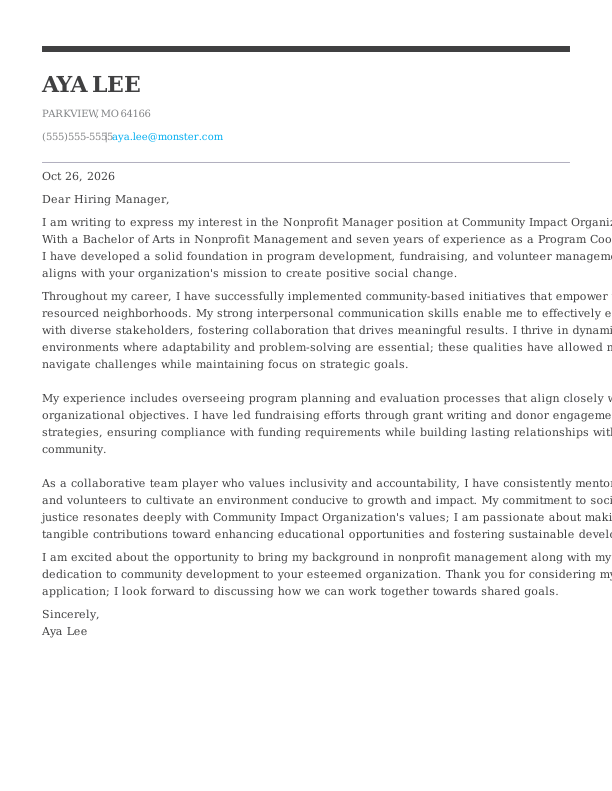
Nonprofit Mid-Level Cover Letter
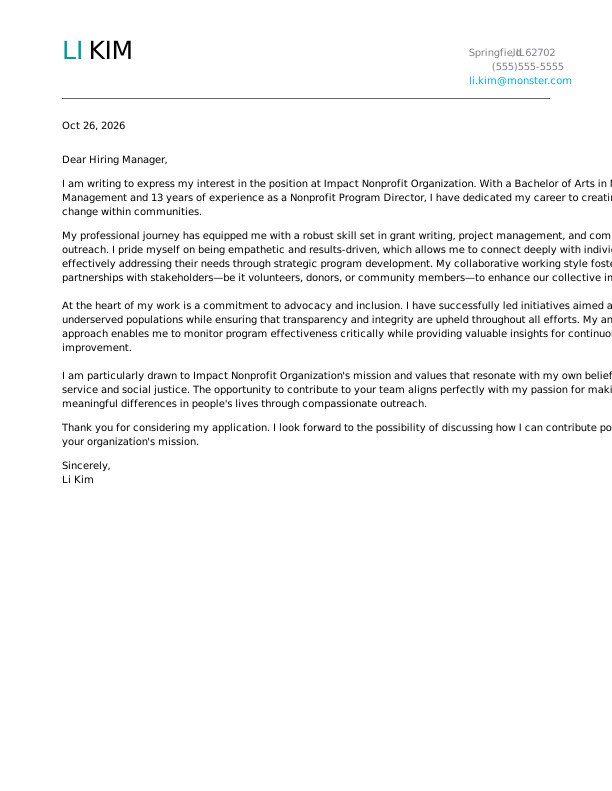
Nonprofit Experienced Cover Letter
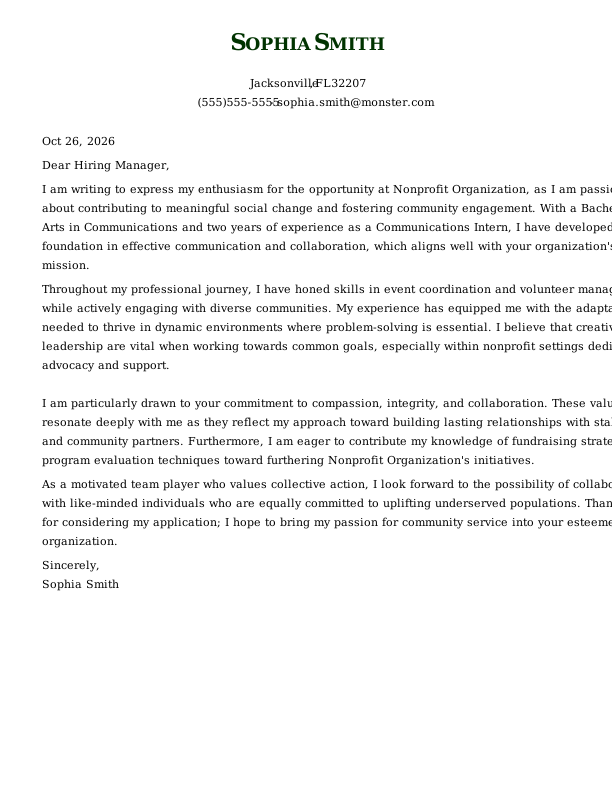
Nonprofit Entry-Level Cover Letter
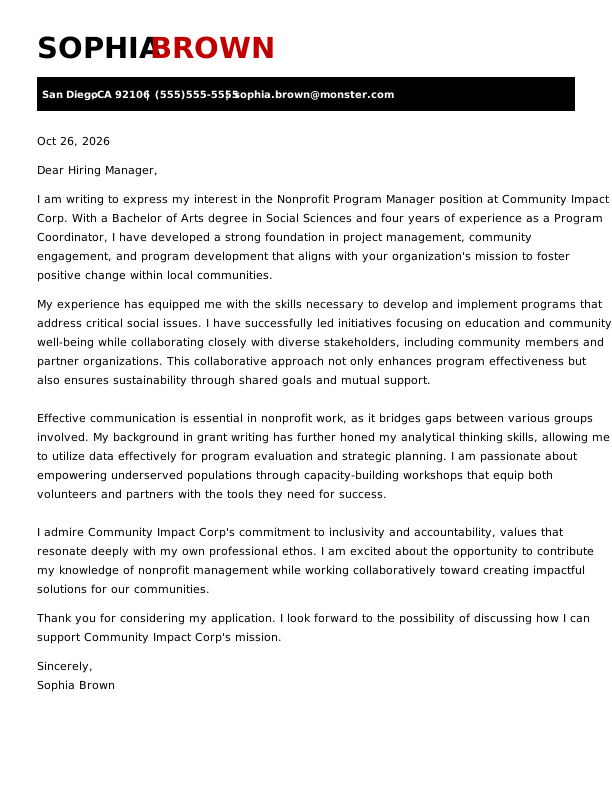
Nonprofit Mid-Level Cover Letter
Browse Free Cover Letter Templates
- Academic
- Account Manager
- Accountant
- Accounts Payable
- Administrative Assistant
- Admissions Counselor
- Architecture
- Artist
- Assistant Principal
- Babysitter
- Barista
- Bartender
- Bookkeeper
- Brand Ambassador
- Business Analyst
- Business
- Caregiver
- Chef
- Civil Engineering
- Computer Science
- Construction
- Consulting
- Copywriter
- Cosmetology
- Custodian
- Customer Service
- Customer Service Representative
- Data Analyst
- Data Entry
- Dental Assistant
- Dental Hygienist
- Digital Marketing
- Electrical Engineering
- Emt
- Engineering
- Esthetician
- Event Coordinator
- Executive Assistant
- Fashion Designer
- Finance
- Financial Analyst
- Firefighter
- Flight Attendant
- Graphic Designer
- Hair Stylist
- Healthcare
- Hr Generalist
- Investment Banking
- It
- Janitor
- Journalism
- Lab Technician
- Law Clerk
- Lawyer
- Librarian
- Logistics
- Maintenance Worker
- Makeup Artist
- Manager
- Marketing Coordinator
- Marketing
- Marketing Manager
- Massage Therapist
- Mechanic
- Mechanical Engineer
- Medical Assistant
- Non Profit
- Nursing
- Occupational Therapy
- Office Assistant
- Office Manager
- Operations Manager
- Paralegal
- Personal Trainer
- Pharmacist
- Pharmacy Technician
- Photographer
- Physician Assistant
- Pilot
- Police Officer
- Program Manager
- Project Manager
- Property Manager
- Psychology
- Receptionist
- Research Assistant
- Restaurant Manager
- Retail
- Sales
- Sales Manager
- School Counselor
- Security
- Security Officer
- Social Work
- Software Engineer
- Special Education Teacher
- Starbucks
- Substitute Teacher
- Teacher
- Teaching Assistant
Cover Letter Examples for Nonprofit Professionals
Cover letter expectations naturally change as you advance in the nonprofit sector. Whether you are stepping into your first community role, coordinating daily programs, or guiding broader organizational strategy, choosing the right approach helps you highlight your strengths effectively.
Entry-Level Nonprofit Cover Letter
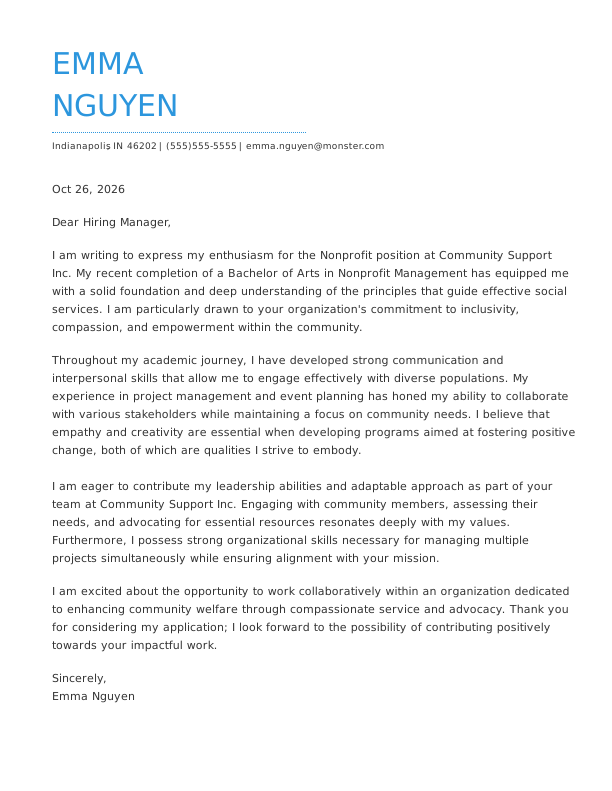
If you are just entering the nonprofit sector or transitioning from another field, this template helps you frame foundational skills, relevant coursework, and personal motivation around a shared community mission.
Mid-Career Nonprofit Cover Letter
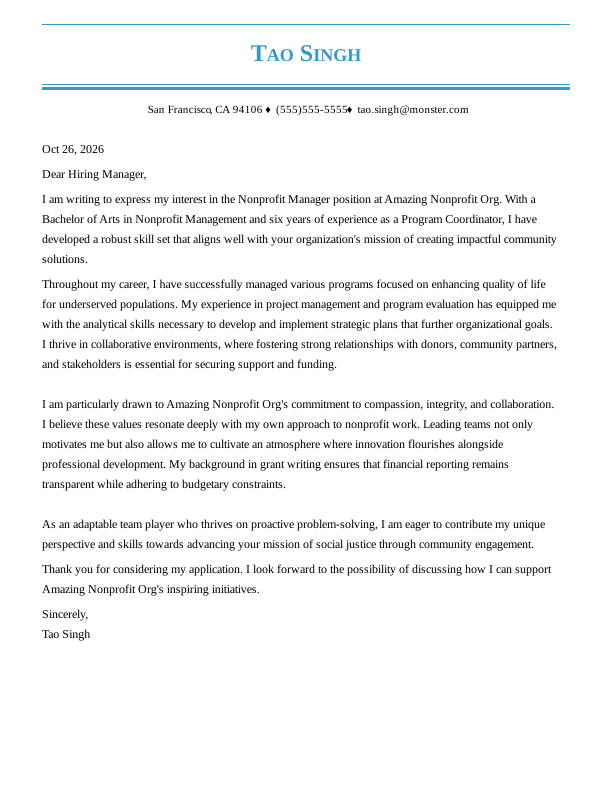
For professionals with several years of experience, this template centers on your ability to coordinate programs independently, manage budgets, collaborate with community partners, and keep daily operations running smoothly.
Experienced Nonprofit Cover Letter
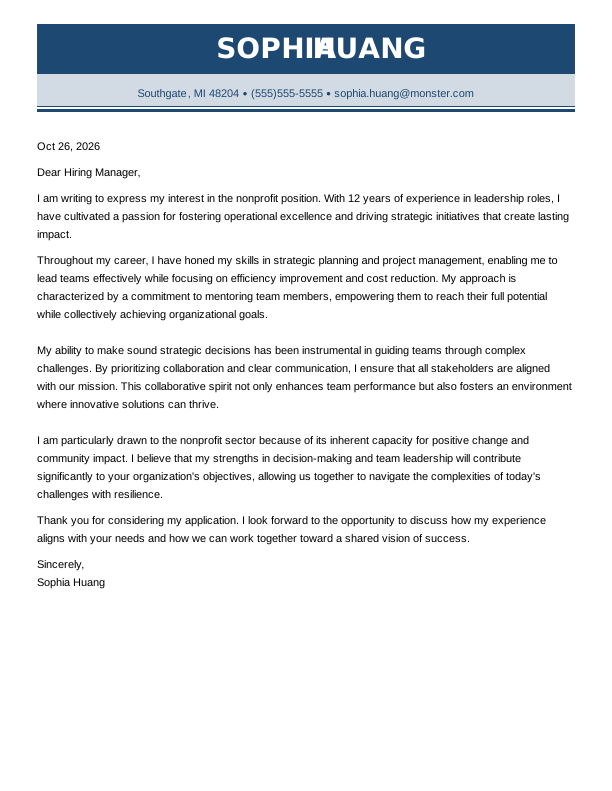
Designed for seasoned nonprofit leaders, this template emphasizes strategic planning, team mentorship, organizational efficiency, and high-level decision-making that guides programs through complex community challenges.
Nonprofit Cover Letter Template (Text)
Copy this nonprofit cover letter template into your document and adapt it by swapping in your volunteer impact metrics or the specific organization you’re applying to.
Min Johnson
Buffalo, NY 14206
(555)555-5555
min.johnson@monster.com
Oct 26, 2026
Dear Hiring Manager,
I am writing to express my interest in the nonprofit position at Target Company. With five years of experience in program development and management, I am passionate about creating positive social change and fostering community engagement through innovative initiatives.
Throughout my career, I have honed my communication and teamwork skills while collaborating with diverse stakeholders to implement programs that address critical social issues. My background in strategic planning has equipped me to develop initiatives that not only align with organizational goals but also meet the unique needs of the communities we serve.
I take pride in my problem-solving abilities and collaborative mindset, which have allowed me to effectively engage with community partners for outreach efforts. Additionally, I have participated in fundraising activities, including grant writing and building donor relationships, always prioritizing transparency and accountability.
At the core of my professional journey is a commitment to community empowerment and sustainability—values that resonate deeply with Target Company’s mission. I thrive in dynamic environments where adaptability is key; my ability to monitor program effectiveness ensures continuous improvement for impactful solutions.
I am excited about the opportunity to contribute to Target Company’s vision of uplifting underserved populations through meaningful collaboration. Thank you for considering my application; I look forward to discussing how I can help further your mission.
Sincerely,
Min Johnson
How to Write a Nonprofit Cover Letter
Writing a strong nonprofit cover letter comes down to showing how your skills solve practical problems for an organization. Instead of relying on generic statements about wanting to help people, use these practical steps to build a clear, grounded story that speaks directly to a hiring manager.
1. Research & Prepare
Before you start writing, take time to learn what the organization is focused on right now. Nonprofits operate under real constraints, from specific grant deliverables to community-driven targets. Reviewing its current initiatives helps you speak directly to its immediate needs and demonstrate that you understand its work.
Here are three simple ways to research an organization before you draft your letter:
- Check its website and recent annual reports to see which programs are expanding and how it measures impact.
- Read the job description carefully for mentions of donor databases, case management platforms, or reporting tools.
- Review its public IRS Form 990 filings on sites like ProPublica to understand its funding sources and program scale.
2. Hook the Reader
Start with a strong opening line that immediately highlights your value instead of repeating basic contact details or stating that you are passionate about the cause. Showing upfront that you understand how programs succeed grabs attention right away.
Consider these practical opening angles:
- Highlight specific results: “By updating our intake process and volunteer shifts, I helped our local pantry increase client visits by 18% in one quarter.”
- Mention operational improvements: “In my previous role, I rebuilt our grant reporting dashboard and cut draft prep times from 10 days down to 4.”
- Point to hands-on coordination: “Having coordinated three school partners while maintaining a 95% waitlist accuracy rate, I understand what it takes to keep youth programs running smoothly.”
3. Tell Your Professional Story
Use the middle of your letter to share how your daily work led to tangible outcomes. While your resume lists your job duties, your cover letter explains the difference your efforts made for the people and communities you served.
Here are a few ways to show your accomplishments clearly:
- Show program growth by explaining how updating outreach forms and schedules helped lift enrollment by 22%.
- Detail fundraising support by noting how segmenting donor lists and sending targeted appeals helped raise $180,000 in unrestricted funds.
- Highlight saved staff time by describing how automating routine paperwork checks cut 35 minutes of processing time per case across 120 files.
4. Showcase Your Skills
Rather than listing generic qualities like “detail-oriented” or “mission-driven,” describe specific moments where your skills solved an everyday challenge. Grounding your abilities in real situations shows hiring teams that you know how to handle the realities of the job.
Here is how you can connect your skills to everyday nonprofit tasks:
- For donor management, explain how you updated constituent notes in your database right after calls so your team always had clear context for follow-ups.
- For grant support, describe how you organized shared document folders and tracked deadlines to ensure submissions were always complete.
- For community relations, share how you listened to a partner’s concerns about program access and incorporated their feedback before finalizing plans.
5. Explain Any Special Circumstances
If you have an employment gap, are changing industries, or recently relocated, address it briefly in one or two clear sentences. Focus on what you did to keep your skills sharp and how that experience prepares you for this role.
You can frame these situations naturally:
- Address work gaps: “During a six-month break between contracts, I stayed engaged by writing monthly grant updates for a local community partner.”
- Explain a career switch: “I’m moving from corporate fundraising to nonprofit development because my background in database management directly supports donor stewardship.”
- Clarify a move directly: “After relocating to Seattle, I began volunteering with a local food bank to stay connected to regional community services.”
6. End With a Professional Goodbye
Wrap up your letter with a clear, polite closing that invites further conversation. Thank the reader for their time and suggest a concrete way you can help their team hit the ground running.
End with a focused, conversational closing:
Suggest a practical topic for your interview, such as: “I would welcome the chance to discuss how my volunteer coordination experience can help support your upcoming summer programs.”
Close with a sincere thank-you followed by a standard sign-off like “Sincerely” or “Best regards.”
4 Tips for Formatting Your Cover Letter
Nonprofit hiring managers often review cover letters while juggling active community projects, grant deadlines, and donor relations. A clean, well-structured page ensures they can quickly spot your key achievements and mission fit without having to dig through dense blocks of text. Clear visual organization also shows that you communicate clearly and take pride in how you present your work.

Keep It to One Page
Keep your letter between 250 and 400 words spread across three to four concise paragraphs. Limiting your letter to a single page forces you to focus only on your strongest qualifications, which respects the reader’s time and keeps your message punchy and engaging.

Use a Professional Font & Layout
Stick to clean, standard fonts like Arial, Calibri, or Georgia set between 10 and 12 points, with 1-inch margins on all sides. A clean layout ensures your letter looks sharp whether a manager reads it on a phone screen, opens it in an email preview, or prints it out for an interview panel.

Address the Hiring Manager Directly
Check the job listing, staff directory, or LinkedIn page to find the specific person leading the search, such as a program manager or executive director. If you cannot find a specific contact, use a welcoming opening like “Dear Hiring Manager” or “To the Hiring Team” rather than stiff, outdated phrases.

Match Your Header to Your Resume
Use the same contact header, font styles, and layout across both your cover letter and resume. A matching header creates a cohesive, professional package that helps busy reviewers quickly recognize your materials as they review multiple applicants.
Key Takeaways
- Connect your everyday work directly to community results by mentioning specific metrics like funds raised, program growth, or hours saved.
- Tailor your letter to the organization’s current focus by reviewing its recent annual reports, active programs, and public 990 forms.
- Keep your layout clean, professional, and limited to one page so a busy hiring manager can scan your experience.
More Cover Letter Examples
Browse Monster’s Resume Templates
Monster also has hundreds of ATS-friendly resume templates for all career levels and industries. Create a matching resume to help you land the interview.
Frequently Asked Questions
Last Update:
Do I really need a cover letter?
You should definitely include a cover letter for a nonprofit job, even when the posting lists it as optional. While your resume outlines your past titles, a cover letter lets you explain your personal connection to the organization’s mission. It also gives you space to show how your background prepares you to support its programs, manage donor relationships, and advocate effectively for the community.
How long should my cover letter be?
Your nonprofit cover letter should always stay on a single page, ideally between 250 and 400 words. Keeping it concise across three or four brief paragraphs ensures a busy hiring manager can quickly review your strengths. By focusing on your most relevant achievements and program outcomes, you make it easy for the reader to see your direct value without feeling overwhelmed by long text blocks.
Should my cover letter match my resume?
Your cover letter should match your resume’s visual design, including your fonts, margins, and contact header. Using a consistent layout makes your entire application look organized and professional from the start. Rather than repeating your resume’s bullet points, use your cover letter to add helpful context around a couple of key achievements that show how you can support this organization’s specific goals.
How do I address my cover letter if I don’t know the hiring manager’s name?
If you don’t know the hiring manager’s name, start by checking the organization’s staff directory or LinkedIn to see who manages the program. If you still can’t identify the right contact, addressing your letter to “Dear Hiring Manager” or “Dear Hiring Team” works perfectly. It sounds polite, modern, and professional, helping you avoid outdated greetings like “To Whom It May Concern.”
How do I write a cover letter for an internal position?
When writing a cover letter for an internal nonprofit position, focus on your hands-on familiarity with the organization’s existing programs, donor relationships, and reporting tools. Point to recent internal wins, such as improving project turnaround times or tightening workflow checklists, to show your dependability. Reiterate your enthusiasm for taking on added responsibility, and maintain a polite, professional tone that treats the internal process with full care.

Megan Dawkins is a career industry editor who empowers job seekers to take control of their career paths using Monster’s comprehensive job search and resume tools. She specializes in helping job seekers navigate the flexible job market.
See More From Megan DawkinsExplore Related Career Advice







How to Write a Cover Letter for Internal Positions or Promotions (Examples & Tips)

Updated:
Apr 23, 2026
|
19 min read


Cover Letter vs Resume: What’s the Difference & Do You Need Both?

Updated:
Apr 23, 2026
|
18 min read