

Free Food Service Cover Letter Templates & Examples
A strong food service cover letter highlights your customer focus, teamwork, and relevant hands-on experience. Use our free templates and clear guidance to show hiring managers how you deliver fast, friendly service while keeping food safety and kitchen cleanliness a top priority.
Real-World Cover Letters That Get Results
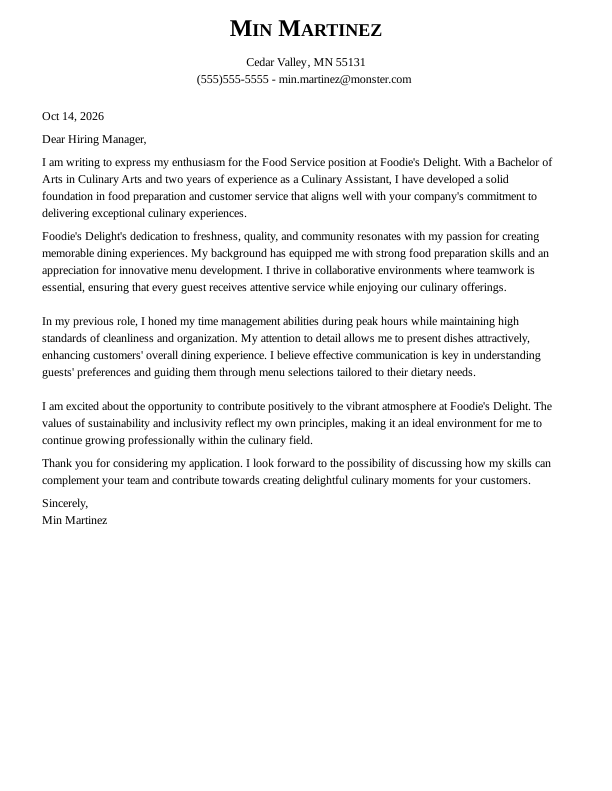
 Free
Food Service Entry-Level Cover Letter
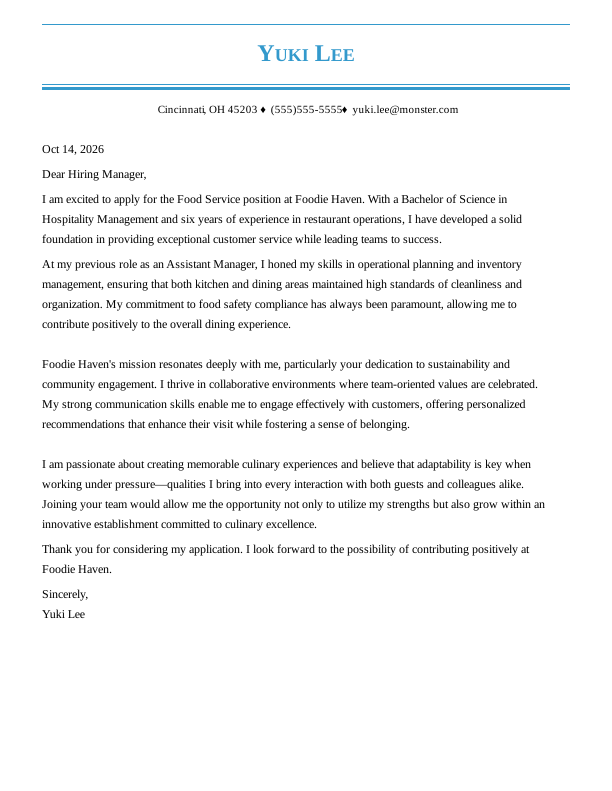
Food Service Mid-Level Cover Letter
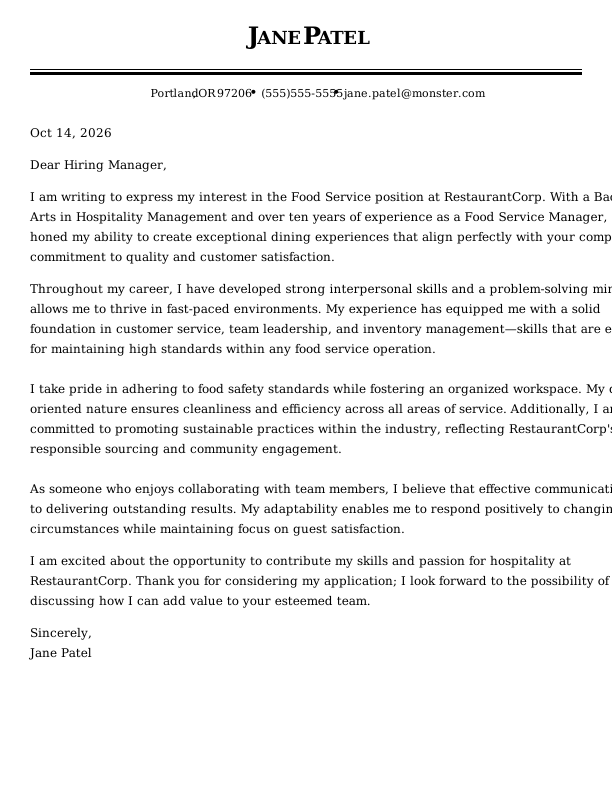
Food Service Experienced Cover Letter
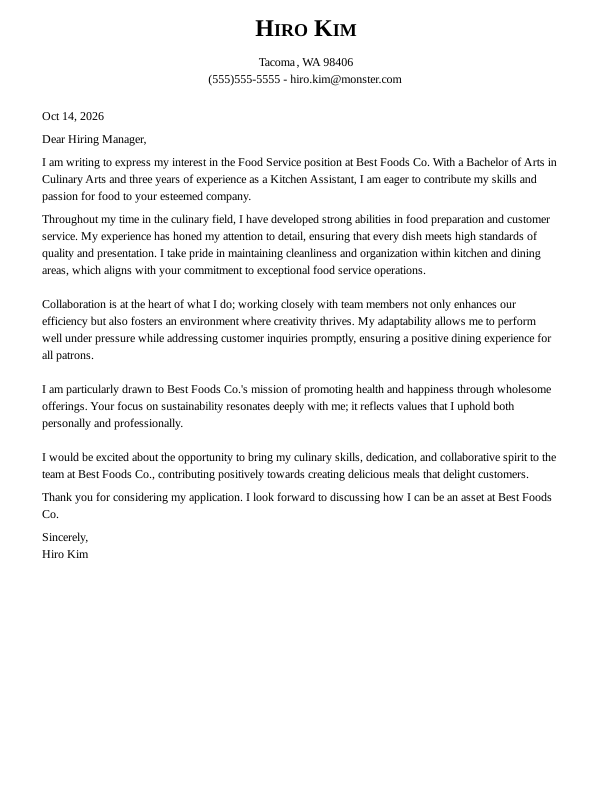
Food Service Entry-Level Cover Letter
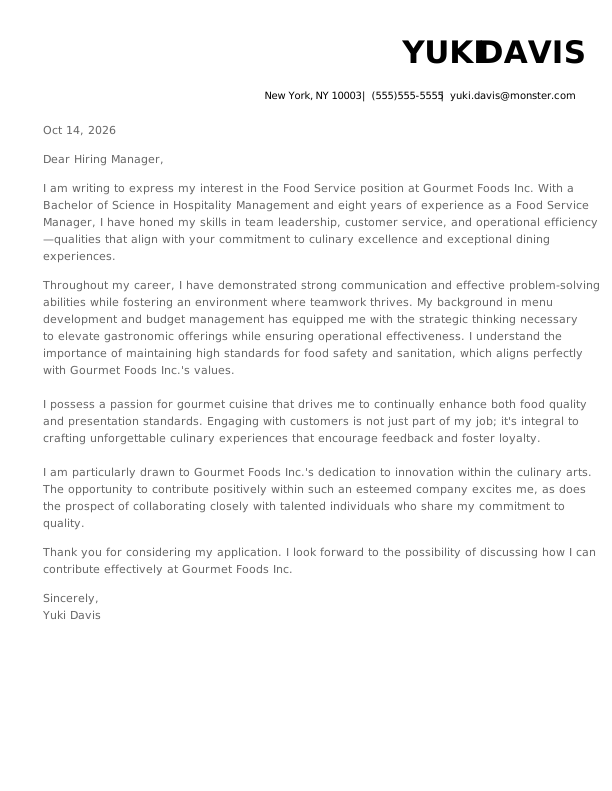
Food Service Mid-Level Cover Letter
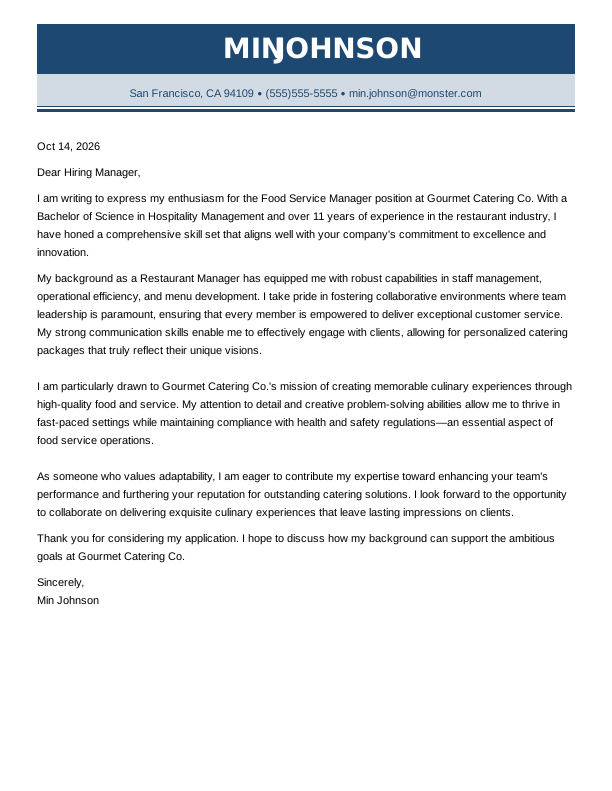
Food Service Experienced Cover Letter
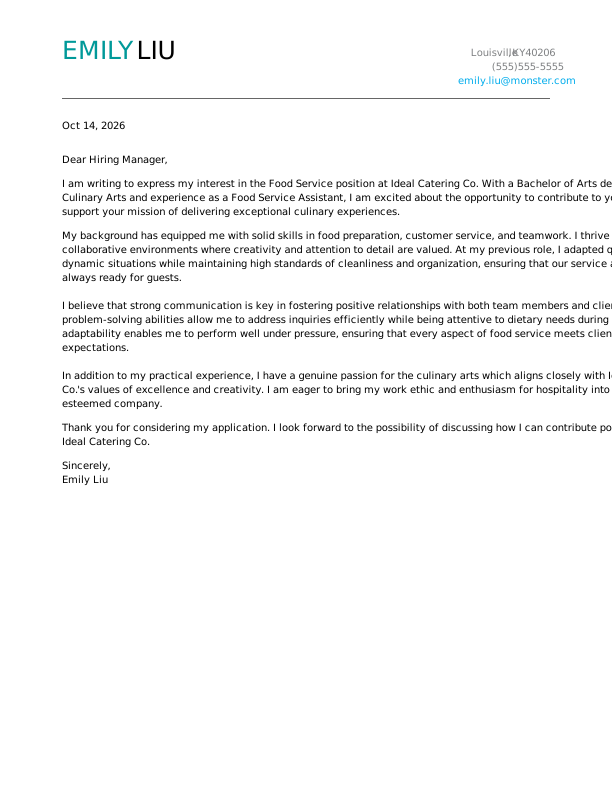
Food Service Entry-Level Cover Letter
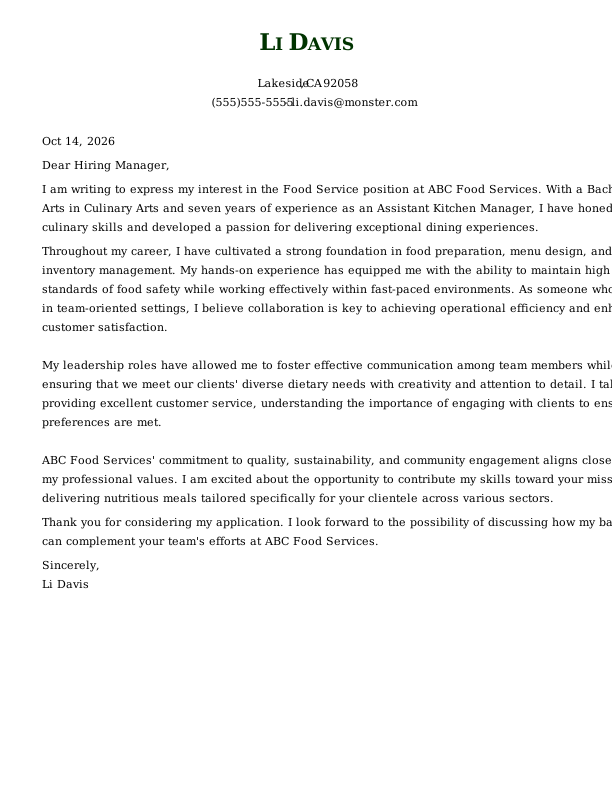
Food Service Mid-Level Cover Letter
Browse Free Cover Letter Templates
- Academic
- Account Manager
- Accountant
- Accounts Payable
- Administrative Assistant
- Admissions Counselor
- Architecture
- Artist
- Assistant Principal
- Babysitter
- Barista
- Bartender
- Bookkeeper
- Brand Ambassador
- Business Analyst
- Business
- Caregiver
- Chef
- Civil Engineering
- Computer Science
- Construction
- Consulting
- Copywriter
- Cosmetology
- Custodian
- Customer Service
- Customer Service Representative
- Data Analyst
- Data Entry
- Dental Assistant
- Dental Hygienist
- Digital Marketing
- Electrical Engineering
- Emt
- Engineering
- Esthetician
- Event Coordinator
- Executive Assistant
- Finance
- Financial Analyst
- Firefighter
- Flight Attendant
- Graphic Designer
- Hair Stylist
- Healthcare
- Hr Generalist
- Investment Banking
- It
- Janitor
- Journalism
- Lab Technician
- Law Clerk
- Lawyer
- Librarian
- Logistics
- Makeup Artist
- Manager
- Marketing Coordinator
- Marketing
- Marketing Manager
- Massage Therapist
- Mechanic
- Mechanical Engineer
- Medical Assistant
- Non Profit
- Nursing
- Occupational Therapy
- Office Assistant
- Office Manager
- Operations Manager
- Paralegal
- Personal Trainer
- Pharmacist
- Pharmacy Technician
- Photographer
- Physician Assistant
- Pilot
- Police Officer
- Program Manager
- Project Manager
- Property Manager
- Psychology
- Receptionist
- Research Assistant
- Restaurant Manager
- Retail
- Sales
- Sales Manager
- School Counselor
- Security Officer
- Social Work
- Software Engineer
- Special Education Teacher
- Substitute Teacher
- Teacher
- Teaching Assistant
- Truck Driver
- Vet Tech
- Veterinary Assistant
- Web Developer
Cover Letter Examples for Food Services
Cover letter expectations change as your food service career grows. Choose the template that matches your current stage to highlight the right balance of daily prep skills, shift leadership, or operational results.
Entry-Level Food Service Cover Letter
Ideal for career changers and recent graduates entering the field, this template shows how to highlight foundational training and customer-focused strengths when applying for entry-level food service roles.
Mid-Career Food Service Cover Letter
Designed for professionals with several years of experience, this template highlights shift leadership, inventory tracking, and daily food safety management across dining and kitchen operations.
Experienced Food Service Cover Letter
Tailored for senior professionals, this template emphasizes full operational oversight, cross-shift team management, inventory control, and long-term commitment to safety and quality standards.
Food Service Cover Letter Template (Text)
Copy this food service cover letter text, paste it into your document, and swap in your shift experience and customer service metrics for the role you want.
Jane Zhang
Albany, NY 12203
(555)555-5555
jane.zhang@monster.com
Oct 14, 2026
Dear Hiring Manager,
I am writing to express my interest in the Food Service position at TargetCompany. With a Bachelor of Science degree in Food Science and four years of experience as a Food Service Manager, I have cultivated a solid foundation in food preparation, customer service, and team leadership that aligns well with your company’s commitment to quality and community engagement.
Throughout my career, I have embraced the values of integrity and excellence. My experience has equipped me with strong communication skills and the ability to work collaboratively within diverse teams. I thrive in fast-paced environments where adaptability is crucial, ensuring that operations run smoothly while maintaining high standards for food safety compliance.
My background includes hands-on menu development and inventory management, allowing me to contribute effectively to various aspects of kitchen operations. I take pride in delivering exceptional customer experiences by addressing guest inquiries promptly and ensuring cleanliness across all areas.
I am drawn to TargetCompany’s mission of enhancing dining experiences through innovative solutions while supporting local suppliers. This aligns with my passion for providing high-quality meals that not only satisfy but also bring people together.
I would be thrilled to bring my expertise in food service management to TargetCompany’s dynamic team. Thank you for considering my application; I look forward to the opportunity to discuss how I can contribute positively to your organization.
Sincerely,
Jane Zhang
How to Write a Food Service Cover Letter
Writing a great cover letter means turning your daily shift experience into clear, practical examples. Follow these simple steps to build a persuasive letter that highlights your exact skills and fits what the hiring team needs.
1. Research & Prepare
Before writing, spend a few minutes learning what matters most to the employer, such as high-volume lunch flow, special dietary care, or catering setup.
Reviewing these preparation steps will help you tailor your letter directly to the employer’s daily operations:
- Review the job listing carefully to identify required food handler cards or safety certifications.
- Explore the company website to understand its service style, dining atmosphere, and core values.
- Note specific shift demands or service models mentioned so you can match them with past experience.
2. Hook the Reader
Start your letter with an opening line that grabs attention by showing you understand the fast-paced reality of food service. Skip generic openings and lead with a clear statement about your hands-on experience.
Here are a few examples of strong opening hooks that showcase different key strengths:
- High-volume efficiency: “I coordinated kitchen prep to serve over 1,000 meals weekly while keeping food prep stations organized and clean.”
- Safety compliance: “By enforcing daily temperature checks and labeling routines, I helped maintain flawless health inspection scores.”
- Team collaboration: “I cross-trained team members across line stations to keep order wait times under five minutes during peak hours.”
3. Tell Your Professional Story
Your cover letter explains how you handle day-to-day floor work. Use clear numbers and concrete examples to paint a realistic picture of your work ethic, whether that means managing busy meal rushes or keeping food waste low.
The examples below demonstrate how you can present your achievements using quantifiable metrics:
- Reduced ingredient waste by 15% through careful prep management and accurate daily stock counts.
- Maintained strict sanitation standards across a dining facility serving over 300 guests each day.
- Supported positive customer feedback scores by resolving guest concerns quickly and attentively on the floor.
4. Showcase Your Skills
Rather than simply stating that you are reliable or friendly, connect your skills directly to job requirements. Show how your strengths translate into smooth service, attentive guest care, and steady teamwork during busy shifts.
Consider these examples of how to highlight core food service skills in action:
- Food safety focus: “I monitored holding temperatures consistently to ensure full compliance with health guidelines.”
- POS proficiency: “I processed guest orders accurately using the POS system while updating stock levels in real time.”
- Customer care: “I answered dietary inquiries helpfully, suggesting menu adjustments to meet guest needs safely.”
5. Explain Any Special Circumstances
If you have employment gaps, are changing careers, or have recently relocated, address them. Keep your explanation to one or two straightforward sentences that highlight your readiness and active commitment to food service.
The following examples show how to frame different special circumstances professionally:
- “During my recent career pause, I renewed my food safety credentials and refreshed my customer service training.”
- “I am transitioning from retail to food service, bringing transferable experience in fast customer assistance and point-of-sale systems.”
- “Having recently moved to the area, I am eager to apply my food handler background to a dynamic local kitchen team.”
6. End With a Professional Goodbye
Wrap up your cover letter with a polite, professional closing paragraph. Reiterate your enthusiasm for the position, suggest a conversation about how you can support the team, and thank the reader for their time.
For instance: “I welcome the opportunity to discuss how my hands-on background and positive attitude can support your dining team. Thank you for your time and consideration.”
End with a standard closing line like “Sincerely,” followed by your full name.
4 Tips for Formatting Your Cover Letter
In food service hiring, managers often review applications during quick breaks between shifts. A clean, well-organized layout ensures your key qualifications, certifications, and availability stand out immediately at a single glance.

Keep It to One Page
Keep your cover letter concise and focused on a single page. Aim for 250 to 400 words arranged across three or four short paragraphs. This gives hiring managers enough space to understand your experience and schedule availability without overwhelming them with text.

Use a Professional Font & Layout
Choose a clear font such as Arial, Calibri, or Times New Roman in 10- to 12-point size. Maintain standard 1-inch margins and match your letter header with your resume style to present a neat, cohesive application package that looks easy to read on screen or on paper.

Address the Hiring Manager Directly
Try to find the name of the hiring manager, head chef, or dining supervisor through the job posting or staff directory. If a specific name is unavailable, addressing your letter to “Dear Hiring Manager” or “Dear Food Service Team” keeps your greeting warm and professional.

Use Bullet Points for Key Achievements
Use bullet points to highlight three or four of your most impressive achievements, such as maintaining safety records or improving prep efficiency. Bulleted formatting breaks up large blocks of text and helps readers spot your top strengths quickly.
Top-Paying States for Food Service Roles
Knowing what food service workers earn across the country helps you compare job offers, plan your budget, and negotiate confidently. The data below comes from the U.S. Bureau of Labor Statistics (BLS) and reflects recent nationwide averages.
Keep in mind that your pay can vary based on location, experience, and whether the role is in a restaurant, school, hospital, or catering company. Hours and shift timing also matter, since busy seasons and weekend work can change total earnings.
| Alabama | $63,650 |
| Alaska | $84,790 |
| Arizona | $68,000 |
| Arkansas | $55,900 |
| California | $77,740 |
| Connecticut | $78,900 |
| Delaware | $81,590 |
| District of Columbia | $91,280 |
| Florida | $71,240 |
| Georgia | $70,520 |
| Hawaii | $89,370 |
| Idaho | $68,120 |
| Illinois | $72,690 |
| Indiana | $67,200 |
| Iowa | $72,650 |
| Kansas | $67,600 |
| Kentucky | $60,860 |
| Louisiana | $66,940 |
| Maine | $68,750 |
| Maryland | $74,740 |
| Massachusetts | $88,770 |
| Michigan | $63,600 |
| Minnesota | $81,070 |
| Mississippi | $60,580 |
| Missouri | $67,150 |
| Montana | $65,210 |
| Nebraska | $67,020 |
| Nevada | $73,180 |
| New Hampshire | $79,210 |
| New Jersey | $89,810 |
| New Mexico | $77,740 |
| New York | $89,310 |
| North Carolina | $71,690 |
| North Dakota | $68,160 |
| Ohio | $64,010 |
| Oklahoma | $74,260 |
| Oregon | $68,090 |
| Pennsylvania | $66,220 |
| Rhode Island | $80,710 |
| South Carolina | $71,280 |
| South Dakota | $62,090 |
| Tennessee | $64,590 |
| Texas | $68,990 |
| Utah | $61,020 |
| Vermont | $76,750 |
| Virginia | $74,370 |
| Washington | $95,470 |
| West Virginia | $54,200 |
| Wisconsin | $59,310 |
| Wyoming | $65,010 |
| Guam | $48,820 |
| Puerto Rico | $42,800 |
| Virgin Islands | $72,930 |
Key Takeaways
- Highlight specific examples of fast service and food safety compliance to show immediate job readiness.
- Include relevant metrics like customer satisfaction scores or reduced kitchen waste to demonstrate your impact.
- Tailor your cover letter to match the unique priorities of the facility type, whether it is a restaurant, school, or hospital setting.
More Cover Letter Examples
Browse Monster’s Resume Templates
Monster also has hundreds of ATS-friendly resume templates for all career levels and industries. Create a matching resume to help you land the interview.
- Agriculture
- Baker
- Banquet Server
- Bar Manager
- Barback
- Barista
- Bartender
- Busser
- Cake Decorator
- Catering
- Chef
- Cook
- Dietary Aide
- Dishwasher
- Executive Chef
- Fast Food
- Fine Dining Server
- Food And Beverage Director
- Food And Beverage Manager
- Food Runner
- Hostess
- Kitchen Manager
- Line Cook
- Mcdonald's
- Meat Cutter
- Pastry Chef
- Prep Cook
- Private Chef
- Restaurant General Manager
- Restaurant Manager
- Restaurant
- Restaurant Server
- Shift Leader
- Sommelier
- Sous Chef
- Starbucks
- Waiter
- Waitress
Frequently Asked Questions
Last Update:
Do I really need a cover letter?
Including a cover letter is highly recommended for food service positions because it helps you stand out from other applicants.
While a resume lists your work history, a cover letter lets you explain your work ethic, enthusiasm, and specific customer service approach. It also gives you space to explain career changes or scheduling availability directly to the hiring team.
How long should my cover letter be?
Your food service cover letter should be brief and fit on a single page, ideally between 250 and 400 words. Hiring managers review applications quickly, so concise writing ensures your message is read completely.
Focus on three or four short paragraphs that highlight your relevant experience, key achievements, and current food safety certifications.
Should my cover letter match my resume?
Matching your cover letter to your resume creates a clean, cohesive application package for the employer. Use the same header format, font styles, and margins across both documents.
Rather than repeating exact bullet points from your resume, use your cover letter to add context to your accomplishments and explain why you want to work for this specific organization.
How do I address my cover letter if I don’t know the hiring manager’s name?
When you do not know the hiring manager’s name, start by checking the job posting or company staff directory. If no specific contact is listed, using greetings like “Dear Hiring Manager” or “Dear Dining Services Manager” is completely appropriate.
Should I mention salary expectations in my cover letter?
You should only mention salary expectations in your cover letter if the job posting explicitly requests them. If required, state a flexible salary range based on local market research for food service roles.
Reiterate that you are open to discussing total compensation, including shift differentials or benefits, during an interview.

Kirsten Chorpenning is a career advice writer who empowers job seekers to take control of their career paths using Monster’s comprehensive job search and resume tools. She specializes in helping job seekers find rewarding jobs in today’s dynamic work environment.
See More From Kirsten ChorpenningExplore Related Career Advice







How to Write a Cover Letter for Internal Positions or Promotions (Examples & Tips)
Updated:
Apr 23, 2026
|
19 min read


Cover Letter vs Resume: What’s the Difference & Do You Need Both?

Updated:
Apr 23, 2026
|
18 min read