


Free Front Desk Receptionist Cover Letter Templates & Examples
A strong front desk receptionist cover letter shows you can greet visitors warmly, manage scheduling and check-ins accurately, and keep the lobby organized on busy days. Our free cover letter examples and step-by-step guidance make it easy to highlight your customer service skills and stand out with clear, relevant details.
Real-World Cover Letters That Get Results
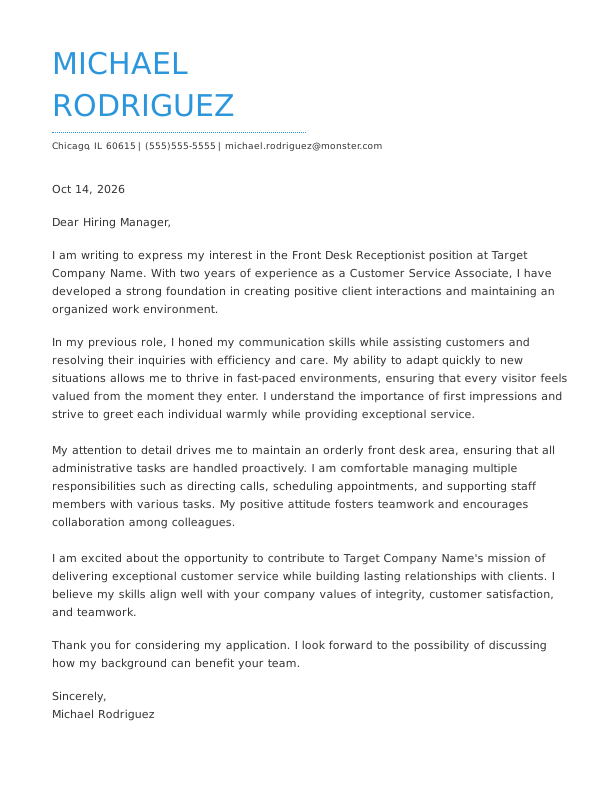
 Free
Front Desk Receptionist Entry-Level Cover Letter
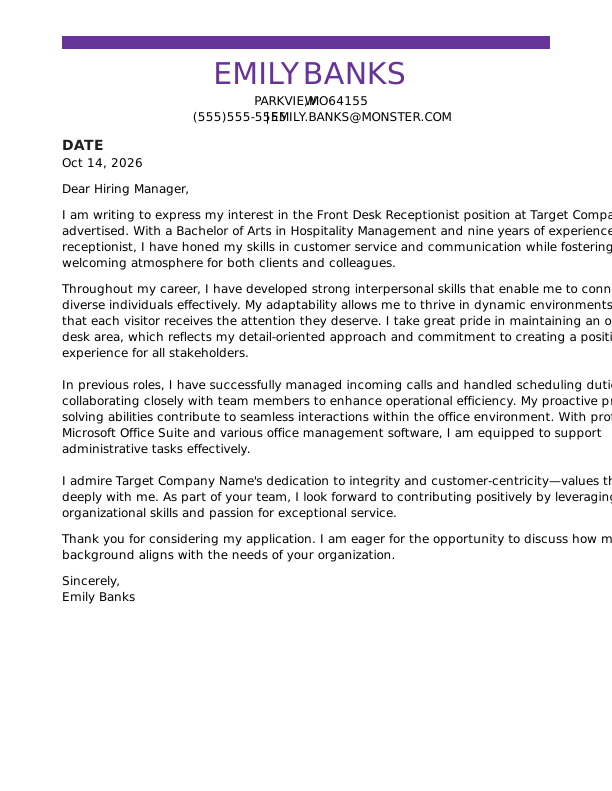
Front Desk Receptionist Mid-Level Cover Letter
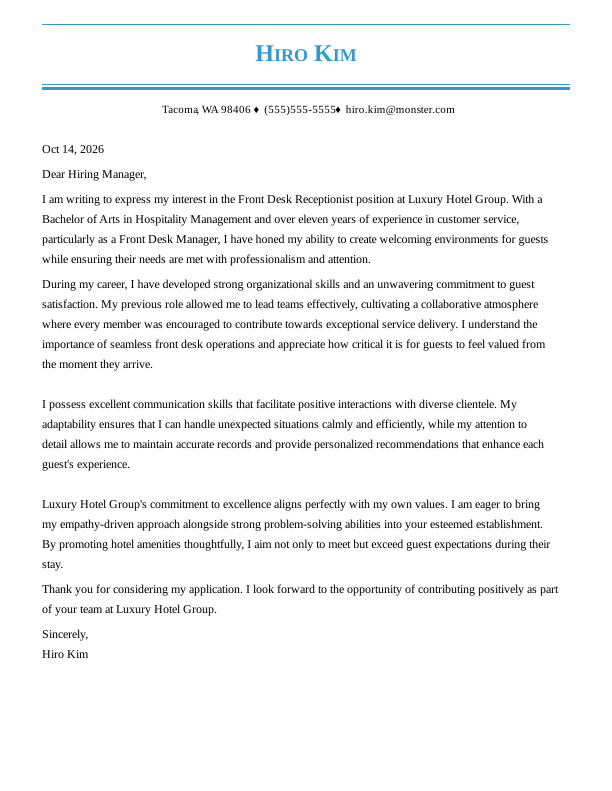
Front Desk Receptionist Experienced Cover Letter
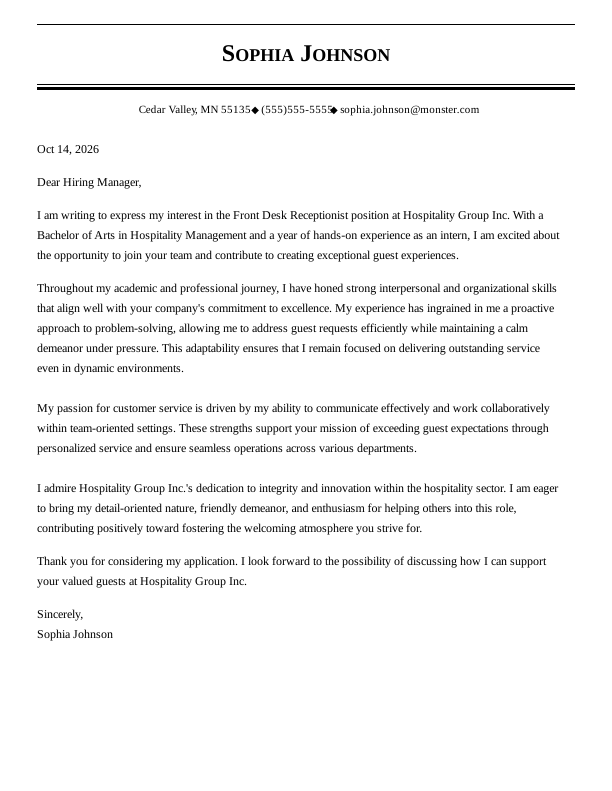
Front Desk Receptionist Entry-Level Cover Letter
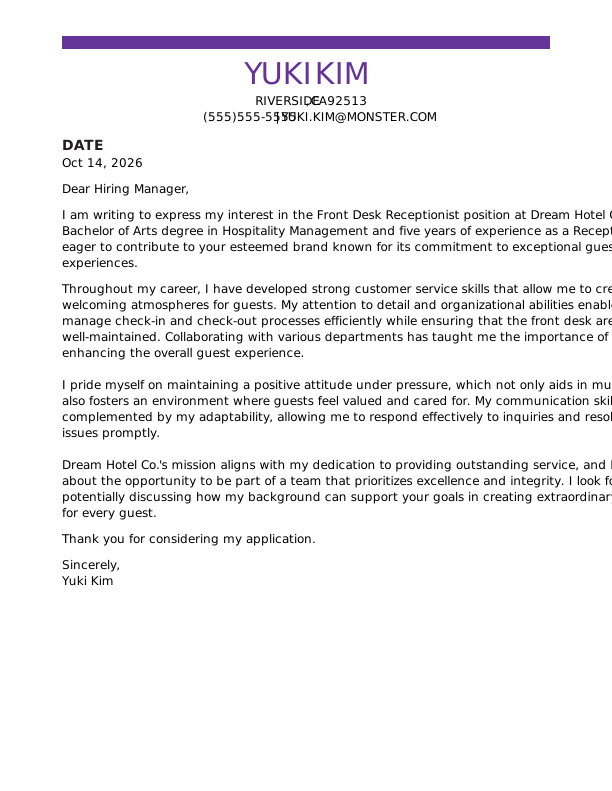
Front Desk Receptionist Mid-Level Cover Letter
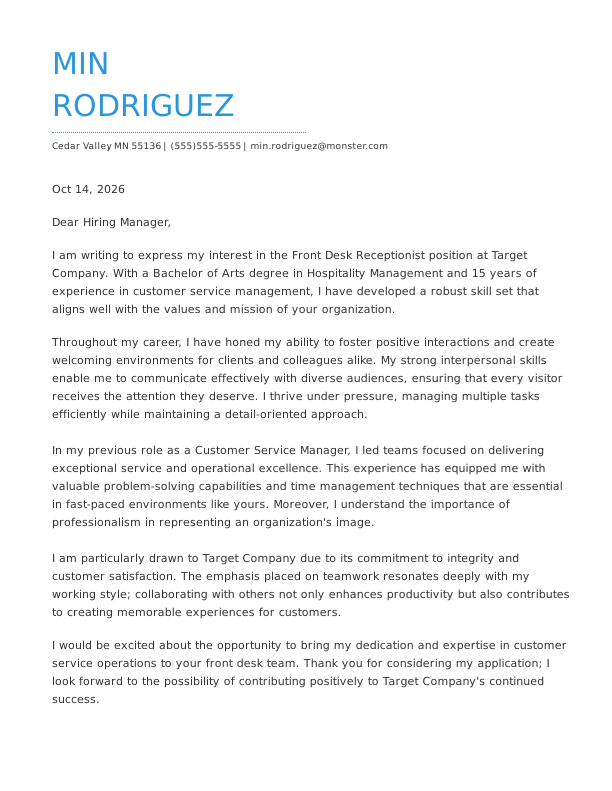
Front Desk Receptionist Experienced Cover Letter
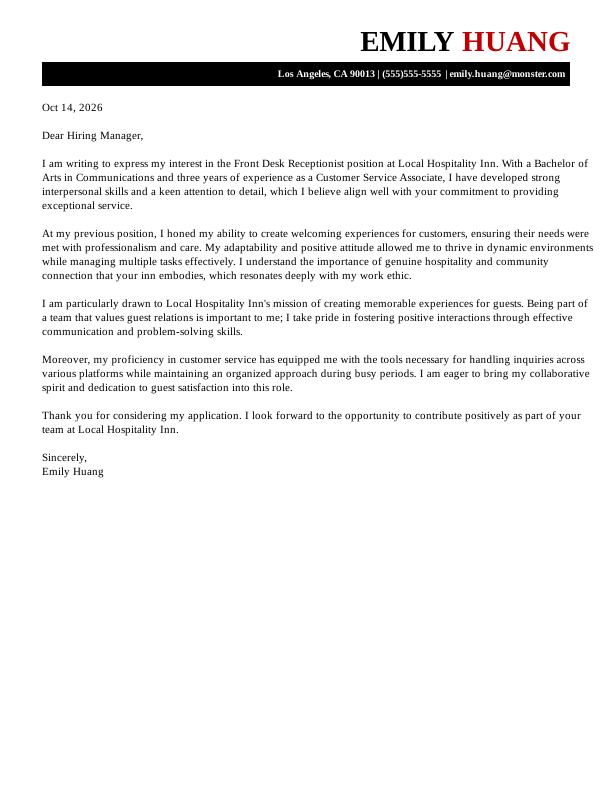
Front Desk Receptionist Entry-Level Cover Letter
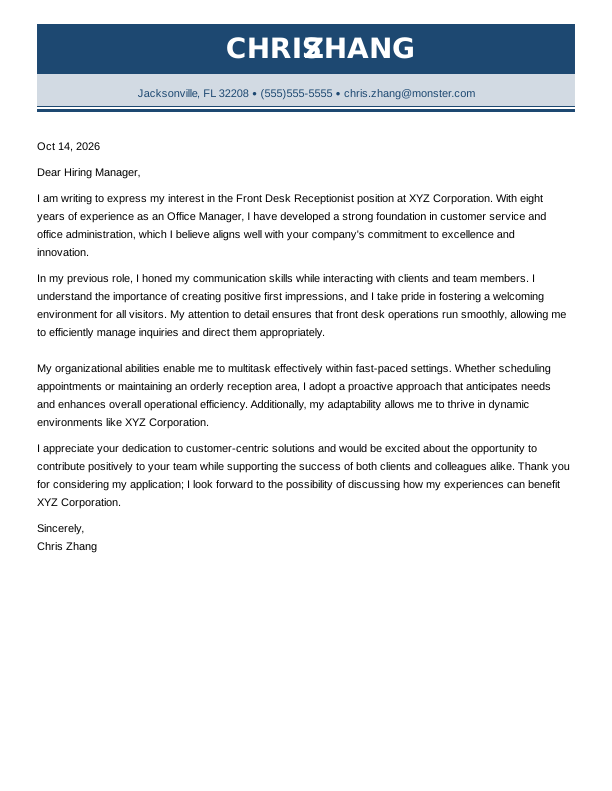
Front Desk Receptionist Mid-Level Cover Letter
Browse Free Cover Letter Templates
- Academic
- Account Manager
- Accountant
- Accounts Payable
- Administrative Assistant
- Admissions Counselor
- Architecture
- Artist
- Assistant Principal
- Babysitter
- Barista
- Bartender
- Bookkeeper
- Brand Ambassador
- Business Analyst
- Business
- Caregiver
- Chef
- Civil Engineering
- Computer Science
- Construction
- Consulting
- Copywriter
- Cosmetology
- Custodian
- Customer Service
- Customer Service Representative
- Data Analyst
- Data Entry
- Dental Assistant
- Dental Hygienist
- Digital Marketing
- Electrical Engineering
- Emt
- Engineering
- Esthetician
- Event Coordinator
- Executive Assistant
- Finance
- Financial Analyst
- Firefighter
- Flight Attendant
- Graphic Designer
- Hair Stylist
- Healthcare
- Hr Generalist
- Investment Banking
- It
- Janitor
- Journalism
- Lab Technician
- Law Clerk
- Lawyer
- Librarian
- Logistics
- Makeup Artist
- Manager
- Marketing Coordinator
- Marketing
- Marketing Manager
- Massage Therapist
- Mechanic
- Mechanical Engineer
- Medical Assistant
- Non Profit
- Nursing
- Occupational Therapy
- Office Assistant
- Office Manager
- Operations Manager
- Paralegal
- Personal Trainer
- Pharmacist
- Pharmacy Technician
- Photographer
- Physician Assistant
- Pilot
- Police Officer
- Program Manager
- Project Manager
- Property Manager
- Psychology
- Receptionist
- Research Assistant
- Restaurant Manager
- Retail
- Sales
- Sales Manager
- School Counselor
- Security Officer
- Social Work
- Software Engineer
- Special Education Teacher
- Starbucks
- Substitute Teacher
- Teacher
- Teaching Assistant
- Truck Driver
- Vet Tech
- Veterinary Assistant
Cover Letter Examples for Front Desk Receptionists
Cover letter expectations change as a front desk receptionist advances from learning daily procedures to coordinating schedules and handling higher-volume guest needs. Choose the template that matches your career stage so you can spotlight the right training, customer service experience, and any office or team responsibilities you’ve taken on.
Entry-Level Front Desk Receptionist Cover Letter
If you’re transitioning from retail or customer service, this template helps you build a strong cover letter without direct receptionist experience. It focuses on your transferable communication skills, reliability, and readiness to handle guest check-ins.
Mid-Career Front Desk Receptionist Cover Letter
Built for receptionists with a few years of experience, this template emphasizes managing multi-line phone systems, coordinating appointment calendars, and efficiently resolving visitor inquiries during peak hours.
Experienced Front Desk Receptionist Cover Letter
Designed for senior receptionists or front office coordinators, this template highlights your leadership in streamlining check-in workflows, training new staff, and managing high-volume lobby traffic for large facilities.
Front Desk Receptionist Cover Letter Template (Text)
Copy this front desk receptionist cover letter template, paste it into your document, and swap in your customer service experience and the clinic or hotel name.
Cameron Henderson
St. Louis, MO 63102
(555)555-5555
cameron.henderson@monster.com
Oct 14, 2026
Dear Hiring Manager,
I am writing to express my interest in the Front Desk Receptionist position at ABC Hospitality. With a Bachelor of Arts in Hospitality Management and four years of experience as an Administrative Assistant, I have developed a strong foundation in customer service and organizational skills that align with your company’s commitment to delivering exceptional guest experiences.
Throughout my career, I have honed my abilities to effectively manage time and communicate professionally with diverse individuals. My attention to detail ensures that every interaction is handled with care, creating a welcoming atmosphere for guests. Adapting quickly to various situations has enabled me to resolve inquiries and complaints promptly while maintaining a positive demeanor.
At ABC Hospitality, I admire your dedication to fostering lasting connections with guests through integrity and community engagement. As someone who thrives in team environments, I believe collaboration is essential for ensuring seamless guest satisfaction. My proficiency in Microsoft Office Suite complements my organizational skills, allowing me to keep the front desk area tidy while managing check-in/check-out processes efficiently.
I am excited about the opportunity to contribute positively to ABC Hospitality’s mission by providing high-quality guest relations and support. Thank you for considering my application; I look forward to the possibility of discussing how my background can support your team’s efforts.
Sincerely,
Cameron Henderson
How to Write a Front Desk Receptionist Cover Letter
Writing a great cover letter for a front desk receptionist job is all about showing how you manage real, day-to-day office tasks. You want to highlight your experience with scheduling tools, visitor sign-in procedures, and phone systems. Follow these simple steps to build a clear, professional application that highlights your strengths.
1. Research & Prepare
Before you start writing, take time to learn about the company and how their front office operates. Check what software they use, such as patient intake systems, call-routing setups, or digital guest logs. Doing a little homework helps you match your experience directly to what they need right now. Here are a few quick ways to prepare before writing your draft:
- Read the job posting carefully for specific programs like check-in software or multi-line phone tools.
- Browse the company website to get a sense of their customer service style and overall tone.
- Look up recent company news or updates that might mean higher visitor counts or busier front desk traffic.
2. Hook the Reader
Your opening paragraph should capture attention right away by demonstrating that you can handle a busy lobby with confidence. Instead of using generic statements about being friendly, share a real moment where your skills made a difference. Here are three strong opening examples you can adapt for your letter:
- Speed at check-in: “I cut guest wait times in half—from eight minutes to four—by reorganizing our check-in routine and updating appointment records live during rush hours.”
- Systems and privacy: “I accurately log every guest in our digital sign-in tool, transfer calls quickly, and follow privacy rules to protect sensitive client data.”
- Team coordination: “When our team was short-staffed, I set up a shared digital status board to track 25 daily visits, ensuring every guest was greeted without delay.”
3. Tell Your Professional Story
The body of your letter should show how you keep the lobby running smoothly when things get chaotic. Use clear figures and simple examples to show employers the measurable value you bring. Take a look at these examples of clear accomplishment statements:
- Lowered average check-in time from 12 minutes to 7 minutes by introducing simpler intake forms.
- Answered around 60 incoming calls daily while maintaining a 95% same-day callback rate for messages.
- Resolved roughly $3,200 in monthly billing and paperwork questions by working directly with accounting teams.
4. Showcase Your Skills
Avoid standard phrases like “great multitasker.” Instead, pick a core skill mentioned in the job post and describe a brief, real-world example of how you use it. Consider these ways to highlight key reception skills:
- Appointment scheduling: “I caught a booking conflict in our system and contacted the client right away to reschedule, preventing a double-booking.”
- Visitor communication: “I welcome every visitor by name, figure out what they need quickly, and coordinate with staff so guests never feel ignored.”
- Front desk tools and records: “I scan incoming documents into our database immediately, checking every page for accuracy so the team has updated information.”
5. Explain Any Special Circumstances
If you have a gap in your work history or are switching careers, address it briefly in one or two clear sentences. Focus on how recent learning or past work keeps your office skills fresh. You can adapt one of these short explanations for your situation:
- After taking six months off for family caregiving, I refreshed my customer service training and picked up weekend reception shifts at a local clinic.
- I am moving from retail into office administration to focus full-time on guest relations, using my phone and organization skills in a part-time role.
- I relocated last fall and have kept my skills sharp through temporary receptionist assignments while learning modern check-in platforms.
6. End With a Professional Goodbye
Wrap up by expressing your interest in an interview and thanking the manager for their time. Keep it direct and focused on how you can support their front office. For example: “I would welcome the opportunity to discuss how I can keep your front desk running smoothly and provide a great experience for your visitors. Thank you for your time and consideration.” Finish with a classic sign-off like “Sincerely” or “Best regards,” followed by your name.
4 Tips for Formatting Your Cover Letter
When you apply for a front desk receptionist role, you may have less than a minute to make a strong impression. Clean formatting ensures your schedule flexibility, communication skills, and technical aptitude stand out right away.

Use a Professional Font & Layout
Choose clean, legible fonts like Arial, Calibri, or Helvetica set at 10–12 pt so your cover letter reads easily on both screens and printed handoffs. Set uniform one-inch margins and keep your header styling consistent with your resume to project instant organization and professionalism.

Address the Hiring Manager Directly
Check the job posting, staff directory, or LinkedIn to find the person who handles hiring—often an office manager, clinic director, or recruiter. If you can’t find a specific name, use “Dear Hiring Manager” or “Dear Hiring Team” rather than outdated phrases like “To Whom It May Concern.”

Balance Spacing & Margins
Use line spacing between single and 1.15, and insert a blank line between paragraphs to keep your letter scannable. Consistent margins frame the text clearly and maintain a polished layout whether viewed digitally or printed out.

Save & Send as a PDF
Save your completed cover letter as a PDF file to prevent formatting shifts and applicant tracking system (ATS) errors. Name your file clearly using a professional format, such as Firstname_Lastname_Cover_Letter.pdf.
Key Takeaways
- Highlight a specific moment you kept your cool while confirming visitor details or guiding an upset caller.
- Include concrete metrics like daily visitor volume, call response times, or schedule accuracy rates.
- Tailor your tone and examples to fit the specific industry, whether it’s patient privacy in healthcare, guest hospitality in hotels, or access control in corporate offices.
More Cover Letter Examples
Browse Monster’s Resume Templates
Monster also has hundreds of ATS-friendly resume templates for all career levels and industries. Create a matching resume to help you land the interview.
- Administrative Assistant
- Administrative Coordinator
- Administrative
- Archivist
- Assistant
- Category Manager
- Clerical
- Clerk
- Clinical Research Assistant
- Data Entry
- Executive Assistant
- Front Desk Receptionist
- Hr Assistant
- Hr Generalist
- Human Resources
- Interpreter
- Office Administrator
- Office Assistant
- Office Coordinator
- Personal Assistant
- Project Assistant
- Real Estate Assistant
- Receptionist
- Scheduler
- Scheduling Coordinator
- Secretary
- Virtual Assistant
Frequently Asked Questions
Last Update:
Do I really need a cover letter?
Submitting a cover letter for a front desk receptionist role is strongly recommended, even when it’s optional. While your resume lists past experience, a cover letter shares your communication style, warm demeanor, and professional initiative. Including one shows genuine interest in the position and proves you can welcome visitors with clarity and care from day one. It’s especially valuable if you’re explaining a career transition, highlighting enthusiasm for client advocacy, or detailing how you keep facilities running smoothly through accurate scheduling and documentation.
How long should my cover letter be?
A front desk receptionist cover letter should stay within one page maximum, targeting 250 to 400 words. Hiring managers review applications quickly between tasks, so concise messaging helps your qualifications stand out immediately. Prioritize quality over quantity by using three to four short paragraphs. Highlight only your most relevant achievements and administrative strengths, such as customer service excellence, scheduling precision, and your ability to maintain a calm lobby during peak hours.
Should my cover letter match my resume?
Yes, your front desk receptionist cover letter should match your resume’s formatting to present a polished, cohesive application package. Use the same font style, color palette, and header layout so your materials look like an intentional set. The text should complement rather than repeat your resume bullet points. Use the letter to expand on a key accomplishment—such as improving check-in flow or managing difficult calls—and explain what draws you to the organization’s specific service goals.
How do I address my cover letter if I don’t know the hiring manager’s name?
Finding the right salutation for a front desk receptionist cover letter without a listed name starts with checking the job posting, company website, or staff directory. If it’s still unclear, search LinkedIn or call the front office to ask who manages hiring for the position. If you truly cannot find a contact, use a professional greeting like “Dear Hiring Manager” or “Dear Front Desk Team.” Always avoid outdated phrases like “To Whom It May Concern,” which can feel impersonal and dated to modern recruiters.
Can I use AI to write my cover letter?
Yes, AI tools can help a front desk receptionist draft an outline, organize key points, and overcome writer’s block. However, you must personalize the output with your own real-world details so it sounds authentic. Use AI-generated text only as a starting draft, then rewrite it heavily with genuine examples—like smoothing check-in bottlenecks, resolving scheduling conflicts, or supporting visitors on busy days. Hiring managers spot generic phrasing quickly, so adding specific reasons you want to work at that exact location makes all the difference.

Elizabeth Muenzen is a Certified Professional Resume Writer (CPRW) and member of the Professional Association of Resume Writers & Career Coaches who empowers job seekers to take control of their career paths using Monster’s comprehensive job search and resume tools.
See More From Elizabeth MuenzenExplore Related Career Advice






How to Write a Cover Letter for Internal Positions or Promotions (Examples & Tips)

Updated:
Apr 23, 2026
|
19 min read

Cover Letter vs Resume: What’s the Difference & Do You Need Both?
Updated:
Apr 23, 2026
|
18 min read