


Free Journalist Cover Letter Templates & Examples
A strong journalist cover letter shows you can report with accuracy, meet tight deadlines, and tell compelling stories that serve the public interest. Our free cover letter examples and step-by-step guidance help you craft a clear narrative of your beat experience, clips, and research skills so hiring managers quickly see your fit.
Real-World Cover Letters That Get Results
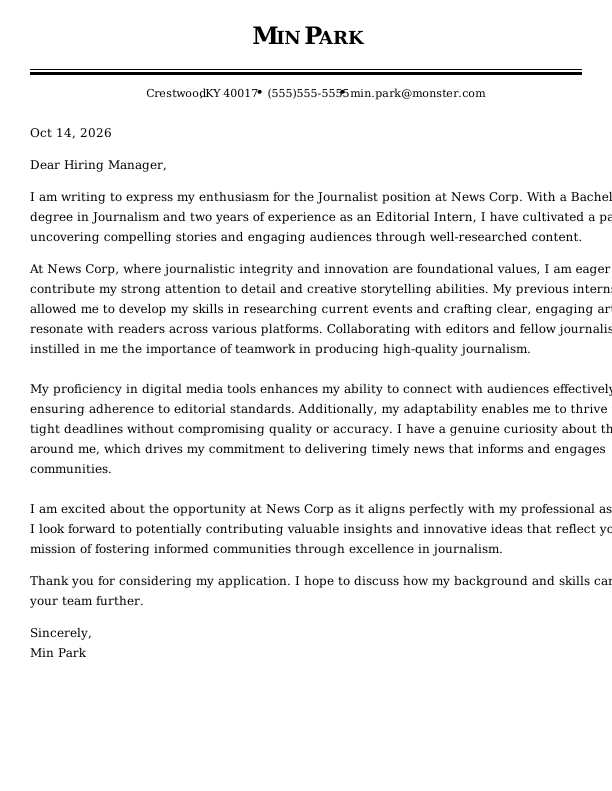
 Free
Journalist Entry-Level Cover Letter
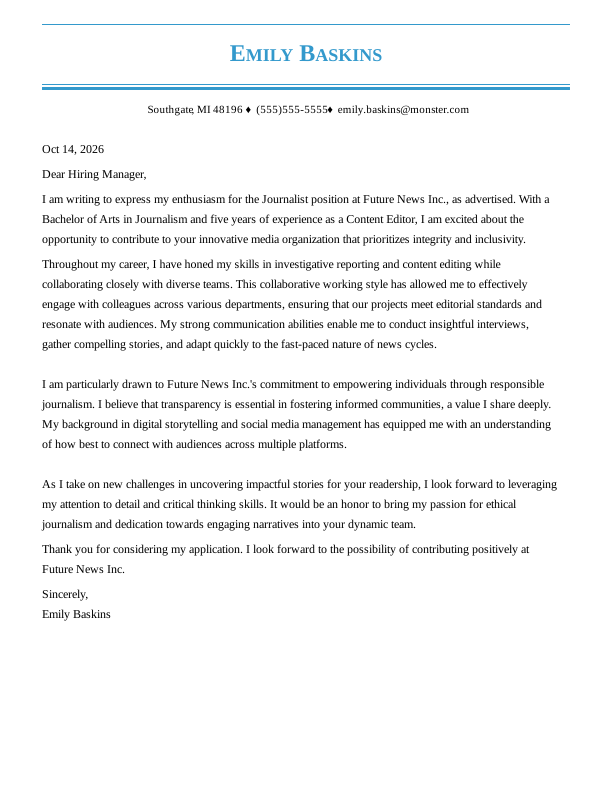
Journalist Mid-Level Cover Letter
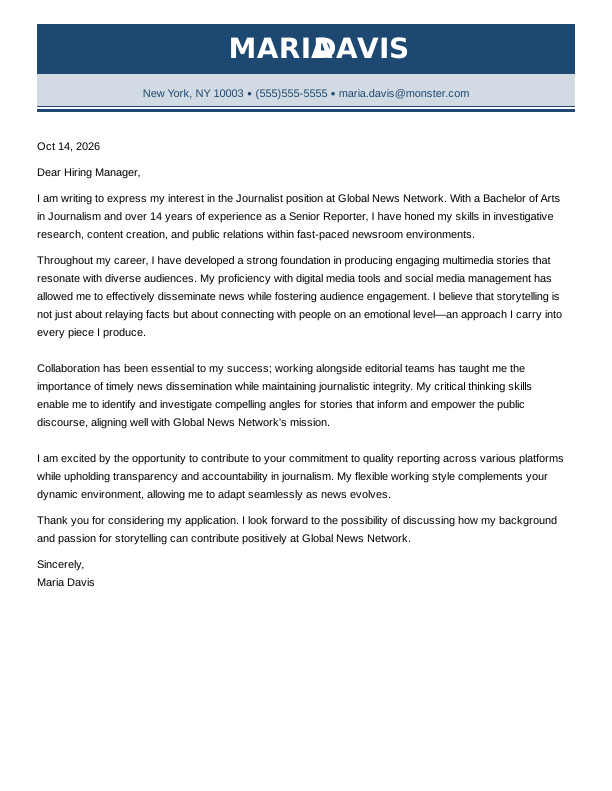
Journalist Experienced Cover Letter
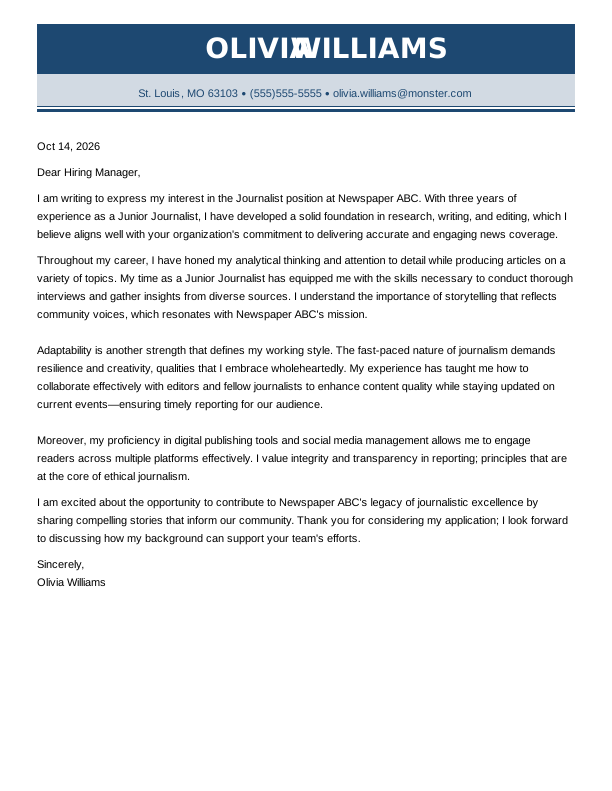
Journalist Entry-Level Cover Letter
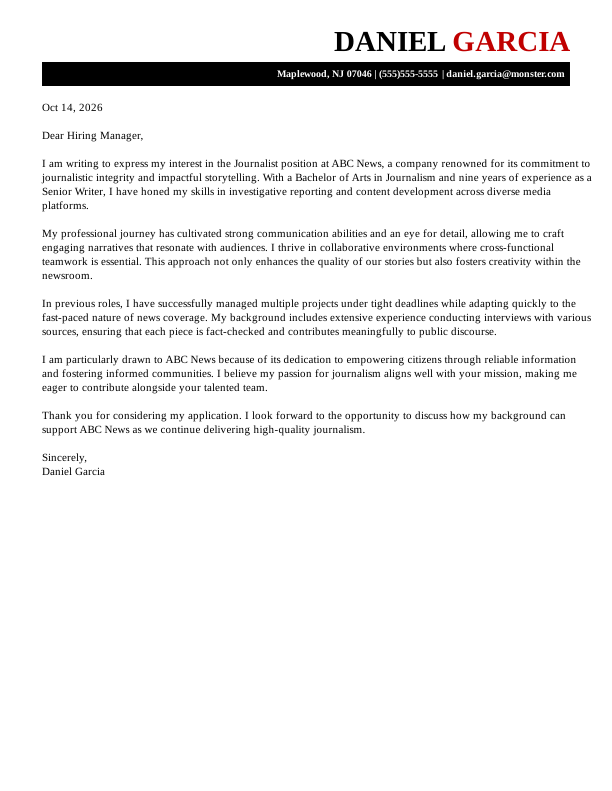
Journalist Mid-Level Cover Letter
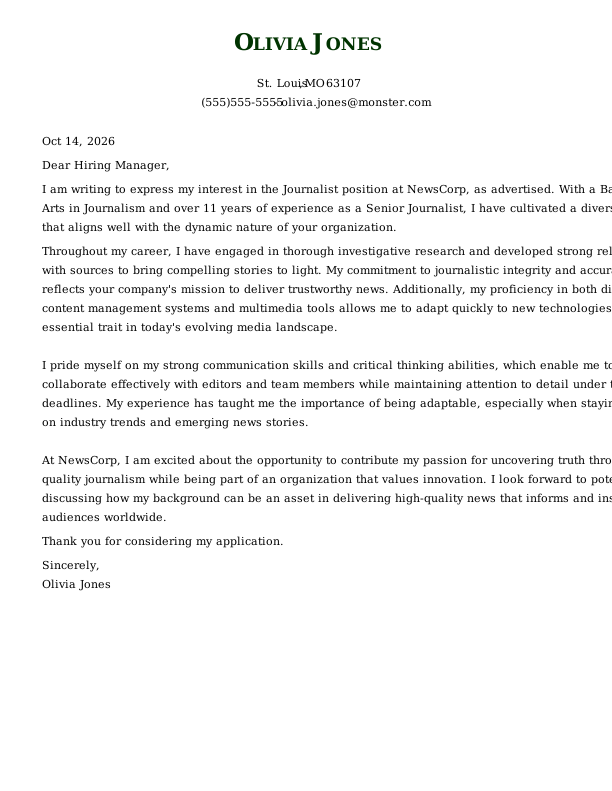
Journalist Experienced Cover Letter
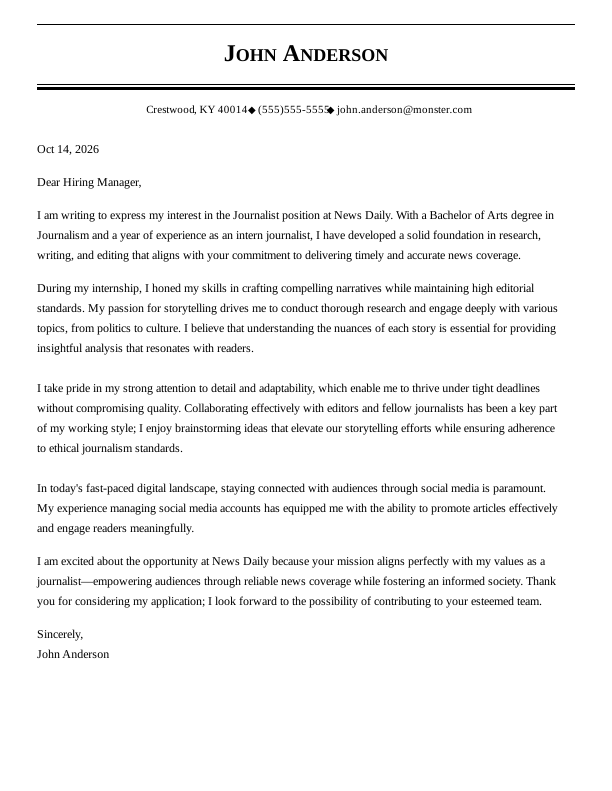
Journalist Entry-Level Cover Letter
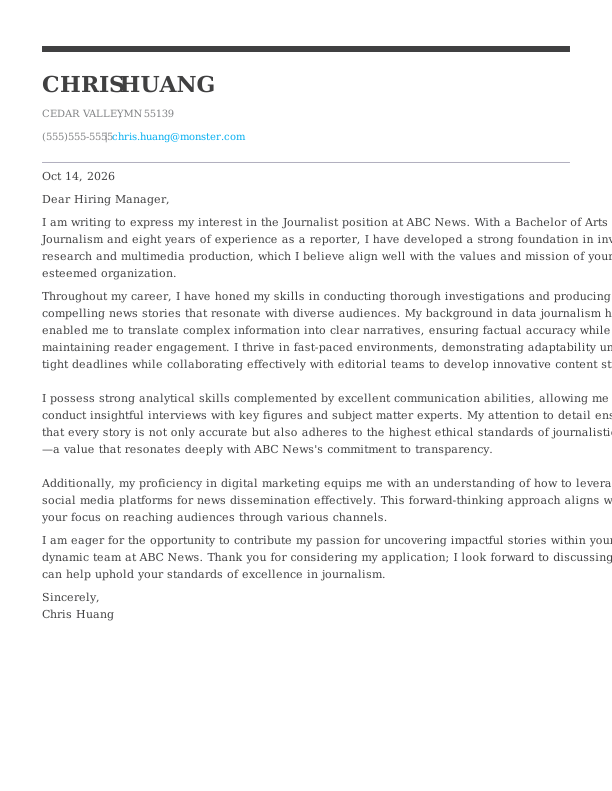
Journalist Mid-Level Cover Letter
Browse Free Cover Letter Templates
- Academic
- Account Manager
- Accountant
- Accounts Payable
- Administrative Assistant
- Admissions Counselor
- Architecture
- Artist
- Assistant Principal
- Babysitter
- Barista
- Bartender
- Bookkeeper
- Brand Ambassador
- Business Analyst
- Business
- Caregiver
- Chef
- Civil Engineering
- Computer Science
- Construction
- Consulting
- Copywriter
- Cosmetology
- Custodian
- Customer Service
- Customer Service Representative
- Data Analyst
- Data Entry
- Dental Assistant
- Dental Hygienist
- Digital Marketing
- Electrical Engineering
- Emt
- Engineering
- Esthetician
- Event Coordinator
- Executive Assistant
- Finance
- Financial Analyst
- Firefighter
- Flight Attendant
- Graphic Designer
- Hair Stylist
- Healthcare
- Hr Generalist
- Investment Banking
- It
- Janitor
- Journalism
- Lab Technician
- Law Clerk
- Lawyer
- Librarian
- Logistics
- Makeup Artist
- Manager
- Marketing Coordinator
- Marketing
- Marketing Manager
- Massage Therapist
- Mechanic
- Mechanical Engineer
- Medical Assistant
- Non Profit
- Nursing
- Occupational Therapy
- Office Assistant
- Office Manager
- Operations Manager
- Paralegal
- Personal Trainer
- Pharmacist
- Pharmacy Technician
- Photographer
- Physician Assistant
- Pilot
- Police Officer
- Program Manager
- Project Manager
- Property Manager
- Psychology
- Receptionist
- Research Assistant
- Restaurant Manager
- Retail
- Sales
- Sales Manager
- School Counselor
- Security Officer
- Social Work
- Software Engineer
- Special Education Teacher
- Starbucks
- Substitute Teacher
- Teacher
- Teaching Assistant
- Truck Driver
- Vet Tech
- Veterinary Assistant
Cover Letter Examples for Journalists
Cover letter expectations for a journalist change as you move from reporting early assignments to taking on bigger beats and leadership roles. Choose the template that matches your experience level so you can highlight the clips, investigations, and editorial responsibilities most relevant to your stage.
Entry-Level Journalist Cover Letter
Designed for recent graduates and career changers, this template demonstrates how to present journalism training, editorial internships, and foundational reporting skills with confidence when applying for initial journalism roles.
Mid-Career Journalist Cover Letter
Tailored for candidates with several years of newsroom experience, this template shows how to highlight beat reporting ownership, story pitching, investigative interviews, and digital content editing.
Experienced Journalist Cover Letter
Ideal for senior reporters and newsroom leads, this template emphasizes major investigative packages, multimedia story production, editorial team mentorship, and audience engagement growth.
Journalist Cover Letter Template (Text)
Paste this journalist cover letter template into your document, then copy and adapt it by swapping in your published stories and beat or outlet.
Jin Lee
Riverside, CA 92507
(555)555-5555
jin.lee@monster.com
Oct 14, 2026
Dear Hiring Manager,
I am writing to express my interest in the journalist position at Global News Network. With a Bachelor of Arts in Journalism and four years of experience as an associate journalist, I am excited about the opportunity to contribute to your commitment to delivering timely and accurate news coverage.
Throughout my career, I have honed my skills in research, writing, and editing while engaging with diverse audiences through digital media. My experience has equipped me with a strong understanding of journalistic ethics and standards, ensuring that I uphold the principles of transparency and accuracy that GNN values.
In my previous role, I collaborated closely with editors and multimedia teams to produce compelling content across various platforms. My strong communication skills enable me to conduct insightful interviews with sources and experts alike, fostering relationships that lead to rich storytelling. Additionally, my detail-oriented approach allows me to navigate complex information effectively while maintaining confidentiality when necessary.
I thrive in fast-paced environments where adaptability is key. Monitoring current events has become second nature for me; this vigilance helps identify newsworthy stories that resonate with audiences globally. As someone who values inclusivity in journalism, I appreciate GNN’s mission statement aimed at reflecting diverse perspectives within its reporting.
I look forward to the possibility of bringing my passion for journalism and collaborative spirit to your esteemed organization. Thank you for considering my application; I hope we can discuss how I can contribute further during an interview.
Sincerely,
Jin Lee
How to Write a Journalist Cover Letter
Writing an effective journalist cover letter requires showing newsroom editors that you understand beat coverage, fact verification, and deadline-driven storytelling. Follow these steps to align your experience with a specific job posting.
1. Research & Prepare
Before writing, research the publication’s primary coverage beats, audience demographics, and editorial voice. Discovering whether the newsroom prioritizes fast-breaking news alerts, long-form investigative packages, or digital multimedia reporting allows you to highlight the exact reporting skills that matter most to the managing editor.
Gather actionable context by exploring these key information sources:
- Review the job description to confirm required beats, expected filing deadlines, and specific content management systems used.
- Explore the publication’s recent archive to understand its story structures, headline styles, and investigative focus.
- Check the outlet’s editorial and corrections policies to align your language with its sourcing and verification standards.
2. Hook the Reader
Start your letter with an engaging opening line that demonstrates your news judgment and ability to deliver verified stories under pressure. Avoid generic statements like “I am writing to apply for the open reporter position.” Instead, capture the editor’s attention by leading with a concrete reporting win or beat accomplishment.
Choose an opening line tailored to your experience using these example approaches:
- Beat reporting match: “I covered city government for six months, reporting on 24 council votes and publishing two detailed explainers built from public-record requests.”
- Verification process: “For a recent investigative package, I verified every claim in a fact-check sheet and confirmed key details through three independent sources before filing.”
- Digital story impact: “I used AP Style and real-time audience analytics to refine headlines on a breaking news story, reaching 180,000 unique readers on launch day.”
3. Tell Your Professional Story
Use the body of your letter to give editors a clear view of your daily newsroom performance. While your resume lists past outlets and degrees, your cover letter explains how you source stories, conduct interviews, and meet filing deadlines. Using specific numbers makes your accomplishments far more compelling.
Incorporate concrete benchmarks like these to illustrate your impact:
- Filed verified breaking news updates within two hours of confirmation across an average of six daily beat assignments.
- Increased monthly readership for a weekly column from 18,000 to 31,000 unique visits after revising lead structures and headlines.
- Published an investigative series citing 14 primary sources that drove a 22% increase in community tip submissions.
4. Showcase Your Skills
Rather than using broad self-descriptors like “great communicator” or “curious,” illustrate how your skills resolve real reporting challenges. Showing the exact moments where your follow-up questions, record checks, or editing saved a story builds trust with the employer.
Connect your practical abilities directly to daily newsroom needs using these examples:
- Interviewing skills: “I followed up on an ambiguous statement by asking for exact timeline details, securing new verified information before finalizing the article.”
- Fact-checking rigor: “I cross-referenced every claim against public court documents, holding the story when two source statements failed to match.”
- CMS and editing workflow: “I drafted articles directly in the content management system, adjusting embeds and headlines smoothly based on editor feedback.”
5. Explain Any Special Circumstances
If you have an employment gap, are transitioning from another field, or recently relocated, address it briefly in one or two direct sentences. Focus your explanation on your active pitch ideas, published clips, and current reporting practice so the editor knows you are ready for newsroom deadlines.
Frame your circumstances clearly using these straightforward approaches:
- Addressing an employment gap: “Following a six-month career break, I kept my reporting active by filing weekly local briefs and maintaining an updated clip portfolio.”
- Transitioning positions: “I am pivoting from corporate communications into investigative journalism, managing public record requests and publishing documented explainers.”
- Handling relocation: “After moving to the area last fall, I began covering local municipal meetings for a regional outlet while building strong local source contacts.”
6. End With a Professional Goodbye
Conclude your letter with a polite, confident statement that invites the editor to contact you for an interview. Keep your sign-off concise, thank the reader for their time, and express enthusiasm for discussing your story ideas in detail.
Structure your final paragraph using this clear approach:
- Offer a clear next step: “I would welcome the opportunity to discuss my reporting strategy and story ideas for your upcoming local election coverage.”
- Express gratitude: “Thank you for your time and consideration.”
- End with a clean sign-off: “Best regards,” followed by your full name.
4 Tips for Formatting Your Cover Letter
When you apply for a journalist position, editors often scan your application quickly between managing publication schedules and breaking news deadlines. They look rapidly for beat fit, published clip experience, and writing clarity. A clean visual presentation with consistent spacing and logical organization makes your top reporting achievements easy to spot and proves that you produce clean, publication-ready work.

Match Your Header to Your Resume
Use the exact same name layout, typography, contact details, and location formatting on both your cover letter and resume. A matching header allows editors to instantly recognize your application package and confirm your contact information while reviewing your clips and background.

Use Bullet Points for Key Achievements
Incorporate three to four bullet points in the body of your letter to highlight key metrics like readership growth, verified source counts, or publication turnaround times. Bulleted lists break up dense text, making it simple for editors to spot your top reporting wins during a quick initial scan.

Balance Spacing & Margins
Set line spacing between 1.0 and 1.15, leaving a full blank line between paragraphs to keep the layout clean and readable. Use uniform margins between 0.75 and 1 inch so your letter looks well-proportioned on screens and printed copies.

Save & Send as a PDF
Save your final cover letter as a PDF to preserve your margins, line spacing, and general layout across different operating systems or mobile devices. Use a clean, professional filename like Firstname_Lastname_Cover_Letter.pdf or Firstname_Lastname_Journalist_Cover_Letter.pdf to make your application easy for editors to organize.
Top-Paying States for Journalist Roles
Knowing what journalists earn across the country gives you a clear baseline when evaluating job offers, planning your career, or negotiating pay. These figures come from the U.S. Bureau of Labor Statistics (BLS) and show recent average earnings for journalism roles nationwide.
Keep in mind that your actual pay will depend on your location, experience level, and reporting beat, with national outlets and specialized beats often paying higher rates. Whether you work in print, broadcast, or digital media—along with your shift schedules and overtime demands—will also play a big part in your total compensation package.
| Alabama | $50,540 |
| Alaska | $51,820 |
| Arizona | $60,780 |
| Arkansas | $37,180 |
| California | $119,420 |
| Connecticut | $106,490 |
| Delaware | $69,400 |
| District of Columbia | $171,300 |
| Florida | $66,190 |
| Georgia | $89,690 |
| Hawaii | $67,730 |
| Idaho | $50,170 |
| Illinois | $84,460 |
| Indiana | $58,730 |
| Iowa | $42,730 |
| Kansas | $44,390 |
| Kentucky | $42,690 |
| Louisiana | $72,790 |
| Maine | $54,830 |
| Maryland | $73,230 |
| Massachusetts | $78,210 |
| Michigan | $76,330 |
| Minnesota | $46,870 |
| Mississippi | $51,950 |
| Missouri | $49,840 |
| Montana | $43,990 |
| Nebraska | $46,950 |
| Nevada | $81,990 |
| New Hampshire | $55,030 |
| New Jersey | $77,100 |
| New Mexico | $63,270 |
| New York | $293,430 |
| North Carolina | $63,030 |
| North Dakota | $53,410 |
| Ohio | $49,920 |
| Oklahoma | $59,810 |
| Oregon | $68,830 |
| Rhode Island | $72,300 |
| South Carolina | $50,380 |
| South Dakota | $42,710 |
| Tennessee | $77,030 |
| Texas | $71,380 |
| Utah | $70,600 |
| Vermont | $52,360 |
| Virginia | $74,500 |
| Washington | $72,580 |
| West Virginia | $36,200 |
| Wisconsin | $63,460 |
| Wyoming | $47,760 |
| Puerto Rico | $50,370 |
Key Takeaways
- Demonstrate news judgment by describing a specific story angle you chose based on public records or data, and how you verified the information.
- Include clear performance metrics like article click-through rates, publication turnaround times, or source counts to prove reporting impact.
- Tailor your letter to the media type by emphasizing community impact for local papers, enterprise depth for national outlets, or SEO performance for digital publications.
More Cover Letter Examples
Browse Monster’s Resume Templates
Monster also has hundreds of ATS-friendly resume templates for all career levels and industries. Create a matching resume to help you land the interview.
Frequently Asked Questions
Last Update:
Do I really need a cover letter?
Yes, submitting a cover letter with your journalist application is strongly recommended because it demonstrates your writing and storytelling skills in real time. While a resume lists past outlets and education, a cover letter explains the reporting context behind your best clips, your news judgment, and your pitch ideas. It also provides space to explain career transitions or gaps.
How long should my cover letter be?
A journalist cover letter should stay within one page, targeting between 250 and 400 words. Editors review applications quickly between news cycles, so direct, concise writing works best. Divide your text into three or four short paragraphs that focus strictly on your beat experience, investigative wins, and digital tools without adding extra clutter.
Should my cover letter match my resume?
Yes, your journalist cover letter should match your resume’s visual formatting to present a polished, cohesive application package. Use the same font styles, margin sizes, color choices, and contact header across both documents. Instead of repeating your resume bullet points, use your cover letter to expand on a specific reporting accomplishment or explain how your work fits the publication’s audience.
How do I address my cover letter if I don’t know the hiring manager’s name?
When addressing a journalist cover letter without a contact name, search the publication’s website, masthead, or professional networks for the managing editor, section editor, or recruiter. You can also contact the newsroom directly to ask who handles hiring for that desk. If you cannot locate a specific name, address your letter to “Dear Hiring Manager” or “Dear Editorial Team.” Avoid using “To Whom It May Concern,” as it sounds outdated.
How do I write a cover letter for an internal position?
To write an internal journalist cover letter, highlight your existing knowledge of the newsroom’s editorial workflows, copy editing standards, and legal review procedures. Mention how you successfully tightened fact-checking turnaround times, reduced correction requests, or supported beat coverage in your current role. Express your readiness to take full ownership of a beat while completing all required internal application steps.

Toni Frana is a Certified Professional Resume Writer (CPRW), member of the Professional Association of Resume Writers & Career Coaches, and career expert who empowers job seekers to take control of their career paths using Monster’s comprehensive job search and resume tools.
See More From Toni FranaExplore Related Career Advice





How to Write a Cover Letter for Internal Positions or Promotions (Examples & Tips)

Updated:
Apr 23, 2026
|
19 min read

Cover Letter vs Resume: What’s the Difference & Do You Need Both?

Updated:
Apr 23, 2026
|
18 min read