

Free Medical Scribe Cover Letter Templates & Examples
A strong medical scribe cover letter shows you can manage accurate real-time charting, support busy clinicians, and protect patient privacy. Our free examples and step-by-step guidance help you write a clear letter that highlights your key documentation skills to hiring managers.
Real-World Cover Letters That Get Results
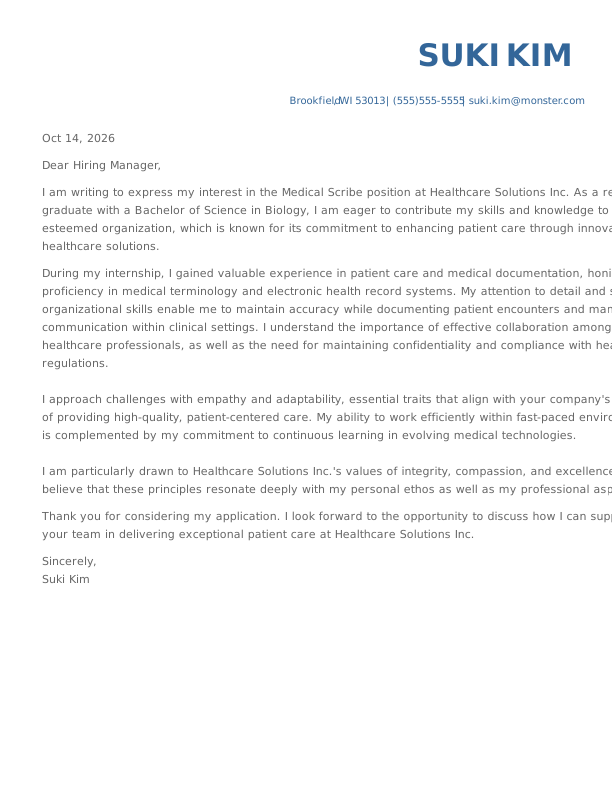
 Free
Medical Scribe Entry-Level Cover Letter
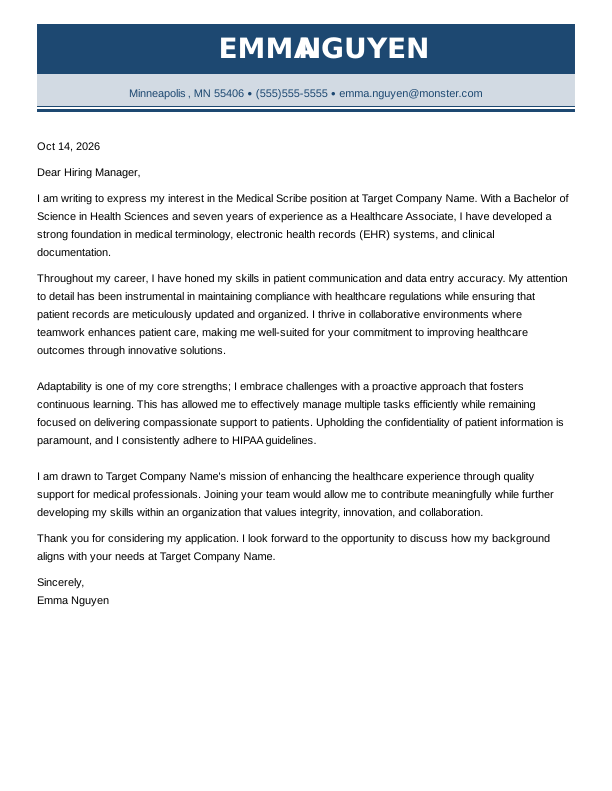
Medical Scribe Mid-Level Cover Letter
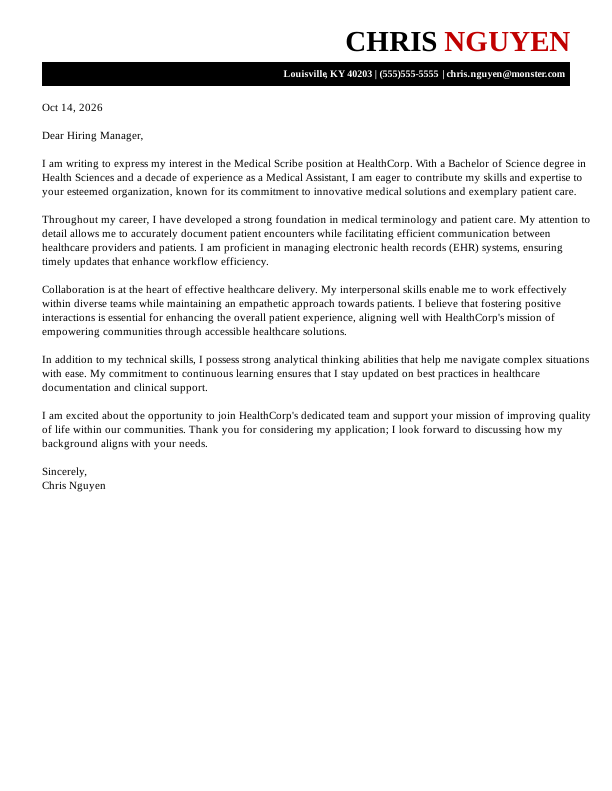
Medical Scribe Experienced Cover Letter
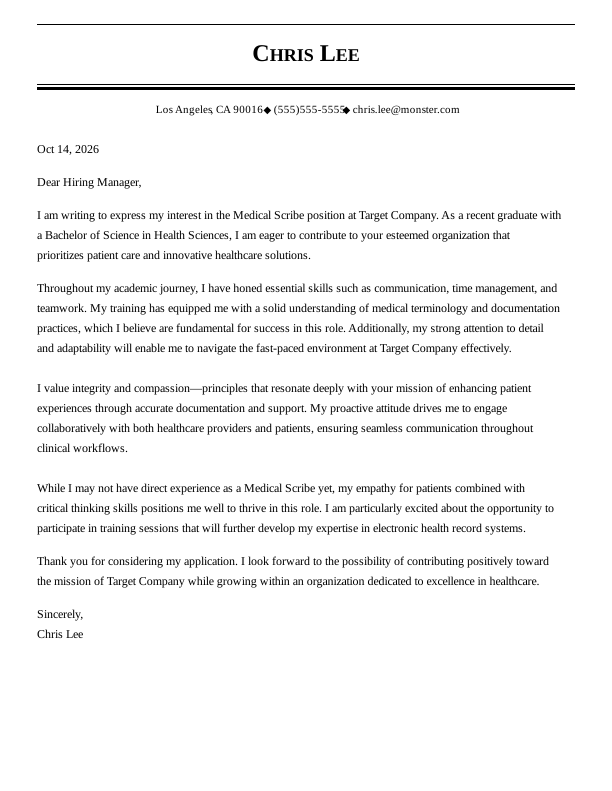
Medical Scribe Entry-Level Cover Letter
Medical Scribe Mid-Level Cover Letter
Medical Scribe Experienced Cover Letter
Medical Scribe Entry-Level Cover Letter
Medical Scribe Mid-Level Cover Letter
Browse Free Cover Letter Templates
- Academic
- Account Manager
- Accountant
- Accounts Payable
- Administrative Assistant
- Admissions Counselor
- Architecture
- Artist
- Assistant Principal
- Babysitter
- Barista
- Bartender
- Bookkeeper
- Brand Ambassador
- Business Analyst
- Business
- Caregiver
- Chef
- Civil Engineering
- Computer Science
- Construction
- Consulting
- Copywriter
- Cosmetology
- Custodian
- Customer Service
- Customer Service Representative
- Data Analyst
- Data Entry
- Dental Assistant
- Dental Hygienist
- Digital Marketing
- Electrical Engineering
- Emt
- Engineering
- Esthetician
- Event Coordinator
- Executive Assistant
- Finance
- Financial Analyst
- Firefighter
- Flight Attendant
- Graphic Designer
- Hair Stylist
- Healthcare
- Hr Generalist
- Investment Banking
- It
- Janitor
- Journalism
- Lab Technician
- Law Clerk
- Lawyer
- Librarian
- Logistics
- Makeup Artist
- Manager
- Marketing Coordinator
- Marketing
- Marketing Manager
- Massage Therapist
- Mechanic
- Mechanical Engineer
- Medical Assistant
- Non Profit
- Nursing
- Occupational Therapy
- Office Assistant
- Office Manager
- Operations Manager
- Paralegal
- Personal Trainer
- Pharmacist
- Pharmacy Technician
- Photographer
- Physician Assistant
- Pilot
- Police Officer
- Program Manager
- Project Manager
- Property Manager
- Psychology
- Receptionist
- Research Assistant
- Restaurant Manager
- Retail
- Sales
- Sales Manager
- School Counselor
- Security Officer
- Social Work
- Software Engineer
- Special Education Teacher
- Substitute Teacher
- Teacher
- Teaching Assistant
- Truck Driver
- Vet Tech
- Veterinary Assistant
- Web Developer
Cover Letter Examples for Medical Scribes
Cover letter expectations for a medical scribe shift as you progress from entry-level documentation to more complex charting and workflow support. Choose the template that matches your career stage so you can foreground the right skills, training, and measurable experience with EMR use, accuracy, and patient-provider communication.
Entry-Level Medical Scribe Cover Letter
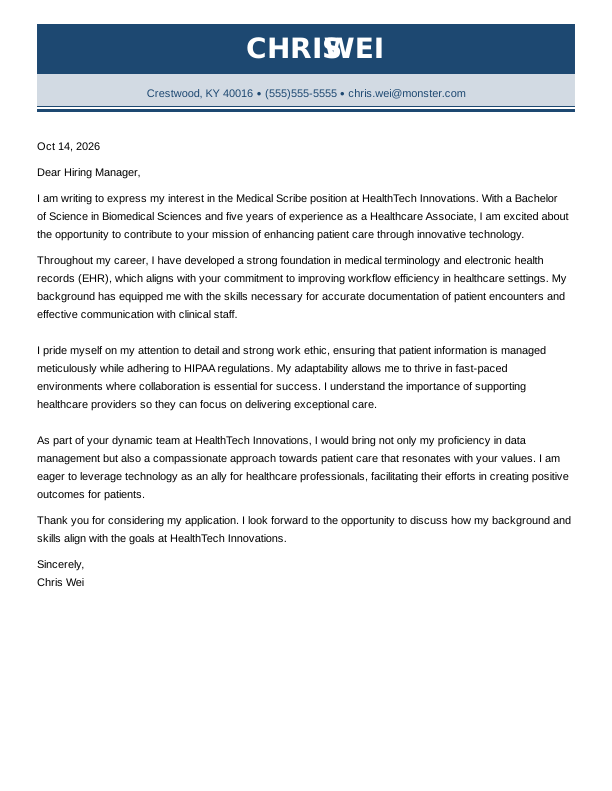
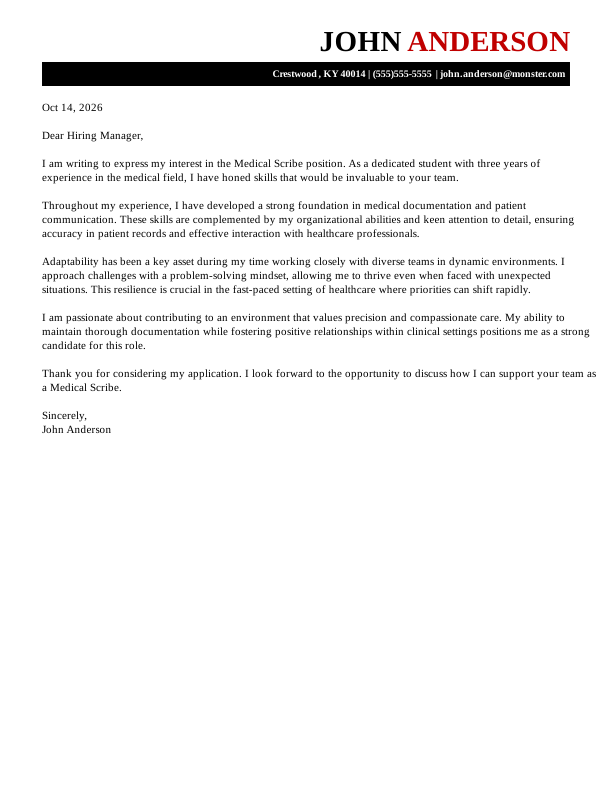
Tailored for recent graduates and career changers, this template demonstrates how to present academic training and foundational skills with confidence when applying for initial medical scribe positions.o learn.
Mid-Career Medical Scribe Cover Letter
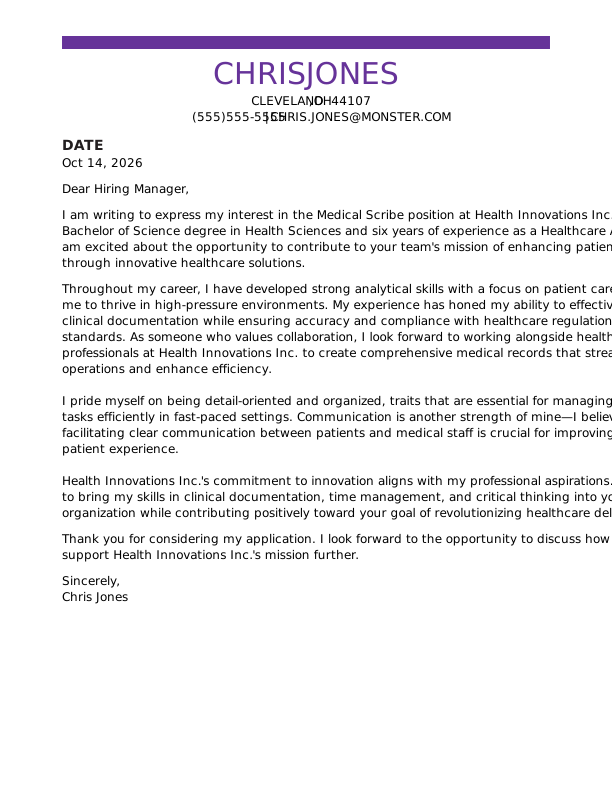
Designed for candidates with several years of clinical support experience, this template shows how to highlight established documentation proficiency and independent workflow ownership.
Experienced Medical Scribe Cover Letter
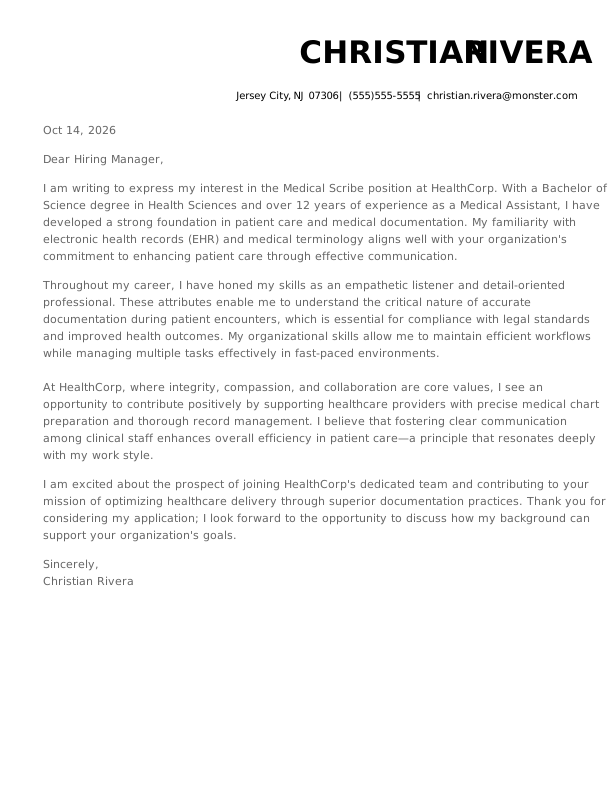
Ideal for seasoned healthcare professionals, this template emphasizes long-term clinical support expertise, comprehensive chart management, and reliable provider collaboration.
Medical Scribe Cover Letter Template (Text)
Copy this medical scribe cover letter template into your document, then adapt it by swapping in your electronic medical records (EMR) experience, documentation metrics, and target clinic name.
David Brown
Nashville, TN 37203
(555)555-5555
david.brown@monster.com
Oct 14, 2026
Dear Hiring Manager,
I am writing to express my interest in the medical scribe position at HealthCorp, as advertised. With a Bachelor of Science in Health Sciences and nine years of experience as a clinical assistant, I have developed a strong foundation in healthcare documentation and patient care that aligns with your organization’s mission of delivering high-quality medical services.
Throughout my career, I have become proficient in medical terminology and patient documentation processes, which are essential for accurate record-keeping and compliance with healthcare regulations. My detail-oriented working style ensures that I approach each task with precision—whether documenting patient encounters or managing electronic health records (EHR). This meticulous attention to detail is complemented by my strong interpersonal skills, allowing me to effectively collaborate with physicians and other healthcare staff.
I understand the importance of fostering efficient workflows within clinical environments. My adaptability enables me to thrive in fast-paced settings while maintaining an empathetic demeanor towards patients—reflecting the values central to HealthCorp’s commitment to patient-centered care. Moreover, my problem-solving abilities equip me to handle challenges proactively, ensuring that all information is current and accurate.
I am excited about the opportunity to contribute positively at HealthCorp by supporting your mission through exemplary documentation practices. Thank you for considering my application; I look forward to discussing how my background can enhance your team’s efforts toward improving operational efficiency.
Sincerely,
David Brown
How to Write a Medical Scribe Cover Letter
Writing an effective cover letter for a medical scribe position requires showing hiring managers that you understand real-time charting, clinical terminology, and fast-paced healthcare workflows. Follow these six steps to build a clear, targeted letter for your next application.
1. Research & Prepare
Before drafting your letter, look into the specific clinical setting, its primary specialty, and the electronic health record (EHR) platform it uses. Understanding whether the facility prioritizes high patient volume, strict chart turnaround times, or specialized specialty templates allows you to tailor your message directly to its daily needs.
When gathering your background details, draw from these key research targets:
- Review the job description to confirm required EHR software platforms and any expected certifications.
- Explore the facility website to identify its primary medical specialties, department sizes, and patient care goals.
- Check current industry documentation standards to understand the charting compliance requirements relevant to the role.
2. Hook the Reader
Start your letter with an energetic opening that immediately highlights your clinical support abilities and comfort in busy healthcare environments. Avoid generic statements like “I am writing to apply for the medical scribe position.” Instead, grab the recruiter’s attention by opening with a specific charting strength or achievement.
Choose an opening line that matches your background, using these examples for inspiration:
- Charting accuracy: “After setting up a personal double-check routine for chart entries, I reduced provider note correction requests by 30% during my clinical rotation.”
- EHR efficiency: “Working busy evening shifts in the emergency department, I logged vitals and history notes for over 20 patients per shift using Cerner.”
- Care team support: “I coordinated closely with attending physicians to ensure history of present illness notes were fully documented before patient exams began.”
3. Tell Your Professional Story
Use the body of your letter to give hiring managers a clear picture of your daily performance during clinical visits. While your resume lists past positions, your cover letter explains how you manage heavy workloads, maintain focus, and keep provider schedules running smoothly. Including specific metrics makes your experience much more tangible.
Incorporate achievements like these to show your impact on shift productivity:
- Documented an average of 28 patient encounters per shift while finalizing progress notes within 30 minutes of visit completion.
- Decreased overall chart discrepancies by 22% across three months by standardizing clinical terminology during intake.
- Saved attending providers approximately 1.5 hours per shift by organizing pending lab results and patient histories ahead of rounds.
4. Showcase Your Skills
Rather than using generic self-descriptors like “hardworking” or “detail-oriented,” illustrate how your skills resolve actual daily challenges in a clinic. Show the hiring manager the precise moments where your focus kept patient records accurate and helped the care team stay aligned.
Connect your practical abilities directly to daily scribing demands with these examples:
- EHR management: “I transcribed provider assessment notes directly into Epic during complex consults, verifying that allergy profiles and medication lists were completely updated.”
- Data accuracy: “When I noticed a diagnosis entry that conflicted with the care plan, I flagged the item for the physician before closing the chart.”
- Team communication: “I highlighted missing demographic fields to the triage nurse immediately so chart profiles could be corrected prior to provider visits.”
5. Explain Any Special Circumstances
If you have an employment gap, are changing careers, or recently relocated, address it briefly in one or two direct sentences. Focus your explanation on your current readiness, active certifications, and up-to-date documentation skills so the employer knows you are fully prepared to jump into the clinic.
Frame your background transitions cleanly using these simple approaches:
- Addressing employment gaps: “Following a six-month break between contracts, I maintained my clinical readiness by completing an Epic refresher course and shadowing shifts at a local clinic.”
- Switching career paths: “I transitioned from pharmacy technician work into medical scribing to focus on clinical documentation, recently completing dedicated medical terminology coursework.”
- Handling relocation: “After moving to the area last fall, I updated all local healthcare clearances and credentials to ensure a seamless transition into a new clinic role.”
6. End With a Professional Goodbye
Conclude your cover letter with a polite, confident statement that encourages the hiring manager to take the next step. Keep your sign-off simple, thank the reader for their time, and express interest in discussing how your charting skills can benefit their clinical team.
Structure your final paragraph using this clear format:
- State your interest in an interview: “I would welcome the opportunity to discuss how my accurate documentation skills and fast-paced charting experience can support your medical team.”
- Add a courteous closing line: “Thank you for your time and consideration.”
- End with a formal sign-off: “Sincerely,” followed by your full name.
4 Tips for Formatting Your Cover Letter
When you apply for a medical scribe position, a clinical manager or recruiter often reviews your letter during a quick initial scan. They need to find your software skills, clinical exposure, and charting background in a matter of seconds. A clean presentation with deliberate spacing and clear organization proves that you take pride in produce orderly, error-free work—a quality that is directly essential for maintaining accurate electronic health records.

Use a Professional Font & Layout
Select standard, easily readable fonts such as Arial, Calibri, Georgia, or Helvetica at 10–12 pt size. Maintain clean 1-inch margins and use the same font choices as your resume to give your complete application a unified, professional appearance.

Address the Hiring Manager Directly
Review the job posting, facility directory, or professional networks to identify the specific clinical manager or head of recruitment. If an individual name is not listed, address your letter to “Dear Hiring Manager” or “Dear Selection Committee” rather than using outdated phrasing.

Match Your Header to Your Resume
Copy the header layout directly from your resume onto your cover letter. Displaying your full name, location, phone number, and professional email address in the exact same format ensures the hiring team instantly connects both documents.

Balance Spacing & Margins
Set line spacing between 1.0 and 1.15, leaving a full blank line between each paragraph to keep the text accessible and uncluttered. Use uniform margins between 0.75 and 1 inch so your letter maintains strong visual appeal both on screen and on paper.
Key Takeaways
- Demonstrate your commitment to accuracy by sharing a specific example of error-free chart documentation.
- Use concrete metrics like note completion speeds or daily encounter volumes to prove your efficiency during shifts.
- Tailor your letter to the setting by highlighting fast throughput for emergency rooms or specialized terminology for specialty clinics.
More Cover Letter Examples
Browse Monster’s Resume Templates
Monster also has hundreds of ATS-friendly resume templates for all career levels and industries. Create a matching resume to help you land the interview.
- Cardiac Sonographer
- Caregiver
- Caretaker
- Certified Medical Assistant
- Chiropractic Assistant
- Clinical Data Specialist
- Clinical Research Associate
- Dietitian
- Direct Support Professional
- Ekg Technician
- Health Information Technician
- Healthcare Administration
- Healthcare
- Healthcare Support
- Healthcare Technology
- Home Health Care
- Lab Technician
- Lactation Consultant
- Medical Administrative Assistant
- Medical Assistant
- Medical Billing
- Medical Coder
- Medical Courier
- Medical Interpreter
- Medical Office Manager
- Medical Office
- Medical Receptionist
- Medical
- Medical School
- Medical Science Liaison
- Medical Scribe
- Medical Secretary
- Medical Technologist
- Medical Transcriptionist
- Mri Technologist
- Ophthalmic Technician
- Optician
- Patient Access Representative
- Patient Care Coordinator
- Patient Care Technician
- Patient Service Representative
- Patient Transporter
- Phlebotomist
- Physical Therapist Assistant
- Private Caregiver
- Radiologic Technologist
- Sonographer
- Surgical Tech
- Unit Secretary
Frequently Asked Questions
Last Update:
Do I really need a cover letter?
Yes, including a cover letter with your medical scribe application is highly beneficial, even when it is listed as optional. While a resume lists past jobs, a cover letter explains how you handle real-time documentation, multi-tasking, and fast-paced clinic environments. It also gives you space to explain a career transition or highlight your specific interest in joining the facility’s care team.
How long should my cover letter be?
A medical scribe cover letter should be one page long, ideally ranging between 250 and 400 words. Hiring managers review applications quickly, so concise phrasing works best. Divide your content into three or four brief paragraphs that focus strictly on your documentation experience, EHR proficiency, and clinical communication skills, avoiding unnecessary fluff that could slow down the reader.
Should my cover letter match my resume?
Yes, matching your cover letter formatting to your resume is essential for creating a cohesive application package. You should use the same font styles, margins, color accents, and header layout across both files. Rather than repeating bullet points from your resume, use your cover letter to expand on key accomplishments, such as documentation accuracy rates or your familiarity with specialty workflows.
What should I include in my cover letter header?
Your cover letter header for a medical scribe position should include your full name, phone number, professional email, and current city and state. Beneath your information, add the date, followed by the hiring manager’s name, title, and facility address if available. Matching this header styling exactly to your resume header creates a clean, uniform look for your application.
How do I write a cover letter for an internal position?
When writing a cover letter for an internal medical scribe position, highlight your existing knowledge of the facility’s specific EHR workflows and provider expectations. Mention your track record of chart accuracy, reduced note turnaround times, and positive collaboration with staff. Reiterate your commitment to supporting clinic goals, mentoring new scribes, and completing all formal internal transfer requirements smoothly.

Elizabeth Muenzen is a Certified Professional Resume Writer (CPRW) and member of the Professional Association of Resume Writers & Career Coaches who empowers job seekers to take control of their career paths using Monster’s comprehensive job search and resume tools.
See More From Elizabeth MuenzenExplore Related Career Advice







How to Write a Cover Letter for Internal Positions or Promotions (Examples & Tips)

Updated:
Apr 23, 2026
|
19 min read


Cover Letter vs Resume: What’s the Difference & Do You Need Both?
Updated:
Apr 23, 2026
|
18 min read