

Free Medical Cover Letter Templates & Examples
A strong medical cover letter shows you can deliver safe, patient-centered care while communicating clearly with patients and care teams. Use our free examples and simple step-by-step guidance to write a cover letter that highlights your skills and stands out to hiring managers.
Real-World Cover Letters That Get Results
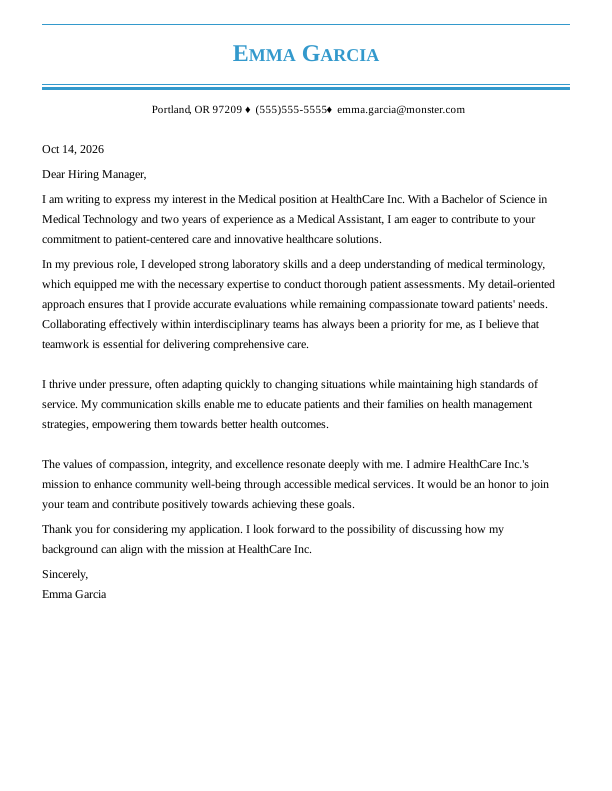
 Free
Medical Entry-Level Cover Letter
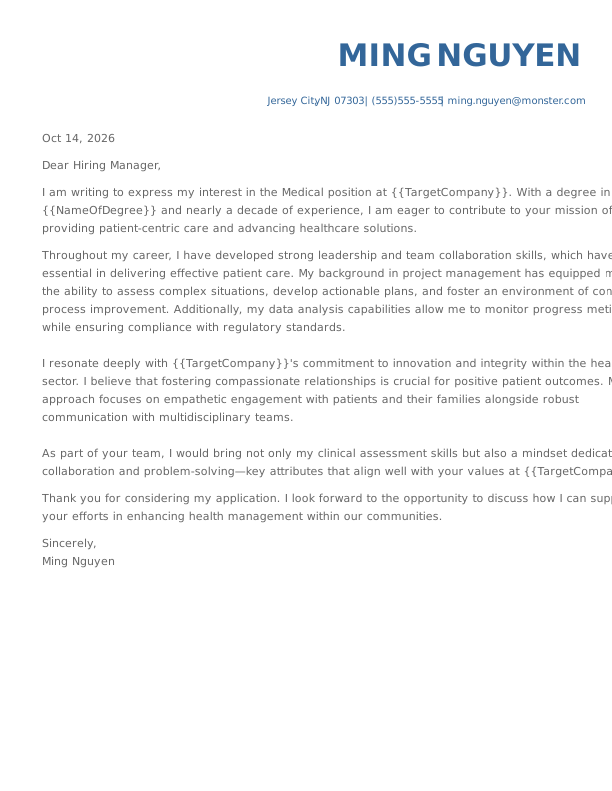
Medical Mid-Level Cover Letter
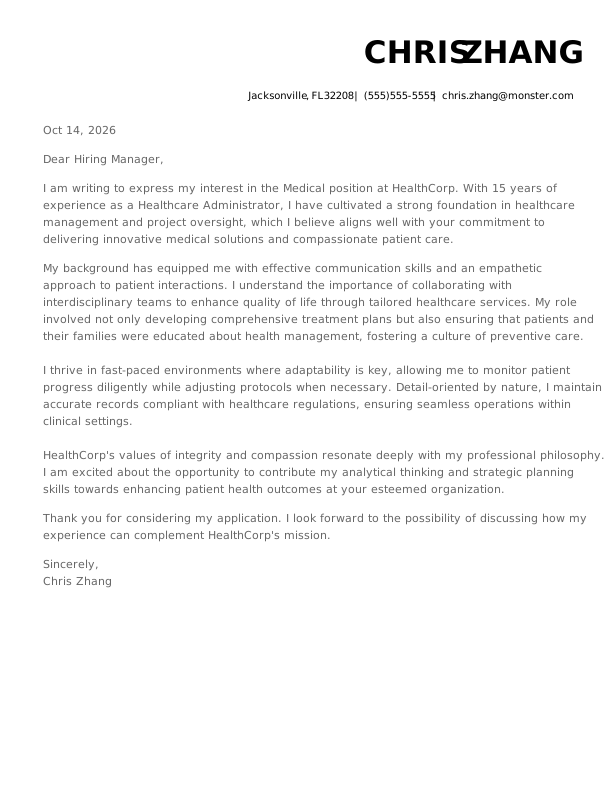
Medical Experienced Cover Letter
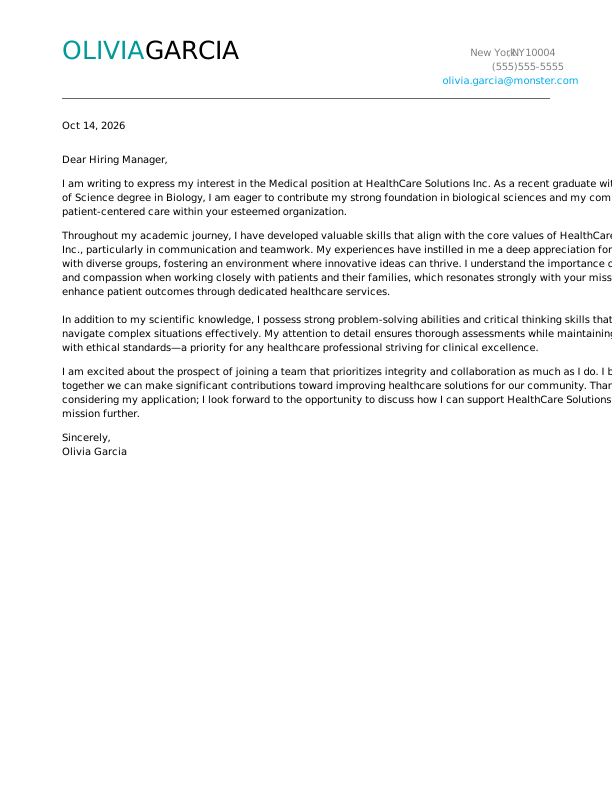
Medical Entry-Level Cover Letter
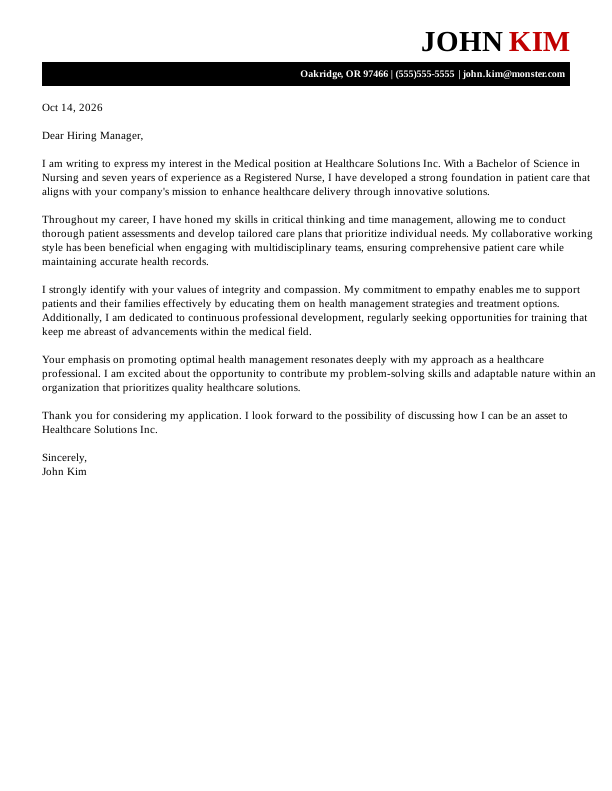
Medical Mid-Level Cover Letter
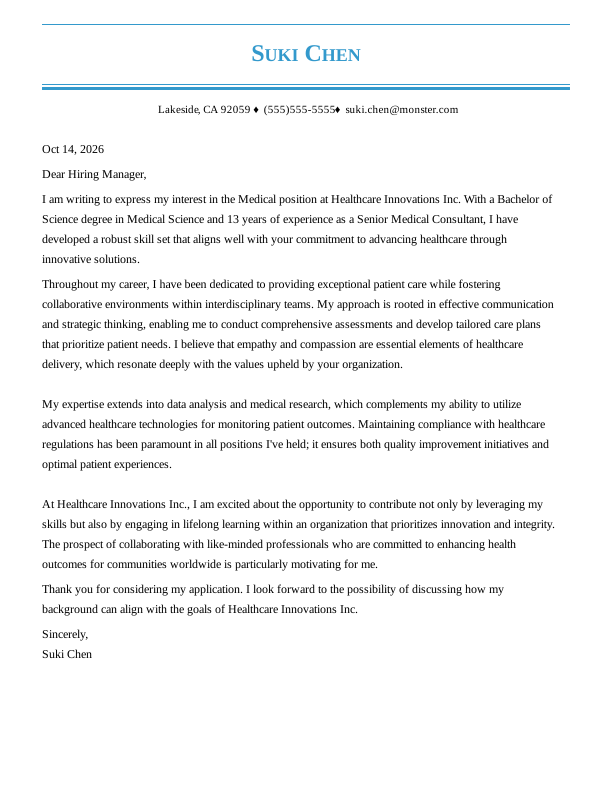
Medical Experienced Cover Letter
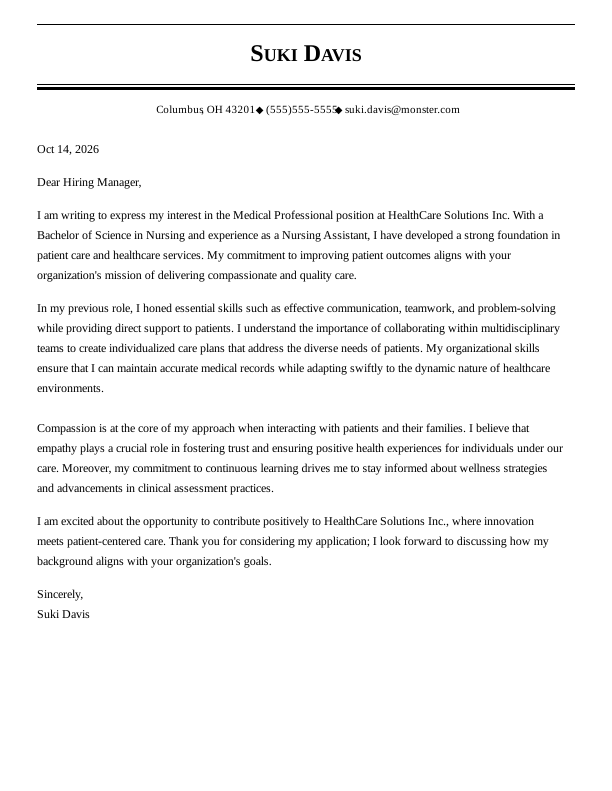
Medical Entry-Level Cover Letter
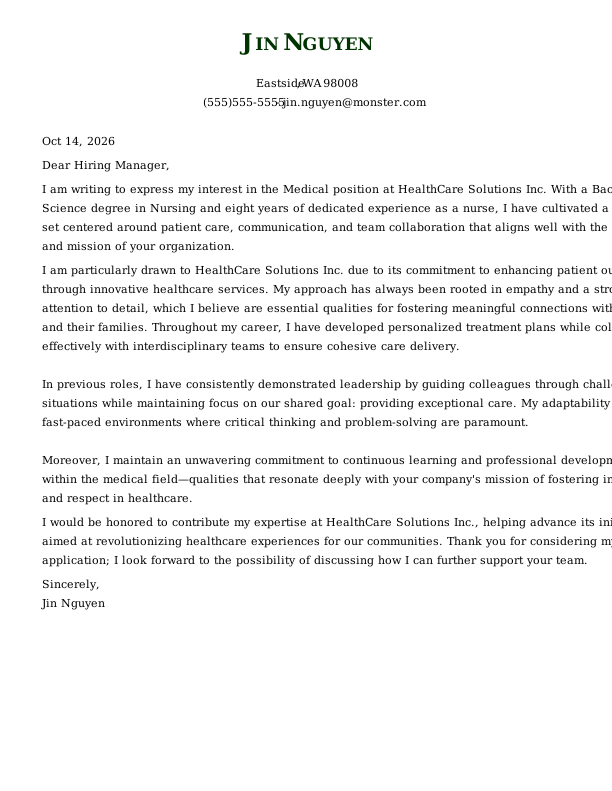
Medical Mid-Level Cover Letter
Browse Free Cover Letter Templates
- Academic
- Account Manager
- Accountant
- Accounts Payable
- Administrative Assistant
- Admissions Counselor
- Architecture
- Artist
- Assistant Principal
- Babysitter
- Barista
- Bartender
- Bookkeeper
- Brand Ambassador
- Business Analyst
- Business
- Caregiver
- Chef
- Civil Engineering
- Computer Science
- Construction
- Consulting
- Copywriter
- Cosmetology
- Custodian
- Customer Service
- Customer Service Representative
- Data Analyst
- Data Entry
- Dental Assistant
- Dental Hygienist
- Digital Marketing
- Electrical Engineering
- Emt
- Engineering
- Esthetician
- Event Coordinator
- Executive Assistant
- Finance
- Financial Analyst
- Firefighter
- Flight Attendant
- Graphic Designer
- Hair Stylist
- Healthcare
- Hr Generalist
- Investment Banking
- It
- Janitor
- Journalism
- Lab Technician
- Law Clerk
- Lawyer
- Librarian
- Logistics
- Makeup Artist
- Manager
- Marketing Coordinator
- Marketing
- Marketing Manager
- Massage Therapist
- Mechanic
- Mechanical Engineer
- Medical Assistant
- Non Profit
- Nursing
- Occupational Therapy
- Office Assistant
- Office Manager
- Operations Manager
- Paralegal
- Personal Trainer
- Pharmacist
- Pharmacy Technician
- Photographer
- Physician Assistant
- Pilot
- Police Officer
- Program Manager
- Project Manager
- Property Manager
- Psychology
- Receptionist
- Research Assistant
- Restaurant Manager
- Retail
- Sales
- Sales Manager
- School Counselor
- Security Officer
- Social Work
- Software Engineer
- Special Education Teacher
- Substitute Teacher
- Teacher
- Teaching Assistant
- Truck Driver
- Vet Tech
- Veterinary Assistant
- Web Developer
Cover Letter Examples for Medical Professionals
Cover letter requirements evolve as a medical career progresses from entry-level training to mid-career responsibilities and experienced leadership. Choose the template that matches your stage so you can highlight the right clinical skills, certifications, and outcomes.
Entry-Level Medical Cover Letter
Built for recent graduates and career changers entering the medical field, this template helps you write a strong cover letter with no experience while highlighting your transferable skills.
Mid-Career Medical Cover Letter
Tailored for medical professionals with a few years of hands-on clinical experience, this template helps you highlight your growing clinical responsibilities, peer leadership, and commitment to quality care.
Experienced Medical Cover Letter
Designed for senior medical professionals and leaders, this template helps you showcase your advanced clinical expertise, program oversight, and ability to drive quality initiatives across departments.
Medical Cover Letter Template (Text)
Copy this medical cover letter text, paste it into your document, and swap in your clinic experience and patient-care metrics for the role.
Aiko Kim
Columbus, OH 43206
(555)555-5555
aiko.kim@monster.com
Oct 14, 2026
Dear Hiring Manager,
I am writing to express my interest in the medical assistant position at Health Innovations Inc. As a recent graduate with a Bachelor of Science in Biomedicine, I am eager to contribute to your team and support your mission of enhancing patient care through innovative solutions and compassionate services.
Throughout my academic journey, I have developed strong communication and teamwork skills while engaging in collaborative projects that emphasized adaptability and critical thinking. My background in biomedicine has equipped me with essential research abilities and an understanding of medical terminology, which will aid me in assisting healthcare providers effectively.
I am particularly drawn to Health Innovations Inc. because of its commitment to fostering innovation within the healthcare sector. Your dedication to improving patient experiences resonates deeply with my own values. I believe that empathy and attention to detail are vital components in delivering high-quality care, aligning perfectly with the attributes you seek for this role.
In addition to my academic qualifications, I possess solid time management skills that will help me thrive in a fast-paced environment while managing multiple tasks efficiently. I look forward to collaborating with multidisciplinary teams at Health Innovations Inc., supporting both clinical tasks and administrative functions as needed.
Thank you for considering my application. I am excited about the opportunity to contribute positively toward enhancing patient outcomes at Health Innovations Inc., and I look forward to discussing how my background can complement your team.
Sincerely,
Aiko Kim
How to Write a Medical Cover Letter
Writing a strong medical cover letter means pairing real examples of your caregiving and clinical work with plain, direct language that fits the role you want. Follow these practical steps to tailor your application for your target role.
1. Research & Prepare
Before drafting your letter, take time to learn about the facility, its specialty areas, and its daily operations. Understanding an employer’s core priorities helps you present relevant skills that match what its care teams need most.
Here are a few quick ways to research the employer before you begin writing:
- Review the job posting to note required clinical certifications, specialty expectations, and primary duties.
- Scan the facility website to identify core focus areas like patient safety, community outreach, or quality initiatives.
- Check public healthcare performance tools or news releases to learn about recent quality benchmarks or organizational goals.
2. Hook the Reader
Use your opening lines to grab the reader’s attention by demonstrating a clear understanding of daily clinical priorities. Skip generic introductory phrases and open with a concrete snapshot of your patient care or workflow efficiency.
You can adapt these realistic lead-in examples to fit your background:
- “On our inpatient service, I helped lower catheter-associated infection rates from 1.8x to 0.6x per 1,000 catheter days over two quarters by standardizing daily safety reviews.”
- “I helped implement an updated sepsis response pathway, cutting average time-to-first-antibiotic from 74 minutes to 52 minutes during our pilot phase.”
- “By partnering closely with our respiratory therapy team on protocol updates, we reduced ICU transfer rates from 9% to 6% across six months.”
3. Tell Your Professional Story
Your resume lists where you have worked, but your cover letter explains the actual impact you made on the day-to-day. Including specific metrics gives hiring managers clear proof of your capabilities rather than broad claims.
Consider highlighting quantifiable accomplishments like these in your overview:
- Reduced medication reconciliation errors by 22% by introducing a standard admission checklist.
- Saved 12 minutes of charting time per patient by introducing streamlined nursing documentation templates.
- Managed a high-volume caseload while coordinating discharge plans, improving on-time discharge rates from 74% to 88%.
4. Showcase Your Skills
Replace broad phrases like “strong communicator” with clear examples that prove how you handle daily patient care and clinical workflows. Pick a core requirement from the job ad and describe how you put it into practice.
Use these examples to frame your hands-on clinical skills effectively:
- EHR documentation: “I record patient assessments promptly during rounds, confirming details during handoffs so oncoming staff has accurate context.”
- Medication safety: “I verify patient identifiers and cross-check order details against the record before administering medications, catching potential scheduling errors early.”
- Patient communication: “I use clear, simple language and teach-back techniques to ensure patients and families fully understand their discharge instructions.”
5. Explain Any Special Circumstances
If you have an employment gap, career pivot, or recent relocation, address it briefly in one or two simple sentences. Focus on your current clinical readiness, active credentials, and passion for returning to or expanding your practice.
Keep your explanation simple and direct with wording like this:
- “After taking time off for family caregiving, I renewed my ACLS certification and returned to bedside care in a step-down unit last fall.”
- “I am transitioning from inpatient care to outpatient infusion, building on my current clinic experience with medication reconciliation and care coordination.”
- “Following my relocation in May, my state license is fully active and ready for immediate clinical practice.”
6. End With a Professional Goodbye
Wrap up your letter by suggesting a clear next step and thanking the hiring manager for their time. Keep this section brief so it reads as polished and professional.
Transition into a closing with a simple statement like: “I would welcome the opportunity to discuss how my clinical experience and patient care approach match your team’s needs.”
Finish with: “Thank you for your time and consideration. Best regards,”
4 Tips for Formatting Your Cover Letter
Hiring managers in healthcare often scan applications to confirm essential credentials, certifications, and clinical fit before reading further. Taking time to format your document properly ensures your key qualifications are easy to find at a glance, making a strong first impression during a fast review.

Keep It to One Page
Keep your cover letter to a single page, ideally between 250 and 400 words across three or four concise paragraphs. A focused one-page document respects the reader’s time while highlighting your license status, clinical skills, and key achievements clearly.

Use a Professional Font & Layout
Choose standard fonts like Arial, Calibri, Helvetica, or Georgia at a 10-point to 12-point size so your letter is easy to read on screens and printed copies. Opt for a layout design that doesn’t overcrowd your text, and feature minimalist design elements in your cover letter template.

Use Bullet Points for Key Achievements
Draft three or four key clinical or operational wins into bullet points to help important details stand out. Bullets break up dense text, allowing a hiring manager to quickly spot your metrics, patient care outcomes, and daily accomplishments.

Balance Spacing & Margins
Use single to 1.15 line spacing with a clear blank line between paragraphs to give your text room to breathe. Uniform margins between 0.75 inches and 1 inch keep your document framed neatly without feeling crowded or sparse.
Top-Paying States for Medical Roles
Knowing what medical professionals earn across the country helps you compare offers and plan your next step. Salary ranges vary by role, setting, and experience, so it’s smart to look at trusted benchmarks first. The figures below are based on the U.S. Bureau of Labor Statistics (BLS) and reflect recent nationwide averages for related medical occupations.
Keep in mind that location, years on the job, certifications, and specialty can shift pay up or down. Your schedule and employer type can also affect compensation.
| Alabama | $101,790 |
| Alaska | $152,400 |
| Arizona | $140,700 |
| Arkansas | $101,000 |
| California | $154,620 |
| Connecticut | $153,040 |
| Delaware | $152,670 |
| District of Columbia | $176,520 |
| Florida | $141,910 |
| Georgia | $168,460 |
| Hawaii | $154,160 |
| Idaho | $124,660 |
| Illinois | $144,140 |
| Indiana | $134,380 |
| Iowa | $132,180 |
| Kansas | $118,980 |
| Kentucky | $118,480 |
| Louisiana | $114,770 |
| Maine | $131,940 |
| Maryland | $151,580 |
| Massachusetts | $159,680 |
| Michigan | $131,230 |
| Minnesota | $131,900 |
| Mississippi | $103,770 |
| Missouri | $124,820 |
| Montana | $121,160 |
| Nebraska | $125,130 |
| Nevada | $124,690 |
| New Hampshire | $155,990 |
| New Jersey | $169,520 |
| New Mexico | $136,140 |
| New York | $177,230 |
| North Carolina | $141,840 |
| North Dakota | $124,270 |
| Ohio | $160,730 |
| Oklahoma | $130,550 |
| Oregon | $173,330 |
| Pennsylvania | $132,210 |
| Rhode Island | $135,480 |
| South Carolina | $141,890 |
| South Dakota | $128,110 |
| Tennessee | $126,450 |
| Texas | $136,640 |
| Utah | $130,710 |
| Vermont | $148,020 |
| Virginia | $141,950 |
| Washington | $185,080 |
| West Virginia | $135,680 |
| Wisconsin | $144,940 |
| Wyoming | $113,700 |
| Guam | $102,190 |
| Puerto Rico | $98,420 |
| Virgin Islands | $94,450 |
Key Takeaways
- Focus your cover letter on your commitment to safe, high-quality patient care and accurate clinical documentation.
- Highlight specific metrics, like reduced wait times or improved chart completion rates, to show your past impact clearly.
- Tailor your experience to match the employer’s specific environment, whether that is a hospital setting, specialty clinic, or health technology team.
More Cover Letter Examples
Browse Monster’s Resume Templates
Monster also has hundreds of ATS-friendly resume templates for all career levels and industries. Create a matching resume to help you land the interview.
- Cardiac Sonographer
- Caregiver
- Caretaker
- Certified Medical Assistant
- Chiropractic Assistant
- Clinical Data Specialist
- Clinical Research Associate
- Dietitian
- Direct Support Professional
- Ekg Technician
- Health Information Technician
- Healthcare Administration
- Healthcare
- Healthcare Support
- Healthcare Technology
- Home Health Care
- Lab Technician
- Lactation Consultant
- Medical Administrative Assistant
- Medical Assistant
- Medical Billing
- Medical Coder
- Medical Courier
- Medical Interpreter
- Medical Office Manager
- Medical Office
- Medical Receptionist
- Medical
- Medical School
- Medical Science Liaison
- Medical Scribe
- Medical Secretary
- Medical Technologist
- Medical Transcriptionist
- Mri Technologist
- Ophthalmic Technician
- Optician
- Patient Access Representative
- Patient Care Coordinator
- Patient Care Technician
- Patient Service Representative
- Patient Transporter
- Phlebotomist
- Physical Therapist Assistant
- Private Caregiver
- Radiologic Technologist
- Sonographer
- Surgical Tech
- Unit Secretary
Frequently Asked Questions
Last Update:
Do I really need a cover letter?
Yes, you should include a cover letter with your medical application even when the posting says it is optional. While your resume lists your credentials and work history, a cover letter provides space to explain your clinical background, technical strengths, and dedication to patient care. Submitting one shows true interest in the role and helps you stand out from candidates who only submit a basic resume.
How long should my cover letter be?
Your medical cover letter should be a single page, generally running between 250 and 400 words. Healthcare hiring managers review applications quickly, so keeping your text brief helps your key qualifications stand out. Focus on writing three to four clear paragraphs that highlight your most relevant clinical experience, certifications, and patient care successes without adding unnecessary detail.
Should my cover letter match my resume?
Your cover letter should match your resume’s visual layout while providing fresh information rather than repeating the same facts. Use matching fonts, margins, and header styles so your application looks like a unified package. Instead of repeating your work history line by line, use the letter to expand on major achievements, detail your clinical strengths, and explain why you want to join this specific healthcare team.
How do I address my cover letter if I don’t know the hiring manager’s name?
When you do not know the hiring manager’s name, start by checking the job ad, facility website, or LinkedIn to find the relevant clinical director or department lead. If you still cannot find a specific name, address your letter to “Dear Hiring Manager” or “Dear Medical Recruitment Team.” This approach keeps your greeting professional and modern, avoiding outdated phrasing like “To Whom It May Concern.”
Should I mention salary expectations in my cover letter?
You should only mention salary expectations in your medical cover letter if the employer explicitly asks you to include them. When required, state a flexible, well-researched pay range based on local market data for your role and specialty rather than a single fixed number. You can also mention that you are open to discussing the overall compensation package, including shift differentials and benefits.

Vicki Salemi is a nationally recognized career expert who helps professionals navigate the hiring landscape and find the right fit on Monster. With over 15 years of experience in corporate recruiting and HR, she offers expert guidance on job search strategies, interview preparation, and career development to help candidates land their next role.
See More From Vicki SalemiExplore Related Career Advice







How to Write a Cover Letter for Internal Positions or Promotions (Examples & Tips)

Updated:
Apr 23, 2026
|
19 min read


Cover Letter vs Resume: What’s the Difference & Do You Need Both?

Updated:
Apr 23, 2026
|
18 min read