


Free Business Manager Cover Letter Templates & Examples
A strong cover letter shows how your skills, leadership, and budget management deliver real results. Use our simple examples and practical steps to highlight your accomplishments so a hiring manager instantly sees what you bring to their team.
Real-World Cover Letters That Get Results
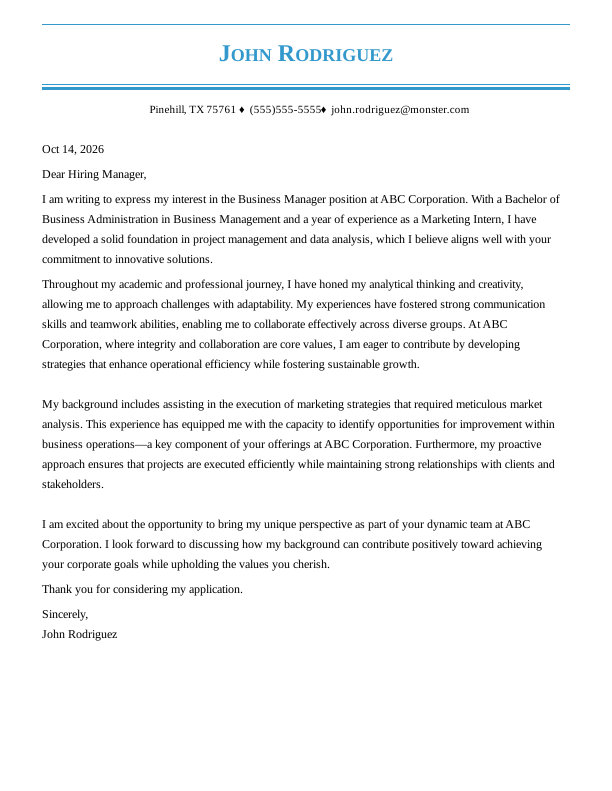
 Free
Business Manager Entry-Level Cover Letter
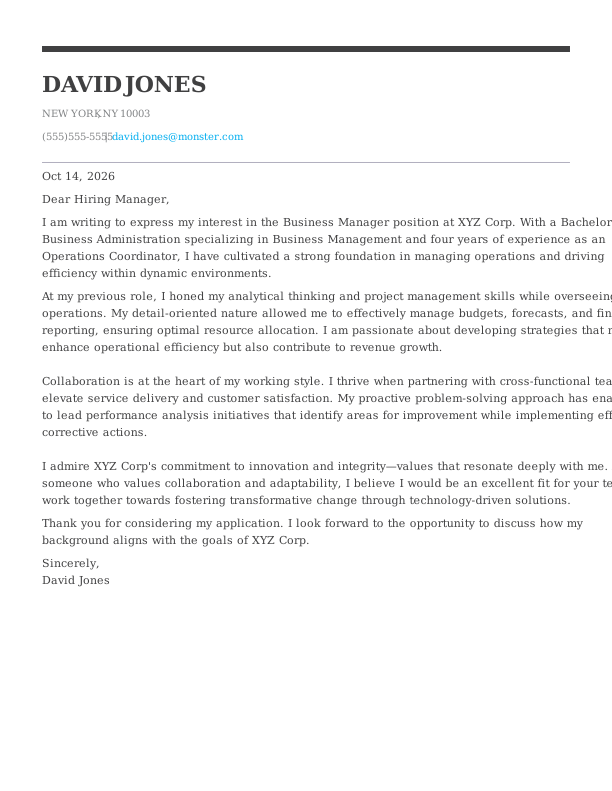
Business Manager Mid-Level Cover Letter
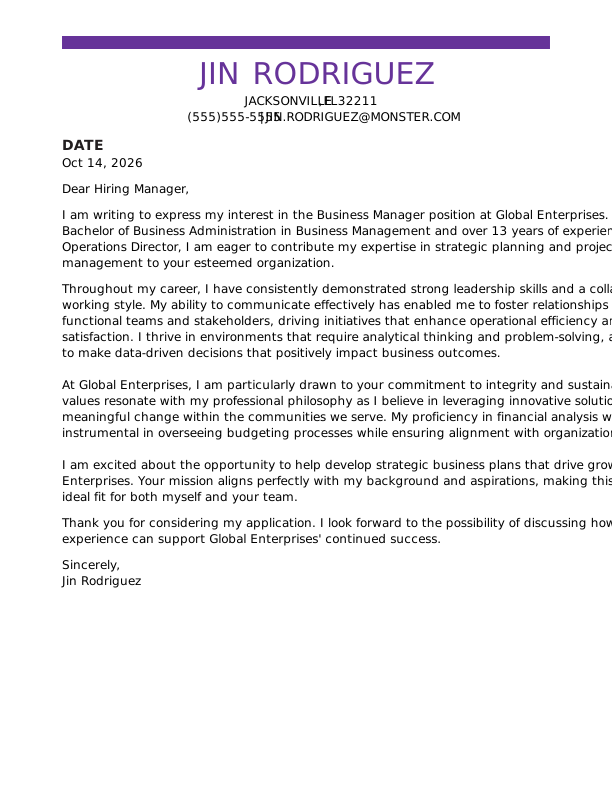
Business Manager Experienced Cover Letter
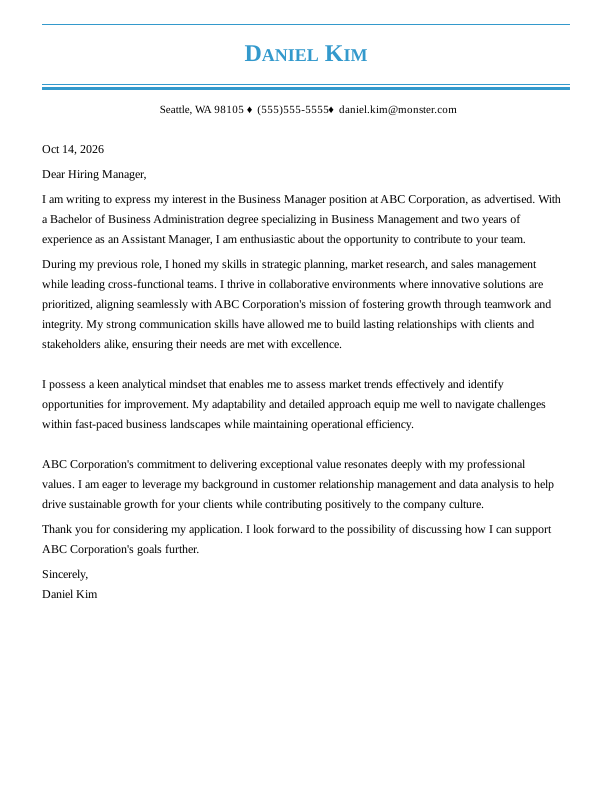
Business Manager Entry-Level Cover Letter
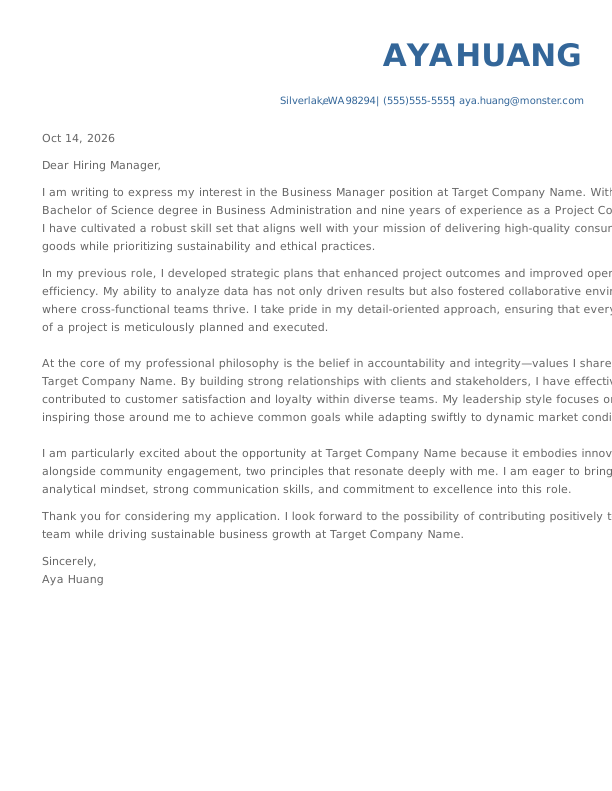
Business Manager Mid-Level Cover Letter
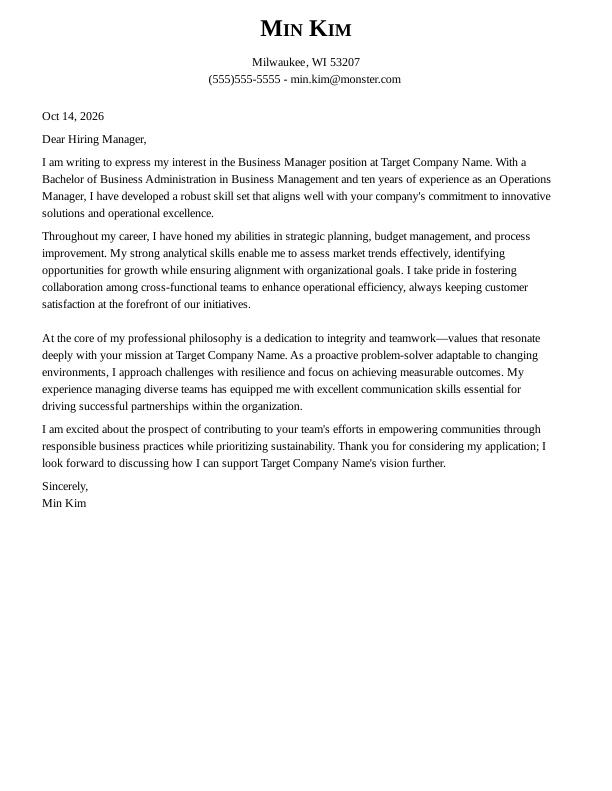
Business Manager Experienced Cover Letter
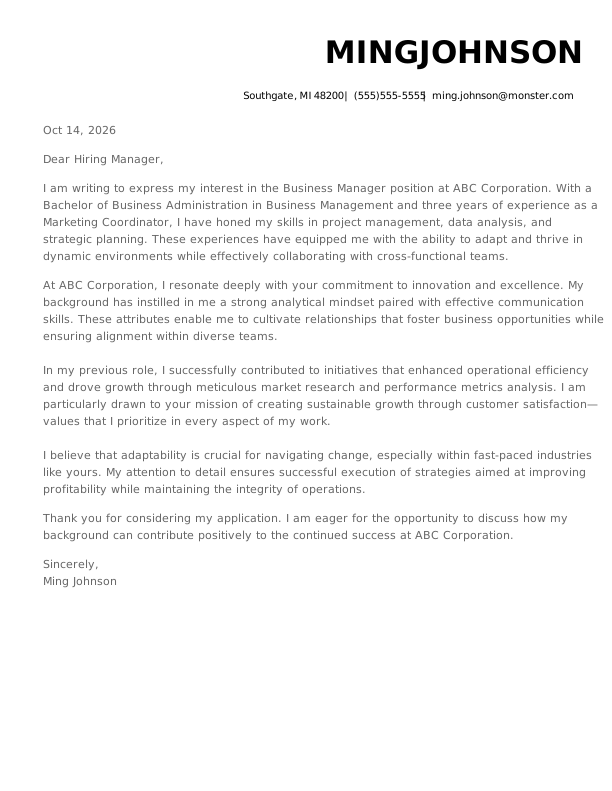
Business Manager Entry-Level Cover Letter
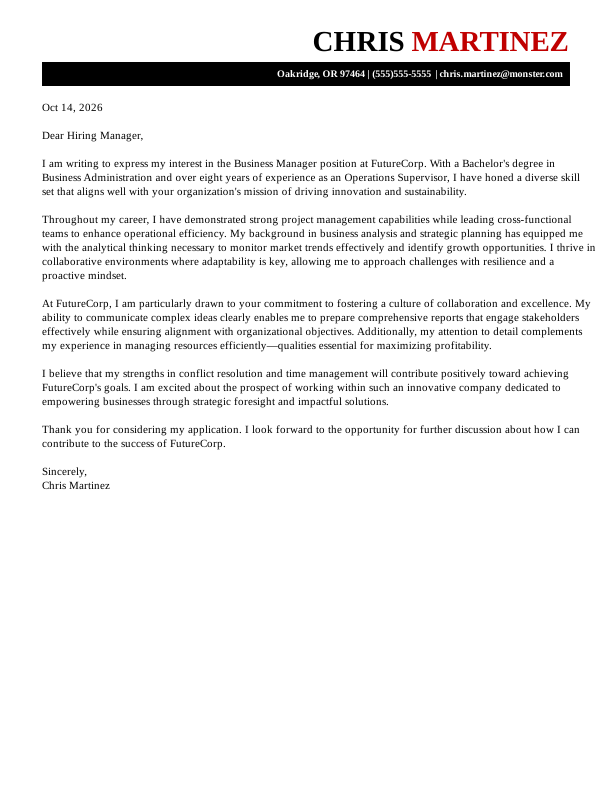
Business Manager Mid-Level Cover Letter
Browse Free Cover Letter Templates
- Academic
- Account Manager
- Accountant
- Accounts Payable
- Administrative Assistant
- Admissions Counselor
- Architecture
- Artist
- Assistant Principal
- Babysitter
- Barista
- Bartender
- Bookkeeper
- Brand Ambassador
- Business Analyst
- Business
- Caregiver
- Chef
- Civil Engineering
- Computer Science
- Construction
- Consulting
- Copywriter
- Cosmetology
- Custodian
- Customer Service
- Customer Service Representative
- Data Analyst
- Data Entry
- Dental Assistant
- Dental Hygienist
- Digital Marketing
- Electrical Engineering
- Emt
- Engineering
- Esthetician
- Event Coordinator
- Executive Assistant
- Finance
- Financial Analyst
- Firefighter
- Flight Attendant
- Graphic Designer
- Hair Stylist
- Healthcare
- Hr Generalist
- Investment Banking
- It
- Janitor
- Journalism
- Lab Technician
- Law Clerk
- Lawyer
- Librarian
- Logistics
- Makeup Artist
- Manager
- Marketing Coordinator
- Marketing
- Marketing Manager
- Massage Therapist
- Mechanic
- Mechanical Engineer
- Medical Assistant
- Non Profit
- Nursing
- Occupational Therapy
- Office Assistant
- Office Manager
- Operations Manager
- Paralegal
- Personal Trainer
- Pharmacist
- Pharmacy Technician
- Photographer
- Physician Assistant
- Pilot
- Police Officer
- Program Manager
- Project Manager
- Property Manager
- Psychology
- Receptionist
- Research Assistant
- Restaurant Manager
- Retail
- Sales
- Sales Manager
- School Counselor
- Security Officer
- Social Work
- Software Engineer
- Special Education Teacher
- Starbucks
- Substitute Teacher
- Teacher
- Teaching Assistant
- Truck Driver
- Vet Tech
- Veterinary Assistant
Cover Letter Examples for Business Managers
Cover letter priorities shift as you move from early support roles to leading big projects and budgets. Pick the example below that matches your current career stage to highlight your relevant experience and growth.
Entry-Level Business Manager Cover Letter
An entry-level cover letter should emphasize your academic foundation, transferable skills, and key internships or project work to demonstrate your operational potential and eagerness to learn.
Mid-Career Business Manager Cover Letter
A mid-career cover letter focuses on proven operational management, team leadership, and track records of improving process efficiency and overseeing daily business operations.
Experienced Business Manager Cover Letter
An experienced-level cover letter highlights high-level strategic vision, multi-departmental leadership, budget ownership, and long-term business growth achievements.
Business Manager Cover Letter Template (Text)
Copy this business manager cover letter text, paste it into your document, and swap in your budget results, KPIs, or target company.
Alexis Cook
Seattle, WA 98104
(555)555-5555
alexis.cook@monster.com
Oct 14, 2026
Dear Hiring Manager,
I am writing to express my interest in the Business Manager position at ABC Corporation. With a Bachelor of Business Administration in Business Management and seven years of experience as an Operations Supervisor, I have developed a comprehensive skill set that aligns well with the dynamic and innovative environment at your organization.
Throughout my career, I have honed my abilities in strategic planning and project management, successfully leading teams to enhance operational efficiency and drive growth. My strong analytical skills enable me to monitor financial performance effectively, providing insights that contribute to informed decision-making. I take pride in fostering robust relationships with clients and stakeholders, ensuring their needs are met while enhancing customer satisfaction.
At ABC Corporation, I admire your commitment to excellence and sustainable growth. Your focus on tailored business solutions resonates with my belief in collaboration as a means of achieving collective goals. My proactive approach ensures adaptability within fast-paced environments; this mindset has consistently driven positive results for my team and organization.
I am excited about the opportunity to bring my detail-oriented perspective and results-driven attitude to ABC Corporation. I look forward to the possibility of contributing positively to your esteemed company’s mission while continuing to grow professionally within such an inspiring setting.
Thank you for considering my application. I hope to discuss how I can support ABC Corporation’s objectives further.
Sincerely,
Alexis Cook
How to Write a Business Manager Cover Letter
Writing a great cover letter means turning your past responsibilities into clear achievements in budgeting, team leadership, and day-to-day operations. Follow these simple steps to build a focused story that connects directly to the job you want.
1. Research & Prepare
Take time to research how your target employer runs its business before you begin writing. Look into its main software tools, current growth goals, and key operational priorities so you can speak directly to its actual needs.
Use these preparation steps to tailor your application effectively:
- Check the job posting for specific finance or software platforms and note your matching experience.
- Scan company updates to learn about current operational targets you can reference.
- Review recent news articles to understand the challenges or expansions the company faces.
2. Hook the Reader
Start your letter with an opening line that grabs attention right away. Skip generic introductory phrases and share a specific win in financial management, team efficiency, or problem-solving that shows what you can do.
Consider these strong options for opening your letter with impact:
- Budget discipline, proven: “Reduced variance between forecast and actuals by 6% in 2024 by tightening weekly P&L reviews and using rolling cash-flow scenarios across three departments.”
- Operational levers you control: “After launching a vendor scorecard initiative, cut procurement cycle time from 21 days to 14 by standardizing approvals and switching to NetSuite purchase order workflows.”
- Cross-functional leadership signal: “When our finance team hit close deadlines, led an after-action standup with IT and HR to fix master data issues that caused month-end rework for 30-plus invoices.”
3. Tell Your Professional Story
Use the middle of your letter to give real context to the achievements on your resume. Specific numbers and percentages show employers the actual impact of your work, proving how you handle shifting goals and financial priorities.
Here are examples of clear, metric-driven achievement statements you can adapt:
- Reduced operating expenses by 12% over 9 months by renegotiating vendor contracts and tightening purchasing approvals.
- Managed a $1.6M annual budget variance to within 0.5% while coordinating monthly forecasts with finance and department leads.
- Improved on-time invoice processing from 74% to 92% by standardizing approval workflows across 3 departments.
4. Showcase Your Skills
Instead of simply listing core management competencies, briefly describe how you put those skills into practice. Sharing short examples helps readers understand how you solve problems, communicate with partners, and support team growth.
Focus on these key areas when illustrating your operational skills:
- Budgeting and forecasting: “Built a rolling monthly forecast in Excel from vendor invoices and staffing changes, then adjusted our spend plan after sales missed a key projection.”
- Stakeholder communication: ” Ran a short working session when departments disagreed on timelines, and summarized decisions in an email so everyone had the same next steps.”
- Operational planning: “Updated our SOPs in Confluence after recurring delays surfaced, and used the revised checklist to align managers on daily execution.”
5. Explain Any Special Circumstances
Address any career transitions, employment breaks, or relocations directly in one or two clear sentences. Reassure the hiring team by highlighting recent training, current software knowledge, or professional certifications.
Use these strategies to briefly explain your background:
- “After nine months out of the workforce for caregiving, I refreshed my budgeting and forecasting using Excel Power Query and completed a quick AP and payroll compliance update before applying.”
- “I am pivoting from operations coordinator into business management by leading weekly KPI reporting in Tableau and rebuilding my process documentation around SOPs and internal controls.”
- “I relocated to Austin in May, and I updated my employer profile and references while keeping my HRIS access current in Workday for benefits administration.”
6. End With a Professional Goodbye
Wrap up your letter with a polite, professional closing paragraph that suggests a specific topic for an interview. Express genuine appreciation for their time and consideration, keeping the final message clear and welcoming.
Mention that you look forward to discussing how your background in operational planning and forecasting can support its upcoming targets. Close with a warm, standard sign-off like “Sincerely” or “Best regards.”
4 Tips for Formatting Your Cover Letter
A well-structured layout helps a reviewer scan your document quickly and spot your key achievements right away. Proper formatting shows strong organizational skills, makes your cover letter easy to read on any screen.

Address the Hiring Manager Directly
Try to find the hiring manager’s name through the job listing, company directory, or professional networks. Using a direct greeting shows attention to detail, but generic alternatives like “Dear Hiring Manager” work well when a name is unavailable.

Match Your Header to Your Resume
Use the same font, contact header, and visual style on both your resume and cover letter. Creating a uniform design connects your documents into a polished application package that looks structured and complete.

Balance Spacing & Margins
Keep line spacing between 1.0 and 1.15, leaving standard margins around the page to prevent a crowded appearance. Clean spacing and clear paragraph breaks help the hiring team scan your main qualifications without feeling overwhelmed.

Save & Send as a PDF
Save your final cover letter as a PDF to preserve your layout across different devices and application portals. Name the file clearly using your full name and job title so HR staff can identify it instantly.
Top-Paying States for Business Manager Roles
Knowing what business managers earn can help you compare offers, plan your next move, and negotiate with confidence. Salary ranges vary by industry, company size, and where the role is based. The U.S.
The Bureau of Labor Statistics (BLS) provides nationwide data that can serve as a helpful benchmark when you’re evaluating compensation. Keep in mind that experience level, scope of responsibility, and specialized skills like operations or budgeting can shift pay meaningfully. Your schedule and employer type also matter, especially in fast-paced sectors with higher demand for strong leadership.
| Arizona | $90,730 |
| Connecticut | $153,890 |
| Georgia | $111,700 |
| Illinois | $96,130 |
| Indiana | $84,670 |
| Kentucky | $89,440 |
| Maryland | $104,000 |
| Michigan | $78,570 |
| Minnesota | $97,330 |
| Nevada | $112,120 |
| New Jersey | $138,640 |
| New York | $152,880 |
| Ohio | $59,010 |
| Oregon | $60,670 |
| Tennessee | $90,120 |
| Texas | $82,830 |
| Utah | $59,000 |
| Virginia | $72,340 |
| Wisconsin | $128,380 |
Key Takeaways
- Highlight specific examples of budget discipline and operational wins to prove your financial oversight skills.
- Include relevant metrics like cost savings and efficiency gains to show clear impact across your team.
- Tailor your cover letter to address the specific priorities and operational scale of your target organization.
More Cover Letter Examples
Browse Monster’s Resume Templates
Monster also has hundreds of ATS-friendly resume templates for all career levels and industries. Create a matching resume to help you land the interview.
- Assistant Project Manager
- Associate Product Manager
- Benefits Specialist
- Business Administration
- Business Development
- Business Management
- Business Manager
- Business Operations
- Business Owner
- Business
- Ceo
- Change Manager
- Chief Of Staff
- Ciso
- Community Outreach Coordinator
- Coo
- Corporate Trainer
- Director Of Operations
- Director
- Entrepreneur
- Executive Director
- Executive Manager
- Executive Recruiter
- Executive
- Freelance
- General Manager
- Healthcare Management
- Hr Analyst
- Hr Business Partner
- Hr Consultant
- Hr Coordinator
- Hr Director
- Hr Manager
- Hr Specialist
- Managing Director
- Onboarding Specialist
- Operations Manager
- Program Coordinator
- Program Director
- Program Manager
- Project Coordinator
- Project Manager
- Recruiter
- Recruiting Coordinator
- Recruitment Coordinator
- Regional Manager
- Risk Management
- Senior Manager
- Senior Program Manager
- Senior Project Manager
- Senior Recruiter
- Small Business Owner
- Supervisor
- Talent Acquisition Specialist
- Team Leader
- Technical Recruiter
- Training Manager
- Vice President
Frequently Asked Questions
Last Update:
Do I really need a cover letter?
A cover letter provides valuable context behind your resume accomplishments. While a resume lists your work duties, a cover letter explains how you make decisions, lead teams, and solve operational challenges.
It also lets you explain career shifts or employment gaps directly, showing a hiring manager why you are a great fit for the opening.
How long should my cover letter be?
Your cover letter should be under one page long, usually between 250 and 400 words. Keeping it concise ensures a recruiter can quickly read your main qualifications during a fast scan.
Focus on three or four short paragraphs that highlight your strongest leadership wins and budget achievements without adding unnecessary filler details.
Should my cover letter match my resume?
Your cover letter should match your resume in visual style, but not in exact wording. Use the same fonts, headers, and spacing so both documents feel like a single package.
Then, focus your letter content on explaining key successes and expressing enthusiasm for the company rather than repeating your bullet points word for word.
How do I address my cover letter if I don’t know the hiring manager’s name?
When addressing your cover letter without a contact name, try checking company directories, job listings, or professional networking sites first. If you still cannot find a specific name, use a polite alternative like “Dear Hiring Manager” or “Dear Operations Team.”
Avoid outdated phrases like “To Whom It May Concern” to keep your tone modern.
Should I mention salary expectations in my cover letter?
You should only mention salary expectations in your cover letter if the job posting explicitly requests them. In those cases, provide a flexible salary range based on local market research for business managers.
Mention that you look forward to discussing the full compensation package, keeping the focus on your overall fit for the role.

Megan Dawkins is a career industry editor who empowers job seekers to take control of their career paths using Monster’s comprehensive job search and resume tools. She specializes in helping job seekers navigate the flexible job market.
See More From Megan DawkinsExplore Related Career Advice







How to Write a Cover Letter for Internal Positions or Promotions (Examples & Tips)

Updated:
Apr 23, 2026
|
19 min read


Cover Letter vs Resume: What’s the Difference & Do You Need Both?

Updated:
Apr 23, 2026
|
18 min read