

Free Project Coordinator Cover Letter Templates & Examples
A strong cover letter shows hiring managers you can keep projects moving, organize resources, and communicate clearly. Tailoring your cover letter to the job title lets you highlight your practical impact and prove you are ready to keep their initiatives on track.
Real-World Cover Letters That Get Results
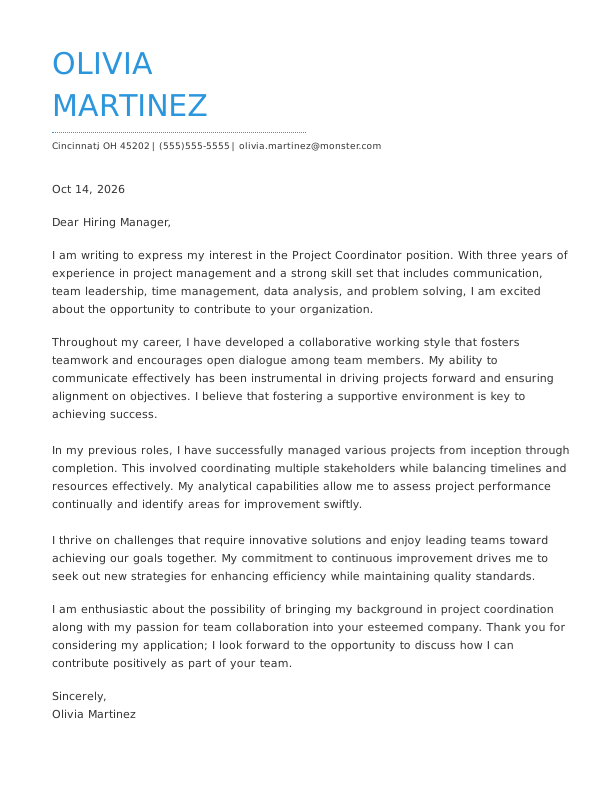
 Free
Project Coordinator Entry-Level Cover Letter
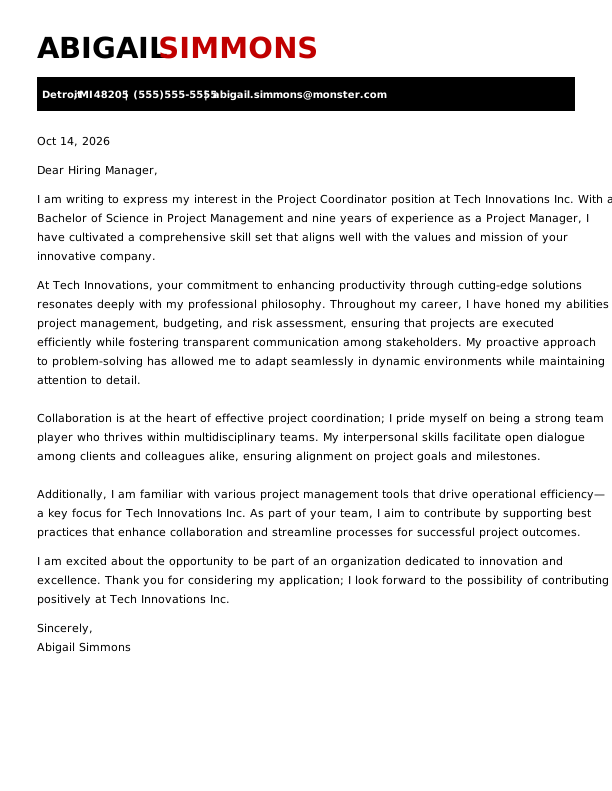
Project Coordinator Mid-Level Cover Letter
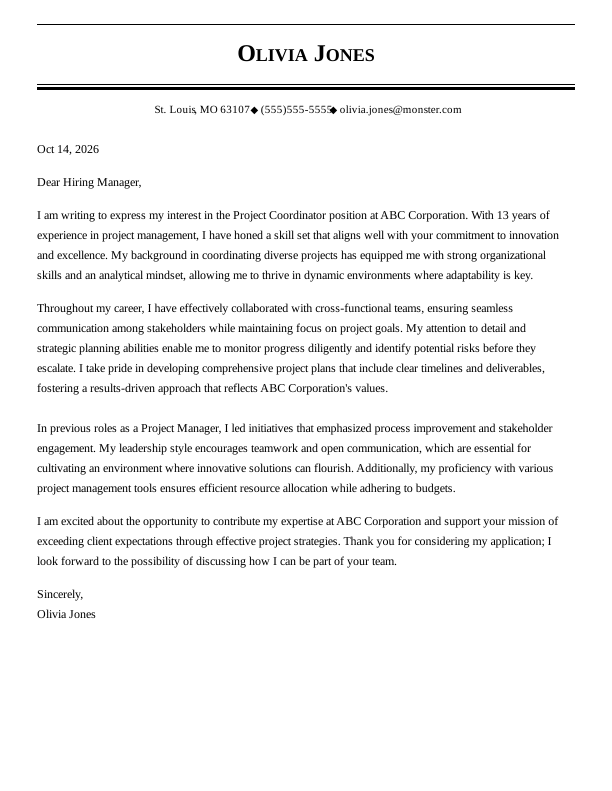
Project Coordinator Experienced Cover Letter
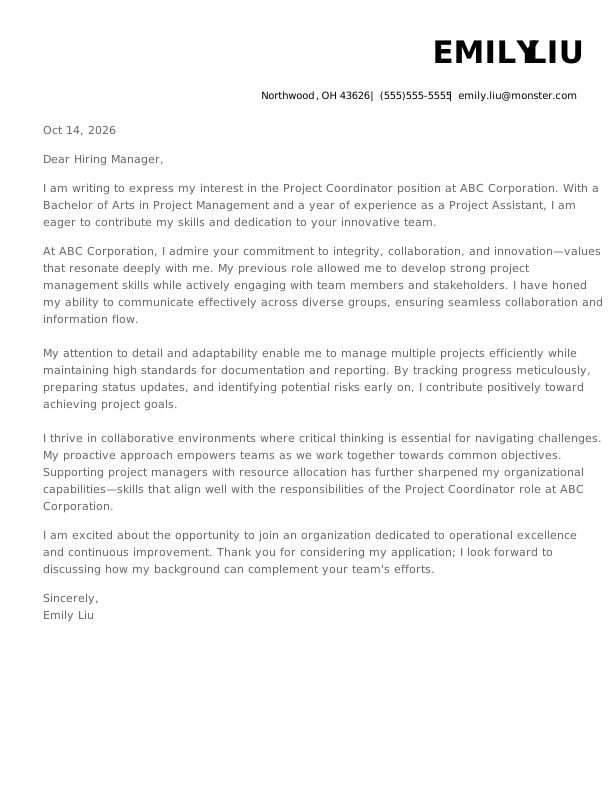
Project Coordinator Entry-Level Cover Letter
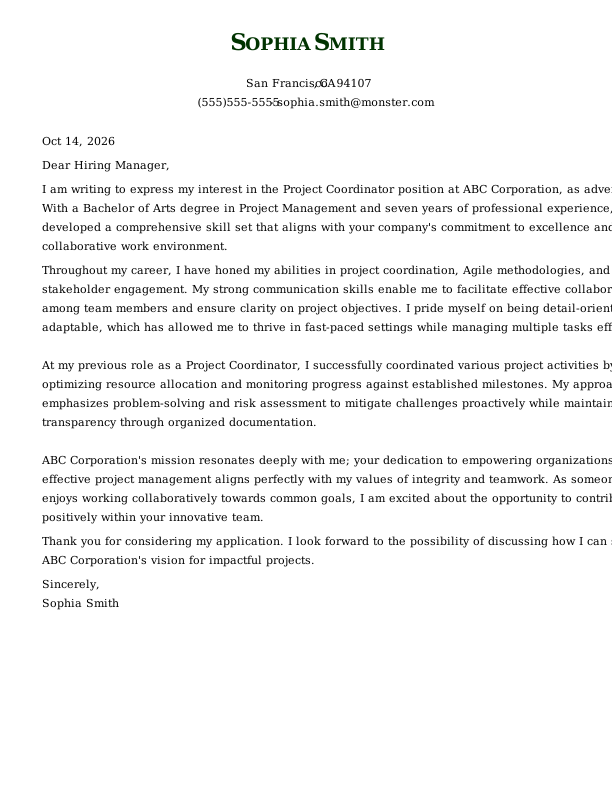
Project Coordinator Mid-Level Cover Letter
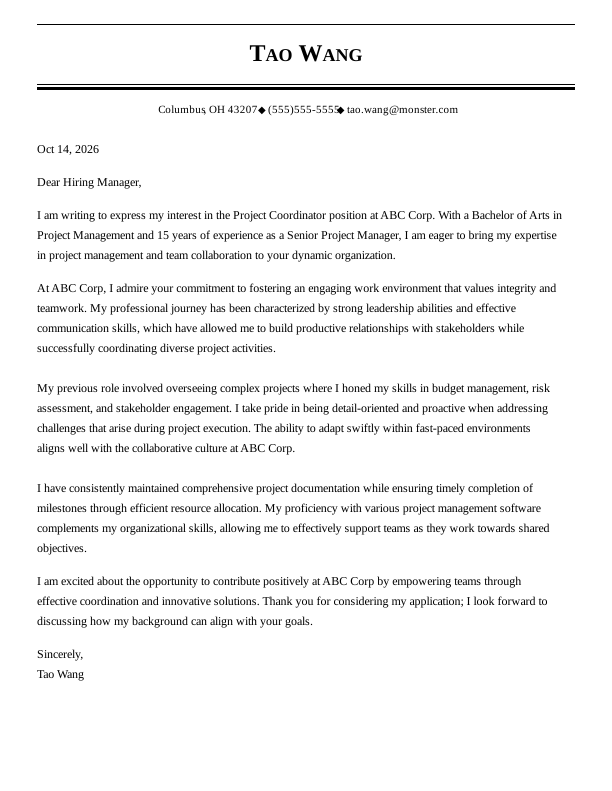
Project Coordinator Experienced Cover Letter
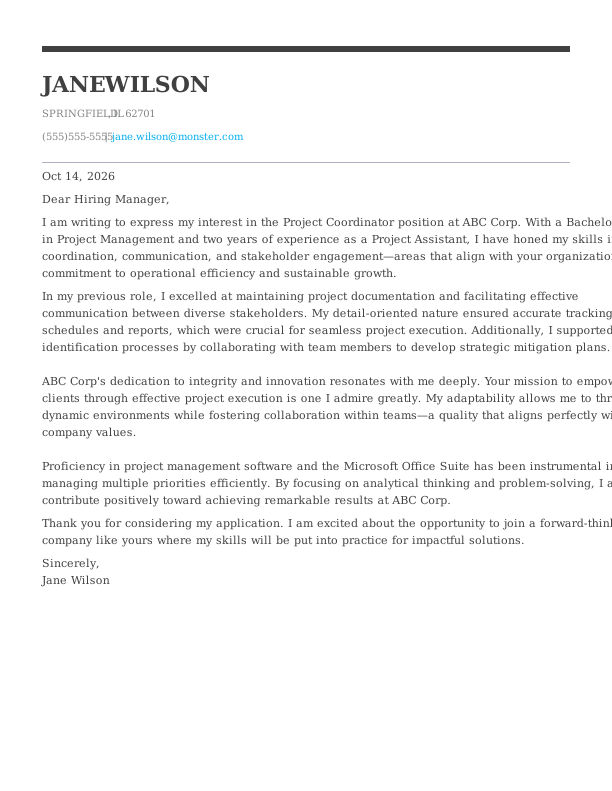
Project Coordinator Entry-Level Cover Letter
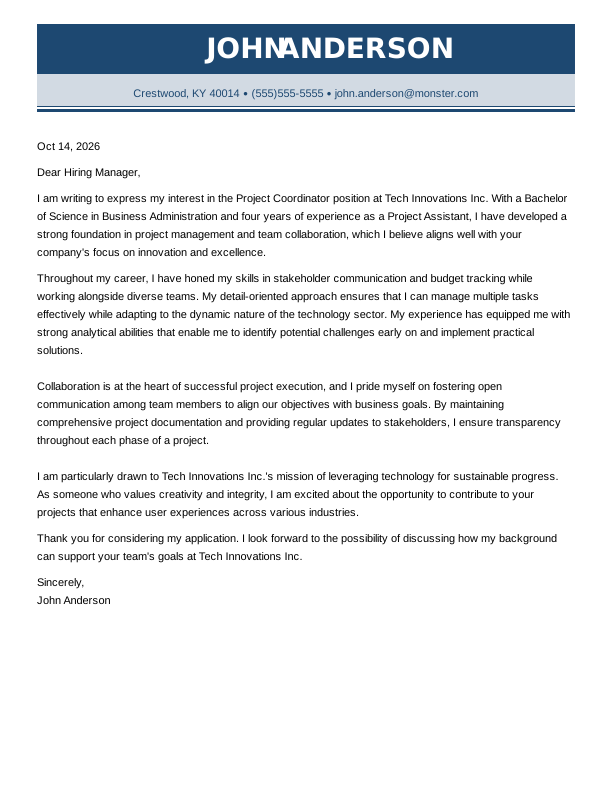
Project Coordinator Mid-Level Cover Letter
Browse Free Cover Letter Templates
- Academic
- Account Manager
- Accountant
- Accounts Payable
- Administrative Assistant
- Admissions Counselor
- Architecture
- Artist
- Assistant Principal
- Babysitter
- Barista
- Bartender
- Bookkeeper
- Brand Ambassador
- Business Analyst
- Business
- Caregiver
- Chef
- Civil Engineering
- Computer Science
- Construction
- Consulting
- Copywriter
- Cosmetology
- Custodian
- Customer Service
- Customer Service Representative
- Data Analyst
- Data Entry
- Dental Assistant
- Dental Hygienist
- Digital Marketing
- Electrical Engineering
- Emt
- Engineering
- Esthetician
- Event Coordinator
- Executive Assistant
- Finance
- Financial Analyst
- Firefighter
- Flight Attendant
- Graphic Designer
- Hair Stylist
- Healthcare
- Hr Generalist
- Investment Banking
- It
- Janitor
- Journalism
- Lab Technician
- Law Clerk
- Lawyer
- Librarian
- Logistics
- Makeup Artist
- Manager
- Marketing Coordinator
- Marketing
- Marketing Manager
- Massage Therapist
- Mechanic
- Mechanical Engineer
- Medical Assistant
- Non Profit
- Nursing
- Occupational Therapy
- Office Assistant
- Office Manager
- Operations Manager
- Paralegal
- Personal Trainer
- Pharmacist
- Pharmacy Technician
- Photographer
- Physician Assistant
- Pilot
- Police Officer
- Program Manager
- Project Manager
- Property Manager
- Psychology
- Receptionist
- Research Assistant
- Restaurant Manager
- Retail
- Sales
- Sales Manager
- School Counselor
- Security Officer
- Social Work
- Software Engineer
- Special Education Teacher
- Substitute Teacher
- Teacher
- Teaching Assistant
- Truck Driver
- Vet Tech
- Veterinary Assistant
- Web Developer
Cover Letter Examples for Project Coordinators
Cover letter expectations for a project coordinator shift as you gain experience, especially around scope ownership and stakeholder coordination. Choose the template that matches your stage so you can highlight the right skills, training, and outcomes from planning through delivery.
Entry-Level Project Coordinator Cover Letter
Ideal for recent graduates and career changers, this template helps you present transferable coordination, communication, and organizational skills confidently.
Mid-Career Project Coordinator Cover Letter
Tailored to professionals with a few years under their belt, this template helps you showcase your experience managing schedules, cross-functional teams, and status reports.
Experienced Project Coordinator Cover Letter
Best suited for seasoned professionals, this template highlights your ability to drive cross-functional project delivery, manage budgets, and align senior stakeholders.
Project Coordinator Cover Letter Template (Text)
Paste this project coordinator cover letter template into your document, then copy and adapt it by swapping in your timeline results and client or employer names.
Yuki Chen
Los Angeles, CA 90005
(555)555-5555
yuki.chen@monster.com
Oct 14, 2026
Dear Hiring Manager,
I am writing to express my interest in the project coordinator position at ABC Corp. With a Bachelor of Arts degree in Business Administration and five years of experience as a project assistant, I have developed a strong foundation in project management and team collaboration that aligns with your company’s commitment to innovation and efficiency.
Throughout my career, I have honed my skills in project management software, which has enabled me to effectively assist teams in planning and coordinating activities that meet organizational goals. My ability to maintain meticulous project documentation ensures transparency and facilitates smooth communication among cross-functional teams. Additionally, I take pride in my strong analytical thinking capabilities, which allow me to identify potential risks early on and work collaboratively with stakeholders to implement effective mitigation strategies.
At the core of my work ethic is a commitment to fostering an environment where collaboration thrives. I believe that open communication is key to successful projects, enabling teams not only to share insights but also to tackle challenges together. My detail-oriented approach helps me manage multiple tasks efficiently and support project managers by documenting crucial decisions made during meetings.
I am excited about the opportunity at ABC Corp because it reflects values that resonate deeply with me: integrity, collaboration, and a focus on delivering exceptional value through innovative solutions. I look forward to contributing positively as part of your team.
Thank you for considering my application.
Sincerely,
Yuki Chen
How to Write a Project Coordinator Cover Letter
Writing a strong cover letter as a project coordinator requires pulling specifics from your timelines, budgets, and stakeholder updates, then using them to explain why you’re the ideal candidate for the job.
Work through the steps below so you can tailor your credentials to your desired project coordinator opening.
1. Research & Prepare
Before you start writing, take time to understand what the project team is actively working on and how they manage their daily workflows. Look into the specific project management tools or systems they rely on, and try to identify their current priorities. Gathering these details beforehand lets you speak directly to the operational pressures the team faces every day.
To get a clear picture of what the team needs, try these prep steps:
- Scan the job posting for specific project management tools, software platforms, and required team workflows.
- Review recent company news releases or announcements to find active, high-priority initiatives that need strong coordination.
- Search local contractor procurement records or public bid notices for compliance deadlines or reporting requirements your role might support.
2. Hook the Reader
Your opening paragraph needs to capture immediate attention by demonstrating that you understand the day-to-day realities of project coordination. Avoid boilerplate introductions that simply restate your job title; open with a compelling accomplishment that proves your ability to drive results from day one.
Consider these strong ways to frame your opening impact:
- Timeline recovery: “I brought a six-week launch plan back on track by rebuilding the critical path in MS Project and running weekly dependency check-ins with engineering and procurement.”
- Stakeholder cadence: “I reduced missed approvals from 18% to 6% by instituting a two-channel sign-off workflow using Teams updates plus a tracked SharePoint action log owned by the program manager.”
- Risk and change control: “When scope drift hit our pilot, I documented change requests, maintained RAID logs, and escalated top risks during steering committee reviews with metrics updated every Friday.”
3. Tell Your Professional Story
While your resume provides a chronological list of your job titles and basic responsibilities, your cover letter gives you the space to explain how you coordinated complex initiatives and why your approach succeeded. Incorporating specific numbers and metrics gives hiring managers a clear picture of the scale you have managed and the real value you delivered in previous roles.
Here are a few ways to quantify your project coordination achievements:
- Coordinated 18 workstreams and delivered milestones on time for 3 consecutive quarters, keeping schedule variance within +/-5%.
- Reduced participant no-shows by 22% over two program cycles by updating reminders, escalation rules, and check-in procedures.
- Managed vendor invoices totaling $310,000 and closed month-end reconciliations in 4 fewer days after improving documentation tracking.
4. Showcase Your Skills
Rather than listing generic qualities like “detail-oriented” or “organized,” show how you apply your skills to resolve real workplace challenges. Connect your core competencies directly to the specific job requirements by sharing brief, concrete examples of how you manage schedules, monitor risks, or keep cross-functional partners aligned.
You can frame your core coordinator skills like this:
- Project scheduling: “I rebuilt a project plan in MS Project after scope changed, then sent the revised timeline to owners so deadlines did not surprise anyone.”
- Risk tracking: “I flagged a vendor delay in our shared tracker and proposed two backup options during the next status meeting.”
- Stakeholder communication: “I chaired weekly check-ins and summarized decisions back to each department so handoffs were clear and action items had owners.”
5. Explain Any Special Circumstances
If you are transitioning industries, returning from a career break, or relocating, address your situation briefly and confidently in one or two sentences. Addressing these factors proactively keeps the hiring manager focused on your qualifications.
The following examples demonstrate how to frame unique circumstances clearly:
- After a six-month pause between contracts, I stayed current by managing my own Trello workflows and updating a portfolio of project plans in MS Project.
- I am pivoting from event coordination into project coordination because I want to work on delivery planning full time, and I have been using Jira for ticket intake and sprint tracking since last quarter.
- I relocated from Austin to Seattle last fall, and I have continued coordinating cross-functional timelines remotely using Slack huddles and shared Google Drive documentation.
6. End With a Professional Goodbye
Close your letter with a clear, polite call to action and a professional thank-you. State exactly what you would like to discuss during an interview and how your coordination skills can benefit their upcoming projects. Keep your sign-off brief and direct so the reader leaves with a positive, professional impression.
You can draft a polished ending by following these simple steps:
- In your final paragraph, state your target topic clearly, such as: “I’d like to walk you through how I coordinated timelines and stakeholders on your upcoming launch schedule.”
- Add a standard expression of gratitude, such as: “Thank you for your time and consideration.”
- End with a professional, traditional sign-off line, such as “Best regards,” followed by your full name.
4 Tips for Formatting Your Cover Letter
Hiring managers often scan applications, so a clean layout helps them evaluate your skills without delay. A well-structured document demonstrates the same organization and attention to detail that you’ll bring to the job. Follow these tips to ensure you have a well-formatted cover letter:

Use a Professional Font & Layout
Choose clean, readable fonts like Arial, Calibri, Georgia, or Verdana set between 10 pt and 12 pt to ensure your letter looks polished on any screen or printer.
Set 1-inch margins on all sides and maintain consistent line spacing throughout. These simple yet effective formatting tips show hiring managers that you value a clear, organized presentation in your work.

Match Your Header to Your Resume
Use the same contact header styling across both your cover letter and your resume, including your name, contact info, and font choices. Creating a unified visual package makes it easier for reviewers to keep your materials organized during rapid screening. It also reinforces your professional personal brand and demonstrates your commitment to consistent, high-quality documentation.

Use Bullet Points for Key Achievements
Break up dense body paragraphs by presenting your top three or four accomplishments in a clean bulleted list. Focus these points on key metrics like schedule adherence, budget management, or process improvements. Bullet points draw the reader’s eye directly to your strongest results, allowing them to assess your real-world impact in just a few seconds.

Balance Spacing & Margins
Set your line spacing between single and 1.15, and insert a full blank line between paragraphs to create a visually balanced page. Proper spacing keeps your document readable on digital screens and prevents it from looking cluttered if printed for an interview.
Key Takeaways
- Demonstrate your control over schedules and timelines in your cover letter by sharing a specific example where you managed project changes or brought a critical path back on track.
- Quantify your coordination impact using clear metrics like on-time milestone completion rates, budget variance percentages, and change-request turnaround times.
- Tailor your cover letter to the employer’s industry by focusing on compliance for healthcare or IT, field reporting for construction, or stakeholder alignment for nonprofits.
More Cover Letter Examples
Browse Monster’s Resume Templates
Monster also has hundreds of ATS-friendly resume templates for all career levels and industries. Create a matching resume to help you land the interview.
- Assistant Project Manager
- Associate Product Manager
- Benefits Specialist
- Business Administration
- Business Development
- Business Management
- Business Manager
- Business Operations
- Business Owner
- Business
- Ceo
- Change Manager
- Chief Of Staff
- Ciso
- Community Outreach Coordinator
- Coo
- Corporate Trainer
- Director Of Operations
- Director
- Entrepreneur
- Executive Director
- Executive Manager
- Executive Recruiter
- Executive
- Freelance
- General Manager
- Healthcare Management
- Hr Analyst
- Hr Business Partner
- Hr Consultant
- Hr Coordinator
- Hr Director
- Hr Manager
- Hr Specialist
- Managing Director
- Onboarding Specialist
- Operations Manager
- Program Coordinator
- Program Director
- Program Manager
- Project Coordinator
- Project Manager
- Recruiter
- Recruiting Coordinator
- Recruitment Coordinator
- Regional Manager
- Risk Management
- Senior Manager
- Senior Program Manager
- Senior Project Manager
- Senior Recruiter
- Small Business Owner
- Supervisor
- Talent Acquisition Specialist
- Team Leader
- Technical Recruiter
- Training Manager
- Vice President
Frequently Asked Questions
Last Update:
Do I really need a cover letter?
Yes, you almost always need a cover letter for your job application. Submit a cover letter for a project coordinator position even when the job posting lists it as optional. While your resume details your past work history, a cover letter lets you explain the practical context behind your accomplishments and demonstrate genuine interest in the company. Cover letters help you explain career transitions, address employment gaps, and highlight how your proactive communication keeps projects on schedule.
How long should my cover letter be?
A project coordinator cover letter should fit on a single page, ideally staying between 250 and 400 words. Hiring managers often review dozens of applications quickly between meetings, so brief and direct writing helps your key qualifications stand out immediately. Focus on three to four concise paragraphs that highlight your top project wins, tool expertise, and stakeholder coordination skills rather than repeating your entire resume.
Should my cover letter match my resume?
Yes, your project coordinator cover letter should visually match your resume to create a cohesive, professional application package. Using the same font, color palette, and contact header layout makes both documents look like a deliberate, matching set. While the visual formatting should match, the text content should complement your resume by diving deeper into specific project successes, timeline improvements, or your interest in the organization.
What should I include in my cover letter header?
Your cover letter header for a project coordinator application should list your full name, phone number, professional email address, and current city and state. Below your contact information, include the current date followed by the recipient’s full name, title, and company name. Aligning the layout, typography, and spacing of this header with your resume header ensures your materials present a polished, organized image to hiring teams.
Should I mention salary expectations in my cover letter?
You should only mention salary expectations in a project coordinator cover letter if the job advertisement explicitly requires you to do so. If requested, provide a flexible, well-researched salary range based on current local market data and your specific level of experience. State clearly that you are open to discussing the full compensation package, including benefits and professional development opportunities, during the interview stage.

Vicki Salemi is a nationally recognized career expert who helps professionals navigate the hiring landscape and find the right fit on Monster. With over 15 years of experience in corporate recruiting and HR, she offers expert guidance on job search strategies, interview preparation, and career development to help candidates land their next role.
See More From Vicki SalemiExplore Related Career Advice







How to Write a Cover Letter for Internal Positions or Promotions (Examples & Tips)

Updated:
Apr 23, 2026
|
19 min read


Cover Letter vs Resume: What’s the Difference & Do You Need Both?

Updated:
Apr 23, 2026
|
18 min read