

Free Executive Cover Letter Templates & Examples
A strong executive cover letter highlights your leadership impact, strategic growth accomplishments, and operational expertise. Use our practical examples and step-by-step formatting guidelines to communicate your value quickly to hiring managers.
Real-World Cover Letters That Get Results
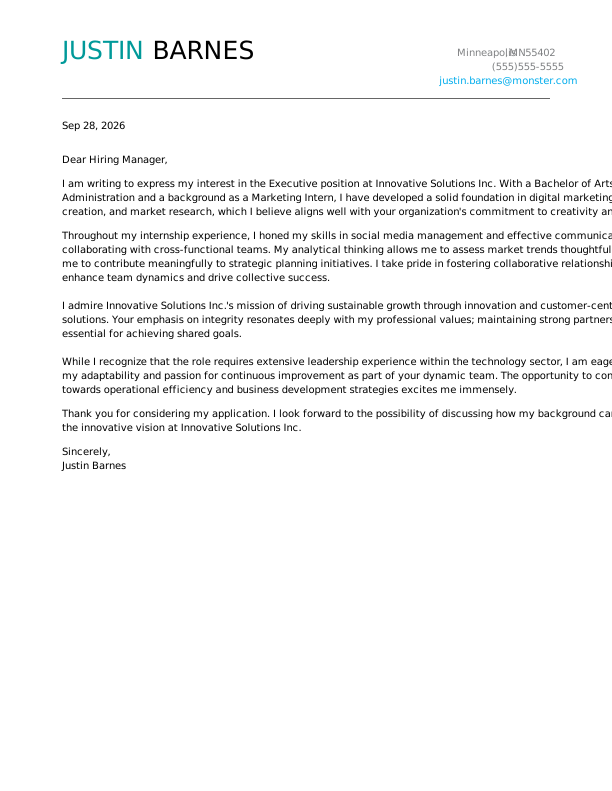
 Free
Executive Entry-Level Cover Letter
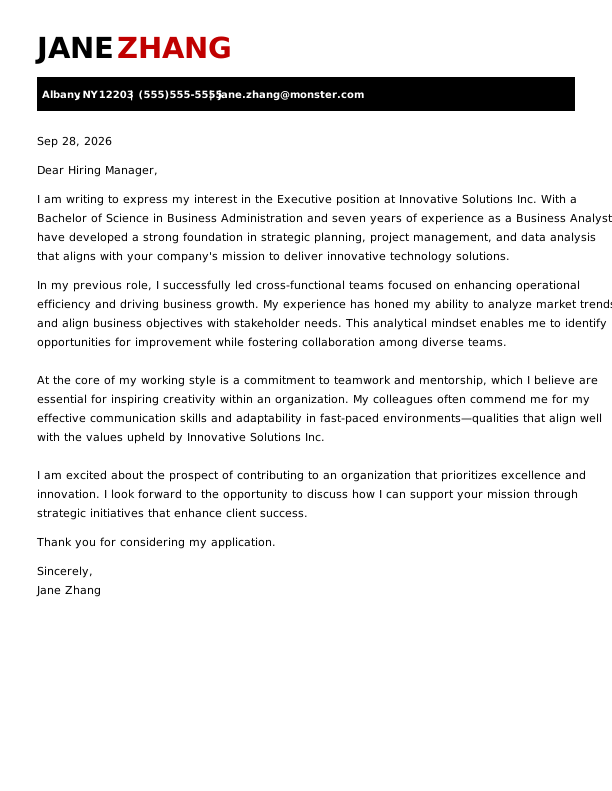
Executive Mid-Level Cover Letter
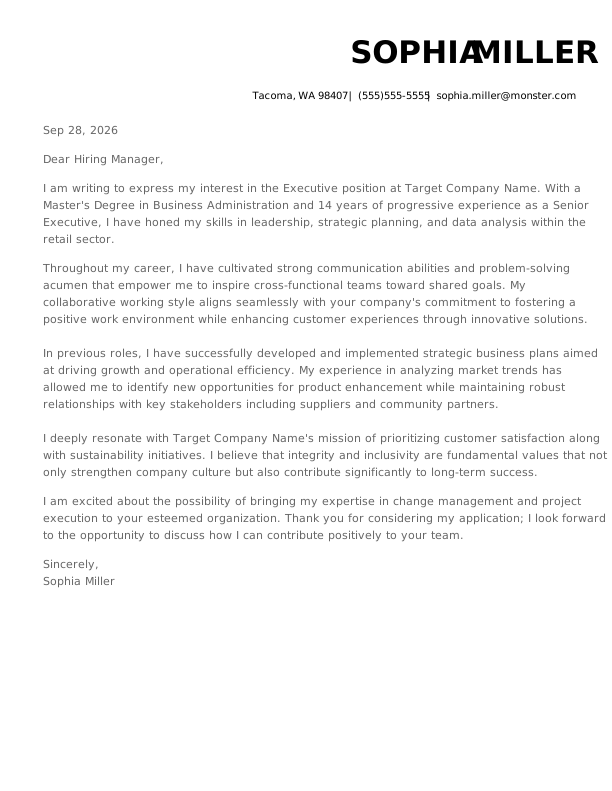
Executive Experienced Cover Letter
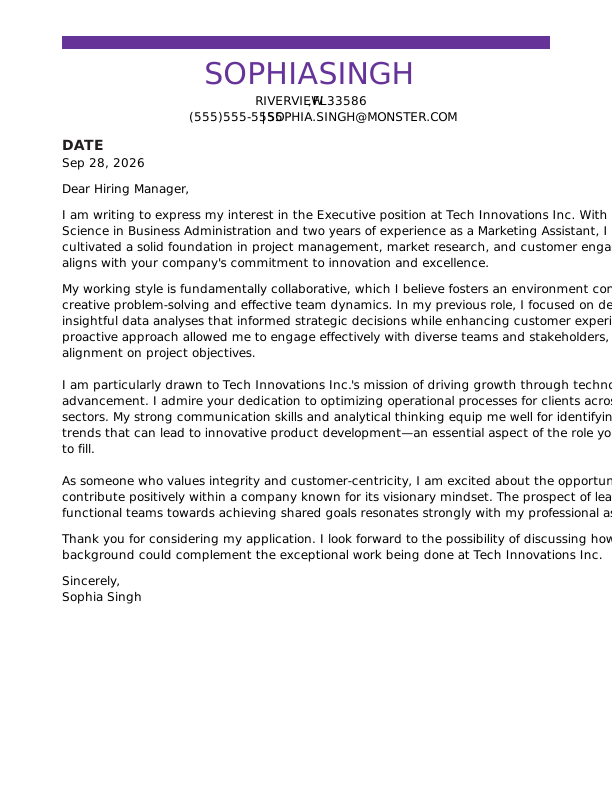
Executive Entry-Level Cover Letter
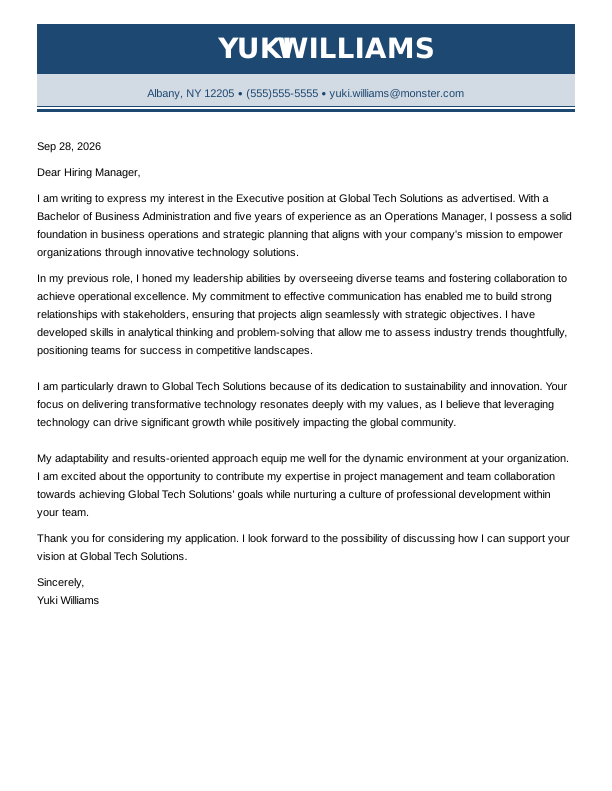
Executive Mid-Level Cover Letter
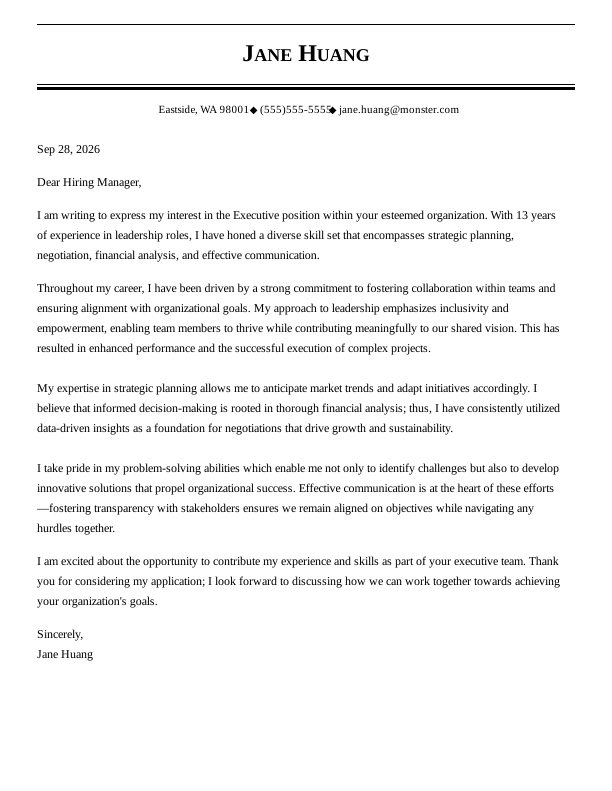
Executive Experienced Cover Letter
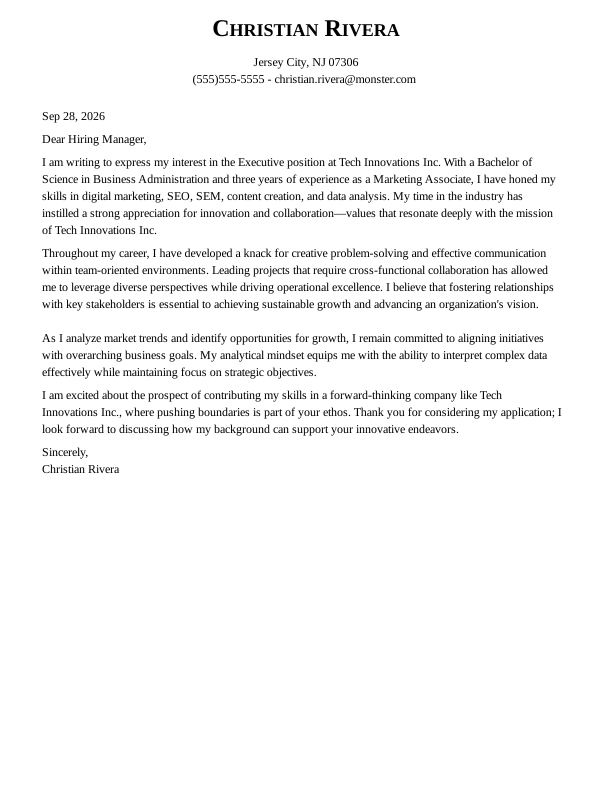
Executive Entry-Level Cover Letter
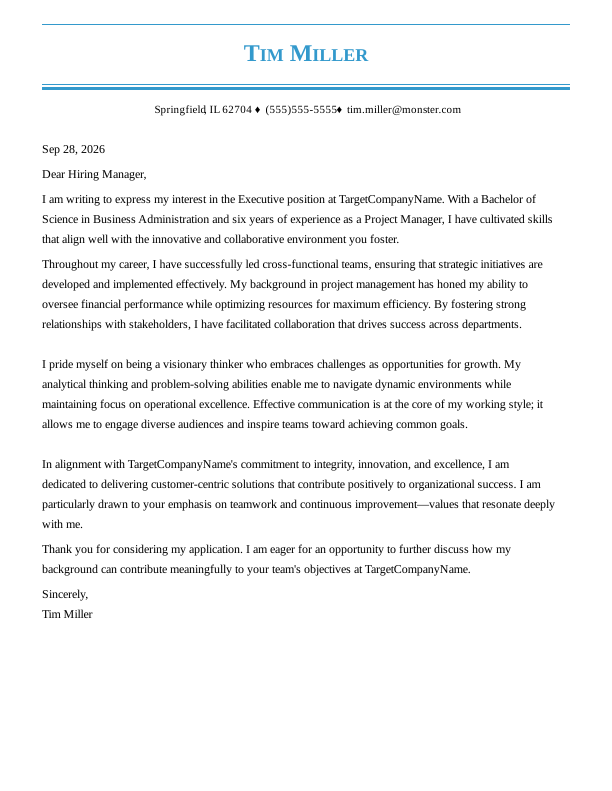
Executive Mid-Level Cover Letter
Browse Free Cover Letter Templates
- Academic
- Account Manager
- Accountant
- Accounts Payable
- Administrative Assistant
- Admissions Counselor
- Architecture
- Artist
- Assistant Principal
- Babysitter
- Barista
- Bartender
- Bookkeeper
- Brand Ambassador
- Business Analyst
- Business
- Caregiver
- Chef
- Civil Engineering
- Computer Science
- Construction
- Consulting
- Copywriter
- Cosmetology
- Custodian
- Customer Service
- Customer Service Representative
- Data Analyst
- Data Entry
- Dental Assistant
- Dental Hygienist
- Digital Marketing
- Electrical Engineering
- Emt
- Engineering
- Esthetician
- Event Coordinator
- Executive Assistant
- Finance
- Financial Analyst
- Firefighter
- Flight Attendant
- Graphic Designer
- Hair Stylist
- Healthcare
- Hr Generalist
- Investment Banking
- It
- Janitor
- Journalism
- Lab Technician
- Law Clerk
- Lawyer
- Librarian
- Logistics
- Makeup Artist
- Manager
- Marketing Coordinator
- Marketing
- Marketing Manager
- Massage Therapist
- Mechanic
- Mechanical Engineer
- Medical Assistant
- Non Profit
- Nursing
- Occupational Therapy
- Office Assistant
- Office Manager
- Operations Manager
- Paralegal
- Personal Trainer
- Pharmacist
- Pharmacy Technician
- Photographer
- Physician Assistant
- Pilot
- Police Officer
- Program Manager
- Project Manager
- Property Manager
- Psychology
- Receptionist
- Research Assistant
- Restaurant Manager
- Retail
- Sales
- Sales Manager
- School Counselor
- Security Officer
- Social Work
- Software Engineer
- Special Education Teacher
- Substitute Teacher
- Teacher
- Teaching Assistant
- Truck Driver
- Vet Tech
- Veterinary Assistant
- Web Developer
Cover Letter Examples for Executives
Explore sample executive cover letters tailored across different leadership levels to present your executive qualifications effectively.
Entry-Level Executive Cover Letter
Discover how emerging leaders introduce core management competencies and transferable strategic successes when applying for executive roles.
Mid-Career Executive Cover Letter
Review how mid-level leaders present cross-functional team direction, project execution, and data-driven achievements clearly.
Experienced Executive Cover Letter
See how senior leaders articulate executive vision, organizational transformation, and long-term business strategy.
Executive Cover Letter Template (Text)
Copy this executive cover letter text into your document and adapt it by swapping in your leadership metrics, board-ready achievements, and target company.
Jane Jones
Newark, NJ 07102
(555)555-5555
jane.jones@monster.com
Sep 28, 2026
Dear Hiring Manager,
I am writing to express my interest in the Executive position at Tech Innovations Inc. With a Bachelor of Business Administration in Business Management and nine years of experience as a Project Manager, I have honed my skills in strategic planning, project management, and team leadership within dynamic environments.
Throughout my career, I have focused on fostering collaboration among stakeholders to achieve shared objectives. My ability to communicate effectively has enabled me to build strong relationships with clients and team members alike, driving innovative solutions that align with organizational goals. I am particularly drawn to Tech Innovations Inc.’s commitment to transforming the technological landscape through cutting-edge solutions.
In my previous roles, I have successfully led teams toward operational excellence by implementing data-driven strategies that address industry challenges while enhancing efficiency. My adaptability and attention to detail allow me to navigate complex situations effectively while maintaining a focus on quality outcomes.
I resonate deeply with your mission of exceeding client expectations through integrity and innovation. As someone who thrives in collaborative settings, I believe that my visionary mindset will contribute positively to your executive team as we work together on advancing Tech Innovations Inc.’s objectives.
Thank you for considering my application. I look forward to the opportunity for further discussion about how my background can support the ongoing success of your organization.
Sincerely,
Jane Jones
How to Write a Executive Cover Letter
Writing a persuasive executive cover letter requires aligning your strategic vision with the company’s specific growth objectives. Follow these straightforward steps to draft a clear narrative that emphasizes your leadership outcomes.
1. Research & Prepare
Gain insights into the target organization before writing so you can address their key strategic focus directly. Use these research actions to prepare your message:
- Review the company’s most recent annual report for stated strategic priorities and KPIs.
- Scan the job posting for named tools or governance systems tied to executive responsibilities.
- Read recent press releases or credible industry news about major initiatives to reference in your letter.
2. Hook the Reader
Start with a strong opening statement that demonstrates immediate leadership value and operating scale. Choose a strong lead-in formula like these examples:
- Operating metrics: “I led a turnaround that reduced days sales outstanding from 62 to 41 by renegotiating payment terms and tightening collections workflows across three regions.”
- Board-ready governance: “As VP of operations, I built an executive KPI dashboard in Power BI and presented monthly risk reviews to the CFO and audit committee, cutting avoidable rework costs by 18%.”
- Strategic growth execution: “I drove a new go-to-market initiative that moved enterprise onboarding from 45 to 28 days by standardizing implementation playbooks and adding Salesforce-based pipeline controls.”
3. Tell Your Professional Story
Illustrate your leadership approach through concise, metric-backed accomplishments rather than passive job descriptions. Incorporate concrete results like these:
- Reduced annual operating expenses by $6.2 million in 12 months after renegotiating vendor contracts and consolidating overlapping programs.
- Improved EBITDA margin from 14% to 18% over two fiscal years by aligning pricing, forecasting, and cost controls across business units.
- Led a reorganization that cut time-to-hire from 70 days to 45 days while maintaining a 92% first-year retention rate for new managers.
4. Showcase Your Skills
Connect your strategic skill set directly to core business demands. Focus on critical leadership competencies like these examples:
- Board-ready communication: “I translated an underperforming quarter into plain options for the board and led the discussion to a clear next step.”
- Budget and forecasting: “I rebuilt our forecast model in Excel after new pipeline data changed assumptions, then walked finance through what shifted and why.”
- Cross-functional alignment: “I chaired a weekly exec sync where I asked each leader for their risks and dependencies, then documented decisions so teams could move without second-guessing.”
5. Explain Any Special Circumstances
Address career transitions or employment gaps concisely before returning to your core leadership strengths. Consider these straightforward approaches:
- “After a six-month sabbatical between roles, I kept current by chairing a quarterly OKR review for my board-advised portfolio and updating our risk dashboard in Q2.”
- “I am pivoting from operations leadership into product strategy by leading discovery workshops and rolling out a roadmap cadence using Jira Align and RICE scoring.”
- “After relocating from Austin to Raleigh, I reconnected with local investor networks and have been actively advising as an interim CFO on monthly close processes using NetSuite.”
6. End With a Professional Goodbye
Conclude your letter with a polite, proactive closing statement that encourages next steps while thanking the reader for their time.
In paragraph two, use inline wording like “I’d appreciate the chance to discuss how your growth strategy will be led across finance, operations, and people priorities.” Then add “Thank you for your time reviewing my application.” Finish with “Sincerely” or “Best regards.”
4 Tips for Formatting Your Cover Letter
Clean layout and structured visual presentation ensure hiring managers can easily digest your career highlights during an initial review. Thoughtful spacing, consistent headers, and standardized typography establish an organized, executive impression immediately.

Use a Professional Font & Layout
Select clean, highly readable fonts such as Arial, Helvetica, or Calibri set to 10–12 pt. Maintain 1-inch margins across the entire document to keep the text well-balanced and printable.

Match Your Header to Your Resume
Align your cover letter header design, font choices, and contact details with your resume header to present a polished, unified application packet.

Use Bullet Points for Key Achievements
Organize three to four core achievements into bullet points so recruiters can quickly locate revenue growth, cost management, and key leadership outcomes.

Balance Spacing & Margins
Use 1.0–1.15 line spacing and leave clear paragraph breaks to ensure comfortable spacing and avoid dense blocks of text.
Top-Paying States for Executive Roles
Knowing what executives earn can help you compare offers, plan your next move, and negotiate with confidence. Salary figures below are based on the U.S. Bureau of Labor Statistics (BLS) and reflect the latest nationwide averages for executive-level roles.
Keep in mind that your actual pay can vary widely. Location, industry, company size, and years of leadership experience often make a difference. Specialty areas like technology or healthcare may also affect compensation, as can performance-based incentives and bonus structures.
| Alabama | $207,190 |
| Alaska | $211,500 |
| Arizona | $213,280 |
| Arkansas | $177,460 |
| California | $289,530 |
| Connecticut | $393,930 |
| Delaware | $233,680 |
| District of Columbia | $344,670 |
| Florida | $69,770 |
| Georgia | $265,000 |
| Hawaii | $280,020 |
| Idaho | $215,780 |
| Illinois | $315,570 |
| Indiana | $290,710 |
| Iowa | $211,710 |
| Kansas | $196,580 |
| Kentucky | $208,380 |
| Louisiana | $175,570 |
| Maine | $184,010 |
| Maryland | $292,170 |
| Massachusetts | $324,340 |
| Michigan | $285,020 |
| Minnesota | $243,330 |
| Mississippi | $155,210 |
| Missouri | $197,780 |
| Montana | $233,880 |
| Nebraska | $240,320 |
| Nevada | $276,150 |
| New Hampshire | $193,280 |
| New Jersey | $465,040 |
| New Mexico | $163,510 |
| New York | $343,030 |
| North Carolina | $327,180 |
| North Dakota | $232,120 |
| Ohio | $273,990 |
| Oklahoma | $177,610 |
| Oregon | $362,310 |
| Pennsylvania | $282,200 |
| Rhode Island | $290,840 |
| South Carolina | $221,870 |
| South Dakota | $357,220 |
| Tennessee | $223,350 |
| Texas | $72,190 |
| Utah | $204,600 |
| Vermont | $220,500 |
| Virginia | $336,960 |
| Washington | $343,950 |
| West Virginia | $203,960 |
| Wisconsin | $284,090 |
| Wyoming | $159,580 |
| Guam | $131,250 |
| Puerto Rico | $120,050 |
| Virgin Islands | $151,670 |
Key Takeaways
- Lead with concrete strategic outcomes and measurable leadership achievements that highlight your business impact.
- Tailor your experience to address the employer’s specific organizational stage, whether focused on rapid scaling, cost optimization, or governance.
- Keep document formatting clean, modern, and perfectly aligned with your resume layout for a cohesive executive presentation.
More Cover Letter Examples
Browse Monster’s Resume Templates
Monster also has hundreds of ATS-friendly resume templates for all career levels and industries. Create a matching resume to help you land the interview.
- Assistant Project Manager
- Associate Product Manager
- Benefits Specialist
- Business Administration
- Business Development
- Business Management
- Business Manager
- Business Operations
- Business Owner
- Business
- Ceo
- Change Manager
- Chief Of Staff
- Ciso
- Community Outreach Coordinator
- Coo
- Corporate Trainer
- Director Of Operations
- Director
- Entrepreneur
- Executive Director
- Executive Manager
- Executive Recruiter
- Executive
- Freelance
- General Manager
- Healthcare Management
- Hr Analyst
- Hr Business Partner
- Hr Consultant
- Hr Coordinator
- Hr Director
- Hr Manager
- Hr Specialist
- Managing Director
- Onboarding Specialist
- Operations Manager
- Program Coordinator
- Program Director
- Program Manager
- Project Coordinator
- Project Manager
- Recruiter
- Recruiting Coordinator
- Recruitment Coordinator
- Regional Manager
- Risk Management
- Senior Manager
- Senior Program Manager
- Senior Project Manager
- Senior Recruiter
- Small Business Owner
- Supervisor
- Talent Acquisition Specialist
- Team Leader
- Technical Recruiter
- Training Manager
- Vice President
Frequently Asked Questions
Last Update:
Do I really need a cover letter?
Including an executive cover letter is highly recommended because it provides essential context for your strategic vision and leadership achievements. It allows you to explain the key motivations behind your career milestones and demonstrate clear alignment with the company’s long-term objectives.
How long should my cover letter be?
An executive cover letter should ideally be three to four short paragraphs long, keeping the total word count between 250 and 400 words. Keeping your letter to a single page ensures hiring teams can scan your core qualifications and impact metrics quickly.
Should my cover letter match my resume?
Matching your cover letter design to your resume is best practice because visual consistency creates a professional, cohesive application package. Using identical headers, fonts, and margin structures signals attention to detail and reinforces your personal executive brand across both documents seamlessly.
How do I address my cover letter if I don’t know the hiring manager’s name?
Addressing your cover letter properly when a name is unavailable involves addressing the specific hiring team or executive board directly. You can use standard professional salutations like “Dear Hiring Committee” or “Dear Executive Leadership Team” to maintain a respectful and contemporary tone throughout your greeting.
Can I use AI to write my cover letter?
Using AI as an initial brainstorming tool can help you structure ideas and outline your cover letter draft efficiently. However, you should thoroughly personalize the final draft with your specific operational wins, leadership metrics, and authentic voice so it effectively reflects your actual career achievements.

Vicki Salemi is a nationally recognized career expert who helps professionals navigate the hiring landscape and find the right fit on Monster. With over 15 years of experience in corporate recruiting and HR, she offers expert guidance on job search strategies, interview preparation, and career development to help candidates land their next role.
See More From Vicki SalemiExplore Related Career Advice







How to Write a Cover Letter for Internal Positions or Promotions (Examples & Tips)

Updated:
Apr 23, 2026
|
19 min read


Cover Letter vs Resume: What’s the Difference & Do You Need Both?

Updated:
Apr 23, 2026
|
18 min read