

Free Electrician Cover Letter Templates & Examples
A strong electrician cover letter shows you can deliver safe, code-compliant electrical work while troubleshooting issues and following jobsite procedures. Our free cover letter examples and step-by-step guidance help you write a clear, confident application that highlights your experience to hiring managers.
Real-World Cover Letters That Get Results
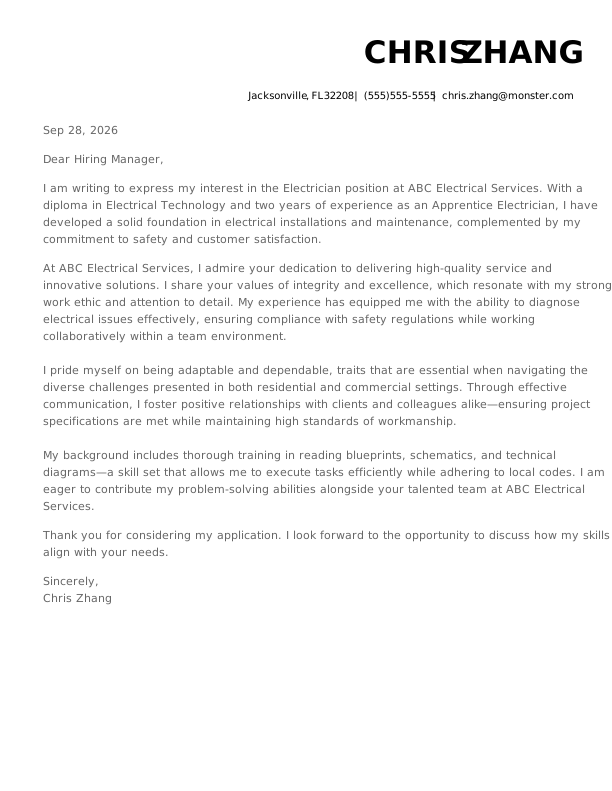
 Free
Electrician Entry-Level Cover Letter
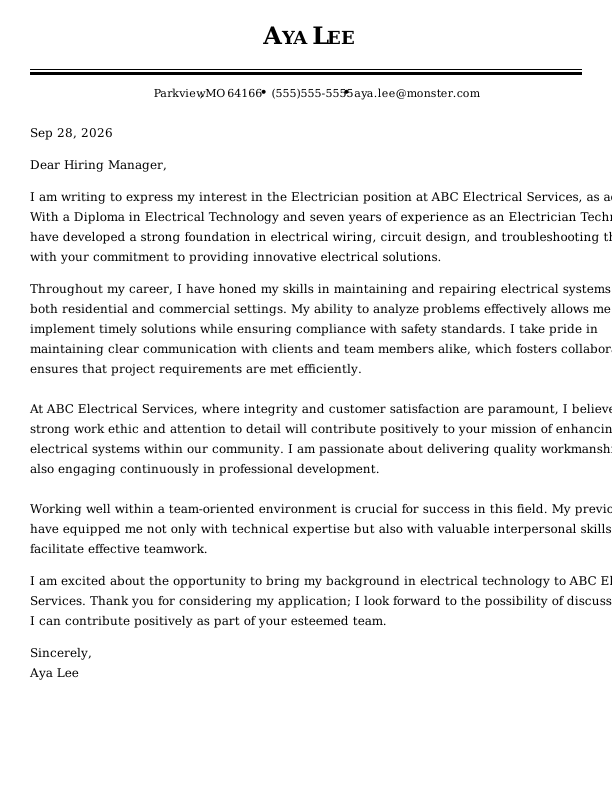
Electrician Mid-Level Cover Letter
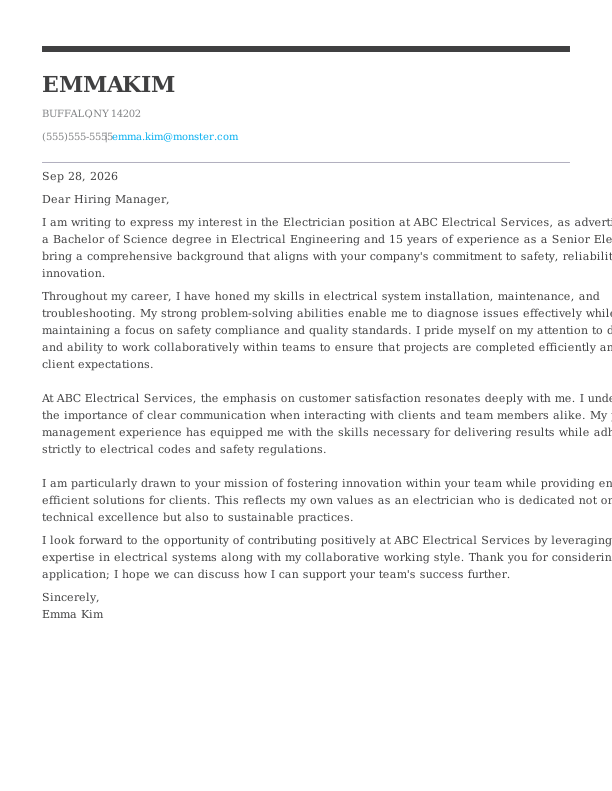
Electrician Experienced Cover Letter
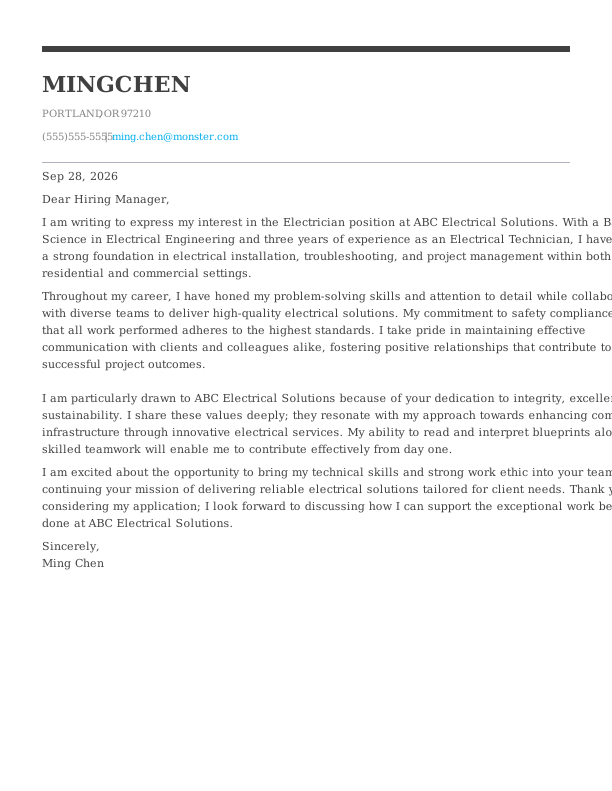
Electrician Entry-Level Cover Letter
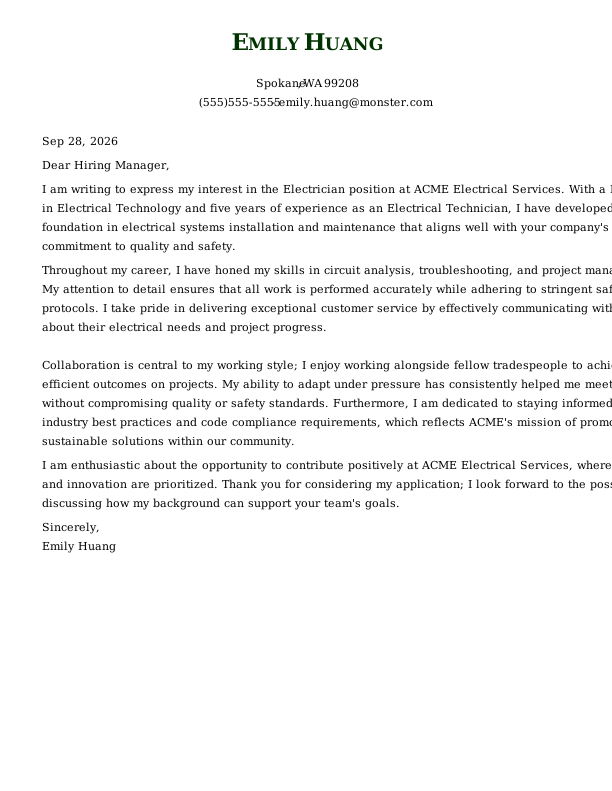
Electrician Mid-Level Cover Letter
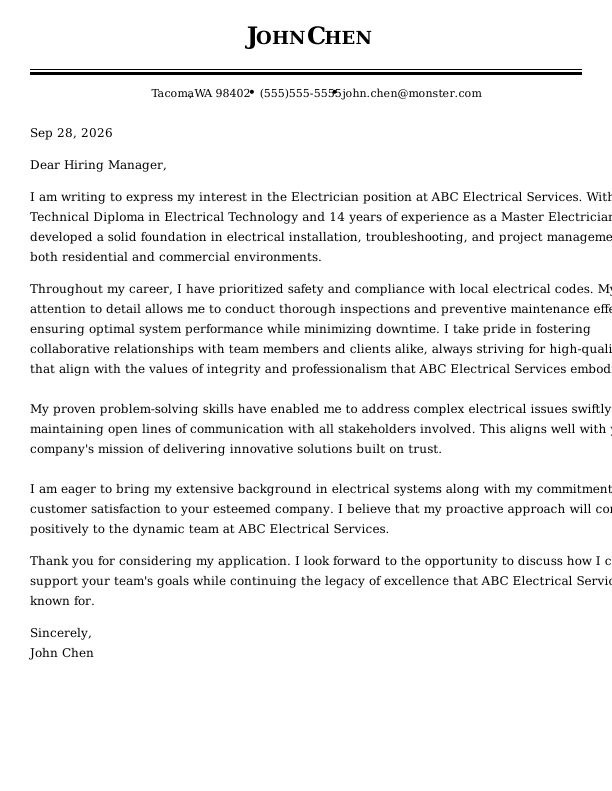
Electrician Experienced Cover Letter
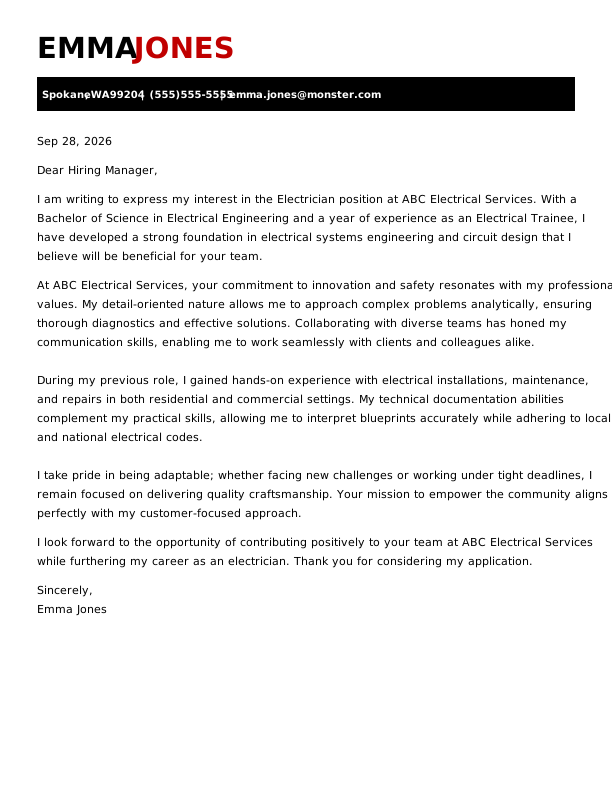
Electrician Entry-Level Cover Letter
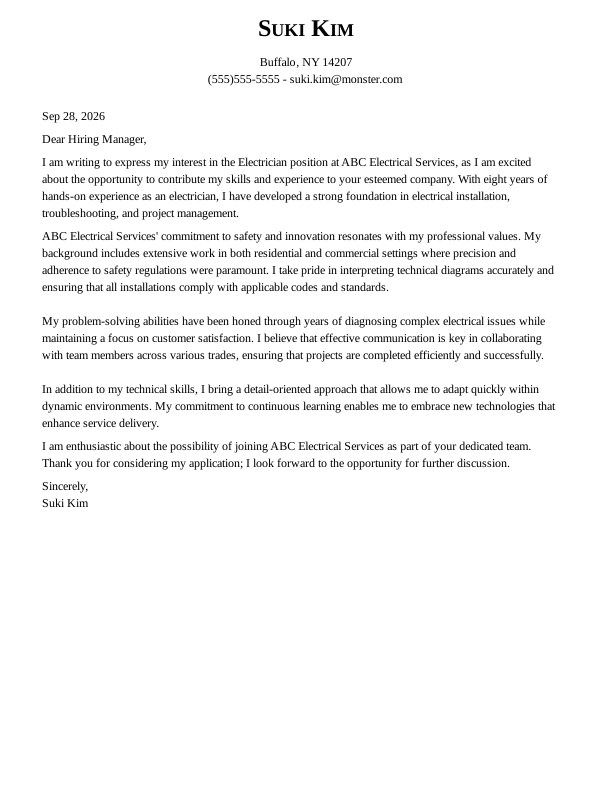
Electrician Mid-Level Cover Letter
Browse Free Cover Letter Templates
- Academic
- Account Manager
- Accountant
- Accounts Payable
- Administrative Assistant
- Admissions Counselor
- Architecture
- Artist
- Assistant Principal
- Babysitter
- Barista
- Bartender
- Bookkeeper
- Brand Ambassador
- Business Analyst
- Business
- Caregiver
- Chef
- Civil Engineering
- Computer Science
- Construction
- Consulting
- Copywriter
- Cosmetology
- Custodian
- Customer Service
- Customer Service Representative
- Data Analyst
- Data Entry
- Dental Assistant
- Dental Hygienist
- Digital Marketing
- Electrical Engineering
- Emt
- Engineering
- Esthetician
- Event Coordinator
- Executive Assistant
- Finance
- Financial Analyst
- Firefighter
- Flight Attendant
- Graphic Designer
- Hair Stylist
- Healthcare
- Hr Generalist
- Investment Banking
- It
- Janitor
- Journalism
- Lab Technician
- Law Clerk
- Lawyer
- Librarian
- Logistics
- Makeup Artist
- Manager
- Marketing Coordinator
- Marketing
- Marketing Manager
- Massage Therapist
- Mechanic
- Mechanical Engineer
- Medical Assistant
- Non Profit
- Nursing
- Occupational Therapy
- Office Assistant
- Office Manager
- Operations Manager
- Paralegal
- Personal Trainer
- Pharmacist
- Pharmacy Technician
- Photographer
- Physician Assistant
- Pilot
- Police Officer
- Program Manager
- Project Manager
- Property Manager
- Psychology
- Receptionist
- Research Assistant
- Restaurant Manager
- Retail
- Sales
- Sales Manager
- School Counselor
- Security Officer
- Social Work
- Software Engineer
- Special Education Teacher
- Substitute Teacher
- Teacher
- Teaching Assistant
- Truck Driver
- Vet Tech
- Veterinary Assistant
- Web Developer
Cover Letter Examples for Electricians
Cover letter expectations change as an electrician’s career progresses from apprenticeship work to supervising jobs and managing safety documentation. Choose the template that matches your experience level so you can emphasize the right skills, certifications, and completed projects for your stage.
Entry-Level Electrician Cover Letter
Designed for recent graduates writing a cover letter with no experience, this template also supports career changers transitioning into electrician roles.
Mid-Career Electrician Cover Letter
Built for electricians a few years into the trade, this template fits professionals who supervise job sites, specialize in service or panel work, and hold current licensing.
Experienced Electrician Cover Letter
Best suited to experienced electricians with close to a decade in the field, this template fits those who oversee jobsite teams and own electrical system installation, troubleshooting, and code-compliant safety planning.
Electrician Cover Letter Template (Text)
Copy this electrician cover letter text, paste it into your document, and swap in your licenses, trade projects, or employer name to fit the role.
Daniel Brown
Jersey City, NJ 07309
(555)555-5555
daniel.brown@monster.com
Sep 28, 2026
Dear Hiring Manager,
I am writing to express my interest in the electrician position at XYZ Electrical Services, as advertised. With a BS in electrical engineering and four years of hands-on experience as an electrical technician, I am eager to contribute my technical skills and collaborative spirit to your esteemed company.
Throughout my career, I have honed my abilities in electrical installation and circuit design while ensuring adherence to safety protocols. My experience has equipped me with strong troubleshooting skills that allow me to efficiently identify issues and implement effective solutions. I take pride in delivering quality workmanship that aligns with industry standards.
At the core of my professional ethos is a commitment to teamwork. I believe that collaboration enhances problem-solving capabilities and fosters innovation, both essential elements at XYZ Electrical Services. My leadership skills enable me to motivate those around me while maintaining clear communication with clients about project requirements and progress.
I appreciate your mission of providing exceptional electrical services grounded in integrity and customer satisfaction. The opportunity to work within an organization that values continuous improvement resonates deeply with my professional aspirations.
I look forward to the possibility of discussing how I can support your team at XYZ Electrical Services by contributing not only technical expertise but also a proactive attitude towards learning and growth within this role.
Thank you for considering my application.
Sincerely,
Daniel Brown
How to Write an Electrician Cover Letter
Writing a strong electrician cover letter means showing how your hands-on experience with wiring, troubleshooting, and safety translates directly to the job. Use these six steps to organize your background and stand out to hiring managers:
1. Research & Prepare
Before writing, research the employer’s specific needs, whether that’s commercial builds, industrial maintenance, or residential service. Knowing the company’s focus helps you highlight the right codes, tools, and projects.
Use these key prep steps to gather details for your draft:
- Review the job posting for required certifications, like a Journeyman license, and key tools or equipment.
- Scan OSHA’s electrical safety standards to see which hazards, like arc flash or lockout/tagout, the employer prioritizes.
- Check local trade news or construction permits to gauge upcoming project timelines and workloads.
2. Hook the Reader
Skip generic intros like “I am applying for the electrician role.” Instead, grab attention immediately with an opening line that proves you can read job specs, follow codes, and keep power running safely.
Here are a few ways to structure a strong hook based on your background:
- Code-first troubleshooting: “On a recent retrofit, I traced a recurring GFCI trip by checking as-built drawings, verified grounding continuity, and corrected the breaker wiring to eliminate callouts.”
- Panel and load planning: “For a 45-unit improvement project, I planned rough-in steps so feeders landed before drywall, labeling breakers to cut commissioning time by 30%.”
- Safety and compliance leadership: “After moving to the night shift, I led weekly lockout/tagout audits and logged zero safety violations while running conduit under NEC codes.”
3. Tell Your Professional Story
While your resume lists job duties, your cover letter highlights how fast and effectively you work. Concrete numbers give hiring managers a clear picture of your efficiency and work quality.
Here are examples of how to frame your impact with numbers:
- Completed 120 preventive maintenance inspections monthly, keeping repeat callouts below 2% within 90 days.
- Cut panel-related service calls by 25% by updating diagnostic steps and documenting findings in the ticketing system.
- Generated $18,500 in labor savings over six months by organizing material staging and reducing job overruns from 12% to 5%.
4. Showcase Your Skills
Rather than listing generic qualities like “detail-oriented,” describe a real-world scenario where you applied your technical expertise or safety protocols on the job.
Use these examples to connect your core skills to everyday site tasks:
- Electrical troubleshooting: “I used a multimeter to trace a no-power issue from panel to receptacle, verifying voltage stability before restoring service.”
- Compliance and safety: “I applied lockout/tagout when replacing a faulty disconnect, testing for absence of voltage before touching any wiring.”
- Customer communication: “I explained the system failure to the homeowner in plain terms and outlined my fix before making any wall cuts.”
5. Explain Any Special Circumstances
If you have an employment gap, career shift, or recent relocation, address it in one or two clear sentences. Focus on your active licenses and readiness to hit the ground running.
Here’s how you can briefly explain common background shifts:
- Career gap: “During my six months between projects, I maintained my active Journeyman license by studying local code updates and practicing diagnostics.”
- Career transition: “I am moving from residential service to commercial installs after completing my OSHA 30-hour training and assisting on conduit runs.”
- Relocation: “I recently relocated from Texas to Arizona, and my license has been transferred so I am ready for work on day one.”
6. End With a Professional Goodbye
Wrap up with a brief, professional closing that proposes a logical next step. Skip passive phrases like “I look forward to hearing from you” in favor of something specific.
Use this simple template to close your letter on a high note:
- Offer a specific topic to discuss: “I’d be glad to review your site safety standards and discuss how my conduit installation meets NEC codes.”
- Express gratitude: “Thank you for your time and consideration.”
- End with a classic sign-off: “Best regards,” followed by your name.
4 Tips for Formatting Your Cover Letter
Hiring managers often scan cover letters in under a minute, so your trade credentials, licenses, and field experience need to stand out immediately. Whether you’re applying for an apprentice role or a journeyman position, these formatting tips will keep your letter clean and easy to read.

Keep It to One Page
Busy site supervisors rarely have time to read long letters. Keep your letter between 250 and 400 words across three or four short paragraphs, highlighting your license, core skills, and a key safety win.

Use Bullet Points for Key Achievements
Break up your text with three or four bullet points to feature your best achievements. This helps recruiters quickly spot key metrics like safety records, response times, and completed inspections without digging through dense text.

Balance Spacing & Margins
Set line spacing between 1.0 and 1.15, and leave a blank line between paragraphs to give the page breathing room. Keep margins even at 0.75 to 1 inch so your layout looks polished on screen and in print.

Save & Send as a PDF
Always save your letter as a PDF to preserve your layout across different screens and applicant tracking systems. Use a simple file format like Firstname_Lastname_Cover_Letter.pdf so hiring managers can find your file easily.
Top-Paying States for Electrician Roles
Knowing what electricians earn across the country helps you compare offers, plan your next steps, and negotiate with confidence. Salary data in this summary is based on the U.S. Bureau of Labor Statistics (BLS) and reflects recent nationwide averages for electricians.
Keep in mind that your actual pay can vary based on location, years of experience, specialty (like residential wiring or industrial work), and whether you’re working for a contractor, utility, or other employer type. Union membership and licensing can also affect earnings.
| Alabama | $56,340 |
| Alaska | $83,520 |
| Arizona | $61,520 |
| Arkansas | $52,860 |
| California | $85,780 |
| Connecticut | $74,170 |
| Delaware | $67,900 |
| District of Columbia | $90,800 |
| Florida | $55,490 |
| Georgia | $61,590 |
| Hawaii | $86,690 |
| Idaho | $62,180 |
| Illinois | $89,190 |
| Indiana | $67,890 |
| Iowa | $63,910 |
| Kansas | $65,470 |
| Kentucky | $60,660 |
| Louisiana | $59,530 |
| Maine | $71,460 |
| Maryland | $72,390 |
| Massachusetts | $82,140 |
| Michigan | $71,060 |
| Minnesota | $83,030 |
| Mississippi | $54,810 |
| Missouri | $71,230 |
| Montana | $68,080 |
| Nebraska | $61,890 |
| Nevada | $72,120 |
| New Hampshire | $63,440 |
| New Jersey | $80,090 |
| New Mexico | $59,420 |
| New York | $83,350 |
| North Carolina | $55,370 |
| North Dakota | $70,330 |
| Ohio | $65,970 |
| Oklahoma | $62,850 |
| Oregon | $91,950 |
| Pennsylvania | $73,510 |
| Rhode Island | $70,760 |
| South Carolina | $58,420 |
| South Dakota | $57,660 |
| Tennessee | $59,530 |
| Texas | $57,250 |
| Utah | $63,010 |
| Vermont | $61,220 |
| Virginia | $66,630 |
| Washington | $93,840 |
| West Virginia | $65,890 |
| Wisconsin | $72,760 |
| Wyoming | $72,260 |
| Guam | $43,040 |
| Puerto Rico | $39,320 |
| Virgin Islands | $72,950 |
Key Takeaways
- Open your letter with a strong hook that highlights your ability to read specs, execute safe troubleshooting, and handle real jobsite challenges.
- Prove your value using concrete numbers like reduced callback rates, safety audit records, and labor savings.
- Tailor your experience to the employer’s domain while keeping your format scannable, professional, and under one page.
More Cover Letter Examples
Browse Monster’s Resume Templates
Monster also has hundreds of ATS-friendly resume templates for all career levels and industries. Create a matching resume to help you land the interview.
- Air Sealing Technician
- Aircraft Mechanic
- Auto Mechanic
- Automotive Technician
- Barber
- Blue Collar
- Boilermaker
- Budtender
- Cable Technician
- Carpenter
- Carpentry
- Cosmetologist
- Crane Operator
- Diesel Mechanic
- Diesel Technician
- Electrician
- Glazier
- Hair Stylist
- Handyman
- Hvac Installer
- Hvac Technician
- Industrial Electrician
- Ironworker
- Journeyman Electrician
- Landscaper
- Lineman
- Machinist
- Millwright
- Painter
- Pipe Fitter
- Plumber
- Roofer
- Solar Installer
- Structural Welder
- Welder
Frequently Asked Questions
Last Update:
Do I really need a cover letter?
Electrician roles strongly benefit from including a cover letter, even when the posting says it’s optional. A resume lists experience and certifications, but it cannot fully show the job-specific context behind your work or demonstrate genuine initiative to join that team.
A cover letter is especially valuable if you’re making a career transition, addressing an employment gap, or targeting a particular employer. For example, you can highlight your commitment to safe installation and facility upkeep while showing enthusiasm for meeting the site’s maintenance needs.
How long should my cover letter be?
An electrician cover letter should stay within one page or approximately 250–400 words. Hiring managers often review applications quickly, so concise messaging helps you stand out.
Focus on quality over quantity by using three to four short paragraphs. Highlight only your most relevant achievements or certifications, such as licenses, safety training, or project results.
Should my cover letter match my resume?
Yes, an electrician cover letter should match your resume’s formatting so it reads as one cohesive application package. Use the same font, colors, and header layout to keep the contact details consistent across both documents.
The text should complement rather than repeat your resume bullets. Expand on a key job accomplishment such as troubleshooting a recurring fault or explain what draws you to this organization and its work.
Can I use AI to write my cover letter?
Yes, AI tools can help an electrician with initial outlining, job-specific structure, and overcoming writer’s block. Still, personalization is essential because your work history, certifications, and site experience must drive the letter.
Use any AI-generated text only as a starting draft. Rewrite heavily with your own examples of installs or troubleshooting, mention relevant licenses and safety practices, and explain why you want this employer’s projects.
Should I mention salary expectations in my cover letter?
You should only mention salary expectations in an electrician cover letter if the job posting explicitly requests it. If it does, share a flexible, researched pay range based on local market data for electricians, and note you’re open to discussing total compensation such as benefits, bonuses, and any shift differentials.

Toni Frana is a Certified Professional Resume Writer (CPRW), member of the Professional Association of Resume Writers & Career Coaches, and career expert who empowers job seekers to take control of their career paths using Monster’s comprehensive job search and resume tools.
See More From Toni FranaExplore Related Career Advice







How to Write a Cover Letter for Internal Positions or Promotions (Examples & Tips)

Updated:
Apr 23, 2026
|
19 min read


Cover Letter vs Resume: What’s the Difference & Do You Need Both?

Updated:
Apr 23, 2026
|
18 min read