


Free Data Engineer Cover Letter Templates & Examples
A strong cover letter shows how your data engineering skills turn complex pipelines into reliable business results. Our templates and tips help you explain your technical experience in clear, simple language that hiring managers notice right away.
Real-World Cover Letters That Get Results
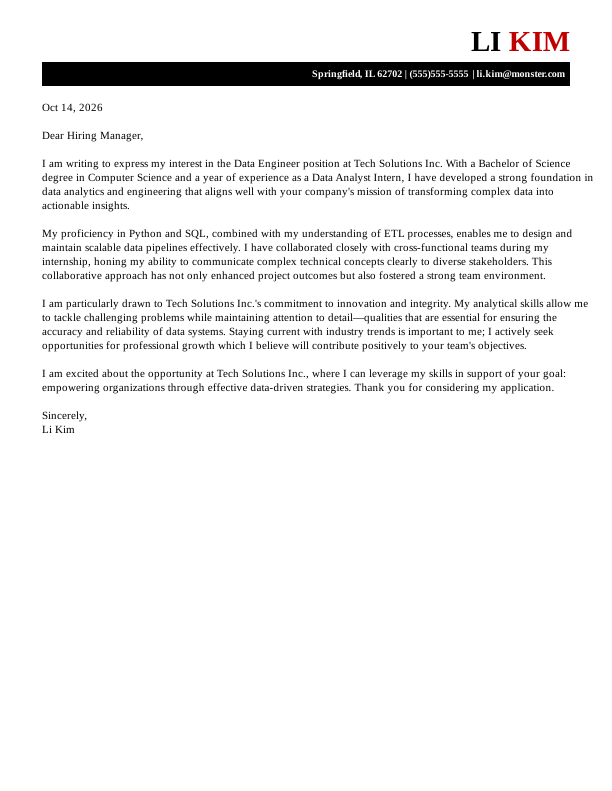
 Free
Data Engineer Entry-Level Cover Letter

Data Engineer Mid-Level Cover Letter
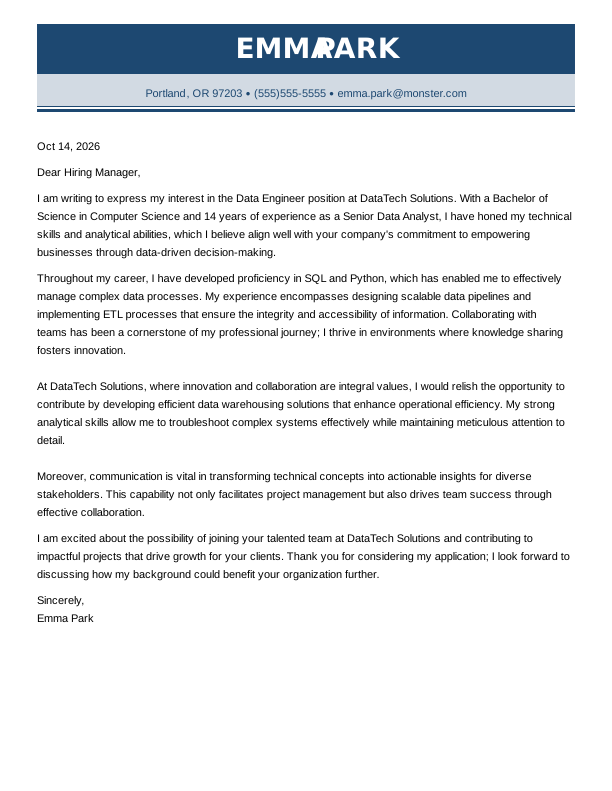
Data Engineer Experienced Cover Letter
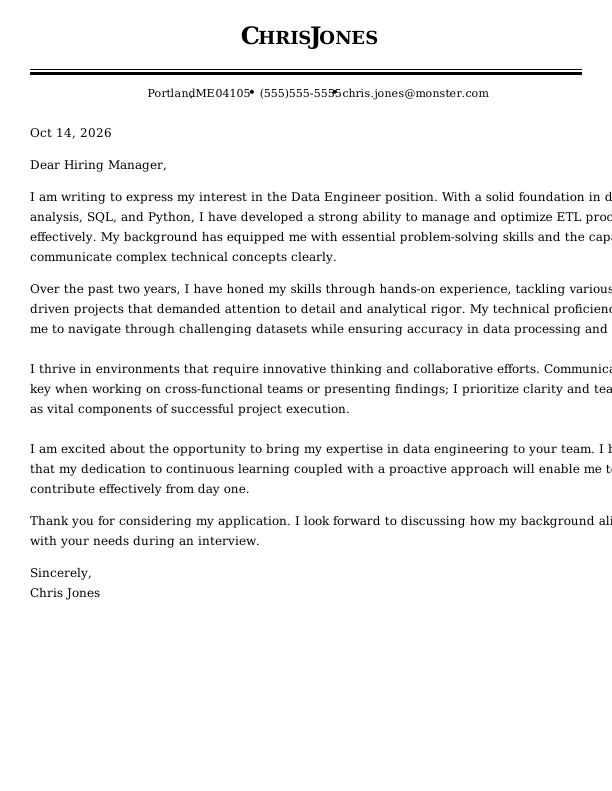
Data Engineer Entry-Level Cover Letter
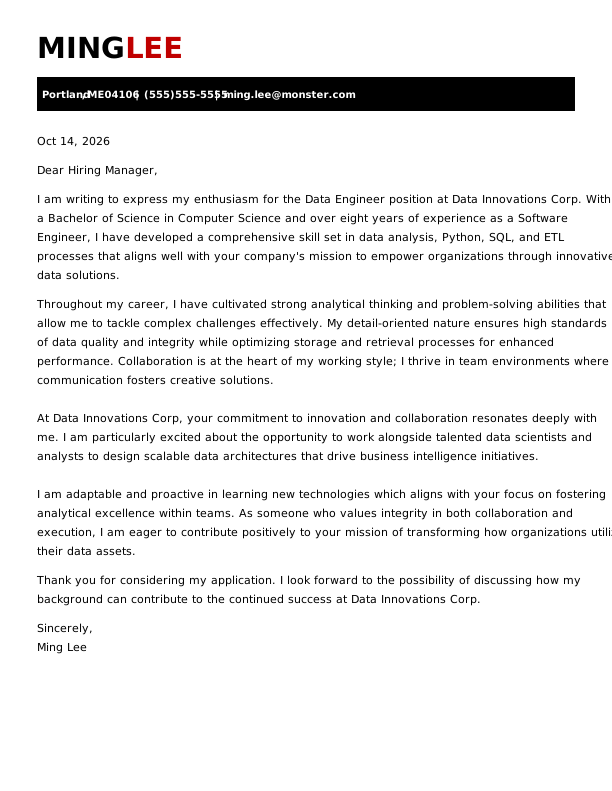
Data Engineer Mid-Level Cover Letter
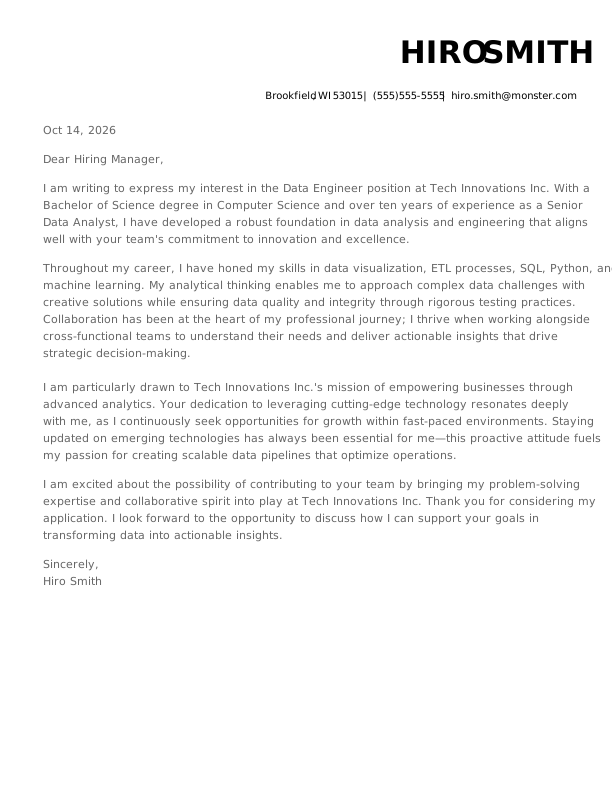
Data Engineer Experienced Cover Letter
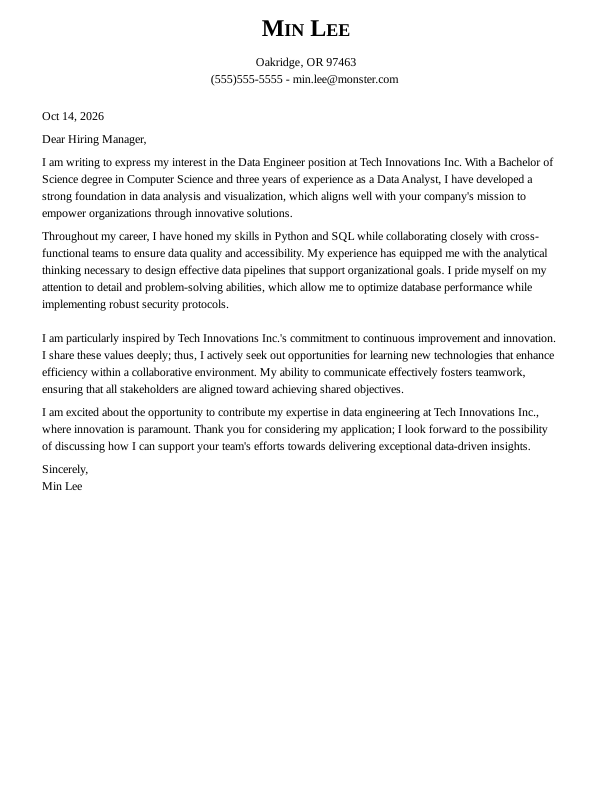
Data Engineer Entry-Level Cover Letter
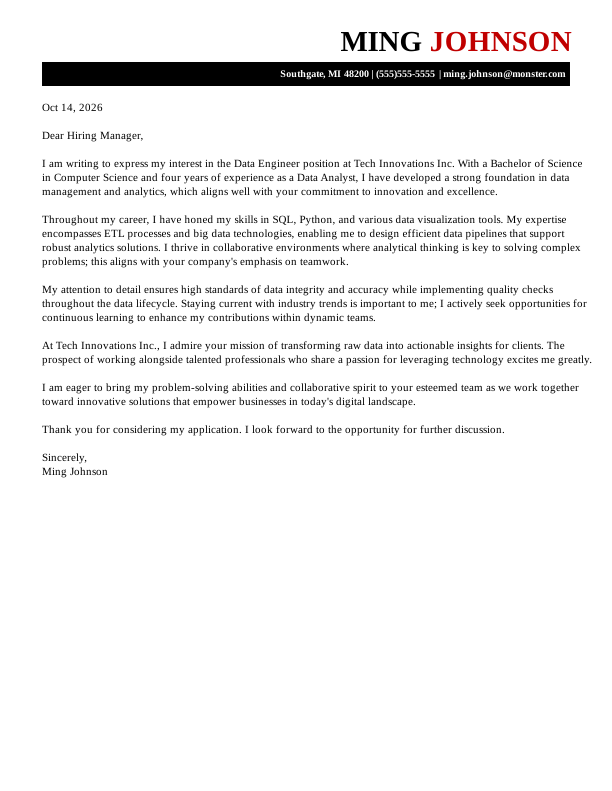
Data Engineer Mid-Level Cover Letter
Browse Free Cover Letter Templates
- Academic
- Account Manager
- Accountant
- Accounts Payable
- Administrative Assistant
- Admissions Counselor
- Architecture
- Artist
- Assistant Principal
- Babysitter
- Barista
- Bartender
- Bookkeeper
- Brand Ambassador
- Business Analyst
- Business
- Caregiver
- Chef
- Civil Engineering
- Computer Science
- Construction
- Consulting
- Copywriter
- Cosmetology
- Custodian
- Customer Service
- Customer Service Representative
- Data Analyst
- Data Entry
- Dental Assistant
- Dental Hygienist
- Digital Marketing
- Electrical Engineering
- Emt
- Engineering
- Esthetician
- Event Coordinator
- Executive Assistant
- Finance
- Financial Analyst
- Firefighter
- Flight Attendant
- Graphic Designer
- Hair Stylist
- Healthcare
- Hr Generalist
- Investment Banking
- It
- Janitor
- Journalism
- Lab Technician
- Law Clerk
- Lawyer
- Librarian
- Logistics
- Makeup Artist
- Manager
- Marketing Coordinator
- Marketing
- Marketing Manager
- Massage Therapist
- Mechanic
- Mechanical Engineer
- Medical Assistant
- Non Profit
- Nursing
- Occupational Therapy
- Office Assistant
- Office Manager
- Operations Manager
- Paralegal
- Personal Trainer
- Pharmacist
- Pharmacy Technician
- Photographer
- Physician Assistant
- Pilot
- Police Officer
- Program Manager
- Project Manager
- Property Manager
- Psychology
- Receptionist
- Research Assistant
- Restaurant Manager
- Retail
- Sales
- Sales Manager
- School Counselor
- Security Officer
- Social Work
- Software Engineer
- Special Education Teacher
- Starbucks
- Substitute Teacher
- Teacher
- Teaching Assistant
- Truck Driver
- Vet Tech
- Veterinary Assistant
Cover Letter Examples for Data Engineers
Your cover letter should reflect your current career stage, whether you are building your first pipelines or leading team-wide data platforms. Choose a sample below to see how to present your background effectively.
Entry-Level Data Engineer Cover Letter
This sample helps entry-level candidates and career changers showcase foundational skills and project experience confidently.
Mid-Career Data Engineer Cover Letter
This sample is designed for mid-level engineers who own production workflows and partner closely with analytics teams.
Experienced Data Engineer Cover Letter
This sample fits senior data engineers who lead high-impact infrastructure projects and drive enterprise data strategy.
Data Engineer Cover Letter Template (Text)
Copy this data engineer cover letter text, paste it into your document, and swap in your ETL projects, performance metrics, and target company.
Emily Banks
Parkview, MO 64155
(555)555-5555
emily.banks@monster.com
Oct 14, 2026
Dear Hiring Manager,
I am excited to apply for the Data Engineer position at Tech Solutions Inc. With a Bachelor of Science in Computer Science and seven years of experience as a Data Analyst, I have honed my skills in data analysis, SQL, Python, and data visualization. My background has provided me with a strong foundation in analytical thinking and problem-solving, which I believe aligns well with your commitment to delivering innovative technology solutions.
At my previous role, I collaborated closely with cross-functional teams to ensure data quality and accessibility while developing efficient data models. This collaborative approach not only enhanced our analytics capabilities but also fostered an environment where ideas could be shared freely. My attention to detail and proactive mindset have always driven me to seek improvements in processes and technologies.
I am particularly drawn to Tech Solutions Inc.’s mission of empowering clients through effective data management. The emphasis on continuous improvement resonates with my professional philosophy. Staying updated on emerging technologies is something I prioritize; it allows me to contribute meaningfully to projects that leverage cutting-edge solutions like cloud computing and big data technologies.
I am eager to bring my expertise in designing scalable data architectures and optimizing database performance while working alongside talented professionals who share a passion for innovation. Thank you for considering my application; I look forward to the opportunity to discuss how I can contribute positively at Tech Solutions Inc.
Sincerely,
Emily Banks
How to Write a Data Engineer Cover Letter
Writing a cover letter is your chance to explain how your technical skills solve real business problems. Instead of listing every tool you know, focus on telling a clear story about how you build, manage, and improve data systems.
Follow these simple steps to craft a persuasive cover letter that stands out to hiring managers.
1. Research & Prepare
Start by researching the company to understand its current technology stack, data challenges, and engineering goals. Knowing whether they focus on streaming data, cloud migrations, or heavy warehousing helps you tailor your message to their immediate needs.
Here are a few practical ways to gather research before you start writing:
- Scan the job posting for the exact ETL or ELT tools they list and note how they describe target pipelines.
- Review the company’s engineering blog or tech news posts for recent releases that mention data platforms, streaming, or governance changes.
- Search GitHub for repositories linked to the company that show their preferred data modeling patterns or CI checks.
2. Hook the Reader
Grab the reader’s attention immediately with a strong opening line that highlights an impressive achievement or core strength. Skip generic introductions and focus on a specific project or metric that proves your ability to handle complex data engineering challenges.
Look at these examples of compelling opening hooks:
- Pipeline performance tune-up: “Reduced our daily ETL run time by 38% by rewriting incremental loads in Spark with partition pruning and updating Airflow DAG retries based on observed failure modes.”
- Data platform ownership: “Migrated 40+ production tables from Hive to Snowflake using dbt models and set up automated tests for freshness and schema drift so analysts trusted releases within hours, not days.”
- Security and governance focus: “On an AWS stack, implemented row-level security with IAM policies and logged data lineage through OpenLineage so audit teams could trace PII access across Glue jobs.”
3. Tell Your Professional Story
Use the middle section of your letter to share key accomplishments that highlight your experience with pipeline reliability, data modeling, or system optimization. Concrete metrics make your contributions memorable and prove the value you bring to a team.
Consider using impact statements like these to show your capabilities:
- Reduced nightly ETL run time from 6 hours to 2.1 hours by partitioning tables and tuning incremental loads.
- Improved data freshness SLA compliance to 99.5% after rebuilding pipeline orchestration and adding automated backfills.
- Saved $38,000 per year by migrating reporting jobs to an optimized warehouse compute schedule and removing redundant transformations.
4. Showcase Your Skills
Showcase your technical capabilities by explaining how you apply specific tools and methodologies to solve practical problems. Connect your expertise directly to the skills requested in the job description to demonstrate that you are a strong technical fit.
Here are effective ways to highlight your technical skills:
- ETL and orchestration: “Built an Airflow DAG that re-ran only the failed partitions after a late-arriving file, so downstream tables stayed consistent.”
- Data modeling: “Revised my star schema after analysts flagged confusing joins, then rewrote the mappings so reports matched business definitions.”
- Stakeholder communication: “When product asked why dashboards changed, I walked them through the lineage and documented what each transformation did in plain language.”
5. Explain Any Special Circumstances
If you have an employment gap, are changing careers, or are relocating, address it briefly and positively. Keep your explanation focused on your continued learning and technical readiness so the employer feels confident in your background.
Use these brief lead-in examples to address special situations smoothy:
- “After seven months out of work, I refreshed my SQL and rebuilt ETL workflows locally using Airflow DAGs and dbt models.”
- “I am pivoting from analytics to data engineering by moving from dashboards to production pipelines with Python, Spark jobs on Databricks, and automated orchestration.”
- “I relocated for family reasons and now work in my new time zone while keeping my GCP credentials current through recent training on BigQuery and Cloud Storage.”
6. End With a Professional Goodbye
Wrap up your letter with a professional sign-off that expresses enthusiasm and invites further conversation. Reiterate your interest in discussing how your data engineering background can support the company’s technical goals, then thank the reader for their time.
In paragraph two, offer a concrete plan, then thank them, then sign off: “I’d like to walk you through how I build reliable pipelines for analytics use cases like yours.” Then add “Thank you for your time.” Finish with “Best regards.”
4 Tips for Formatting Your Cover Letter
A well-formatted cover letter makes a great first impression by showing that you value clarity, organization, and professionalism. Hiring managers often scan applications quickly, so clean spacing and readable fonts help them find key information fast.

Keep It to One Page
Keep your cover letter to a single page to maintain strong focus and engagement. Aim for three or four short paragraphs that highlight your core technical skills, pipeline projects, and key achievements without overwhelming the reader with excessive detail.

Use a Professional Font & Layout
Use clean, standard fonts like Arial or Calibri at 10 to 12 points with standard one-inch margins. Matching the design header of your resume creates a polished, cohesive package that looks highly organized.

Address the Hiring Manager Directly
Try to find the name of the hiring manager or engineering team lead through the job posting or company staff pages. If no specific name is available, a professional greeting like “Dear Hiring Manager” works perfectly.

Use Bullet Points for Key Achievements
Use bullet points to draw immediate visual attention to your top achievements, such as performance improvements or cost reductions. Bulleted lists break up text naturally and make key outcomes easy to skim.
Key Takeaways
- Highlight specific data pipeline projects to demonstrate how your technical skills solve real business problems.
- Quantify your engineering impact with clear metrics such as pipeline uptime, processing speeds, or reduced error rates.
- Tailor your experience directly to the company’s technology stack and specific data management requirements.
More Cover Letter Examples
Browse Monster’s Resume Templates
Monster also has hundreds of ATS-friendly resume templates for all career levels and industries. Create a matching resume to help you land the interview.
- Actuary
- Analyst
- Bioinformatics
- Biology
- Biostatistician
- Business Analyst
- Business Intelligence
- Chief Data Officer
- Clinical Data Manager
- Compensation Analyst
- Data Analyst
- Data Annotator
- Data Engineer
- Data Scientist
- Environmental Science
- Healthcare Data Analyst
- Hris Analyst
- Intelligence Analyst
- Math
- Physical Science
- Quantitative Analyst
- Quantitative Researcher
- Science
- Scientist
- Social Science
- Tableau Developer
Frequently Asked Questions
Last Update:
Do I really need a cover letter?
You should include a cover letter because it provides context for your resume and lets you explain how your technical experience matches the job.
It gives you a chance to highlight specific pipeline achievements, discuss your career motivation, and show genuine interest in the team’s data engineering work.
How long should my cover letter be?
Your cover letter should be kept to three or four short paragraphs on a single page, totaling about 250 to 400 words. Keeping your letter concise ensures busy hiring managers can quickly read your main achievements and understand your core technical strengths.
Should my cover letter match my resume?
Your cover letter should match your resume in visual style by using identical fonts, margins, and header formatting. Matching styles creates a cohesive appearance, though your text should expand on key wins rather than simply repeating your resume bullet points.
How do I address my cover letter if I don’t know the hiring manager’s name?
Addressing your cover letter when you do not know the hiring manager’s name is best done by using a professional general salutation, such as “Dear Hiring Manager” or “Dear Data Engineering Team.” Avoid outdated phrases like “To Whom It May Concern.”
Can I use AI to write my cover letter?
Using AI tools to help write your cover letter can be effective for brainstorming outlines or refining sentence structure. However, you should always edit the draft heavily to include your personal voice, specific project metrics, and real-world engineering details.

Toni Frana is a Certified Professional Resume Writer (CPRW), member of the Professional Association of Resume Writers & Career Coaches, and career expert who empowers job seekers to take control of their career paths using Monster’s comprehensive job search and resume tools.
See More From Toni FranaExplore Related Career Advice







How to Write a Cover Letter for Internal Positions or Promotions (Examples & Tips)

Updated:
Apr 23, 2026
|
19 min read


Cover Letter vs Resume: What’s the Difference & Do You Need Both?

Updated:
Apr 23, 2026
|
18 min read