


Free Electrical Engineer Cover Letter Templates & Examples
A strong electrical engineer cover letter highlights your technical skills, system design experience, and project impact. Our cover letter templates and tips help you share your story clearly so hiring managers see why you’re a great fit for their team.
Real-World Cover Letters That Get Results
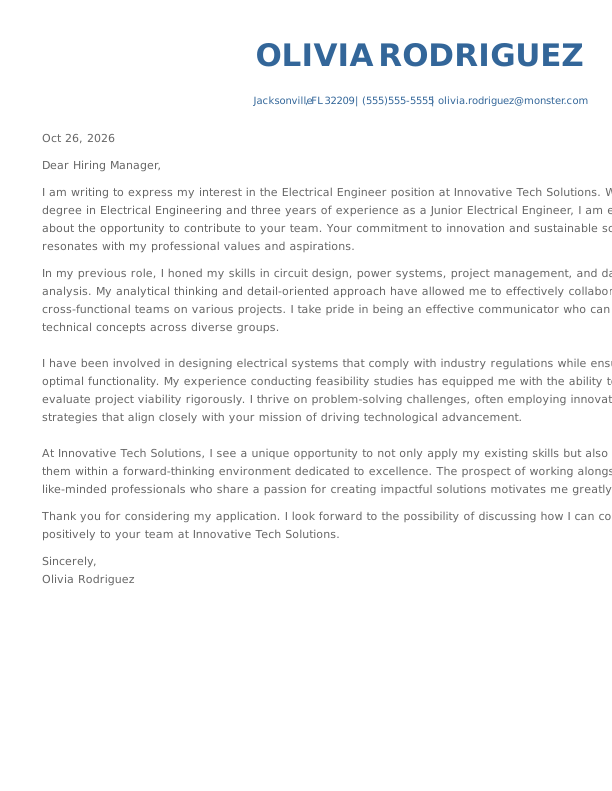
 Free
Electrical Engineer Entry-Level Cover Letter
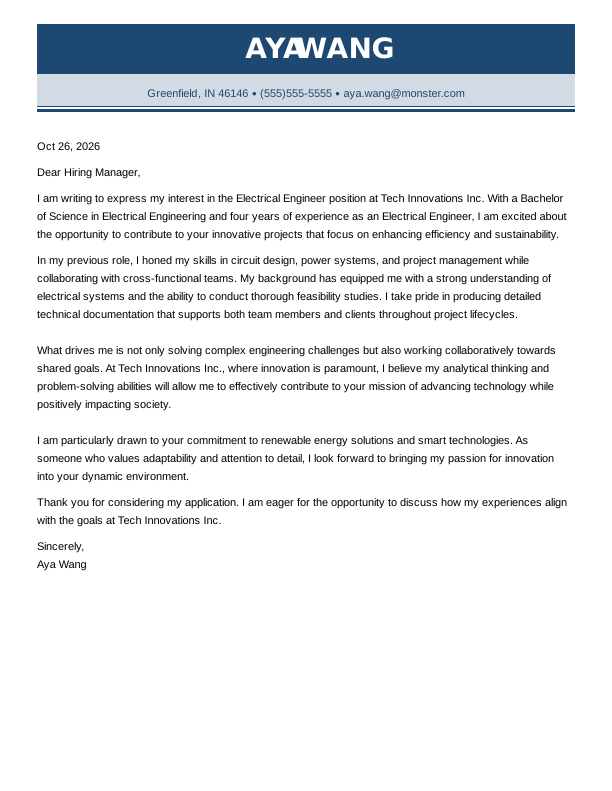
Electrical Engineer Mid-Level Cover Letter
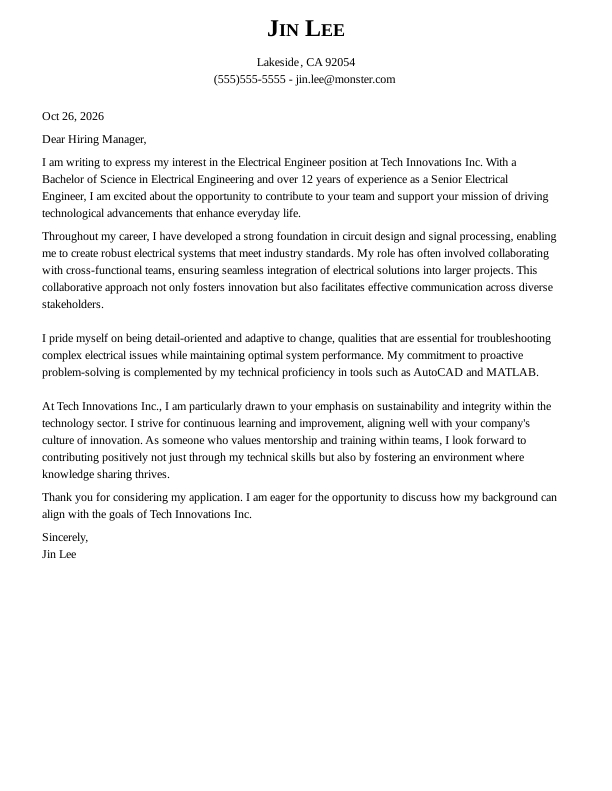
Electrical Engineer Experienced Cover Letter
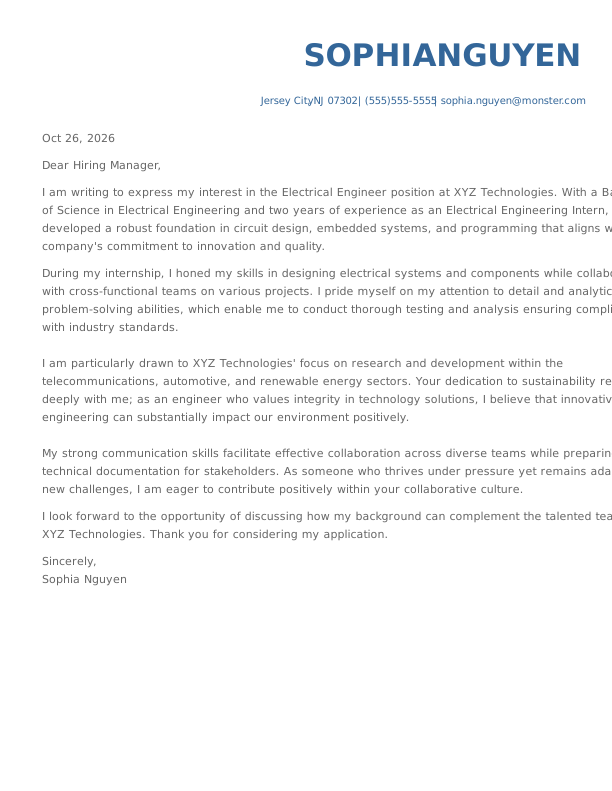
Electrical Engineer Entry-Level Cover Letter
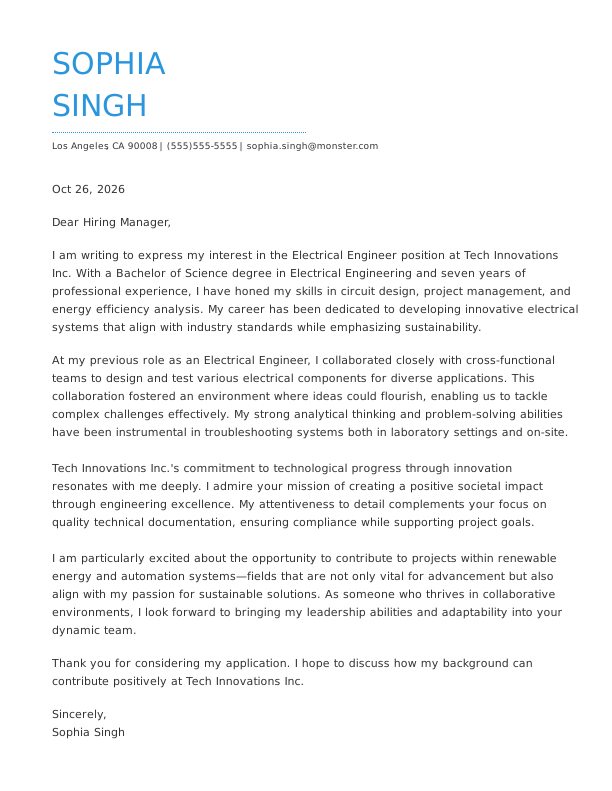
Electrical Engineer Mid-Level Cover Letter
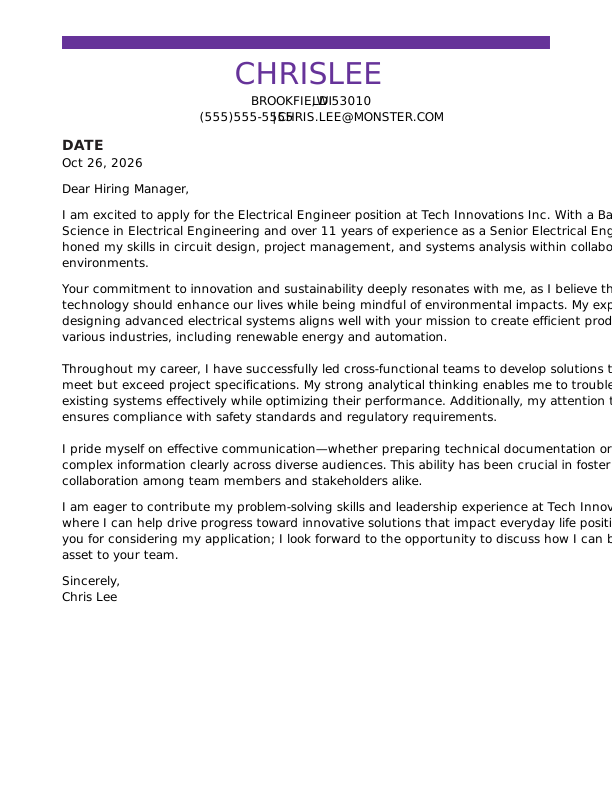
Electrical Engineer Experienced Cover Letter
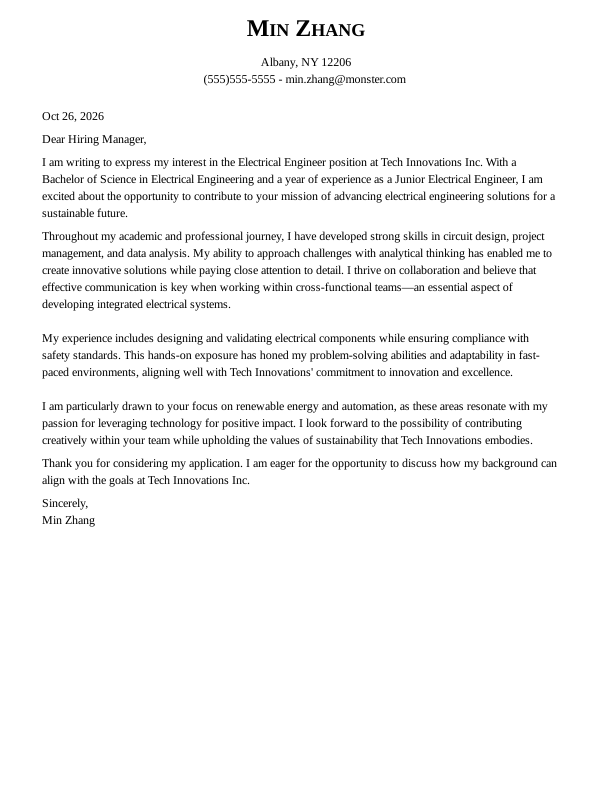
Electrical Engineer Entry-Level Cover Letter
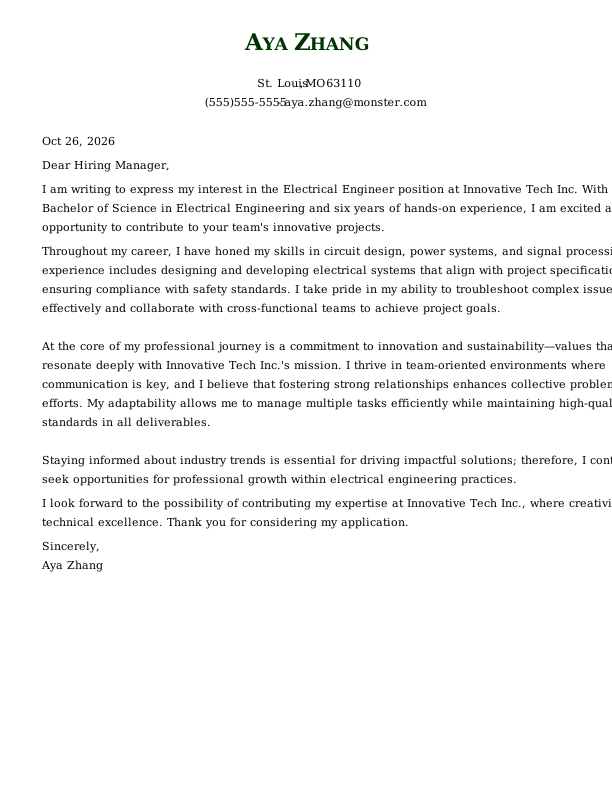
Electrical Engineer Mid-Level Cover Letter
Browse Free Cover Letter Templates
- Academic
- Account Manager
- Accountant
- Accounts Payable
- Administrative Assistant
- Admissions Counselor
- Architecture
- Artist
- Assistant Principal
- Babysitter
- Barista
- Bartender
- Bookkeeper
- Brand Ambassador
- Business Analyst
- Business
- Caregiver
- Chef
- Civil Engineering
- Computer Science
- Construction
- Consulting
- Copywriter
- Cosmetology
- Custodian
- Customer Service
- Customer Service Representative
- Data Analyst
- Data Entry
- Dental Assistant
- Dental Hygienist
- Digital Marketing
- Electrical Engineering
- Emt
- Engineering
- Esthetician
- Event Coordinator
- Executive Assistant
- Fashion Designer
- Finance
- Financial Analyst
- Firefighter
- Flight Attendant
- Graphic Designer
- Hair Stylist
- Healthcare
- Hr Generalist
- Investment Banking
- It
- Janitor
- Journalism
- Lab Technician
- Law Clerk
- Lawyer
- Librarian
- Logistics
- Maintenance Worker
- Makeup Artist
- Manager
- Marketing Coordinator
- Marketing
- Marketing Manager
- Massage Therapist
- Mechanic
- Mechanical Engineer
- Medical Assistant
- Non Profit
- Nursing
- Occupational Therapy
- Office Assistant
- Office Manager
- Operations Manager
- Paralegal
- Personal Trainer
- Pharmacist
- Pharmacy Technician
- Photographer
- Physician Assistant
- Pilot
- Police Officer
- Program Manager
- Project Manager
- Property Manager
- Psychology
- Receptionist
- Research Assistant
- Restaurant Manager
- Retail
- Sales
- Sales Manager
- School Counselor
- Security
- Security Officer
- Social Work
- Software Engineer
- Special Education Teacher
- Starbucks
- Substitute Teacher
- Teacher
- Teaching Assistant
Cover Letter Examples for Electrical Engineers
Cover letter requirements evolve as an electrical engineer advances from early design and lab work to leading projects, testing, and compliance. Choose the template that matches your career stage so you can emphasize the right skills, training, and measurable results.
Entry-Level Electrical Engineer Cover Letter
This stage focuses on foundational engineering knowledge, relevant coursework, academic projects, and hands-on lab or internship experience for those starting out in the field.
Mid-Career Electrical Engineer Cover Letter
This stage emphasizes growing autonomy, core project contributions, technical problem-solving, and collaboration across engineering teams as you build your career.
Experienced Electrical Engineer Cover Letter
This stage highlights high-level technical leadership, end-to-end system ownership, cross-functional initiative, and proven project execution across complex engineering work.
Electrical Engineer Cover Letter Template (Text)
Copy this electrical engineer cover letter template into your document, then adapt it by swapping in your project results, like a PCB redesign or reliability metrics, and the employer name.
Aya Nakamura
Lakeside, CA 92041
(555)555-5555
aya.nakamura@monster.com
Oct 26, 2026
Dear Hiring Manager,
I am writing to express my interest in the Electrical Engineer position at Tech Innovations Inc. With a Bachelor of Science in Electrical Engineering and nine years of experience as an Electronics Technician, I have developed a strong foundation in circuit design and embedded systems that align with your company’s commitment to innovation and sustainability.
Throughout my career, I have honed my skills in project management and team collaboration, effectively working alongside cross-functional teams to deliver high-quality electrical solutions. My analytical thinking and attention to detail enable me to conduct thorough feasibility studies and cost analyses, ensuring that each project meets both performance standards and budgetary constraints.
I am particularly drawn to Tech Innovations Inc. due to your dedication to creating smart technologies that enhance everyday life while promoting environmental responsibility. I believe that effective communication is crucial for fostering collaboration within diverse teams, which has been a key aspect of my professional approach.
In addition, my problem-solving abilities equip me with the skills necessary for troubleshooting existing systems while optimizing designs for energy efficiency—core values reflected in your mission statement. I am excited about the possibility of contributing innovative solutions at Tech Innovations Inc., leveraging both my technical expertise and passion for continuous learning.
Thank you for considering my application. I look forward to the opportunity to discuss how I can contribute positively to your team.
Sincerely,
Aya Nakamura
How to Write an Electrical Engineer Cover Letter
A great cover letter turns technical details like circuit designs, schematic reviews, and testing results into clear evidence of your capability. Follow these six straightforward steps to build a persuasive letter that highlights your accomplishments and catches a hiring manager’s attention.
1. Research & Prepare
Before drafting your text, identify the exact systems you will manage and the key design constraints of the company. Look up their preferred software, testing standards, and compliance priorities so you can tailor your message to their real-world needs.
Focus on these key areas during your initial research:
- Identify required CAD tools or simulation software listed in the job description.
- Check the company’s quality or reliability documentation for industry standards such as IEC 61010 or ISO 9001.
- Review recent product announcements or company news to understand upcoming project timelines and commissioning targets.
2. Hook the Reader
Start with a compelling opening statement instead of standard stock introductory lines. Hooking the reader with specific engineering achievements shows immediately that you possess the skills required for the role.
Here are a few ways to structure an impactful opening line:
- Commissioning impact: “I cut false relay trips by 18% by adjusting protective settings and testing coordination curves with IEC 61850 scripts.”
- Design tradeoff focus: “I redesigned the gate driver for a motor retrofit using SiC MOSFETs, reducing power switching loss from 120 W down to 78 W during thermal testing.”
- Standards and documentation: “I drafted an EMC compliance test plan and tracking matrix that cleared Class A radiated emissions testing with 3 dB of safety margin.”
3. Tell Your Professional Story
Use body paragraphs to elaborate on engineering decisions that yielded measurable outcomes. Clear metrics demonstrate real impact far better than broad claims like “improved design performance.”
Consider using metric-driven bullet points like these to showcase your accomplishments:
- Lowered functional test error rates by 12% by redesigning feedback circuitry and revising calibration workflows for motor drives.
- Saved $75,000 annually by securing approved alternate suppliers for control modules while maintaining exact performance specs.
- Reduced panel assembly rework times from 6 hours down to 3.5 hours by improving wiring harness layout and torque verification steps.
4. Showcase Your Skills
Rather than simply listing soft skills or software proficiencies, demonstrate how you applied them to solve technical challenges.
These examples illustrate how to connect your core skills directly to real-world tasks:
- Circuit analysis: “I diagnosed an intermittent fault on a driver board using schematic diagrams and oscilloscope readings to replace a faulty feedback resistor.”
- Testing and verification: “I completed insulation resistance and continuity checks before powering up new equipment, documenting all issues for immediate correction.”
- Cross-functional communication: “I explained complex test findings in plain terms to non-technical stakeholders during reviews and converted their feedback into design updates.”
5. Explain Any Special Circumstances
Address any career gaps, industry shifts, or relocations concisely in one or two sentences. Focus on recent projects, certifications, or active skill development to reassure hiring managers that your engineering expertise remains current.
These examples illustrate how to connect your core skills directly to real-world tasks:
- Following a six-month career break, I maintained my technical skills by completing FPGA bring-up on a Xilinx board and practicing Verilog timing routines weekly.
- I am transitioning from software to hardware engineering after completing an analog design course, building functional op-amp and ADC circuits using LTspice and bench tools.
- After moving to Seattle, I transferred my professional engineering license and began supporting hardware validation using Python automation scripts.
6. End With a Professional Goodbye
Conclude your cover letter with a polite, proactive closing statement that invites follow-up conversation. Keep your final paragraph brief, courteous, and focused on how your skills can support the team’s upcoming goals.
For example, you might write: “I would welcome the chance to discuss how my background in power supply validation can support your upcoming hardware projects. Thank you for your time and consideration.” End with a standard closing sign-off such as “Sincerely” or “Best regards,” followed by your full name.
4 Tips for Formatting Your Cover Letter
A clean, organized layout helps engineering managers quickly scan your cover letter and evaluate key qualifications. Structured headings, balanced margins, and distinct paragraphs highlight technical skills, circuit design experience, and project impact without clutter. Clear visual formatting ensures hiring leads immediately grasp your relevant expertise and attention to detail during fast initial reviews.

Keep It to One Page
Keep your cover letter short and focused. Aim for 250 to 400 words spread across three or four brief paragraphs on a single page. Hiring managers usually skim applications quickly between design reviews or shift changes, so a concise letter ensures your core technical accomplishments and project results stand out right away.

Use a Professional Font & Layout
Pick a clean, readable font like Arial, Calibri, or Georgia set between 10 pt and 12 pt size. Keep standard 1-inch margins and match your font and header styles to your resume. Consistent styling across both documents creates a cohesive, professional package that reflects the care you put into technical documentation.

Address the Hiring Manager Directly
Try to find the specific name of the engineering manager or technical recruiter reviewing applications. If the job listing or company page doesn’t list a contact name, opening with “Dear Hiring Manager” or “Dear Engineering Team” is a friendly and professional alternative.

Match Your Header to Your Resume
Use the exact same header layout, contact information, and font choices at the top of your cover letter as you do on your resume. This matching layout helps hiring managers immediately connect both pages of your application as they review your materials.
Top-Paying States for Electrical Engineer Roles
Knowing what electrical engineers earn across the country helps you compare offers and plan your next step with confidence. The figures below are based on the U.S. Bureau of Labor Statistics (BLS) and reflect the latest nationwide averages for electrical engineers.
Keep in mind that your actual pay can vary based on location, experience level, and whether you work in industries like manufacturing or utilities. Specialized skills, project scope, and certifications can also affect outcomes.
| Alabama | $122,950 |
| Alaska | $118,550 |
| Arizona | $124,080 |
| Arkansas | $97,980 |
| California | $148,390 |
| Connecticut | $115,110 |
| Delaware | $117,400 |
| District of Columbia | $138,380 |
| Florida | $112,780 |
| Georgia | $111,120 |
| Hawaii | $107,980 |
| Idaho | $132,910 |
| Illinois | $114,350 |
| Indiana | $104,990 |
| Iowa | $126,950 |
| Kansas | $100,510 |
| Kentucky | $96,190 |
| Louisiana | $114,060 |
| Maine | $116,730 |
| Maryland | $126,270 |
| Massachusetts | $132,220 |
| Michigan | $108,310 |
| Minnesota | $111,900 |
| Mississippi | $102,990 |
| Missouri | $114,670 |
| Montana | $102,400 |
| Nebraska | $102,810 |
| Nevada | $111,440 |
| New Hampshire | $138,430 |
| New Jersey | $123,540 |
| New Mexico | $144,120 |
| New York | $118,770 |
| North Carolina | $118,960 |
| North Dakota | $108,800 |
| Ohio | $104,100 |
| Oklahoma | $110,130 |
| Oregon | $118,000 |
| Pennsylvania | $119,550 |
| Rhode Island | $113,870 |
| South Carolina | $111,210 |
| South Dakota | $101,620 |
| Tennessee | $114,080 |
| Texas | $118,620 |
| Utah | $117,860 |
| Vermont | $123,460 |
| Virginia | $124,080 |
| Washington | $130,870 |
| West Virginia | $110,680 |
| Wisconsin | $101,580 |
| Wyoming | $122,630 |
| Guam | $70,470 |
| Puerto Rico | $74,970 |
Key Takeaways
- Show your engineering problem-solving by describing specific design adjustments you made after testing.
- Include concrete technical metrics like power efficiency, thermal limits, or cost savings to prove your impact.
- Tailor your accomplishments to match the primary priorities and standards of the specific industry you are targeting.
More Cover Letter Examples
- Biotechnology
- Cashier
- Civil Engineer
- Customer Success Manager
- Engineering Manager
- Retail Customer Service
Browse Monster’s Resume Templates
Monster also has hundreds of ATS-friendly resume templates for all career levels and industries. Create a matching resume to help you land the interview.
- Aerospace Engineer
- Agricultural Engineer
- Ai Engineer
- Automation Engineer
- Bim Engineer
- Biomedical Engineering
- Chemical Engineering
- Civil Engineer
- Controls Engineer
- Design Engineer
- Electrical Engineer
- Embedded Systems Engineer
- Engineering Manager
- Engineering Project Manager
- Engineering
- Enterprise Architect
- Environmental Engineer
- Field Engineer
- Industrial Engineer
- Mechanical Engineer
- Petroleum Engineer
- Robotics Engineer
- System Engineer
- Test Engineer
Frequently Asked Questions
Last Update:
Do I really need a cover letter?
Yes, you really need a cover letter when applying for electrical engineering roles because it gives you space to explain complex technical background that resumes cannot capture. While many job postings list them as optional, a well-written letter lets you share specific design trade-offs, testing methodologies, or engineering achievements. It proves your genuine interest and highlights how your hands-on problem-solving skills fit the hiring team’s exact project needs.
How long should my cover letter be?
Your cover letter should be kept strictly to one page, targeting between 250 and 400 words across three or four brief paragraphs. Engineering managers skim applications quickly between design reviews or lab shifts, so concise messaging helps your core qualifications stand out immediately. Focus only on your most relevant technical milestones, safety sign-offs, or circuit design successes rather than trying to list every project you have ever worked on.
Should my cover letter match my resume?
Yes, your cover letter should match your resume’s visual formatting so your application reads as one cohesive, professional package. Use the same font style, margins, and header layout at the top of both documents. However, ensure the text complements rather than repeats your resume bullets by expanding on a specific design decision, testing hurdle, or the technical motivations drawing you to the employer’s current hardware projects.
Can I use AI to write my cover letter?
Yes, you can use AI to write your cover letter as a starting draft to overcome writer’s block and organize your technical points. However, you must supply the real substance by adding specific circuits, control systems, test results, or optimization constraints you designed. Rewrite the AI-generated text heavily to match your natural voice and highlight genuine interest in the employer’s specific products since engineering managers easily spot generic phrasing.
How do I write a cover letter for an internal position?
When you write a cover letter for an internal electrical engineering position, you should highlight your familiarity with existing maintenance workflows, safety sign-off procedures, and operational coordination during outages. Discuss how your current stakeholder cadence keeps projects on schedule and mention recent reliability improvements or metric gains. Clearly outline your motivation to lead upcoming initiatives and mentor junior engineers while completing every required step of the formal internal application process.

Vicki Salemi is a nationally recognized career expert who helps professionals navigate the hiring landscape and find the right fit on Monster. With over 15 years of experience in corporate recruiting and HR, she offers expert guidance on job search strategies, interview preparation, and career development to help candidates land their next role.
See More From Vicki SalemiExplore Related Career Advice







How to Write a Cover Letter for Internal Positions or Promotions (Examples & Tips)

Updated:
Apr 23, 2026
|
19 min read


Cover Letter vs Resume: What’s the Difference & Do You Need Both?

Updated:
Apr 23, 2026
|
18 min read