


Free Biotechnology Cover Letter Templates & Examples
A standout biotechnology cover letter connects your laboratory expertise and research skills to real scientific impact. Our sample letters and practical advice will help you build a focused, conversational application that shows hiring managers how you solve problems and deliver reliable results.
Real-World Cover Letters That Get Results
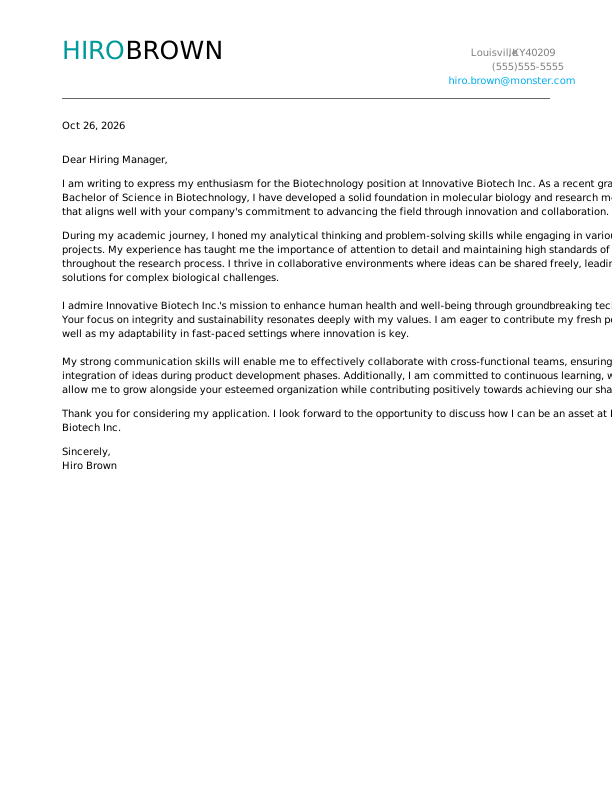
 Free
Biotechnology Entry-Level Cover Letter
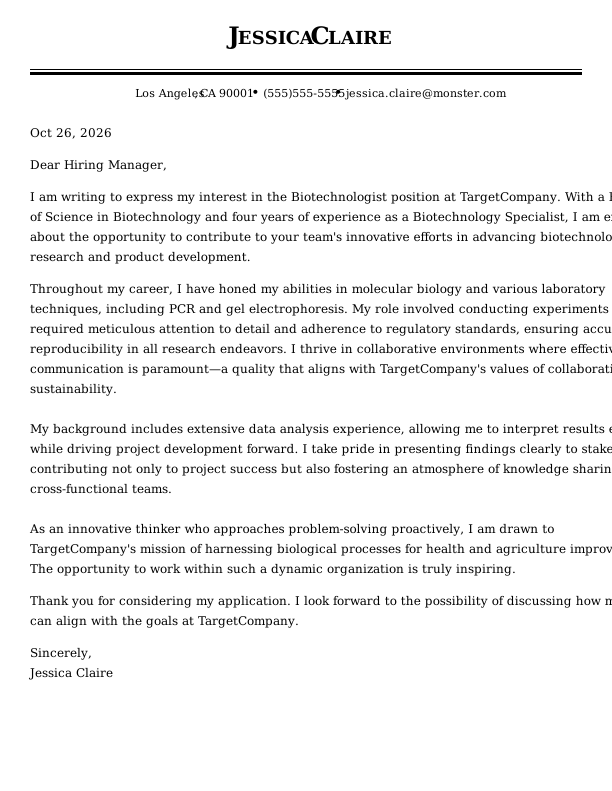
Biotechnology Mid-Level Cover Letter
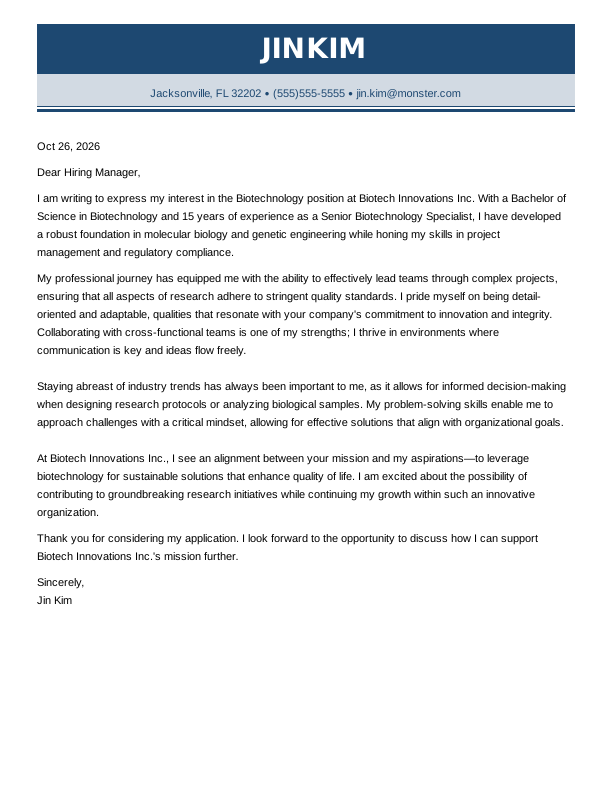
Biotechnology Experienced Cover Letter
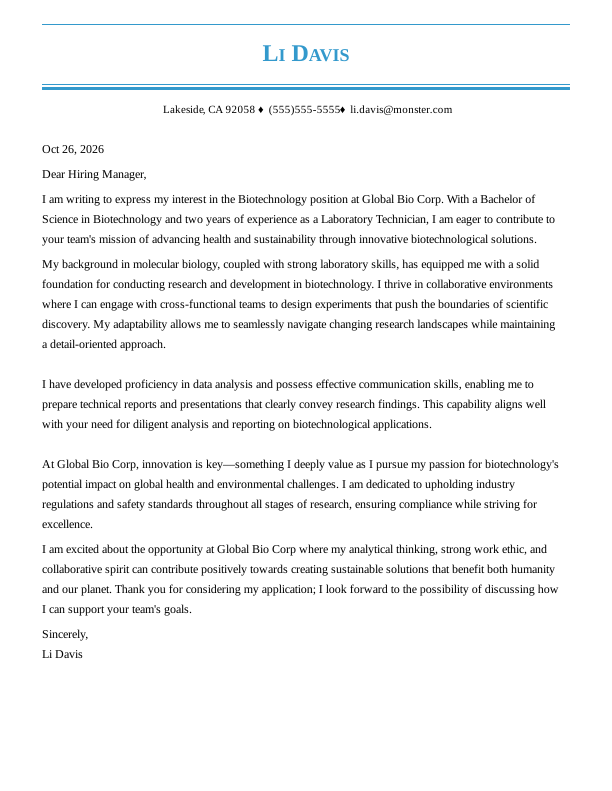
Biotechnology Entry-Level Cover Letter
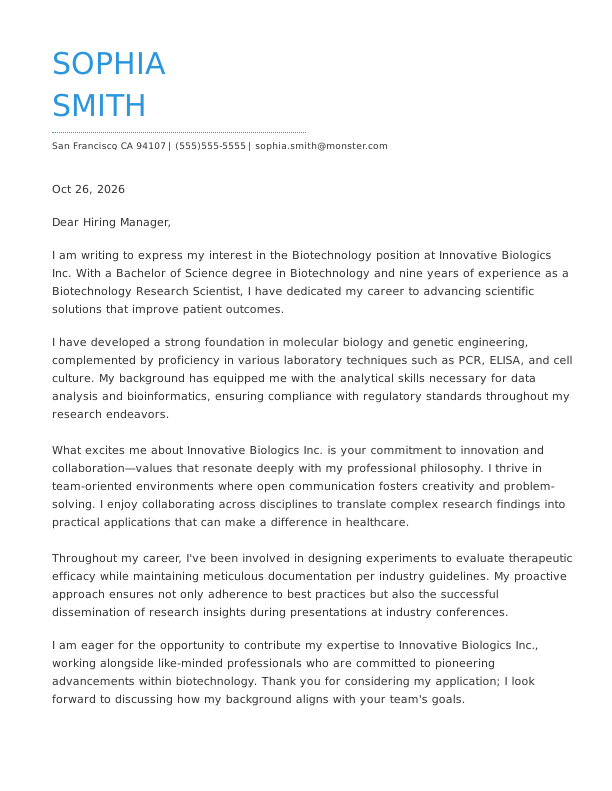
Biotechnology Mid-Level Cover Letter
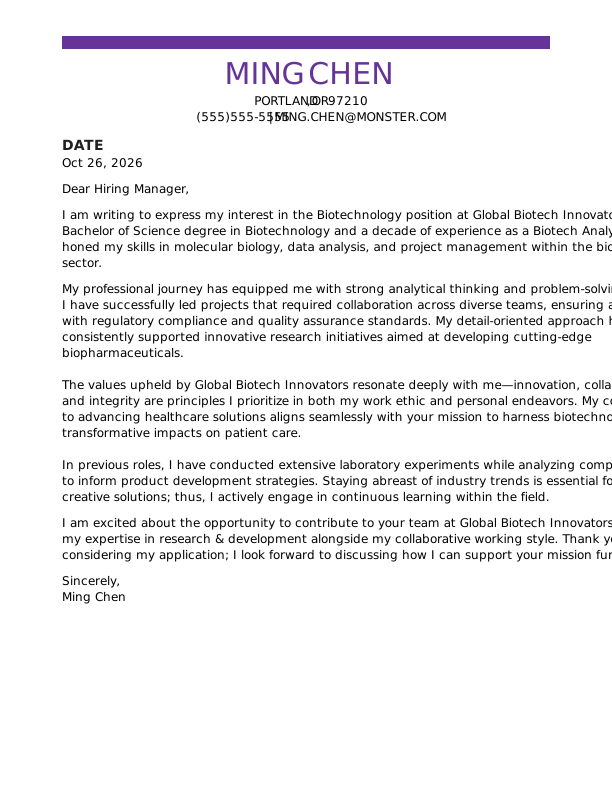
Biotechnology Experienced Cover Letter
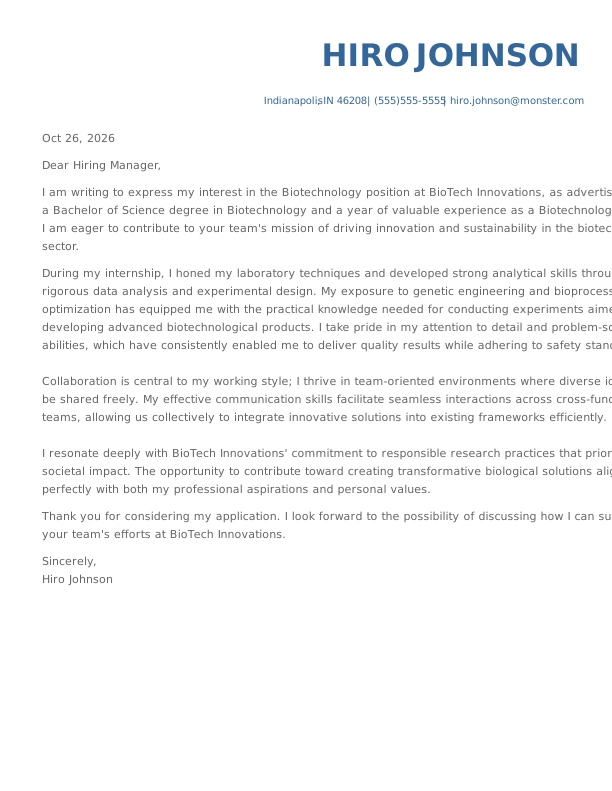
Biotechnology Entry-Level Cover Letter
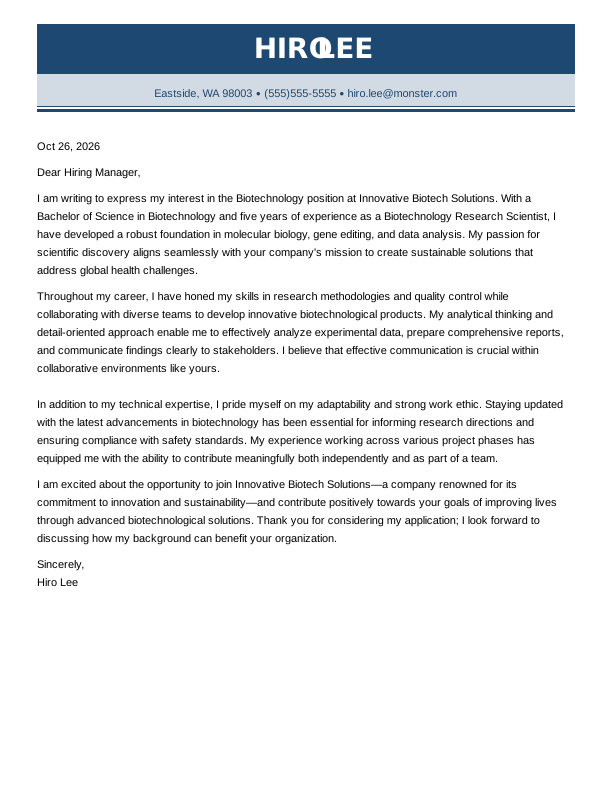
Biotechnology Mid-Level Cover Letter
Browse Free Cover Letter Templates
- Academic
- Account Manager
- Accountant
- Accounts Payable
- Administrative Assistant
- Admissions Counselor
- Architecture
- Artist
- Assistant Principal
- Babysitter
- Barista
- Bartender
- Bookkeeper
- Brand Ambassador
- Business Analyst
- Business
- Caregiver
- Chef
- Civil Engineering
- Computer Science
- Construction
- Consulting
- Copywriter
- Cosmetology
- Custodian
- Customer Service
- Customer Service Representative
- Data Analyst
- Data Entry
- Dental Assistant
- Dental Hygienist
- Digital Marketing
- Electrical Engineering
- Emt
- Engineering
- Esthetician
- Event Coordinator
- Executive Assistant
- Fashion Designer
- Finance
- Financial Analyst
- Firefighter
- Flight Attendant
- Graphic Designer
- Hair Stylist
- Healthcare
- Hr Generalist
- Investment Banking
- It
- Janitor
- Journalism
- Lab Technician
- Law Clerk
- Lawyer
- Librarian
- Logistics
- Maintenance Worker
- Makeup Artist
- Manager
- Marketing Coordinator
- Marketing
- Marketing Manager
- Massage Therapist
- Mechanic
- Mechanical Engineer
- Medical Assistant
- Non Profit
- Nursing
- Occupational Therapy
- Office Assistant
- Office Manager
- Operations Manager
- Paralegal
- Personal Trainer
- Pharmacist
- Pharmacy Technician
- Photographer
- Physician Assistant
- Pilot
- Police Officer
- Program Manager
- Project Manager
- Property Manager
- Psychology
- Receptionist
- Research Assistant
- Restaurant Manager
- Retail
- Sales
- Sales Manager
- School Counselor
- Security
- Security Officer
- Social Work
- Software Engineer
- Special Education Teacher
- Starbucks
- Substitute Teacher
- Teacher
- Teaching Assistant
Cover Letter Examples for Biotechnologists
Cover letter requirements for biotechnology roles change as your career progresses and your scope expands from lab-focused work to cross-functional ownership. Choose the template that matches your experience level so you can highlight relevant training, assays or protocols, and any leadership in studies or regulatory documentation.
Entry-Level Biotechnology Cover Letter
Designed for recent graduates and early-career job seekers, this sample highlights how academic coursework, foundational bench skills, and collaborative team research prepare you for your first full-time lab role.
Mid-Career Biotechnology Cover Letter
Built for professionals with several years of laboratory experience, this sample shows how independent assay execution, cross-functional collaboration, and daily compliance rigor demonstrate you are ready for greater project ownership.
Experienced Biotechnology Cover Letter
Crafted for seasoned industry veterans, this sample illustrates how senior leadership, cross-departmental coordination, and long-term oversight of research standards and regulatory compliance qualify you for high-level technical direction.
Biotechnology Cover Letter Template (Text)
Copy this biotechnology cover letter template, paste it into your document, and swap in your research focus, assay or trial metrics, and target lab or employer.
David Kim
Spokane, WA 99207
(555)555-5555
david.kim@monster.com
Oct 26, 2026
Dear Hiring Manager,
I am writing to express my interest in the biotechnology specialist position at Innovative Biotech Corp. With a Bachelor of Science degree in Biotechnology and six years of experience as a biotechnology analyst, I have developed a robust skill set that aligns well with your company’s commitment to advancing health and sustainability through innovative research.
Throughout my career, I have honed my expertise in data analysis and molecular biology, excelling at designing experiments and ensuring compliance with regulatory standards. My attention to detail and problem-solving abilities enable me to produce high-quality work while effectively managing multiple projects within fast-paced environments.
Collaboration has been central to my work style, allowing me to engage successfully with cross-functional teams. I believe that open communication fosters innovation, which is vital for tackling global challenges in health and environmental sustainability—values that resonate deeply with the mission of Innovative Biotech Corp.
In addition, my proficiency in technical writing equips me to clearly present complex findings, ensuring stakeholders are informed throughout project timelines. I approach each task with integrity and enthusiasm for continuous learning—a mindset essential for driving impactful results.
I am excited about the possibility of contributing to your team’s efforts in developing biotechnological solutions that enhance lives while promoting environmental stewardship. Thank you for considering my application; I look forward to the opportunity to discuss how I can support the innovative goals at Innovative Biotech Corp.
Sincerely,
David Kim
How to Write a Biotechnology Cover Letter
Writing a strong biotechnology cover letter comes down to translating your everyday bench work into clear, meaningful results. Hiring managers want to see how your technical choices, protocols, and data analysis solve real research challenges. Use the following steps to turn your scientific background into a compelling, easy-to-read cover letter.
1. Research & Prepare
Before drafting your letter, take time to understand what the employer is trying to solve right now. Look into its active research pipeline, key development platforms, and everyday lab tools. Knowing whether a lab focuses on cell line development, assay automation, or diagnostic validation helps you decide which techniques and data points to spotlight.
Here are a few quick ways to gather actionable details on an employer before writing:
- Review the company website and recent press releases to see which drug candidates, diagnostic tools, or production platforms it is scaling.
- Note specific laboratory software mentioned in the posting, like electronic lab notebooks (ELN) or Laboratory Information Management Systems (LIMS), so you can reference similar workflows.
- Check regulatory databases, like FDA clearance records or trial registries, to understand the compliance standards the lab follows.
2. Hook the Reader
Start with a strong opening line that immediately connects your technical background to the employer’s current work. Skip generic introductions like “I am writing to apply for the open role.” Instead, introduce a specific assay, workflow improvement, or technical milestone that proves you understand the science right away.
Consider these opening angles to capture attention from the first sentence:
- Assay optimization: “After troubleshooting our qPCR primer design, I reduced our Cq variance from 0.9 to 0.3 across three consecutive runs while maintaining high target specificity.”
- Regulatory compliance: “During recent stability testing, I completed all deviation reports within 15 business days and organized batch documentation to prepare our team for a smooth GMP tech transfer.”
- Process scaling: “By fine-tuning dissolved oxygen feed controls during pilot bioreactor runs, I helped our upstream team raise viable cell density from 6.0 × 10⁶ to 1.2 × 10⁷ cells per mL.”
3. Tell Your Professional Story
Your resume lists where you have worked, but your cover letter explains the real-world outcomes of your scientific decisions. Focus on one or two key projects where your initiative improved data quality, streamlined testing, or kept a study on schedule.
Here are examples of how to frame your laboratory achievements using clear metrics:
- Cut PCR contamination rates from 2.5% to 0.6% by revising sample prep protocols and setting tighter quality-control release standards across 24 weekly runs.
- Oversaw a $180,000 monthly consumables budget and lowered wasted inventory by 22% by forecasting reorders and auditing supplier shipments.
- Reduced clinical case report data extraction times from 45 minutes down to 28 minutes per subject, keeping enrollment on track for a 320-patient trial.
4. Showcase Your Skills
Rather than listing broad soft skills like “detail-oriented” or “great communicator,” describe an actual moment in the lab where those qualities paid off. Walking the reader through a specific technical decision shows how your habits protect data integrity.
These scenarios illustrate how to back up your capabilities with concrete bench examples:
- Assay troubleshooting: When melt curve analyses showed off-target binding, I re-evaluated primer efficiency and adjusted our annealing temperatures to restore clean amplification.
- Data integrity: I consistently audit raw instrument outputs against electronic lab notebooks before team reviews, ensuring every outlier traces back to clear run conditions.
- Team communication: When an unexpected variance appeared in a shared run, I walked our lead scientist through the sample preparation timeline so we could agree on corrective controls together.
5. Explain Any Special Circumstances
If you have a career gap, are pivoting from another scientific field, or are relocating, explain it briefly in one or two sentences. Biotechnology managers care most about whether your technical instincts and safety habits are current, so simply highlight your recent lab practice or relevant training.
You can address non-traditional paths with direct, positive explanations like these:
- Career break: “Following a nine-month caregiving leave, I kept my bench skills sharp by attending weekly wet-lab workshops and completing an updated GxP compliance course last quarter.”
- Industry pivot: “Transitioning from chemical engineering to molecular biology allows me to apply my fluid dynamics background to cell culture, supported by hands-on qPCR training completed this spring.”
- Relocation: “Having recently relocated to the area, I hold current BSL-2 safety credentials and bring immediate familiarity with modern automated cell culture equipment.”
6. End With a Professional Goodbye
Close your letter with a polite, professional sign-off that expresses enthusiasm for discussing the science further. Propose a clear, sensible next step, thank the reader for their time, and keep your closing clean and direct.
State what you hope to discuss: “I would welcome the chance to discuss how my assay validation experience can support your team’s upcoming development milestones.”
Add a simple courtesy: “Thank you for your time and consideration.”
Use a standard closing: “Sincerely,” or “Best regards,” followed by your full name.
4 Tips for Formatting Your Cover Letter
Hiring managers and lab directors may review cover letters during quick breaks between experiments and meetings. A clean, structured layout helps them spot your core techniques, assay experience, and key accomplishments in a matter of seconds. The following cover letter format guidelines will show you bring precision, care, and clarity to your written records—qualities that are essential for any regulated laboratory environment.

Address the Hiring Manager Directly
Take a few minutes to check the job posting, the company website, or professional networks to identify the lab director, principal investigator, or team lead hiring for the role. Using the manager’s actual name shows initiative and personal attention. If you cannot find a specific contact, use “Dear Hiring Manager” or “Dear Biotechnology Search Committee.” Avoid outdated greetings like “To Whom It May Concern.”

Match Your Header to Your Resume
Use the same contact header, font styles, and margin sizes across both your cover letter and resume. Consistent presentation creates a unified, professional application packet that is easy to recognize at a glance. In biotechnology, this visual consistency reflects the methodical care you apply to standard operating procedures and documentation.

Use Bullet Points for Key Achievements
Break up dense paragraphs by using three to four bullet points to highlight major laboratory wins. Skimmable bullet points make it easy for a busy reviewer to notice gains in assay sensitivity, reductions in cycle times, or improvements in data reproducibility without digging through heavy blocks of text.

Save & Send as a PDF
Always export your completed letter as a PDF unless the job application portal specifically asks for a Word document. A PDF locks in your margins, spacing, and fonts so the file displays exactly as intended on any screen or applicant tracking system. Give your file a clean, clear name like “Firstname_Lastname_Cover_Letter.pdf.”
Key Takeaways
- Focus your letter on concrete scientific outcomes, such as tighter assay sensitivity, lower contamination rates, or faster protocol run times.
- Tailor your technical examples to match the employer’s specific platform, whether it focuses on research discovery, contract testing, or regulated clinical manufacturing.
- Keep your layout clean, scannable, and limited to a single page with a header that matches your resume.
More Cover Letter Examples
Browse Monster’s Resume Templates
Monster also has hundreds of ATS-friendly resume templates for all career levels and industries. Create a matching resume to help you land the interview.
- Aerospace Engineer
- Agricultural Engineer
- Ai Engineer
- Automation Engineer
- Bim Engineer
- Biomedical Engineering
- Chemical Engineering
- Civil Engineer
- Controls Engineer
- Design Engineer
- Electrical Engineer
- Embedded Systems Engineer
- Engineering Manager
- Engineering Project Manager
- Engineering
- Enterprise Architect
- Environmental Engineer
- Field Engineer
- Industrial Engineer
- Mechanical Engineer
- Petroleum Engineer
- Robotics Engineer
- System Engineer
- Test Engineer
Frequently Asked Questions
Last Update:
Do I really need a cover letter?
You really do need a cover letter for biotechnology roles, even when the application lists it as optional. While your resume lists your technical skills, a cover letter lets you explain the practical thinking behind your research. It gives you space to show your enthusiasm for the company’s specific pipeline, highlight hands-on troubleshooting, and explain how your lab experience will help the team succeed from day one.
How long should my cover letter be?
Your cover letter should be between 250 and 400 words and never exceed one page. Lab directors and hiring teams review applications quickly, so a concise letter ensures your core strengths stand out immediately. Stick to three or four short paragraphs that focus on your strongest laboratory achievements, your relevant technical proficiencies, and your direct fit for the role.
Should my cover letter match my resume?
Your cover letter should match your resume in visual style, using the same fonts, margins, and contact header. This cohesive look shows attention to detail and ties your application together neatly. While the visual design should match, your letter’s text should build on your resume rather than repeat it, giving helpful context to your proudest research achievements and laboratory contributions.
What should I include in my cover letter header?
In your cover letter header, you should include your full name, phone number, professional email address, and your general location, such as your city and state. Directly below your information, add the date and the recipient’s name, title, company name, and address if available. Keeping this header identical to the one on your resume ensures your application materials look organized and polished.
How do I write a cover letter for an internal position?
When writing a cover letter for an internal position, you should focus on your proven familiarity with your facility’s protocols, team workflows, and quality systems. Highlight specific improvements you have already made in the lab, such as shortening turnaround times or solving compliance bottlenecks. Express your excitement about stepping into greater responsibility, and thank your colleagues for considering your continued growth within the company.

Vicki Salemi is a nationally recognized career expert who helps professionals navigate the hiring landscape and find the right fit on Monster. With over 15 years of experience in corporate recruiting and HR, she offers expert guidance on job search strategies, interview preparation, and career development to help candidates land their next role.
See More From Vicki SalemiExplore Related Career Advice







How to Write a Cover Letter for Internal Positions or Promotions (Examples & Tips)

Updated:
Apr 23, 2026
|
19 min read


Cover Letter vs Resume: What’s the Difference & Do You Need Both?

Updated:
Apr 23, 2026
|
18 min read