


Free Grad School Cover Letter Templates & Examples
A strong grad school cover letter connects your academic background, research interests, and hands-on projects directly to the program. It gives you space to show your genuine curiosity, explain your goals, and prove you’re ready for advanced study in clear, simple terms.
Real-World Cover Letters That Get Results
 Free
Grad School Entry-Level Cover Letter
Grad School Mid-Level Cover Letter
Grad School Experienced Cover Letter
Grad School Entry-Level Cover Letter
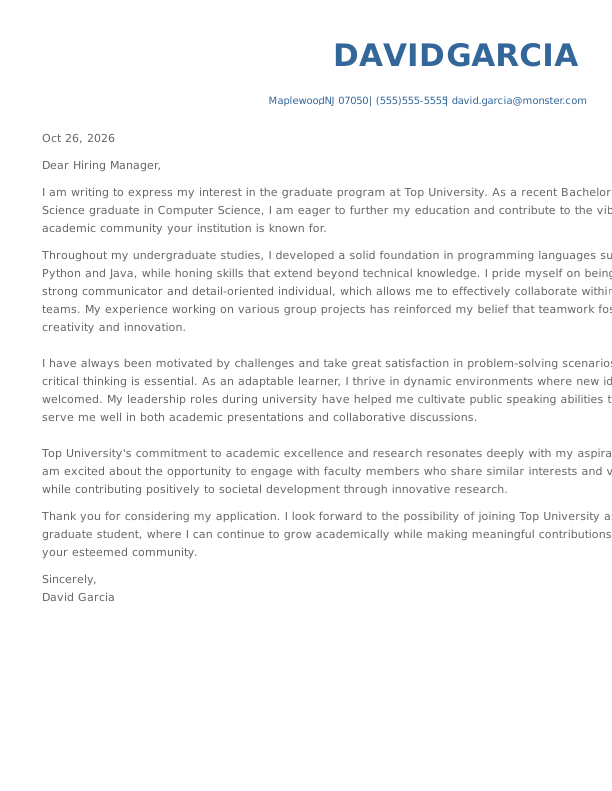
Grad School Mid-Level Cover Letter
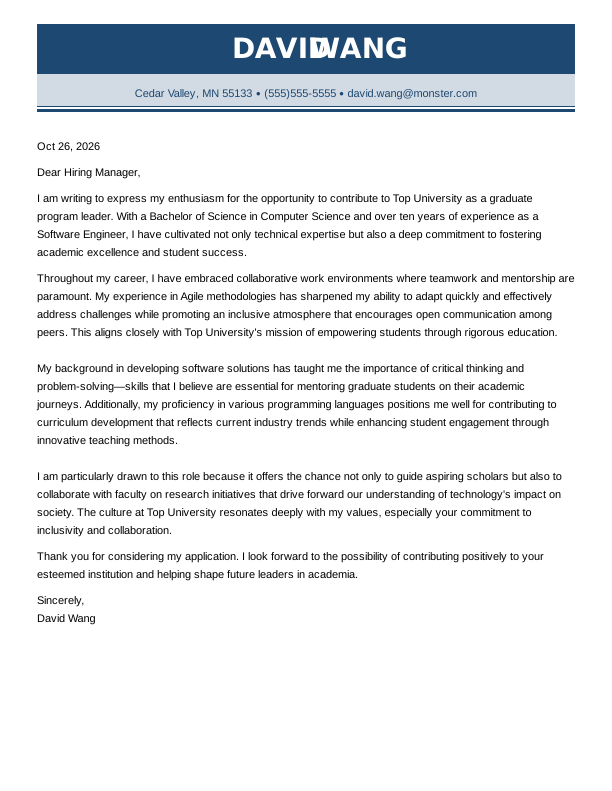
Grad School Experienced Cover Letter
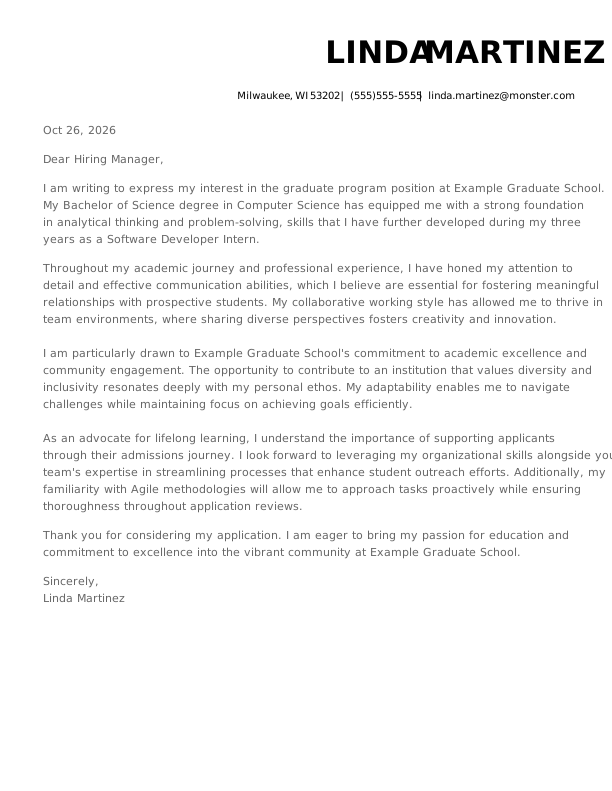
Grad School Entry-Level Cover Letter
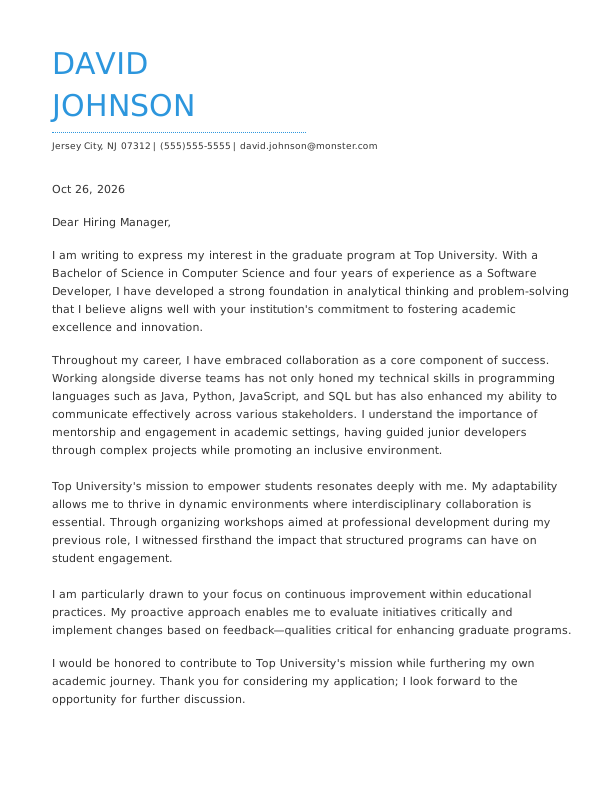
Grad School Mid-Level Cover Letter
Browse Free Cover Letter Templates
- Academic
- Account Manager
- Accountant
- Accounts Payable
- Administrative Assistant
- Admissions Counselor
- Architecture
- Artist
- Assistant Principal
- Babysitter
- Barista
- Bartender
- Bookkeeper
- Brand Ambassador
- Business Analyst
- Business
- Caregiver
- Chef
- Civil Engineering
- Computer Science
- Construction
- Consulting
- Copywriter
- Cosmetology
- Custodian
- Customer Service
- Customer Service Representative
- Data Analyst
- Data Entry
- Dental Assistant
- Dental Hygienist
- Digital Marketing
- Electrical Engineering
- Emt
- Engineering
- Esthetician
- Event Coordinator
- Executive Assistant
- Fashion Designer
- Finance
- Financial Analyst
- Firefighter
- Flight Attendant
- Graphic Designer
- Hair Stylist
- Healthcare
- Hr Generalist
- Investment Banking
- It
- Janitor
- Journalism
- Lab Technician
- Law Clerk
- Lawyer
- Librarian
- Logistics
- Maintenance Worker
- Makeup Artist
- Manager
- Marketing Coordinator
- Marketing
- Marketing Manager
- Massage Therapist
- Mechanic
- Mechanical Engineer
- Medical Assistant
- Non Profit
- Nursing
- Occupational Therapy
- Office Assistant
- Office Manager
- Operations Manager
- Paralegal
- Personal Trainer
- Pharmacist
- Pharmacy Technician
- Photographer
- Physician Assistant
- Pilot
- Police Officer
- Program Manager
- Project Manager
- Property Manager
- Psychology
- Receptionist
- Research Assistant
- Restaurant Manager
- Retail
- Sales
- Sales Manager
- School Counselor
- Security
- Security Officer
- Social Work
- Software Engineer
- Special Education Teacher
- Starbucks
- Substitute Teacher
- Teacher
- Teaching Assistant
Cover Letter Examples for Grad School
Cover letter requirements change as grad school experience grows into more advanced research and professional work. Choose the template that matches your career stage so you can highlight the right training, projects, publications, or teaching and assistant roles.
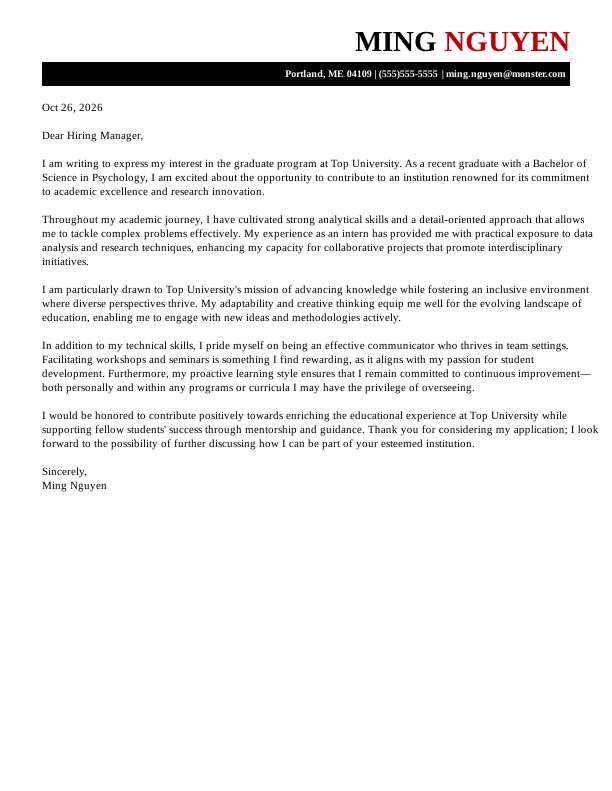
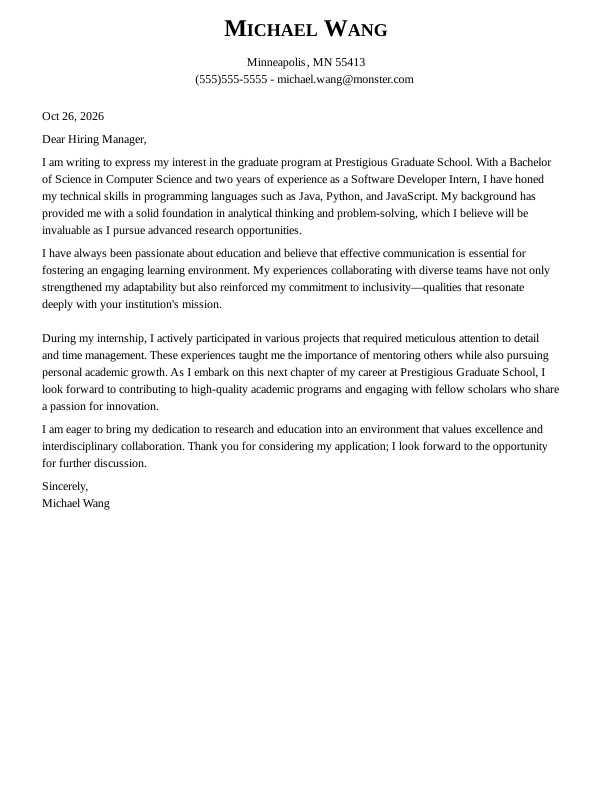
Entry-Level Grad School Cover Letter
This entry-level template is designed for recent college graduates or career changers who want to highlight their academic foundation, internship experience, and readiness for graduate-level study.
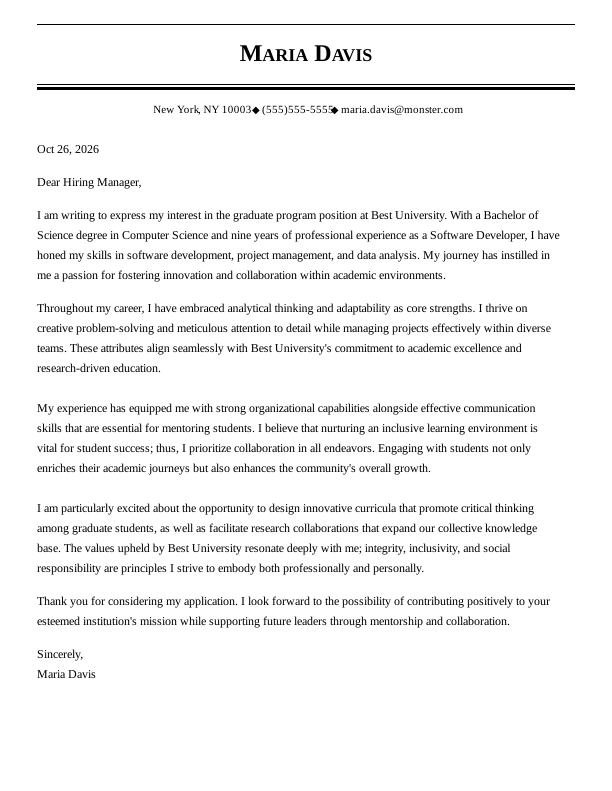
Mid-Career Grad School Cover Letter
This mid-career template is built for professionals with several years of work experience who want to show how their practical skills, project leadership, and career growth prepare them for advanced academic work.
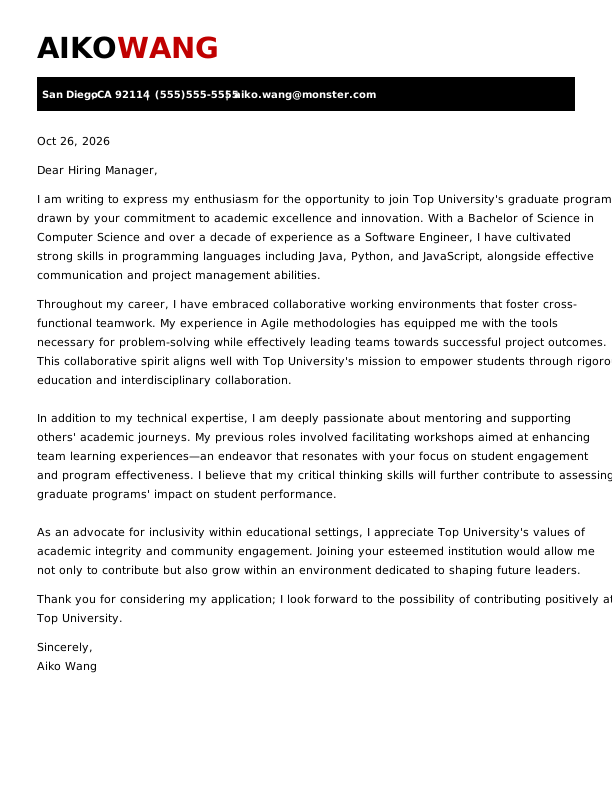
Experienced Grad School Cover Letter
This experienced template suits seasoned professionals with extensive field experience who want to translate their leadership, technical depth, and mentorship background into a strong case for graduate study.
Grad School Cover Letter Template (Text)
Copy this grad school cover letter template, paste it into your document, and replace your program interests, research focus, and advisor or university names.
Ming Johnson
Southgate, MI 48200
(555)555-5555
ming.johnson@monster.com
Oct 26, 2026
Dear Admissions Committee,
I am writing to express my interest in the graduate program position at Anytown University, as advertised. With a Master of Science degree in Computer Science and eight years of experience as a software engineer, I have developed a strong foundation in analytical thinking and problem-solving that I believe aligns well with your institution’s commitment to academic excellence and innovation.
Throughout my career, I have honed my skills in programming languages such as Python, Java, and C++, while also embracing Agile methodologies to foster team collaboration. My previous experiences required effective communication and adaptability – traits I value deeply—especially when mentoring junior colleagues or collaborating on complex projects. These experiences will enable me to advise and support graduate students effectively in their academic journeys.
I am particularly drawn to Anytown University’s mission of empowering individuals through education. My background has instilled a passion for nurturing talent, ensuring that individuals are equipped with the necessary tools for success. Additionally, my proficiency in data analysis will allow me to contribute meaningfully to program evaluation efforts aimed at enhancing student satisfaction.
The opportunity to develop curricula collaboratively with faculty members excites me greatly. I appreciate the emphasis on inclusivity and community engagement within your programs; these values resonate strongly with my own professional ethos.
Thank you for considering my application. I look forward to the possibility of contributing positively to Anytown University’s vibrant academic community.
Sincerely,
Ming Johnson
How to Write a Grad School Cover Letter
Writing a strong cover letter for graduate school is all about telling a clear, cohesive story. While your transcripts and resume show where you went to school and what courses you took, your cover letter explains why your background matters and how it fits your target program. Use these steps to turn your past academic and professional work into a compelling application letter.
1. Research & Prepare
Before you write your first sentence, spend some time exploring how the department operates and what it values most. Graduate committees look for candidates whose academic goals align naturally with their faculty’s active work and available resources. Knowing these details helps you decide which papers, projects, and methods to highlight.
Here are three simple ways to gather useful background details before writing:
- Browse the department website to review degree prerequisites, lab specializations, and current research themes.
- Review the university course catalog to spot specific methods courses, software tools, or practicum requirements central to the curriculum.
- Check recent department announcements and faculty publications to see what topics the program is actively investing in right now.
2. Hook the Reader
Admissions committees review dozens of applications, so skip generic openers that merely state your name and the degree you want. Instead, open with a concrete snapshot of your intellectual focus, a core project, or a specific research question. Starting with clear substance immediately signals that you take the field seriously and understand what graduate work requires.
Here are a few ways to craft an engaging opening line:
- Frame your research focus: “I am applying to your Master of Public Health program because my undergraduate thesis builds on your department’s recent community health studies, using difference-in-differences analysis to track local policy outcomes.”
- Highlight hands-on methods: “In my senior capstone project, I used R to run hierarchical regression models and diagnostic tests, which directly reflects your lab’s focus on applied data analysis.”
- Show academic leadership: “As a teaching assistant for an introductory biology course, I ran weekly problem sessions for 42 students and helped refine our lab rubrics to clarify expectations.”
3. Tell Your Professional Story
Use the body of your letter to show how your past work prepared you for rigorous study. Rather than claiming you have strong study habits or great lab skills, give clear examples that illustrate your growth and work ethic. Concrete details and measurable outcomes make your accomplishments easy for a committee to picture and evaluate.
Consider these examples of how to ground your academic story in clear facts:
- Raised my cumulative upper-division GPA to 3.8 across two terms by building structured weekly study schedules and attending faculty office hours consistently.
- Co-authored two conference abstracts based on my thesis research and delivered poster presentations to audiences of more than 40 faculty members and peers.
- Completed 120 hours of field practicum work while cutting report turnaround times by 25% through standardized observation templates.
4. Showcase Your Skills
Take one or two key requirements listed on the program’s admissions page and connect them to problems you solved in the past. Admissions committees appreciate candidates who can adapt when an experiment stalls, a dataset gets messy, or project feedback requires a change in direction.
Here are a few ways to show practical problem-solving in everyday language:
- Research adaptability: “When initial search queries missed critical peer-reviewed sources for my literature review, I reworked my keywords and rebuilt the database search strategy from scratch.”
- Data troubleshooting: “While cleaning survey responses in Python, I spotted an inverted variable, corrected the data pipeline, and verified the output before running final summary models.”
- Scholarly communication: “After receiving feedback from my faculty advisor on an early draft, I scheduled a follow-up meeting with targeted questions to ensure my revisions matched the journal’s guidelines.”
5. Explain Any Special Circumstances
If you have an employment gap, an academic detour, or a pivot between fields, address it in a brief, matter-of-fact sentence or two. Focus on how you kept your skills sharp and stayed engaged with your discipline during that period. Being clear and transparent shows confidence and keeps the reader focused on your current readiness.
Here is how you can address common transitions cleanly:
- “After stepping away from full-time work to prepare for graduate study, I stayed current by completing an applied statistics course and building weekly data projects in Python.”
- “I paused my corporate career to earn a professional certificate in data analytics, and I now use SQL and R regularly to analyze open-source datasets.”
- “Following a relocation last spring, I kept my technical skills fresh by participating in remote research workshops and contributing code to open academic repositories.”
6. End With a Professional Goodbye
Wrap up your letter with a polite, direct closing paragraph that outlines your enthusiasm and next steps. Avoid passive clichés like “I hope to hear from you soon.” Instead, reaffirm your interest in contributing to their academic community and thank them for their time and consideration.
A clean closing only needs two or three sentences:
“I would welcome the opportunity to discuss how my research background aligns with your department’s current projects. Thank you for your time and consideration. Sincerely, [Your Name]”
4 Tips for Formatting Your Cover Letter
A well-formatted cover letter makes a strong first impression before the reader even finishes the first sentence. Faculty and admissions officers review large stacks of applications, so they frequently scan documents to check for key prerequisites, core research areas, and relevant experience. Clean margins, readable type, and consistent structure make your letter effortless to navigate, showing the committee that you communicate with care and professionalism.

Use a Professional Font & Layout
Pick a clean, standard typeface like Arial, Calibri, Georgia, or Helvetica, set between 10 pt and 12 pt. Keep your margins at 1 inch on all sides so the page does not look crowded. Matching your header layout and font choices to your academic CV or resume also gives your entire application packet a polished, unified feel.

Address the Hiring Manager Directly
Look through the program’s webpage, staff directory, or application portal to find the name of the graduate program director, department chair, or admissions coordinator. Addressing a real person shows you did your homework. If no specific name is listed, use “Dear Graduate Admissions Committee” or “Dear Program Director,” and avoid outdated openings like “To Whom It May Concern.”

Use Bullet Points for Key Achievements
Break up dense paragraphs by placing two or three major accomplishments into a short bulleted list. This makes your strongest credentials—such as a standout GPA, a publication, a poster session, or a teaching award—jump out immediately during a quick scan. Just be sure to frame each bullet around a specific result rather than a vague duty.

Save & Send as a PDF
Always export your finished cover letter as a PDF unless the application instructions explicitly ask for a Word document. A PDF preserves your exact fonts, line spacing, and margins across different computers, tablets, and operating systems. Save the file with a clear, professional name like Firstname_Lastname_Cover_Letter.pdf so the review team can easily identify it in their system.
Key Takeaways
- Tailor your letter to each graduate program by connecting your academic interests directly to its faculty research and course offerings.
- Include concrete numbers, such as your GPA, lab hours, presentations, or data sample sizes, to show real evidence of your academic readiness.
- Format your letter with clean margins, readable fonts, and a PDF export so the admissions committee can scan your accomplishments easily.
More Cover Letter Examples
Browse Monster’s Resume Templates
Monster also has hundreds of ATS-friendly resume templates for all career levels and industries. Create a matching resume to help you land the interview.
Frequently Asked Questions
Last Update:
Do I really need a cover letter?
You should include a cover letter with your grad school application even if the program lists it as optional. While your transcript and resume document your grades and positions, they cannot explain your personal motivations or research curiosities. A cover letter gives you the space to show genuine initiative, explain why you want to study in that specific department, and prove you understand its focus.
How long should my cover letter be?
Your grad school cover letter should be one page long, typically between 250 and 400 words. Admissions committees read through large volumes of files, so they appreciate clear, concise writing that gets right to the point. Break your letter into three or four focused paragraphs so the committee can easily scan your academic background, research interests, and program fit without wading through filler.
Should my cover letter match my resume?
Your cover letter should match your resume in visual style and formatting so your materials look like a coordinated package. Use identical fonts, margins, colors, and header designs across both documents. While the visual presentation should match, your letter’s text should expand on your best achievements and explain your academic goals, rather than simply repeating the bullet points from your resume or CV.
How do I address my cover letter if I don’t know the hiring manager’s name?
To address your cover letter when you cannot find an individual contact name, begin by checking the department’s website or directory for the graduate program coordinator. If no specific contact is listed anywhere, address your letter to “Dear Graduate Admissions Committee” or “Dear Admissions Team.” Avoid outdated phrases like “To Whom It May Concern,” which sound impersonal and stiff.
Can I use AI to write my cover letter?
You can use AI to help write your cover letter, but treat it as a drafting partner rather than a final writer. AI tools are great for brainstorming outlines, organizing your thoughts, and smoothing rough transitions. However, you need to rewrite the text in your own voice, adding specific details about your actual research, projects, and personal reasons for choosing that university.

Toni Frana is a Certified Professional Resume Writer (CPRW), member of the Professional Association of Resume Writers & Career Coaches, and career expert who empowers job seekers to take control of their career paths using Monster’s comprehensive job search and resume tools.
See More From Toni FranaExplore Related Career Advice







How to Write a Cover Letter for Internal Positions or Promotions (Examples & Tips)

Updated:
Apr 23, 2026
|
19 min read


Cover Letter vs Resume: What’s the Difference & Do You Need Both?

Updated:
Apr 23, 2026
|
18 min read