


Free Inventory Specialist Cover Letter Templates & Examples
A strong inventory specialist cover letter shows you can keep stock accurate, catch discrepancies early, and prevent costly delays. Our straightforward examples and practical advice will help you highlight your attention to detail, technical skills, and everyday reliability to hiring teams.
Real-World Cover Letters That Get Results
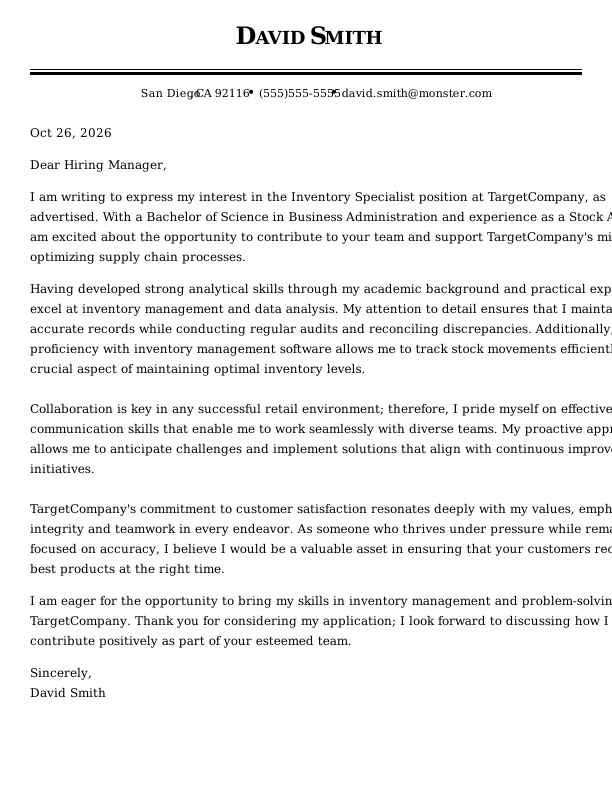
 Free
Inventory Specialist Entry-Level Cover Letter
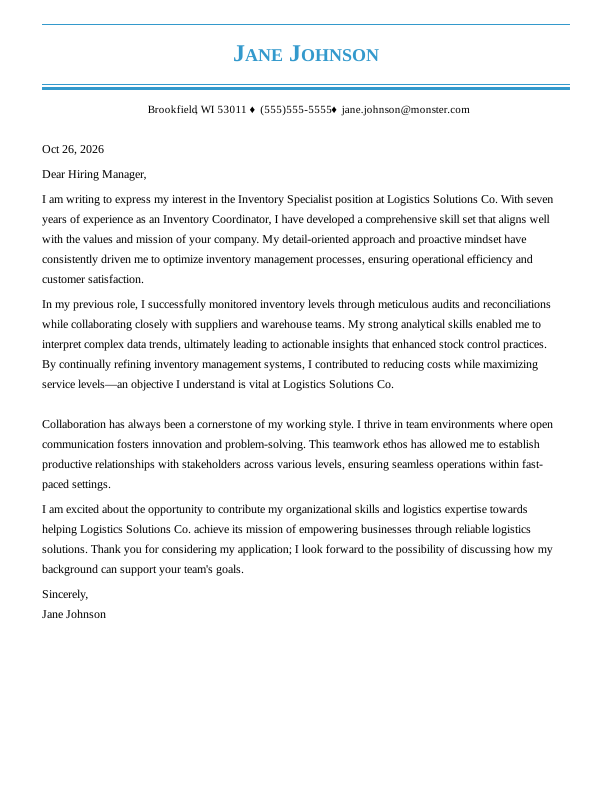
Inventory Specialist Mid-Level Cover Letter
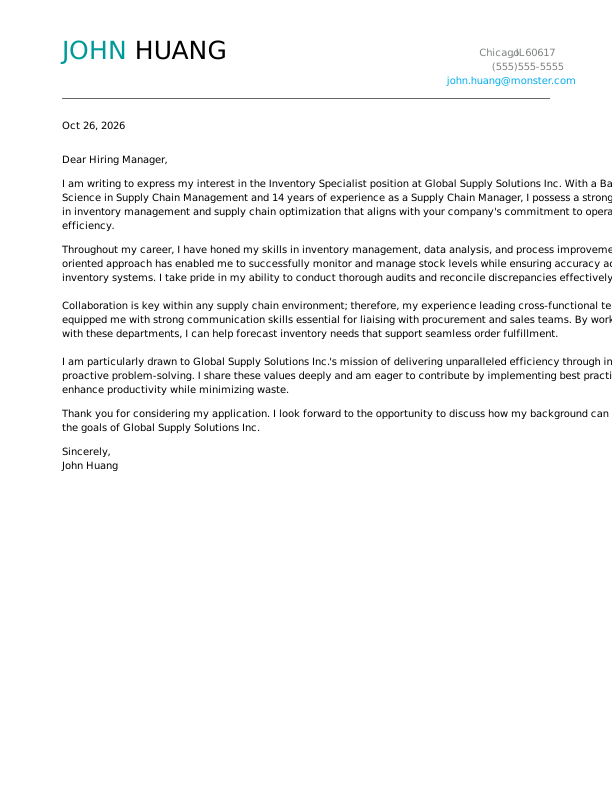
Inventory Specialist Experienced Cover Letter
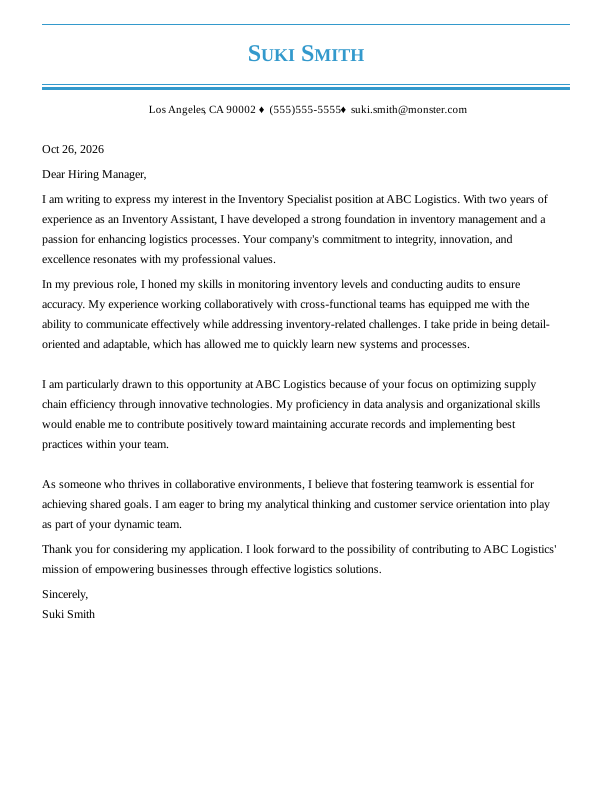
Inventory Specialist Entry-Level Cover Letter
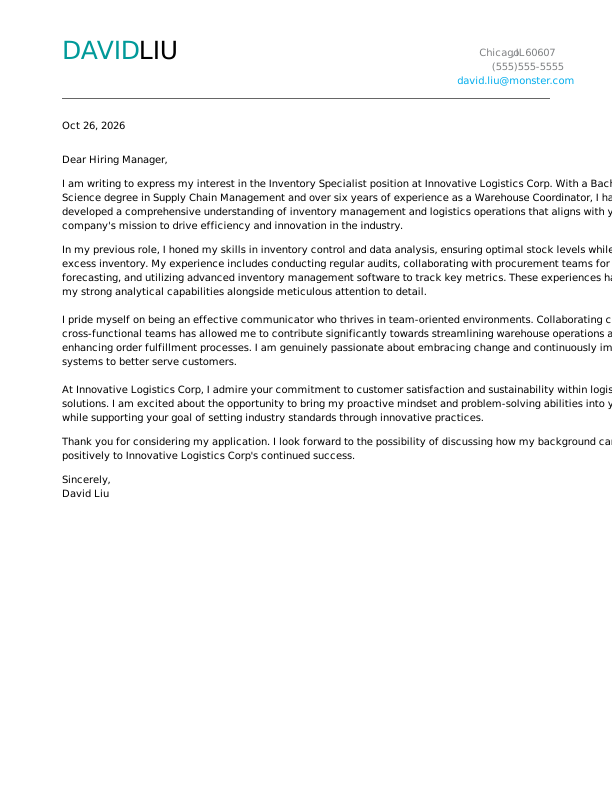
Inventory Specialist Mid-Level Cover Letter
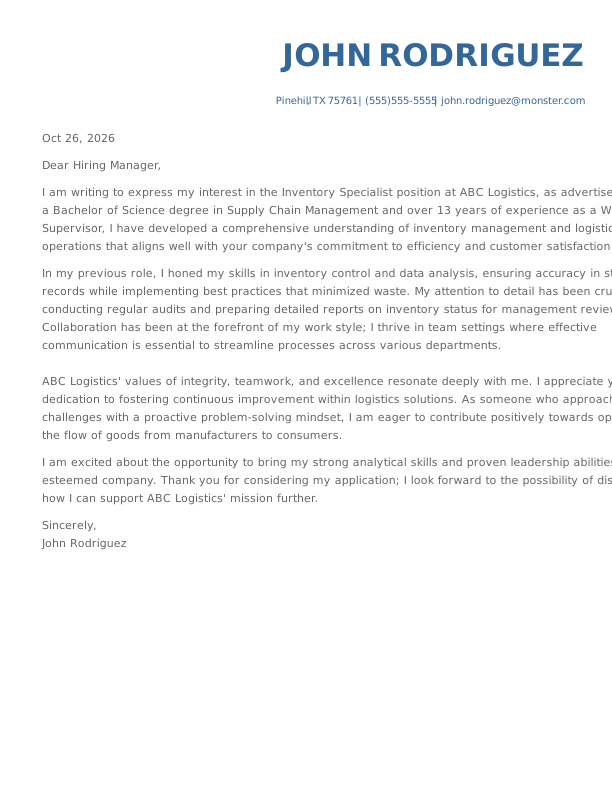
Inventory Specialist Experienced Cover Letter
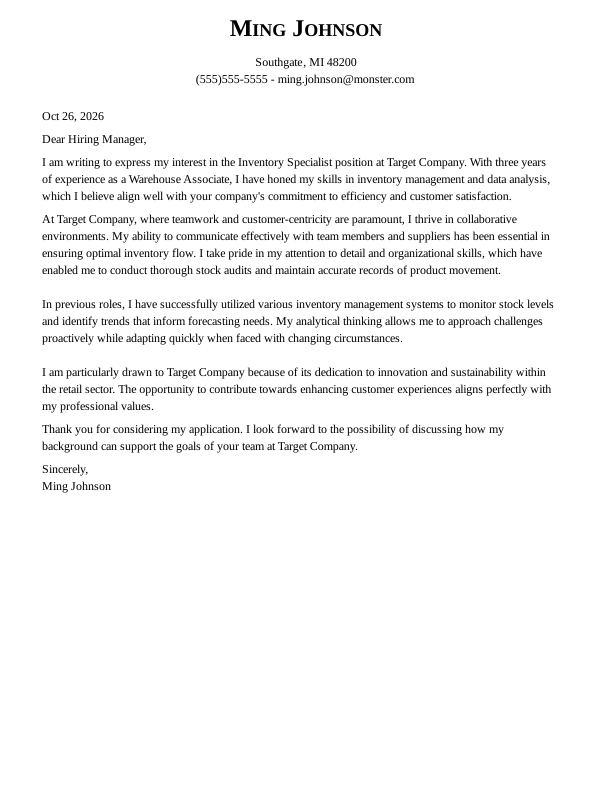
Inventory Specialist Entry-Level Cover Letter
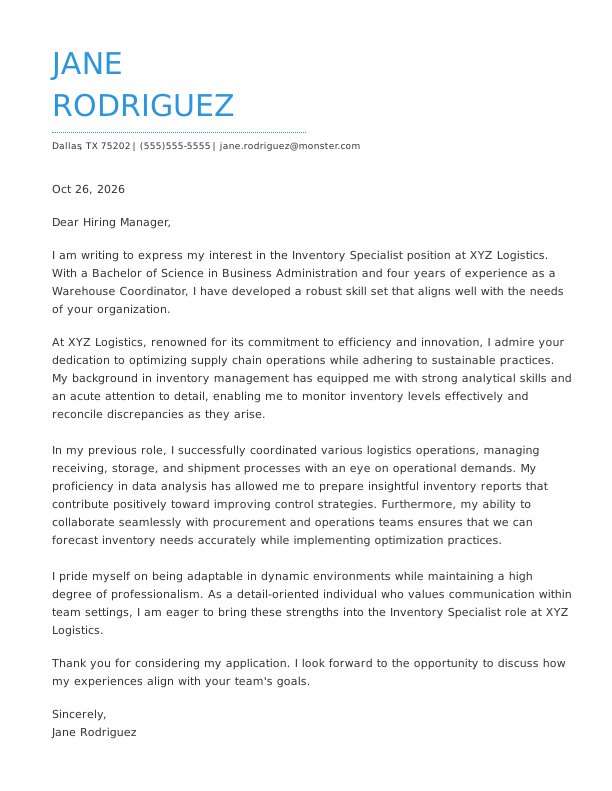
Inventory Specialist Mid-Level Cover Letter
Browse Free Cover Letter Templates
- Academic
- Account Manager
- Accountant
- Accounts Payable
- Administrative Assistant
- Admissions Counselor
- Architecture
- Artist
- Assistant Principal
- Babysitter
- Barista
- Bartender
- Bookkeeper
- Brand Ambassador
- Business Analyst
- Business
- Caregiver
- Chef
- Civil Engineering
- Computer Science
- Construction
- Consulting
- Copywriter
- Cosmetology
- Custodian
- Customer Service
- Customer Service Representative
- Data Analyst
- Data Entry
- Dental Assistant
- Dental Hygienist
- Digital Marketing
- Electrical Engineering
- Emt
- Engineering
- Esthetician
- Event Coordinator
- Executive Assistant
- Fashion Designer
- Finance
- Financial Analyst
- Firefighter
- Flight Attendant
- Graphic Designer
- Hair Stylist
- Healthcare
- Hr Generalist
- Investment Banking
- It
- Janitor
- Journalism
- Lab Technician
- Law Clerk
- Lawyer
- Librarian
- Logistics
- Maintenance Worker
- Makeup Artist
- Manager
- Marketing Coordinator
- Marketing
- Marketing Manager
- Massage Therapist
- Mechanic
- Mechanical Engineer
- Medical Assistant
- Non Profit
- Nursing
- Occupational Therapy
- Office Assistant
- Office Manager
- Operations Manager
- Paralegal
- Personal Trainer
- Pharmacist
- Pharmacy Technician
- Photographer
- Physician Assistant
- Pilot
- Police Officer
- Program Manager
- Project Manager
- Property Manager
- Psychology
- Receptionist
- Research Assistant
- Restaurant Manager
- Retail
- Sales
- Sales Manager
- School Counselor
- Security
- Security Officer
- Social Work
- Software Engineer
- Special Education Teacher
- Starbucks
- Substitute Teacher
- Teacher
- Teaching Assistant
Cover Letter Examples for Inventory Specialists
Cover letter expectations for an inventory specialist shift as you gain experience, from learning cycle counts to managing accuracy across multiple locations. Choose the template that matches your career stage so you can highlight the right skills, training, and accomplishments.
Entry-Level Inventory Specialist Cover Letter
Designed for early-career job seekers and career changers, this template highlights foundational stockroom knowledge, academic background, and transferable skills to show you’re ready to step into an inventory role.
Mid-Career Inventory Specialist Cover Letter
Tailored for candidates with several years on the job, this template focuses on day-to-day operational execution, cross-functional coordination, and proven methods for keeping stock records accurate and efficient.
Experienced Inventory Specialist Cover Letter
Best suited for seasoned professionals, this template highlights strategic inventory control, cross-departmental alignment, process improvements, and senior leadership across broader supply chain operations.
Inventory Specialist Cover Letter Template (Text)
Copy this inventory specialist cover letter template, paste it into your document, and tailor it with your warehouse metrics and preferred employer name.
Emily Davis
Riverview, FL 33588
(555)555-5555
emily.davis@monster.com
Oct 26, 2026
Dear Hiring Manager,
I am writing to express my interest in the inventory specialist position at Future Logistics Solutions. With a Bachelor of Science degree in Logistics and Supply Chain Management and nine years of experience as a logistics coordinator, I have developed a robust skill set that aligns well with your company’s mission to enhance operational efficiency and optimize supply chain processes.
Throughout my career, I have honed my abilities in inventory management, logistics coordination, and data analysis. My detail-oriented approach has enabled me to conduct thorough inventory audits while ensuring optimal stock availability. I believe that effective communication is paramount when collaborating with procurement and warehouse teams to streamline operations.
My strong analytical skills allow me to generate insightful reports that identify trends and support data-driven decisions for inventory optimization. Additionally, I thrive in fast-paced environments where adaptability is key, consistently meeting deadlines while maintaining accuracy.
Future Logistics Solutions’ commitment to sustainability and continuous improvement resonates deeply with my professional values. I am eager to contribute my proactive mindset and problem-solving attitude toward empowering businesses through tailored logistics solutions.
Thank you for considering my application. I look forward to the opportunity to discuss how my background can support your team’s goals at Future Logistics Solutions.
Sincerely,
Emily Davis
How to Write an Inventory Specialist Cover Letter
Writing a solid cover letter lets you translate physical counts, variance logs, and reorder routines into clear, practical examples. The steps below show you how to tailor your day-to-day experience to what an employer needs, presenting your background in a clean, direct way.
1. Research & Prepare
Before drafting your letter, take time to learn how the company handles stock. Pay attention to the specific inventory control systems, barcode workflows, and auditing schedules it mentions in its job posting. Also check whether the team is focused on minimizing stockouts, curbing shrink, or improving picking efficiency, as this tells you which achievements to highlight.
Here are a few quick ways to gather useful details before writing:
- Review the job description for specific software requirements like SAP, NetSuite, or proprietary warehouse management systems.
- Look over the company’s website for information on its distribution network, turnaround standards, or fulfillment commitments.
- Check trade news or company updates for warehouse expansions, seasonal spikes, or recent supply chain shifts that affect daily operations.
2. Hook the Reader
Skip overused lines like “I am writing to apply for the open role.” Instead, lead with a strong opening statement that connects your hands-on work to real inventory wins. Hiring managers look for immediate proof that you can handle audits, run counts, and maintain reliable stock records without constant supervision.
Consider starting your letter with a strong, result-driven statement like one of these:
- “Over the past two years, I lowered our cycle count variance from 6.0% to 1.5% by reorganizing primary bin locations and standardizing scanning procedures.”
- “Using SAP MM to monitor safety stock thresholds and adjust reorder points, I helped maintain a 98% order fulfillment rate across our fastest-moving items.”
- “During annual audit preparations, I coordinated physical counts for over 2,400 SKUs, resolving record discrepancies within five business days.”
3. Tell Your Professional Story
Your resume tracks where you worked, but your cover letter explains how you solved real warehouse and storeroom problems. When describing your accomplishments, use specific metrics to paint a clear picture of your speed, accuracy, and operational impact.
Here are a few examples of how to frame everyday duties as measurable successes:
- Reduced overall inventory shrink by 22% over nine months by verifying deliveries against purchase orders and tightening return checks.
- Boosted demand forecast accuracy from 78% to 91% on high-turnover products by reviewing weekly run rates with the purchasing team.
- Completed regular cycle counts across 1,200 unique SKUs each month while holding our average record variance to just 0.6%.
4. Showcase Your Skills
Rather than calling yourself “detail-oriented,” share a specific scenario where you caught an error or kept operations running smoothly. Grounding your skills in actual warehouse situations proves your capabilities much better than a generic list of adjectives.
Here is how you can describe common inventory challenges and how you handled them:
- Resolving record variances: Walk through how you tracked a high-value discrepancy back to an incorrect receiving scan, updated the warehouse management system, and corrected the shelf tag.
- Running routine audits: Explain your method for running batch cycle counts and checking physical numbers against purchase orders before adjusting live counts.
- Cross-team coordination: Describe how you flagged a delayed replenishment order to the purchasing team early so fulfillment staff could adjust order queues.
5. Explain Any Special Circumstances
If you have an employment gap, are switching careers, or recently relocated, address it plainly in one or two sentences. Focus on how you kept your logistical knowledge sharp or how your background directly supports inventory control.
Use one of these simple approaches to explain your situation clearly:
- Addressing a work gap: “During a six-month career break, I kept my inventory skills fresh by volunteering to manage stock counts and supply logs for a community distribution center.”
- Changing career paths: “After three years in retail sales, I am pivoting into inventory management, bringing hands-on picking experience, barcode scanner familiarity, and ERP training.”
- Explaining a relocation: “Having recently moved to Chicago, I am available to start immediately and ready to apply my receiving and stockroom auditing background to your team.”
6. End With a Professional Goodbye
Wrap up your letter with a polite, forward-looking close. Reaffirm how your background can support the team’s operational goals, thank the reader for their time, and sign off with a standard, professional closing.
A simple closing could look like this: “I would welcome the opportunity to discuss how my audit experience and focus on accurate counts can support your warehouse goals. Thank you for your time and consideration.”
Sign off with “Sincerely” or “Best regards,” followed by your full name.
4 Tips for Formatting Your Cover Letter
When a hiring manager reviews applications for an inventory specialist, they often scan each document in seconds to gauge your organizational habits. Because this role demands meticulous attention to detail, a clean cover letter layout with clear margins, readable spacing, and scannable sections shows that you naturally care about order, clarity, and consistency.

Address the Hiring Manager Directly
Whenever possible, find the actual name of the person hiring for the role, such as the warehouse supervisor, inventory control manager, or lead logistics recruiter. You can usually find their name on the job posting, the company’s staff directory, or LinkedIn. If you can’t track down a specific person, “Dear Hiring Manager” or “Dear Inventory Hiring Team” works well.

Match Your Header to Your Resume
Keep your cover letter header identical to the one on your resume by using the same fonts, contact details, and layout styling. A uniform design looks polished and makes it easy for a recruiter to quickly cross-check your phone number or email across documents.

Use Bullet Points for Key Achievements
Break up long paragraphs by placing three or four of your best metrics in a short bulleted list. Bullet points help your cycle count percentages, variance reductions, and software proficiencies jump out during a fast first read.

Balance Spacing & Margins
Set your line spacing between 1.0 and 1.15, leaving a blank line between each paragraph to keep the page open and easy on the eyes. Use standard margins between 0.75 and 1 inch so your letter looks well-proportioned whether read on a monitor or printed out.
Key Takeaways
- Focus on measurable results like cycle count accuracy, shrink reduction, and order fulfillment rates to prove your daily reliability.
- Connect your past hands-on tasks directly to the specific inventory control software and auditing methods mentioned in the job posting.
- Keep your layout clean, scannable, and formatted to match your resume so hiring teams can evaluate your qualifications quickly.
More Cover Letter Examples
Browse Monster’s Resume Templates
Monster also has hundreds of ATS-friendly resume templates for all career levels and industries. Create a matching resume to help you land the interview.
Frequently Asked Questions
Last Update:
Do I really need a cover letter?
You should definitely include a cover letter for an inventory specialist role, even if the application says it’s optional. While your resume lists your job duties, a cover letter lets you explain how you actually track items, resolve discrepancies, and work under pressure. It’s also the best place to explain a career shift or highlight why you’re interested in that specific facility’s operations.
How long should my cover letter be?
Your inventory specialist cover letter should be no longer than one page, typically landing between 250 and 400 words. Operations managers and warehouse leads have tight schedules, so they appreciate clear, fast-reading letters. Keeping your letter to three or four short paragraphs lets you highlight your strongest audit metrics and inventory software experience without losing the reader’s attention.
Should my cover letter match my resume?
Yes, your inventory specialist cover letter should match your resume’s visual design and overall message. Using the same fonts, margins, and contact header helps both documents look like an organized, professional pair. In the text itself, avoid just repeating your resume line for line. Instead, pick one or two notable inventory wins and give the hiring manager the real story behind them.
How do I address my cover letter if I don’t know the hiring manager’s name?
If you don’t know the hiring manager’s name for an inventory specialist job, try checking the job listing, LinkedIn, or the company website for the warehouse lead or operations supervisor. If a name still isn’t available, simply address your letter to “Dear Hiring Manager” or “Dear Inventory Team.” Skip stiff phrases like “To Whom It May Concern,” which feel outdated today.
What should I include in my cover letter header?
Your inventory specialist cover letter header should include your full name, phone number, professional email, and your current city and state. Underneath your information, add the date, the hiring manager’s name, their job title, and the company’s full name and address. Matching this header to your resume makes your application look unified, organized, and ready for review.

Vicki Salemi is a nationally recognized career expert who helps professionals navigate the hiring landscape and find the right fit on Monster. With over 15 years of experience in corporate recruiting and HR, she offers expert guidance on job search strategies, interview preparation, and career development to help candidates land their next role.
See More From Vicki SalemiExplore Related Career Advice







How to Write a Cover Letter for Internal Positions or Promotions (Examples & Tips)

Updated:
Apr 23, 2026
|
19 min read


Cover Letter vs Resume: What’s the Difference & Do You Need Both?

Updated:
Apr 23, 2026
|
18 min read