


Free Tutor Cover Letter Templates & Examples
A strong tutor cover letter shows you can assess a student’s needs, explain concepts clearly, and build confidence through patient, personalized support. Our free cover letter examples and step-by-step guidance help you craft a standout application that highlights your teaching approach to hiring managers.
Real-World Cover Letters That Get Results
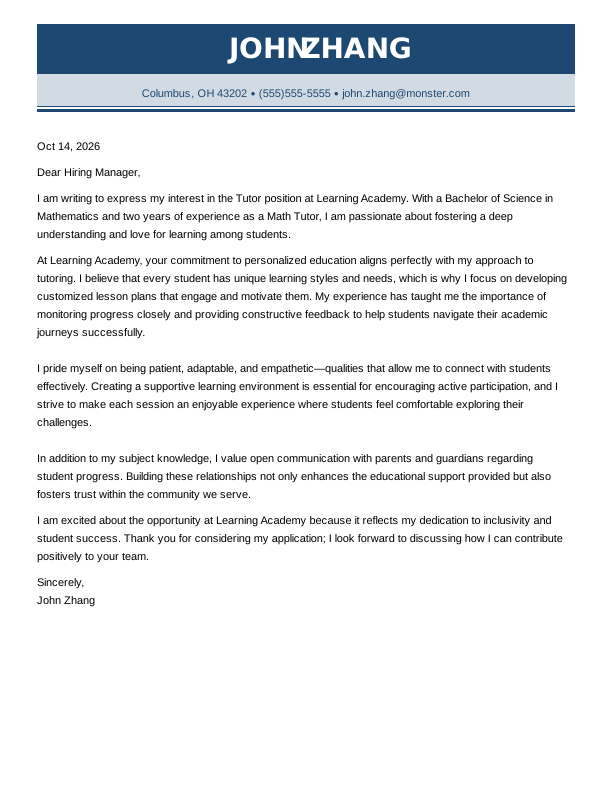
 Free
Tutor Entry-Level Cover Letter
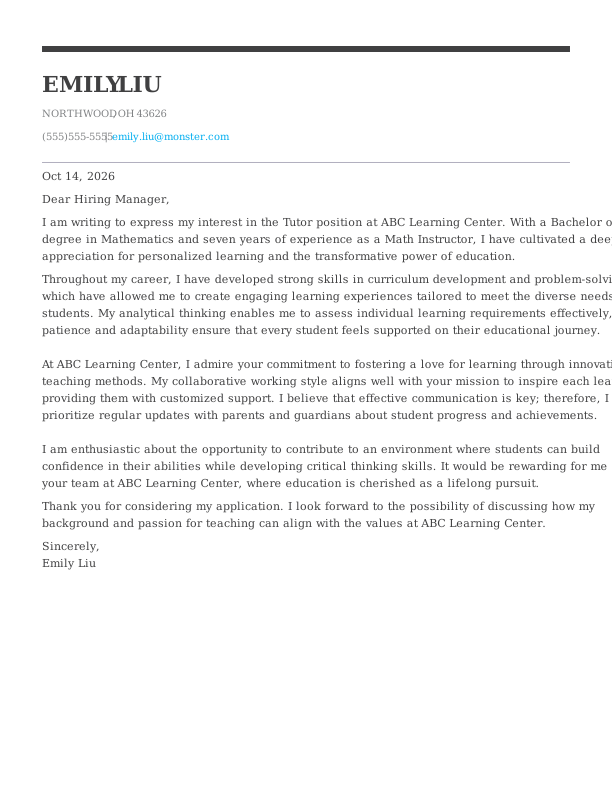
Tutor Mid-Level Cover Letter
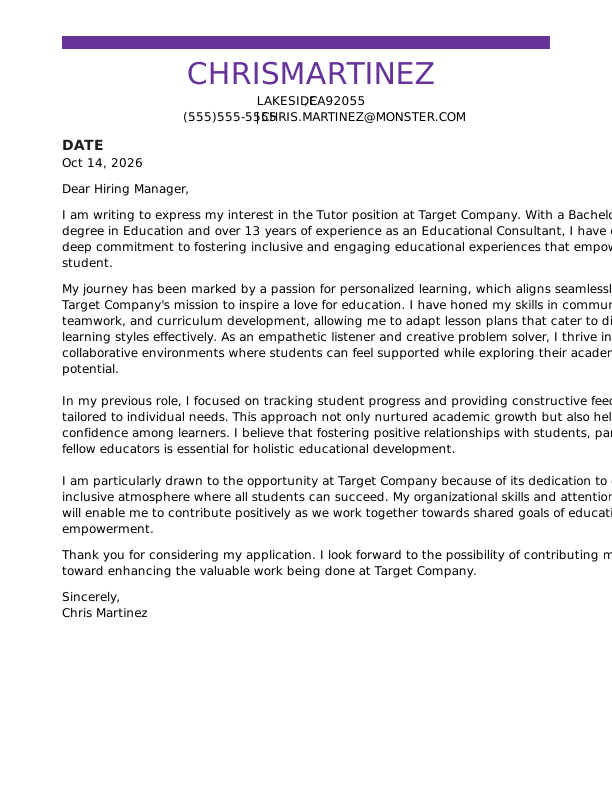
Tutor Experienced Cover Letter
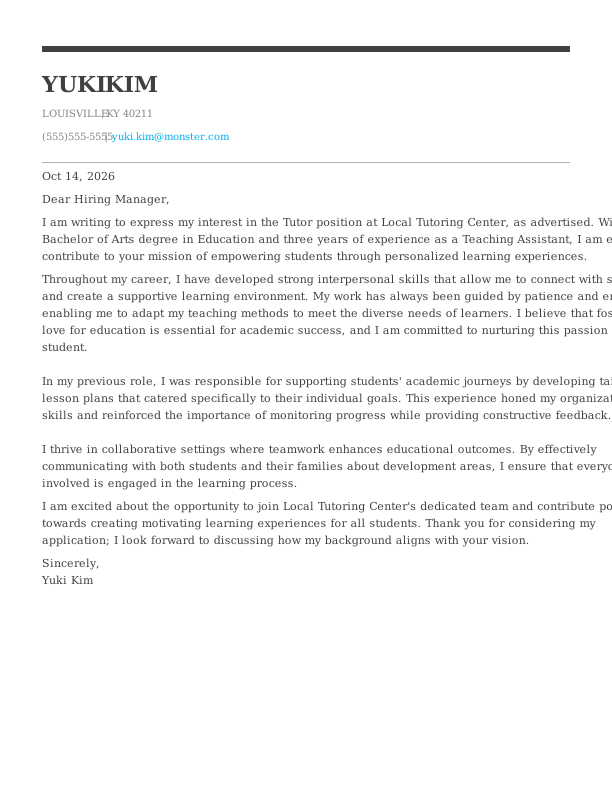
Tutor Entry-Level Cover Letter
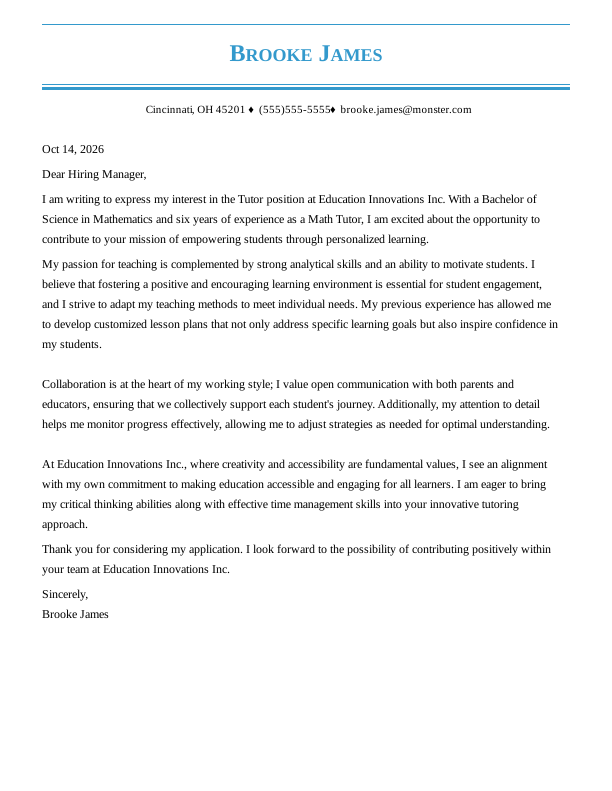
Tutor Mid-Level Cover Letter
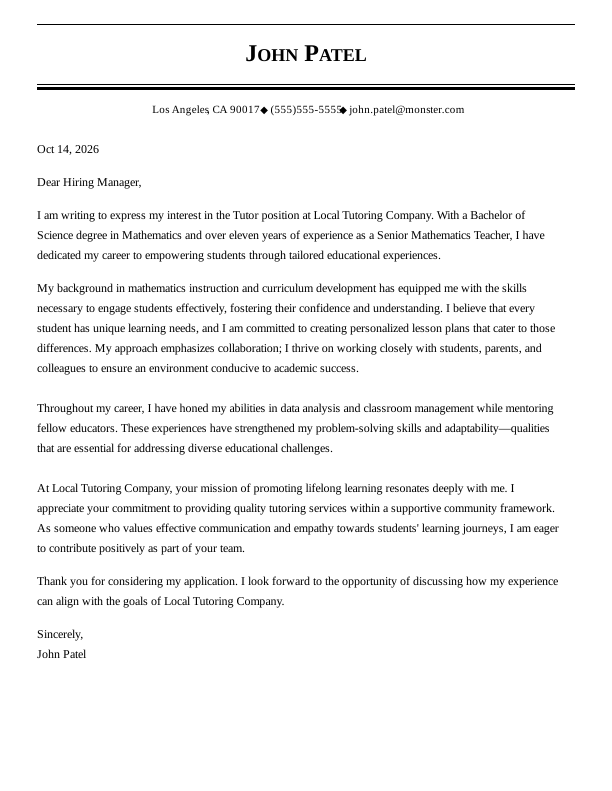
Tutor Experienced Cover Letter
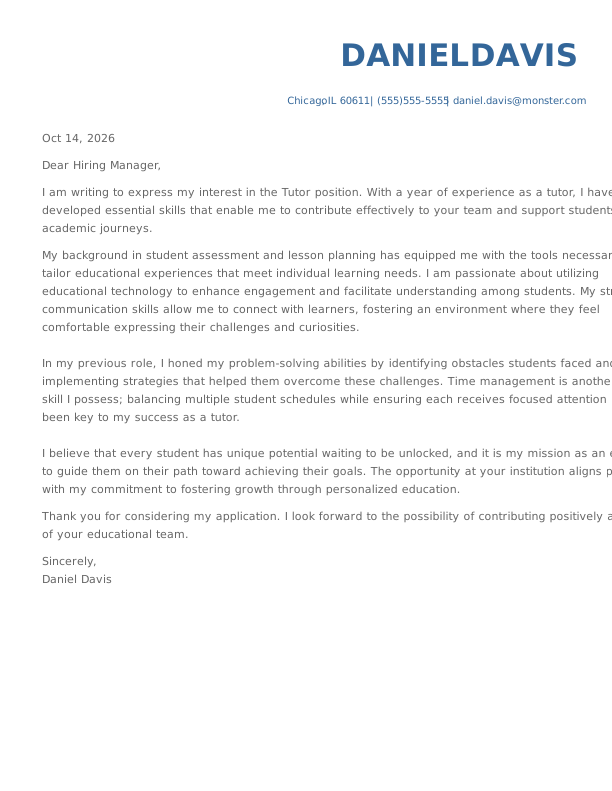
Tutor Entry-Level Cover Letter
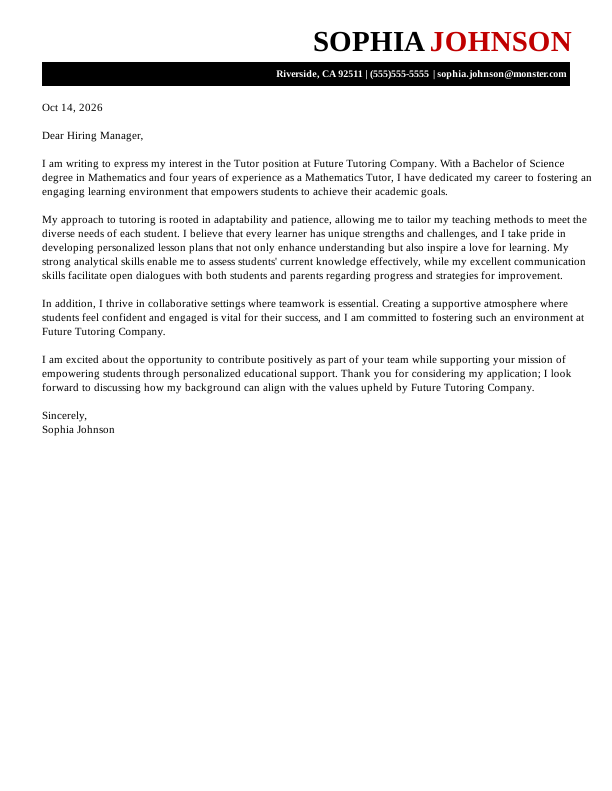
Tutor Mid-Level Cover Letter
Browse Free Cover Letter Templates
- Academic
- Account Manager
- Accountant
- Accounts Payable
- Administrative Assistant
- Admissions Counselor
- Architecture
- Artist
- Assistant Principal
- Babysitter
- Barista
- Bartender
- Bookkeeper
- Brand Ambassador
- Business Analyst
- Business
- Caregiver
- Chef
- Civil Engineering
- Computer Science
- Construction
- Consulting
- Copywriter
- Cosmetology
- Custodian
- Customer Service
- Customer Service Representative
- Data Analyst
- Data Entry
- Dental Assistant
- Dental Hygienist
- Digital Marketing
- Electrical Engineering
- Emt
- Engineering
- Esthetician
- Event Coordinator
- Executive Assistant
- Finance
- Financial Analyst
- Firefighter
- Flight Attendant
- Graphic Designer
- Hair Stylist
- Healthcare
- Hr Generalist
- Investment Banking
- It
- Janitor
- Journalism
- Lab Technician
- Law Clerk
- Lawyer
- Librarian
- Logistics
- Makeup Artist
- Manager
- Marketing Coordinator
- Marketing
- Marketing Manager
- Massage Therapist
- Mechanic
- Mechanical Engineer
- Medical Assistant
- Non Profit
- Nursing
- Occupational Therapy
- Office Assistant
- Office Manager
- Operations Manager
- Paralegal
- Personal Trainer
- Pharmacist
- Pharmacy Technician
- Photographer
- Physician Assistant
- Pilot
- Police Officer
- Program Manager
- Project Manager
- Property Manager
- Psychology
- Receptionist
- Research Assistant
- Restaurant Manager
- Retail
- Sales
- Sales Manager
- School Counselor
- Security Officer
- Social Work
- Software Engineer
- Special Education Teacher
- Starbucks
- Substitute Teacher
- Teacher
- Teaching Assistant
- Truck Driver
- Vet Tech
- Veterinary Assistant
Cover Letter Examples for Tutors
Cover letter requirements evolve as a tutor’s career progresses, especially from early tutoring sessions to more structured instruction and mentoring. Choose the template that matches your experience level so you can spotlight relevant skills, training, and results with specific subjects or student outcomes.
Entry-Level Tutor Cover Letter
Designed for recent graduates and career changers, this template demonstrates how to present academic achievement, subject mastery, and coaching experience with confidence when applying for initial tutoring roles.
Mid-Career Tutor Cover Letter
Tailored for candidates with several years of instruction experience, this template shows how to highlight small-group instruction, personalized learning plans, student progress tracking, and parent communication.
Experienced Tutor Cover Letter
Ideal for veteran educators and learning consultants, this template emphasizes curriculum adaptation, specialized learning strategies, multi-subject support, and academic mentorship.
Tutor Cover Letter Template (Text)
Paste this tutor cover letter template into your document, then swap in your subject specialties and tutoring outcomes so it fits your application.
Chris Chen
Northwood, OH 43620
(555)555-5555
chris.chen@monster.com
Oct 14, 2026
Dear Hiring Manager,
I am writing to express my interest in the tutor position at Educational Center. With a Bachelor of Science in Education and nine years of experience as a high school teacher, I have cultivated a robust skill set that aligns well with your mission of fostering a love for learning through personalized educational support.
Throughout my teaching career, I have embraced collaborative methodologies that emphasize communication and teamwork. My approach has always been centered on creating an empathetic and nurturing environment where students feel comfortable to explore their academic challenges. I pride myself on being detail-oriented and organized, which allows me to develop tailored lesson plans that engage diverse learning styles.
I understand the importance of adaptability in education, recognizing that each student’s needs are unique. This perspective drives me to continuously assess individual progress while providing constructive feedback aimed at inspiring growth and motivation. Additionally, my strong interpersonal skills enhance my ability to connect with both students and parents alike, ensuring open lines of communication regarding academic performance.
At Educational Center, I would be excited to contribute my passion for student development within your supportive atmosphere dedicated to academic excellence. The values you uphold resonate deeply with me; I believe every student has the potential for success when given the right guidance.
Thank you for considering my application. I look forward to the opportunity to discuss how my background can benefit your team and help empower students at Educational Center.
Sincerely,
Chris Chen
How to Write a Tutor Cover Letter
Writing an effective tutor cover letter requires showing hiring managers that you understand learning gap diagnostics, individualized lesson planning, and student progress tracking. Follow these steps to align your experience with a specific job posting.
1. Research & Prepare
Before writing, research the learning center or school’s primary student age groups, subject specialties, and tracking tools. Discovering whether the organization focuses on high-stakes test preparation, foundational K-12 literacy, or college-level STEM tutoring allows you to highlight the exact teaching methods that matter most to the education coordinator.
Gather actionable context by exploring these key information sources:
- Review the job description to confirm required academic credentials, subject certifications, and specific learning management platforms used.
- Explore the employer’s website to understand its instructional philosophy, session formats, and progress reporting expectations.
- Check regional curriculum standards or grade-level benchmarks to align your language with current educational goals.
2. Hook the Reader
Start your letter with an engaging opening line that demonstrates your ability to improve academic performance and build student confidence. Avoid generic statements like “I am writing to apply for the open tutor position.” Instead, capture the hiring manager’s attention by leading with a concrete instructional achievement or diagnostic success.
Choose an opening line tailored to your experience using these example approaches:
- Diagnostic improvement: “After analyzing initial practice test error patterns, I helped an Algebra II student raise their exam scores from 52% to 86% in six weeks using targeted error logs.”
- Curriculum alignment: “In my AP Biology prep sessions, I built weekly practice modules aligned with exam rubrics, tracking concept mastery unit by unit.”
- Parent communication: “I send concise progress summaries following each tutoring session, keeping parents informed on skill improvements and homework practice goals.”
3. Tell Your Professional Story
Use the body of your letter to give hiring managers a clear view of your daily tutoring impact. While your resume lists degrees and subject areas, your cover letter explains how you adapt explanations, guide practice, and achieve measurable learning gains. Using specific numbers makes your accomplishments far more compelling.
Incorporate concrete benchmarks like these to illustrate your impact:
- Raised a student’s algebra test scores from 62% to 84% through targeted twice-weekly tutoring sessions over six weeks.
- Improved reading comprehension accuracy from 68% to 86% for middle school learners using benchmark passage drills over one semester.
- Managed study schedules for four students simultaneously, cutting average homework completion times by two days through structured weekly checklists.
4. Showcase Your Skills
Rather than using broad self-descriptors like “patient” or “good at explaining,” illustrate how your skills resolve real academic challenges. Showing the exact moments where your lesson adjustments, visual aids, or encouragement helped a stuck student builds trust with the employer.
Connect your practical abilities directly to daily tutoring needs using these examples:
- Lesson adaptation: “I adjusted my fraction lesson plan after noticing a student struggling with word problems, switching from abstract formulas to guided visual models.”
- Learning tools: “I used online learning platforms to share step-by-step practice hints, tracking which problem types the student retried independently.”
- Family communication: “When student progress slowed, I communicated clearly with parents about our practice focus and suggested supportive study habits for home.”
5. Explain Any Special Circumstances
If you have an employment gap, are transitioning careers, or recently relocated, address it briefly in one or two direct sentences. Focus your explanation on your active subject knowledge, updated teaching materials, and eagerness to work with students so the manager knows you are ready for instruction.
Frame your circumstances clearly using these straightforward approaches:
- Addressing an employment gap: “Following a six-month career break, I resumed active tutoring sessions and refreshed my lesson plans using updated digital practice sets.”
- Transitioning positions: “I am pivoting from corporate training into academic tutoring, leveraging my strong math background and completing specialized instruction workshops.”
- Handling relocation: “After moving to the area last fall, I updated my regional background checks and began providing online subject tutoring to maintain active teaching practice.”
6. End With a Professional Goodbye
Conclude your letter with a polite, confident statement that invites the hiring manager to contact you for an interview. Keep your sign-off concise, thank the reader for their time, and express enthusiasm for discussing your tutoring approach in detail.
Structure your final paragraph using this clear approach:
- Offer a clear next step: “I would welcome the opportunity to discuss how my diagnostic assessment methods and personalized study plans can support your students’ academic goals.”
- Express gratitude: “Thank you for your time and consideration.”
- End with a clean sign-off: “Sincerely,” followed by your full name.
4 Tips for Formatting Your Cover Letter
When you apply for a tutor position, education coordinators often scan your application quickly between managing schedules and parent inquiries. They look rapidly for subject expertise, grade-level experience, and evidence of student progress. A clean visual presentation with consistent spacing and logical organization makes your top qualifications easy to spot and proves that you take pride in clear, professional communication.

Use a Professional Font & Layout
Select standard, highly legible fonts such as Arial, Calibri, Georgia, or Helvetica in 10–12 pt size. Maintain clean 1-inch margins and use the exact same header design as your resume so your entire application package presents a unified, professional appearance.

Address the Hiring Manager Directly
Search the job posting, school staff directory, or professional networking profiles to identify the specific program director, tutoring coordinator, or center manager. If you cannot find an individual name, address your letter to “Dear Hiring Manager” or “Dear Tutoring Team” rather than using outdated phrases.

Match Your Header to Your Resume
Copy the exact same name layout, typography, contact details, and location formatting from your resume onto your cover letter. A matching header allows hiring managers to instantly recognize your application package and confirm your contact information while reviewing your resume.

Balance Spacing & Margins
Set line spacing between 1.0 and 1.15, leaving a full blank line between paragraphs to keep the layout clean and readable. Use uniform margins between 0.75 and 1 inch so your letter looks well-proportioned on screens and printed copies.
Top-Paying States for Tutor Roles
Knowing what tutors earn across the country gives you a clear baseline when evaluating opportunities, setting your rates, or planning your schedule. These figures come from the U.S. Bureau of Labor Statistics (BLS) and show recent average earnings for the role nationwide.
Keep in mind that your actual pay will depend on your location, experience level, and the subjects you teach, with specialized fields like test prep or advanced coursework often paying higher rates. Whether you tutor independently, work for a school district, or join an agency—along with seasonal surges around exam periods—will also play a big part in your earnings.
| Alabama | $34,930 |
| Alaska | $43,540 |
| Arizona | $49,030 |
| Arkansas | $44,770 |
| California | $49,750 |
| Connecticut | $60,060 |
| Delaware | $35,460 |
| Florida | $46,990 |
| Georgia | $45,040 |
| Hawaii | $39,220 |
| Idaho | $37,300 |
| Illinois | $40,550 |
| Indiana | $48,210 |
| Iowa | $43,570 |
| Kansas | $36,770 |
| Kentucky | $34,960 |
| Louisiana | $35,010 |
| Maine | $54,770 |
| Maryland | $53,010 |
| Massachusetts | $60,940 |
| Michigan | $42,390 |
| Minnesota | $43,460 |
| Mississippi | $54,640 |
| Missouri | $38,630 |
| Montana | $42,520 |
| Nebraska | $44,520 |
| Nevada | $34,340 |
| New Hampshire | $52,600 |
| New Jersey | $49,530 |
| New Mexico | $41,540 |
| New York | $60,120 |
| North Carolina | $44,670 |
| North Dakota | $42,590 |
| Ohio | $48,510 |
| Oklahoma | $35,400 |
| Oregon | $52,170 |
| Pennsylvania | $45,780 |
| Rhode Island | $65,580 |
| South Carolina | $42,090 |
| South Dakota | $37,940 |
| Tennessee | $46,640 |
| Texas | $35,140 |
| Utah | $40,020 |
| Vermont | $53,870 |
| Virginia | $55,330 |
| Washington | $43,820 |
| West Virginia | $45,990 |
| Wisconsin | $43,520 |
| Wyoming | $68,690 |
Key Takeaways
- Demonstrate learning impact by sharing a specific example where you diagnosed a student’s learning gap and adjusted your instruction to help them succeed.
- Include concrete performance metrics like test score growth percentages, benchmark accuracy gains, or assignment completion rates to prove tutoring effectiveness.
- Tailor your letter to the tutoring setting by emphasizing behavior management for afterschool programs, score gains for test prep centers, or clear study plans for private clients.
More Cover Letter Examples
Browse Monster’s Resume Templates
Monster also has hundreds of ATS-friendly resume templates for all career levels and industries. Create a matching resume to help you land the interview.
Frequently Asked Questions
Last Update:
Do I really need a cover letter?
Yes, submitting a cover letter with your tutor application is strongly recommended because it demonstrates your communication style and teaching approach in real time. While a resume lists your education and subject areas, a cover letter explains how you assess learning gaps, build student confidence, and track progress. It also provides space to explain career transitions or gaps.
How long should my cover letter be?
A tutor cover letter should stay within one page, targeting between 250 and 400 words. Hiring managers review many applications quickly, so direct, concise writing works best. Divide your text into three or four short paragraphs that focus strictly on your subject expertise, teaching methods, and measurable student outcomes without adding extra clutter.
Should my cover letter match my resume?
Yes, your tutor cover letter should match your resume’s visual formatting to present a polished, cohesive application package. Use the same font styles, margin sizes, color choices, and contact header across both documents. Instead of repeating your resume bullet points, use your cover letter to expand on a specific student achievement or explain how your teaching style fits the center’s goals.
How do I address my cover letter if I don’t know the hiring manager’s name?
When addressing a tutor cover letter without a contact name, search the job posting, organization website, or social media for the tutoring coordinator, education director, or center manager. You can also call the location directly to ask who handles hiring. If you cannot locate a specific name, address your letter to “Dear Hiring Manager” or “Dear Tutoring Team.” Avoid using “To Whom It May Concern,” as it sounds outdated.
Should I mention salary expectations in my cover letter?
You should only mention salary expectations in a tutor cover letter if the job posting explicitly requests them. If required, state a flexible pay range based on local market research for your subject level and experience. Mention briefly that you are open to discussing total compensation, including performance bonuses and scheduling flexibility, during the interview process.

Toni Frana is a Certified Professional Resume Writer (CPRW), member of the Professional Association of Resume Writers & Career Coaches, and career expert who empowers job seekers to take control of their career paths using Monster’s comprehensive job search and resume tools.
See More From Toni FranaExplore Related Career Advice







How to Write a Cover Letter for Internal Positions or Promotions (Examples & Tips)

Updated:
Apr 23, 2026
|
19 min read


Cover Letter vs Resume: What’s the Difference & Do You Need Both?

Updated:
Apr 23, 2026
|
18 min read