


Free Academic Advisor Cover Letter Templates & Examples
A strong academic advisor cover letter shows you can guide students, track progress, and support success through thoughtful communication. Our free cover letter examples and step-by-step guidance help you write a focused application that highlights your advising experience to hiring managers.
Real-World Cover Letters That Get Results
 Free
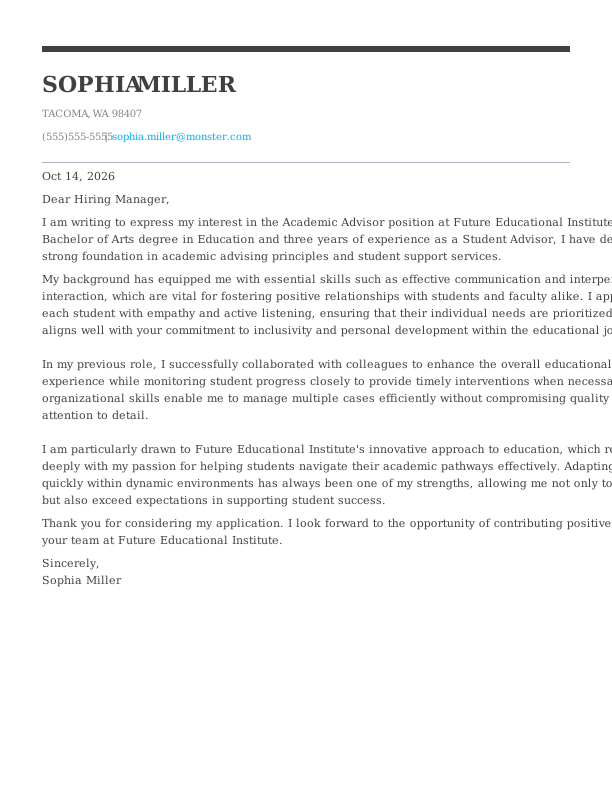
Academic Advisor Entry-Level Cover Letter
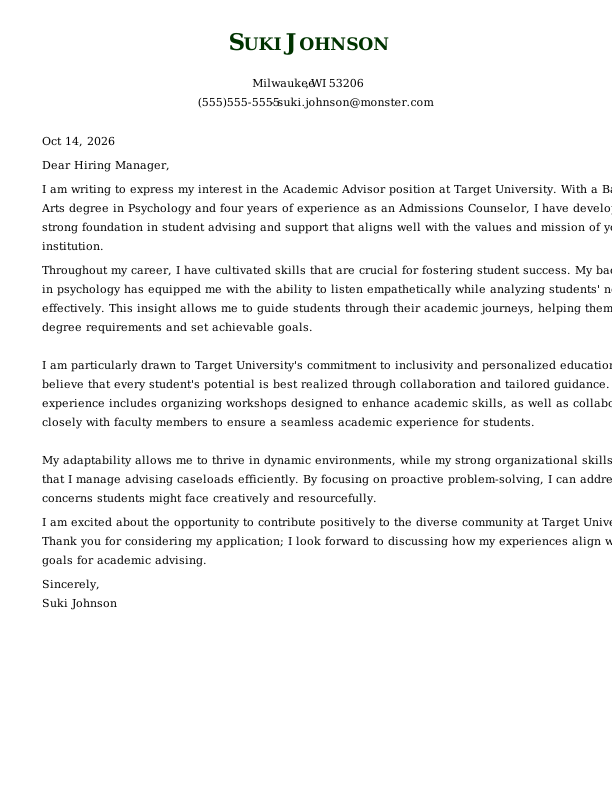
Academic Advisor Mid-Level Cover Letter
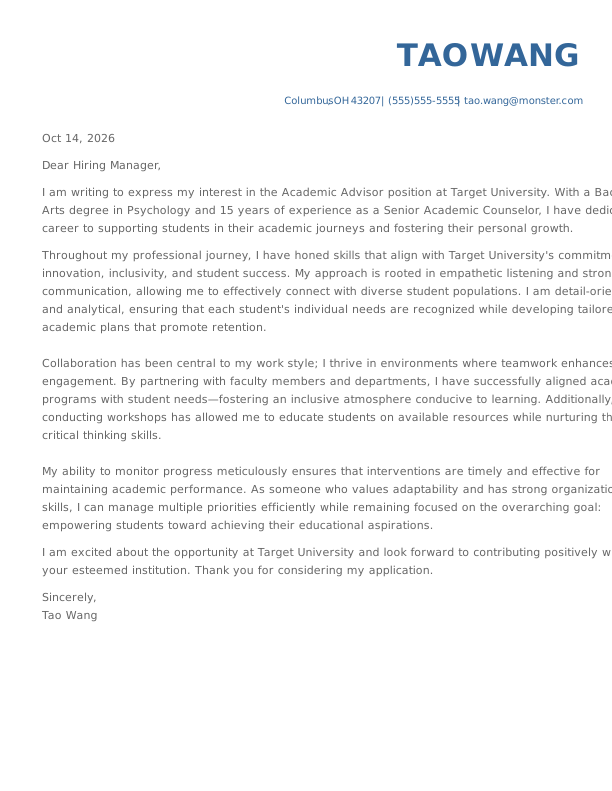
Academic Advisor Experienced Cover Letter
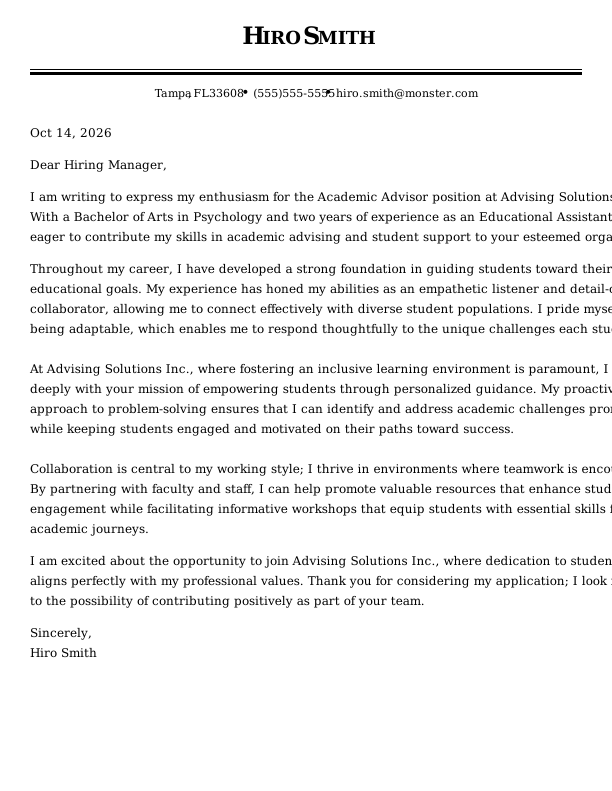
Academic Advisor Entry-Level Cover Letter
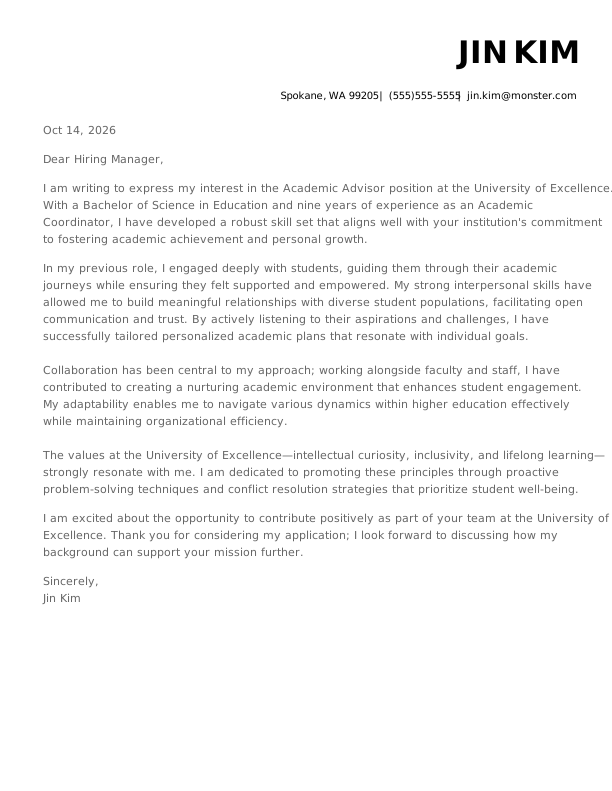
Academic Advisor Mid-Level Cover Letter
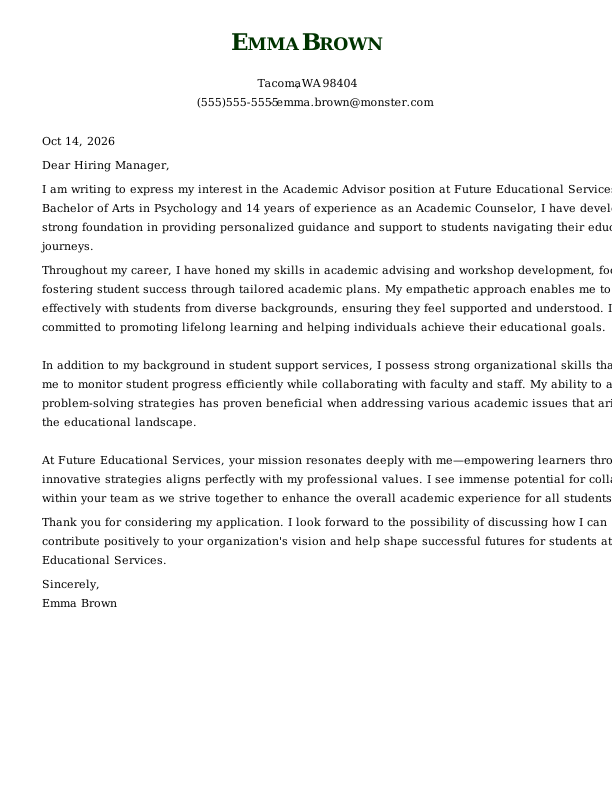
Academic Advisor Experienced Cover Letter
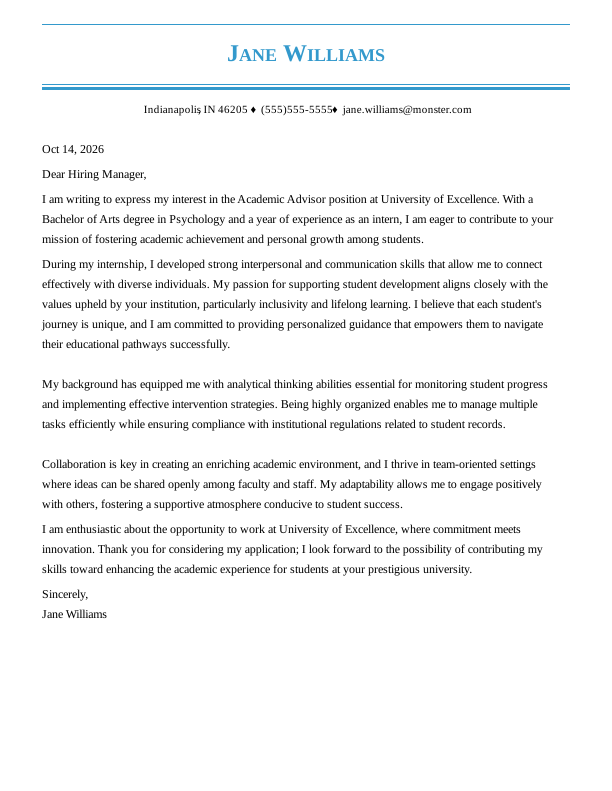
Academic Advisor Entry-Level Cover Letter
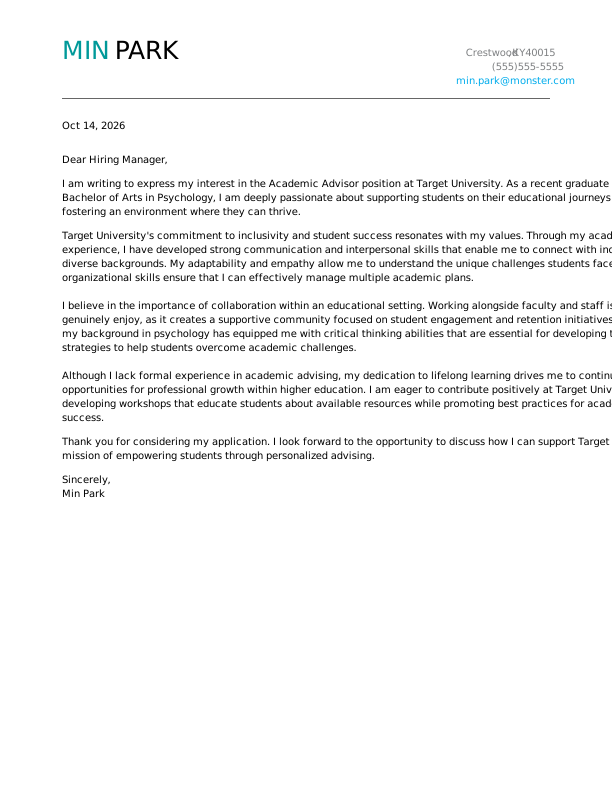
Academic Advisor Mid-Level Cover Letter
Browse Free Cover Letter Templates
- Academic
- Account Manager
- Accountant
- Accounts Payable
- Administrative Assistant
- Admissions Counselor
- Architecture
- Artist
- Assistant Principal
- Babysitter
- Barista
- Bartender
- Bookkeeper
- Brand Ambassador
- Business Analyst
- Business
- Caregiver
- Chef
- Civil Engineering
- Computer Science
- Construction
- Consulting
- Copywriter
- Cosmetology
- Custodian
- Customer Service
- Customer Service Representative
- Data Analyst
- Data Entry
- Dental Assistant
- Dental Hygienist
- Digital Marketing
- Electrical Engineering
- Emt
- Engineering
- Esthetician
- Event Coordinator
- Executive Assistant
- Finance
- Financial Analyst
- Firefighter
- Flight Attendant
- Graphic Designer
- Hair Stylist
- Healthcare
- Hr Generalist
- Investment Banking
- It
- Janitor
- Journalism
- Lab Technician
- Law Clerk
- Lawyer
- Librarian
- Logistics
- Makeup Artist
- Manager
- Marketing Coordinator
- Marketing
- Marketing Manager
- Massage Therapist
- Mechanic
- Mechanical Engineer
- Medical Assistant
- Non Profit
- Nursing
- Occupational Therapy
- Office Assistant
- Office Manager
- Operations Manager
- Paralegal
- Personal Trainer
- Pharmacist
- Pharmacy Technician
- Photographer
- Physician Assistant
- Pilot
- Police Officer
- Program Manager
- Project Manager
- Property Manager
- Psychology
- Receptionist
- Research Assistant
- Restaurant Manager
- Retail
- Sales
- Sales Manager
- School Counselor
- Security Officer
- Social Work
- Software Engineer
- Special Education Teacher
- Starbucks
- Substitute Teacher
- Teacher
- Teaching Assistant
- Truck Driver
- Vet Tech
- Veterinary Assistant
Cover Letter Examples for Academic Advisors
What you highlight in your cover letter changes as you move through your career as an academic advisor, shifting from direct student support to broader program leadership and impact. Choose the template that fits your experience so you can showcase the right skills and achievements for where you’re at right now.
Entry-Level Academic Advisor Cover Letter
If you’re a recent graduate or changing careers, this template helps you write a strong cover letter without needing direct advising experience. It’s built to spotlight your transferable skills and show you’re ready for the role.
Mid-Career Academic Advisor Cover Letter
Made for advisors with a few years under their belt, this template focuses on managing student caseloads, running workshops, and mentoring newer team members.
Experienced Academic Advisor Cover Letter
Ideal for advisors approaching 10 years of experience, this template highlights your leadership in student success strategies, program management, and cross-departmental efforts to boost retention.
Academic Advisor Cover Letter Template (Text)
Paste this academic advisor cover letter template into your document, then edit your advising outcomes, caseload metrics, and the school or program name.
Min Nguyen
Seattle, WA 98103
(555)555-5555
min.nguyen@monster.com
Oct 14, 2026
Dear Hiring Manager,
I am writing to express my interest in the Academic Advisor position at the University of Learning. With a Bachelor of Science in Psychology and six years of experience as an Admissions Counselor, I have developed a strong foundation in student engagement and support that aligns with your institution’s commitment to fostering academic excellence and personal growth.
Throughout my career, I have honed my communication skills and gained valuable insights into the diverse challenges faced by students. My empathetic listening ability allows me to provide personalized guidance, ensuring that each individual feels supported as they navigate their academic journey. Collaboration is at the core of my working style; I thrive when partnering with faculty and staff to create strategies that enhance student retention and success.
In addition to advising on course selection and degree requirements, I am passionate about conducting workshops that empower students with essential skills for their future endeavors. My organizational skills enable me to maintain accurate records of student interactions while tracking progress effectively.
I admire the University of Learning’s mission to prioritize accessibility, inclusivity, and lifelong learning, values that resonate deeply with me. By creating a supportive academic community where every student can flourish, we can prepare them not only for their careers but also as contributing members of society.
Thank you for considering my application. I look forward to the opportunity to contribute positively to your team while supporting students in achieving their educational goals.
Sincerely,
Min Nguyen
How to Write an Academic Advisor Cover Letter
Writing a strong cover letter comes down to showing how your advising experience meets the institution’s current needs. Follow these straightforward steps to convert your background into an engaging draft.
1. Research & Prepare
Take a few minutes to explore how the school serves its students before writing. Look for details on advising tools, degree audit systems, and retention goals. Essential research areas include:
- Review the job posting on the employer website for their advising platform and required competencies.
- Scan the institution’s registrar policies for how they handle degree audits and transfer credit evaluation.
- Read recent institutional news releases for stated goals tied to retention or graduation.
2. Hook the Reader
Skip standard openings and immediately showcase how you manage student caseloads and deliver results. Effective opening strategies include highlighting:
- Track record with retention: “I reduced first-year stop-outs by 9% in my caseload by running weekly degree-progress audits and intervening within two days of early alerts using Starfish and DegreeWorks.”
- Workflow and compliance: “I built a repeatable probation review process that cut missed SAP deadlines to zero by standardizing checklists, documenting actions in Colleague, and coordinating with financial aid counselors.”
- Student success initiative: “As part of our First-Gen Success cohort launch, I paired intrusive advising with a structured career mapping session every fall term for 120 students.”
3. Tell Your Professional Story
Use your letter to detail the concrete impact of your work rather than summarizing your resume. Quantifiable results make your achievements clear, as shown in these examples:
- Improved fall-to-spring retention by 9% by running targeted outreach for at-risk students and coordinating weekly check-ins.
- Resolved an average of 40 advising holds per week within 24 hours after redesigning my intake workflow and triage rubric.
- Helped 312 students complete degree plans on time by auditing requirements each term and sending personalized reminders.
4. Showcase Your Skills
Demonstrate key strengths through practical examples instead of listing skills. Match position requirements by describing routine interactions such as:
- Student advising: “I met with a first-year student who was failing two courses and helped them map weekly study blocks to the syllabi so they could choose a realistic next step.”
- Degree planning tools: “I updated degree audit notes in our advising system after a catalog change and walked the student through how their remaining requirements would shift.”
- Crisis communication: “When a student missed deadlines due to an unexpected family issue, I documented concerns clearly and coordinated next steps with their instructors so they had one consistent plan.”
5. Explain Any Special Circumstances
Address career gaps, moves, or sector changes briefly and directly to show readiness. Consider these options for framing typical situations:
- After a year out of advising for caregiving, I renewed my NACADA membership and completed an online student success workshop before taking on roles supporting first-year registration at my local college.
- I am pivoting from career services into academic advising by using Navigate Student to map degree plans and by completing NACADA coursework focused on academic coaching and retention strategies.
- After relocating to Austin last fall, I resumed advising with current FERPA training through my new institution’s compliance portal while maintaining the same caseload management process.
6. End With a Professional Goodbye
Close with a polite sign-off and a direct request to connect. Keep your final sentence clear and professional, such as: “I would welcome the opportunity to discuss how my advising background aligns with your team’s student success goals. Thank you for your consideration.” Conclude with a standard closing like “Sincerely.”
4 Tips for Formatting Your Cover Letter
Search committees and department chairs only scan cover letters briefly, so your formatting must make your student-centered philosophy, advising load metrics, and key caseload outcomes stand out immediately. Whether you are applying for an entry-level Academic Advisor I position or transitioning into higher education administration, these standards ensure your application looks polished and professional.

Keep It to One Page
Advising directors review applications between student drop-in hours and registration peaks, so overly long letters get set aside. Aim for 250–400 words across 3–4 concise paragraphs. Direct attention to your developmental advising framework, student retention stats (such as first-year persistence), and degree audit expertise.

Match Your Header to Your Resume
Maintain identical contact information, credentials (e.g., M.Ed., NACADA member), and typography between your resume and cover letter. Consistent header branding shows professional attention to detail—a critical trait for managing student records and graduation checks.

Balance Spacing & Margins
Set line spacing between 1.0 and 1.15 with single blank lines separating paragraphs for quick readability. Use standard 0.75–1 inch margins to maintain clean white space, making your advising achievements easy to digest on mobile devices and printed committee packets.

Save & Send as a PDF
Export your cover letter as a PDF to ensure formatting stays intact across university applicant tracking systems (ATS). Name your file clearly, such as Firstname_Lastname_Academic_Advisor_Cover_Letter.pdf, to keep your submission organized for hiring managers.
Key Takeaways
- Share a specific story that demonstrates how your advising helped a student stay on track.
- Include clear metrics like graduation and retention rates to prove your impact.
- Tailor your accomplishments to highlight what matters most to the target institution.
More Cover Letter Examples
Browse Monster’s Resume Templates
Monster also has hundreds of ATS-friendly resume templates for all career levels and industries. Create a matching resume to help you land the interview.
Frequently Asked Questions
Last Update:
Do I really need a cover letter?
Including a cover letter is strongly recommended, even when optional. A resume highlights education and work experience, but it can’t capture your specific advising approach or professional story. Sending one shows genuine initiative and helps you stand out from other applicants.
It’s especially valuable when explaining a career transition or employment gap, or showing personal interest in the school. You can highlight enthusiasm for student advocacy and connect your motivation directly to their advising goals.
How long should my cover letter be?
An academic advisor cover letter should stay at 1 page maximum, targeting 250 to 400 words total. Hiring managers often review applications quickly between meetings, so concise messaging helps your application stand out right away.
Focus on quality over quantity by structuring text into 3 to 4 short paragraphs. Highlight only your most relevant achievements, retention metrics, or specialized certifications to keep the entire document clear, focused, and effective for reviewers.
Should my cover letter match my resume?
Yes, your cover letter should match your resume’s formatting so your application reads as a cohesive package. Use the same font, accent colors, and header layout to help the hiring manager recognize your materials instantly across both documents.
Keep text complementary instead of repeating resume bullet points line for line. Use the letter to expand on an advising outcome or explain what draws you to this institution and how its priorities connect to your personal student support approach.
How do I address my cover letter if I don’t know the hiring manager’s name?
Always try to locate a specific contact before writing your cover letter. Check the job posting, department website, and LinkedIn for the advising director or program coordinator handling the position.
If you can’t find a specific person, use greetings like “Dear Hiring Manager” or “Dear Academic Advising Team.” Skip outdated phrases like “To Whom It May Concern” to ensure your greeting sounds modern and tailored to the department.
Can I use AI to write my cover letter?
Yes, AI tools can help draft a structure, generate ideas, and overcome writer’s block. Personalization remains essential because your student support philosophy and reasons for joining the institution must come directly from your own professional experiences.
Use AI text as an initial baseline draft, then rewrite heavily using real advising examples, such as improving retention through specific interventions. Hiring managers spot generic phrasing quickly, so add your authentic voice to demonstrate true alignment with their mission.

Elizabeth Muenzen is a Certified Professional Resume Writer (CPRW) and member of the Professional Association of Resume Writers & Career Coaches who empowers job seekers to take control of their career paths using Monster’s comprehensive job search and resume tools.
See More From Elizabeth MuenzenExplore Related Career Advice







How to Write a Cover Letter for Internal Positions or Promotions (Examples & Tips)

Updated:
Apr 23, 2026
|
19 min read


Cover Letter vs Resume: What’s the Difference & Do You Need Both?
Updated:
Apr 23, 2026
|
18 min read