


Free Communications Cover Letter Templates & Examples
A strong communications cover letter shows how you shape messages for different audiences and turn ideas into clear, useful content. Our cover letter examples and writing tips help you explain your approach and connect your writing, campaign, or media experience to the role.
Real-World Cover Letters That Get Results
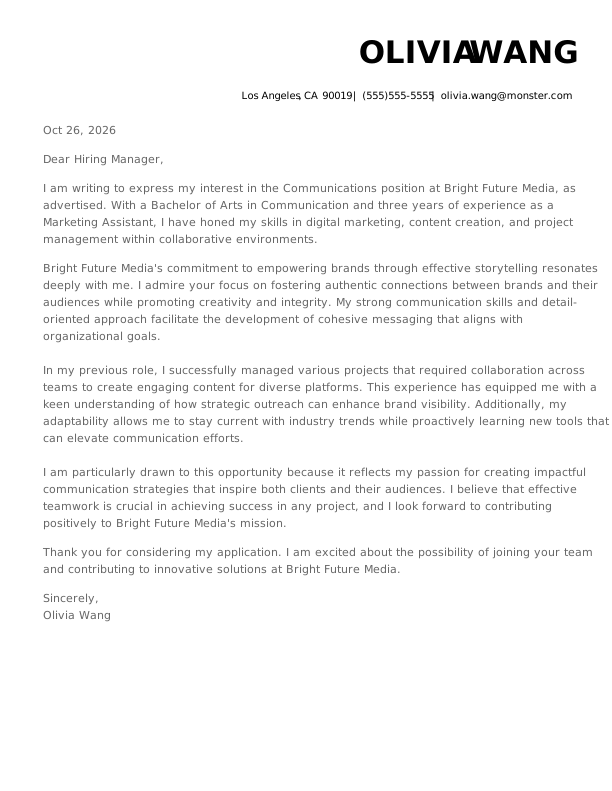
 Free
Communications Entry-Level Cover Letter
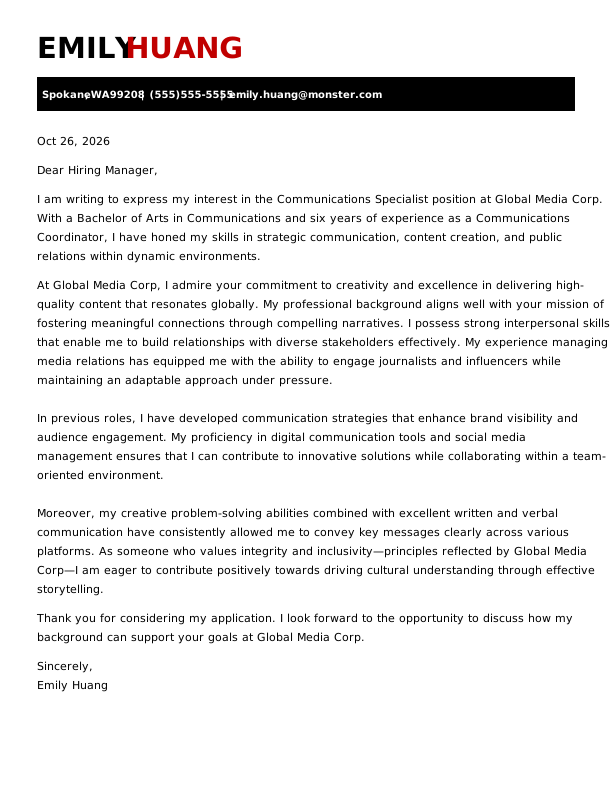
Communications Mid-Level Cover Letter
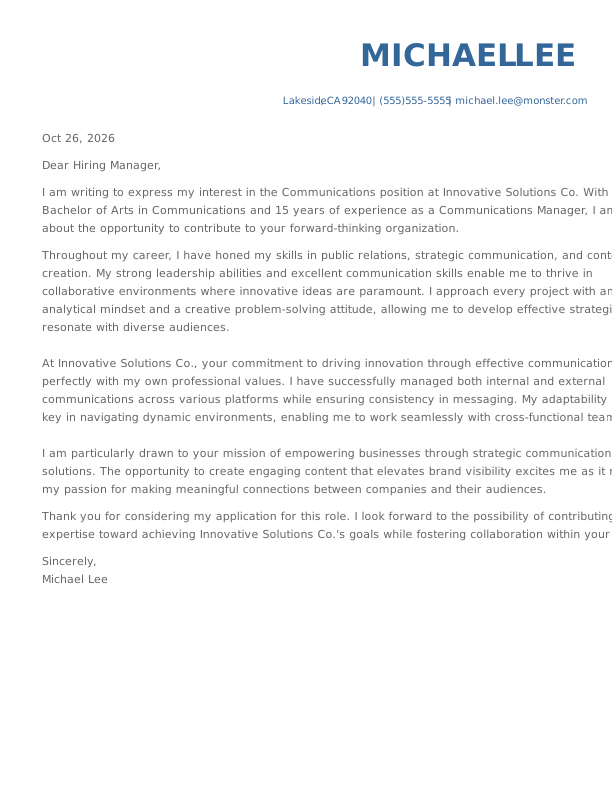
Communications Experienced Cover Letter
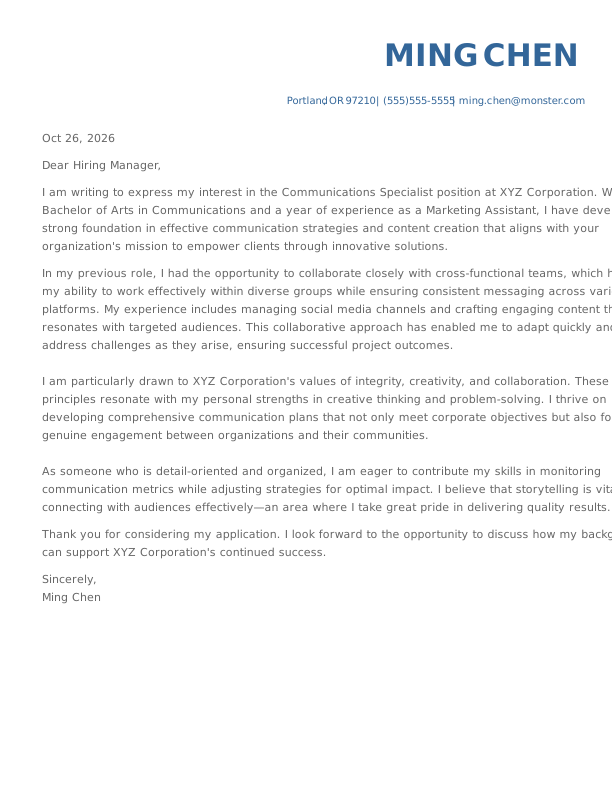
Communications Entry-Level Cover Letter
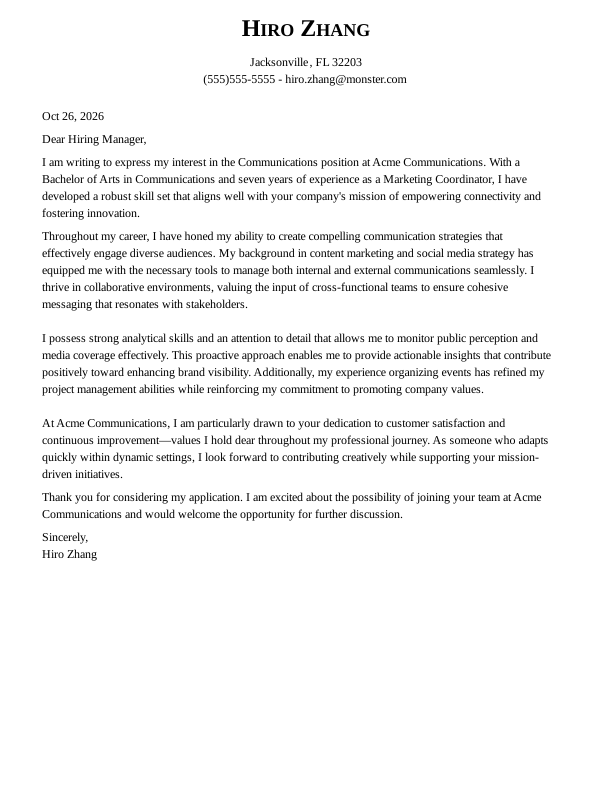
Communications Mid-Level Cover Letter
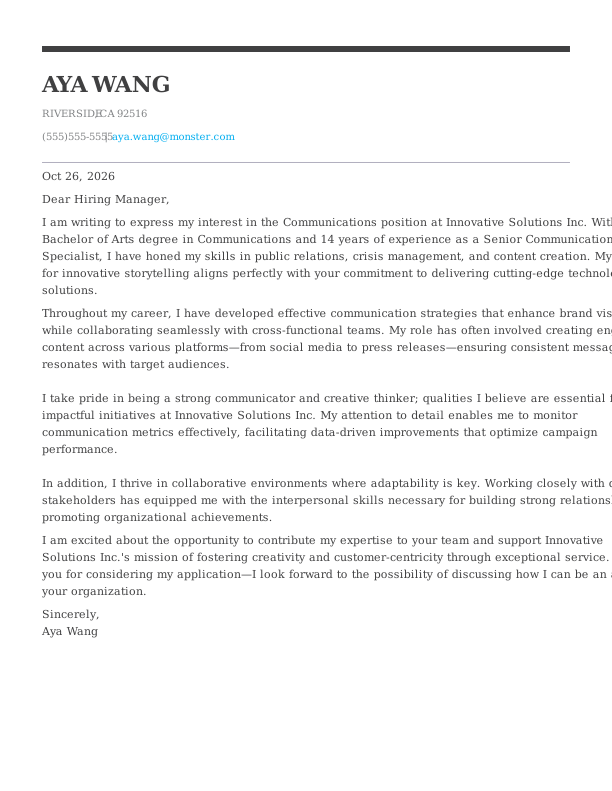
Communications Experienced Cover Letter
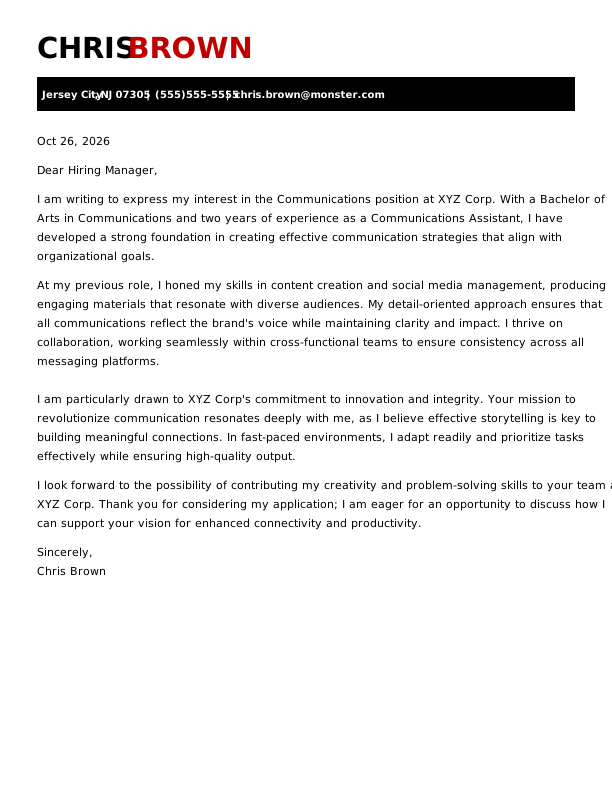
Communications Entry-Level Cover Letter
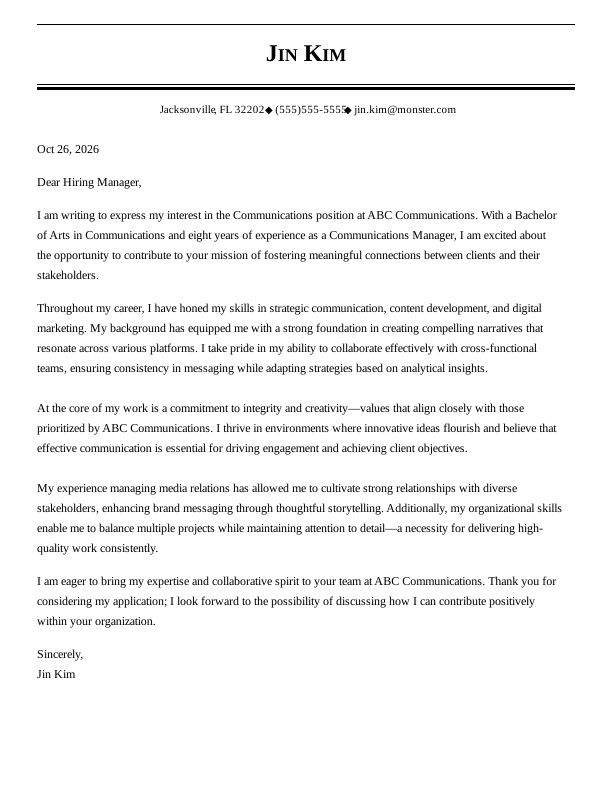
Communications Mid-Level Cover Letter
Browse Free Cover Letter Templates
- Academic
- Account Manager
- Accountant
- Accounts Payable
- Administrative Assistant
- Admissions Counselor
- Architecture
- Artist
- Assistant Principal
- Babysitter
- Barista
- Bartender
- Bookkeeper
- Brand Ambassador
- Business Analyst
- Business
- Caregiver
- Chef
- Civil Engineering
- Computer Science
- Construction
- Consulting
- Copywriter
- Cosmetology
- Custodian
- Customer Service
- Customer Service Representative
- Data Analyst
- Data Entry
- Dental Assistant
- Dental Hygienist
- Digital Marketing
- Electrical Engineering
- Emt
- Engineering
- Esthetician
- Event Coordinator
- Executive Assistant
- Finance
- Financial Analyst
- Firefighter
- Flight Attendant
- Graphic Designer
- Hair Stylist
- Healthcare
- Hr Generalist
- Investment Banking
- It
- Janitor
- Journalism
- Lab Technician
- Law Clerk
- Lawyer
- Librarian
- Logistics
- Makeup Artist
- Manager
- Marketing Coordinator
- Marketing
- Marketing Manager
- Massage Therapist
- Mechanic
- Mechanical Engineer
- Medical Assistant
- Non Profit
- Nursing
- Occupational Therapy
- Office Assistant
- Office Manager
- Operations Manager
- Paralegal
- Personal Trainer
- Pharmacist
- Pharmacy Technician
- Photographer
- Physician Assistant
- Pilot
- Police Officer
- Program Manager
- Project Manager
- Property Manager
- Psychology
- Receptionist
- Research Assistant
- Restaurant Manager
- Retail
- Sales
- Sales Manager
- School Counselor
- Security Officer
- Social Work
- Software Engineer
- Special Education Teacher
- Starbucks
- Substitute Teacher
- Teacher
- Teaching Assistant
- Truck Driver
- Vet Tech
- Veterinary Assistant
Cover Letter Examples for Communications
As your communications career develops, employers look for different evidence of your skills, from writing and coordination to campaign planning and strategic decisions. Choose the example that fits your experience level to highlight the training, responsibilities, and accomplishments most relevant to your next role.
Entry-Level Communications Cover Letter
For applicants beginning a communications career or moving from a related field, this example shows how to connect education and supporting experience to the role.
Mid-Career Communications Cover Letter
Designed for communications professionals with several years of experience, this example shows how to present your campaign work, media relationships, and growing responsibility for messaging.
Experienced Communications Cover Letter
For experienced communications professionals, this example shows how to highlight your strategic judgment, leadership, and ability to keep messaging consistent across teams and channels.
Communications Cover Letter Template (Text)
Copy this communications cover letter template, paste it into your document, and swap in your press releases, campaign metrics, or target organization for the role.
Olivia Martinez
Hillcrest, NY 11511
(555)555-5555
olivia.martinez@monster.com
Oct 26, 2026
Dear Hiring Manager,
I am writing to express my enthusiasm for the Communications position at Innovative Media Solutions. With a Bachelor of Arts in Communications and four years of experience as a Marketing Coordinator, I have cultivated a diverse skill set that aligns well with your company’s mission to redefine the media landscape through creativity and innovation.
In my previous role, I developed communication strategies that enhanced brand visibility and audience engagement. My experience in digital marketing and social media management has equipped me with the tools to create compelling content tailored for various platforms, fostering meaningful connections between brands and their audiences. I thrive in collaborative environments where innovative ideas are encouraged, drawing on my strengths in creativity, analytical thinking, and team leadership.
Understanding the importance of clear messaging across all channels, I am detail-oriented when crafting high-quality content while remaining adaptable to rapidly changing industry trends. My interpersonal skills allow me to build relationships effectively with diverse stakeholders, ensuring alignment with organizational objectives.
I admire Innovative Media Solutions’ commitment to excellence and client success and would be honored to contribute my background in communications to help elevate your clients’ narratives. Thank you for considering my application; I look forward to the opportunity to discuss how my experiences can support your team’s goals.
Sincerely,
Olivia Martinez
How to Write a Communications Cover Letter
To write a communications cover letter, turn your writing and campaign experience into specific details about who you reached, what you communicated, and what changed. Work through the steps below to choose relevant examples and shape them into a letter that fits the position.
1. Research & Prepare
Start by looking at how the employer communicates with its audiences. Read the job posting alongside a few recent announcements, articles, or social posts, and notice which responsibilities overlap with your experience. Use what you find to decide whether your letter should emphasize writing, media outreach, employee updates, or another area.
Look for information you can use to tailor your application:
- Identify the main audiences and channels mentioned in the posting.
- Read recent content to understand the employer’s tone and the topics it covers.
- Select examples that relate to its work, such as explaining a service change or promoting an event.
2. Hook the Reader
Give the reader an early example of what you can do. You could open with a writing project, a campaign result, or an occasion when you made complicated information easier to understand. Choose an example that fits the role rather than trying to cover your full background in the first paragraph.
Depending on your experience, you might begin with something like this:
- Content creation: “As a marketing assistant, I’ve adapted product information into email and social content for customers with different levels of familiarity with our services.”
- Audience engagement: “I increased our newsletter’s click-through rate from 2% to 3% over three months by testing calls to action and adjusting content based on reader interests.”
- Editorial coordination: “I coordinated a monthly employee newsletter across four departments, keeping contributions and approvals on schedule.”
3. Tell Your Professional Story
Develop one example by explaining the communication challenge, your response, and the result. Help the reader understand your decisions, such as why you changed a message or chose a particular channel. Where you have reliable data, include the timeframe and starting point so the result is easy to interpret.
Use examples like these as models, replacing the details and figures with your own:
- “Raised newsletter open rates from 28% to 35% over three months by testing subject lines and tailoring content to subscriber interests.”
- “Reduced approval time for weekly staff updates from two days to one by introducing a shared review schedule.”
- “Helped increase event registrations from 180 to 260 through a six-week email campaign and partner promotions.”
4. Showcase Your Skills
Pick a requirement from the posting and describe how you’ve put it into practice. For example, show your editing skills through a piece you clarified, or your media relations experience through a pitch you tailored. If you mention a tool, explain how you used it to complete the work rather than simply adding a software name.
These examples show how to make a skill specific:
- Clear writing: “I turned a technical product update into a customer FAQ, checking the details with the product team before publication.”
- Media relations: “I tailored a press pitch to a reporter’s recent coverage and coordinated an interview with our spokesperson.”
- Editorial coordination: “I used comments and suggested edits in Google Docs to resolve feedback from product and legal reviewers before sending the final announcement.”
5. Explain Any Special Circumstances
Address a career change or employment gap when the context would help the reader understand your application. Keep the explanation brief and connect it to what you’re ready to do now. If you’ve completed relevant freelance work, volunteer assignments, or training, mention that without feeling you need to justify every change in your work history.
Here are a few ways to provide that context:
- “During a caregiving break, I volunteered to write a local nonprofit’s monthly newsletter and added those issues to my portfolio.”
- “I’m moving from customer support into communications, bringing experience explaining product information and responding to customer concerns.”
- “After my contract ended, I took on freelance editing assignments while looking for a permanent communications role.”
6. End With a Professional Goodbye
Bring the letter to a close with a thank-you and an invitation to discuss your work. For example: “Thank you for considering my application. I’d welcome the chance to share how I approached these campaigns and learn more about your communications priorities.” Sign off with “Sincerely” or “Best regards,” followed by your full name.
4 Tips for Formatting Your Cover Letter
Keep your communications cover letter organized so the hiring manager can quickly find your relevant experience. Use short paragraphs and consistent spacing to make it easy to scan, and include a clearly labeled link to your writing samples.

Keep It to One Page
Aim for 250–400 words across three or four short paragraphs. Give your strongest example enough context, then remove details that don’t help explain your fit. Link to relevant writing samples instead of using the letter to summarize your entire portfolio.

Use a Professional Font & Layout
Choose a readable font, such as Arial, Calibri, Helvetica, or Georgia, at 10–12 points. Use 1-inch margins and a blank line between paragraphs. Match your resume’s header and font, and keep any decorative elements from distracting from the text.

Address the Hiring Manager Directly
Look for the hiring contact in the posting or on the employer’s team page. This might be a communications director, department manager, or recruiter. Use the person’s full name when you can verify it; otherwise, “Dear Hiring Manager” is a suitable greeting.

Save & Send as a PDF
Check the application instructions before choosing a file format. If the employer doesn’t specify one, use a PDF to preserve your layout. Name it clearly, such as Firstname_Lastname_Cover_Letter.pdf, and test any portfolio links in the saved copy.
Top-Paying States for Communications Roles
Knowing what communications professionals earn helps you compare offers, plan your next move, and negotiate with confidence. Salary ranges vary by location, experience level, and the type of employer, such as agencies versus in-house teams. The U.S. Bureau of Labor Statistics (BLS) provides nationwide salary data that can serve as a helpful baseline when you’re researching roles like corporate communications or public relations.
Keep in mind that specialized skills, industry focus, and portfolio strength can affect outcomes more than averages alone.
| Alabama | $66,270 |
| Alaska | $91,230 |
| Arizona | $77,480 |
| Arkansas | $63,440 |
| California | $149,930 |
| Connecticut | $99,610 |
| Delaware | $76,130 |
| District of Columbia | $96,940 |
| Florida | $78,800 |
| Georgia | $75,170 |
| Hawaii | $79,770 |
| Idaho | $91,140 |
| Illinois | $81,970 |
| Indiana | $73,940 |
| Iowa | $77,180 |
| Kansas | $79,950 |
| Kentucky | $67,840 |
| Louisiana | $85,060 |
| Maine | $84,380 |
| Maryland | $90,530 |
| Massachusetts | $96,080 |
| Michigan | $88,030 |
| Minnesota | $81,550 |
| Mississippi | $61,800 |
| Missouri | $78,940 |
| Montana | $96,140 |
| Nebraska | $79,640 |
| Nevada | $75,840 |
| New Hampshire | $83,150 |
| New Jersey | $99,210 |
| New Mexico | $59,970 |
| New York | $105,650 |
| North Carolina | $72,590 |
| North Dakota | $80,630 |
| Ohio | $70,780 |
| Oklahoma | $70,160 |
| Oregon | $104,800 |
| Pennsylvania | $87,420 |
| Rhode Island | $99,870 |
| South Carolina | $74,410 |
| South Dakota | $62,720 |
| Tennessee | $69,990 |
| Texas | $85,170 |
| Utah | $72,570 |
| Vermont | $75,540 |
| Virginia | $86,130 |
| Washington | $75,090 |
| West Virginia | $78,800 |
| Wisconsin | $84,560 |
| Wyoming | $72,280 |
| Puerto Rico | $81,290 |
| Virgin Islands | $50,090 |
Key Takeaways
- Choose examples that show how you adapted a message for a specific audience, channel, or communications goal.
- Explain your decisions and support results with accurate figures, including a starting point and timeframe when available.
- Use your letter to demonstrate clear writing, and link to relevant samples that give the employer a closer look at your work.
More Cover Letter Examples
- Digital Marketing Specialist
- Marketing Assistant
- Product Marketing Manager
- Production Assistant
- Public Relations
- SEO
- Social Media Manager
Browse Monster’s Resume Templates
Monster also has hundreds of ATS-friendly resume templates for all career levels and industries. Create a matching resume to help you land the interview.
Frequently Asked Questions
Last Update:
Do I really need a cover letter?
A communications cover letter is worth including because it lets you demonstrate the writing skills the employer is seeking. Beyond listing results, you can explain why you chose a particular message, audience, or channel. Even when the letter is optional, use the space to share a relevant example that adds something the reader won’t learn from your resume.
How long should my cover letter be?
Aim for a communications cover letter of around 250–400 words, kept to one page. Spend most of that space on a relevant example rather than a long introduction. If you’re describing a campaign, cover the goal, your contribution, and the outcome briefly, then direct the reader to a writing sample or portfolio for a closer look.
Should my cover letter match my resume?
Your communications cover letter should match your resume’s visual style and factual details, including your contact information and job titles. You don’t need to repeat the same wording. If your resume reports an increase in newsletter engagement, for example, use the letter to explain how you revised the content and what you learned about the audience.
Can I use AI to write my cover letter?
You can use AI to help outline your communications cover letter or suggest ways to shorten a draft. Review the wording carefully, add your own examples, and verify every claim before submitting it. Since employers may read the letter as evidence of your writing ability, make sure the final version reflects how you communicate and the work you’ve actually done.
What should I include in my cover letter header?
Include your name, phone number, professional email address, and city and state in your cover letter header. A portfolio link can also help, especially if the role involves writing or content creation. Choose samples you have permission to share, check that the link opens without a login, and keep the header consistent with your resume.

Kirsten Chorpenning is a career advice writer who empowers job seekers to take control of their career paths using Monster’s comprehensive job search and resume tools. She specializes in helping job seekers find rewarding jobs in today’s dynamic work environment.
See More From Kirsten ChorpenningExplore Related Career Advice







How to Write a Cover Letter for Internal Positions or Promotions (Examples & Tips)
Updated:
Apr 23, 2026
|
19 min read


Cover Letter vs Resume: What’s the Difference & Do You Need Both?

Updated:
Apr 23, 2026
|
18 min read