


Free Driver Cover Letter Templates & Examples
A strong driver cover letter shows you can deliver cargo safely and stick to tight schedules. It highlights your clean driving record, reliable vehicle-check routines, and calm communication with dispatch, showing employers you are ready for the road.
Real-World Cover Letters That Get Results
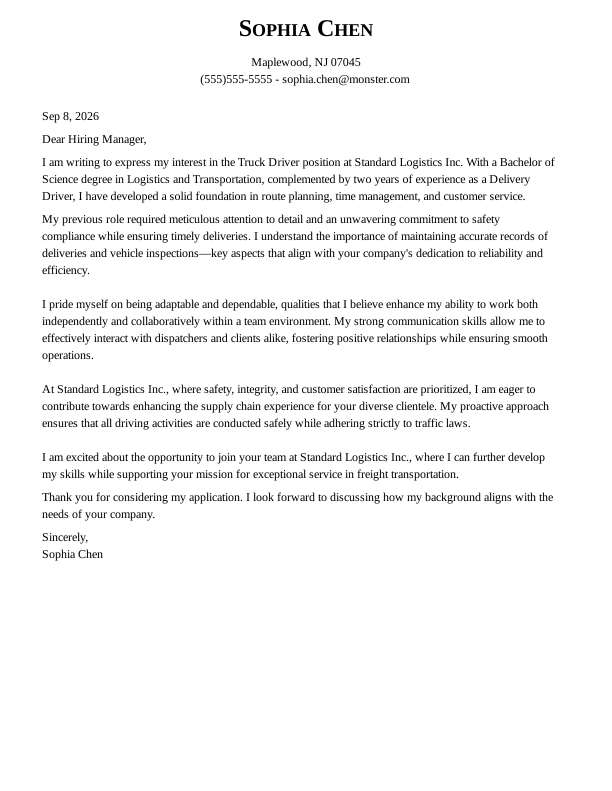
 Free
Driver Entry-Level Cover Letter
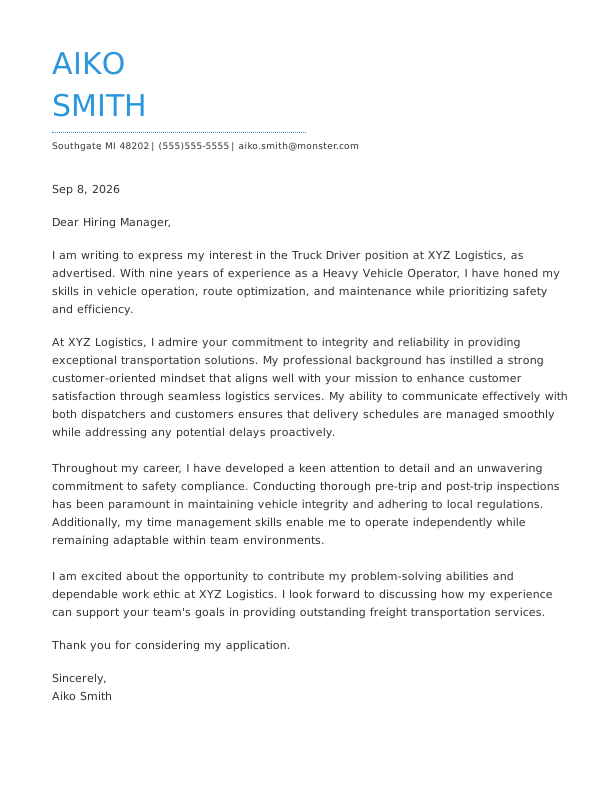
Driver Mid-Level Cover Letter
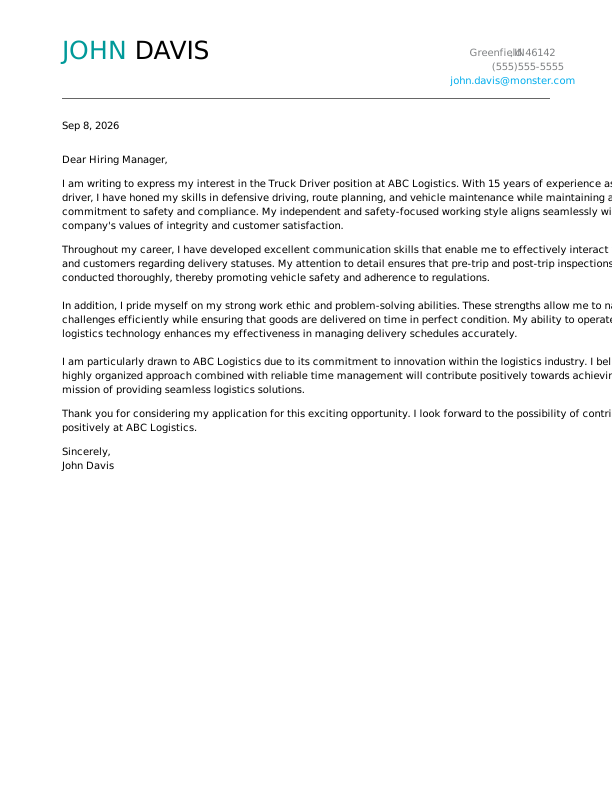
Driver Experienced Cover Letter
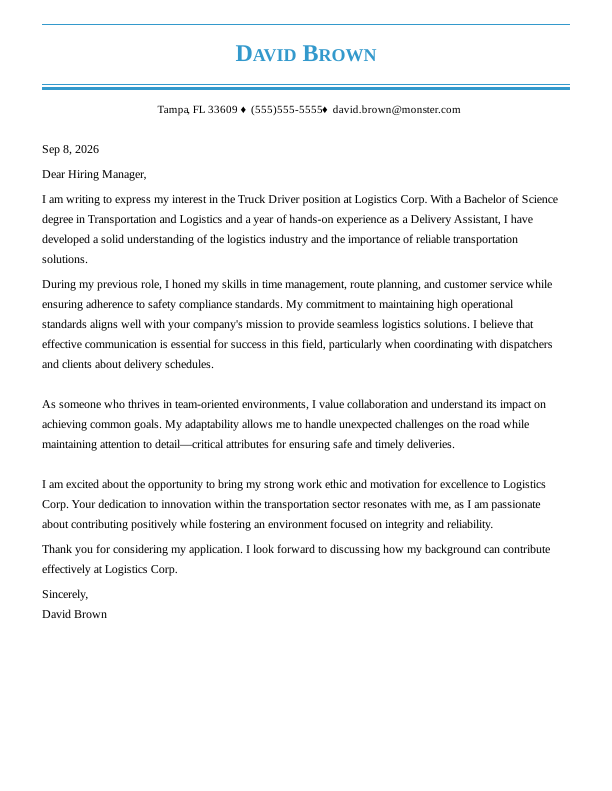
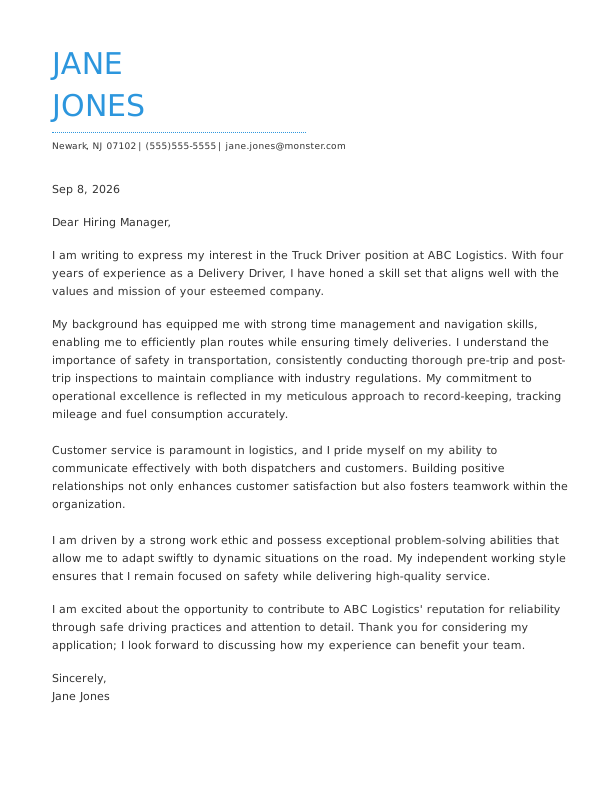
Driver Entry-Level Cover Letter
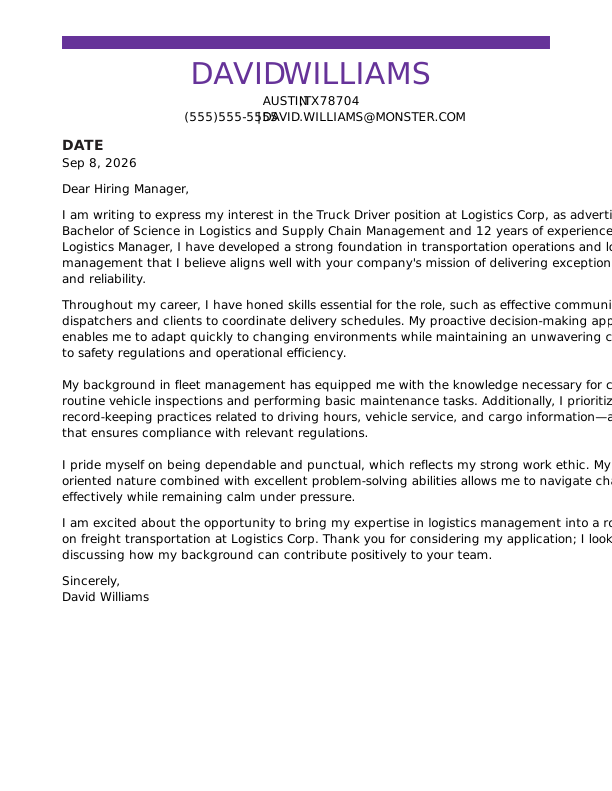
Driver Mid-Level Cover Letter
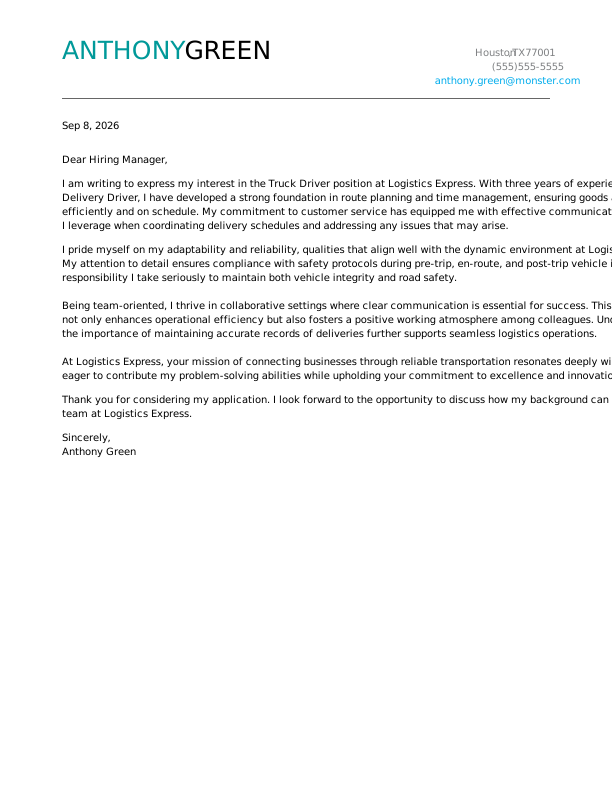
Driver Experienced Cover Letter
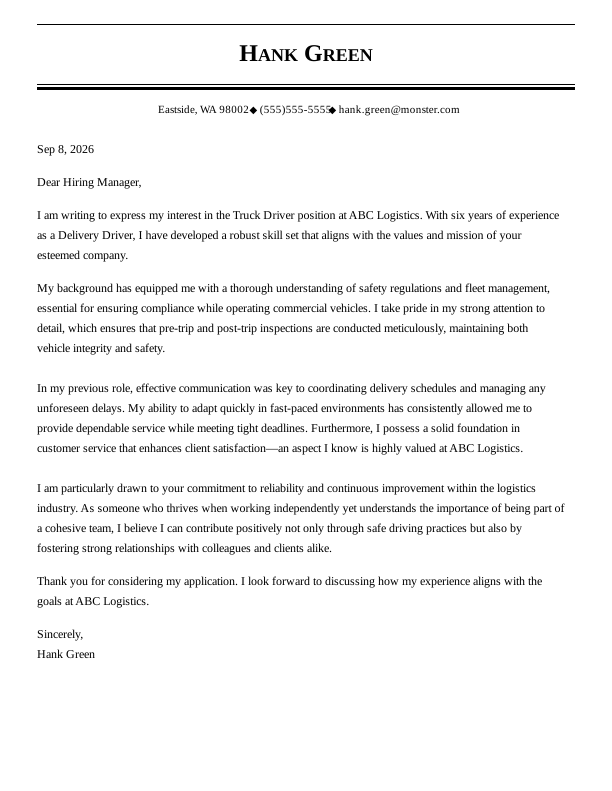
Driver Entry-Level Cover Letter
Driver Mid-Level Cover Letter
Browse Free Cover Letter Templates
- Academic
- Account Manager
- Accountant
- Accounts Payable
- Administrative Assistant
- Admissions Counselor
- Architecture
- Artist
- Assistant Principal
- Babysitter
- Barista
- Bartender
- Bookkeeper
- Brand Ambassador
- Business Analyst
- Business
- Caregiver
- Chef
- Civil Engineering
- Computer Science
- Construction
- Consulting
- Copywriter
- Cosmetology
- Custodian
- Customer Service
- Customer Service Representative
- Data Analyst
- Data Entry
- Dental Assistant
- Dental Hygienist
- Digital Marketing
- Electrical Engineering
- Emt
- Engineering
- Esthetician
- Event Coordinator
- Executive Assistant
- Fashion Designer
- Finance
- Financial Analyst
- Firefighter
- Flight Attendant
- Graphic Designer
- Hair Stylist
- Healthcare
- Hr Generalist
- Investment Banking
- It
- Janitor
- Journalism
- Lab Technician
- Law Clerk
- Lawyer
- Librarian
- Logistics
- Maintenance Worker
- Makeup Artist
- Manager
- Marketing Coordinator
- Marketing
- Marketing Manager
- Massage Therapist
- Mechanic
- Mechanical Engineer
- Medical Assistant
- Non Profit
- Nursing
- Occupational Therapy
- Office Assistant
- Office Manager
- Operations Manager
- Paralegal
- Personal Trainer
- Pharmacist
- Pharmacy Technician
- Photographer
- Physician Assistant
- Pilot
- Police Officer
- Program Manager
- Project Manager
- Property Manager
- Psychology
- Receptionist
- Research Assistant
- Restaurant Manager
- Retail
- Sales
- Sales Manager
- School Counselor
- Security
- Security Officer
- Social Work
- Software Engineer
- Special Education Teacher
- Starbucks
- Substitute Teacher
- Teacher
- Teaching Assistant
Cover Letter Examples for Drivers
Cover letter expectations change as a driver’s career progresses, especially around route experience, safety records, and customer service. Choose the template that matches your level to highlight the right training, licenses, and on-the-road accomplishments.
Entry-Level Driver Cover Letter
If you are starting your driving career, this template shows how to present your foundational training, safety mindset, and reliable work ethic to earn an employer’s trust early on.
Mid-Career Driver Cover Letter
Aimed at drivers with several years behind the wheel, this template helps you showcase steady on-time execution, dependable route navigation, and your ability to work smoothly with dispatch and customers.
Experienced Driver Cover Letter
Geared toward seasoned drivers with extensive time in the field, this template highlights long-term safety records, leadership on the road, and an ability to protect fleet equipment while keeping operations moving efficiently.
Driver Cover Letter Template (Text)
Paste this driver cover letter template into your document, then copy and adapt it by swapping in your license class, route experience, and employer name.
Emma Davis
Westbrook, ME 04099
(555)555-5555
emma.davis@monster.com
Oct 26, 2026
Dear Hiring Manager,
I am writing to express my interest in the driver position at ABC Logistics, as advertised. With a Bachelor of Arts in Business Administration and nine years of experience as a logistics coordinator, I have developed strong organizational skills and an ability to thrive in fast-paced environments. I am excited about the opportunity to contribute to your team while aligning with ABC Logistics’ mission of delivering exceptional service and operational efficiency.
Throughout my career, I have honed key competencies in logistics management and inventory control that complement your company’s commitment to reliability and customer satisfaction. My background has equipped me with a solid understanding of freight transportation processes, ensuring safe handling of goods while adhering strictly to safety compliance and regulations.
I take pride in my problem-solving abilities and time management skills, which have allowed me to meet tight deadlines consistently. My experience working collaboratively within teams has fostered effective communication skills that enable me to engage proactively with colleagues and clients alike. I understand the importance of maintaining accurate delivery logs while addressing any potential challenges on the road efficiently.
Joining ABC Logistics would provide an exciting opportunity for me to leverage my expertise further while contributing positively towards enhancing your logistics solutions. Thank you for considering my application; I look forward to the possibility of discussing how I can support your team’s continued success.
Sincerely,
Emma Davis
How to Write a Driver Cover Letter
Writing an effective cover letter comes down to backing up your claims with real-world road habits, safety records, and schedule discipline. Use the steps below to craft a letter that shows an employer you can handle its routes without issue.
1. Research & Prepare
Before putting pen to paper, take time to learn what the company needs from its drivers on day one. A local multi-stop delivery fleet has very different daily priorities than an interstate freight carrier. Reviewing an employer’s business model helps you decide which credentials and habits to put front and center.
Look through these resources to gather useful details before you start drafting:
- The job posting itself, noting the exact commercial driver’s license class, endorsements, and physical requirements needed.
- The company’s operational profile or website, checking what navigation, route planning, or telematics tools its fleet uses.
- Federal or state safety compliance databases, such as the FMCSA Safety Measurement System, to see the safety benchmarks it values most.
2. Hook the Reader
Grab the hiring manager’s attention right away by sharing a quick win or standout metric instead of using generic opening lines. Hiring managers read dozens of letters that start the same way, so leading with safe miles or punctual deliveries sets you apart immediately.
Consider adapting one of these opening approaches for your own letter:
- A strong safety milestone: “Over the past three years, I have logged more than 160,000 regional delivery miles without a single preventable incident or safety violation.”
- A schedule reliability stat: “By refining daily stop sequences and coordinating closely with dispatch, I maintained a 97% on-time delivery rate across a high-volume urban route.”
- A regulatory compliance focus: “In my previous delivery role, I managed electronic logging devices and performed thorough pre-trip inspections, catching and reporting mechanical defects before vehicles left the yard.”
3. Tell Your Professional Story
While your resume lists past employers and dates, your cover letter explains how you manage daily road challenges. Bring your routine to life by describing how you handle tight loading windows, heavy traffic, or difficult weather conditions.
Here are a few ways to show practical impact using specific details:
- Maintained a flawless vehicle check record over 12 months, preventing roadside breakdowns through early detection of tire wear and fluid leaks.
- Improved delivery completion rates by 18% during peak holiday volume by pre-planning alternative paths around known highway construction zones.
- Handled an average of 65 customer drop-offs each day while sustaining zero cargo damage over an entire operating year.
4. Showcase Your Skills
Instead of simply calling yourself a “careful driver,” walk the reader through a specific scenario that demonstrates your judgment. This allows the hiring manager to see how you think on your feet when unexpected problems arise on the route.
Think about how you handle core responsibilities like these:
- Smart route adjustments: “When unexpected road closures blocked my primary morning route, I recalculated my drop-offs using live traffic updates to ensure priority stops still arrived on schedule.”
- Diligent inspections: “During a routine pre-trip walkaround, I caught a damaged trailer air hose and notified maintenance immediately, avoiding a dangerous roadside breakdown on the highway.”
- Professional customer care: “When a recipient’s loading dock was closed for repairs, I called the site manager to coordinate safe curbside offloading, keeping the shipment on schedule without delaying my remaining stops.”
5. Explain Any Special Circumstances
If you have a gap in your employment, recently relocated, or switched from another industry, address it briefly and positively. Employers simply want to confirm that your credentials are fully up to date and that you are ready to drive safely.
Use straightforward explanations like these to address unique situations:
- Returning after a work pause: “After taking six months away to manage family priorities, I renewed my medical card and refreshed my road hours through a local commercial driving refresher course.”
- Relocating to a new area: “Having recently moved from Phoenix to Atlanta, I have transferred my commercial credentials and am fully licensed to take on regional routes immediately.”
- Changing careers: “Transitioning from warehouse inventory management to commercial driving allows me to pair my deep understanding of freight safety with my recent professional driver training.”
6. End With a Professional Goodbye
Wrap up your letter with a clear, polite closing that invites the hiring manager to take the next step. Let the employer know you are eager to discuss its specific routes, equipment, and scheduling needs, and always thank the reader for their time.
Conclude with a clean sign-off such as: “I welcome the chance to discuss how my clean driving record and dedication to vehicle safety can support your team. Thank you for your time and consideration. Sincerely, [Your Name].”
4 Tips for Formatting Your Cover Letter
When a hiring manager reviews driver applications, they often look through documents on a busy schedule. A clean, well-spaced format allows a manager to spot your license class, driving record, and route capabilities in just a few seconds.
Follow these cover letter format tips to ensure your presentation demonstrates the same attention to detail and professional pride that you bring to your driving profession.

Keep It to One Page
Keep your letter strictly to a single page, aiming for 250 to 400 words across three or four concise paragraphs. Fleet managers do not have time to dig through multi-page documents when checking route qualifications. Sticking to a single page forces you to highlight only your most relevant road experience, license status, and clean driving history.

Use Bullet Points for Key Achievements
Break up dense paragraphs by using a short bulleted list of two to three standout achievements. Bullets make it easy for a busy recruiter to instantly spot critical data, such as your on-time delivery percentage, total incident-free miles, or audit success rates.

Balance Spacing & Margins
Set your page margins between 0.75 and 1 inch and use single or 1.15 line spacing throughout the document. Adding a clean blank line between paragraphs keeps the text readable on a screen and ensures the page looks neat and organized if an interviewer prints it out before a road test.

Save & Send as a PDF
Always export your completed letter as a PDF unless an employer’s application system specifically asks for a Word document. A PDF preserves your margins, fonts, and clean layout across all computers, tablets, and phones, ensuring your application looks sharp no matter how a hiring team opens it. Use a simple, professional file name like Firstname_Lastname_Cover_Letter.pdf.
Top-Paying States for Driver Roles
Knowing what drivers earn across the country helps you compare job offers and plan your next move. The data below comes from the U.S. Bureau of Labor Statistics (BLS) and reflects recent nationwide averages for driver wages.
Keep in mind that your take-home pay can vary based on location, experience, route type, and whether you haul local or long-distance loads. Schedules also matter, since some roles involve nights, weekends, or overtime. Your employer type and any required certifications or endorsements can further affect earning potential.
| Alabama | $54,040 |
| Alaska | $86,890 |
| Arizona | $55,420 |
| Arkansas | $56,570 |
| California | $105,720 |
| Connecticut | $57,710 |
| Delaware | $57,660 |
| District of Columbia | $66,740 |
| Florida | $54,470 |
| Georgia | $57,190 |
| Hawaii | $61,300 |
| Idaho | $55,340 |
| Illinois | $67,770 |
| Indiana | $64,980 |
| Iowa | $58,350 |
| Kansas | $59,350 |
| Kentucky | $60,060 |
| Louisiana | $57,650 |
| Maine | $53,960 |
| Maryland | $74,100 |
| Massachusetts | $111,450 |
| Michigan | $55,090 |
| Minnesota | $62,110 |
| Mississippi | $55,240 |
| Missouri | $54,480 |
| Montana | $59,050 |
| Nebraska | $60,150 |
| Nevada | $61,760 |
| New Hampshire | $59,120 |
| New Jersey | $102,080 |
| New Mexico | $51,530 |
| New York | $71,880 |
| North Carolina | $53,990 |
| North Dakota | $59,840 |
| Ohio | $59,700 |
| Oklahoma | $56,300 |
| Oregon | $63,890 |
| Pennsylvania | $92,470 |
| Rhode Island | $59,870 |
| South Carolina | $55,110 |
| South Dakota | $58,150 |
| Tennessee | $57,670 |
| Texas | $63,270 |
| Utah | $59,460 |
| Vermont | $57,050 |
| Virginia | $56,990 |
| Washington | $107,370 |
| West Virginia | $51,920 |
| Wisconsin | $56,980 |
| Wyoming | $63,220 |
| Guam | $38,560 |
| Puerto Rico | $28,600 |
| Virgin Islands | $45,770 |
Key Takeaways
- Highlight a clean driving record and specific on-time performance figures to show employers you are reliable on the road.
- Match the skills you emphasize to the fleet type, whether that means strict dock schedules for freight or careful passenger service for local transit.
- Keep your letter to one cleanly spaced page so a busy hiring manager can review your credentials in a fast scan.
More Cover Letter Examples
Browse Monster’s Resume Templates
Monster also has hundreds of ATS-friendly resume templates for all career levels and industries. Create a matching resume to help you land the interview.
Frequently Asked Questions
Last Update:
Do I really need a cover letter?
You really need a cover letter for a driver position because it shows your work ethic and attitude in ways a list of past jobs cannot. While your resume lists your licenses and employers, your letter lets you explain your daily safety habits, clean driving history, and communication skills. It gives an employer confidence that you will handle its vehicles and cargo with care.
How long should my cover letter be?
Your driver cover letter should be between 250 and 400 words and fit neatly on one single page. Hiring managers often review applications between busy shift runs, so keeping your letter brief helps them see your value quickly. Stick to three or four short paragraphs covering your license credentials, your route experience, and your commitment to vehicle and road safety.
Should my cover letter match my resume?
Your driver cover letter should match your resume in its visual style so the entire application looks cohesive. Use the same fonts, margin widths, and contact information header on both documents to present a clean, professional package. While the visual design should match, use your letter to share context behind your safe driving habits rather than simply repeating the bullet points from your resume.
Should I mention salary expectations in my cover letter?
You should only mention salary expectations in your driver cover letter if the employer explicitly requests them in the job posting. When required, state a realistic pay range based on local market rates for your license class and route type. Add a brief note stating that you remain open to discussing total compensation based on shift schedules, route demands, and benefits.
How do I write a cover letter for an internal position?
When writing a cover letter for an internal driver position, focus on your proven reliability with the company’s current routes, equipment, and safety policies. Mention your familiarity with the fleet’s daily dispatch tools and your track record of safe, punctual runs. Reiterate your commitment to supporting the team and explain how stepping into this new schedule or route category helps the company meet its delivery goals.

Vicki Salemi is a nationally recognized career expert who helps professionals navigate the hiring landscape and find the right fit on Monster. With over 15 years of experience in corporate recruiting and HR, she offers expert guidance on job search strategies, interview preparation, and career development to help candidates land their next role.
See More From Vicki SalemiExplore Related Career Advice







How to Write a Cover Letter for Internal Positions or Promotions (Examples & Tips)

Updated:
Apr 23, 2026
|
19 min read


Cover Letter vs Resume: What’s the Difference & Do You Need Both?

Updated:
Apr 23, 2026
|
18 min read