


Free Interior Designer Cover Letter Templates & Examples
A strong interior designer cover letter highlights your ability to plan functional spaces, understand client needs, and bring designs to life. Our cover letter examples and writing tips help you connect your skills and project experience to the job’s requirements.
Real-World Cover Letters That Get Results
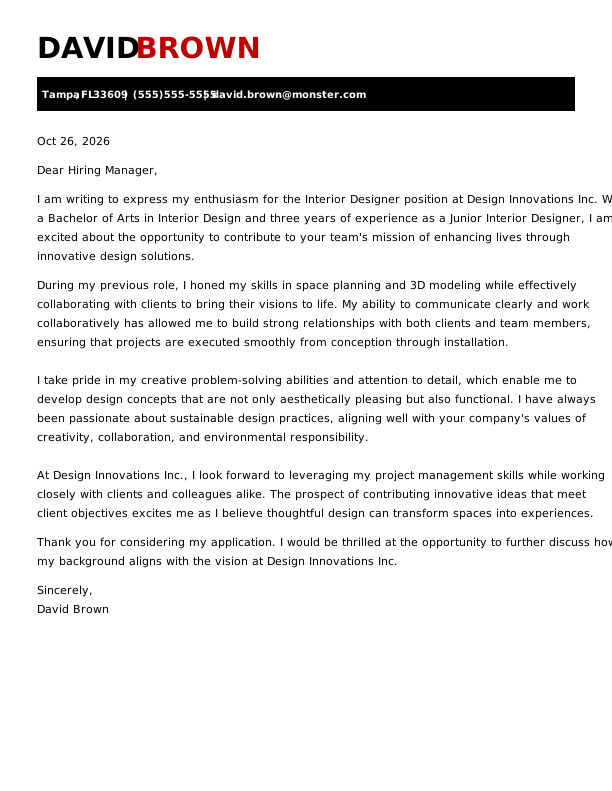
 Free
Interior Designer Entry-Level Cover Letter
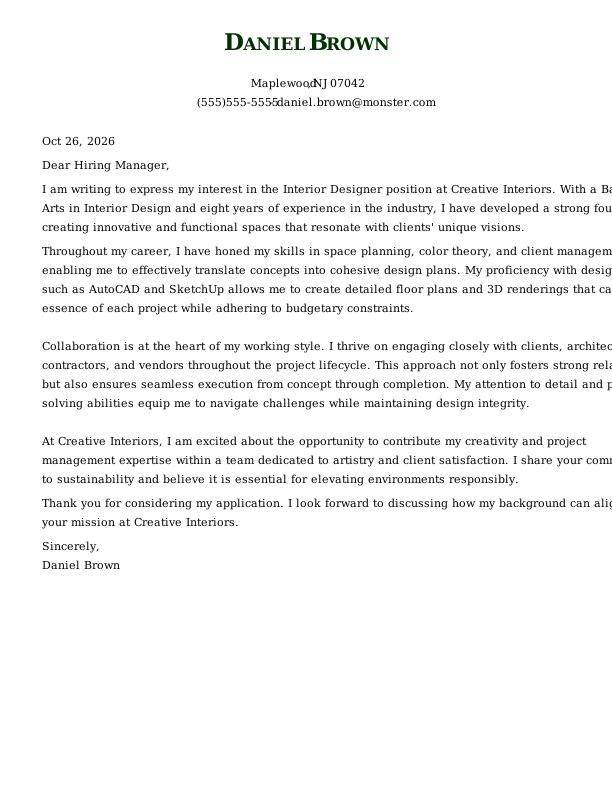
Interior Designer Mid-Level Cover Letter
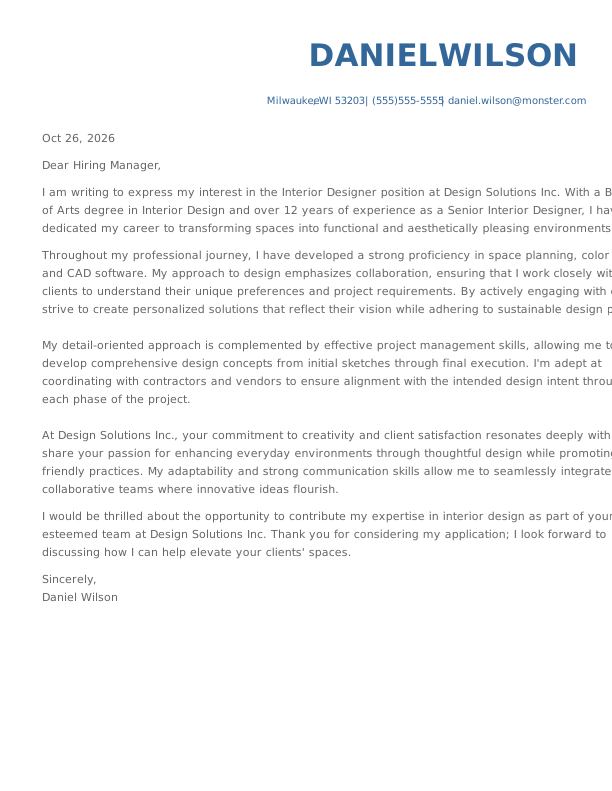
Interior Designer Experienced Cover Letter
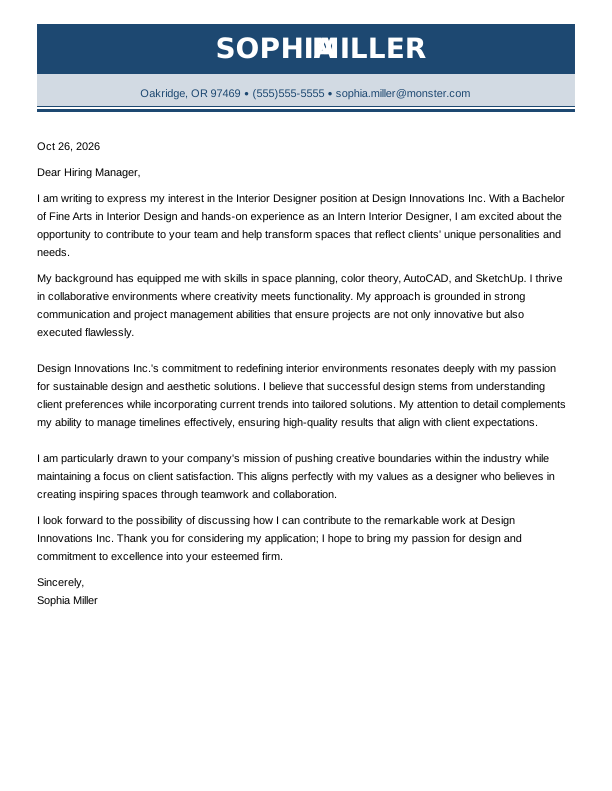
Interior Designer Entry-Level Cover Letter
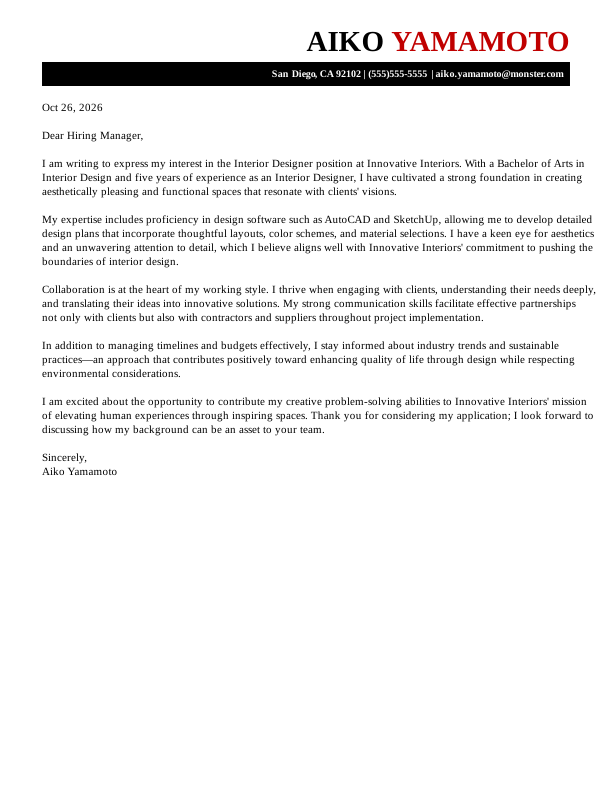
Interior Designer Mid-Level Cover Letter
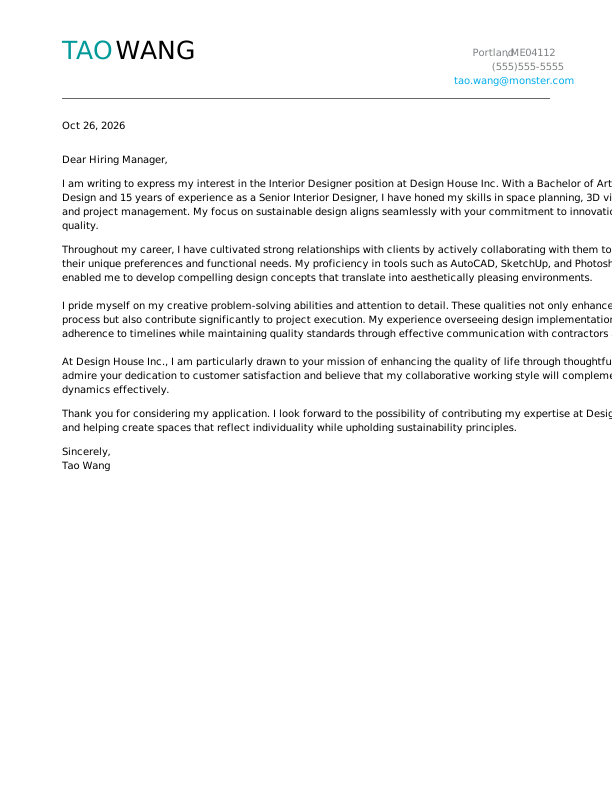
Interior Designer Experienced Cover Letter
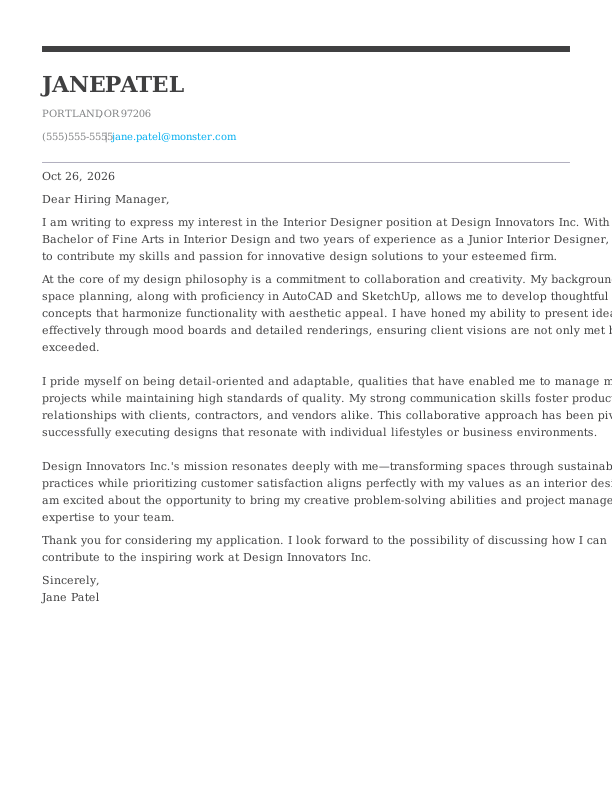
Interior Designer Entry-Level Cover Letter
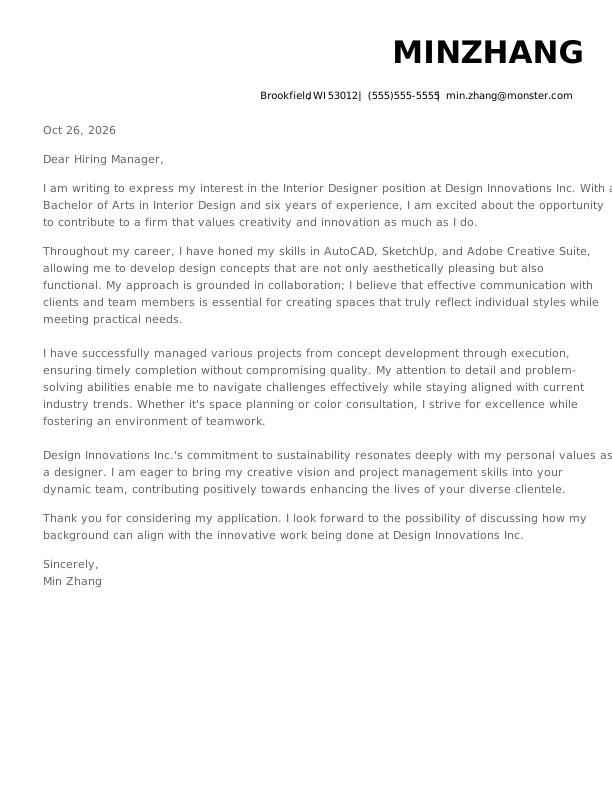
Interior Designer Mid-Level Cover Letter
Browse Free Cover Letter Templates
- Academic
- Account Manager
- Accountant
- Accounts Payable
- Administrative Assistant
- Admissions Counselor
- Architecture
- Artist
- Assistant Principal
- Babysitter
- Barista
- Bartender
- Bookkeeper
- Brand Ambassador
- Business Analyst
- Business
- Caregiver
- Chef
- Civil Engineering
- Computer Science
- Construction
- Consulting
- Copywriter
- Cosmetology
- Custodian
- Customer Service
- Customer Service Representative
- Data Analyst
- Data Entry
- Dental Assistant
- Dental Hygienist
- Digital Marketing
- Electrical Engineering
- Emt
- Engineering
- Esthetician
- Event Coordinator
- Executive Assistant
- Finance
- Financial Analyst
- Firefighter
- Flight Attendant
- Graphic Designer
- Hair Stylist
- Healthcare
- Hr Generalist
- Investment Banking
- It
- Janitor
- Journalism
- Lab Technician
- Law Clerk
- Lawyer
- Librarian
- Logistics
- Makeup Artist
- Manager
- Marketing Coordinator
- Marketing
- Marketing Manager
- Massage Therapist
- Mechanic
- Mechanical Engineer
- Medical Assistant
- Non Profit
- Nursing
- Occupational Therapy
- Office Assistant
- Office Manager
- Operations Manager
- Paralegal
- Personal Trainer
- Pharmacist
- Pharmacy Technician
- Photographer
- Physician Assistant
- Pilot
- Police Officer
- Program Manager
- Project Manager
- Property Manager
- Psychology
- Receptionist
- Research Assistant
- Restaurant Manager
- Retail
- Sales
- Sales Manager
- School Counselor
- Security Officer
- Social Work
- Software Engineer
- Special Education Teacher
- Starbucks
- Substitute Teacher
- Teacher
- Teaching Assistant
- Truck Driver
- Vet Tech
- Veterinary Assistant
Cover Letter Examples for Interior Designers
Cover letter requirements evolve as your interior design career progresses, especially as you move from supporting design work to managing larger projects. Choose the template that matches your experience level to highlight the skills, training, and accomplishments that fit the role you’re applying for.
Entry-Level Interior Designer Cover Letter
Designed for interior designers early in their careers and applicants moving into the field, this example shows how to highlight relevant training, design skills, and related experience.
Mid-Career Interior Designer Cover Letter
For interior designers with several years of experience, this example shows how to highlight your project work, technical skills, and ability to coordinate with clients and contractors.
Experienced Interior Designer Cover Letter
For professionals with an extensive interior design background, this example shows how to highlight your design expertise and experience guiding projects from concept to completion.
Interior Designer Cover Letter Template (Text)
Copy this interior designer cover letter template, paste it into your document, and swap in your portfolio projects and client results for the role you want.
Aya Zhang
St. Louis, MO 63110
(555)555-5555
aya.zhang@monster.com
Oct 26, 2026
Dear Hiring Manager,
I am writing to express my interest in the Interior Designer position at Design Innovators Inc. With a Bachelor of Arts degree in Interior Design and seven years of experience as a Junior Interior Designer, I have developed a strong foundation in creating innovative spaces that align with client visions and enhance functionality.
Throughout my career, I have honed my skills in space planning, CAD software, and collaborative design to deliver projects that are both aesthetically pleasing and functionally efficient. My ability to communicate effectively with clients has been pivotal in translating their ideas into reality while ensuring satisfaction through every phase of the project.
At Design Innovators Inc., your commitment to creativity and innovation resonates deeply with my own professional values. I am particularly drawn to your emphasis on sustainable design practices, as they align with my passion for creating spaces that are not only beautiful but also environmentally responsible.
In previous roles, I have demonstrated strong problem-solving abilities and adaptability when faced with complex design challenges. My attention to detail ensures that all aspects of the project meet high-quality standards while staying within budgetary constraints. Leading teams during collaborative efforts has further strengthened my leadership skills, which are crucial for coordinating effectively with contractors and vendors.
I am enthusiastic about the opportunity to contribute to Design Innovators Inc.’s mission by bringing fresh perspectives and dedication to excellence in every project undertaken. Thank you for considering my application; I look forward to the possibility of discussing how I can support your team’s continued success.
Sincerely,
Aya Zhang
How to Write an Interior Designer Cover Letter
To write a strong interior designer cover letter, start by turning your project experience into clear details about space planning, material selection, and client collaboration. Use the steps below to match your experience to the job and organize your letter so it’s easy for the hiring manager to scan.
1. Research & Prepare
Before writing, read the job posting and explore the firm’s website to learn about its projects. Look for connections between your background and its work, whether that’s residential interiors, workplace design, or hospitality renovations. Note any software or technical requirements so you can address them with relevant experience.
As you research, focus on these details:
- Review the posting for required software, project experience, and credentials.
- Look at the firm’s portfolio to understand the spaces it designs and the clients it serves.
- Choose one or two projects from your background that relate to those needs.
2. Hook the Reader
Begin with a skill or project accomplishment that connects to the position you’re applying for. Depending on your background, you could mention developing layouts, presenting concepts, or coordinating an installation. If you’re just starting out, draw on coursework, internships, or junior design work to explain what’s prepared you for the role.
Consider an opening along these lines:
- Early-career experience: “During my design internship, I developed furniture layouts and presentation boards to help clients compare options for their homes.”
- Technical skills: “Using AutoCAD and SketchUp, I’ve developed floor plans and 3D renderings that help clients understand a design before construction begins.”
- Project experience: “I recently coordinated finish selections and vendor deliveries for a six-room office renovation completed within the client’s budget.”
3. Tell Your Professional Story
Build on your opening by describing a project that relates to the employer’s work. Explain the client’s needs, the decisions you made, and how your contribution helped. Include accurate numbers when they clarify a project’s size, budget, or results, and describe a concrete outcome when you don’t have reliable figures.
Adapt examples like these using your own details and figures:
- “Reworked a 1,200-square-foot office layout to add two workstations while keeping shared walkways clear.”
- “Compared suppliers and revised finish selections to bring a $55,000 materials estimate within the client’s $50,000 budget.”
- “Created detailed millwork drawings and reviewed dimensions with the contractor, helping avoid changes during installation.”
4. Showcase Your Skills
As you describe your work, include skills the employer has requested. Rather than simply listing space planning, software, or client communication, explain how you’ve used those skills to develop or refine a design. Be clear about your contribution, including whether you supported a senior designer or managed the work yourself.
You might describe your skills through examples like these:
- AutoCAD: “I updated the floor plan after a site visit revealed different room dimensions, then checked the revised furniture layout.”
- Client communication: “I presented two finish palettes with material samples and documented the client’s selections for the project team.”
- Project coordination: “When a specified fixture became unavailable, I compared alternatives and confirmed the replacement with the client and contractor.”
5. Explain Any Special Circumstances
If a career change, relocation, or employment gap needs context, address it briefly before returning to your qualifications. Share relevant details about your experience, recent training, or availability without feeling you need to explain every break in employment. Mention portfolio updates or software practice only if you’ve completed that work.
For situations that need a little context, try wording like this:
- “After a caregiving break, I refreshed my AutoCAD skills and added a residential design concept to my portfolio.”
- “I’m moving from set design into residential interiors, bringing experience with spatial layouts, material selection, and project deadlines.”
- “I’m relocating to Seattle in May, and I’ll be available to start work on June 1.”
6. End With a Professional Goodbye
Close by thanking the hiring manager and expressing interest in discussing the position. For example: “Thank you for considering my application. I’d welcome the opportunity to discuss my portfolio and how my space-planning and project coordination experience could support your studio.” End with “Sincerely” or “Best regards,” followed by your full name.
4 Tips for Formatting Your Cover Letter
A clear layout helps a hiring manager find your interior design experience and qualifications during a quick scan. Short paragraphs and consistent spacing make your project details, software skills, and portfolio link easy to locate. Keep the presentation organized so the reader can focus on your work without navigating a crowded page.

Keep It to One Page
Aim for 250–400 words across three or four short paragraphs. Focus on the project experience and skills most relevant to the position, and include a portfolio link so the employer can explore your work. Trim less relevant details rather than trying to summarize every project.

Address the Hiring Manager Directly
Check the posting and firm’s website for the person handling applications, such as the design director or studio manager. If you can verify the name, use “Dear” followed by the person’s full name. Otherwise, “Dear Hiring Manager” works well.

Match Your Header to Your Resume
Use the same header, font, and contact details on your letter and resume. Include your name, phone number, professional email address, and portfolio link so the employer can easily view your work and contact you.

Balance Spacing & Margins
Use a readable font in 10–12 point size, with margins between 0.75 and 1 inch. Set line spacing between single and 1.15, and leave a blank line between paragraphs. Keep any visual elements simple so your contact details and project experience remain easy to read.
Top-Paying States for Interior Designer Roles
Knowing what interior designers earn across the country helps you compare offers and plan your next move. Salary ranges below are based on data from the U.S. Bureau of Labor Statistics (BLS) and reflect the most recent nationwide averages for interior designers.
Keep in mind that your actual pay can vary based on location, years of experience, and whether you work for a design firm, as a freelancer, or in a corporate setting. Specializing in residential, commercial, or hospitality projects can also affect earning potential.
| Alabama | $62,790 |
| Arizona | $65,010 |
| Arkansas | $72,340 |
| California | $85,650 |
| Connecticut | $63,450 |
| Delaware | $59,910 |
| District of Columbia | $90,960 |
| Florida | $65,230 |
| Georgia | $71,600 |
| Hawaii | $68,860 |
| Idaho | $59,990 |
| Illinois | $76,400 |
| Indiana | $61,930 |
| Iowa | $68,640 |
| Kansas | $61,130 |
| Kentucky | $58,890 |
| Louisiana | $59,340 |
| Maine | $55,830 |
| Maryland | $74,410 |
| Massachusetts | $82,040 |
| Michigan | $65,800 |
| Minnesota | $69,850 |
| Mississippi | $60,530 |
| Missouri | $64,210 |
| Montana | $56,580 |
| Nebraska | $62,890 |
| Nevada | $70,170 |
| New Hampshire | $63,920 |
| New Jersey | $75,040 |
| New Mexico | $50,290 |
| New York | $77,170 |
| North Carolina | $58,530 |
| North Dakota | $56,750 |
| Ohio | $63,800 |
| Oklahoma | $57,990 |
| Oregon | $73,520 |
| Pennsylvania | $68,370 |
| Rhode Island | $67,330 |
| South Carolina | $60,990 |
| South Dakota | $67,960 |
| Tennessee | $62,310 |
| Texas | $68,930 |
| Utah | $62,460 |
| Vermont | $75,440 |
| Virginia | $71,590 |
| Washington | $81,030 |
| West Virginia | $51,070 |
| Wisconsin | $78,580 |
| Wyoming | $71,190 |
| Puerto Rico | $36,720 |
Key Takeaways
- Match your design skills and project experience to the firm’s work and job requirements.
- Explain your design decisions with specific examples and accurate figures when they add context.
- Keep your letter to one readable page and include an accessible portfolio link.
More Cover Letter Examples
- Cashier
- Creative Director
- Customer Success Manager
- Fashion
- Fashion Designer
- Retail Customer Service
- Ux Designer
- Ux Researcher
Browse Monster’s Resume Templates
Monster also has hundreds of ATS-friendly resume templates for all career levels and industries. Create a matching resume to help you land the interview.
Frequently Asked Questions
Last Update:
Do I really need a cover letter?
An interior designer cover letter is worth including, even when it’s optional, because it lets you explain the thinking behind your portfolio. You can describe how you approached a client brief, worked through a design challenge, or chose materials within a budget. Focus on details that help the employer understand your contribution rather than repeating your resume.
How long should my cover letter be?
Your interior designer cover letter should fit on one page, usually around 250–400 words. Aim for three or four short paragraphs covering your interest, relevant project experience, and a brief closing. Choose one or two examples that fit the position, and link to your portfolio so the employer can explore the finished work without a lengthy description.
Should my cover letter match my resume?
Your interior designer cover letter should match your resume’s font, header, and contact details so the employer can easily recognize both documents as part of your application. Keep job titles, dates, and qualifications consistent, too. Use the letter to explain a design decision or project contribution in more detail, and let your portfolio show the visual results.
How do I address my cover letter if I don’t know the hiring manager’s name?
If you don’t know the hiring manager’s name, use “Dear Hiring Manager” in your interior designer cover letter. Check the posting and firm’s team page first for a named contact, such as the design director or studio manager. If you can’t confirm who handles applications, a general greeting works well and lets you focus on explaining your qualifications.
How do I write a cover letter for an internal position?
For an internal interior designer position, connect your current work to the responsibilities you’d like to take on. Describe a relevant contribution, such as coordinating a client presentation, developing drawings, or resolving a supplier issue, and explain your interest in the move. Include enough context for someone who may not know your daily work, and follow the firm’s application process.

Kirsten Chorpenning is a career advice writer who empowers job seekers to take control of their career paths using Monster’s comprehensive job search and resume tools. She specializes in helping job seekers find rewarding jobs in today’s dynamic work environment.
See More From Kirsten ChorpenningExplore Related Career Advice







How to Write a Cover Letter for Internal Positions or Promotions (Examples & Tips)
Updated:
Apr 23, 2026
|
19 min read


Cover Letter vs Resume: What’s the Difference & Do You Need Both?

Updated:
Apr 23, 2026
|
18 min read