


Free UX Researcher Cover Letter Templates & Examples
A strong UX researcher’s cover letter demonstrates how you uncover user needs, partner with cross-functional teams, and turn qualitative and quantitative insights into product impact. Explore our free templates and writing tips to highlight your research methods, key metrics, and strategic value.
Real-World Cover Letters That Get Results
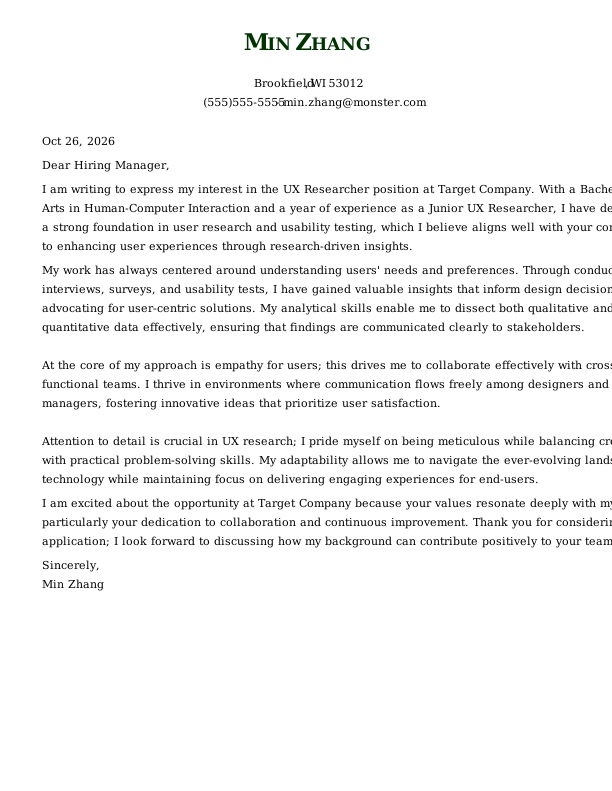
 Free
UX Researcher Entry-Level Cover Letter
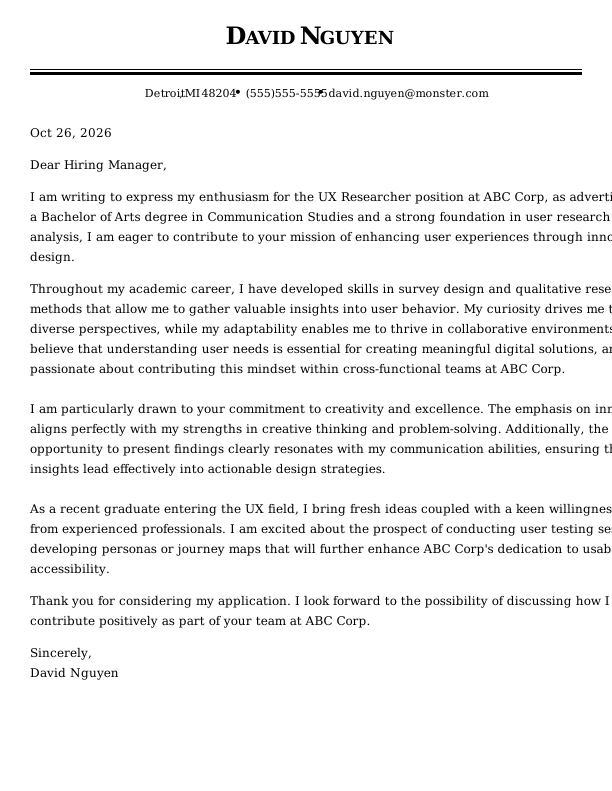
UX Researcher Mid-Level Cover Letter
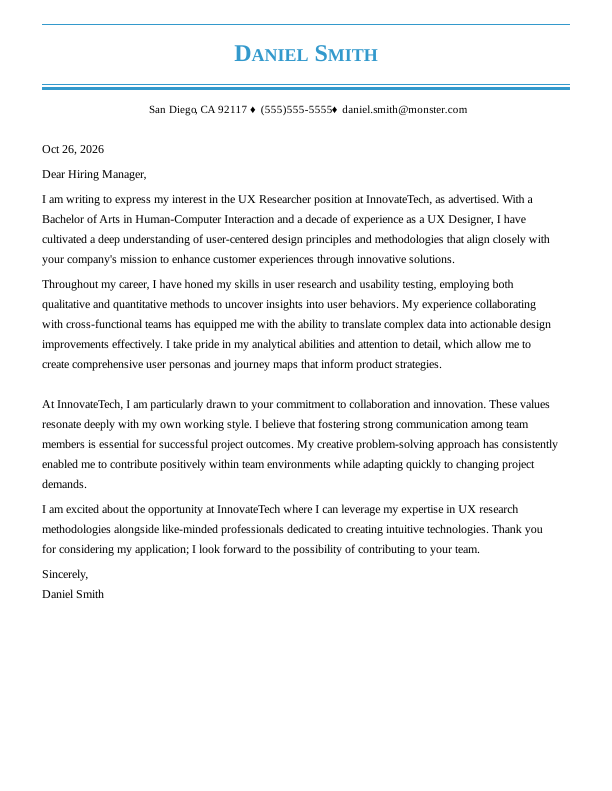
UX Researcher Experienced Cover Letter
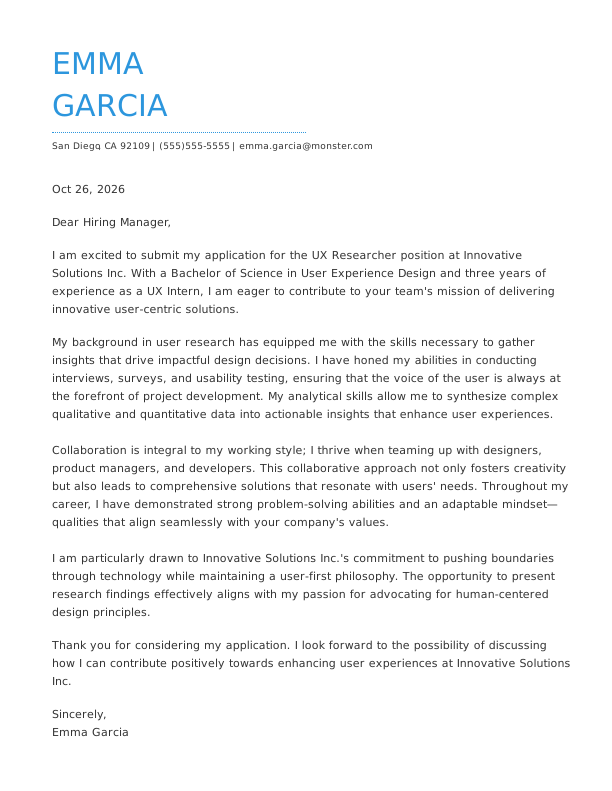
UX Researcher Entry-Level Cover Letter
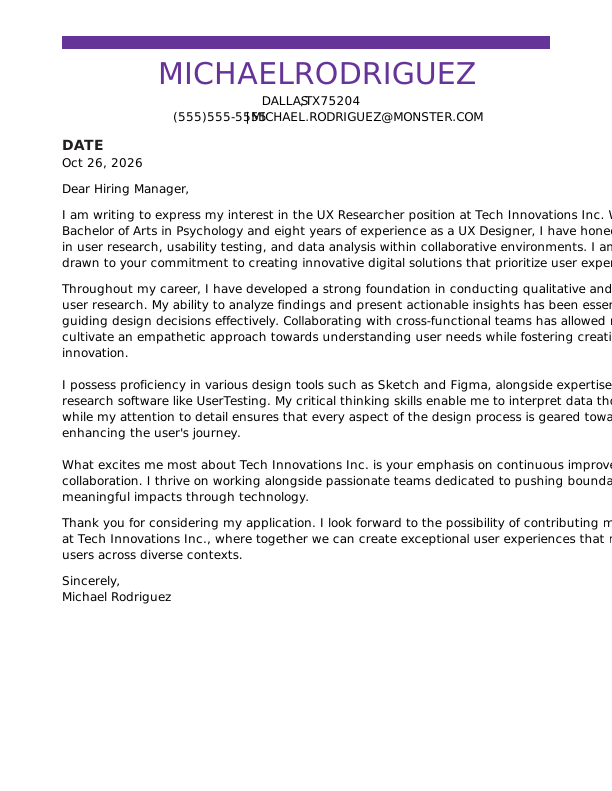
UX Researcher Mid-Level Cover Letter
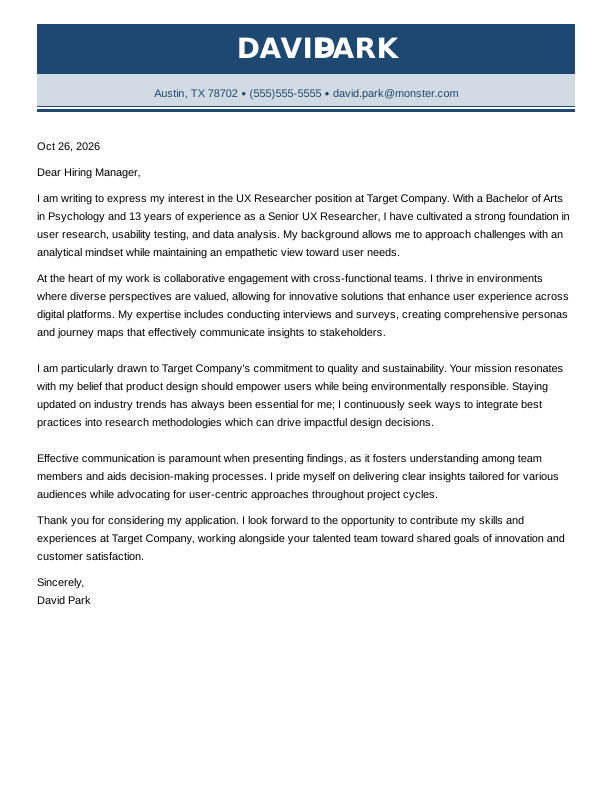
UX Researcher Experienced Cover Letter
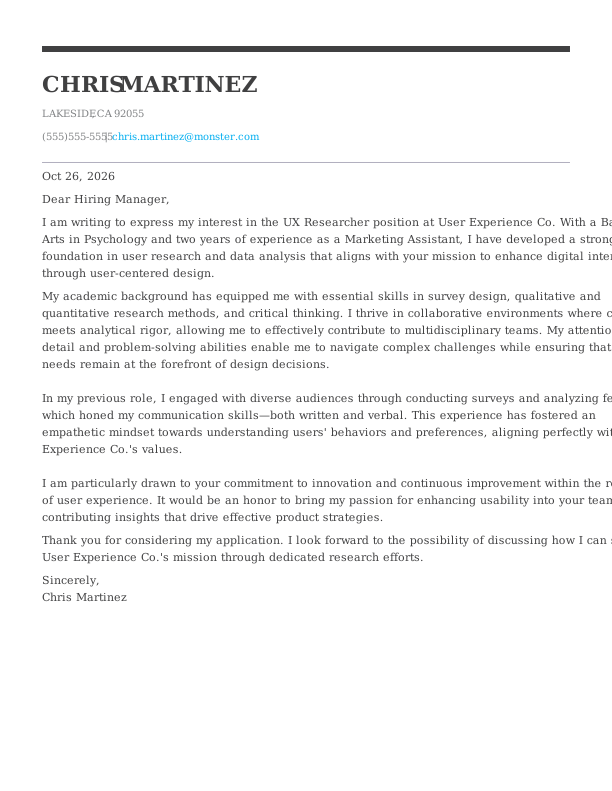
UX Researcher Entry-Level Cover Letter
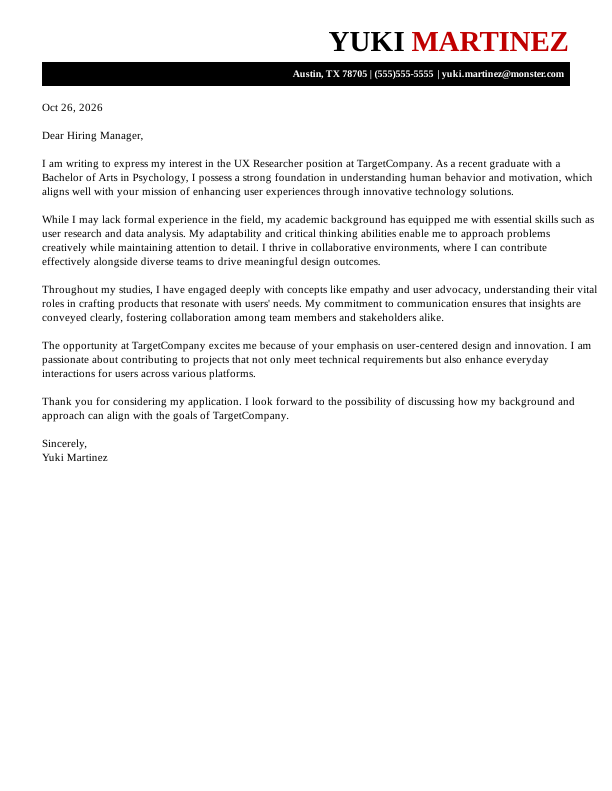
UX Researcher Mid-Level Cover Letter
Browse Free Cover Letter Templates
- Academic
- Account Manager
- Accountant
- Accounts Payable
- Administrative Assistant
- Admissions Counselor
- Architecture
- Artist
- Assistant Principal
- Babysitter
- Barista
- Bartender
- Bookkeeper
- Brand Ambassador
- Business Analyst
- Business
- Caregiver
- Chef
- Civil Engineering
- Computer Science
- Construction
- Consulting
- Copywriter
- Cosmetology
- Custodian
- Customer Service
- Customer Service Representative
- Data Analyst
- Data Entry
- Dental Assistant
- Dental Hygienist
- Digital Marketing
- Electrical Engineering
- Emt
- Engineering
- Esthetician
- Event Coordinator
- Executive Assistant
- Finance
- Financial Analyst
- Firefighter
- Flight Attendant
- Graphic Designer
- Hair Stylist
- Healthcare
- Hr Generalist
- Investment Banking
- It
- Janitor
- Journalism
- Lab Technician
- Law Clerk
- Lawyer
- Librarian
- Logistics
- Makeup Artist
- Manager
- Marketing Coordinator
- Marketing
- Marketing Manager
- Massage Therapist
- Mechanic
- Mechanical Engineer
- Medical Assistant
- Non Profit
- Nursing
- Occupational Therapy
- Office Assistant
- Office Manager
- Operations Manager
- Paralegal
- Personal Trainer
- Pharmacist
- Pharmacy Technician
- Photographer
- Physician Assistant
- Pilot
- Police Officer
- Program Manager
- Project Manager
- Property Manager
- Psychology
- Receptionist
- Research Assistant
- Restaurant Manager
- Retail
- Sales
- Sales Manager
- School Counselor
- Security Officer
- Social Work
- Software Engineer
- Special Education Teacher
- Starbucks
- Substitute Teacher
- Teacher
- Teaching Assistant
- Truck Driver
- Vet Tech
- Veterinary Assistant
Cover Letter Examples for Ux Researchers
Cover letter needs change as you gain experience in UX research. Select the sample below that fits your career stage to see how to present your research skills, training, and achievements effectively.
Entry-Level UX Researcher Cover Letter
Tailored for recent graduates and career changers entering the UX research field, this template highlights foundational research methods, user empathy, and collaborative skills.
Mid-Career UX Researcher Cover Letter
Designed for UX researchers with a few years of experience, this template emphasizes end-to-end study ownership, survey design, and communicating actionable insights to design and product teams.
Experienced UX Researcher Cover Letter
Ideal for seasoned UX researchers and research leads, this template highlights strategic research leadership, mixed-methods expertise, cross-functional alignment, and driving business goals through user insights.
UX Researcher Cover Letter Template (Text)
Paste this ux researcher cover letter template into your document, then customize it by swapping in your usability study findings and target company.
Emily Liu
Louisville, KY 40206
(555)555-5555
emily.liu@monster.com
Oct 26, 2026
Dear Hiring Manager,
I am writing to express my interest in the UX Researcher position at InnovateTech. With a Bachelor of Arts in Psychology and seven years of experience as a UX Researcher, I have cultivated a strong foundation in user research and data analysis that aligns well with your company’s commitment to enhancing user experiences through innovative technology.
Throughout my career, I have developed skills in conducting interviews, usability testing, and synthesizing insights from both qualitative and quantitative data. My analytical mindset allows me to delve deeply into user behaviors and preferences, ensuring that design decisions are grounded in genuine user needs. Collaboration has been at the core of my working style; I thrive when working alongside cross-functional teams to integrate feedback effectively into product development.
At previous roles, I emphasized empathy towards users by creating detailed personas and journey maps that communicated critical findings clearly to stakeholders. This approach not only fostered understanding but also encouraged constructive dialogue about how we could better meet our users’ expectations.
I am particularly drawn to InnovateTech’s mission of empowering users through intuitive technology solutions. Your emphasis on creativity and continuous improvement resonates with my own professional values. I am eager to contribute my expertise while continuing to learn from the dynamic environment you offer.
Thank you for considering my application. I look forward to the opportunity for further discussion on how my background can support InnovateTech’s mission.
Sincerely,
Emily Liu
How to Write a UX Researcher Cover Letter
Writing a standout cover letter is all about framing your study methods, user insights, and data findings into a clear, compelling narrative. Follow these straightforward steps to craft a tailored letter for your next UX research role.
1. Research & Prepare
Before writing your cover letter, research the target company’s product ecosystem, user base, and research goals. Review job postings and company tech blogs to help you tailor your experience directly to their team’s current needs.
Useful preparation steps include:
- Identify required research tools like Figma, Dovetail, or UsabilityHub mentioned in the job post.
- Check company blogs and product updates to understand their current feature focus and target user segments.
- Look for details on accessibility standards, study cadences, or specific qualitative and quantitative methods they prioritize.
2. Hook the Reader
Start with a strong opening statement that demonstrates your understanding of user research and product impact. Focus on how your methodology and collaborative approach immediately bring value to their research team.
Consider using one of these opening angles:
- Research impact snapshot: “Led 12 usability testing sessions that identified key onboarding friction points, helping reduce user drop-off by 18 percent.”
- Methods and rigor signal: “To support your team’s discovery work, I bring hands-on experience in rapid prototype testing, qualitative coding, and quantitative task analysis.”
- Stakeholder collaboration angle: “I specialize in partnering with product managers and designers to translate user study findings into actionable roadmap items within tight sprint cycles.”
3. Tell Your Professional Story
Use the body of your letter to detail specific studies you have conducted and the measurable outcomes they delivered.
Connect your research process directly to business and user goals by incorporating metrics and concrete outcomes like these:
- Decreased task failure rates by 23 percent after conducting moderated usability sessions with 18 participants to refine the checkout process.
- Lowered customer support ticket volume by 14 percent over 8 weeks by identifying microcopy confusion during user interviews.
- Saved product teams approximately 6 hours per week by establishing a centralized research repository for study findings and templates.
4. Showcase Your Skills
Highlight key competencies by describing how you apply them in real project scenarios rather than simply listing skills.
Show hiring managers your practical expertise across core UX research areas through concrete examples like:
- Research synthesis: “Coded interview notes in Dovetail, then mapped repeated frustrations to two competing journey points before I wrote my recommendations.”
- Prototype testing: “Built a clickable Figma prototype for usability sessions and adjusted the flow after participants got stuck on the same step twice.”
- Stakeholder communication: “Facilitated a workshop with product and engineering using plain-language evidence from my findings so everyone agreed on next experiments.”
5. Explain Any Special Circumstances
Briefly explain career pivots, employment gaps, or relocations with clear, positive phrasing. Reassure the hiring manager by showing how you maintained research skills and stayed current with industry standards.
Here are a few ways to frame your situation:
- “During a recent career break, I kept my skills sharp by managing independent usability studies and documenting research insights in Figma and Notion.”
- “Transitioning from a product analytics role into UX research allowed me to combine quantitative data skills with qualitative interviewing and journey mapping.”
- “Following a recent relocation, I completed specialized coursework in user research methods to refine my study protocols and testing methodologies.”
6. End With a Professional Goodbye
Wrap up your letter with a brief, professional sign-off that expresses gratitude and proposes a clear next step. Avoid generic, passive phrasing like “I look forward to hearing from you.”
Instead, offer to walk the team through a specific case study or discuss how your research approach fits their current goals, closing warmly with “Sincerely” or “Best regards.”
4 Tips for Formatting Your Cover Letter
Your cover letter is a direct reflection of how you communicate and organize information. Hiring managers often skim applications quickly, so a clean visual structure, logical scannability, and thoughtful presentation help your key research methods and outcomes jump off the page.

Keep It to One Page
Keeping your cover letter to a single page shows you respect a reviewer’s time and can summarize information. Aim for 250 to 400 words across three or four well-spaced paragraphs to keep your research highlights front and center.

Match Your Header to Your Resume
Using the same header, fonts, and contact details across both your cover letter and resume creates a cohesive look. Consistent visual hierarchy helps hiring teams quickly identify your application materials and reinforces your eye for design and attention to detail.

Use Bullet Points for Key Achievements
Bullet points draw the eye directly to your most impressive findings, such as task completion improvements, usability scores, or error rate reductions. Grouping key achievements into bulleted lists breaks up dense text, making your impact instantly scannable for busy recruiters.

Save & Send as a PDF
Saving your document as a PDF preserves your formatting, margins, and typography across different devices and application portals. Use a clear, standard naming convention like Firstname_Lastname_Cover_Letter.pdf so recruiters can organize and find your file easily.
Key Takeaways
- Showcase research rigor by describing study methods, participant criteria, and actionable design recommendations.
- Highlight tangible impact using metrics such as task success rates, time-on-task improvements, and usability scores.
- Tailor your letter to reflect the company’s product environment, development speed, and accessibility priorities.
More Cover Letter Examples
Browse Monster’s Resume Templates
Monster also has hundreds of ATS-friendly resume templates for all career levels and industries. Create a matching resume to help you land the interview.
Frequently Asked Questions
Last Update:
Do I really need a cover letter?
Including a cover letter for a UX researcher role is strongly recommended, as it allows you to explain the reasoning behind your research choices and how your methodology directly connects to product decisions. A well-crafted cover letter provides important context for your work and highlights your genuine enthusiasm for joining the team.
How long should my cover letter be?
A UX researcher’s cover letter should be kept to a single page, ideally ranging between 250 and 400 words across three or four concise paragraphs. Focusing on key research achievements and study impact ensures your document remains engaging and quick to read for busy hiring teams.
Should my cover letter match my resume?
Matching your cover letter design to your resume is important for creating a polished and professional application. Using consistent fonts, margins, and header styling across both documents helps reinforce your personal brand and presents a clear, organized package to reviewers.
How do I address my cover letter if I don’t know the hiring manager’s name?
If you do not know the hiring manager’s name for a UX researcher position, try researching the company website or LinkedIn page to identify the design or research lead. If you cannot find a specific contact name, addressing your letter to “Dear Hiring Manager” or “Dear UX Research Team” provides a professional alternative.
What should I include in my cover letter header?
Including a clear header in your UX researcher cover letter ensures the employer has your key contact details, including your full name, phone number, email address, portfolio link, and location. Matching your header layout and typography to your resume creates a unified presentation across your application materials.

Kirsten Chorpenning is a career advice writer who empowers job seekers to take control of their career paths using Monster’s comprehensive job search and resume tools. She specializes in helping job seekers find rewarding jobs in today’s dynamic work environment.
See More From Kirsten ChorpenningExplore Related Career Advice






How to Write a Cover Letter for Internal Positions or Promotions (Examples & Tips)
Updated:
Apr 23, 2026
|
19 min read


Cover Letter vs Resume: What’s the Difference & Do You Need Both?

Updated:
Apr 23, 2026
|
18 min read