


Free Payroll Cover Letter Templates & Examples
A great payroll cover letter shows you process pay accurately, protect sensitive data, and hit every deadline. Use our examples and tips to highlight your key skills and show employers why you’re a reliable fit for the role.
Real-World Cover Letters That Get Results
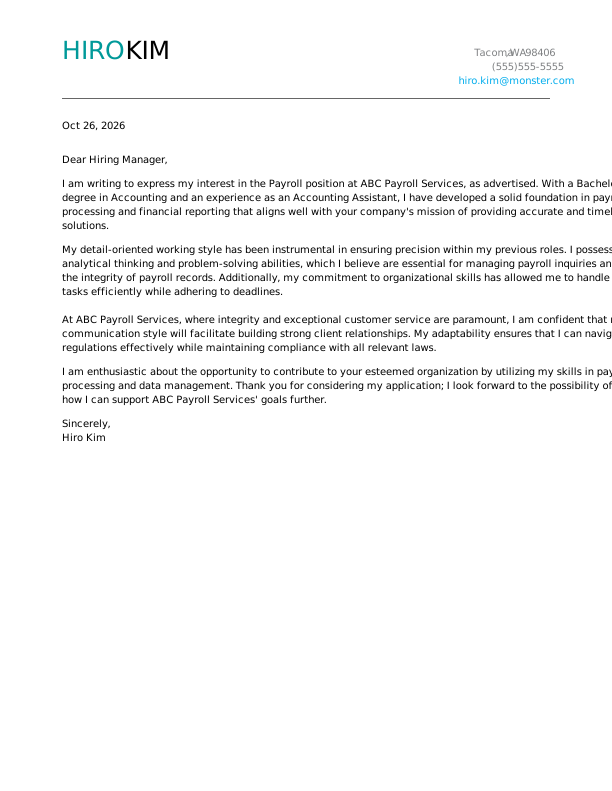
 Free
Payroll Entry-Level Cover Letter
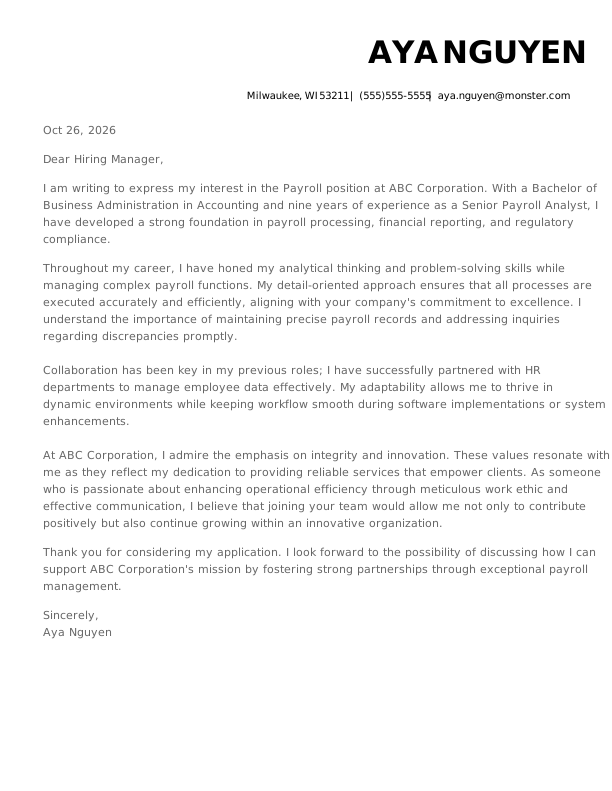
Payroll Mid-Level Cover Letter
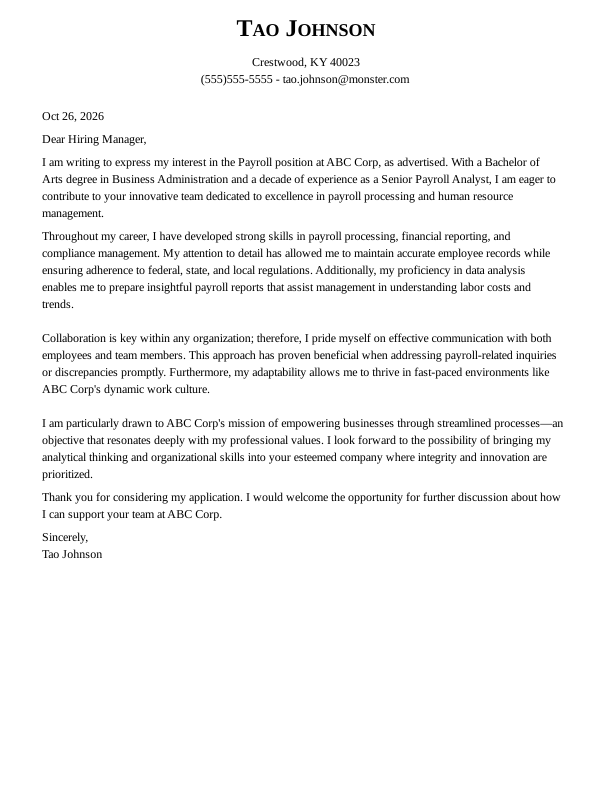
Payroll Experienced Cover Letter
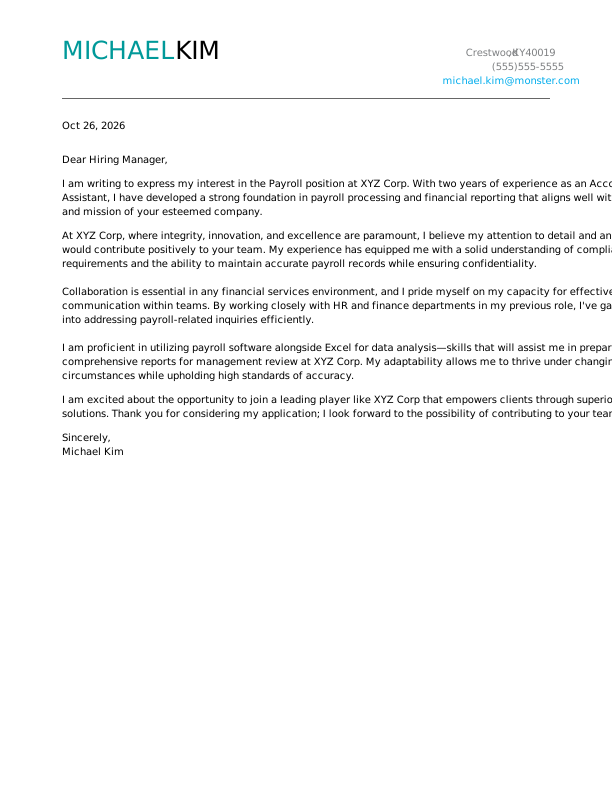
Payroll Entry-Level Cover Letter
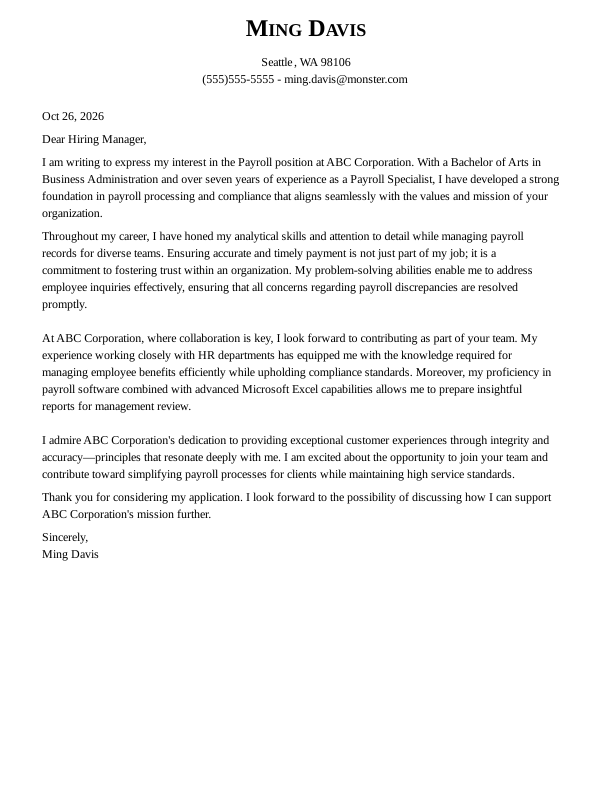
Payroll Mid-Level Cover Letter
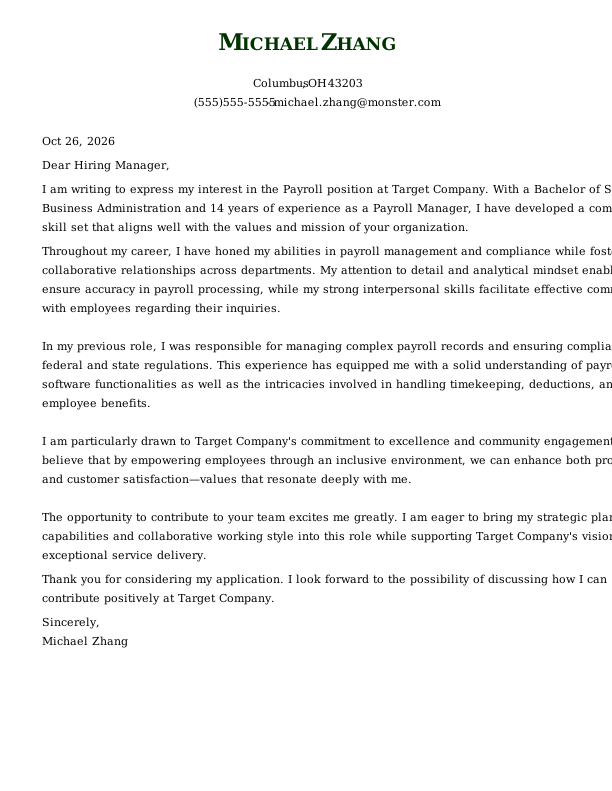
Payroll Experienced Cover Letter
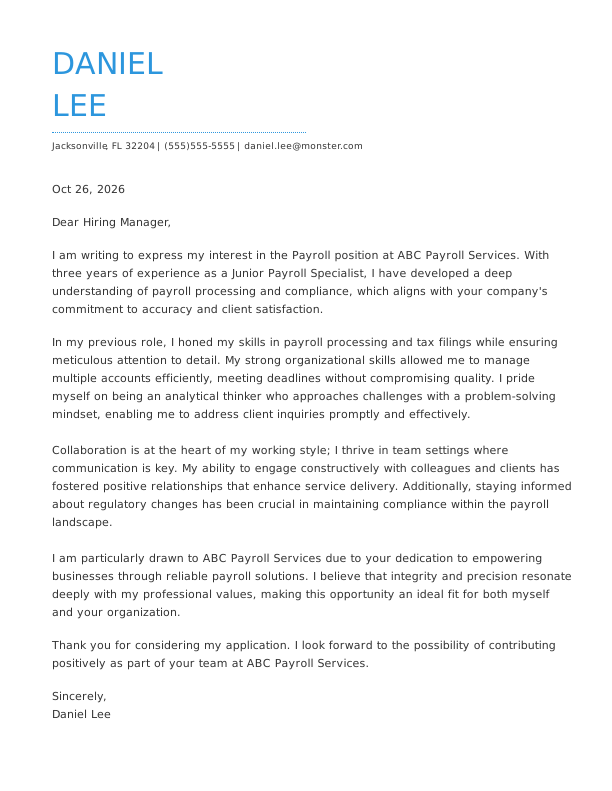
Payroll Entry-Level Cover Letter
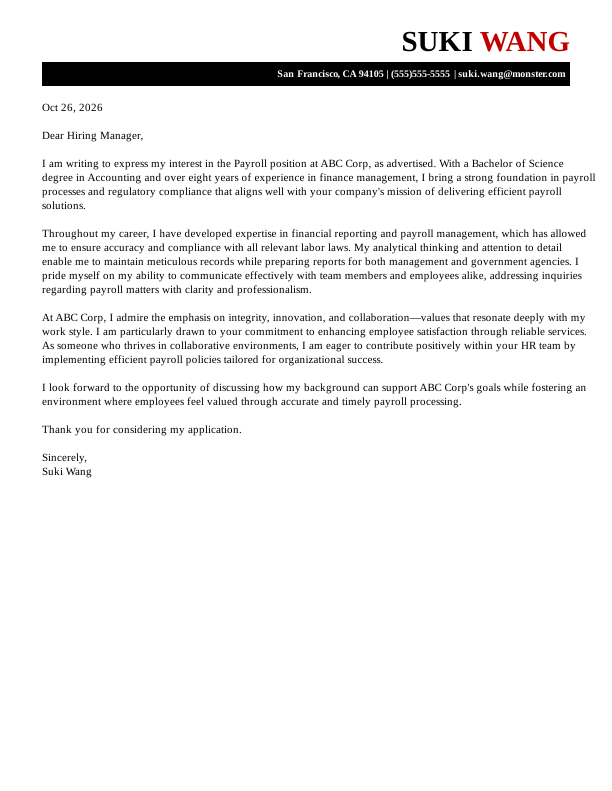
Payroll Mid-Level Cover Letter
Browse Free Cover Letter Templates
- Academic
- Account Manager
- Accountant
- Accounts Payable
- Administrative Assistant
- Admissions Counselor
- Architecture
- Artist
- Assistant Principal
- Babysitter
- Barista
- Bartender
- Bookkeeper
- Brand Ambassador
- Business Analyst
- Business
- Caregiver
- Chef
- Civil Engineering
- Computer Science
- Construction
- Consulting
- Copywriter
- Cosmetology
- Custodian
- Customer Service
- Customer Service Representative
- Data Analyst
- Data Entry
- Dental Assistant
- Dental Hygienist
- Digital Marketing
- Electrical Engineering
- Emt
- Engineering
- Esthetician
- Event Coordinator
- Executive Assistant
- Fashion Designer
- Finance
- Financial Analyst
- Firefighter
- Flight Attendant
- Graphic Designer
- Hair Stylist
- Healthcare
- Hr Generalist
- Investment Banking
- It
- Janitor
- Journalism
- Lab Technician
- Law Clerk
- Lawyer
- Librarian
- Logistics
- Maintenance Worker
- Makeup Artist
- Manager
- Marketing Coordinator
- Marketing
- Marketing Manager
- Massage Therapist
- Mechanic
- Mechanical Engineer
- Medical Assistant
- Non Profit
- Nursing
- Occupational Therapy
- Office Assistant
- Office Manager
- Operations Manager
- Paralegal
- Personal Trainer
- Pharmacist
- Pharmacy Technician
- Photographer
- Physician Assistant
- Pilot
- Police Officer
- Program Manager
- Project Manager
- Property Manager
- Psychology
- Receptionist
- Research Assistant
- Restaurant Manager
- Retail
- Sales
- Sales Manager
- School Counselor
- Security
- Security Officer
- Social Work
- Software Engineer
- Special Education Teacher
- Starbucks
- Substitute Teacher
- Teacher
- Teaching Assistant
Cover Letter Examples for Payroll Roles
Your cover letter should reflect your growth as you move from handling basic tasks to leading full payroll operations. Pick a template that fits your career stage to showcase your relevant experience and key strengths.
Entry-Level Payroll Cover Letter
Designed for newcomers to the field, this option focuses on foundational skills, accuracy, and enthusiasm for supporting payroll operations.
Mid-Career Payroll Cover Letter
A strong choice for mid-level professionals who handle routine processing, support team workflows, and help keep operations running smoothly.
Experienced Payroll Cover Letter
Tailored for senior professionals, this option emphasizes strategic leadership, complex system oversight, and full compliance management.
Payroll Cover Letter Template (Text)
Copy this payroll cover letter template, paste it into your document, and swap in your own processing metrics and employer names to fit the role.
Jin Lee
Cleveland, OH 44106
(555)555-5555
jin.lee@monster.com
Oct 26, 2026
Dear Hiring Manager,
I am writing to express my interest in the Payroll position at ABC Corporation. With a Bachelor of Science degree in Accounting and four years of experience as an Accounting Assistant, I have developed a strong foundation in payroll processing and financial management, which aligns well with the needs of your innovative organization.
Throughout my career, I have honed skills such as payroll processing, financial reporting, account reconciliation, and tax compliance. My attention to detail has been instrumental in ensuring accuracy in all facets of my work. I take pride in my analytical abilities and possess strong communication skills that foster collaboration within team environments.
At ABC Corporation, where integrity and customer-centricity are paramount, I believe that my organizational skills will help streamline processes while maintaining compliance with regulatory standards. My experience includes preparing payroll tax filings and addressing employee inquiries regarding payroll issues—key components of the responsibilities outlined for this role.
I am particularly drawn to ABC Corporation’s commitment to delivering exceptional service through cutting-edge technology. As someone who thrives on teamwork and values innovation, I am eager to contribute positively to your mission of providing seamless payroll solutions that empower businesses.
Thank you for considering my application. I look forward to the opportunity to discuss how my background can support the continued success of ABC Corporation.
Sincerely,
Jin Lee
How to Write a Payroll Cover Letter
A strong payroll cover letter shows how you handle real-world figures, deadlines, and compliance rules. Use your letter to explain how you apply your skills with tools like Workday, ADP, or QuickBooks to keep payroll running smoothly. Follow the simple steps below to craft a letter that highlights your accuracy and value to potential employers.
1. Research & Prepare
Gather details about the employer’s current payroll environment. Look for the specific platforms they use, such as Workday, ADP Workforce Now, or UKG Pro, and check if they process multi-state payroll or manage complex benefit plans. Mentioning these specific factors early on demonstrates that you understand their daily workflow and operational needs.
Before drafting your letter, keep these preparation steps in mind:
- Identify key software tools and integration needs directly from the job posting.
- Review recent company updates or financial news to gauge team size and potential payroll growth.
- Check state labor websites for updated wage laws that apply to the hiring company’s locations.
2. Hook the Reader
Skip generic openings like “I am writing to apply for the open position.” Instead, open with a strong statement that shows your experience with accurate processing, tax reconciliations, or tight deadline management. Highlighting a key accomplishment in your very first sentence grabs attention right away.
Here are a few strong ways to open your letter:
- Focus on accuracy: “Over the past five years, I have maintained a 99.9% pay accuracy rate across biweekly runs for over 1,500 employees.”
- Focus on compliance: “I have successfully managed multi-state tax filings and quarterly audits across four state jurisdictions without missing a deadline.”
- Focus on efficiency: “By streamlining timecard approvals in Workday, I cut manual adjustment tickets by 40% within my first six months.”
3. Tell Your Professional Story
Use the main body of your letter to connect your past responsibilities to tangible outcomes. While your resume lists your day-to-day duties, your cover letter lets you explain how your attention to detail saved time or reduced payroll errors. Clear metrics and percentages give hiring managers measurable proof of your performance.
Consider using examples like these to format your achievements:
- Processed multi-state payroll for 1,800 staff members while achieving 99.98% pay accuracy across six distinct pay groups.
- Reduced end-of-month adjustments by 32% after introducing new automated reporting for retroactive pay changes.
- Saved roughly six processing hours per pay period by standardizing digital time-entry sign-offs for team managers.
4. Showcase Your Skills
Rather than simply listing soft skills like “detail-oriented” or “great communicator,” demonstrate them through real scenarios. Match your specific strengths to the top requirements listed in the job description, showing exactly how your skill set solves everyday operational challenges.
The following examples demonstrate how to highlight key competencies clearly:
- Payroll Auditing: Reconciled biweekly time records against schedule templates to catch and fix overtime discrepancies before processing.
- Data Integrity: Cross-checked employee profile updates against effective dates to prevent incorrect rate calculations.
- Cross-Department Collaboration: Partnered with HR and department leads to create clear, simple checklists for submission deadlines.
5. Explain Any Special Circumstances
If you have an employment gap, are transitioning from another field, or recently relocated, address it briefly and positively. Keep your explanation to one or two straightforward sentences that highlight continuous learning, active certifications, or recent system updates.
You can adapt these introductory phrases depending on your background:
- “During my career break, I maintained my industry knowledge by completing ADP training modules and tracking multi-state tax updates.”
- “Transitioning from an HR coordinator role, I am focusing my career on full-cycle processing while working toward my Fundamental Payroll Certification.”
- “Following my recent move, I updated my regional compliance knowledge and continue to manage multi-state filings seamlessly.”
6. End With a Professional Goodbye
Wrap up your letter with a polite, proactive closing. State your desire for an interview, express appreciation for their time, and sign off cleanly. A direct call to action shows confidence while keeping the tone professional and respectful.
For example, write: “I would welcome the chance to discuss how my background in multi-state processing and audit readiness can support your team. Thank you for your time and consideration. Sincerely, [Your Name].”
4 Tips for Formatting Your Cover Letter
Hiring managers usually glance at cover letters in under a minute. A clean layout and clear organization help your key details stand out immediately, showing that you value accuracy and efficiency. Taking time to make your letter easy to skim creates an inviting first impression before anyone reads a single word.

Keep It to One Page
Keep your letter between 250 and 400 words across three or four short paragraphs. Briefly highlight the payroll software you know best, such as ADP, alongside a concrete result like reliable processing timelines or reduced error rates.

Address the Hiring Manager Directly
Try to find the specific person leading the team by searching the job listing or company profile. Greeting them by name shows genuine interest, but if no name is available, a simple opening like “Dear Hiring Manager” works best.

Use Bullet Points for Key Achievements
Use a short list of bullet points to call attention to your strongest wins, like streamlining payroll routines or keeping audit records spotless. Bulleted items give reviewers a quick breakdown of your practical strengths right away.

Balance Spacing & Margins
Set standard margins between 0.75 and 1 inch, and leave a line of space between paragraphs to prevent dense blocks of text. Generous spacing makes the document look neat and easy to read whether viewed on a screen or printed out.
Top-Paying States for Payroll Roles
Knowing what payroll professionals earn across the country helps you compare offers and plan your next career move. Salary ranges can vary based on location, years of experience, industry, and whether you handle multi-state or high-volume processing. The U.S. Bureau of Labor Statistics (BLS) is a helpful source for salary data and offers nationwide context so you can gauge where a role may fall. Keep in mind that additional responsibilities like auditing, compliance support, or running HRIS systems can also affect pay.
| Alabama | $46,580 |
| Alaska | $58,660 |
| Arizona | $53,660 |
| Arkansas | $50,790 |
| California | $64,010 |
| Connecticut | $62,970 |
| Delaware | $57,760 |
| District of Columbia | $72,140 |
| Florida | $50,610 |
| Georgia | $54,650 |
| Hawaii | $59,640 |
| Idaho | $56,870 |
| Illinois | $60,620 |
| Indiana | $50,890 |
| Iowa | $56,290 |
| Kansas | $53,950 |
| Kentucky | $52,120 |
| Louisiana | $51,820 |
| Maine | $56,280 |
| Maryland | $59,130 |
| Massachusetts | $62,670 |
| Michigan | $54,660 |
| Minnesota | $61,530 |
| Mississippi | $45,900 |
| Missouri | $53,700 |
| Montana | $51,870 |
| Nebraska | $55,610 |
| Nevada | $56,370 |
| New Hampshire | $61,030 |
| New Jersey | $60,870 |
| New Mexico | $53,570 |
| New York | $62,690 |
| North Carolina | $52,880 |
| North Dakota | $58,670 |
| Ohio | $53,560 |
| Oklahoma | $46,870 |
| Oregon | $59,830 |
| Pennsylvania | $55,820 |
| Rhode Island | $60,090 |
| South Carolina | $51,930 |
| South Dakota | $48,170 |
| Tennessee | $51,780 |
| Texas | $52,950 |
| Utah | $55,020 |
| Vermont | $59,190 |
| Virginia | $55,070 |
| Washington | $65,360 |
| West Virginia | $43,750 |
| Wisconsin | $56,310 |
| Wyoming | $53,330 |
| Guam | $45,520 |
| Puerto Rico | $32,350 |
| Virgin Islands | $47,300 |
Key Takeaways
- Highlight a specific example where you caught and resolved a payroll mistake prior to processing.
- Quantify your accomplishments using concrete metrics like on-time percentage and error rates.
- Tailor your experience to address the distinct needs and compliance priorities of the targeted employer.
More Cover Letter Examples
Browse Monster’s Resume Templates
Monster also has hundreds of ATS-friendly resume templates for all career levels and industries. Create a matching resume to help you land the interview.
Frequently Asked Questions
Last Update:
Do I really need a cover letter?
You really do need a cover letter for a payroll role because it gives you space to explain the story behind your resume. While your experience proves you can handle timecards and software, a letter lets you highlight your commitment to accuracy, confidentiality, and smooth issue resolution. It shows hiring managers you have strong communication skills and real initiative.
How long should my cover letter be?
Your payroll cover letter should be three to four short paragraphs, capping out at 250 to 400 words on a single page. Hiring managers skim quickly, so focus on concise quality over quantity. Stick to your top achievements, like improving processing accuracy, staying on top of compliance rules, or streamlining tax filings.
Should my cover letter match my resume?
Your payroll cover letter should visually match your resume in fonts, colors, and header style, but the text shouldn’t simply repeat your bullet points. Use the letter to elaborate on key achievements, like cutting processing errors or resolving complex employee pay queries, while sharing why you are excited about joining their team.
Should I mention salary expectations in my cover letter?
You should only mention salary expectations in your cover letter if the job listing explicitly asks for them. If requested, provide a realistic pay range based on local market research for payroll roles, and state that you are open to discussing the full compensation package during the interview process.
How do I write a cover letter for an internal position?
When writing a cover letter for an internal payroll position, tailor your message to your company’s specific workflows, timekeeping tools, and team goals. Highlight how your recent contributions have improved pay cycle efficiency or error rates, and explain how taking on this new role will allow you to drive even greater process improvements.

Vicki Salemi is a nationally recognized career expert who helps professionals navigate the hiring landscape and find the right fit on Monster. With over 15 years of experience in corporate recruiting and HR, she offers expert guidance on job search strategies, interview preparation, and career development to help candidates land their next role.
See More From Vicki SalemiExplore Related Career Advice







How to Write a Cover Letter for Internal Positions or Promotions (Examples & Tips)

Updated:
Apr 23, 2026
|
19 min read


Cover Letter vs Resume: What’s the Difference & Do You Need Both?

Updated:
Apr 23, 2026
|
18 min read