


Free Physical Therapist Cover Letter Templates & Examples
A strong physical therapist cover letter highlights your clinical skills, hands-on patient care, and ability to help patients reach their movement goals. Use these examples and practical tips to build a cover letter that clearly showcases your experience and value to employers.
Real-World Cover Letters That Get Results
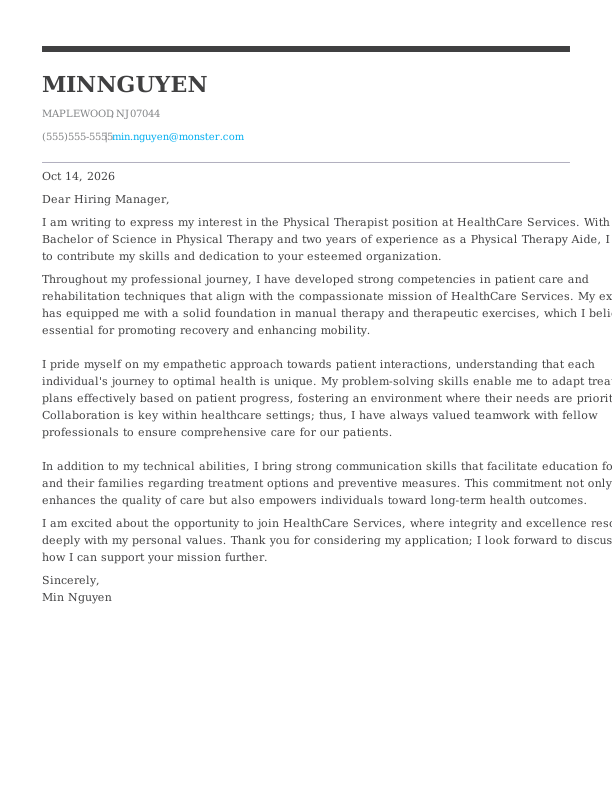
 Free
Physical Therapist Entry-Level Cover Letter
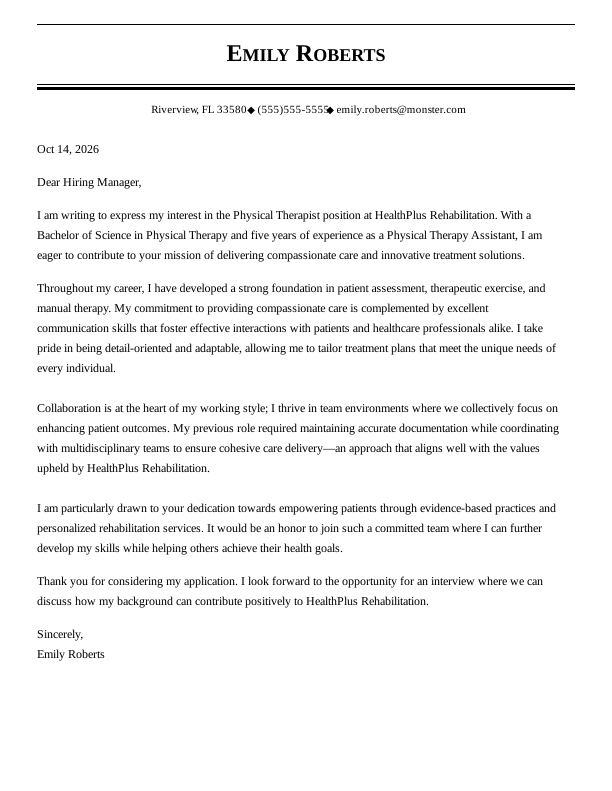
Physical Therapist Mid-Level Cover Letter
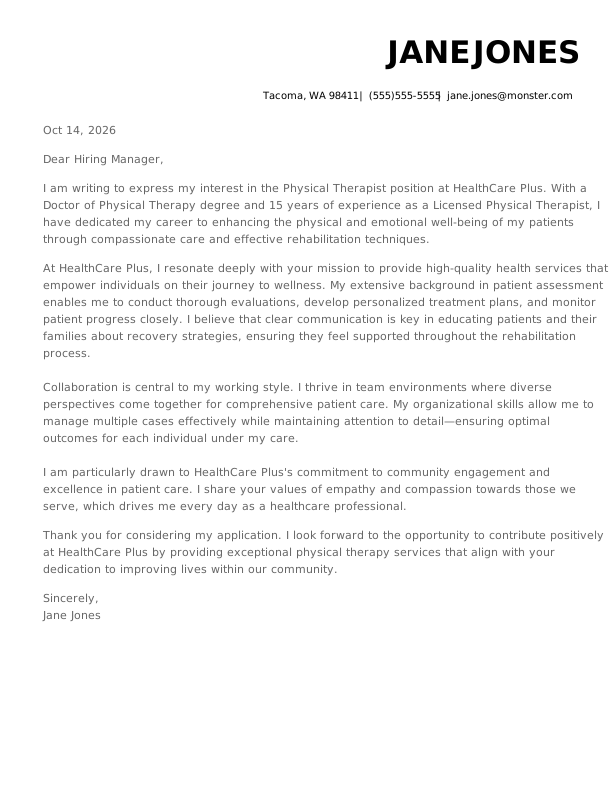
Physical Therapist Experienced Cover Letter
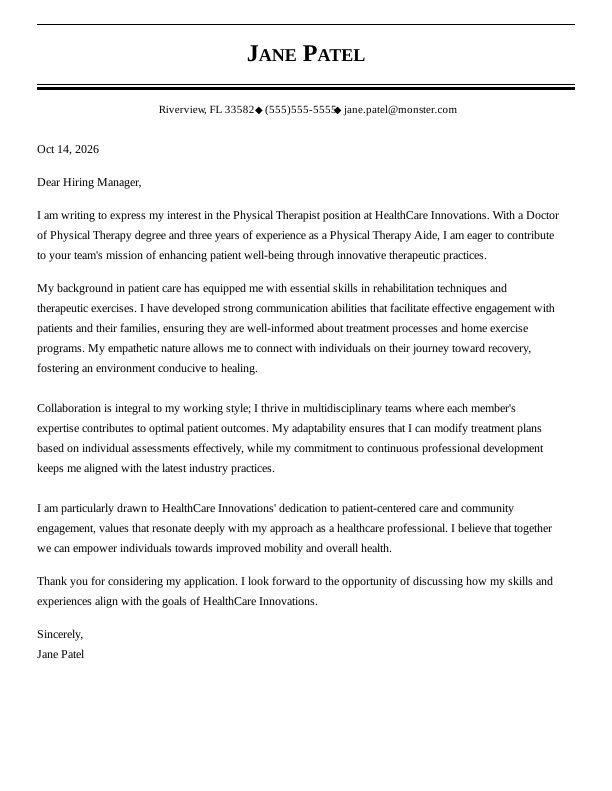
Physical Therapist Entry-Level Cover Letter
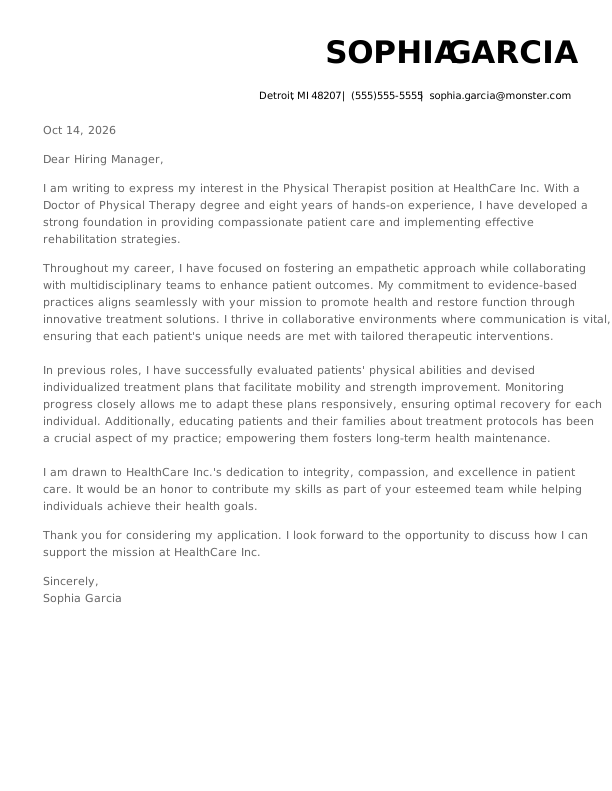
Physical Therapist Mid-Level Cover Letter
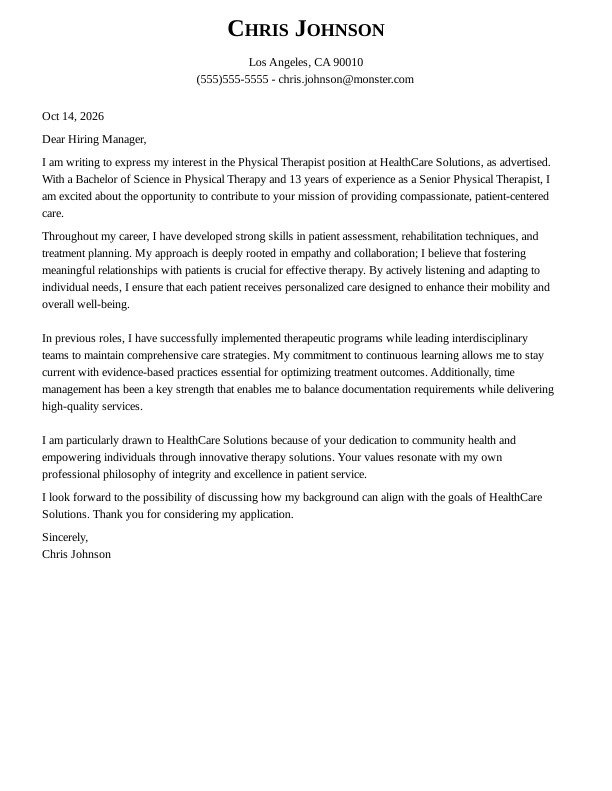
Physical Therapist Experienced Cover Letter
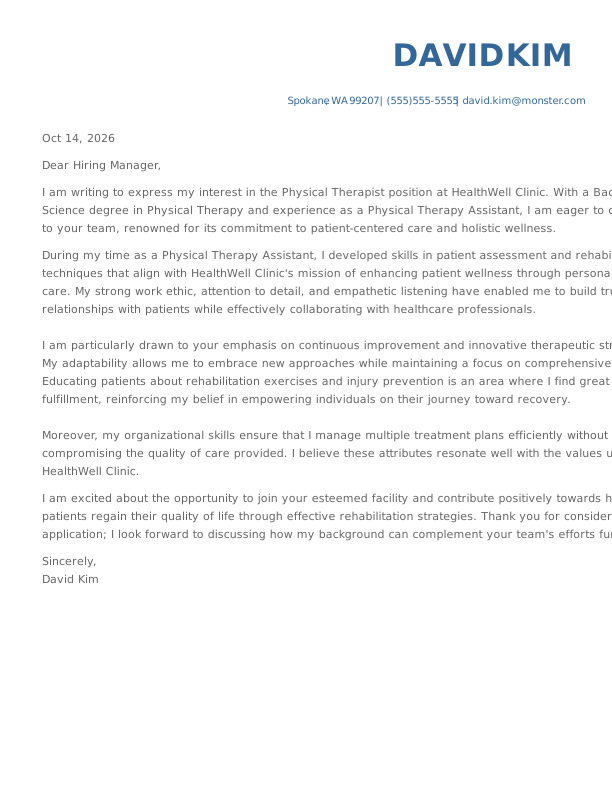
Physical Therapist Entry-Level Cover Letter
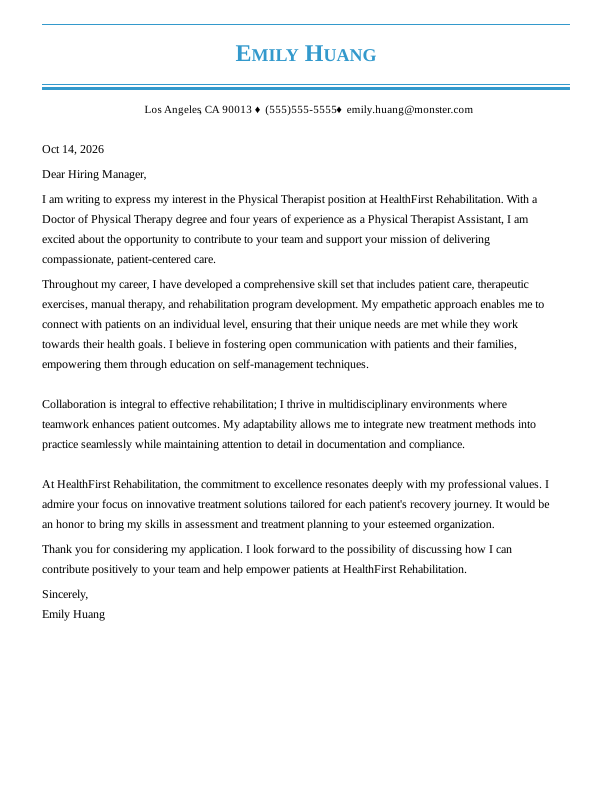
Physical Therapist Mid-Level Cover Letter
Browse Free Cover Letter Templates
- Academic
- Account Manager
- Accountant
- Accounts Payable
- Administrative Assistant
- Admissions Counselor
- Architecture
- Artist
- Assistant Principal
- Babysitter
- Barista
- Bartender
- Bookkeeper
- Brand Ambassador
- Business Analyst
- Business
- Caregiver
- Chef
- Civil Engineering
- Computer Science
- Construction
- Consulting
- Copywriter
- Cosmetology
- Custodian
- Customer Service
- Customer Service Representative
- Data Analyst
- Data Entry
- Dental Assistant
- Dental Hygienist
- Digital Marketing
- Electrical Engineering
- Emt
- Engineering
- Esthetician
- Event Coordinator
- Executive Assistant
- Finance
- Financial Analyst
- Firefighter
- Flight Attendant
- Graphic Designer
- Hair Stylist
- Healthcare
- Hr Generalist
- Investment Banking
- It
- Janitor
- Journalism
- Lab Technician
- Law Clerk
- Lawyer
- Librarian
- Logistics
- Makeup Artist
- Manager
- Marketing Coordinator
- Marketing
- Marketing Manager
- Massage Therapist
- Mechanic
- Mechanical Engineer
- Medical Assistant
- Non Profit
- Nursing
- Occupational Therapy
- Office Assistant
- Office Manager
- Operations Manager
- Paralegal
- Personal Trainer
- Pharmacist
- Pharmacy Technician
- Photographer
- Physician Assistant
- Pilot
- Police Officer
- Program Manager
- Project Manager
- Property Manager
- Psychology
- Receptionist
- Research Assistant
- Restaurant Manager
- Retail
- Sales
- Sales Manager
- School Counselor
- Security Officer
- Social Work
- Software Engineer
- Special Education Teacher
- Starbucks
- Substitute Teacher
- Teacher
- Teaching Assistant
- Truck Driver
- Vet Tech
- Veterinary Assistant
Cover Letter Examples for Physical Therapists
As your career progresses, your cover letter should reflect your growing clinical expertise, caseload responsibilities, and care leadership. Pick a template that fits your career stage to highlight the right skills and achievements for the role you want.
Entry-Level Physical Therapist Cover Letter
An entry-level cover letter should highlight foundational clinical skills, practical training, and an eagerness to deliver quality patient care under initial clinical supervision.
Mid-Career Physical Therapist Cover Letter
A mid-career cover letter focuses on proven clinical experience, independent caseload management, and effective collaboration with interdisciplinary care teams.
Experienced Physical Therapist Cover Letter
An experienced-level cover letter emphasizes advanced clinical expertise, program development, mentorship, and broader leadership responsibilities within healthcare settings.
Physical Therapist Cover Letter Template (Text)
Copy this physical therapist cover letter text, paste it into your document, and swap in your patient outcomes, specialties, and clinic or employer name.
Daniel Martinez
Crestwood, KY 40024
(555)555-5555
daniel.martinez@monster.com
Oct 14, 2026
Dear Hiring Manager,
I am writing to express my interest in the Physical Therapist position at HealthCare Systems Inc. With a Doctor of Physical Therapy degree and nine years of experience in providing patient-centered care, I am excited about the opportunity to contribute to your mission of enhancing quality of life through innovative rehabilitation services.
Throughout my career, I have developed a strong foundation in patient assessment and rehabilitation techniques. My empathetic approach allows me to connect with patients on a personal level, ensuring they feel supported during their recovery journey. I pride myself on my analytical skills and critical thinking abilities, which enable me to create customized treatment plans tailored to each individual’s needs.
In previous roles, I have successfully collaborated with interdisciplinary teams to optimize patient outcomes. My communication skills foster effective dialogue not only with patients but also among team members, reinforcing our commitment to achieving comprehensive care. Additionally, my background in educating patients and their families has equipped them with the knowledge necessary for home exercise regimens and injury prevention strategies.
I am drawn to HealthCare Systems Inc.’s values of compassion, integrity, and collaboration—principles that align closely with my professional ethos. I believe that by joining your team, I can further contribute positively towards empowering individuals through personalized care within a supportive environment.
Thank you for considering my application. I look forward to the possibility of discussing how my experience aligns with the goals at HealthCare Systems Inc.
Sincerely,
Daniel Martinez
How to Write a Physical Therapist Cover Letter
Writing a physical therapist cover letter is all about showing how your hands-on care helps patients recover and regain mobility. These simple steps will guide you through connecting your background to what employers look for in a clinician.
1. Research & Prepare
Take time to research the clinic or facility before you start writing so you can tailor your application to their specific environment. Review their focus areas to show you understand their care goals and daily operations.
Here are a few key things to review before drafting your letter:
- Scan the job posting for the specific EMR or documentation platform they use.
- Review the clinic or hospital service line pages for current rehab priorities and patient populations.
- Check your state’s physical therapy licensing board site for continuing education expectations tied to active practice.
2. Hook the Reader
Start your cover letter with a strong opening line that immediately highlights your clinical focus or a specific achievement. Sharing a clear win upfront grabs the reader’s attention and sets a professional tone.
Consider these opening style examples for your intro:
- Outcome tracking for functional goals: “Reduced 30-day falls in our ortho outpatient program by 18% by standardizing TUG and sit-to-stand progressions for patients after total knee arthroplasty.”
- Evidence-based evaluation style: “Used the Berg Balance Scale and timed gait trials to tailor vestibular and dual-task training during an eight-week stroke group program.”
- Team-based rehab coordination: “Documented HEP adherence weekly and coordinated with OT on adaptive equipment for post-COPD discharge planning under respiratory case manager DeShawn Lee.”
3. Tell Your Professional Story
Use the main body of your letter to share specific examples of patient progress and care delivery. Including measurable metrics gives hiring managers a clear picture of your impact in clinical settings.
Here are examples of how to highlight measurable results:
- Improved average timed up and go scores by 33% (18 seconds to 12 seconds) across 24 outpatient balance patients over eight weeks.
- Reduced missed visits by 22% after updating home exercise plans and sending same-day reminders for patients with transportation barriers.
- Managed a caseload of 10 to 12 orthopedic patients per day while coordinating with physicians to shorten return-to-work timelines by an average of 2 weeks.
4. Showcase Your Skills
Highlight key clinical abilities that align directly with the job description to demonstrate your practical strengths. Demonstrating how you apply core competencies in practice helps build confidence in your capabilities.
Use these bullet points as inspiration for presenting your skills:
- Treatment planning: “Adjusted a home exercise plan after seeing a patient compensate during their sit-to-stand practice and explained how to correct the movement.”
- Documentation: “Documented objective findings in the EHR right after each session so the next therapist could follow my rationale for progression.”
- Patient communication: “Asked a patient to tell me what they expected from therapy, then tailored education around their concerns until they could repeat the safety cues back to me.”
5. Explain Any Special Circumstances
If you are changing settings, relocating, or returning from a leave, address it briefly in a positive and clear tone. Explaining your background reassures employers about your license status and readiness to work.
Here are ways to address common career situations:
- “After six months out for caregiving, I stayed current by finishing my annual CPR renewal and completing 40 hours of outpatient manual therapy continuing education last quarter.”
- “Shifting from sports coaching into physical therapy practice because I wanted to work clinically with movement-based recovery plans, and I completed my dry needling training through the APTA-recognized program this spring.”
- “Relocated to Austin in May, and my Texas PT license is active while I continued seeing patients remotely under my prior state’s supervision until the transfer cleared.”
6. End With a Professional Goodbye
Wrap up your letter with a polite call to action and a professional sign-off. Expressing enthusiasm for an interview shows confidence and keeps the door open for next steps.
Briefly state your desire to discuss how your physical therapy experience fits their team, thank them for their time, and close with a standard sign-off like “Sincerely.”
4 Tips for Formatting Your Cover Letter
A well-organized cover letter makes a strong first impression on hiring managers who often review applications quickly. Presenting your information clearly ensures that your patient care achievements and qualifications stand out right away.

Use a Professional Font & Layout
Choose a standard, readable font like Arial or Calibri set to 10–12 pt. Maintain 1-inch margins so your document looks clean and organized, allowing reviewers to focus on your physical therapy background without visual distractions.

Address the Hiring Manager Directly
Try to identify the specific clinic manager or rehab director leading the hiring process. If a specific name is unavailable, using a respectful greeting like “Dear Hiring Manager” keeps your opening professional.

Match Your Header to Your Resume
Align the header of your cover letter with your resume header for a cohesive look. Matching your font styles and contact layout creates a polished application package that looks unified to hiring teams.

Save & Send as a PDF
Save your finished cover letter as a PDF to preserve your layout and formatting across different systems. Name the file clearly with your name and job title so recruiters can easily locate your file.
Top-Paying States for Physical Therapist Roles
Knowing what physical therapists earn across the country helps you compare offers and plan your next step with confidence. Salary figures can vary based on location, years of experience, and the setting you work in, such as outpatient clinics versus hospitals. The U.S. Bureau of Labor Statistics (BLS) is a helpful source for nationwide pay data and provides context on typical earnings for the profession.
Keep in mind that specialized experience, caseload type, and any relevant credentials may also affect what you take home.
| Alabama | $97,890 |
| Alaska | $113,190 |
| Arizona | $104,250 |
| Arkansas | $96,510 |
| California | $120,970 |
| Connecticut | $102,420 |
| Delaware | $106,450 |
| District of Columbia | $109,970 |
| Florida | $94,690 |
| Georgia | $101,610 |
| Hawaii | $100,900 |
| Idaho | $93,470 |
| Illinois | $107,980 |
| Indiana | $98,320 |
| Iowa | $92,630 |
| Kansas | $96,250 |
| Kentucky | $93,370 |
| Louisiana | $101,380 |
| Maine | $92,780 |
| Maryland | $107,690 |
| Massachusetts | $104,130 |
| Michigan | $96,840 |
| Minnesota | $98,700 |
| Mississippi | $95,090 |
| Missouri | $94,760 |
| Montana | $91,290 |
| Nebraska | $93,510 |
| Nevada | $113,700 |
| New Hampshire | $93,750 |
| New Jersey | $109,470 |
| New Mexico | $99,360 |
| New York | $100,770 |
| North Carolina | $95,600 |
| North Dakota | $89,870 |
| Ohio | $99,500 |
| Oklahoma | $97,760 |
| Oregon | $104,150 |
| Pennsylvania | $98,830 |
| Rhode Island | $98,190 |
| South Carolina | $96,630 |
| South Dakota | $90,270 |
| Tennessee | $98,090 |
| Texas | $106,450 |
| Utah | $96,920 |
| Vermont | $94,060 |
| Virginia | $102,990 |
| Washington | $102,830 |
| West Virginia | $99,470 |
| Wisconsin | $99,340 |
| Wyoming | $100,100 |
| Puerto Rico | $47,730 |
Key Takeaways
- Tailor your cover letter to highlight relevant clinical achievements and hands-on patient outcomes.
- Include specific metrics and functional goals to prove the impact of your therapeutic interventions.
- Maintain clean formatting and a clear layout to ensure your letter looks professional and readable.
More Cover Letter Examples
- Medical
- Medical Receptionist
- Medical Scribe
- Phlebotomist
- Physical Therapist Assistant
- Physical Therapy
- Respiratory Therapist
Browse Monster’s Resume Templates
Monster also has hundreds of ATS-friendly resume templates for all career levels and industries. Create a matching resume to help you land the interview.
Frequently Asked Questions
Last Update:
Do I really need a cover letter?
A cover letter as a physical therapist provides essential context about your clinical approach that a resume alone cannot convey. While your resume lists credentials and work history, a cover letter explains how you treat patients, collaborate with multidisciplinary teams, and achieve positive rehabilitation outcomes.
It gives you a dedicated space to showcase your passion for patient care and detail your practical capabilities effectively.
How long should my cover letter be?
Your physical therapist cover letter should ideally be three to four paragraphs long, fitting comfortably on a single page between 250 and 400 words. Keeping your text concise ensures hiring managers can quickly scan your top qualifications, clinical experience, and patient success stories without feeling overwhelmed.
Focus on delivering clear, impactful statements about your background rather than attempting to list every single job responsibility you have held.
Should my cover letter match my resume?
Your physical therapist cover letter should match your resume in visual style, font choices, and header layout to create a unified application package. However, the content of your letter should expand upon your resume rather than simply repeat the same bullet points.
Use your cover letter to share the story behind your clinical successes, elaborate on specific treatment achievements, and explain why you want to join that clinic team.
Can I use AI to write my cover letter?
You can use AI tools to generate ideas or structure your physical therapist cover letter, but you must thoroughly personalize the final content. Generative tools help create an initial outline or refine your wording, but hiring managers appreciate authentic stories about real patient care.
Make sure to refine any draft by adding your genuine voice, specific clinical certifications, and concrete examples of patient progress you facilitated.
Should I mention salary expectations in my cover letter?
You should generally avoid mentioning salary expectations in your physical therapist cover letter unless the job posting explicitly requires you to do so. If pay details are requested, provide a flexible salary range based on regional healthcare market standards and your clinical expertise.
Keeping the conversation focused on your professional value during early application stages allows you to negotiate compensation more effectively later in the hiring process.

Vicki Salemi is a nationally recognized career expert who helps professionals navigate the hiring landscape and find the right fit on Monster. With over 15 years of experience in corporate recruiting and HR, she offers expert guidance on job search strategies, interview preparation, and career development to help candidates land their next role.
See More From Vicki SalemiExplore Related Career Advice







How to Write a Cover Letter for Internal Positions or Promotions (Examples & Tips)

Updated:
Apr 23, 2026
|
19 min read


Cover Letter vs Resume: What’s the Difference & Do You Need Both?

Updated:
Apr 23, 2026
|
18 min read