


Free Respiratory Therapist Cover Letter Templates & Examples
A strong respiratory therapist cover letter showcases your expertise in patient care, ventilator management, and emergency response. Use our free examples and step-by-step guidance to highlight your clinical skills and show hiring managers you are ready to deliver safe, effective care.
Real-World Cover Letters That Get Results
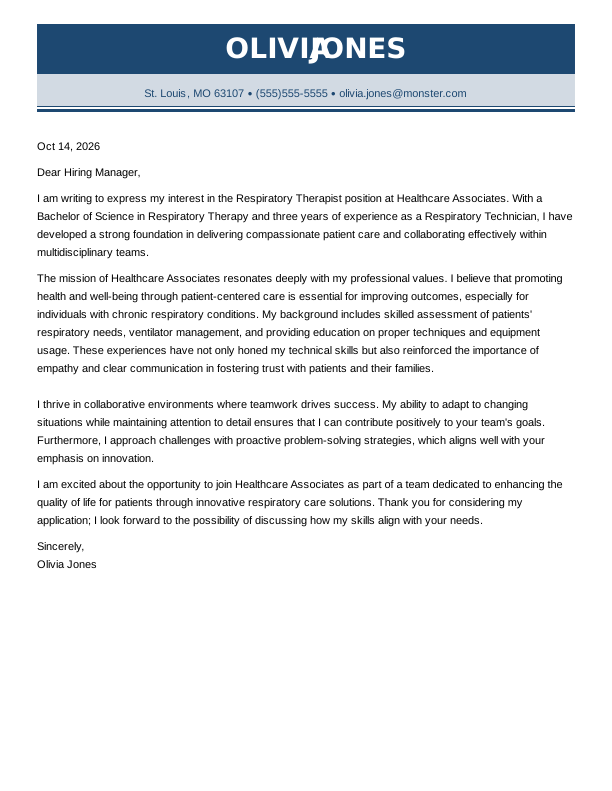
 Free
Respiratory Therapist Entry-Level Cover Letter
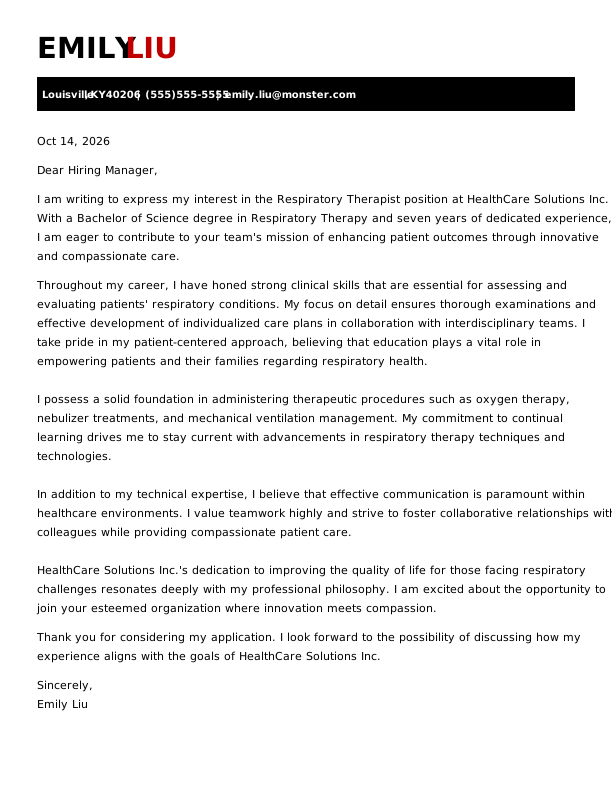
Respiratory Therapist Mid-Level Cover Letter
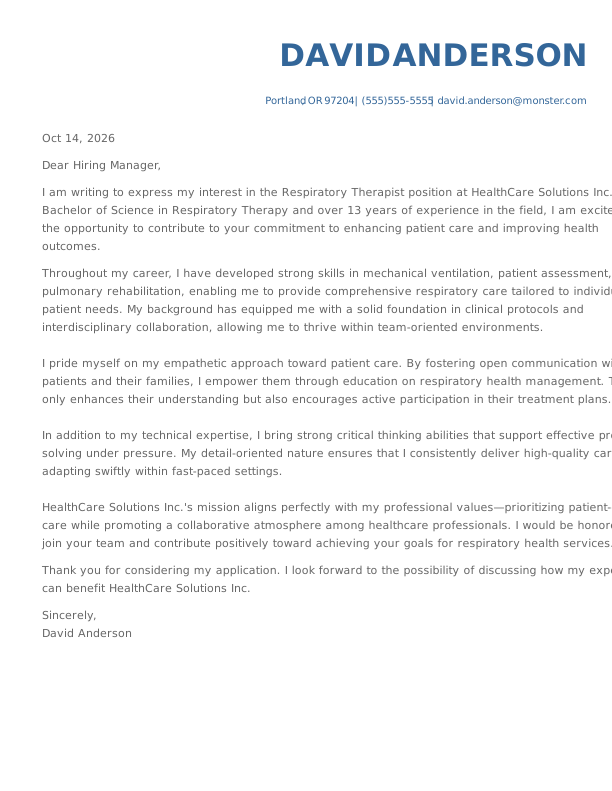
Respiratory Therapist Experienced Cover Letter
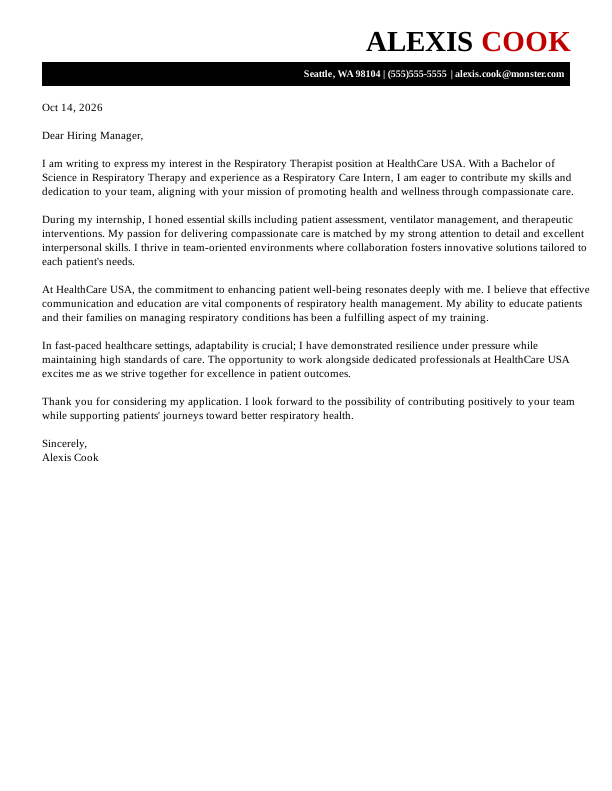
Respiratory Therapist Entry-Level Cover Letter
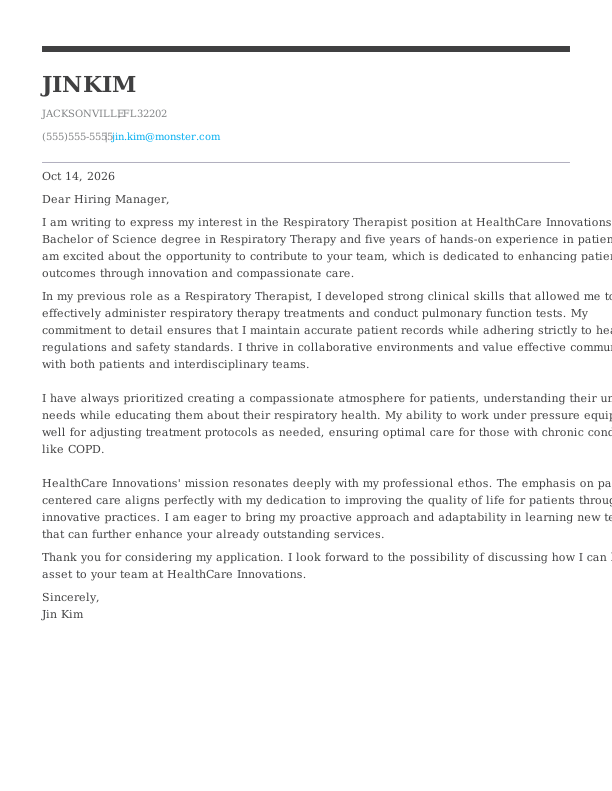
Respiratory Therapist Mid-Level Cover Letter
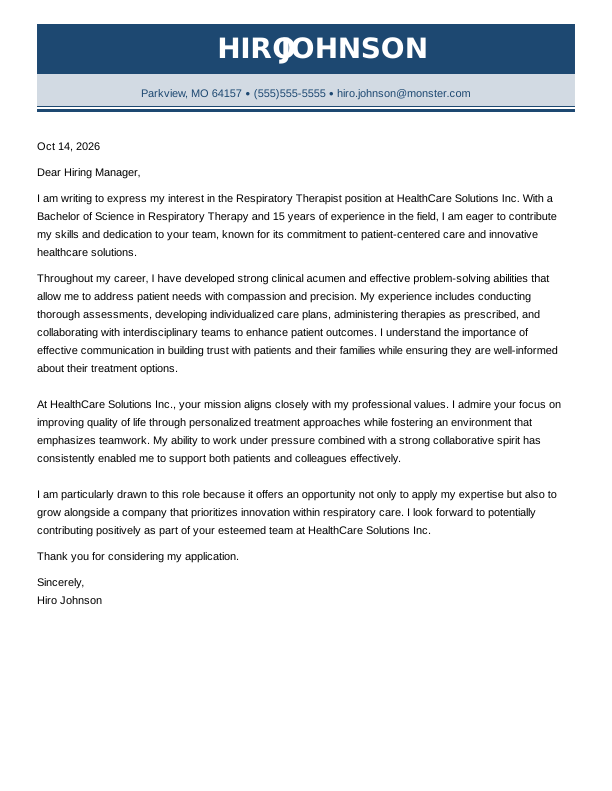
Respiratory Therapist Experienced Cover Letter
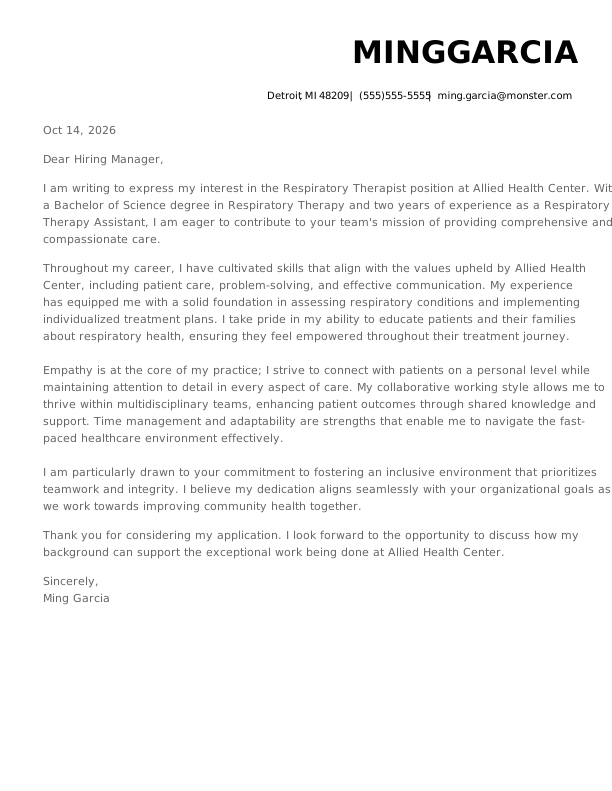
Respiratory Therapist Entry-Level Cover Letter
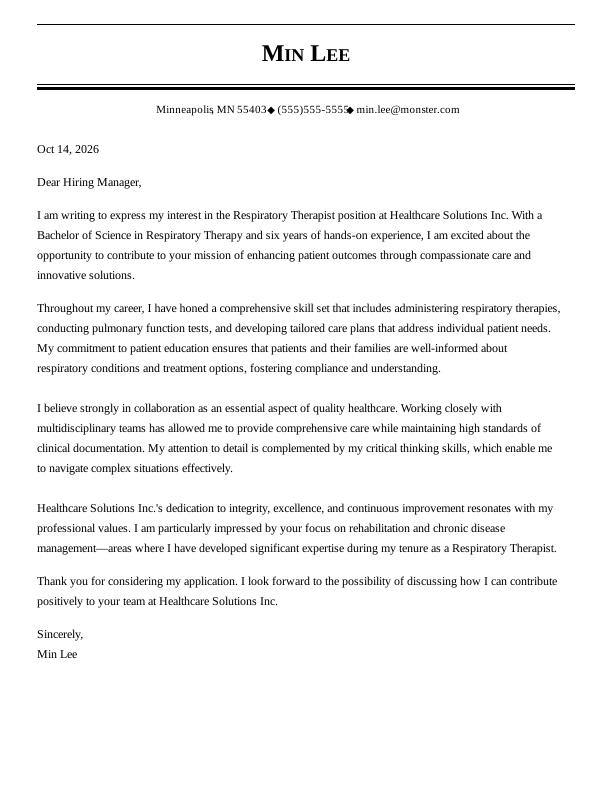
Respiratory Therapist Mid-Level Cover Letter
Browse Free Cover Letter Templates
- Academic
- Account Manager
- Accountant
- Accounts Payable
- Administrative Assistant
- Admissions Counselor
- Architecture
- Artist
- Assistant Principal
- Babysitter
- Barista
- Bartender
- Bookkeeper
- Brand Ambassador
- Business Analyst
- Business
- Caregiver
- Chef
- Civil Engineering
- Computer Science
- Construction
- Consulting
- Copywriter
- Cosmetology
- Custodian
- Customer Service
- Customer Service Representative
- Data Analyst
- Data Entry
- Dental Assistant
- Dental Hygienist
- Digital Marketing
- Electrical Engineering
- Emt
- Engineering
- Esthetician
- Event Coordinator
- Executive Assistant
- Finance
- Financial Analyst
- Firefighter
- Flight Attendant
- Graphic Designer
- Hair Stylist
- Healthcare
- Hr Generalist
- Investment Banking
- It
- Janitor
- Journalism
- Lab Technician
- Law Clerk
- Lawyer
- Librarian
- Logistics
- Makeup Artist
- Manager
- Marketing Coordinator
- Marketing
- Marketing Manager
- Massage Therapist
- Mechanic
- Mechanical Engineer
- Medical Assistant
- Non Profit
- Nursing
- Occupational Therapy
- Office Assistant
- Office Manager
- Operations Manager
- Paralegal
- Personal Trainer
- Pharmacist
- Pharmacy Technician
- Photographer
- Physician Assistant
- Pilot
- Police Officer
- Program Manager
- Project Manager
- Property Manager
- Psychology
- Receptionist
- Research Assistant
- Restaurant Manager
- Retail
- Sales
- Sales Manager
- School Counselor
- Security Officer
- Social Work
- Software Engineer
- Special Education Teacher
- Starbucks
- Substitute Teacher
- Teacher
- Teaching Assistant
- Truck Driver
- Vet Tech
- Veterinary Assistant
Cover Letter Examples for Respiratory Therapists
Cover letter expectations change as you advance. Early-career therapists should highlight clinical rotations and foundational skills, while experienced professionals should showcase leadership, complex case management, and protocol development. Select the template below that aligns with your experience to highlight your certifications and key achievements.
Entry-Level Respiratory Therapist Cover Letter
Ideal for recent graduates and new credential holders, this cover letter example highlights hands-on clinical training, academic foundation, and readiness to provide safe patient care under supervision.
Mid-Career Respiratory Therapist Cover Letter
Designed for respiratory therapists with a few years of bedside experience, this sample focuses on unit leadership, specialized equipment management, and protocol compliance.
Experienced Respiratory Therapist Cover Letter
Tailored for senior respiratory therapists and charge RTs, this cover letter showcases critical care expertise, team mentorship, and contribution to facility-wide respiratory care protocols.
Respiratory Therapist Cover Letter Template (Text)
Copy this respiratory therapist cover letter text, paste it into your document, and swap in your credentialing, shift experience, and employer name for the role.
Olivia Martinez
Cincinnati, OH 45202
(555)555-5555
olivia.martinez@monster.com
Oct 14, 2026
Dear Hiring Manager,
I am writing to express my interest in the Respiratory Therapist position at Healthcare Solutions Inc. With a Bachelor of Science degree in Respiratory Therapy and four years of experience as a Respiratory Therapy Technician, I have developed a strong foundation in patient care and clinical practices that align well with your commitment to enhancing patient outcomes through compassionate care.
Throughout my career, I have honed my skills in administering respiratory therapy treatments, including mechanical ventilation support and diagnostic testing. My background has equipped me with the ability to assess patients’ respiratory conditions effectively and collaborate with multidisciplinary teams to create tailored care plans that address individual needs.
I pride myself on my strong communication abilities and adaptability, which allow me to educate patients and their families about respiratory health management clearly and empathetically. My detail-oriented approach ensures accurate monitoring of patient progress while adjusting treatment plans as necessary for optimal results.
At Healthcare Solutions Inc., I admire your mission to prioritize patient well-being through integrity, collaboration, and innovation. I share these values deeply; therefore, I am excited about the opportunity to contribute to a team dedicated to improving lives through high-quality healthcare solutions.
Thank you for considering my application. I look forward to discussing how my experience can support the excellent work being done at Healthcare Solutions Inc.
Sincerely,
Olivia Martinez
How to Write a Respiratory Therapist Cover Letter
Crafting an effective respiratory therapist cover letter involves translating your hands-on patient care experience into clear, compelling examples. By highlighting concrete clinical achievements like ventilator support, oxygen therapy, ABG interpretation, and accurate documentation, you can build a stand-out application. Learn how to write a cover letter by following our simple, step-by-step guide to showcase your technical skills and clinical impact effectively.
1. Research & Prepare
To understand what a healthcare facility needs right now, review its specific respiratory care unit, patient population, and job posting requirements. Here are three ways to gather that targeted evidence:
- Review the job posting for required RT credentials and specific EHR software so you can match its required qualifications in your text.
- Check the hospital’s site for recent respiratory quality initiatives or service expansions so you can reference its current clinical goals.
- Verify state licensing board requirements for active RRT or CRT credentials to ensure your application uses the exact professional terminology expected.
2. Hook the Reader
Your opening line should grab attention immediately by showing your understanding of clinical workflows and patient care requirements. Instead of relying on boilerplate statements that repeat your job title, lead with clear proof of bedside decision-making and patient outcomes using options like these:
- Ventilation outcomes: “On a 20-bed ICU unit, I helped reduce ventilator-associated events by 18% over six months by standardizing spontaneous breathing trials and implementing RT-led daily checklists.”
- Protocol-driven assessment: “When ABGs were trending off-target, I recalibrated our i-STAT workflow and adjusted bronchodilator protocols using response scoring to cut time-to-nebulization from 45 to 25 minutes.”
- Collaboration on escalation: “After our team revised oxygen therapy targets, I coordinated closely with charge nurses during rapid deteriorations to ensure BiPAP settings met clinical goals within 10 minutes.”
3. Tell Your Professional Story
Your cover letter explains how you deliver patient care under pressure. Using concrete numbers and specific metrics helps readers visualize your day-to-day workload and clinical judgment through examples such as these:
- Reduced ventilator alarm frequency by 22% over three months by standardizing inline suction technique and circuit checks during rounds.
- Improved incentive spirometry compliance from 54% to 81% by coaching post-op patients on goal sets and documenting shift progress clearly.
- Managed an average caseload of 14 patients per shift across COPD and critical care cases while maintaining a 30-minute treatment turnaround target.
4. Showcase Your Skills
Bring core requirements from the job posting to life by sharing brief, real-world examples from past clinical scenarios rather than relying on buzzwords. The following examples illustrate how to demonstrate your hands-on expertise and problem-solving abilities:
- Ventilator troubleshooting: “When I noticed rising peak airway pressures, I systematically checked ventilator circuits, suctioned as needed, and collaborated with nursing before optimizing settings.”
- Oxygen therapy titration: “I titrated FiO2 during ABG follow-ups whenever patient SpO2 levels drifted, documenting treatment responses so oncoming shifts had clear care plans.”
- Patient & family education: “I explained nebulizer maintenance to worried family members in clear steps, ensuring they could demonstrate proper administration techniques independently.”
5. Explain Any Special Circumstances
If you need to address employment gaps, career transitions, or relocations, keep your explanation brief and direct so employers can easily confirm your active credentials and clinical readiness. You can address these situations clearly using examples like these:
- “After time away for caregiving, I completed an RT clinical refresher and returned to PRN work in a hospital pulmonary unit, managing BiPAP and mechanical ventilation.”
- “I’m transitioning from emergency coverage into critical care, having updated my ACLS certification and spent six months managing ventilator protocols in the ICU.”
- “Following my relocation, I transferred my state license—which is active as of today—while continuing to perform diagnostic spirometry and oxygen titration.”
6. End With a Professional Goodbye
Wrap up your letter with a polite, direct closing that thanks the reader and sets up a brief conversation about how your clinical skills align with the respiratory team’s goals. Avoid passive phrasing and instead use a concise call to action, such as: “I’d welcome the chance to discuss how my ventilator management experience and commitment to patient safety can support your department’s goals. Thank you for your time and consideration.”
4 Tips for Formatting Your Cover Letter
Hiring managers often spend only seconds skimming a cover letter before deciding whether to evaluate a candidate’s credentials further. Clear visual layout, consistent styling, and professional structure make it easy for recruiters to scan your application quickly and spot your key qualifications. Follow these four formatting tips to ensure your document leaves a strong impression:

Address the Hiring Manager Directly
Whenever possible, address your cover letter to the specific department supervisor or healthcare recruiter. Review the job posting, hospital directory, or professional networks to identify the leader responsible for respiratory care hiring. If you can’t find a specific name, use professional greetings like “Dear Respiratory Care Manager” or “Dear Hiring Team,” avoiding outdated openings like “To Whom It May Concern.”

Match Your Header to Your Resume
Maintain consistency across your application documents by using the exact same header design on both your resume and cover letter. Align your full name, professional credentials (such as RRT or CRT), contact details, and typography styles. This cohesive presentation creates a clean visual brand that mirrors the organization and attention to detail required in clinical settings.

Use Bullet Points for Key Achievements
Organize your top professional accomplishments into a concise bulleted list of three or four key points. Focus on quantifiable achievements, such as reduced ventilator weaning times, improved ABG turnaround, or high patient satisfaction scores. Bullet points break up dense text, letting recruiters review your core qualifications and measurable outcomes at a glance.

Save & Send as a PDF
Export your finished document as a PDF to preserve your custom formatting, margins, and font choices across different operating systems. PDF files prevent automated tracking software or recipient email viewers from scrambling your layout. Be sure to use a clear, professional file naming convention like Firstname_Lastname_Respiratory_Therapist_Cover_Letter.pdf so hiring teams can organize your application easily.
Top-Paying States for Respiratory Therapist Roles
Knowing what respiratory therapists earn across the country can help you compare offers, plan your next step, and negotiate with confidence. Salary figures in the data below come from the U.S. Bureau of Labor Statistics (BLS) and reflect the most recent nationwide averages for respiratory therapists.
Keep in mind that your pay can vary based on location, years of experience, and the care setting. For example, hospital roles may differ from outpatient or home-care work. Specialty areas and required credentials can also affect outcomes.
| Alabama | $65,500 |
| Alaska | $93,670 |
| Arizona | $76,990 |
| Arkansas | $67,790 |
| California | $106,790 |
| Connecticut | $88,770 |
| Delaware | $89,890 |
| District of Columbia | $102,460 |
| Florida | $81,310 |
| Georgia | $85,890 |
| Hawaii | $94,220 |
| Idaho | $73,890 |
| Illinois | $81,810 |
| Indiana | $75,510 |
| Iowa | $71,460 |
| Kansas | $73,300 |
| Kentucky | $67,650 |
| Louisiana | $73,100 |
| Maine | $77,720 |
| Maryland | $88,600 |
| Massachusetts | $95,120 |
| Michigan | $75,230 |
| Minnesota | $90,030 |
| Mississippi | $70,410 |
| Missouri | $74,120 |
| Montana | $78,540 |
| Nebraska | $75,000 |
| Nevada | $85,160 |
| New Hampshire | $84,750 |
| New Jersey | $97,110 |
| New Mexico | $70,780 |
| New York | $105,740 |
| North Carolina | $76,710 |
| North Dakota | $81,610 |
| Ohio | $78,380 |
| Oklahoma | $75,230 |
| Oregon | $94,160 |
| Pennsylvania | $76,170 |
| Rhode Island | $84,490 |
| South Carolina | $73,720 |
| South Dakota | $64,000 |
| Tennessee | $68,820 |
| Texas | $78,150 |
| Utah | $81,840 |
| Vermont | $75,950 |
| Virginia | $82,480 |
| Washington | $96,050 |
| West Virginia | $68,440 |
| Wisconsin | $82,530 |
| Wyoming | $73,390 |
| Puerto Rico | $31,090 |
Key Takeaways
- Highlight core clinical competencies and active credentials early to establish immediate credibility with the employer.
- Quantify your patient care successes with concrete data points such as weaning rates, turnaround times, and assessment scores.
- Tailor your messaging directly to the facility’s care environment, whether it is an acute care ICU, outpatient clinic, or long-term care unit.
More Cover Letter Examples
- Medical
- Medical Receptionist
- Medical Scribe
- Phlebotomist
- Physical Therapist Assistant
- Physical Therapist
- Physical Therapy
Browse Monster’s Resume Templates
Monster also has hundreds of ATS-friendly resume templates for all career levels and industries. Create a matching resume to help you land the interview.
Frequently Asked Questions
Last Update:
Do I really need a cover letter?
Yes, submitting a respiratory therapist cover letter is highly recommended even when listed as optional. While your resume lists credentials and shift history, a cover letter explains your clinical reasoning, bedside decision-making, and commitment to patient advocacy. It provides valuable context regarding how you handle critical care situations and integrate with healthcare teams.
How long should my cover letter be?
A respiratory therapist cover letter should be between 250 and 400 words, fitting neatly on a single page. This concise length allows you to highlight your essential clinical credentials, key ventilator management experience, and measurable patient care achievements clearly without overwhelming the hiring manager with unnecessary background details or dense paragraphs.
Should my cover letter match my resume?
Yes, your cover letter visual formatting should match your resume to present a clean, unified application package. Using consistent font choices, color accents, and header layouts demonstrates strong attention to detail. The cover letter content should complement your resume by expanding on key accomplishments rather than simply duplicating listed bullet points.
Can I use AI to write my cover letter?
Yes, you can use AI tools to assist with outlining and refining your initial draft, but you must personalize the content. Ensure the letter reflects your authentic voice and specific clinical context, including real examples of ventilator care, patient education, or unit protocols. Reviewing and editing ensures your application remains genuine.
How do I write a cover letter for an internal position?
When writing an internal cover letter, emphasize your familiarity with the facility’s existing protocols, staff, and patient care standards. Highlight specific achievements on your current unit, such as improving workflow or mentoring peers. Expressing enthusiasm for growth within the organization demonstrates commitment while ensuring you complete all standard internal application requirements.

Megan Dawkins is a career industry editor who empowers job seekers to take control of their career paths using Monster’s comprehensive job search and resume tools. She specializes in helping job seekers navigate the flexible job market.
See More From Megan DawkinsExplore Related Career Advice







How to Write a Cover Letter for Internal Positions or Promotions (Examples & Tips)

Updated:
Apr 23, 2026
|
19 min read


Cover Letter vs Resume: What’s the Difference & Do You Need Both?

Updated:
Apr 23, 2026
|
18 min read