


Free DevOps Engineer Cover Letter Templates & Examples
A strong DevOps engineer cover letter shows how a candidate improves software delivery and system reliability using automation and teamwork. Our free samples and practical advice help applicants share relevant skills clearly so hiring managers can see their value quickly.
Real-World Cover Letters That Get Results
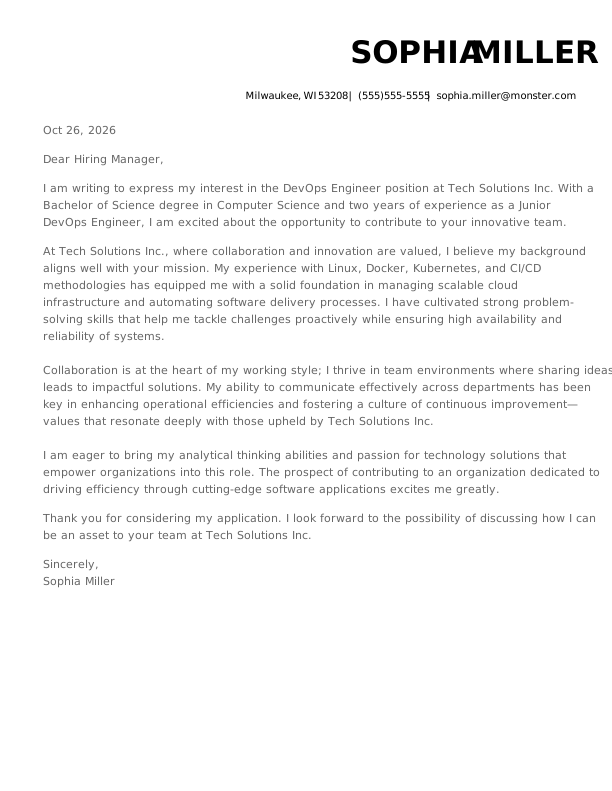
 Free
Devops Engineer Entry-Level Cover Letter
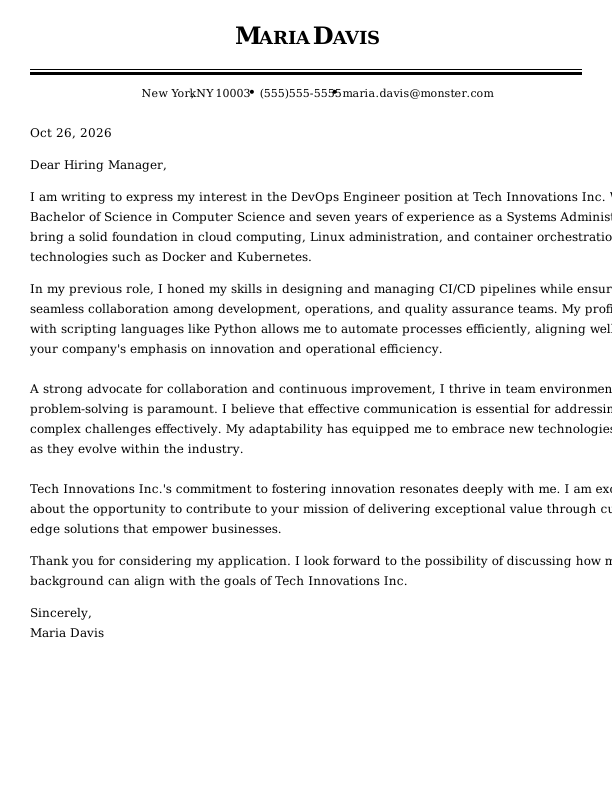
Devops Engineer Mid-Level Cover Letter
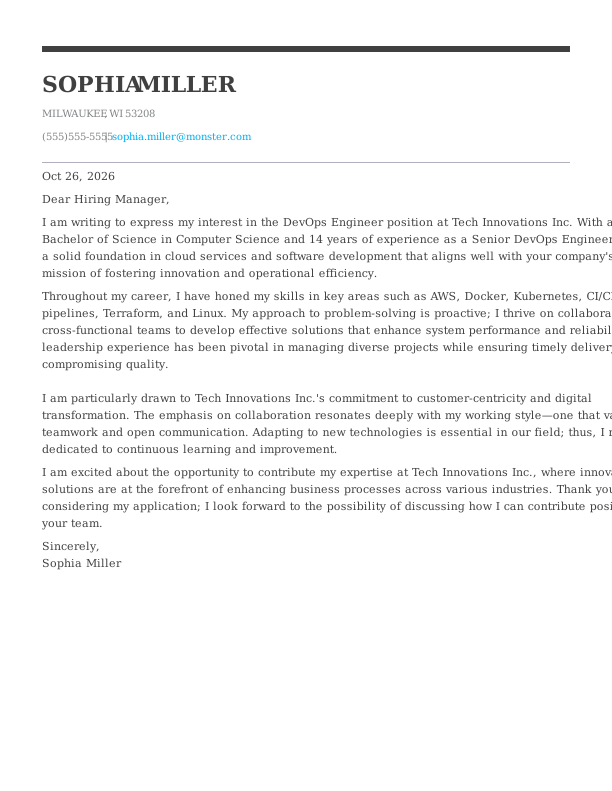
Devops Engineer Experienced Cover Letter
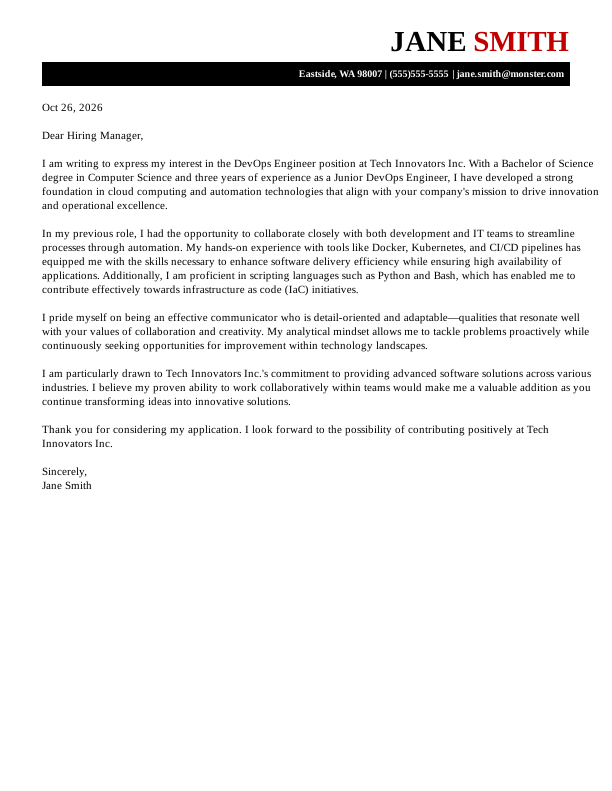
Devops Engineer Entry-Level Cover Letter
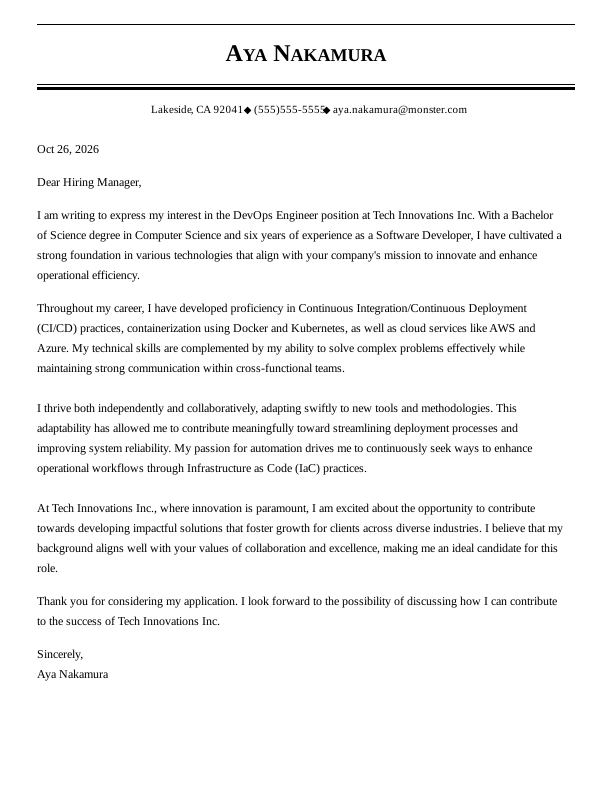
Devops Engineer Mid-Level Cover Letter
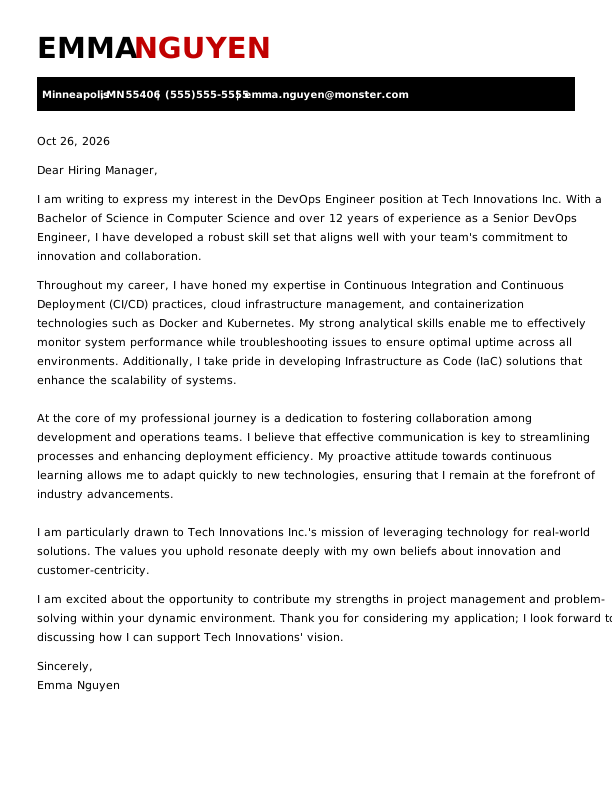
Devops Engineer Experienced Cover Letter
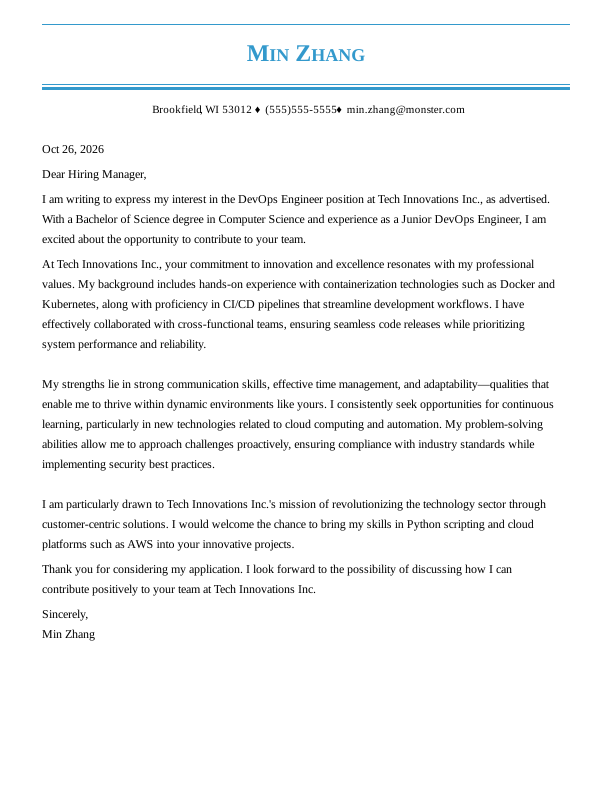
Devops Engineer Entry-Level Cover Letter
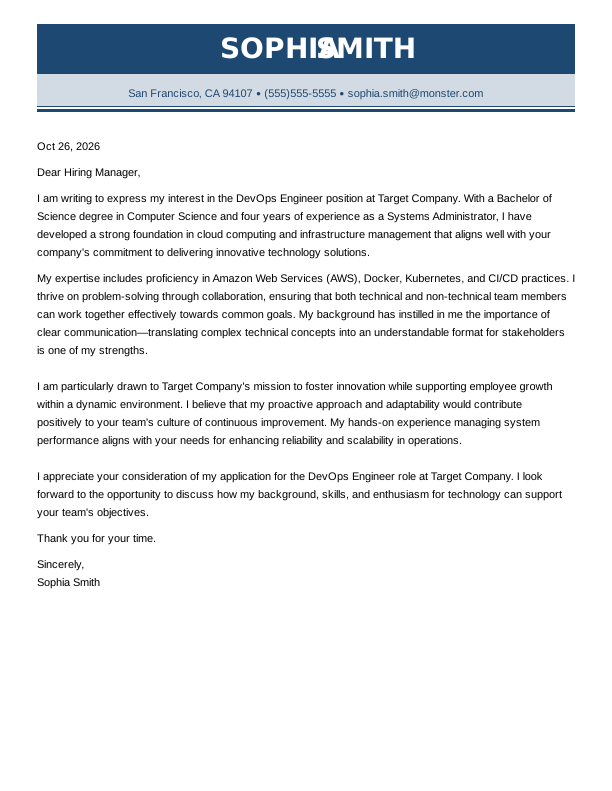
Devops Engineer Mid-Level Cover Letter
Browse Free Cover Letter Templates
- Academic
- Account Manager
- Accountant
- Accounts Payable
- Administrative Assistant
- Admissions Counselor
- Architecture
- Artist
- Assistant Principal
- Babysitter
- Barista
- Bartender
- Bookkeeper
- Brand Ambassador
- Business Analyst
- Business
- Caregiver
- Chef
- Civil Engineering
- Computer Science
- Construction
- Consulting
- Copywriter
- Cosmetology
- Custodian
- Customer Service
- Customer Service Representative
- Data Analyst
- Data Entry
- Dental Assistant
- Dental Hygienist
- Digital Marketing
- Electrical Engineering
- Emt
- Engineering
- Esthetician
- Event Coordinator
- Executive Assistant
- Finance
- Financial Analyst
- Firefighter
- Flight Attendant
- Graphic Designer
- Hair Stylist
- Healthcare
- Hr Generalist
- Investment Banking
- It
- Janitor
- Journalism
- Lab Technician
- Law Clerk
- Lawyer
- Librarian
- Logistics
- Makeup Artist
- Manager
- Marketing Coordinator
- Marketing
- Marketing Manager
- Massage Therapist
- Mechanic
- Mechanical Engineer
- Medical Assistant
- Non Profit
- Nursing
- Occupational Therapy
- Office Assistant
- Office Manager
- Operations Manager
- Paralegal
- Personal Trainer
- Pharmacist
- Pharmacy Technician
- Photographer
- Physician Assistant
- Pilot
- Police Officer
- Program Manager
- Project Manager
- Property Manager
- Psychology
- Receptionist
- Research Assistant
- Restaurant Manager
- Retail
- Sales
- Sales Manager
- School Counselor
- Security Officer
- Social Work
- Software Engineer
- Special Education Teacher
- Starbucks
- Substitute Teacher
- Teacher
- Teaching Assistant
- Truck Driver
- Vet Tech
- Veterinary Assistant
Cover Letter Examples for Devops Engineers
Cover letter expectations change as a DevOps career grows from basic support to leading major projects. Choose a sample below that matches your experience level to highlight your work with automation, cloud setups, and system performance.
Entry-Level DevOps Engineer Cover Letter
Designed for beginners and career changers, this sample helps new DevOps engineers present their foundational skills clearly and confidently.
Mid-Career DevOps Engineer Cover Letter
Ideal for mid-level professionals, this example focuses on managing build pipelines, automating processes, and coordinating across engineering teams.
Experienced DevOps Engineer Cover Letter
Tailored for senior engineers, this sample emphasizes high-level leadership, infrastructure design, and cloud strategy.
DevOps Engineer Cover Letter Template (Text)
Paste this DevOps engineer cover letter template into your document, then customize it by swapping in your CI/CD projects, AWS certifications, and target company.
Samuel Perry
Chicago, IL 60601
(555)555-5555
samuel.perry@monster.com
Oct 26, 2026
Dear Hiring Manager,
I am writing to express my enthusiasm for the DevOps Engineer position at Tech Innovations Inc. With a Bachelor of Science in Computer Science and five years of experience as a Systems Administrator, I have developed a robust skill set that aligns well with your company’s mission to leverage technology for impactful solutions.
My background in cloud computing, along with hands-on expertise in containerization technologies such as Docker and Kubernetes, has equipped me with the tools necessary to contribute effectively to your team. I take pride in my ability to collaborate seamlessly across teams, ensuring that both development and operations work harmoniously towards common goals. My experience managing CI/CD pipelines has honed my skills in optimizing software delivery processes while maintaining high standards of security and reliability.
I thrive in environments where innovation is key. My problem-solving mindset allows me to proactively identify challenges and implement effective solutions using industry-standard tools. Moreover, I am committed to continuous learning, always seeking out new technologies and methodologies that can enhance our systems’ performance.
At Tech Innovations Inc., I see an exciting opportunity not just to apply my skills but also to grow alongside a forward-thinking organization dedicated to excellence and customer-centricity. I am eager to bring my adaptability and collaborative spirit into your dynamic work environment.
Thank you for considering my application. I look forward to the possibility of discussing how I can contribute positively at Tech Innovations Inc.
Sincerely,
Samuel Perry
How to Write a DevOps Engineer Cover Letter
Writing a DevOps engineer cover letter means connecting practical skills with real infrastructure outcomes. Follow these simple steps to customize your letter for a specific job posting.
1. Research & Prepare
Before writing, research how the company manages its infrastructure and deployments. Look at its preferred cloud tools, platforms, and current projects so you can tailor your examples to its needs.
Use these practical research strategies to gather helpful details before writing:
- Review the job description to find the exact tools and platforms the employer uses daily.
- Read company engineering posts or news to learn about its recent platform updates or challenges.
- Explore open-source repositories to understand how the organization structures its software workflows.
2. Hook the Reader
Start with a strong opening line that grabs attention by showing an understanding of core delivery and reliability goals. Highlight a key accomplishment right away instead of listing basic resume facts.
Consider these effective opening line examples based on different technical strengths:
- Reliability impact: “Reduced incident recovery time from 42 minutes to 18 minutes by improving system monitoring and runbooks.”
- Pipeline modernization: “Migrated our build system to GitHub Actions, cutting build times by 35% across production environments.”
- Security and platform ownership: “Partnered with security leads to set up strict access roles and automated compliance checks.”
3. Tell Your Professional Story
Use body paragraphs to explain how you solve real problems and keep systems stable. Include clear numbers and results so hiring managers can see the impact of your past work.
Here are examples of clear, outcome-focused bullet points to include:
- Lowered system errors by 32% over six months by adding automated deployment checks.
- Saved $68,000 annually by optimizing cloud server usage and rightsizing resources.
- Reduced deployment times from 45 minutes to 12 minutes by standardizing release pipelines.
4. Showcase Your Skills
Connect your technical skills directly to the requirements listed in the job description. Share specific examples of how you handled key challenges in your daily work.
Use these examples to frame your practical technical experience:
- Deployment pipelines: “Resolved build failures by updating and locking tool versions in our container setups.”
- Infrastructure as code: “Updated cloud security settings with Terraform and verified them in a test environment first.”
- Team communication: “Worked with development teams to review system logs and establish clear recovery steps.”
5. Explain Any Special Circumstances
Briefly explain career transitions, gaps, or relocations in a sentence or two. Focus on your recent learning or continuous skills development to reassure the hiring team.
Here are simple ways to address common career situations:
- “After a career break, I refreshed my cloud certifications and built new automation projects to stay current.”
- “Transitioning from software development to DevOps by practicing infrastructure tools and container deployment in home projects.”
- “Recently relocated to the area and updated my setup to start working immediately with cloud environments.”
6. End With a Professional Goodbye
Close your cover letter with a polite, professional call to action. Keep it short and direct so the hiring manager knows you are eager to discuss the role further.
Express your willingness to share more details about your work, thank the reader for their time, and end with a traditional sign-off like “Sincerely.”
4 Tips for Formatting Your Cover Letter
Clean presentation and clear layout help a hiring manager scan your document quickly. A well-formatted letter highlights your technical skills and experience without clutter, ensuring a positive first impression.

Address the Hiring Manager Directly
Try to find the manager’s name from the job post or LinkedIn. If it is unavailable, use “Dear Hiring Manager” or “To the Hiring Team” instead of outdated greetings.

Match Your Header to Your Resume
Use the same header layout and contact info on both your resume and cover letter. Consistent formatting creates a cohesive application package that looks polished.

Use Bullet Points for Key Achievements
Include three or four key bullet points to feature major outcomes like uptime or cost savings. Bullets make key achievements easy to read during a fast review.

Balance Spacing & Margins
Use standard single- to 1.15-line spacing and 1-inch margins so your document remains easy to read. Leaving enough whitespace prevents your text from feeling crowded on screen or paper.
Key Takeaways
- Highlight specific examples of how you handled system reliability and automated fixes in past roles.
- Include clear metrics like recovery speed or deployment frequency to demonstrate your real impact.
- Tailor your experience to match what matters most to the target company and its tech stack.
More Cover Letter Examples
Browse Monster’s Resume Templates
Monster also has hundreds of ATS-friendly resume templates for all career levels and industries. Create a matching resume to help you land the interview.
- Agile Project Manager
- Ai Product Manager
- Aws Devops Engineer
- Chief Information Officer
- Computer
- Computer Science
- Computer Technician
- Cto
- Cyber Security
- Data Center Technician
- Database Administrator
- Digital Project Manager
- Epic Analyst
- Gis
- Health Informatics
- Healthcare It
- Implementation Specialist
- It Help Desk
- It Manager
- It Project Manager
- It
- It Support
- It Support Specialist
- It Technician
- Network Administrator
- Network Engineer
- Product Owner
- Salesforce Administrator
- Service Desk Analyst
- Systems Administrator
- Technical Program Manager
- Technical Project Manager
- Technical Support Specialist
- Technology
- It Developer
Frequently Asked Questions
Last Update:
Do I really need a cover letter?
A cover letter is strongly recommended for a DevOps engineer application because it gives context to your technical accomplishments. While a resume lists tools and roles, it cannot fully explain how you solve problems, handle reliability challenges, or approach automation.
How long should my cover letter be?
A DevOps engineer cover letter should be less than one page long and stay around 250 to 400 words. Keeping it concise helps a busy hiring manager review your background quickly while focusing on your most impressive achievements.
Should my cover letter match my resume?
Your cover letter should match your resume in visual style and formatting. Using consistent fonts, colors, and headers creates a clean presentation that looks organized to an employer.
Can I use AI to write my cover letter?
You can use AI tools to generate ideas or build a starting draft for your cover letter. However, it is important to edit the text yourself so it includes your actual achievements and real experience.
Should I mention salary expectations in my cover letter?
You should only mention salary expectations in your cover letter if the job posting specifically asks for them. If requested, state a reasonable pay range based on market research and note that you are open to discussion.

Vicki Salemi is a nationally recognized career expert who helps professionals navigate the hiring landscape and find the right fit on Monster. With over 15 years of experience in corporate recruiting and HR, she offers expert guidance on job search strategies, interview preparation, and career development to help candidates land their next role.
See More From Vicki SalemiExplore Related Career Advice







How to Write a Cover Letter for Internal Positions or Promotions (Examples & Tips)

Updated:
Apr 23, 2026
|
19 min read


Cover Letter vs Resume: What’s the Difference & Do You Need Both?

Updated:
Apr 23, 2026
|
18 min read