


Free HR Assistant Cover Letter Templates & Examples
A great HR assistant cover letter shows you can manage daily hiring, onboarding, and sensitive records with care and accuracy. Use our free examples and simple writing tips to highlight your practical skills and land your next HR interview.
Real-World Cover Letters That Get Results
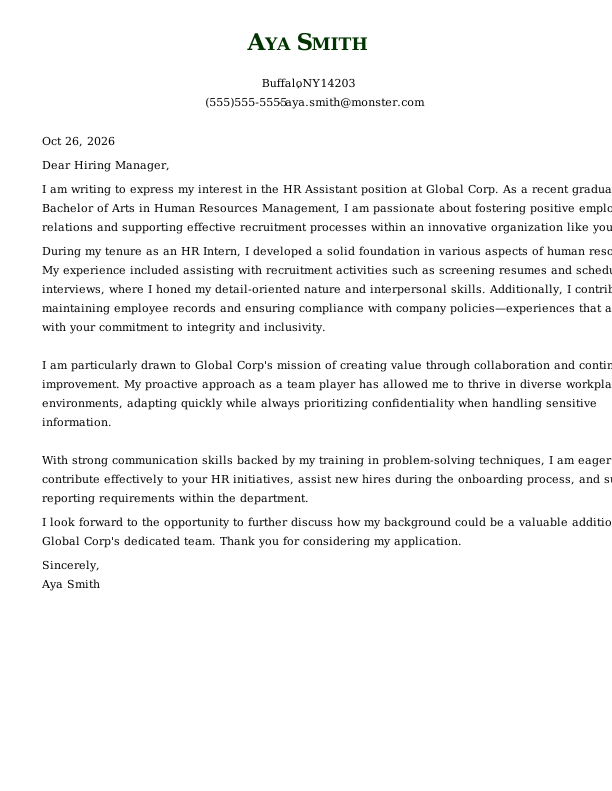
 Free
HR Assistant Entry-Level Cover Letter
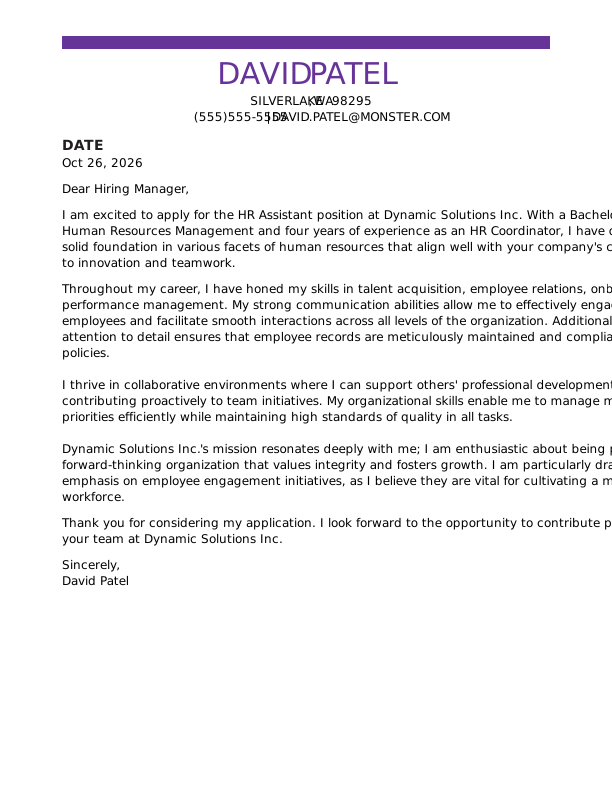
HR Assistant Mid-Level Cover Letter
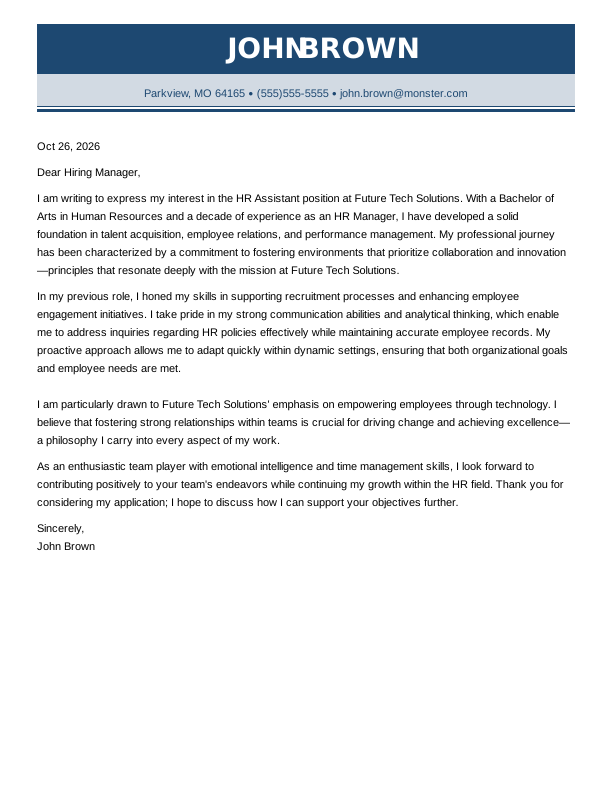
HR Assistant Experienced Cover Letter
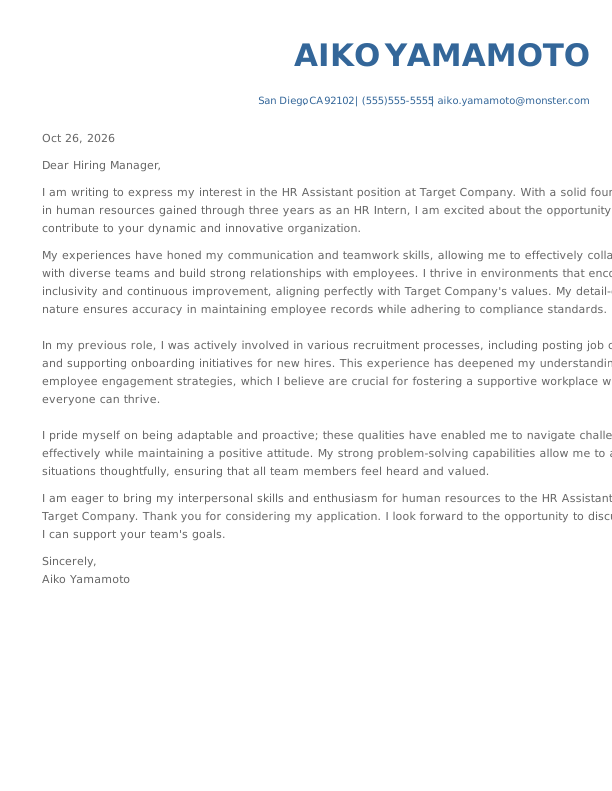
HR Assistant Entry-Level Cover Letter
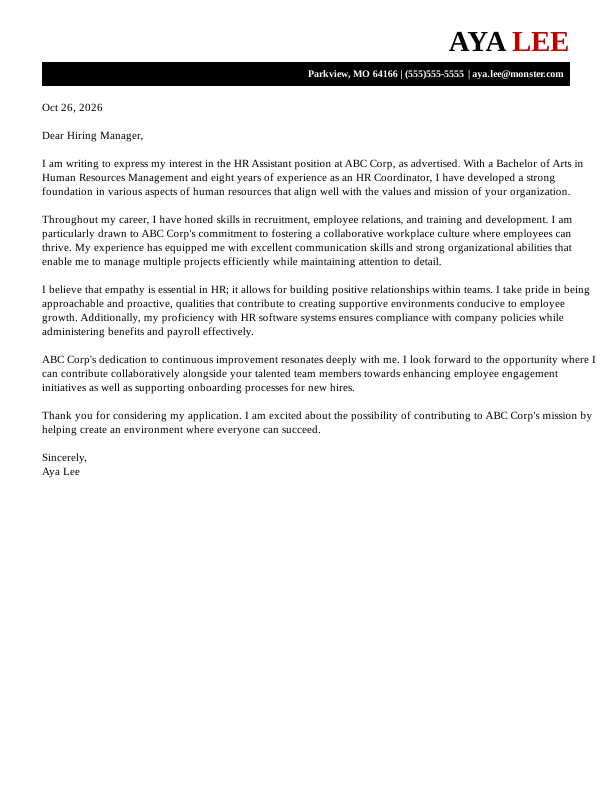
HR Assistant Mid-Level Cover Letter
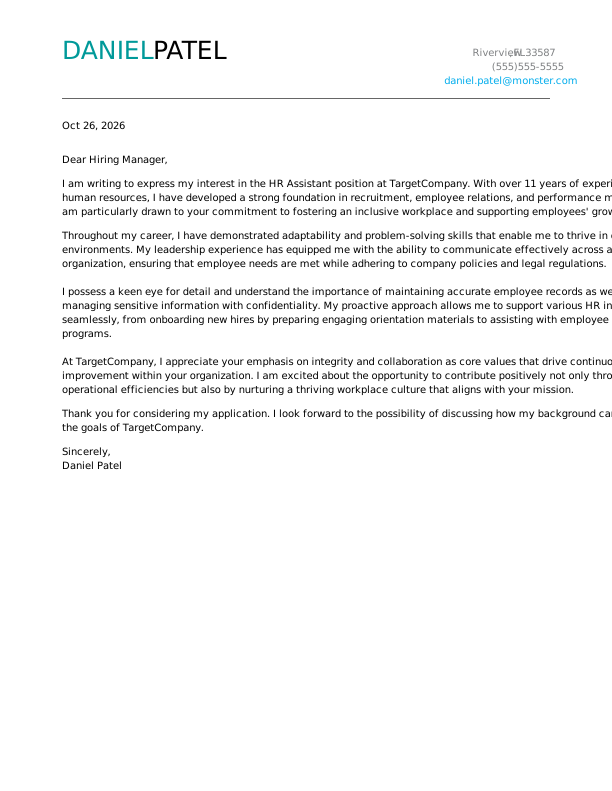
HR Assistant Experienced Cover Letter
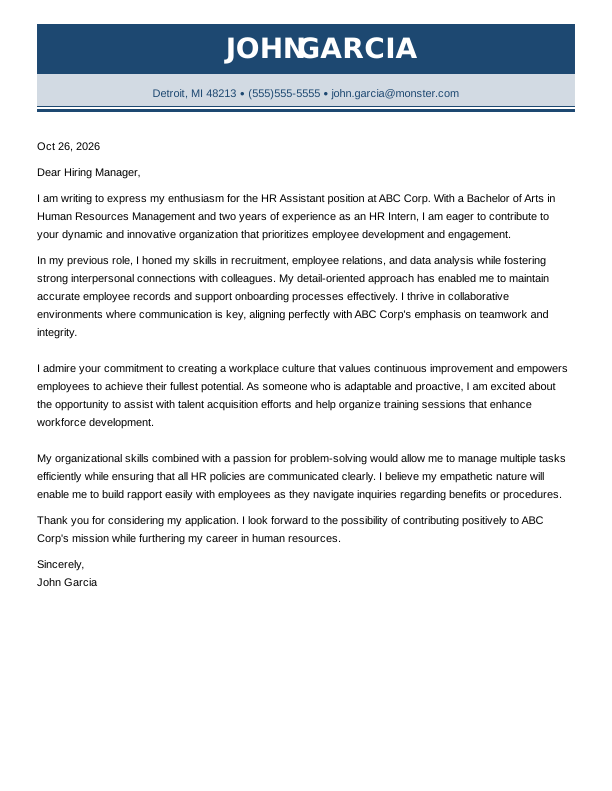
HR Assistant Entry-Level Cover Letter
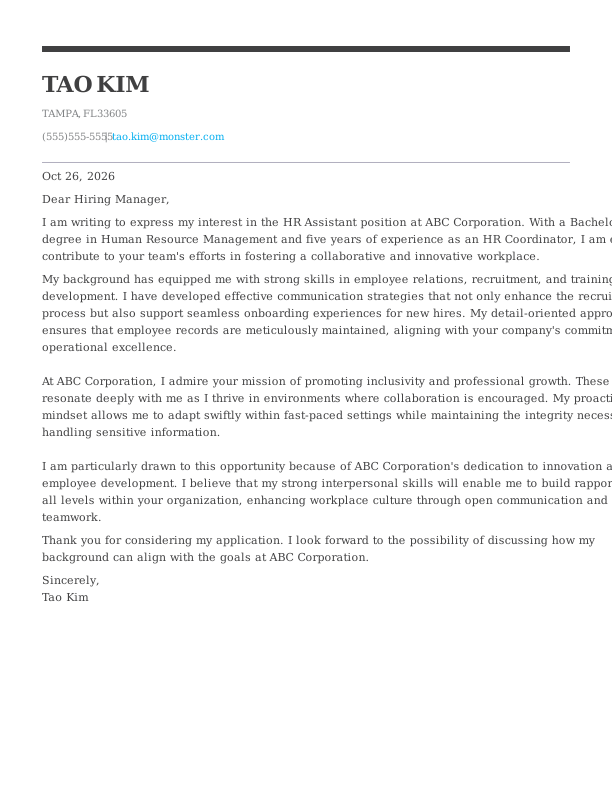
HR Assistant Mid-Level Cover Letter
Browse Free Cover Letter Templates
- Academic
- Account Manager
- Accountant
- Accounts Payable
- Administrative Assistant
- Admissions Counselor
- Architecture
- Artist
- Assistant Principal
- Babysitter
- Barista
- Bartender
- Bookkeeper
- Brand Ambassador
- Business Analyst
- Business
- Caregiver
- Chef
- Civil Engineering
- Computer Science
- Construction
- Consulting
- Copywriter
- Cosmetology
- Custodian
- Customer Service
- Customer Service Representative
- Data Analyst
- Data Entry
- Dental Assistant
- Dental Hygienist
- Digital Marketing
- Electrical Engineering
- Emt
- Engineering
- Esthetician
- Event Coordinator
- Executive Assistant
- Fashion Designer
- Finance
- Financial Analyst
- Firefighter
- Flight Attendant
- Graphic Designer
- Hair Stylist
- Healthcare
- Hr Generalist
- Investment Banking
- It
- Janitor
- Journalism
- Lab Technician
- Law Clerk
- Lawyer
- Librarian
- Logistics
- Maintenance Worker
- Makeup Artist
- Manager
- Marketing Coordinator
- Marketing
- Marketing Manager
- Massage Therapist
- Mechanic
- Mechanical Engineer
- Medical Assistant
- Non Profit
- Nursing
- Occupational Therapy
- Office Assistant
- Office Manager
- Operations Manager
- Paralegal
- Personal Trainer
- Pharmacist
- Pharmacy Technician
- Photographer
- Physician Assistant
- Pilot
- Police Officer
- Program Manager
- Project Manager
- Property Manager
- Psychology
- Receptionist
- Research Assistant
- Restaurant Manager
- Retail
- Sales
- Sales Manager
- School Counselor
- Security
- Security Officer
- Social Work
- Software Engineer
- Special Education Teacher
- Starbucks
- Substitute Teacher
- Teacher
- Teaching Assistant
Cover Letter Examples for HR Assistants
Cover letter requirements for an HR assistant shift as your career progresses, especially as you take on more complex support work. Choose the template that matches your stage to spotlight relevant skills, such as onboarding coordination, employee relations support, and HRIS or compliance training.
Entry-Level HR Assistant Cover Letter
If you’re just starting out or moving into HR from another field, use this template to highlight your education, foundational knowledge, and eager attitude toward supporting a busy department.
Mid-Career HR Assistant Cover Letter
Designed for professionals with several years of experience, this template shows how you manage core tasks independently, handle day-to-day employee needs, and keep everyday HR operations running smoothly.
Experienced HR Assistant Cover Letter
This template is built for seasoned professionals looking to demonstrate deep functional expertise, strong problem-solving abilities, and a proven track record of guiding critical HR processes.
HR Assistant Cover Letter Template (Text)
Paste this HR assistant cover letter template into your document, then swap in your recruiting metrics and the company name to fit your application.
Emma Davis
Westbrook, ME 04099
(555)555-5555
emma.davis@monster.com
Oct 26, 2026
Dear Hiring Manager,
I am writing to express my interest in the HR assistant position at ABC Corporation. With a Bachelor of Arts in Human Resources Management and nine years of experience as an HR coordinator, I am excited about the opportunity to contribute to your dynamic team.
ABC Corporation’s commitment to excellence and a customer-first approach resonates with my professional values. I take pride in fostering positive relationships within teams and across organizations, ensuring that collaboration is at the heart of every project. My background encompasses key areas such as recruitment, employee relations, performance management, and compliance with labor laws—skills that align well with your mission of nurturing talent while driving innovation.
In my previous role, I developed strong organizational skills alongside attention to detail while managing diverse HR responsibilities. I effectively coordinated candidate communications during recruitment processes and supported onboarding initiatives for new hires—all while maintaining meticulous employee records in compliance with regulations. My ability to adapt swiftly has allowed me to thrive in fast-paced environments where teamwork is essential.
I am particularly drawn to ABC Corporation’s values of integrity and continuous improvement. As someone who approaches challenges proactively and communicates effectively, I believe my contributions can support your goal of creating a positive impact within the communities you serve.
Thank you for considering my application. I look forward to the opportunity to discuss how my experience can benefit ABC Corporation’s HR team.
Sincerely,
Emma Davis
How to Write an HR Assistant Cover Letter
Writing a strong HR assistant cover letter comes down to connecting your actual workplace support skills directly to what the employer needs. Instead of listing generic duties, walk the reader through your everyday wins using the six practical steps below.
1. Research & Prepare
Before drafting your letter, take time to understand how this specific HR department operates day to day. Every team has different pain points—some need help staying organized during rapid hiring phases, while others focus on updating systems or ensuring tight compliance.
Here are three key details you should look for before you start writing:
- Note which HRIS or applicant tracking system the company lists in the job post, such as Workday, ADP, or Greenhouse.
- Explore the company’s career page to see what it values most in its workplace culture and team dynamics.
- Review local or state workplace rules so you understand the specific compliance standards the team manages.
2. Hook the Reader
Start with a strong first sentence that immediately shows you can handle the team’s daily workload. Skip passive openers like “I’m writing to express my interest in your open role,” and lead with how you solve real problems.
Here are a few ways to start your letter with an immediate impact:
- Records and payroll support: “Over the past year, I processed onboarding paperwork for 35 new hires each quarter in Workday, keeping every digital file audit-ready with zero missing I-9s.”
- Recruiting and ATS coordination: “Using Greenhouse, I screened resumes and coordinated interviews across three busy hiring teams, consistently confirming candidate availability within 24 hours.”
- Employee help desk: “As the first point of contact in ServiceNow, I resolved routine benefits questions within two days while smoothly escalating complex issues to senior partners.”
3. Tell Your Professional Story
Your resume outlines where you worked, but your cover letter gives you the space to explain how you got things done. Using clear, measurable results helps the reader picture your day-to-day contributions.
Here are three examples of how to turn routine HR duties into concrete achievements:
- Kept employee files organized by processing 72 onboarding packets a week with a 98% form accuracy rate.
- Lowered benefits enrollment errors by 24% by creating an updated checklist and following up with staff within one business day.
- Cut interview no-shows by 15% across 18 monthly interview panels by sending timely calendar invites and pre-screen reminders.
4. Showcase Your Skills
It is easy to claim you have strong communication skills or great attention to detail, but hiring managers prefer seeing those traits in action. Pick a key requirement from the job listing and describe a moment you put that skill to work.
Here is how you can present your core competencies through practical examples:
- Protecting confidentiality: When I noticed an email thread containing employee compensation had too broad a distribution list, I immediately moved the conversation to a secure channel to protect private data.
- HRIS maintenance: I entered benefits updates into Workday, double-checking effective dates and deductions before passing the records to payroll for final sign-off.
- Candidate support: I reached out directly to candidates who had incomplete applications, explaining what forms they needed and walking them through the next steps so hiring stayed on schedule.
5. Explain Any Special Circumstances
If you have an employment gap, are switching careers, or recently relocated, address it briefly in one or two clear sentences. The goal is simply to show that your HR knowledge, technical skills, and credentials are fresh and ready to use.
Here are simple ways to address common career situations naturally:
- Covering a career gap: “During my six months away from full-time work, I maintained my knowledge by completing SHRM training modules and helping a local community group run weekly onboarding sessions.”
- Pivoting from another field: “Coming from retail management, I bring direct experience handling staff schedules, screening applicants, and tracking training records in Workday.”
- Relocating to a new area: “Having recently moved to Austin, I’m fully set up to work locally and have kept my applicant tracking skills sharp through a remote recruiting internship.”
6. End With a Professional Goodbye
Wrap up your letter with a friendly, professional sign-off and an invitation to talk. Keep it concise so you leave a crisp final impression, and avoid tired lines like “I look forward to hearing from you.”
Instead, try an active closing that focuses on how you can support their team: “I’d love the opportunity to discuss how my experience with onboarding paperwork, benefits updates, and interview scheduling can help your HR team stay ahead of deadlines. Thank you for your time and consideration.”
Close with a warm, standard sign-off like “Sincerely” or “Best regards,” followed by your name.
4 Tips for Formatting Your Cover Letter
When a hiring manager reviews applications for an HR assistant role, they typically scan each cover letter in less than a minute. Because this position requires strong organization, clear communication, and sharp attention to detail, how your letter looks on the page matters just as much as what it says. A clean layout with balanced margins and scannable sections proves you take pride in professional presentation before the reader even finishes the first sentence.

Keep It to One Page
HR teams review dozens of applications at a time, so keep your letter focused and respectful of their schedule. Aim for 250 to 400 words spread across three or four short paragraphs. This gives you plenty of room to mention your HR software experience, recruiting support background, and a couple of key achievements without overcrowding the page.

Match Your Header to Your Resume
Use the same contact header, fonts, and clean margins on both your cover letter and your resume. When your documents look identical in style, it makes your application feel organized and unified, showing the hiring team that you have an eye for consistency.

Use Bullet Points for Key Achievements
Break up dense paragraphs by placing your top two or three wins in a short bulleted list. Bullets draw the reader’s eye straight to your best results—like processing paperwork on tight deadlines, scheduling interview panels, or cleaning up data errors—making your qualifications effortless to digest during a quick skim.

Save & Send as a PDF
Unless an employer specifically asks for a Word document, always save your final letter as a PDF. A PDF locks your margins, fonts, and spacing in place so nothing shifts when opened on different screens or applicant tracking systems. Save the file with a clear, professional name, such as Firstname_Lastname_Cover_Letter.pdf.
Key Takeaways
- Tailor your letter to the job posting by spotlighting practical experience with specific HR systems, recruiting support, and accurate employee record management.
- Back up your everyday responsibilities with real numbers to show the positive impact you made on scheduling, paperwork processing, or onboarding timelines.
- Keep your layout clean, scannable, and limited to one page so the hiring manager can spot your core qualifications in a quick scan.
More Cover Letter Examples
- Administrative
- Cashier
- Customer Success Manager
- Front Desk Receptionist
- Retail Customer Service
- Secretary
- Virtual Assistant
Browse Monster’s Resume Templates
Monster also has hundreds of ATS-friendly resume templates for all career levels and industries. Create a matching resume to help you land the interview.
- Administrative Assistant
- Administrative Coordinator
- Administrative
- Archivist
- Assistant
- Category Manager
- Clerical
- Clerk
- Clinical Research Assistant
- Data Entry
- Executive Assistant
- Front Desk Receptionist
- Hr Assistant
- Hr Generalist
- Human Resources
- Interpreter
- Office Administrator
- Office Assistant
- Office Coordinator
- Personal Assistant
- Project Assistant
- Real Estate Assistant
- Receptionist
- Scheduler
- Scheduling Coordinator
- Secretary
- Virtual Assistant
Frequently Asked Questions
Last Update:
Do I really need a cover letter?
You really do need a cover letter for an HR assistant role, even when the listing says it’s optional. A good letter lets you explain the practical experience behind your resume, show your personality, and prove your interest in the organization. It’s also the best place to explain career transitions and demonstrate how carefully you handle sensitive workplace communications.
How long should my cover letter be?
Your cover letter should be between 250 and 400 words and fit neatly on a single page. HR hiring teams evaluate piles of paperwork daily, so a focused letter shows you respect their time. Stick to three or four short paragraphs that clearly highlight your software skills, support background, and best professional wins without unnecessary filler.
Should my cover letter match my resume?
Your cover letter should match your resume in its visual style, including identical fonts, margins, colors, and header layouts. This creates a polished, cohesive package that looks intentional. While the formatting should match, the written content shouldn’t simply repeat your resume; use the letter to tell the story behind your proudest workplace achievements.
How do I address my cover letter if I don’t know the hiring manager’s name?
When addressing your cover letter without a contact name, try searching the job listing, company website, or LinkedIn for the head of HR or talent acquisition. If you still can’t find a specific person after looking, use a friendly, professional greeting like “Dear Hiring Manager” or “Dear HR Team” rather than outdated phrases like “To Whom It May Concern.”
What should I include in my cover letter header?
Your cover letter header should include your full name, phone number, professional email address, city, and state. Beneath your info, add the date, the hiring manager’s name and title, the company name, and its address if available. Keeping this section identical to your resume’s header ensures your application looks organized, complete, and easy to read.

Megan Dawkins is a career industry editor who empowers job seekers to take control of their career paths using Monster’s comprehensive job search and resume tools. She specializes in helping job seekers navigate the flexible job market.
See More From Megan DawkinsExplore Related Career Advice







How to Write a Cover Letter for Internal Positions or Promotions (Examples & Tips)

Updated:
Apr 23, 2026
|
19 min read


Cover Letter vs Resume: What’s the Difference & Do You Need Both?

Updated:
Apr 23, 2026
|
18 min read